ignition CHEVROLET MALIBU 2004 5.G Repair Manual
[x] Cancel search | Manufacturer: CHEVROLET, Model Year: 2004, Model line: MALIBU, Model: CHEVROLET MALIBU 2004 5.GPages: 426, PDF Size: 3.98 MB
Page 268 of 426
With the proper preparation and equipment, many
vehicle can be towed in these ways. See “Dinghy
Towing” and “Dolly Towing”, following.
Here are some important things to consider before you
do recreational vehicle towing:
What’s the towing capacity of the towing vehicle?
Be sure you read the tow vehicle manufacturer’s
recommendations.
How far will you tow? Some vehicles have
restrictions on how far and how long they can tow.
Do you have the proper towing equipment?
See your dealer or trailering professional for
additional advice and equipment recommendations.
Is your vehicle ready to be towed? Just as you
would prepare your vehicle for a long trip, you’ll
want to make sure your vehicle is prepared to be
towed. SeeBefore Leaving on a Long Trip on
page 4-23.
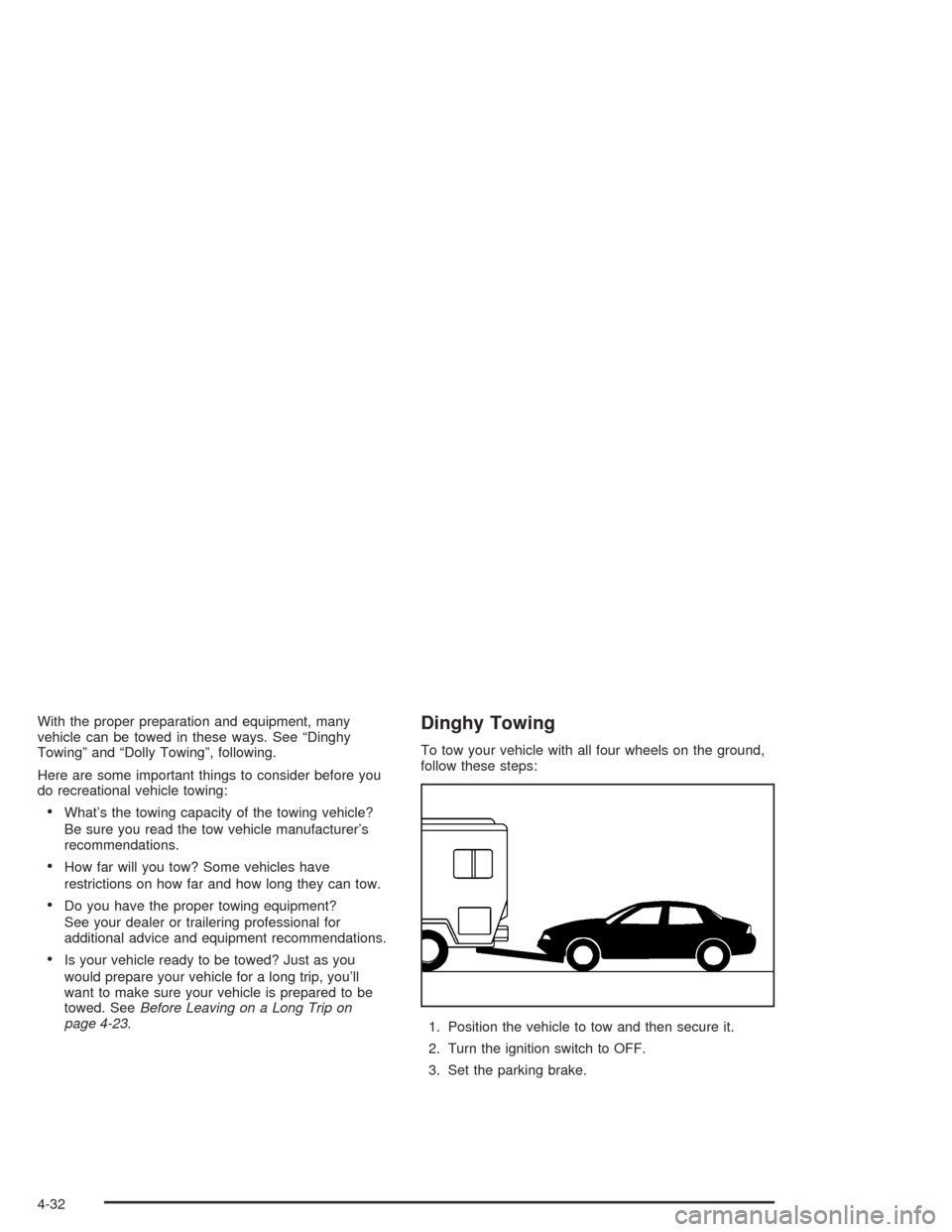
Dinghy Towing
To tow your vehicle with all four wheels on the ground,
follow these steps:
1. Position the vehicle to tow and then secure it.
2. Turn the ignition switch to OFF.
3. Set the parking brake.
4-32
Page 269 of 426
4. To prevent your battery from draining while the
vehicle is being towed, remove the following
fuse from the engine compartment fuse block: 20)
IBCM 1. See “Engine Compartment Fuse Block”
underFuses on page 5-88
5. Turn the ignition switch to ACCESSORY.
6. Shift your transaxle to NEUTRAL (N).
7. Release the parking brake.
Remember to install the fuses once you reach your
destination. To reinstall a fuse do the following:
1. Set the parking brake.
2. Remove the key from the ignition switch.
3. Reinstall the fuse.
Notice:If you exceed 65 mph (110 km/h) while
towing your vehicle, it could be damaged. Never
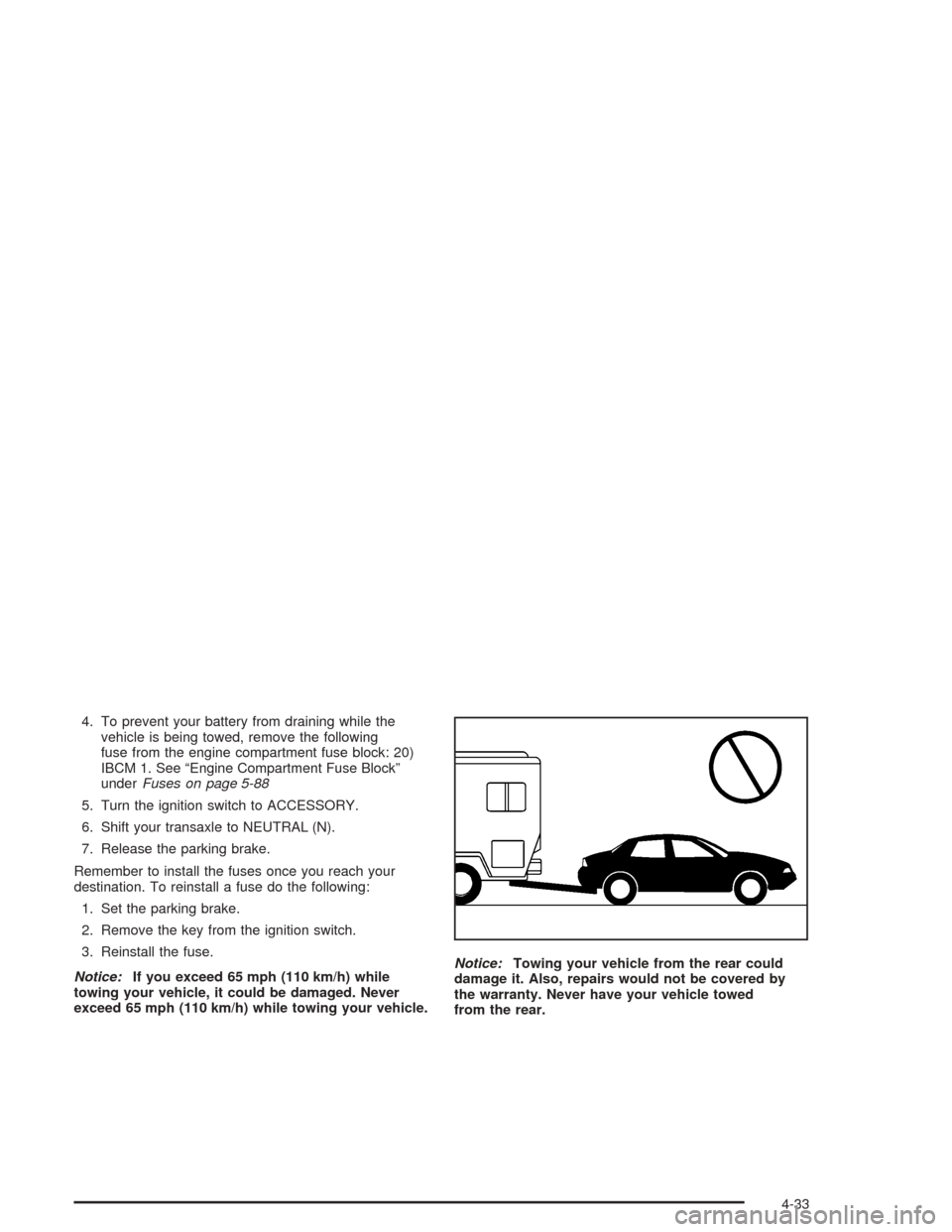
exceed 65 mph (110 km/h) while towing your vehicle.Notice:Towing your vehicle from the rear could
damage it. Also, repairs would not be covered by
the warranty. Never have your vehicle towed
from the rear.
4-33
Page 322 of 426
Trying to start your vehicle by pushing or pulling it
will not work, and it could damage your vehicle.
1. Check the other vehicle. It must have a 12-volt
battery with a negative ground system.
Notice:If the other vehicle’s system is not a 12-volt
system with a negative ground, both vehicles can
be damaged. Only use vehicles with 12-volt systems
with negative grounds to jump start your vehicle.
2. Get the vehicles close enough so the jumper cables
can reach, but be sure the vehicles aren’t touching
each other. If they are, it could cause a ground
connection you don’t want. You wouldn’t be able to
start your vehicle, and the bad grounding could
damage the electrical systems.
To avoid the possibility of the vehicles rolling, set
the parking brake rmly on both vehicles involved in
the jump start procedure. Put an automatic
transaxle in PARK (P) or a manual transaxle in
NEUTRAL before setting the parking brake.Notice:If you leave your radio or other accessories
on during the jump starting procedure, they could
be damaged. The repairs would not be covered
by your warranty. Always turn off your radio and
other accessories when jump starting your vehicle.
3. Turn off the ignition on both vehicles. Unplug
unnecessary accessories plugged into the cigarette
lighter or in the accessory power outlet. Turn off
the radio and all lamps that aren’t needed. This will
avoid sparks and help save both batteries. And it
could save your radio!
4. Open the hoods and locate the batteries. Find the
positive (+) and negative (−) terminal locations on
each vehicle. SeeEngine Compartment Overview
on page 5-14for more information on location.
{CAUTION:
An electric fan can start up even when the
engine is not running and can injure you.
Keep hands, clothing and tools away from
any underhood electric fan.
5-40
Page 372 of 426

Fuses Usage
CLUSTER/THEFTInstrument Panel Cluster,
Theft Deterrent System
ONSTAR
®OnStar®System
NOT INSTALLED Not Used
AIRBAG (IGN) Airbag System
HVAC CTRL
(BATT)Climate Control System
PEDALAdjustable Throttle and
Brake Pedal
WIPER SWWindshield Wiper/Washer
Switch
IGN SENSOR Ignition Switch
NOT INSTALLED Not Used
NOT INSTALLED Not Used
RADIO Audio System
INTERIOR
LIGHTSOverhead Lighting,
Trunk/Cargo Lighting
NOT INSTALLED Not Used
HVAC CTRL (IGN) Climate Control System
Fuses Usage
HVAC BLOWER Climate Control System
DOOR LOCK Automatic Door Lock System
ROOF/HEAT
SEATSunroof, Heated Seats,
Automatic Dimming
Rearview Mirror
POWER
WINDOWSPower Window Switch
NOT INSTALLED Not Used
NOT INSTALLED Not Used
AIRBAG (BATT) Airbag System
FUSE PULLER Fuse Puller
SPARE FUSE
HOLDERSpare
SPARE FUSE
HOLDERSpare
SPARE FUSE
HOLDERSpare
SPARE FUSE
HOLDERSpare
5-90
Page 373 of 426
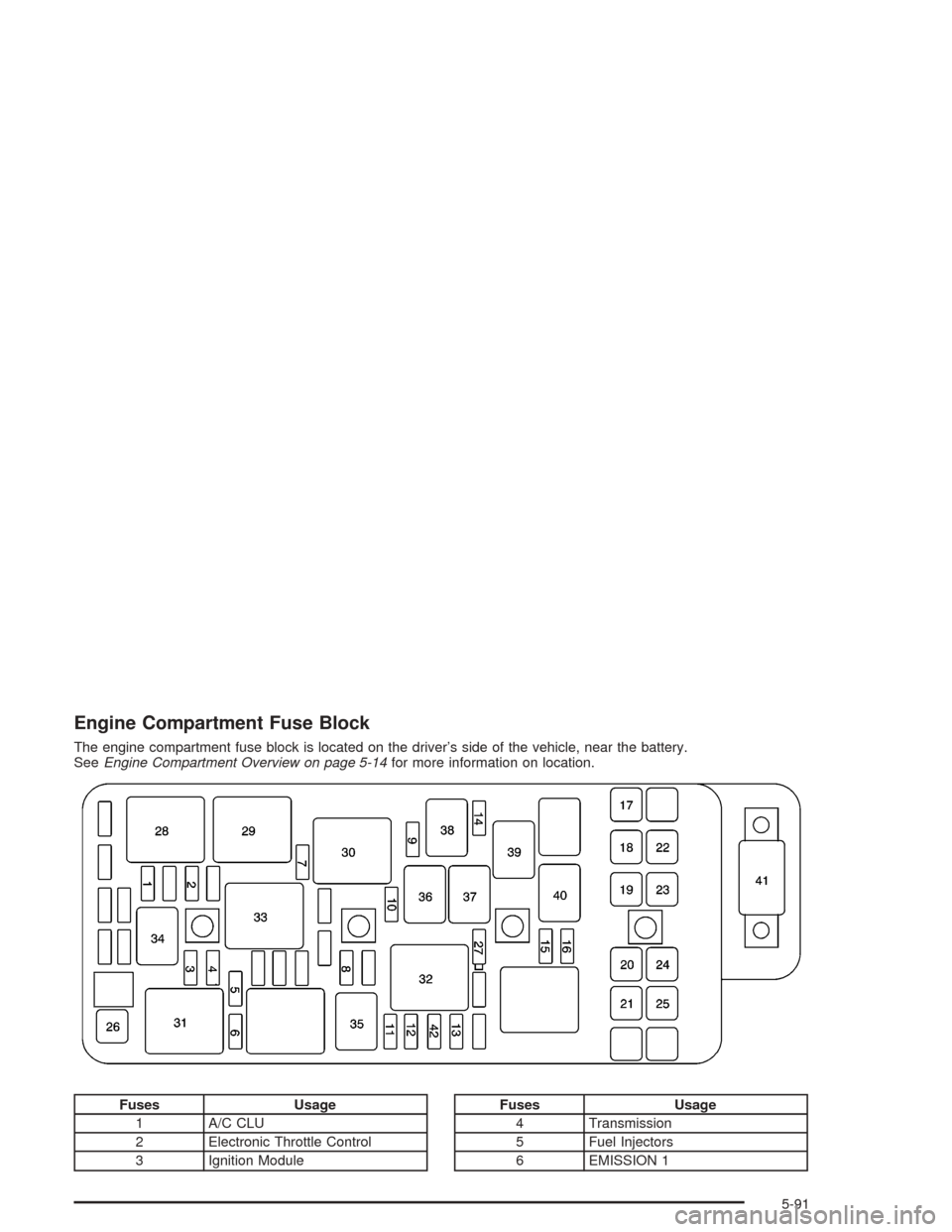
Engine Compartment Fuse Block
The engine compartment fuse block is located on the driver’s side of the vehicle, near the battery.
SeeEngine Compartment Overview on page 5-14for more information on location.
Fuses Usage
1 A/C CLU
2 Electronic Throttle Control
3 Ignition ModuleFuses Usage
4 Transmission
5 Fuel Injectors
6 EMISSION 1
5-91
Page 374 of 426
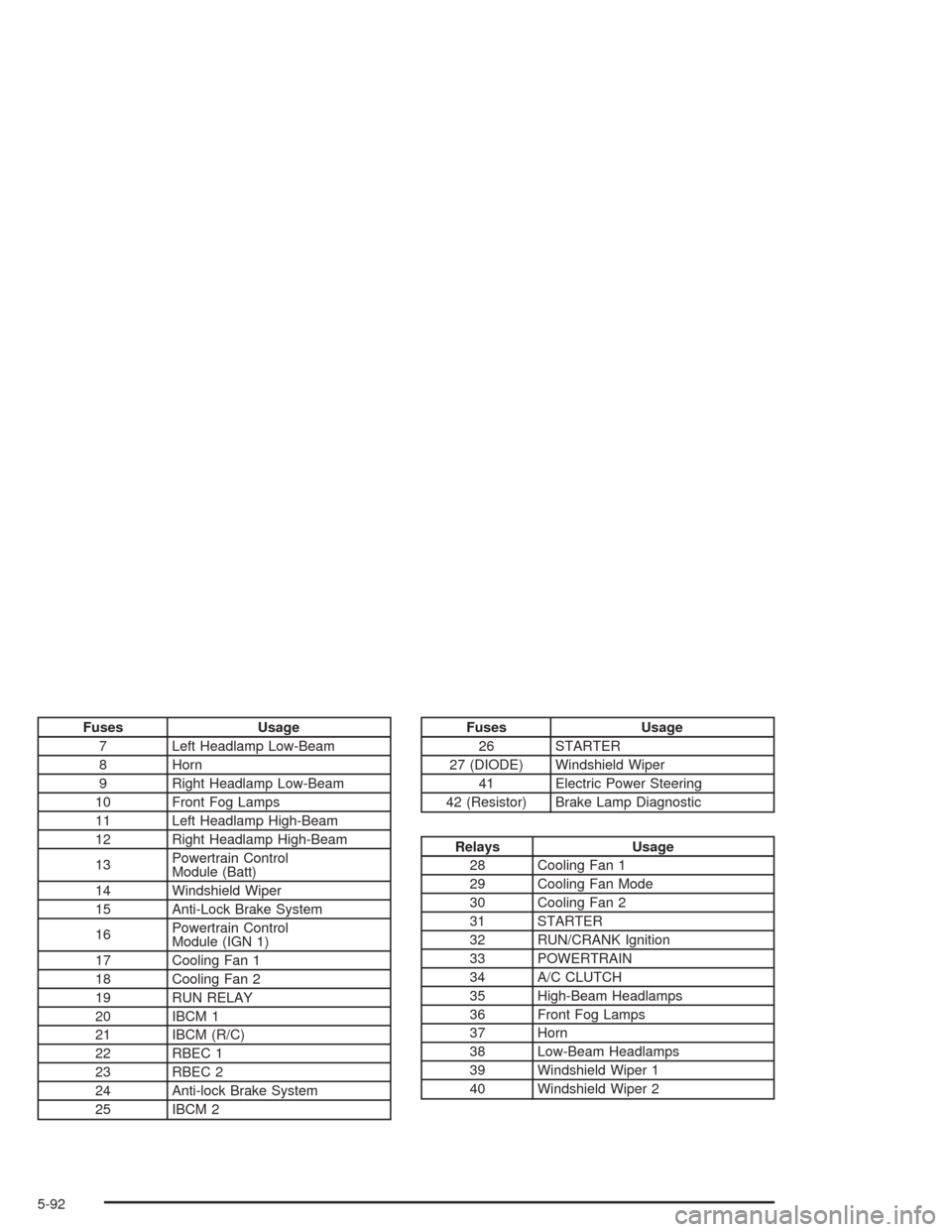
Fuses Usage
7 Left Headlamp Low-Beam
8 Horn
9 Right Headlamp Low-Beam
10 Front Fog Lamps
11 Left Headlamp High-Beam
12 Right Headlamp High-Beam
13Powertrain Control
Module (Batt)
14 Windshield Wiper
15 Anti-Lock Brake System
16Powertrain Control
Module (IGN 1)
17 Cooling Fan 1
18 Cooling Fan 2
19 RUN RELAY
20 IBCM 1
21 IBCM (R/C)
22 RBEC 1
23 RBEC 2
24 Anti-lock Brake System
25 IBCM 2Fuses Usage
26 STARTER
27 (DIODE) Windshield Wiper
41 Electric Power Steering
42 (Resistor) Brake Lamp Diagnostic
Relays Usage
28 Cooling Fan 1
29 Cooling Fan Mode
30 Cooling Fan 2
31 STARTER
32 RUN/CRANK Ignition
33 POWERTRAIN
34 A/C CLUTCH
35 High-Beam Headlamps
36 Front Fog Lamps
37 Horn
38 Low-Beam Headlamps
39 Windshield Wiper 1
40 Windshield Wiper 2
5-92
Page 389 of 426
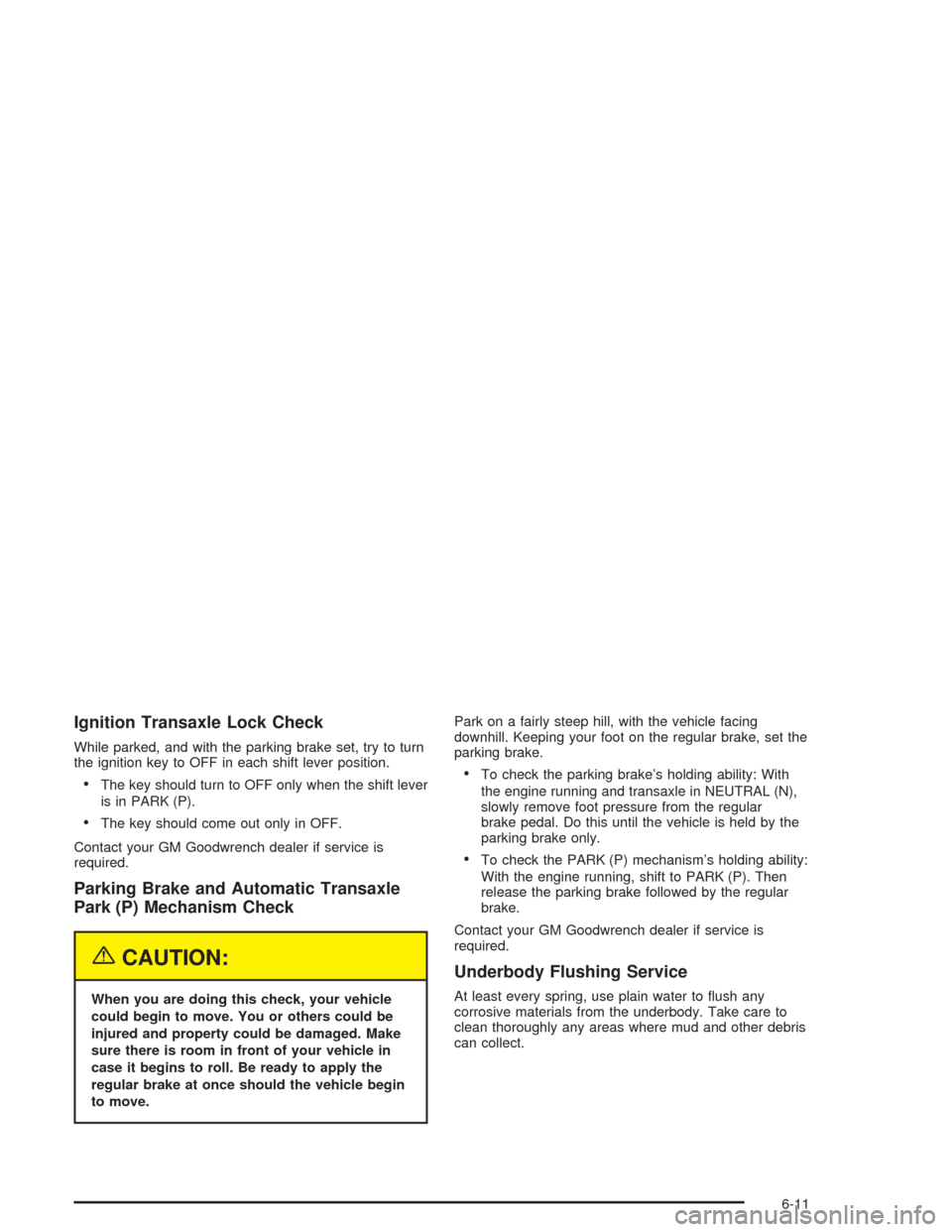
Ignition Transaxle Lock Check
While parked, and with the parking brake set, try to turn
the ignition key to OFF in each shift lever position.
The key should turn to OFF only when the shift lever
is in PARK (P).
The key should come out only in OFF.
Contact your GM Goodwrench dealer if service is
required.
Parking Brake and Automatic Transaxle
Park (P) Mechanism Check
{CAUTION:
When you are doing this check, your vehicle
could begin to move. You or others could be
injured and property could be damaged. Make
sure there is room in front of your vehicle in
case it begins to roll. Be ready to apply the
regular brake at once should the vehicle begin
to move.Park on a fairly steep hill, with the vehicle facing
downhill. Keeping your foot on the regular brake, set the
parking brake.
To check the parking brake’s holding ability: With
the engine running and transaxle in NEUTRAL (N),
slowly remove foot pressure from the regular
brake pedal. Do this until the vehicle is held by the
parking brake only.
To check the PARK (P) mechanism’s holding ability:
With the engine running, shift to PARK (P). Then
release the parking brake followed by the regular
brake.
Contact your GM Goodwrench dealer if service is
required.
Underbody Flushing Service
At least every spring, use plain water to ush any
corrosive materials from the underbody. Take care to
clean thoroughly any areas where mud and other debris
can collect.
6-11
Page 417 of 426
Gasoline
Octane........................................................ 5-5
Specications............................................... 5-6
Gate Operator and Canadian Programming........2-43
Glove Box.....................................................2-44
GM Mobility Program for Persons with
Disabilities.................................................... 7-6
H
Hazard Warning Flashers................................... 3-6
Head Restraints............................................... 1-6
Headlamp High/Low-Beam Changer.................... 3-9
Headlamp Wiring............................................5-87
Headlamps....................................................5-45
Bulb Replacement.......................................5-45
Halogen Bulbs............................................5-45
Headlamps Off in Park (P)...............................3-18
Headlamps On Reminder................................... 3-9
Headphones...................................................3-97
Heated Seats................................................... 1-4
Highway Hypnosis...........................................4-24
Hill and Mountain Roads..................................4-24
Hitches..........................................................4-43
HomeLink
®Transmitter....................................2-40
HomeLink®Transmitter, Programming................2-41Hood
Release.....................................................5-12
Horn............................................................... 3-7
How the System Alarm is Activated...................2-19
How to Add Coolant to the Coolant Surge Tank......5-30
How to Check................................................5-58
How to Detect a Tamper Condition....................2-19
How to Inspect the Engine Air Cleaner/Filter.......5-22
How to Turn Off the System Alarm....................2-19
How to Use This Manual...................................... ii
How to Wear Safety Belts Properly...................1-15
Hydroplaning..................................................4-20
I
If No Steam Is Coming From Your Engine..........5-28
If Steam Is Coming From Your Engine...............5-27
If the Light is Flashing.....................................3-40
If the Light Is On Steady.................................3-41
If You Are Caught in a Blizzard.........................4-28
If You Are Stuck in Sand, Mud, Ice or Snow.......4-30
If You Do Decide To Pull a Trailer.....................4-41
Ignition Positions.............................................2-22
Infants and Young Children, Restraints...............1-34
Ination - Tire Pressure...................................5-57
Information Mode (INFO Button)........................3-46
7