warning CHEVROLET MALIBU 2007 6.G Workshop Manual
[x] Cancel search | Manufacturer: CHEVROLET, Model Year: 2007, Model line: MALIBU, Model: CHEVROLET MALIBU 2007 6.GPages: 510, PDF Size: 2.8 MB
Page 383 of 510

{CAUTION:
The brake wear warning sound means that
soon the brakes will not work well. That
could lead to an accident. When you hear
the brake wear warning sound, have your
vehicle serviced.
Notice:Continuing to drive with worn-out
brake pads could result in costly brake repair.
Some driving conditions or climates can cause
a brake squeal when the brakes are rst applied or
lightly applied. This does not mean something is
wrong with the brakes.
Properly torqued wheel nuts are necessary to help
prevent brake pulsation. When tires are rotated,
inspect brake pads for wear and evenly tighten
wheel nuts in the proper sequence to torque
specications inCapacities and Specications on
page 454.If you have rear drum brakes, they do not have
wear indicators, but if you ever hear a rear brake
rubbing noise, have the rear brake linings
inspected immediately. Also, the rear brake drums
should be removed and inspected each time
the tires are removed for rotation or changing.
When you have the front brake pads replaced,
have the rear brakes inspected, too.
Brake linings should always be replaced as
complete axle sets.
Brake Pedal Travel
See your dealer/retailer if the brake pedal does
not return to normal height, or if there is a rapid
increase in pedal travel. This could be a sign that
brake service might be required.
Brake Adjustment
Every time you apply the brakes, with or without
the vehicle moving, the brakes adjust for wear.
383
Page 384 of 510

Replacing Brake System Parts
The braking system on a vehicle is complex.
Its many parts have to be of top quality and work
well together if the vehicle is to have really good
braking. Your vehicle was designed and tested with
top-quality brake parts. When you replace parts of
the braking system — for example, when the
brake linings wear down and you need new
ones put in — be sure you get new approved
replacement parts. If you do not, the brakes might
not work properly. For example, if someone puts in
brake linings that are wrong for your vehicle, the
balance between the front and rear brakes can
change — for the worse. The braking performance
you have come to expect can change in many other
ways if someone puts in the wrong replacement
brake parts.
Battery
Your vehicle has a maintenance free battery.
When it is time for a new battery, get one that has
the replacement number shown on the original
battery’s label. We recommend an ACDelco
®
replacement battery. SeeEngine Compartment
Overview on page 354for battery location.Warning:Battery posts, terminals, and related
accessories contain lead and lead compounds,
chemicals known to the State of California
to cause cancer and reproductive harm. Wash
hands after handling.
Vehicle Storage
If you are not going to drive your vehicle for
25 days or more, remove the black, negative (−)
cable from the battery. This will help keep the
battery from running down.
{CAUTION:
Batteries have acid that can burn you and
gas that can explode. You can be badly
hurt if you are not careful. SeeJump
Starting on page 385for tips on working
around a battery without getting hurt.
384
Page 413 of 510

While the tires available on General Motors
passenger cars and light trucks may vary with
respect to these grades, they must also conform
to federal safety requirements and additional
General Motors Tire Performance Criteria (TPC)
standards.
Treadwear
The treadwear grade is a comparative rating based
on the wear rate of the tire when tested under
controlled conditions on a specied government
test course. For example, a tire graded 150 would
wear one and a half (1.5) times as well on the
government course as a tire graded 100. The
relative performance of tires depends upon the
actual conditions of their use, however, and may
depart signicantly from the norm due to variations
in driving habits, service practices, and differences
in road characteristics and climate.
Traction – AA, A, B, C
The traction grades, from highest to lowest, are AA,
A, B, and C. Those grades represent the tire’s
ability to stop on wet pavement as measured under
controlled conditions on specied government test
surfaces of asphalt and concrete. A tire marked C
may have poor traction performance.Warning:The traction grade assigned to this tire is
based on straight-ahead braking traction tests, and
does not include acceleration, cornering,
hydroplaning, or peak traction characteristics.
Temperature – A, B, C
The temperature grades are A (the highest), B,
and C, representing the tire’s resistance to the
generation of heat and its ability to dissipate heat
when tested under controlled conditions on a
specied indoor laboratory test wheel. Sustained
high temperature can cause the material of the tire
to degenerate and reduce tire life, and excessive
temperature can lead to sudden tire failure. The
grade C corresponds to a level of performance
which all passenger car tires must meet under the
Federal Motor Vehicle Safety Standard No. 109.
Grades B and A represent higher levels of
performance on the laboratory test wheel than the
minimum required by law.
Warning:The temperature grade for this tire is
established for a tire that is properly inated
and not overloaded. Excessive speed,
underination, or excessive loading, either
separately or in combination, can cause heat
buildup and possible tire failure.
413
Page 418 of 510

Changing a Flat Tire
If a tire goes at, avoid further tire and wheel
damage by driving slowly to a level place.
Turn on your vehicle’s hazard warning ashers.
SeeHazard Warning Flashers on page 170
for more information.
{CAUTION:
Changing a tire can be dangerous. The
vehicle can slip off the jack and roll over
or fall on you or other people. You and
they could be badly injured or even killed.
Find a level place to change your tire.
To help prevent the vehicle from moving:
1. Set the parking brake rmly.
2. Put the shift lever in PARK (P).
CAUTION: (Continued)
CAUTION: (Continued)
3. Turn off the engine and do not restart
while the vehicle is raised.
4. Do not allow passengers to remain in
the vehicle.
To be even more certain the vehicle will
not move, you should put blocks at the
front and rear of the tire farthest away
from the one being changed. That would
be the tire, on the other side, at the
opposite end of the vehicle.
418
Page 495 of 510

A
Accessories and Modications..................... 344
Adding Equipment to Your
Airbag-Equipped Vehicle............................ 89
Additives, Fuel............................................ 347
Add-On Electrical Equipment....................... 445
Adjustable Throttle and Brake Pedal............ 121
Air Cleaner/Filter, Engine............................. 364
Air Conditioning..................................188, 192
Airbag
Passenger Status Indicator....................... 203
Readiness Light....................................... 202
Airbag Sensing and Diagnostic
Module (SDM).......................................... 486
Airbag System............................................... 72
What Will You See After an
Airbag Inates?...................................... 80
When Should an Airbag Inate?................. 78
Where Are the Airbags?............................. 74
Airbag Systems
Adding Equipment to Your
Airbag-Equipped Vehicle......................... 89
How Does an Airbag Restrain?.................. 79
Passenger Sensing System....................... 82Airbag Systems (cont.)
Servicing Your Airbag-Equipped Vehicle....... 88
What Makes an Airbag Inate?.................. 79
Antenna, Backglass..................................... 286
Antenna, Fixed Mast................................... 285
Antenna, XM™ Satellite Radio Antenna
System.................................................... 286
Anti-Lock Brake System.............................. 293
Anti-Lock Brake, System Warning Light....... 208
Appearance Care
Aluminum Wheels.................................... 441
Care of Safety Belts................................ 439
Chemical Paint Spotting........................... 442
Cleaning Exterior Lamps/Lenses.............. 440
Cleaning the Inside of Your Vehicle.......... 435
Fabric/Carpet........................................... 436
Finish Care.............................................. 440
Finish Damage......................................... 442
Instrument Panel, Vinyl, and Other
Plastic Surfaces.................................... 438
Leather.................................................... 437
Sheet Metal Damage............................... 442
Tires........................................................ 441
Ultra Lux Suede....................................... 438
Underbody Maintenance........................... 442
Vehicle Care/Appearance Materials.......... 443
495
Page 496 of 510

Appearance Care (cont.)
Washing Your Vehicle.............................. 439
Weatherstrips........................................... 439
Windshield and Wiper Blades................... 440
Audio System.............................................. 228
Audio Steering Wheel Controls........282, 283
Backglass Antenna................................... 286
Care of Your CD and DVD Player............ 285
Care of Your CDs and DVDs................... 285
Fixed Mast Antenna................................. 285
Radio with CD................................230, 236
Radio with Six-Disc CD............................ 246
Rear Seat Audio (RSA)...................278, 280
Setting the Time with Radio Data
Systems (RDS)..................................... 230
Setting the Time without Radio Data
Systems (RDS)..................................... 229
Theft-Deterrent Feature............................ 281
Understanding Radio Reception............... 284
XM™ Satellite Radio Antenna System...... 286
Automatic Climate Control System............... 192
Automatic Headlamp System....................... 183
Automatic Transaxle
Fluid...............................................365, 366
Operation........................................124, 128B
Backglass Antenna...................................... 286
Battery........................................................ 384
Run-Down Protection............................... 186
Before Leaving on a Long Trip.................... 313
Brake
Emergencies............................................ 295
Parking.................................................... 132
Brakes........................................................ 381
System Warning Light.............................. 206
Braking....................................................... 292
Braking in Emergencies............................... 295
Break-In, New Vehicle................................. 117
Bulb Replacement....................................... 389
Halogen Bulbs......................................... 389
Headlamps, Front Turn Signal, and
Parking Lamps..................................... 390
License Plate Lamps................................ 393
Replacement Bulbs.................................. 394
Taillamps, Turn Signal, Stoplamps and
Back-up Lamps..................................... 392
Buying New Tires........................................ 410
496
Page 497 of 510

C
Calibration..........................................139, 141
California Fuel............................................. 347
California Proposition 65 Warning................ 345
Canadian Owners........................................... 3
Capacities and Specications...................... 454
Carbon Monoxide..............108, 136, 317, 333
Care of
Safety Belts............................................. 439
Your CD and DVD Player........................ 285
Your CDs and DVDs................................ 285
Cargo Lamp................................................ 186
Center Console Storage Area...................... 160
Chains, Tire................................................. 416
Charging System Light................................ 206
Check
Engine Light............................................ 212
Checking Things Under the Hood................ 352
Chemical Paint Spotting.............................. 442
Child Restraints
Child Restraint Systems............................. 49
Infants and Young Children........................ 45
Lower Anchors and Tethers for
Children.................................................. 56
Older Children........................................... 42Child Restraints (cont.)
Securing a Child Restraint in a
Rear Seat Position ................................. 65
Securing a Child Restraint in the
Right Front Seat Position........................ 67
Where to Put the Restraint........................ 54
Cigarette Lighter.......................................... 187
Cleaning
Aluminum Wheels.................................... 441
Exterior Lamps/Lenses............................. 440
Fabric/Carpet........................................... 436
Finish Care.............................................. 440
Inside of Your Vehicle.............................. 435
Instrument Panel, Vinyl, and Other
Plastic Surfaces.................................... 438
Leather.................................................... 437
Tires........................................................ 441
Ultra Lux Suede....................................... 438
Underbody Maintenance........................... 442
Washing Your Vehicle.............................. 439
Weatherstrips........................................... 439
Windshield and Wiper Blades................... 440
Climate Control System............................... 188
Automatic................................................. 192
Outlet Adjustment..................................... 197
497
Page 498 of 510

Clock
Radios with Radio Data
Systems (RDS)..................................... 230
Radios without Radio Data
Systems (RDS)..................................... 229
Collision Damage Repair............................. 487
Comfort Guides, Rear Safety Belt................. 37
Compact Spare Tire.................................... 434
Compass............................................139, 141
Competitive Driving..................................... 305
Content Theft-Deterrent............................... 113
Control of a Vehicle..................................... 292
Convenience Net......................................... 163
Coolant
Engine Temperature Gage........................ 211
Engine Temperature Warning Light........... 211
Heater, Engine......................................... 122
Surge Tank Pressure Cap........................ 371
Cooling System........................................... 374
Cruise Control............................................. 176
Cruise Control Light.................................... 216
Cupholder(s)................................................ 160
Customer Assistance Information
Courtesy Transportation........................... 483
Customer Assistance for Text
Telephone (TTY) Users......................... 479Customer Assistance Information (cont.)
Customer Assistance Offices.................... 479
Customer Satisfaction Procedure.............. 476
GM Mobility Reimbursement Program...... 480
Reporting Safety Defects to
General Motors..................................... 492
Reporting Safety Defects to the
Canadian Government.......................... 491
Reporting Safety Defects to the
United States Government.................... 491
Roadside Assistance Program.................. 481
Service Publications Ordering
Information........................................... 492
D
Daytime Running Lamps............................. 182
Defensive Driving........................................ 288
Delayed Headlamps.................................... 182
Delayed Locking.......................................... 106
Doing Your Own Service Work.................... 345
Dome Lamp................................................ 184
Door
Delayed Locking...................................... 106
Door Ajar Reminder................................. 105
498
Page 499 of 510
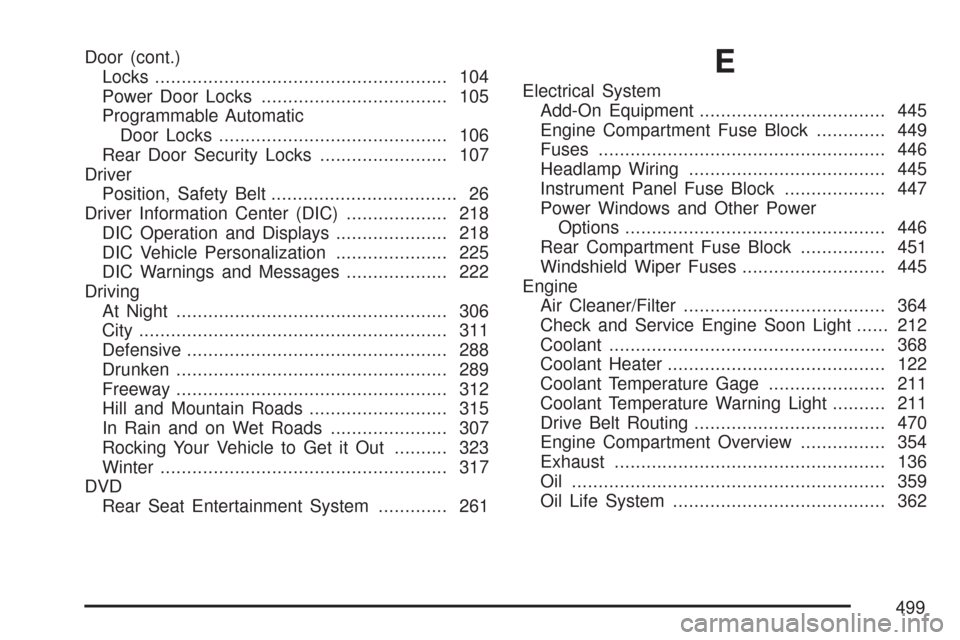
Door (cont.)
Locks....................................................... 104
Power Door Locks................................... 105
Programmable Automatic
Door Locks........................................... 106
Rear Door Security Locks........................ 107
Driver
Position, Safety Belt................................... 26
Driver Information Center (DIC)................... 218
DIC Operation and Displays..................... 218
DIC Vehicle Personalization..................... 225
DIC Warnings and Messages................... 222
Driving
At Night................................................... 306
City.......................................................... 311
Defensive................................................. 288
Drunken................................................... 289
Freeway................................................... 312
Hill and Mountain Roads.......................... 315
In Rain and on Wet Roads...................... 307
Rocking Your Vehicle to Get it Out.......... 323
Winter...................................................... 317
DVD
Rear Seat Entertainment System............. 261E
Electrical System
Add-On Equipment................................... 445
Engine Compartment Fuse Block............. 449
Fuses...................................................... 446
Headlamp Wiring..................................... 445
Instrument Panel Fuse Block................... 447
Power Windows and Other Power
Options................................................. 446
Rear Compartment Fuse Block................ 451
Windshield Wiper Fuses........................... 445
Engine
Air Cleaner/Filter...................................... 364
Check and Service Engine Soon Light...... 212
Coolant.................................................... 368
Coolant Heater......................................... 122
Coolant Temperature Gage...................... 211
Coolant Temperature Warning Light.......... 211
Drive Belt Routing.................................... 470
Engine Compartment Overview................ 354
Exhaust................................................... 136
Oil ........................................................... 359
Oil Life System........................................ 362
499
Page 500 of 510

Engine (cont.)
Overheated Protection Operating Mode...... 373
Overheating............................................. 371
Running While Parked............................. 137
Starting.................................................... 120
Enhanced Traction System (ETS)................ 297
Active Light.............................................. 210
Warning Light........................................... 210
Entry/Exit Lighting....................................... 185
Event Data Recorders (EDR)...................... 486
Extender, Safety Belt..................................... 41
Exterior Lamps............................................ 179
F
Filter
Engine Air Cleaner................................... 364
Finish Damage............................................ 442
Fixed Mast Antenna.................................... 285
Flashers, Hazard Warning........................... 170
Flash-to-Pass.............................................. 173
Flat Tire...................................................... 417
Flat Tire, Changing...................................... 418Flat Tire, Storing........................428, 430, 432
Fluid
Power Steering........................................ 379
Windshield Washer.................................. 380
Fog Lamp
Fog .......................................................... 184
Folding Seatback, Passenger........................ 14
Front Reading Lamps.................................. 185
Fuel............................................................ 346
Additives.................................................. 347
California Fuel.......................................... 347
Filling a Portable Fuel Container.............. 351
Filling Your Tank...................................... 349
Fuels in Foreign Countries....................... 348
Gage....................................................... 217
Gasoline Octane...................................... 346
Gasoline Specications............................ 347
Fuses.......................................................... 446
Engine Compartment Fuse Block............. 449
Instrument Panel Fuse Block................... 447
Rear Compartment Fuse Block................ 451
Windshield Wiper..................................... 445
500