trunk CHEVROLET MALIBU 2008 6.G User Guide
[x] Cancel search | Manufacturer: CHEVROLET, Model Year: 2008, Model line: MALIBU, Model: CHEVROLET MALIBU 2008 6.GPages: 412, PDF Size: 2.22 MB
Page 232 of 412
Winter Driving
Here are some tips for winter driving:
Have your vehicle in good shape for winter.
You might want to put winter emergency supplies in
your trunk.
Include an ice scraper, a small brush or broom, a
supply of windshield washer uid, a rag, some winter
outer clothing, a small shovel, a ashlight, a red
cloth, and a couple of reective warning triangles.
And, if you will be driving under severe conditions,
include a small bag of sand, a piece of old carpet,
or a couple of burlap bags to help provide traction.
Be sure you properly secure these items in your vehicle.
Also seeTires on page 5-52.
Driving on Snow or Ice
Most of the time, those places where the tires meet the
road probably have good traction.
However, if there is snow or ice between the tires and
the road, you can have a very slippery situation. You
have a lot less traction, or grip, and need to be very
careful.
What is the worst time for this? Wet ice. Very cold snow
or ice can be slick and hard to drive on. But wet ice
can be even more trouble because it can offer the leasttraction of all. You can get wet ice when it is about
freezing, 32°F (0°C), and freezing rain begins to fall.
Try to avoid driving on wet ice until salt and sand crews
can get there.
Whatever the condition — smooth ice, packed, blowing,
or loose snow — drive with caution.
Accelerate gently. Try not to break the fragile traction.
If you accelerate too fast, the drive wheels will spin and
polish the surface under the tires even more.
The Antilock Brake System (ABS) improves your
vehicle’s stability when you make a hard stop on a
slippery road. Even though you have ABS, begin
stopping sooner than you would on dry pavement.
SeeAntilock Brake System (ABS) on page 4-5.
Allow greater following distance on any
slippery road.
Watch for slippery spots. The road might be ne
until you hit a spot that is covered with ice. On an
otherwise clear road, ice patches can appear in
shaded areas where the sun cannot reach, such as
around clumps of trees, behind buildings, or under
bridges. Sometimes the surface of a curve or an
overpass can remain icy when the surrounding roads
are clear. If you see a patch of ice ahead of you,
brake before you are on it. Try not to brake while you
are actually on the ice, and avoid sudden steering
maneuvers.
4-18
Page 240 of 412

If things like suitcases, tools, packages, or
anything else are put inside the vehicle, they will
go as fast as the vehicle goes. If you have to stop
or turn quickly, or if there is a crash, they will
keep going.
{CAUTION:
Things you put inside the vehicle can
strike and injure people in a sudden stop
or turn, or in a crash.
Put things in the trunk of your vehicle.
In a trunk, put them as far forward as
you can. Try to spread the weight
evenly.
Never stack heavier things, like
suitcases, inside the vehicle so that
some of them are above the tops of
the seats.
Do not leave an unsecured child
restraint in the vehicle.
When you carry something inside the
vehicle, secure it whenever you can.
Do not leave a seat folded down
unless you need to.
Towing
Towing Your Vehicle
To avoid vehicle damage, a platform or atbed trailer
should be used to transport this vehicle. Consult
your dealer/retailer or a professional towing service if
you need to have your disabled vehicle towed. See
Roadside Assistance Program on page 7-7.
If you want to tow your vehicle behind another vehicle
for recreational purposes (such as behind a motorhome),
see “Recreational Vehicle Towing” following.
Recreational Vehicle Towing
Recreational vehicle towing means towing the vehicle
behind another vehicle – such as behind a motorhome.
The two most common types of recreational vehicle
towing are known as dinghy towing and dolly towing.
Dinghy towing is towing the vehicle with all four wheels
on the ground. Dolly towing is towing the vehicle
with two wheels on the ground and two wheels up
on a device known as a dolly.
With the proper preparation and equipment, many
vehicles can be towed in these ways. See “Dinghy
Towing” and “Dolly Towing,” following.
4-26
Page 261 of 412
{CAUTION:
If a re starts while you are refueling, do not
remove the nozzle. Shut off the ow of fuel
by shutting off the pump or by notifying the
station attendant. Leave the area immediately.
Notice:If you need a new fuel cap, be sure to get
the right type. Your dealer/ retailer can get one
for you. If you get the wrong type, it may not
t properly. This may cause your malfunction
indicator lamp to light and may damage your
fuel tank and emissions system. SeeMalfunction
Indicator Lamp on page 3-41.
Filling a Portable Fuel Container
{CAUTION:
Never ll a portable fuel container while it is in
your vehicle. Static electricity discharge from
the container can ignite the fuel vapor. You can
be badly burned and your vehicle damaged if
this occurs. To help avoid injury to you and
others:
Dispense fuel only into approved
containers.
Do not ll a container while it is inside a
vehicle, in a vehicle’s trunk, pickup bed,
or on any surface other than the ground.
Bring the ll nozzle in contact with the
inside of the ll opening before operating
the nozzle. Contact should be maintained
until the lling is complete.
Do not smoke while pumping fuel.
Do not use a cellular phone while
pumping fuel.
5-11
Page 299 of 412
Taillamps, Turn Signal, and
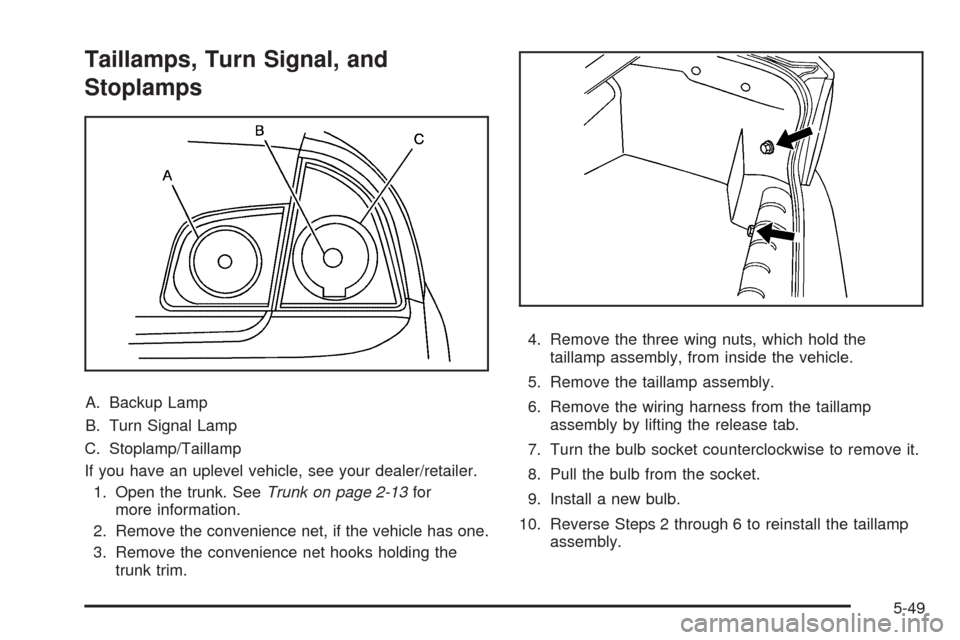
Stoplamps
A. Backup Lamp
B. Turn Signal Lamp
C. Stoplamp/Taillamp
If you have an uplevel vehicle, see your dealer/retailer.
1. Open the trunk. SeeTrunk on page 2-13for
more information.
2. Remove the convenience net, if the vehicle has one.
3. Remove the convenience net hooks holding the
trunk trim.4. Remove the three wing nuts, which hold the
taillamp assembly, from inside the vehicle.
5. Remove the taillamp assembly.
6. Remove the wiring harness from the taillamp
assembly by lifting the release tab.
7. Turn the bulb socket counterclockwise to remove it.
8. Pull the bulb from the socket.
9. Install a new bulb.
10. Reverse Steps 2 through 6 to reinstall the taillamp
assembly.
5-49
Page 300 of 412
Back-up Lamp
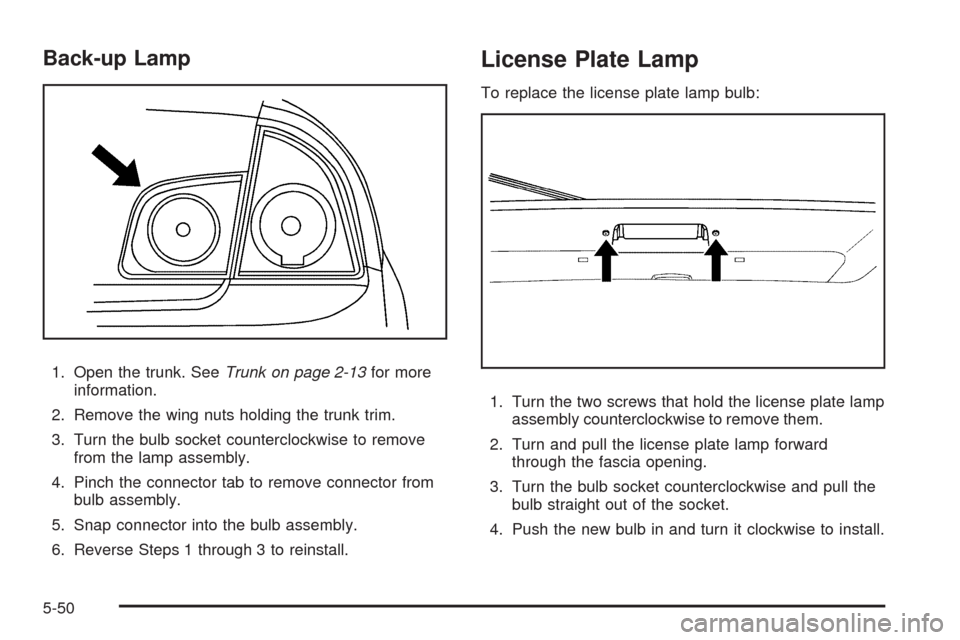
1. Open the trunk. SeeTrunk on page 2-13for more
information.
2. Remove the wing nuts holding the trunk trim.
3. Turn the bulb socket counterclockwise to remove
from the lamp assembly.
4. Pinch the connector tab to remove connector from
bulb assembly.
5. Snap connector into the bulb assembly.
6. Reverse Steps 1 through 3 to reinstall.
License Plate Lamp
To replace the license plate lamp bulb:
1. Turn the two screws that hold the license plate lamp
assembly counterclockwise to remove them.
2. Turn and pull the license plate lamp forward
through the fascia opening.
3. Turn the bulb socket counterclockwise and pull the
bulb straight out of the socket.
4. Push the new bulb in and turn it clockwise to install.
5-50
Page 329 of 412
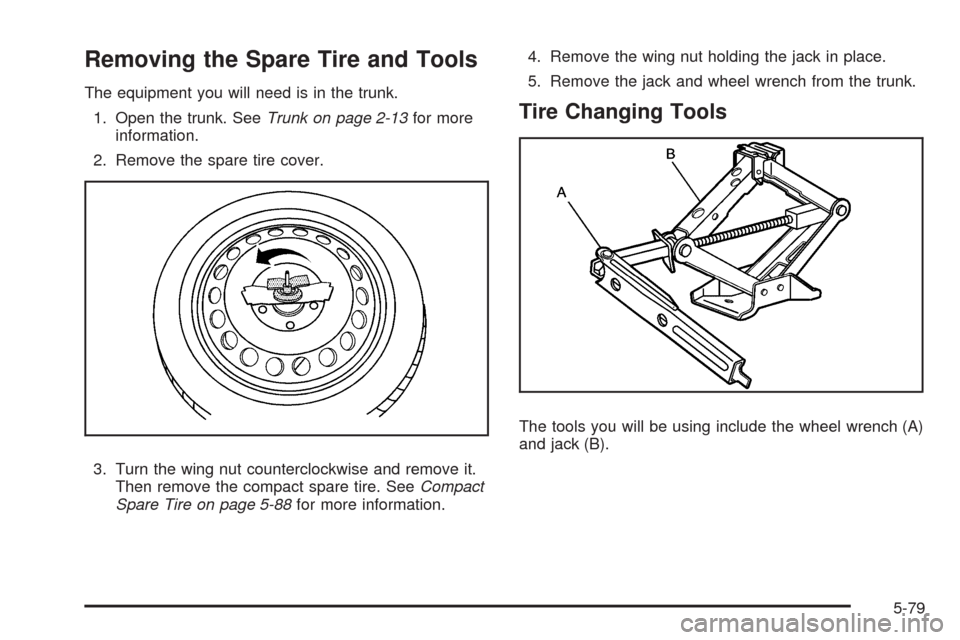
Removing the Spare Tire and Tools
The equipment you will need is in the trunk.
1. Open the trunk. SeeTrunk on page 2-13for more
information.
2. Remove the spare tire cover.
3. Turn the wing nut counterclockwise and remove it.
Then remove the compact spare tire. SeeCompact
Spare Tire on page 5-88for more information.4. Remove the wing nut holding the jack in place.
5. Remove the jack and wheel wrench from the trunk.
Tire Changing Tools
The tools you will be using include the wheel wrench (A)
and jack (B).
5-79
Page 336 of 412

{CAUTION:
Incorrect or improperly tightened wheel nuts
can cause the wheel to come loose and even
come off. This could lead to a crash. If you have
to replace them, be sure to get new original
equipment wheel nuts. Stop somewhere as
soon as you can and have the nuts tightened
with a torque wrench to the proper torque
specication. SeeCapacities and Specifications
on page 5-108for wheel nut torque
specication.
Notice:Improperly tightened wheel nuts can
lead to brake pulsation and rotor damage. To avoid
expensive brake repairs, evenly tighten the wheel
nuts in the proper sequence and to the proper torque
specication. SeeCapacities and Specifications on
page 5-108for the wheel nut torque specication.14. Tighten the wheel nuts
rmly in a crisscross
sequence, as shown,
with the wheel wrench.
Notice:Wheel covers will not t on your vehicle’s
compact spare. If you try to put a wheel cover on
the compact spare, the cover or the spare could be
damaged.
Do not try to put a wheel cover on your compact spare
tire. It will not t. Store the wheel cover and wheel nut
caps in the trunk until you have the at tire repaired or
replaced.
5-86
Page 337 of 412

Storing a Flat or Spare Tire
and Tools
Storing a Flat Tire and Tools
{CAUTION:
Storing a jack, a tire, or other equipment in the
passenger compartment of the vehicle could
cause injury. In a sudden stop or collision,
loose equipment could strike someone.
Store all these in the proper place.To store the at tire and tools in the compact spare tire
compartment, do the following:
A. Cover
B. Retainer
C. Bolt Extension
D. Flat TireE. Wing Nut
F. Jack and Wheel
Wrench
G. Bolt
1. Open the trunk. SeeTrunk on page 2-13for more
information.
2. Remove the bolt extension from the jack and
remove the center cap from the wheel.
5-87
Page 338 of 412

3. Place the jack over the bolt on the oor, making
sure in contacts the bolt and thread the jack
retainer nut until in contacts the jack.
4. With the valve stem up, place the tire on the
compartment oor with the rear of the tire beneath
the trim panel (tire may not lay completely at).
5. Line up the center hole of the wheel with the bolt.
6. With the yellow cap in place to prevent the
wheel from being scratched, screw the bolt
extension onto the bolt through the wheel nut hole.
7. Remove the yellow cap from the bolt extension.
8. Secure the tire and wheel with the larger wing nut.
The compact spare is for temporary use only. Replace
the compact spare tire with a full-size tire as soon
as you can.Compact Spare Tire on page 5-88.
See the storage instructions label to replace your
compact into your trunk properly.
Compact Spare Tire
Although the compact spare tire was fully inated
when the vehicle was new, it can lose air after a time.
Check the ination pressure regularly. It should be
60 psi (420 kPa).After installing the compact spare on the vehicle, stop
as soon as possible and make sure the spare tire is
correctly inated. The compact spare is made to perform
well at speeds up to 65 mph (105 km/h) for distances up
to 3,000 miles (5 000 km), so you can nish your trip
and have the full-size tire repaired or replaced at your
convenience. Of course, it is best to replace the spare
with a full-size tire as soon as possible. The spare tire
will last longer and be in good shape in case it is needed
again.
Notice:When the compact spare is installed,
do not take your vehicle through an automatic
car wash with guide rails. The compact spare can
get caught on the rails. That can damage the tire
and wheel, and maybe other parts of your vehicle.
Do not use the compact spare on other vehicles.
And do not mix the compact spare tire or wheel with
other wheels or tires. They will not t. Keep the
spare tire and its wheel together.
Notice:Tire chains will not t your compact spare.
Using them can damage your vehicle and can
damage the chains too. Do not use tire chains
on your compact spare.
5-88
Page 349 of 412

Fuses
The wiring circuits in your vehicle are protected from
short circuits by a combination of fuses, circuit breakers
and fusible links. This greatly reduces the chance of
damage caused by electrical problems.
Look at the silver-colored band inside the fuse. If the
band is broken or melted, replace the fuse. Be sure
to replace a bad fuse with a new one of the identical
size and rating.
There are three fuse blocks in your vehicle: one in
the center of the instrument panel, one in the engine
compartment and one in the trunk.
There is a fuse puller located on the instrument panel
fuse block. It can be used to easily remove fuses
from the fuse block.
Instrument Panel Fuse Block
The instrument panel fuse block is located on the
passenger side of the vehicle, on the lower portion
of the instrument panel near the oor.
Remove the panel cover to access the fuse block, then
remove the fuse block cover to access the fuses.
Your vehicle might not have all the fuses and features
listed.
5-99