cooling CHEVROLET MALIBU 2011 7.G User Guide
[x] Cancel search | Manufacturer: CHEVROLET, Model Year: 2011, Model line: MALIBU, Model: CHEVROLET MALIBU 2011 7.GPages: 382, PDF Size: 5.81 MB
Page 258 of 382
Black plate (16,1)Chevrolet Malibu Owner Manual - 2011
10-16 Vehicle Care
{WARNING
An electric engine cooling fan
under the hood can start up even
when the engine is not running
and can cause injury. Keep
hands, clothing, and tools away
from any underhood electric fan.
{WARNING
Heater and radiator hoses, and
other engine parts, can be very
hot. Do not touch them. If you do,
you can be burned.
Do not run the engine if there is a
leak. If you run the engine, it
could lose all coolant. That could
cause an engine fire, and you
could be burned. Get any leak
fixed before you drive the vehicle.Notice:
Using coolant other than
DEX-COOL
®can cause premature
engine, heater core, or radiator
corrosion. In addition, the engine
coolant could require changing
sooner, at 50 000 km
(30,000 miles) or 24 months,
whichever occurs first. Any
repairs would not be covered by
the vehicle warranty. Always use
DEX-COOL (silicate-free) coolant
in the vehicle.
Engine Coolant
The cooling system in the vehicle is
filled with DEX-COOL®engine
coolant. This coolant is designed to
remain in the vehicle for 5 years or
240 000 km (150,000 mi), whichever
occurs first.
The following explains the cooling
system and how to check and add
coolant when it is low. If there is a
problem with engine overheating,
see Engine Overheating
on
page 10‑19.
What to Use
{WARNING
Adding only plain water or some
other liquid to the cooling system
can be dangerous. Plain water
and other liquids, can boil before
the proper coolant mixture will.
The vehicle's coolant warning
system is set for the proper
coolant mixture. With plain water
or the wrong mixture, the engine
could get too hot but you would
not get the overheat warning. The
engine could catch fire and you or
others could be burned. Use a
50/50 mixture of clean, drinkable
water and DEX-COOL coolant.
Page 259 of 382
Black plate (17,1)Chevrolet Malibu Owner Manual - 2011
Vehicle Care 10-17
Use a 50/50 mixture of clean,
drinkable water and DEX-COOL
coolant. If using this mixture,
nothing else needs to be added.
This mixture:
.Gives freezing protection down
to−37°C (−34°F), outside
temperature.
.Gives boiling protection up to
129°C (265°F), engine
temperature.
.Protects against rust and
corrosion.
.Will not damage aluminum parts.
.Helps keep the proper engine
temperature.
Notice: If an improper coolant
mixture is used, the engine could
overheat and be badly damaged.
The repair cost would not be
covered by the vehicle warranty.
Too much water in the mixture
can freeze and crack the engine,
radiator, heater core, and other
parts.
Checking Coolant
The vehicle must be on a level
surface when checking the coolant
level.
Check to see if coolant is visible in
the coolant surge tank. If the coolant
inside the coolant surge tank is
boiling, do not do anything else until
it cools down. If coolant is visible
but the coolant level is not at or
above the FULL COLD mark, add a
50/50 mixture of clean, drinkable
water and DEX-COOL coolant at the
coolant surge tank, but be sure the
cooling system is cool before this is
done. See Engine Overheating
on
page 10‑19for more information.
The coolant level should be at or
above the FULL COLD mark on the
coolant surge tank. If it is not, there
may be a leak at the pressure cap
or in the radiator hoses, heater
hoses, radiator, water pump,
or somewhere else in the cooling
system.
How to Add Coolant to the
Coolant Surge Tank
{WARNING
You can be burned if you spill
coolant on hot engine parts.
Coolant contains ethylene glycol
and it will burn if the engine parts
are hot enough. Do not spill
coolant on a hot engine.
Notice: This vehicle has a
specific coolant fill procedure.
Failure to follow this procedure
could cause the engine to
overheat and be severely
damaged.
If coolant is needed, add the proper
DEX-COOL coolant mixture at the
coolant surge tank.
Page 260 of 382
Black plate (18,1)Chevrolet Malibu Owner Manual - 2011
10-18 Vehicle Care
How to Add Coolant to the
Radiator
{WARNING
An electric engine cooling fan
under the hood can start up even
when the engine is not running
and can cause injury. Keep
hands, clothing, and tools away
from any underhood electric fan.
{WARNING
Steam and scalding liquids from a
hot cooling system can blow out
and burn you badly. They are
under pressure, and if you turn
the surge tank pressure
cap—even a little —they can
come out at high speed. Never
turn the cap when the cooling
system, including the surge tank
(Continued)
WARNING (Continued)
pressure cap, is hot. Wait for the
cooling system and surge tank
pressure cap to cool if you ever
have to turn the pressure cap.
If coolant is needed, add the proper
mixture directly to the radiator, but
be sure the cooling system is cool
before this is done.
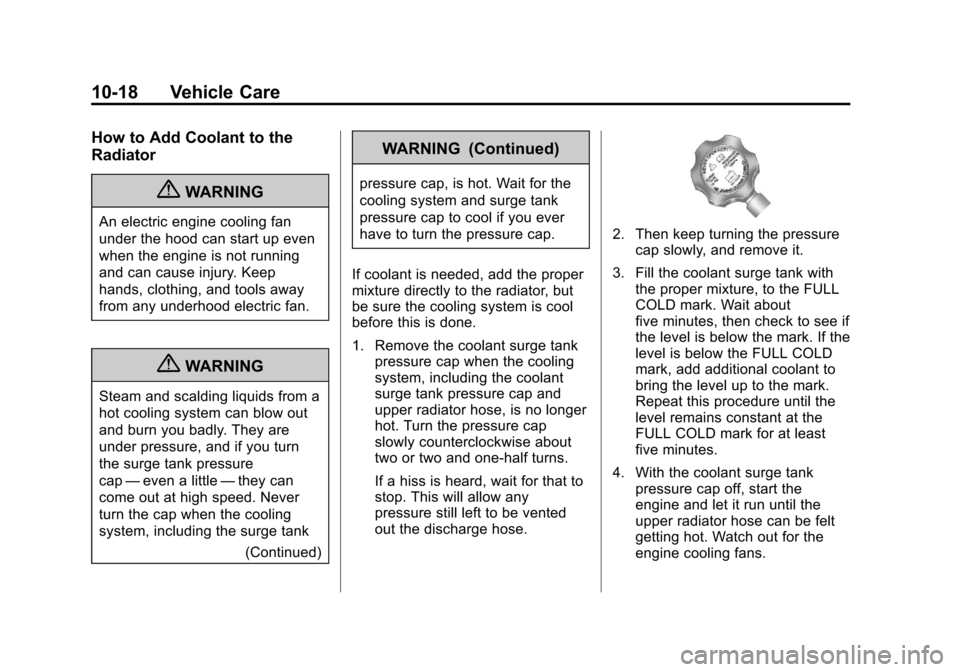
1. Remove the coolant surge tank pressure cap when the cooling
system, including the coolant
surge tank pressure cap and
upper radiator hose, is no longer
hot. Turn the pressure cap
slowly counterclockwise about
two or two and one-half turns.
If a hiss is heard, wait for that to
stop. This will allow any
pressure still left to be vented
out the discharge hose.
2. Then keep turning the pressurecap slowly, and remove it.
3. Fill the coolant surge tank with the proper mixture, to the FULL
COLD mark. Wait about
five minutes, then check to see if
the level is below the mark. If the
level is below the FULL COLD
mark, add additional coolant to
bring the level up to the mark.
Repeat this procedure until the
level remains constant at the
FULL COLD mark for at least
five minutes.
4. With the coolant surge tank pressure cap off, start the
engine and let it run until the
upper radiator hose can be felt
getting hot. Watch out for the
engine cooling fans.
Page 261 of 382
Black plate (19,1)Chevrolet Malibu Owner Manual - 2011
Vehicle Care 10-19
By this time, the coolant level
inside the coolant surge tank
might be lower. If the level is
lower than the FULL COLD
mark, add more of the proper
mixture to the coolant surge tank
until the level reaches the FULL
COLD mark.
5. Then replace the pressure cap. Be sure the pressure cap is
hand-tight and fully seated.
Notice: If the pressure cap is not
tightly installed, coolant loss and
possible engine damage may
occur. Be sure the cap is properly
and tightly secured.
Engine Overheating
The vehicle has several indicators
to warn of engine overheating.
There is an engine coolant
temperature gauge as well as an
engine coolant temperature warning
light on the vehicle's instrument
panel cluster. See Engine Coolant Temperature Gauge on page 5‑20
and
Engine Coolant Temperature
Warning Light on page 5‑20.
If it is decided not to lift the hood
when this warning appears, but
instead get service help right away.
See Roadside Assistance Program
(United States and Canada)
on
page 13‑7or Roadside Assistance
Program (Mexico) on page 13‑9.
If it is decided to lift the hood, make
sure the vehicle is parked on a level
surface.
Then check to see if the engine
cooling fans are running. If the
engine is overheating, both fans
should be running. If they are not,
do not continue to run the engine
and have the vehicle serviced.
Notice: Engine damage from
running the engine without
coolant is not covered by the
warranty.
If Steam is Coming from the
Engine Compartment
{WARNING
Steam from an overheated engine
can burn you badly, even if you
just open the hood. Stay away
from the engine if you see or hear
steam coming from it. Just turn it
off and get everyone away from
the vehicle until it cools down.
Wait until there is no sign of
steam or coolant before you open
the hood.
If you keep driving when your
engine is overheated, the liquids
in it can catch fire. You or others
could be badly burned. Stop your
engine if it overheats, and get out
of the vehicle until the engine
is cool.
Page 274 of 382
Black plate (32,1)Chevrolet Malibu Owner Manual - 2011
10-32 Vehicle Care
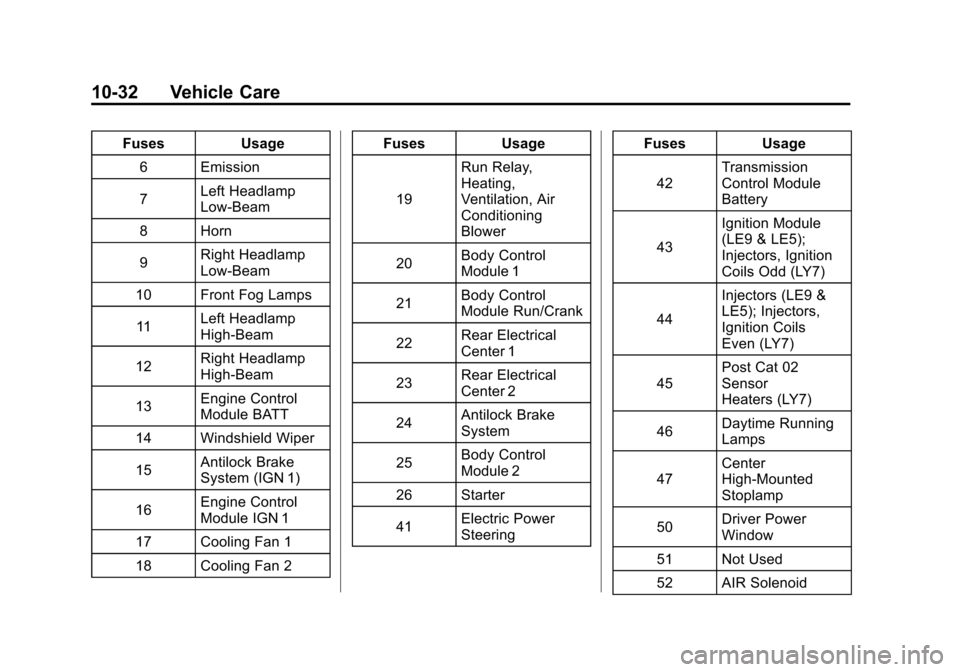
FusesUsage
6 Emission
7 Left Headlamp
Low-Beam
8 Horn
9 Right Headlamp
Low-Beam
10 Front Fog Lamps
11 Left Headlamp
High-Beam
12 Right Headlamp
High-Beam
13 Engine Control
Module BATT
14 Windshield Wiper
15 Antilock Brake
System (IGN 1)
16 Engine Control
Module IGN 1
17 Cooling Fan 1
18 Cooling Fan 2 Fuses
Usage
19 Run Relay,
Heating,
Ventilation, Air
Conditioning
Blower
20 Body Control
Module 1
21 Body Control
Module Run/Crank
22 Rear Electrical
Center 1
23 Rear Electrical
Center 2
24 Antilock Brake
System
25 Body Control
Module 2
26 Starter
41 Electric Power
Steering Fuses
Usage
42 Transmission
Control Module
Battery
43 Ignition Module
(LE9 & LE5);
Injectors, Ignition
Coils Odd (LY7)
44 Injectors (LE9 &
LE5); Injectors,
Ignition Coils
Even (LY7)
45 Post Cat 02
Sensor
Heaters (LY7)
46 Daytime Running
Lamps
47 Center
High-Mounted
Stoplamp
50 Driver Power
Window
51 Not Used
52 AIR Solenoid
Page 275 of 382
Black plate (33,1)Chevrolet Malibu Owner Manual - 2011
Vehicle Care 10-33
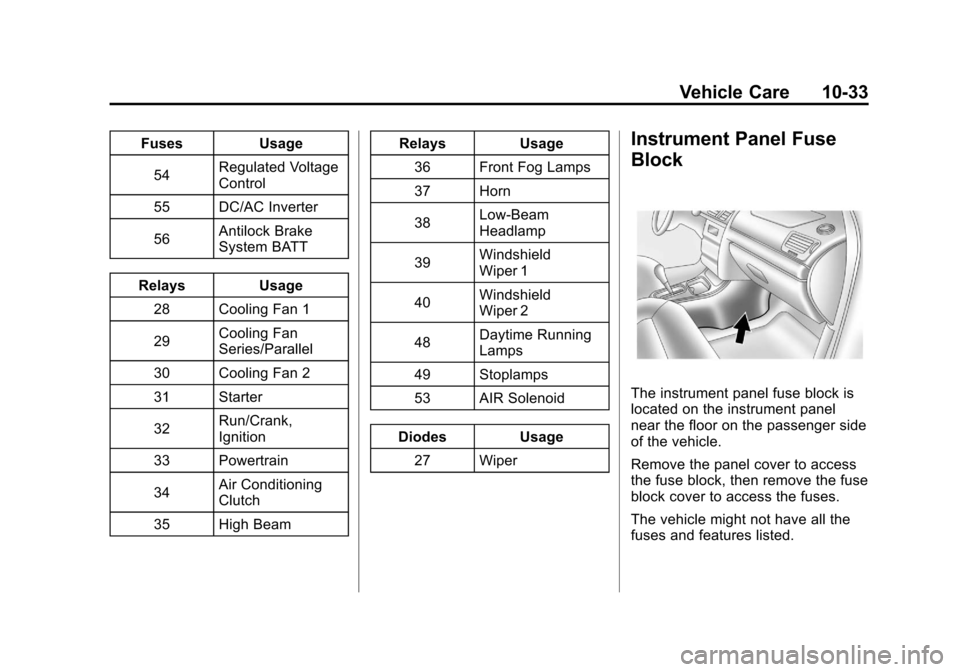
FusesUsage
54 Regulated Voltage
Control
55 DC/AC Inverter
56 Antilock Brake
System BATT
Relays Usage
28 Cooling Fan 1
29 Cooling Fan
Series/Parallel
30 Cooling Fan 2
31 Starter
32 Run/Crank,
Ignition
33 Powertrain
34 Air Conditioning
Clutch
35 High Beam Relays
Usage
36 Front Fog Lamps
37 Horn
38 Low-Beam
Headlamp
39 Windshield
Wiper 1
40 Windshield
Wiper 2
48 Daytime Running
Lamps
49 Stoplamps
53 AIR Solenoid
Diodes Usage
27 WiperInstrument Panel Fuse
Block
The instrument panel fuse block is
located on the instrument panel
near the floor on the passenger side
of the vehicle.
Remove the panel cover to access
the fuse block, then remove the fuse
block cover to access the fuses.
The vehicle might not have all the
fuses and features listed.
Page 301 of 382
Black plate (59,1)Chevrolet Malibu Owner Manual - 2011
Vehicle Care 10-59
Notice:The wrong wheel can
also cause problems with bearing
life, brake cooling, speedometer
or odometer calibration,
headlamp aim, bumper height,
vehicle ground clearance, and tire
or tire chain clearance to the
body and chassis.
See If a Tire Goes Flat
on
page 10‑59for more information.
Used Replacement Wheels
{WARNING
Putting a used wheel on the
vehicle is dangerous. You cannot
know how it has been used or
how far it has been driven.
It could fail suddenly and cause a
crash. If you have to replace a
wheel, use a new GM original
equipment wheel.
Tire Chains
{WARNING
Do not use tire chains. There is
not enough clearance. Tire chains
used on a vehicle without the
proper amount of clearance can
cause damage to the brakes,
suspension or other vehicle parts.
The area damaged by the tire
chains could cause you to lose
control of the vehicle and you or
others may be injured in a crash.
Use another type of traction
device only if its manufacturer
recommends it for use on the
vehicle and tire size combination
and road conditions. Follow that
manufacturer's instructions. To
help avoid damage to the vehicle,
drive slowly, readjust or remove
the device if it is contacting the
(Continued)
WARNING (Continued)
vehicle, and do not spin the
vehicle's wheels. If you do find
traction devices that will fit, install
them on the front tires.
If a Tire Goes Flat
It is unusual for a tire to blowout
while you are driving, especially if
you maintain your vehicle's tires
properly. If air goes out of a tire, it is
much more likely to leak out slowly.
But if you should ever have a
blowout, here are a few tips about
what to expect and what to do:
If a front tire fails, the flat tire
creates a drag that pulls the vehicle
toward that side. Take your foot off
the accelerator pedal and grip the
steering wheel firmly. Steer to
maintain lane position, and then
gently brake to a stop, well off the
road, if possible.
Page 339 of 382
Black plate (3,1)Chevrolet Malibu Owner Manual - 2011
Service and Maintenance 11-3
Your dealer has trained service
technicians who will perform this
work and reset the system. If the
engine oil life system is reset
accidentally, service the vehicle
within 5 000 km/3,000 miles since
the last service. Reset the oil life
system whenever the oil is changed.
SeeEngine Oil Life System
on
page 10‑12.
Every Engine Oil Change
.Change engine oil and filter.
Reset oil life system. See
Engine Oil
on page 10‑9and
Engine Oil Life Systemon
page 10‑12. An Emission Control
Service.
.Engine coolant level check. See
Engine Coolant on page 10‑16.
.Engine cooling system
inspection. Visual inspection of
hoses, pipes, fittings, and
clamps and replacement,
if needed.
.Windshield washer fluid level
check. See Washer Fluidon
page 10‑22.
.Windshield wiper blade
inspection for wear, cracking,
or contamination and windshield
and wiper blade cleaning, if contaminated. See
Exterior
Care
on page 10‑85. Worn or
damaged wiper blade
replacement. See Wiper Blade
Replacement on page 10‑27.
.Tire inflation pressures check.
See Tire Pressure on
page 10‑45.
.Tire wear inspection. See Tire
Inspection on page 10‑51.
.Rotate tires if necessary. See
Tire Rotation on page 10‑52.
.Fluids visual leak check (or
every 12 months, whichever
occurs first). A leak in any
system must be repaired and
the fluid level checked.
.Engine air cleaner filter
inspection. See Engine Air
Cleaner/Filter on page 10‑14.
.Brake system inspection (or
every 12 months, whichever
occurs first).
Page 341 of 382
Black plate (5,1)Chevrolet Malibu Owner Manual - 2011
Service and Maintenance 11-5
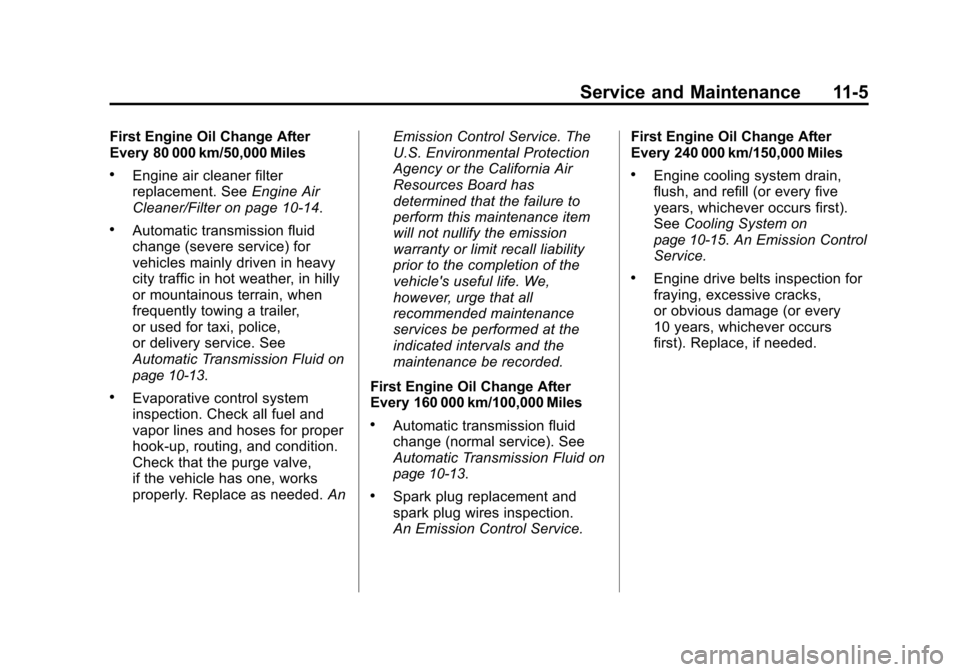
First Engine Oil Change After
Every 80 000 km/50,000 Miles
.Engine air cleaner filter
replacement. SeeEngine Air
Cleaner/Filter on page 10‑14.
.Automatic transmission fluid
change (severe service) for
vehicles mainly driven in heavy
city traffic in hot weather, in hilly
or mountainous terrain, when
frequently towing a trailer,
or used for taxi, police,
or delivery service. See
Automatic Transmission Fluid
on
page 10‑13.
.Evaporative control system
inspection. Check all fuel and
vapor lines and hoses for proper
hook‐up, routing, and condition.
Check that the purge valve,
if the vehicle has one, works
properly. Replace as needed. AnEmission Control Service. The
U.S. Environmental Protection
Agency or the California Air
Resources Board has
determined that the failure to
perform this maintenance item
will not nullify the emission
warranty or limit recall liability
prior to the completion of the
vehicle's useful life. We,
however, urge that all
recommended maintenance
services be performed at the
indicated intervals and the
maintenance be recorded.
First Engine Oil Change After
Every 160 000 km/100,000 Miles
.Automatic transmission fluid
change (normal service). See
Automatic Transmission Fluid
on
page 10‑13.
.Spark plug replacement and
spark plug wires inspection.
An Emission Control Service. First Engine Oil Change After
Every 240 000 km/150,000 Miles
.Engine cooling system drain,
flush, and refill (or every five
years, whichever occurs first).
See
Cooling System
on
page 10‑15. An Emission Control
Service.
.Engine drive belts inspection for
fraying, excessive cracks,
or obvious damage (or every
10 years, whichever occurs
first). Replace, if needed.
Page 350 of 382
Black plate (2,1)Chevrolet Malibu Owner Manual - 2011
12-2 Technical Data
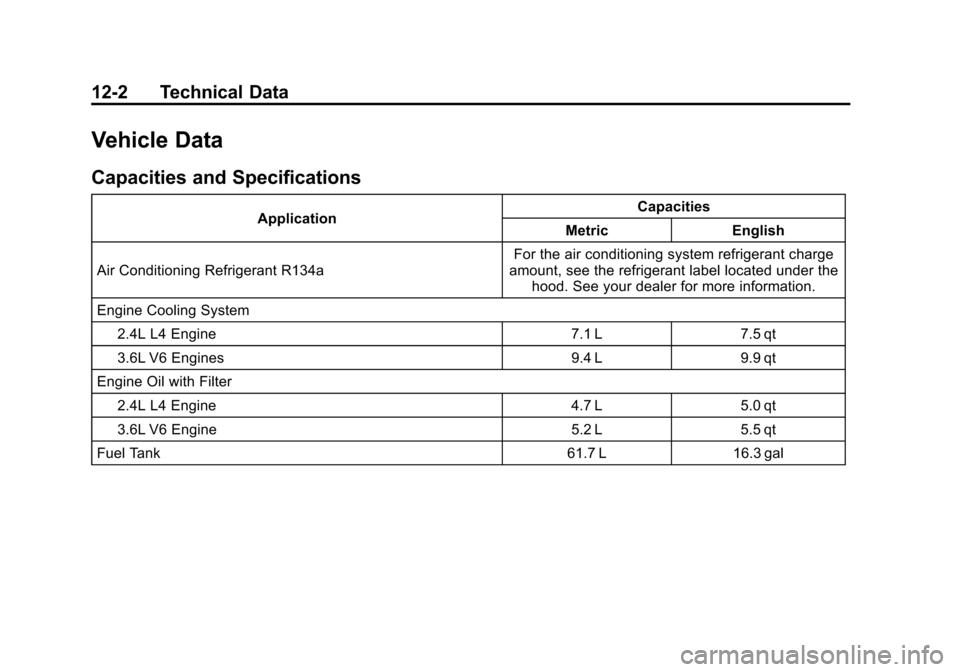
Vehicle Data
Capacities and Specifications
ApplicationCapacities
Metric English
Air Conditioning Refrigerant R134a For the air conditioning system refrigerant charge
amount, see the refrigerant label located under the hood. See your dealer for more information.
Engine Cooling System 2.4L L4 Engine 7.1 L 7.5 qt
3.6L V6 Engines 9.4 L 9.9 qt
Engine Oil with Filter
2.4L L4 Engine 4.7 L 5.0 qt
3.6L V6 Engine 5.2 L 5.5 qt
Fuel Tank 61.7 L 16.3 gal