ECU CHEVROLET MALIBU 2017 9.G User Guide
[x] Cancel search | Manufacturer: CHEVROLET, Model Year: 2017, Model line: MALIBU, Model: CHEVROLET MALIBU 2017 9.GPages: 419, PDF Size: 7.81 MB
Page 73 of 419
Chevrolet Malibu Owner Manual (GMNA-Localizing-U.S./Canada/Mexico-10122664) - 2017 - crc - 5/23/16
72 Seats and Restraints
{Warning
Because airbags inflate with great
force and faster than the blink of
an eye, anyone who is up
against, or very close to any
airbag when it inflates can be
seriously injured or killed. Do not
sit unnecessarily close to any
airbag, as you would be if sitting
on the edge of the seat or leaning
forward. Safety belts help keep
you in position before and during
acrash.Alwayswearasafety
belt, even with airbags. The driver
should sit as far back as possible
while still maintaining control of
the vehicle. The safety belts and
the front outboard passenger
airbags are most effective when
you are sitting well back and
upright in the seat with both feet
on the floor.
Occupants should not lean on or
sleep against the door or side
windows in seating positions with
seat-mounted side impact airbags
and/or roof-rail airbags.
{Warning
Children who are up against,
or very close to, any airbag when
it inflates can be seriously injured
or killed. Always secure children
properly in the vehicle. To read
how, seeOlder Children083or
Infants and Young Children085.
There is an airbag readiness lighton the instrument cluster, whichshows the airbag symbol. Thesystem checks the airbag electricalsystem for malfunctions. The lighttells you if there is an electricalproblem. SeeAirbag ReadinessLight0120for more information.
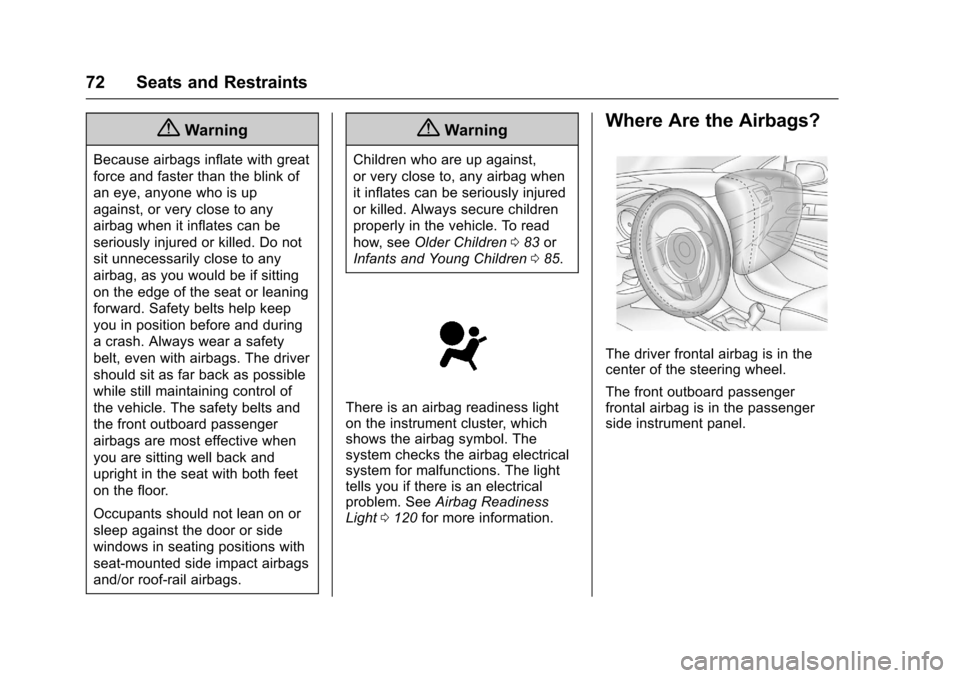
Where Are the Airbags?
The driver frontal airbag is in thecenter of the steering wheel.
The front outboard passengerfrontal airbag is in the passengerside instrument panel.
Page 75 of 419
Chevrolet Malibu Owner Manual (GMNA-Localizing-U.S./Canada/Mexico-10122664) - 2017 - crc - 5/23/16
74 Seats and Restraints
Warning (Continued)
clear. Do not put anything
between an occupant and an
airbag, and do not attach or put
anything on the steering wheel
hub or on or near any other
airbag covering.
Do not use seat accessories that
block the inflation path of a
seat-mounted side impact airbag.
Never secure anything to the roof
of a vehicle with roof-rail airbags
by routing a rope or tie⇣down
through any door or window
opening. If you do, the path of an
inflating roof-rail airbag will be
blocked.
When Should an Airbag
Inflate?
This vehicle is equipped withairbags. SeeAirbag System071.Airbags are designed to inflate if theimpact exceeds the specific airbagsystem's deployment threshold.Deployment thresholds are used to
predict how severe a crash is likelyto be in time for the airbags toinflate and help restrain theoccupants. The vehicle haselectronic sensors that help theairbag system determine theseverity of the impact. Deploymentthresholds can vary with specificvehicle design.
Frontal airbags are designed toinflate in moderate to severe frontalor near frontal crashes to helpreduce the potential for severeinjuries, mainly to the driver's orfront outboard passenger's headand chest.
Whether the frontal airbags will orshould inflate is not based primarilyon how fast the vehicle is traveling.It depends on what is hit, thedirection of the impact, and howquickly the vehicle slows down.
Frontal airbags may inflate atdifferent crash speeds depending onwhether the vehicle hits an objectstraight on or at an angle, andwhether the object is fixed ormoving, rigid or deformable, narrowor wide.
Frontal airbags are not intended toinflate during vehicle rollovers, rearimpacts, or in many side impacts.
In addition, the vehicle hasadvanced technology frontalairbags. Advanced technologyfrontal airbags adjust the restraintaccording to crash severity.
Knee airbags are designed to inflatein moderate to severe frontal ornear frontal impacts. Knee airbagsare not designed to inflate duringvehicle rollovers, in rear impacts,or in many side impacts.
Seat-mounted side impact airbagsare designed to inflate in moderateto severe side crashes dependingon the location of the impact.Seat-mounted side impact airbagsare not designed to inflate in frontalimpacts, near frontal impacts,rollovers, or rear impacts.Aseat-mountedsideimpactairbagis designed to inflate on the side ofthe vehicle that is struck.
Roof-rail airbags are designed toinflate in moderate to severe sidecrashes depending on the locationof the impact. In addition, these
Page 78 of 419
Chevrolet Malibu Owner Manual (GMNA-Localizing-U.S./Canada/Mexico-10122664) - 2017 - crc - 5/23/16
Seats and Restraints 77
other parts. The service manualfor the vehicle covers the needto replace other parts.
.The vehicle has a crash sensingand diagnostic module whichrecords information after acrash. SeeVehicle DataRecording and Privacy0394andEvent DataRecorders0395.
.Let only qualified technicianswork on the airbag systems.Improper service can mean thatan airbag system will not workproperly. See your dealer forservice.
Passenger Sensing
System
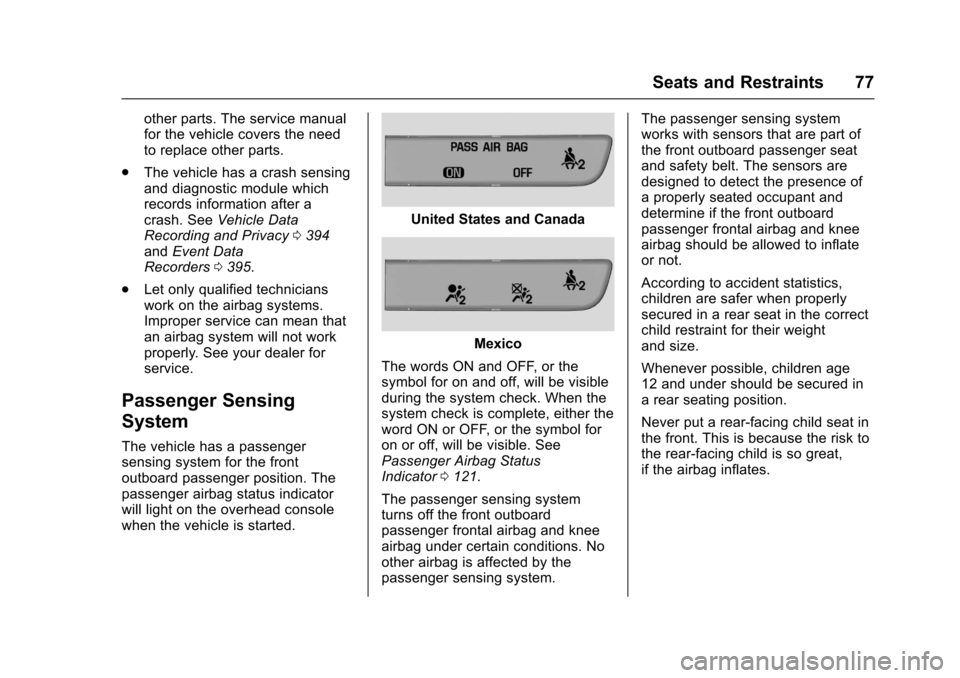
The vehicle has a passengersensing system for the frontoutboard passenger position. Thepassenger airbag status indicatorwill light on the overhead consolewhen the vehicle is started.
United States and Canada
Mexico
The words ON and OFF, or thesymbol for on and off, will be visibleduring the system check. When thesystem check is complete, either theword ON or OFF, or the symbol foron or off, will be visible. SeePassenger Airbag StatusIndicator0121.
The passenger sensing systemturns off the front outboardpassenger frontal airbag and kneeairbag under certain conditions. Noother airbag is affected by thepassenger sensing system.
The passenger sensing systemworks with sensors that are part ofthe front outboard passenger seatand safety belt. The sensors aredesigned to detect the presence ofaproperlyseatedoccupantanddetermine if the front outboardpassenger frontal airbag and kneeairbag should be allowed to inflateor not.
According to accident statistics,children are safer when properlysecured in a rear seat in the correctchild restraint for their weightand size.
Whenever possible, children age12 and under should be secured inarearseatingposition.
Never put a rear-facing child seat inthe front. This is because the risk tothe rear-facing child is so great,if the airbag inflates.
Page 79 of 419
Chevrolet Malibu Owner Manual (GMNA-Localizing-U.S./Canada/Mexico-10122664) - 2017 - crc - 5/23/16
78 Seats and Restraints
{Warning
Achildinarear-facingchild
restraint can be seriously injured
or killed if the passenger frontal
airbag inflates. This is because
the back of the rear-facing child
restraint would be very close to
the inflating airbag. A child in a
forward-facing child restraint can
be seriously injured or killed if the
passenger frontal airbag inflates
and the passenger seat is in a
forward position.
Even if the passenger sensing
system has turned off the front
outboard passenger airbag(s), no
system is fail-safe. No one can
guarantee that an airbag will not
deploy under some unusual
circumstance, even though the
airbag(s) are off.
Never put a rear-facing child
restraint in the front seat, even if
the airbag is off. If securing a
forward-facing child restraint in
(Continued)
Warning (Continued)
the front outboard passenger
seat, always move the seat as far
back as it will go. It is better to
secure child restraints in the rear
seat. Consider using another
vehicle to transport the child
when a rear seat is not available.
The passenger sensing system isdesigned to turn off the frontoutboard passenger frontal airbagand knee airbag if:
.The front outboard passengerseat is unoccupied.
.The system determines that aninfant is present in a childrestraint.
.Afrontoutboardpassengertakes his/her weight off of theseat for a period of time.
.There is a critical problem withthe airbag system or thepassenger sensing system.
When the passenger sensingsystem has turned off the frontoutboard passenger frontal airbagand knee airbag, the off indicatorwill light and stay lit as a reminderthat the airbags are off. SeePassenger Airbag StatusIndicator0121.
The passenger sensing system isdesigned to turn on the frontoutboard passenger frontal airbagand knee airbag anytime the systemsenses that a person of adult size issitting properly in the front outboardpassenger seat. When thepassenger sensing system hasallowed the airbag(s) to be enabled,the on indicator will light and stay litas a reminder that the airbag(s) areactive.
For some children, includingchildren in child restraints and forvery small adults, the passengersensing system may or may not turnoff the front outboard passengerfrontal airbag and knee airbag,depending upon the person'sseating posture and body build.Everyone in the vehicle who hasoutgrown child restraints should
Page 80 of 419
Chevrolet Malibu Owner Manual (GMNA-Localizing-U.S./Canada/Mexico-10122664) - 2017 - crc - 5/23/16
Seats and Restraints 79
wear a safety belt properly—whether or not there is an airbag forthat person.
{Warning
If the airbag readiness light ever
comes on and stays on, it means
that something may be wrong
with the airbag system. To help
avoid injury to yourself or others,
have the vehicle serviced right
away. SeeAirbag Readiness
Light0120for more information,
including important safety
information.
If the On Indicator Is Lit for a
Child Restraint
The passenger sensing system isdesigned to turn off the frontoutboard passenger frontal airbagand knee airbag if the systemdetermines that an infant is presentin a child restraint. If a child restrainthas been installed and the onindicator is lit:
1. Turn the vehicle off.
2. Remove the child restraint fromthe vehicle.
3. Remove any additional itemsfrom the seat such as blankets,cushions, seat covers, seatheaters, or seat massagers.
4. Reinstall the child restraintfollowing the directionsprovided by the child restraintmanufacturer and refer toSecuring Child Restraints (Withthe Safety Belt in the FrontSeat)098orSecuring ChildRestraints (With the Safety Beltin the Rear Seat)096.
Make sure the safety beltretractor is locked by pullingthe shoulder belt all the wayout of the retractor wheninstalling the child restraint,even if the child restraint isequipped with a safety beltlock-off. When the retractorlock is set, the belt can betightened but not pulled out ofthe retractor.
5. If, after reinstalling the childrestraint and restarting thevehicle, the on indicator is still
lit, turn the vehicle off. Thenslightly recline the vehicleseatback and adjust the seatcushion, if adjustable, to makesure that the vehicle seatbackis not pushing the childrestraint into the seat cushion.
Also make sure the childrestraint is not trapped underthe vehicle head restraint.If this happens, adjust the headrestraint. SeeHeadRestraints055.
6. Restart the vehicle.
The passenger sensing system mayor may not turn off the airbags for achild in a child restraint dependingupon the child’ssize.Itisbettertosecure the child restraint in a rearseat. Never put a rear-facing childrestraint in the front seat, even if theon indicator is not lit.
Page 83 of 419
Chevrolet Malibu Owner Manual (GMNA-Localizing-U.S./Canada/Mexico-10122664) - 2017 - crc - 5/23/16
82 Seats and Restraints
Yo u r d e a l e r a n d t h e s e r v i c e m a n u a lhave information about the locationof the airbag sensors, sensing anddiagnostic module, and airbagwiring.
In addition, the vehicle has apassenger sensing system for thefront outboard passenger position,which includes sensors that are partof the passenger seat. Thepassenger sensing system may notoperate properly if the original seattrim is replaced with non-GMcovers, upholstery, or trim; or withGM covers, upholstery, or trimdesigned for a different vehicle. Anyobject, such as an aftermarket seatheater or a comfort-enhancing pador device, installed under or on topof the seat fabric, could alsointerfere with the operation of thepassenger sensing system. Thiscould either prevent properdeployment of the passengerairbag(s) or prevent the passengersensing system from properlyturning off the passenger airbag(s).SeePassenger SensingSystem077.
If the vehicle has rollover roof-railairbags, seeDifferent Size Tiresand Wheels0334for additionalimportant information.
If you have to modify your vehiclebecause you have a disability andyou have questions about whetherthe modifications will affect thevehicle's airbag system, or if youhave questions about whether theairbag system will be affected if thevehicle is modified for any otherreason, call Customer Assistance.SeeCustomer AssistanceOffices0385.
Airbag System Check
The airbag system does not needregularly scheduled maintenance orreplacement. Make sure the airbagreadiness light is working. SeeAirbag Readiness Light0120.
Caution
If an airbag covering is damaged,
opened, or broken, the airbag
may not work properly. Do not
(Continued)
Caution (Continued)
open or break the airbag
coverings. If there are any
opened or broken airbag
coverings, have the airbag
covering and/or airbag module
replaced. For the location of the
airbags, seeWhere Are the
Airbags?072.Seeyourdealer
for service.
Replacing Airbag System
Parts after a Crash
{Warning
Acrashcandamagetheairbag
systems in the vehicle.
Adamagedairbagsystemmay
not properly protect you and your
passenger(s) in a crash, resulting
in serious injury or even death. To
help make sure the airbag
systems are working properly
after a crash, have them
(Continued)
Page 86 of 419
Chevrolet Malibu Owner Manual (GMNA-Localizing-U.S./Canada/Mexico-10122664) - 2017 - crc - 5/23/16
Seats and Restraints 85
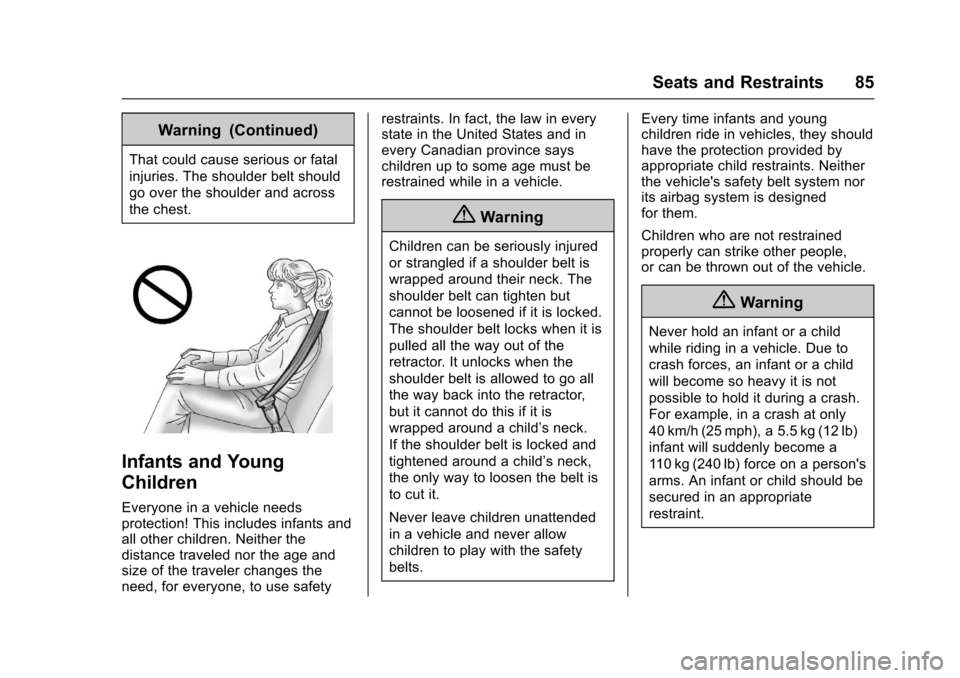
Warning (Continued)
That could cause serious or fatal
injuries. The shoulder belt should
go over the shoulder and across
the chest.
Infants and Young
Children
Everyone in a vehicle needsprotection! This includes infants andall other children. Neither thedistance traveled nor the age andsize of the traveler changes theneed, for everyone, to use safety
restraints. In fact, the law in everystate in the United States and inevery Canadian province sayschildren up to some age must berestrained while in a vehicle.
{Warning
Children can be seriously injured
or strangled if a shoulder belt is
wrapped around their neck. The
shoulder belt can tighten but
cannot be loosened if it is locked.
The shoulder belt locks when it is
pulled all the way out of the
retractor. It unlocks when the
shoulder belt is allowed to go all
the way back into the retractor,
but it cannot do this if it is
wrapped around a child’sneck.
If the shoulder belt is locked and
tightened around a child’sneck,
the only way to loosen the belt is
to cut it.
Never leave children unattended
in a vehicle and never allow
children to play with the safety
belts.
Every time infants and youngchildren ride in vehicles, they shouldhave the protection provided byappropriate child restraints. Neitherthe vehicle's safety belt system norits airbag system is designedfor them.
Children who are not restrainedproperly can strike other people,or can be thrown out of the vehicle.
{Warning
Never hold an infant or a child
while riding in a vehicle. Due to
crash forces, an infant or a child
will become so heavy it is not
possible to hold it during a crash.
For example, in a crash at only
40 km/h (25 mph), a 5.5 kg (12 lb)
infant will suddenly become a
11 0 k g ( 2 4 0 l b ) f o r c e o n a p e r s o n ' s
arms. An infant or child should be
secured in an appropriate
restraint.
Page 87 of 419
Chevrolet Malibu Owner Manual (GMNA-Localizing-U.S./Canada/Mexico-10122664) - 2017 - crc - 5/23/16
86 Seats and Restraints
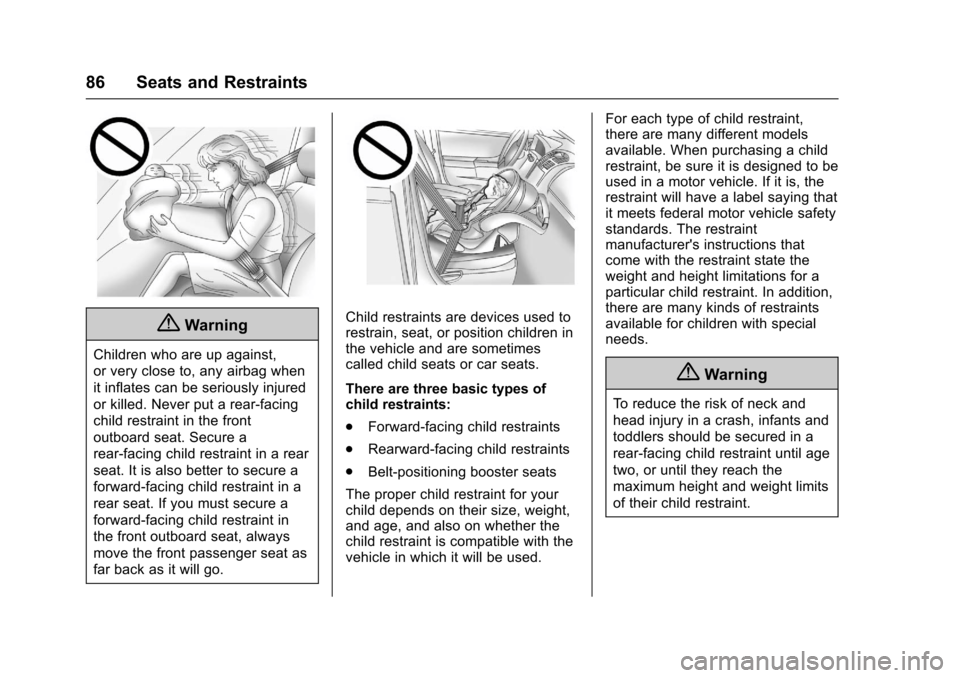
{Warning
Children who are up against,
or very close to, any airbag when
it inflates can be seriously injured
or killed. Never put a rear-facing
child restraint in the front
outboard seat. Secure a
rear-facing child restraint in a rear
seat. It is also better to secure a
forward-facing child restraint in a
rear seat. If you must secure a
forward-facing child restraint in
the front outboard seat, always
move the front passenger seat as
far back as it will go.
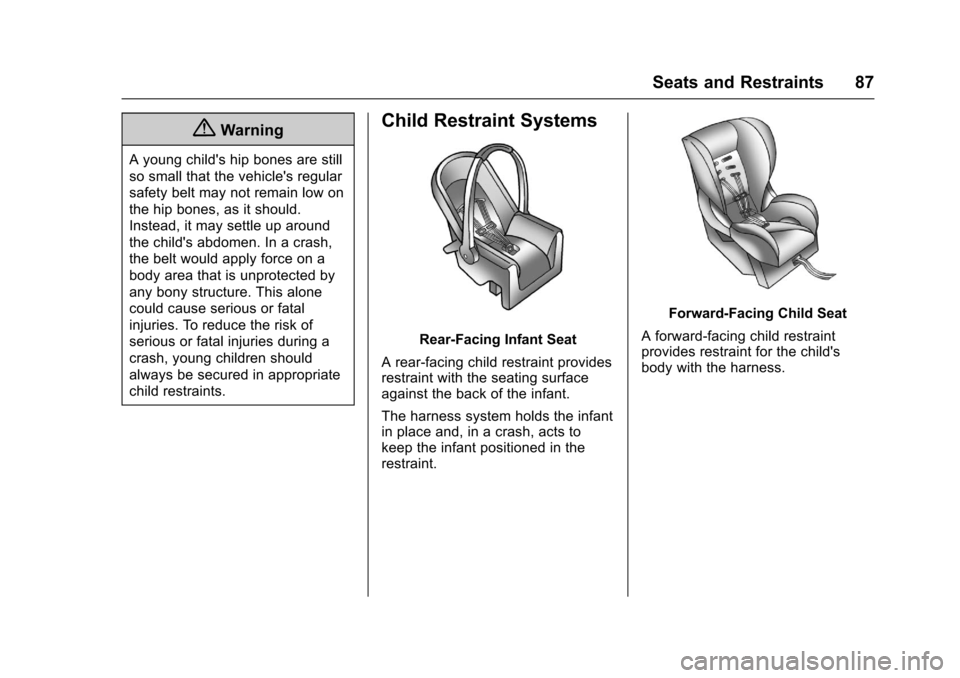
Child restraints are devices used torestrain, seat, or position children inthe vehicle and are sometimescalled child seats or car seats.
There are three basic types ofchild restraints:
.Forward-facing child restraints
.Rearward-facing child restraints
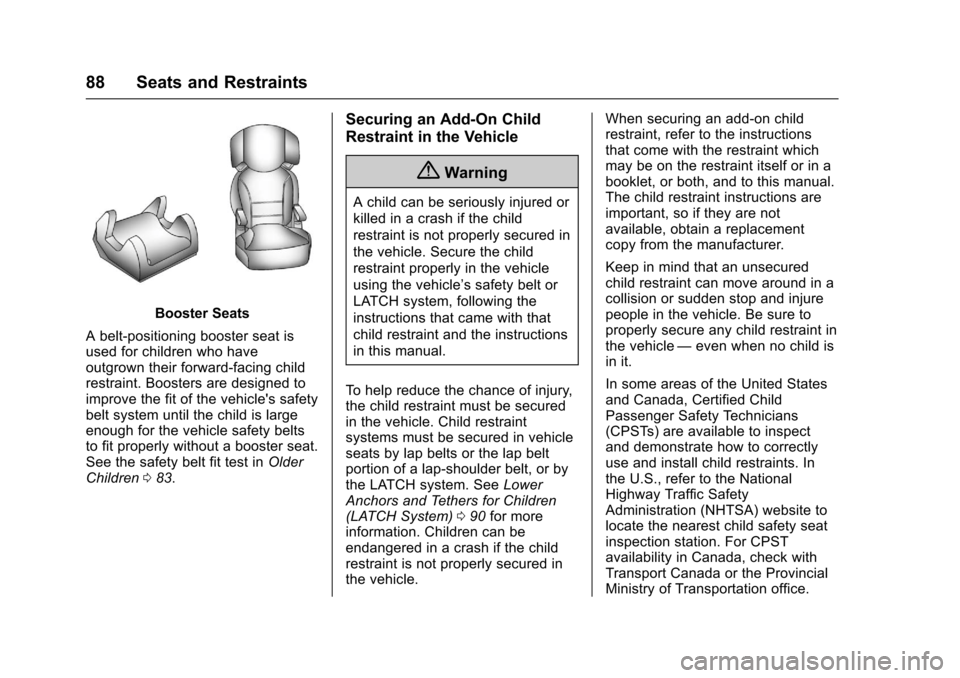
.Belt-positioning booster seats
The proper child restraint for yourchild depends on their size, weight,and age, and also on whether thechild restraint is compatible with thevehicle in which it will be used.
For each type of child restraint,there are many different modelsavailable. When purchasing a childrestraint, be sure it is designed to beused in a motor vehicle. If it is, therestraint will have a label saying thatit meets federal motor vehicle safetystandards. The restraintmanufacturer's instructions thatcome with the restraint state theweight and height limitations for aparticular child restraint. In addition,there are many kinds of restraintsavailable for children with specialneeds.
{Warning
To r e d u c e t h e r i s k o f n e c k a n d
head injury in a crash, infants and
toddlers should be secured in a
rear-facing child restraint until age
two, or until they reach the
maximum height and weight limits
of their child restraint.
Page 88 of 419
Chevrolet Malibu Owner Manual (GMNA-Localizing-U.S./Canada/Mexico-10122664) - 2017 - crc - 5/23/16
Seats and Restraints 87
{Warning
Ayoungchild'shipbonesarestill
so small that the vehicle's regular
safety belt may not remain low on
the hip bones, as it should.
Instead, it may settle up around
the child's abdomen. In a crash,
the belt would apply force on a
body area that is unprotected by
any bony structure. This alone
could cause serious or fatal
injuries. To reduce the risk of
serious or fatal injuries during a
crash, young children should
always be secured in appropriate
child restraints.
Child Restraint Systems
Rear-Facing Infant Seat
Arear-facingchildrestraintprovidesrestraint with the seating surfaceagainst the back of the infant.
The harness system holds the infantin place and, in a crash, acts tokeep the infant positioned in therestraint.
Forward-Facing Child Seat
Aforward-facingchildrestraintprovides restraint for the child'sbody with the harness.
Page 89 of 419
Chevrolet Malibu Owner Manual (GMNA-Localizing-U.S./Canada/Mexico-10122664) - 2017 - crc - 5/23/16
88 Seats and Restraints
Booster Seats
Abelt-positioningboosterseatisused for children who haveoutgrown their forward-facing childrestraint. Boosters are designed toimprove the fit of the vehicle's safetybelt system until the child is largeenough for the vehicle safety beltsto fit properly without a booster seat.See the safety belt fit test inOlderChildren083.
Securing an Add-On Child
Restraint in the Vehicle
{Warning
Achildcanbeseriouslyinjuredor
killed in a crash if the child
restraint is not properly secured in
the vehicle. Secure the child
restraint properly in the vehicle
using the vehicle’ssafetybeltor
LATCH system, following the
instructions that came with that
child restraint and the instructions
in this manual.
To h e l p r e d u c e t h e c h a n c e o f i n j u r y,the child restraint must be securedin the vehicle. Child restraintsystems must be secured in vehicleseats by lap belts or the lap beltportion of a lap-shoulder belt, or bythe LATCH system. SeeLowerAnchors and Tethers for Children(LATCH System)090for moreinformation. Children can beendangered in a crash if the childrestraint is not properly secured inthe vehicle.
When securing an add-on childrestraint, refer to the instructionsthat come with the restraint whichmay be on the restraint itself or in abooklet, or both, and to this manual.The child restraint instructions areimportant, so if they are notavailable, obtain a replacementcopy from the manufacturer.
Keep in mind that an unsecuredchild restraint can move around in acollision or sudden stop and injurepeople in the vehicle. Be sure toproperly secure any child restraint inthe vehicle—even when no child isin it.
In some areas of the United Statesand Canada, Certified ChildPassenger Safety Technicians(CPSTs) are available to inspectand demonstrate how to correctlyuse and install child restraints. Inthe U.S., refer to the NationalHighway Traffic SafetyAdministration (NHTSA) website tolocate the nearest child safety seatinspection station. For CPSTavailability in Canada, check withTransport Canada or the ProvincialMinistry of Transportation office.