trailer CHEVROLET MALIBU 2022 Owner's Manual
[x] Cancel search | Manufacturer: CHEVROLET, Model Year: 2022, Model line: MALIBU, Model: CHEVROLET MALIBU 2022Pages: 351, PDF Size: 9.4 MB
Page 225 of 351
Chevrolet Malibu Owner Manual (GMNA-Localizing-U.S./Canada-
14584249) - 2021 - CRC - 11/9/20
224 Driving and Operating
Engine Cooling When Trailer Towing
The cooling system may temporarily
overheat during severe operating conditions.
SeeEngine Overheating 0241.
Trailer Towing
Caution
Towing a trailer improperly can damage
the vehicle and result in costly repairs
not covered by the vehicle warranty. To
tow a trailer correctly, follow the
directions in this section and see your
dealer for important information about
towing a trailer with the vehicle.
Trailer Weight
{Warning
Never exceed the towing capacity for
your vehicle.
Safe trailering requires monitoring the
weight, speed, altitude, road grades, outside
temperature, dimensions of the front of the
trailer, and how frequently the vehicle is
used to tow a trailer. Before towing a trailer, always separately
weigh:
.The fully loaded vehicle and trailer
combination.
.The trailer.
.The trailer tongue.
{Warning
You and others could be seriously injured
or killed if the trailer is too heavy or the
trailer brakes are inadequate for the load.
The vehicle may be damaged, and the
repairs would not be covered by the
vehicle warranty.
Only tow a trailer if all the steps in this
section have been followed. Ask your
dealer for advice and information about
towing a trailer.
Gross Vehicle Weight Rating (GVWR)
For information about the vehicle's
maximum load capacity, see
Vehicle Load
Limits 0179. When calculating the GVWR
with a trailer attached, the trailer tongue
weight must be included as part of the
weight the vehicle is carrying.
Maximum Trailer Weight
The trailer should never weigh more than
454 kg (1,000 lb). The maximum allowable
weight of the trailer may be lower based on
the weight of the passengers and cargo in
your trailer.
Trailer Load Balance
The correct trailer load balance must be
maintained to ensure trailer stability.
Incorrect load balance is a leading cause of
trailer sway.
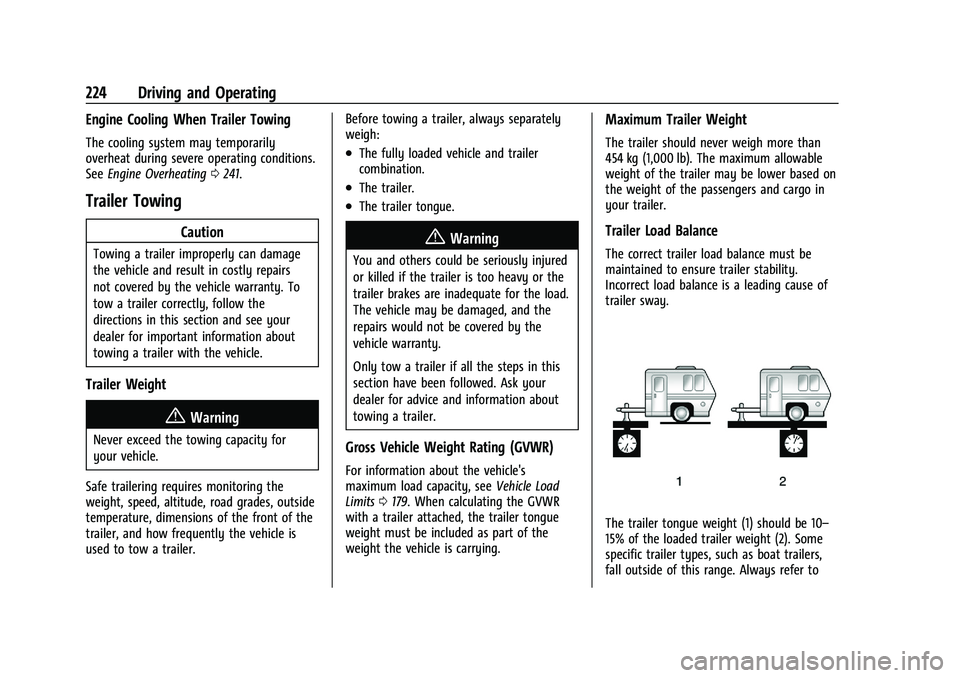
The trailer tongue weight (1) should be 10–
15% of the loaded trailer weight (2). Some
specific trailer types, such as boat trailers,
fall outside of this range. Always refer to
Page 226 of 351
Chevrolet Malibu Owner Manual (GMNA-Localizing-U.S./Canada-
14584249) - 2021 - CRC - 11/9/20
Driving and Operating 225
the trailer owner’s manual for the
recommended trailer tongue weight for each
trailer. Never exceed the maximum loads for
your vehicle, hitch and trailer.
After loading the trailer, separately weigh
the trailer and then the trailer tongue to see
if the weights are appropriate for your
vehicle. If the trailer weight is too high, it
may be possible to transfer some of the
cargo into your vehicle. If the trailer tongue
weight is too high or too low, it may be
possible to rearrange some of the cargo
inside of the trailer.
Do not exceed the maximum allowable
tongue weight for your vehicle. Use the
shortest hitch extension available to position
the hitch ball closer to your vehicle. This will
help reduce the effect of the trailer tongue
weight on the trailer hitch and the rear axle.
If a cargo carrier is used in the trailer hitch
receiver, choose a carrier that positions the
load as close to the vehicle as possible.
Make sure the total weight, including the
carrier, is no more than half of the
maximum allowable tongue weight for the
vehicle or 227 kg (500 lb), whichever is less.
Ask your dealer for trailering information or
assistance.Towing Equipment
Hitches
Always use the correct hitch equipment for
your vehicle. Crosswinds, large trucks going
by, and rough roads can affect the trailer
and the hitch.
Never attach rental hitches or other
bumper-type hitches. Only use
frame-mounted hitches that do not attach to
the bumper.
Always seal any holes in your vehicle if the
trailer hitch removed. If not sealed, dirt,
water, and carbon monoxide (CO) from the
exhaust may enter your vehicle. SeeEngine
Exhaust 0188.
Consider using mechanical sway controls
with any trailer. Ask a trailering professional
about sway controls or refer to the trailer
manufacturer's recommendations and
instructions.
Tires
.Do not tow a trailer while using a
compact spare tire on the vehicle.
.Tires must be properly inflated to support
loads while towing a trailer. See Tires
0 259 for instructions on proper tire
inflation.
Safety Chains
Always attach chains between the vehicle
and the trailer, and attach the chains to the
holes on the trailer hitch platform.
Instructions about safety chains may be
provided by the hitch manufacturer or by
the trailer manufacturer.
Cross the safety chains under the tongue of
the trailer to help prevent the tongue from
contacting the road if it becomes separated
from the hitch. Always leave just enough
slack so the combination can turn. Never
allow safety chains to drag on the ground.
State or local regulations may require
trailers to have their own braking system if
the loaded weight of the trailer exceeds
certain minimums that can vary from state
to state. Read and follow the instructions for
the trailer brakes so they are installed,
adjusted, and maintained properly. Never
attempt to tap into your vehicle's hydraulic
brake system. If you do, both the vehicle
anti-lock brakes and the trailer brakes may
not function, which could result in a crash.
Page 227 of 351
Chevrolet Malibu Owner Manual (GMNA-Localizing-U.S./Canada-
14584249) - 2021 - CRC - 11/9/20
226 Driving and Operating
Trailer Lamps
Always check all trailer lamps are working at
the beginning of each trip, and periodically
on longer trips.
Turn Signals When Towing a Trailer
When properly connected, the trailer turn
signals will illuminate to indicate the vehicle
is turning, changing lanes, or stopping.
When towing a trailer, the arrows on the
instrument cluster will illuminate even if the
trailer is not properly connected or the bulbs
are burned out.
Trailer Tires
Special Trailer (ST) tires differ from vehicle
tires. Trailer tires are designed with stiff
sidewalls to help prevent sway and to
support heavy loads. These features can
make it difficult to determine if the trailer
tire pressures are low only based on a visual
inspection.
Always check all trailer tire pressures before
each trip when the tires are cool. Low trailer
tire pressure is a leading cause of trailer tire
blow-outs.Trailer tires deteriorate over time. The trailer
tire sidewall will show the week and year
the tire was manufactured. Many trailer tire
manufacturers recommend replacing tires
more than six years old.
Overloading is another leading cause of
trailer tire blow-outs. Never load your trailer
with more weight than the tires are
designed to support. The load rating is
located on the trailer tire sidewall.
Always know the maximum speed rating for
the trailer tires before driving. This may be
significantly lower than the vehicle tire
speed rating. The speed rating may be on
the trailer tire sidewall. If the speed rating is
not shown, the default trailer tire speed
rating is 105 km/h (65 mph).
Conversions and Add-Ons
Add-On Electrical Equipment
{Warning
The Data Link Connector (DLC) is used for
vehicle service and Emission Inspection/
Maintenance testing. See
Malfunction
Indicator Lamp (Check Engine Light) 087.
(Continued)
Warning (Continued)
A device connected to the DLC —such as
an aftermarket fleet or driver-behavior
tracking device —may interfere with
vehicle systems. This could affect vehicle
operation and cause a crash. Such devices
may also access information stored in the
vehicle’s systems.
Caution
Some electrical equipment can damage
the vehicle or cause components to not
work and would not be covered by the
vehicle warranty. Always check with your
dealer before adding electrical equipment.
Add-on equipment can drain the vehicle's
12-volt battery, even if the vehicle is not
operating.
The vehicle has an airbag system. Before
attempting to add anything electrical to the
vehicle, see Servicing the Airbag-Equipped
Vehicle 053 and
Adding Equipment to the Airbag-Equipped
Vehicle 053.
Page 294 of 351
Chevrolet Malibu Owner Manual (GMNA-Localizing-U.S./Canada-
14584249) - 2021 - CRC - 11/9/20
Vehicle Care 293
Recreational Vehicle Towing
Recreational vehicle towing means towing
the vehicle behind another vehicle–such as
behind a motor home. The two most
common types of recreational vehicle
towing are known as dinghy towing and
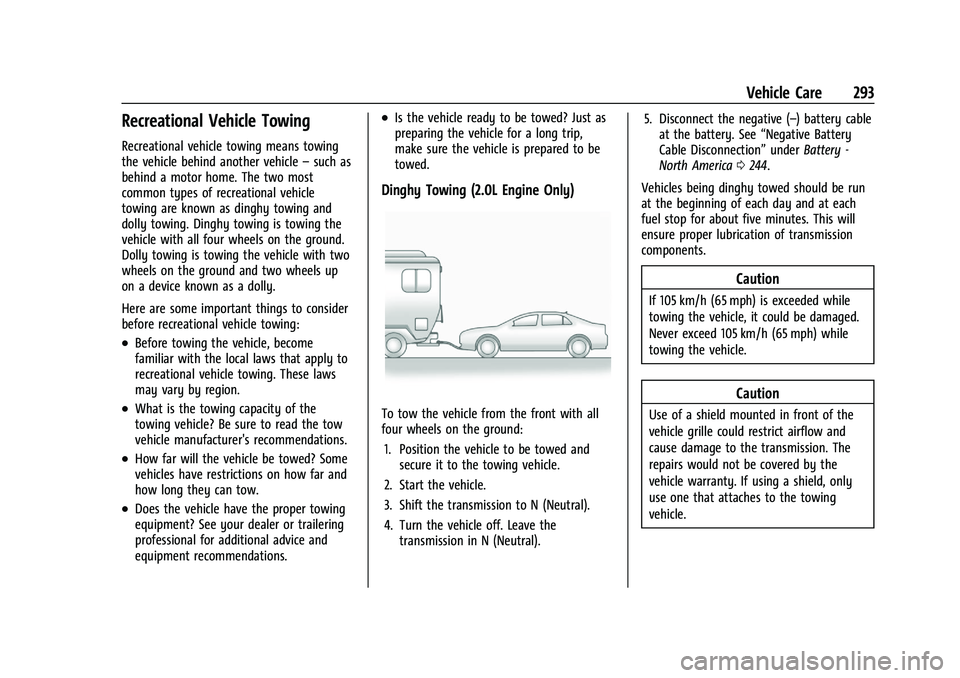
dolly towing. Dinghy towing is towing the
vehicle with all four wheels on the ground.
Dolly towing is towing the vehicle with two
wheels on the ground and two wheels up
on a device known as a dolly.
Here are some important things to consider
before recreational vehicle towing:
.Before towing the vehicle, become
familiar with the local laws that apply to
recreational vehicle towing. These laws
may vary by region.
.What is the towing capacity of the
towing vehicle? Be sure to read the tow
vehicle manufacturer's recommendations.
.How far will the vehicle be towed? Some
vehicles have restrictions on how far and
how long they can tow.
.Does the vehicle have the proper towing
equipment? See your dealer or trailering
professional for additional advice and
equipment recommendations.
.Is the vehicle ready to be towed? Just as
preparing the vehicle for a long trip,
make sure the vehicle is prepared to be
towed.
Dinghy Towing (2.0L Engine Only)
To tow the vehicle from the front with all
four wheels on the ground:
1. Position the vehicle to be towed and secure it to the towing vehicle.
2. Start the vehicle.
3. Shift the transmission to N (Neutral).
4. Turn the vehicle off. Leave the transmission in N (Neutral). 5. Disconnect the negative (–) battery cable
at the battery. See “Negative Battery
Cable Disconnection” underBattery -
North America 0244.
Vehicles being dinghy towed should be run
at the beginning of each day and at each
fuel stop for about five minutes. This will
ensure proper lubrication of transmission
components.
Caution
If 105 km/h (65 mph) is exceeded while
towing the vehicle, it could be damaged.
Never exceed 105 km/h (65 mph) while
towing the vehicle.
Caution
Use of a shield mounted in front of the
vehicle grille could restrict airflow and
cause damage to the transmission. The
repairs would not be covered by the
vehicle warranty. If using a shield, only
use one that attaches to the towing
vehicle.
Page 305 of 351
Chevrolet Malibu Owner Manual (GMNA-Localizing-U.S./Canada-
14584249) - 2021 - CRC - 11/9/20
304 Service and Maintenance
Because of the way people use vehicles,
maintenance needs vary. There may need to
be more frequent checks and services. The
Additional Required Services - Normal are for
vehicles that:
.Carry passengers and cargo within
recommended limits on the Tire and
Loading Information label. SeeVehicle
Load Limits 0179.
.Are driven on reasonable road surfaces
within legal driving limits.
.Use the recommended fuel. See
Recommended Fuel (1.5L Engine) 0218 or
Recommended Fuel (2.0L Engine) 0218.
Refer to the information in the Maintenance
Schedule Additional Required Services -
Normal chart.
The Additional Required Services - Severe are
for vehicles that are:
.Mainly driven in heavy city traffic in hot
weather.
.Mainly driven in hilly or mountainous
terrain.
.Frequently towing a trailer.
.Used for high speed or competitive
driving.
.Used for taxi, police, or delivery service. Refer to the information in the Maintenance
Schedule Additional Required Services -
Severe chart.
{Warning
Performing maintenance work can be
dangerous and can cause serious injury.
Perform maintenance work only if the
required information, proper tools, and
equipment are available. If they are not,
see your dealer to have a trained
technician do the work. See
Doing Your
Own Service Work 0229.
Maintenance Schedule
Owner Checks and Services
Check the engine oil level. See Engine Oil
0 234.
Once a Month
.Check the tire inflation pressures. See Tire
Pressure 0266.
.Inspect the tires for wear. See Tire
Inspection 0272.
.Check the windshield washer fluid level.
See Washer Fluid 0242.
Engine Oil Change
When the CHANGE ENGINE OIL SOON
message displays, have the engine oil and
filter changed within the next 1 000 km
(600 mi). If driven under the best conditions,
the engine oil life system may not indicate
the need for vehicle service for up to a year.
The engine oil and filter must be changed at
least once a year and the oil life system
must be reset. Your trained dealer technician
can perform this work. If the engine oil life
system is reset accidentally, service the
vehicle within 5 000 km (3,000 mi) since the
last service. Reset the oil life system when
the oil is changed. See Engine Oil Life
System 0236.
Engine Air Filter Change
When the REPLACE AT NEXT OIL CHANGE
message displays, the engine air filter
should be replaced at the next engine oil
change. When the REPLACE ENGINE AIR
FILTER SOON message displays, the engine
air filter should be replaced at the earliest
convenience. Reset the engine air filter life
system after the engine air filter is replaced.
See Engine Air Filter Life System 0237.
Page 349 of 351
Chevrolet Malibu Owner Manual (GMNA-Localizing-U.S./Canada-
14584249) - 2021 - CRC - 11/9/20
348 Index
System (cont'd)Forward Collision Alert (FCA) . . . . . . . . . . . 209
Global Positioning . . . . . . . . . . . . . . . . . . . . . 135
Infotainment . . . . . . . . . . . . . . . . . . . . . . . . . . . 330
OnStar . . . . . . . . . . . . . . . . . . . . . . . . . . . . . . . . . 134
Systems Driver Assistance . . . . . . . . . . . . . . . . . . . . . . 204
T
Tachometer . . . . . . . . . . . . . . . . . . . . . . . . . . . . . . . 83
TaillampsBulb Replacement . . . . . . . . . . . . . . . . . . 250, 251
Teen Driver . . . . . . . . . . . . . . . . . . . . . . . . . . . . . . . 153
Text Telephone (TTY) Users . . . . . . . . . . . . . . 322
Theft-Deterrent Systems . . . . . . . . . . . . . . . . . . 20 Immobilizer . . . . . . . . . . . . . . . . . . . . . . . . . . . . . 20
Time . . . . . . . . . . . . . . . . . . . . . . . . . . . . . . . . . . . . . . 76
Tires . . . . . . . . . . . . . . . . . . . . . . . . . . . . . . . . . . . . . 259
All-Season . . . . . . . . . . . . . . . . . . . . . . . . . . . . . 260
Buying New Tires . . . . . . . . . . . . . . . . . . . . . . 274
Chains . . . . . . . . . . . . . . . . . . . . . . . . . . . . . . . . . 277
Changing . . . . . . . . . . . . . . . . . . . . . . . . . . . . . . 285
Compact Spare . . . . . . . . . . . . . . . . . . . . . . . . 289
Designations . . . . . . . . . . . . . . . . . . . . . . . . . . . 263
Different Size . . . . . . . . . . . . . . . . . . . . . . . . . . 275
If a Tire Goes Flat . . . . . . . . . . . . . . . . . . . . . 278
Inspection . . . . . . . . . . . . . . . . . . . . . . . . . . . . . 272
Low Profile . . . . . . . . . . . . . . . . . . . . . . . . . . . . 261 Tires (cont'd)
Pressure . . . . . . . . . . . . . . . . . . . . . . . . . . 266, 267
Pressure Light . . . . . . . . . . . . . . . . . . . . . . . . . . 92
Pressure Monitor Operation . . . . . . . . . . . 269
Pressure Monitor System . . . . . . . . . . . . . . 268
Rotation . . . . . . . . . . . . . . . . . . . . . . . . . . . . . . . 272
Sealant and Compressor Kit . . . . . . . . . . . . 279
Sealant and Compressor Kit,
Storing . . . . . . . . . . . . . . . . . . . . . . . . . . . . . . . 284
Sidewall Labeling . . . . . . . . . . . . . . . . . . . . . . 261
Terminology and Definitions . . . . . . . . . . . 263
Uniform Tire Quality Grading . . . . . . . . . . 275
Wheel Alignment and Tire Balance . . . . 276
Wheel Replacement . . . . . . . . . . . . . . . . . . . . 276
When It Is Time for New Tires . . . . . . . . . 273
Winter . . . . . . . . . . . . . . . . . . . . . . . . . . . . . . . . . 260
Top Tier Fuel . . . . . . . . . . . . . . . . . . . . . . . . . . . . . 217
Towing Driving Characteristics . . . . . . . . . . . . . . . . . 221
Equipment . . . . . . . . . . . . . . . . . . . . . . . . . . . . . 225
General Information . . . . . . . . . . . . . . . . . . . 220
Recreational Vehicle . . . . . . . . . . . . . . . . . . . 293
Trailer . . . . . . . . . . . . . . . . . . . . . . . . . . . . . . . . . 224
Vehicle . . . . . . . . . . . . . . . . . . . . . . . . . . . . . . . . 292
Traction Control System (TCS)/StabiliTrak
Light . . . . . . . . . . . . . . . . . . . . . . . . . . . . . . . . . . 91
Off Light . . . . . . . . . . . . . . . . . . . . . . . . . . . . . . . . 90 Traction Control/Electronic Stability
Control . . . . . . . . . . . . . . . . . . . . . . . . . . . . . . . . . 193
Trademarks and License Agreements . . . . . 156
Trailer Towing . . . . . . . . . . . . . . . . . . . . . . . . . . . . . . . . 224
Transmission Automatic . . . . . . . . . . . . . . . . . . . . . . . . . . . . . 188
Fluid, Automatic . . . . . . . . . . . . . . . . . . . . . . . 236
Transportation Program, Courtesy . . . . . . . 325
Trip Odometer . . . . . . . . . . . . . . . . . . . . . . . . . . . . 82
Trunk . . . . . . . . . . . . . . . . . . . . . . . . . . . . . . . . . . . . . .18
Turn and Lane-Change Signals . . . . . . . . . . . 107
Turn Signal Bulb Replacement . . . . . . . . . . . . . . . . . . 250, 251
U
Umbrella Storage . . . . . . . . . . . . . . . . . . . . . . . . . .73
Uniform Tire Quality Grading . . . . . . . . . . . . 275
UpdatesMap Data . . . . . . . . . . . . . . . . . . . . . . . . . . . . . . 136
Software . . . . . . . . . . . . . . . . . . . . . . . . . . . . . . . . 116
USB Port . . . . . . . . . . . . . . . . . . . . . . . . . . . . . . . . . 120
Using the Navigation System . . . . . . . . . . . . .124
Using the System . . . . . . . . . . . . . . . . . . . . . . . . . 113
Using This Manual . . . . . . . . . . . . . . . . . . . . . . . . . .2
V
Vehicle Alarm System . . . . . . . . . . . . . . . . . . . . . . . . . . 19