Engine CHEVROLET MALIBU MAXX 2007 6.G Repair Manual
[x] Cancel search | Manufacturer: CHEVROLET, Model Year: 2007, Model line: MALIBU MAXX, Model: CHEVROLET MALIBU MAXX 2007 6.GPages: 510, PDF Size: 2.8 MB
Page 323 of 510
{CAUTION:
If you let your vehicle’s tires spin at
high speed, they can explode, and you
or others could be injured. And, the
transaxle or other parts of the vehicle
can overheat. That could cause an
engine compartment re or other damage.
When you are stuck, spin the wheels
as little as possible. Do not spin the
wheels above 35 mph (55 km/h) as
shown on the speedometer.
Notice:Spinning the wheels can destroy
parts of your vehicle as well as the tires.
If you spin the wheels too fast while shifting
the transaxle back and forth, you can destroy
the transaxle. SeeRocking Your Vehicle to
Get It Out on page 323.
For information about using tire chains on your
vehicle, seeTire Chains on page 416.
Rocking Your Vehicle to Get It Out
First, turn the steering wheel left and right.
That will clear the area around the front wheels.
If your vehicle has a traction system, you
should turn the traction system off. SeeTraction
Control System (TCS) on page 295orEnhanced
Traction System (ETS) on page 297. Then
shift back and forth between REVERSE (R) and
a forward gear, spinning the wheels as little
as possible. Release the accelerator pedal while
you shift, and press lightly on the accelerator pedal
when the transaxle is in gear. By slowly spinning
the wheels in the forward and reverse directions,
you will cause a rocking motion that may free
your vehicle. If that does not get your vehicle
out after a few tries, it may need to be towed out.
If your vehicle does need to be towed out, see
Towing Your Vehicle on page 330.
323
Page 333 of 510
Towing a Trailer
{CAUTION:
If you do not use the correct equipment
and drive properly, you can lose control
when you pull a trailer. For example, if the
trailer is too heavy, the brakes may not
work well — or even at all. You and your
passengers could be seriously injured.
You may also damage your vehicle; the
resulting repairs would not be covered by
your warranty. Pull a trailer only if you
have followed all the steps in this section.
Ask your dealer/retailer for advice and
information about towing a trailer with
your vehicle.
If you have a Malibu Sedan SS or a Maxx SS,
trailer towing is not recommended. Your vehicle
was neither designed nor intended to tow a trailer.Your vehicle can tow a trailer if it is equipped with
a 3.5L V6 engine and the proper trailer towing
equipment.
To identify the trailering capacity of your vehicle,
you should read the information in “Weight of
the Trailer” that appears later in this section.
Trailering is different than just driving your vehicle
by itself. Trailering means changes in handling,
durability and fuel economy. Successful, safe
trailering takes correct equipment, and it has to
be used properly.
That’s the reason for this part. In it are many
time-tested, important trailering tips and safety
rules. Many of these are important for your safety
and that of your passengers. So please read
this section carefully before you pull a trailer.
Load-pulling components such as the engine,
transmission, wheel assemblies and tires
are forced to work harder against the drag of the
added weight. The engine is required to operate
at relatively higher speeds and under greater
loads, generating extra heat. What’s more,
the trailer adds considerably to wind resistance,
increasing the pulling requirements.
333
Page 334 of 510
If You Do Decide To Pull A Trailer
If you do, here are some important points:
There are many different laws, including speed
limit restrictions, having to do with trailering.
Make sure your rig will be legal, not only
where you live but also where you’ll be driving.
A good source for this information can be
state or provincial police.
Consider using a sway control. You can ask
a hitch dealer/retailer about sway controls.
Don’t tow a trailer at all during the rst
1,000 miles (1 600 km) your new vehicle
is driven. Your engine, axle or other parts
could be damaged.
Then, during the rst 500 miles (800 km) that
you tow a trailer, don’t drive over 50 mph
(80 km/h) and don’t make starts at full throttle.
This helps your engine and other parts of
your vehicle wear in at the heavier loads.
Obey speed limit restrictions when towing a
trailer. Don’t drive faster than the maximum
posted speed for trailers, or no more than
55 mph (90 km/h), to save wear on your
vehicle’s parts.Three important considerations have to do
with weight:
the weight of the trailer,
the weight of the trailer tongue
and the total weight on your vehicle’s tires.
Weight of the Trailer
How heavy can a trailer safely be?
It should never weigh more than 1,000 lbs (450 kg).
But even that can be too heavy.
It depends on how you plan to use your rig.
For example, speed, altitude, road grades, outside
temperature and how much your vehicle is used
to pull a trailer are all important. It can also depend
on any special equipment that you have on your
vehicle, and the amount of tongue weight the
vehicle can carry. See “Weight of the Trailer
Tongue” later in this section for more information.
Maximum trailer weight is calculated assuming
only the driver is in the tow vehicle and it has
all the required trailering equipment. The weight of
additional optional equipment, passengers and
cargo in the tow vehicle must be subtracted from
the maximum trailer weight.
334
Page 335 of 510
When towing a trailer on long uphill grades while
the outside temperature is above 85°F (29°C),
reduce your vehicle speed to 45 mph (72 km/h)
to avoid overheating the engine cooling system.
You can ask your dealer/retailer for our trailering
information or advice, or you can write us at
our Customer Assistance Offices. SeeCustomer
Assistance Offices on page 479for more
information.
Weight of the Trailer Tongue
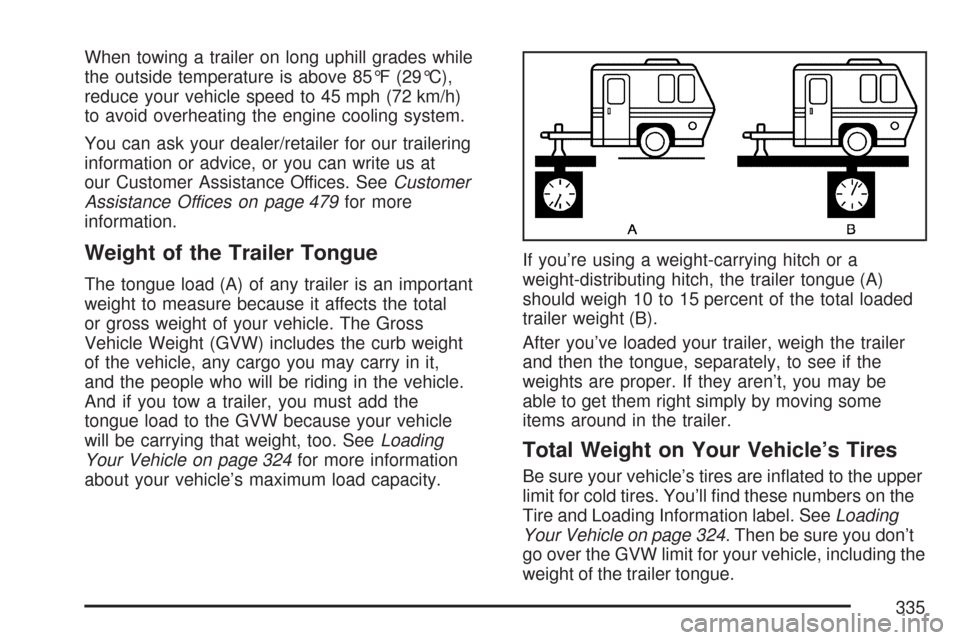
The tongue load (A) of any trailer is an important
weight to measure because it affects the total
or gross weight of your vehicle. The Gross
Vehicle Weight (GVW) includes the curb weight
of the vehicle, any cargo you may carry in it,
and the people who will be riding in the vehicle.
And if you tow a trailer, you must add the
tongue load to the GVW because your vehicle
will be carrying that weight, too. SeeLoading
Your Vehicle on page 324for more information
about your vehicle’s maximum load capacity.If you’re using a weight-carrying hitch or a
weight-distributing hitch, the trailer tongue (A)
should weigh 10 to 15 percent of the total loaded
trailer weight (B).
After you’ve loaded your trailer, weigh the trailer
and then the tongue, separately, to see if the
weights are proper. If they aren’t, you may be
able to get them right simply by moving some
items around in the trailer.
Total Weight on Your Vehicle’s Tires
Be sure your vehicle’s tires are inated to the upper
limit for cold tires. You’ll nd these numbers on the
Tire and Loading Information label. SeeLoading
Your Vehicle on page 324. Then be sure you don’t
go over the GVW limit for your vehicle, including the
weight of the trailer tongue.
335
Page 336 of 510
Hitches
It’s important to have the correct hitch equipment.
Crosswinds, large trucks going by and rough
roads are a few reasons why you’ll need the
right hitch. Here are some rules to follow:
The rear bumper on your vehicle is not
intended for hitches. Do not attach rental
hitches or other bumper-type hitches to it.
Use only a frame-mounted hitch that does
not attach to the bumper.
Will you have to make any holes in the body
of your vehicle when you install a trailer
hitch? If you do, then be sure to seal the
holes later when you remove the hitch.
If you don’t seal them, deadly carbon
monoxide (CO) from your exhaust can get
into your vehicle. SeeEngine Exhaust
on page 136. Dirt and water can, too.
Safety Chains
You should always attach chains between
your vehicle and your trailer. Cross the safety
chains under the tongue of the trailer so that
the tongue will not drop to the road if it becomes
separated from the hitch. Instructions about
safety chains may be provided by the hitch
manufacturer or by the trailer manufacturer.
Follow the manufacturer’s recommendation for
attaching safety chains and do not attach them
to the bumper. Always leave just enough slack
so you can turn with your rig. And, never
allow safety chains to drag on the ground.
Trailer Brakes
Does your trailer have its own brakes?
Be sure to read and follow the instructions for
the trailer brakes so you’ll be able to install, adjust
and maintain them properly. And because you
may have anti-lock brakes, do not try to tap into
your vehicle’s hydraulic brake system. If you
do, both systems won’t work well, or at all.
336
Page 338 of 510
Making Turns
Notice:Making very sharp turns while
trailering could cause the trailer to come in
contact with the vehicle. Your vehicle could
be damaged. Avoid making very sharp
turns while trailering.
When you’re turning with a trailer, make wider
turns than normal. Do this so your trailer
won’t strike soft shoulders, curbs, road signs,
trees or other objects. Avoid jerky or sudden
maneuvers. Signal well in advance.
Turn Signals When Towing a Trailer
When you tow a trailer, your vehicle may
need additional wiring. Check with your
dealer/retailer. The arrows on your instrument
panel will ash whenever you signal a turn or
lane change. Properly hooked up, the trailer
lamps will also ash, telling other drivers you’re
about to turn, change lanes or stop.When towing a trailer, the arrows on your
instrument panel will ash for turns even if the
bulbs on the trailer are burned out. Thus, you
may think drivers behind you are seeing
your signal when they are not. It’s important to
check occasionally to be sure the trailer bulbs
are still working.
Driving On Grades
When towing a trailer on long uphill grades while
the outside temperature is above 85°F (29°C),
reduce your vehicle speed to 45 mph (72 km/h)
to avoid overheating the engine cooling system.
Reduce speed and shift to a lower gearbefore
you start down a long or steep downgrade.
If you don’t shift down, you might have to use
your brakes so much that they would get hot
and no longer work well.
Pay attention to the engine coolant gage.
If the indicator is in the red area, turn off the
air conditioning to reduce engine load. See
Engine Overheating on page 371.
338
Page 340 of 510
When You Are Ready to Leave After
Parking on a Hill
1. Apply your regular brakes and hold the
pedal down while you:
start your engine,
shift into a gear, and
release the parking brake.
2. Let up on the brake pedal.
3. Drive slowly until the trailer is clear
of the chocks.
4. Stop and have someone pick up and
store the chocks.
Maintenance When Trailer Towing
Your vehicle will need service more often when
you’re pulling a trailer. Things that are especially
important in trailer operation are automatic
transmission uid (don’t overll), engine oil,
drive belt, cooling system and brake system.
Each of these is covered in this manual, and
the Index will help you nd them quickly.
If you’re trailering, it’s a good idea to review
this information before you start your trip.
Check periodically to see that all hitch nuts
and bolts are tight.
Engine Cooling When Trailer Towing
Your cooling system may temporarily overheat
during severe operating conditions. See
Engine Overheating on page 371.
340
Page 341 of 510
Service........................................................ 344
Accessories and Modications................... 344
California Proposition 65 Warning.............. 345
Doing Your Own Service Work.................. 345
Adding Equipment to the Outside of
Your Vehicle.......................................... 346
Fuel............................................................. 346
Gasoline Octane........................................ 346
Gasoline Specications.............................. 347
California Fuel........................................... 347
Additives................................................... 347
Fuels in Foreign Countries........................ 348
Filling the Tank......................................... 349
Filling a Portable Fuel Container............... 351
Checking Things Under the Hood.............. 352
Hood Release........................................... 352
Engine Compartment Overview.................. 354
Engine Oil................................................. 359
Engine Oil Life System.............................. 362
Engine Air Cleaner/Filter............................ 364
Automatic Transaxle Fluid
(2.2L L4 and 3.5L V6 Engines).............. 365Automatic Transaxle Fluid
(3.9L V6 Engine).................................... 366
Engine Coolant.......................................... 368
Coolant Surge Tank Pressure Cap............ 371
Engine Overheating................................... 371
Overheated Engine Protection Operating
Mode (3.5L V6 and 3.9L V6 Engines).... 373
Cooling System......................................... 374
Power Steering Fluid................................. 379
Windshield Washer Fluid........................... 380
Brakes...................................................... 381
Battery...................................................... 384
Jump Starting............................................ 385
Bulb Replacement....................................... 389
Halogen Bulbs........................................... 389
Headlamps, Front Turn Signal, and
Parking Lamps....................................... 390
Taillamps, Turn Signal, Stoplamps
and Back-up Lamps............................... 392
License Plate Lamp................................... 393
Replacement Bulbs................................... 394
Windshield Wiper Blade Replacement....... 394
Section 5 Service and Appearance Care
341
Page 343 of 510
Vehicle Identication.................................. 444
Vehicle Identication Number (VIN)........... 444
Service Parts Identication Label............... 444
Electrical System........................................ 445
Add-On Electrical Equipment..................... 445
Headlamp Wiring....................................... 445
Windshield Wiper Fuses............................ 445Power Windows and Other Power
Options.................................................. 446
Fuses........................................................ 446
Instrument Panel Fuse Block..................... 447
Engine Compartment Fuse Block............... 449
Rear Compartment Fuse Block.................. 451
Capacities and Specications.................... 454
Section 5 Service and Appearance Care
343
Page 345 of 510
California Proposition 65 Warning
Most motor vehicles, including this one, contain
and/or emit chemicals known to the State of
California to cause cancer and birth defects or
other reproductive harm. Engine exhaust,
many parts and systems (including some inside
the vehicle), many uids, and some component
wear by-products contain and/or emit these
chemicals.
Doing Your Own Service Work
{CAUTION:
You can be injured and your vehicle could
be damaged if you try to do service work
on a vehicle without knowing enough
about it.
Be sure you have sufficient knowledge,
experience, the proper replacement
parts, and tools before you attempt any
vehicle maintenance task.
Be sure to use the proper nuts, bolts,
and other fasteners. English and metric
fasteners can be easily confused. If you
use the wrong fasteners, parts can later
break or fall off. You could be hurt.
If you want to do some of your own service work,
you should use the proper service manual.
It tells you much more about how to service your
vehicle than this manual can. To order the
proper service manual, seeService Publications
Ordering Information on page 492.
345