ESP CHEVROLET MONTE CARLO 1973 2.G Owners Manual
[x] Cancel search | Manufacturer: CHEVROLET, Model Year: 1973, Model line: MONTE CARLO, Model: CHEVROLET MONTE CARLO 1973 2.GPages: 86, PDF Size: 33.46 MB
Page 4 of 86
Downloaded from www.Manualslib.com manuals search engine YOUR CAR'S FIRST
FEW HUNDRED MILES OF DRIVING
You can operate your new car
from its very first mile without ad
hering to a formal
"break-in" sched
ule. However, during the first
few
hundred miles of driving you can,
by observing a
few simple precau
tions, add to the future performance
and economy of your car.
It is recommended that your
speed during the first 500 miles
be confined to a maximum of
60
M.P.H., but do not drive for ex
tended periods at
anyone constant
speed, either fast
or slow. Dur
ing this period, avoid full throttle
starts and, if possible, avoid hard
stops especially during the first
200
miles of operation since brake mis-
2
use during this period will destroy
much future brake efficiency.
Always drive at moderate speed
until the engine has completely
warmed up.
If you plan to use your new car
for trailer hauling see additional
information on page 11.
Page 7 of 86
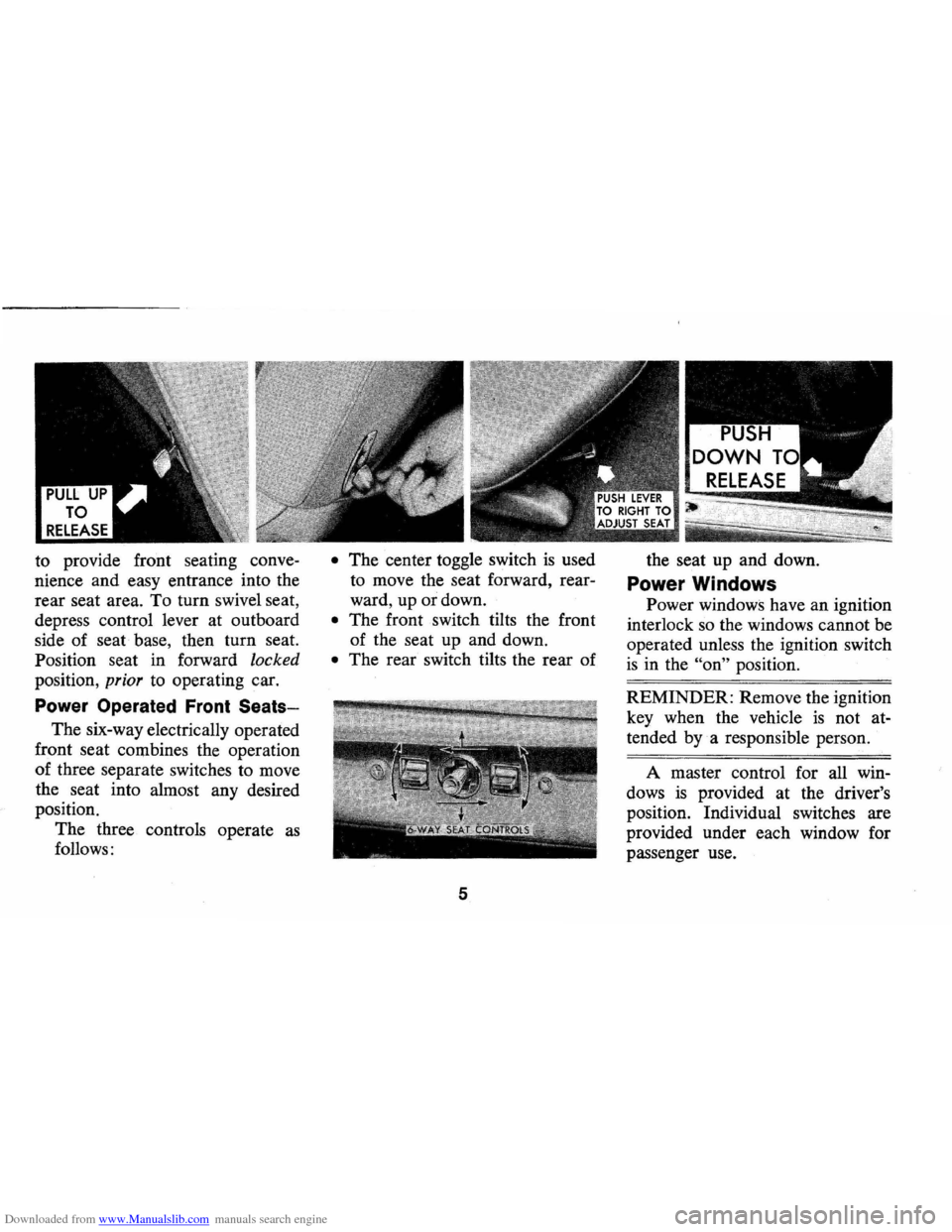
Downloaded from www.Manualslib.com manuals search engine to provide front seating conve
nience and easy entrance into the
rear seat area. To turn swivel seat,
depress control lever at outboard
side of seat base, then turn seat.
Position seat in forward
locked
position, prior to operating car.
Power Operated Front Seats-
The six-way electrically operated
front seat combines the operation
of three separate switches to move
the seat into almost any desired
position.
The three controls operate
as
follows:
• The center toggle switch is used
to move the seat forward, rear
ward, up or down.
• The front switch tilts the front
of the seat up and down.
• The rear switch tilts the rear of
5
the seat up and down.
Power Windows
Power windows have an ignition
interlock so the windows cannot be
operated unless the ignition switch
is in the "on" position.
REMINDER: Remove the ignition
key when the vehicle
is not at
tended
bya responsible person.
A master control for all win
dows
is provided at the driver's
position. Individual switches are
provided under each window for
passenger use.
Page 15 of 86
Downloaded from www.Manualslib.com manuals search engine •
Operation in Foreign Countries
Your Monte Carlo is designed
to operate on fuel of approximately
91 research octane number or
higher, sold in the United States
and Canada.
If you plan to operate your
Monte Carlo outside the continen
tal limits of the United States
or
Canada, there is a possibility that
the best fuels available in some
countries are so low in anti-knock
quality that excessive knocking and
serious engine damage may result
from their use. To minimize this
possibility, write to Chevrolet Divi-sion,
Service Department, Detroit,
Michigan 48202,
(or in Canada
write to General Motors of Can
ada Limited,
Owner Relations De
partment, Oshawa, Ontario),
giving:
• The vehicle identification num
ber ( on plate
on instrument
panel ahead of the steering
wheel and visible through the
windshield, or from registration
slip
or title).
• The country or countries in
which you plan to traveL
You will be furnished informa-
13
tion on the quality of fuels avail
able in the countries in which you
plan to traveL
It is recommended
that you not operate your Monte
Carlo in any country not having
fuels meeting the requirements of
your Chevrolet engine. Engine
modifications are not available to
compensate for low anti-knock
quality fuels. Operation of your car
under conditions of continuous
or
excessive knocking constitutes mis
use of the engine for which the
Chevrolet Division
is not responsi
ble under the terms of the Chev
rolet New Vehicle Warranty.
Page 18 of 86
Downloaded from www.Manualslib.com manuals search engine 2. Place transmission selector
in uP" or uN" (UP" preferred).
A starter safety switch prevents
starter operation while the trans
mission selector
is in any drive
position.
(If it is necessary to
re-start the engine with the car
moving, place the selector lever
in
"N".)
3. Depress accelerator pedal and
activate starter
as outlined be
low for different conditions.
• Cold Engine -Fully de
press
accelerator pedal and
slowly release.
With foot off
the pedal, crank the engine
by turning the ignition key
to the Start position-release
when engine starts.
If engine starts, but fails to
run, repeat this procedure.
When engine is running
smoothly (approximately 30
seconds), the idle speed may
be reduced by slightly de- pressing
the accelerator pedal
and then slowly releasing.
• Warm Engine -Depress ac
celerator
pedal about halfway
and hold while cranking the
engine.
• Extremely Cold Weather
(Below 0° F.) Or After Car
Has Been Standing
Idle
Several
Oays-
Fully depress and release
accelerator pedal two or three
times before cranking the
engine.
With foot off the ac
celerator pedal,
crank the
engine by turning the key to
the Start position and release
when engine starts.
Manual Transmission Models
1. Apply parking brake and shift
16
transmission to neutral.
2.
Hold clutch pedal to floor
throughout the starting proce
dure.
A starter interlock pre
vents starter operation when
clutch
is not fully depressed.
(Select the proper gear position
before releasing the clutch pedal.)
3. Operate accelerator pedal and
starter
as outlined in step 3
(under Automatic Transmission
Models).
Engine Flooded
Depress accelerator pedal aJ;ld
hold to floor while starting until
engine
is cleared of excess fuel
and
is running smoothly. Never
"pump" the accelerator pedal.
Warm-Up
Always let the engine idle for
20 to 30 seconds after starting
and drive at moderate speeds for
several miles, especially during
cold weather.
Page 24 of 86
Downloaded from www.Manualslib.com manuals search engine your foot from the accelerator.
If control button is not fully de
pressed, when changing speed
setting,
. the car will resume your
previously selected speed.
To disengage system, lightly de
press brake pedal or fully de
press the control button.
Horn
The hom on your Monte Carlo
is actuated · by firmly pressing on
the pad in the center of the steering
wheel. As a good motorist, use of the
horn should be kept at a minimum.
However, acquaint yourself
as soon
as possible with this function of
your car, should it ever become
necessary to give a warning to a
pedestrian
or another motorist.
Holding Car on an Upgrade
When stopped on an upgrade,
maintain your position by apply
ing the brakes. Never hold the
car in place by accelerating en-gine
with transmission in gear.
This could cause damage by over
heating the transmission (auto
matic)
or clutch (manual).
Parking Your Car
Always engage the parking
brake and place the automatic
transmission selector lever in
"Park" position when leaving your
car unattended. Also with auto
matic transmissions, never park
for prolonged periods with engine
idling and transmission in gear,
especially if your car
is equipped
with air conditioning. This prac
tice
is detrimental to the trans
mission, due to overheating.
NOTE: For operation of hazard flasher, see page 41, in Section "In Case of Emergency."
22
Page 30 of 86
Downloaded from www.Manualslib.com manuals search engine • Stopping distances may be
greater.
• Greater pedal effort may be
required .
• Pedal travel may be greater.
3.
Tryout braking operation by
starting and stopping on road
shoulder -then:
• If you judge such operation
to be safe , proceed cautious
ly
at a s afe speed to nearest
dealer for repair.
• Or have car towed to dealer
for repair.
Continued operation of the car
in this condition
is dangerous.
Headlight Beam Indicator
Light
The headlights of your car have
high and low beams to provide
ybu
with proper night-time visibility
for most driving conditons . The
"low" beams are used during most
city driving. The "high" beams are especially
useful when driving
on
dark roads since they provide ex
cellent long range illumination.
The headlight beam indicator will
be on whenever the high beams
or
"brights" are in use. The Headlight
Beam Switch controls the headlight
beams (see
Page 24).
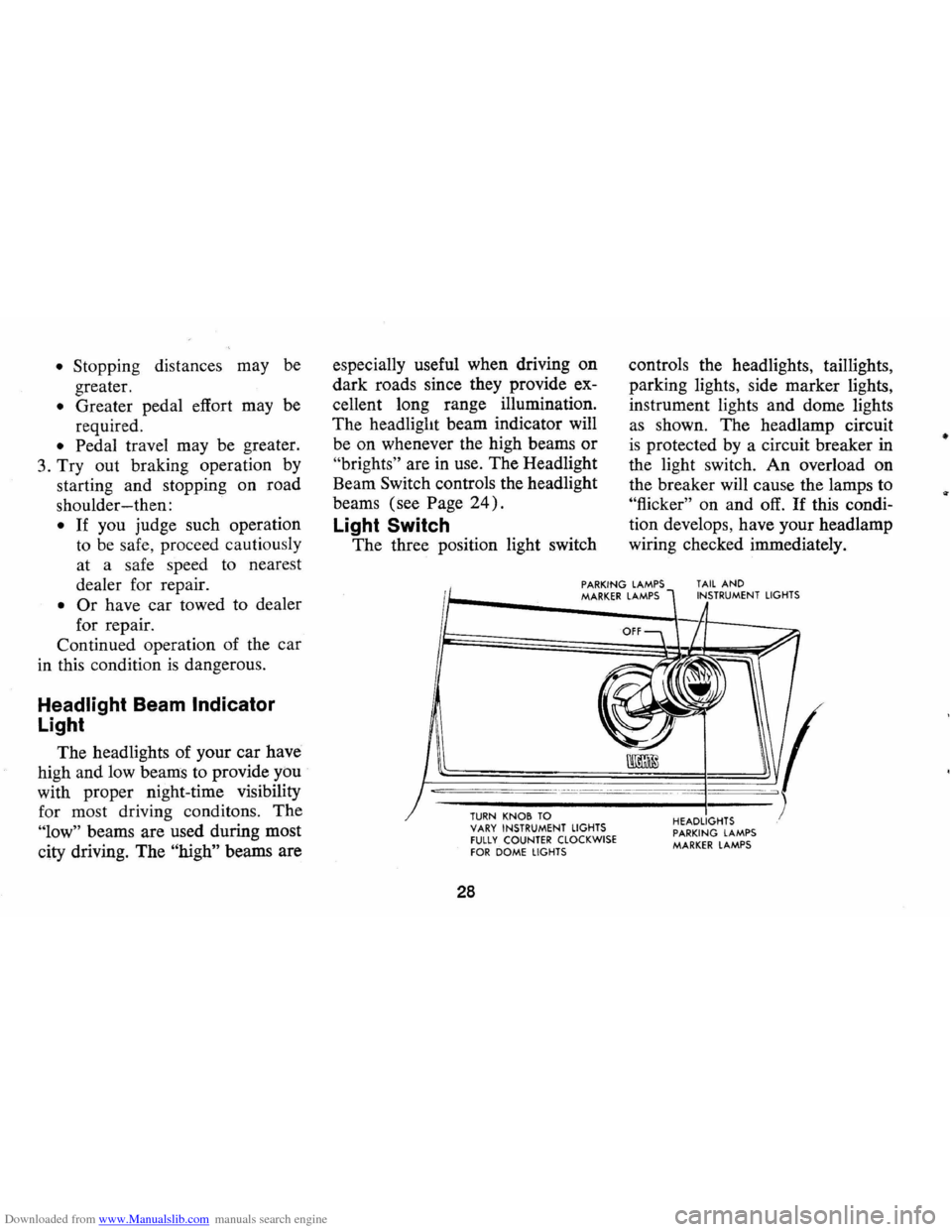
Light Switch
The three position light switch controls
the headlights, taillights,
parking lights, side marker lights,
instrument lights and dome lights
as shown. The headlamp circuit
is protected by a circuit breaker in
the light switch. An overload on
the breaker will cause the lamps to
"flicker" on and off. If this condi
tion develops, have your headlamp
wiring checked immediately.
PARKING LAMPS MARKER LAMPS TAIL AND INSTRUMENT LIGHTS
--,---.---~------ -- --------
TURN KNOB TO VARY INSTRUMENT LIGHTS fULLY COUNTER CLOCKWISE fOR DOME LIGHTS
28
HEADLIGHTS PARKING LAMPS MARKER LAMPS
•
Page 52 of 86
Downloaded from www.Manualslib.com manuals search engine SERVICE AND MAINTENANCE
The time or mileage intervals
on the following
pages are in
tended as a guide for establishing
regular maintenance and lubrica
tion periods for your car. Sus
tained heavy duty or high speed
operations
or operation under
adverse conditions may necessi
tate more frequent servicing.
To
determine specific recommenda
tions for conditions under which
Fuel
Requirements
Your Monte Carlo is designed
to operate
on a good quality fuel
of approximately
91 Research Oc
tane Number or higher , commonly
sold in the United States and
Canada.
Use of a fuel which is too
low in anti-knock quality will re- you
use your car, consult your
Authorized Chevrolet Dealer.
Maintenance Schedule
For owner convenience, a sepa
rate maintenance folder has been
provided with your car which con
tains a complete schedule and
brief explanation of the safety,
suIt in
"spark knock", a metallic
rapping noise generated during the
combustion process. It should be
noted that Research Octane Num
ber does not completely describe
fuel octane quality. Therefore , if
you hear knock in your engine you
may wish to try a different gaso
line.
If knocking persists consult
your authorized Chevrolet dealer.
In any case, continuous
or exces-
50
emission control, lubrication and
general maintenance it requires.
The maintenance folder informa
tion
is supplemented by this sec
tion of the Owner 's Manual,
as
well as the separate emission con
trol systems folder also furnished
with your car. Read all three pub
lications for a full understanding
of vehicle maintenance require
ments.
sive knocking may result in engine
damage and constitutes misuse of
the engine for which Chevrolet
Motor Division
is not responsible
under the terms of the New Ve
hicle Warranty.
General Motors recommends the
use of unleaded or low-lead
(0 to
0.5 grams per gallon) gasolines
to minimize emissions of hydro
carbons and particulates.
If un-
Page 61 of 86
Downloaded from www.Manualslib.com manuals search engine 3. If radiator is not equipped
with a drain valve start to
drain system
as follows:
a. With engine stopped , insert
one end of a 5-foot length
of
% inch tubing into the
filler neck until it touches
the bottom of the radiator.
b. Insert any type of large
syringe into the open end
of the tubing and initiate
the siphoning process by
squeezing and releasing the
ball.
c. Completely drain radiator
coolant through the siphon
tube. (To speed this
oper
ation, the drain plugs in
block can also be removed.)
d. Remove tubing (install
block drain plugs,
if re
moved) and add sufficient
water to
fill system.
4. Close drain valve (install
block drain plugs,
if removed)
if so equipped and add
suffi
cient water to fill system.
5 . Run engine, drain and refill
the system,
as described in
steps
1, 2, 3, and 4, a suffi
cient number of times until
the drained liquid
is nearly
colorless.
6. Allow system to drain com
pletely and then close radia
tor drain valve tightly if so
equipped (Install block drain
plugs,
if removed.)
7. Remove recovery cap leaving
hoses in place. Remove
cool
ant recovery tank and empty
of fluid. Plush tank with clean
water, drain and reinstall.
8. Add sufficient ethylene glycol
coolant, meeting GM
specifi
cation 1899-M, to provide the
required freezing and corro-
59
sion protection-at least a 44
percent solution
(_200P). Pill
radiator to the base of the
radiator filler neck and add
sufficient coolant to the
re
covery tank to raise level to
the
"PULL HOT" mark. Re
install recovery tank cap.
9. Run engine, with radiator cap
removed, until normal
operat
ing temperature is reached.
(Radiator upper hose becomes
hot.)
10. With engine idling, add cool
ant until level reaches bottom
of filler neck and install
radi
ator cap making certain ar
rows line up with overflow
tube.
It is the owner's responsibility
to keep the freeze protection at a
level commensurate with the
tem
peratures which may occur in the
area of vehicle operation.
Page 71 of 86
Downloaded from www.Manualslib.com manuals search engine The chart on the previous page, and the information on the pages which follow, contains information designed to aid the average driver to discover, and possibly correct, conditions resulting in minor
mechanical difficulties in his cor. The chart, designed to point out
possible solutions to several of the most common automotive malfunctions and point out a logical checking sequence, will lead step by step to the most likely causes and corrective procedures. If, after making the checks and adjustments suggested,' the source of the
trouble has not been found and corrected, it is strongly recommended that an Authorized Chevrolet Dealer inspect the vehicle and make whatever repairs or adjustments are necessary.
FUEL SYSTEM AND ENGINE
If the ignition switch will cause the engine to "turn over" or "crank" but the cor will not start,
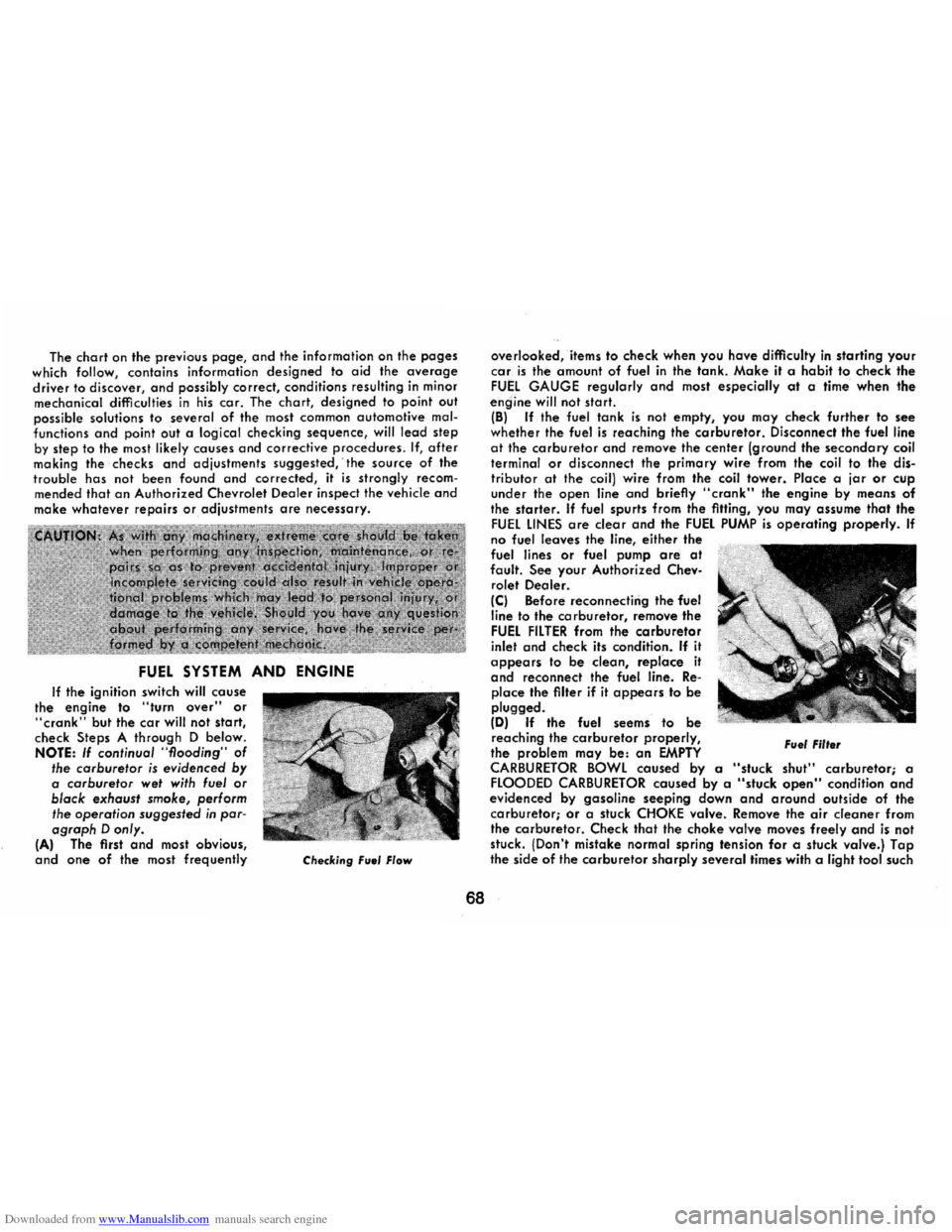
check Steps A through D below. NOTE: If continual "f1ooding" of the carburetor is evidenced by a carburetor wet with fuel or black exhaust smoke, perform the operation suggested in paragraph 0 only. (A) The first and most obvious, and one of the most frequently Checlcing Fuel Flow
68
overlooked, items to check when you have difficulty in starting your car is the amount of fuel in the tank. Make it a habit to check the FUEL GAUGE regularly and most especially at a time' when the engine will not start. (B) If the fuel tank is not empty, you may check further to see whether the fuel is reaching the carburetor_ Disconnect the fuel line at the carburetor and remove the center (ground the secondary coil
terminal or disconnect the primary wire from the coil to the distributor at the coil) wire from the coil tower. Place a jar or cup under the open line and briefly "crank" the engine by means of the starter. If fuel spurts from the fitting, you may assume that the FUEL LINES are clear and the FUEL PUMP is operating properly. If no fuel leaves the line, either the
fuel lines or fuel pump are at fault. See your Authorized Chevrolet Dealer. (C) Before reconnecting the fuel
line to the carburetor, remove the FUEL FILTER from the carburetor inlet and check its condition. If it appears to be clean, replace it and reconnect the fuel line. Replace the filter if it appears to be plugged. (0) If the fuel seems to be reaching the carburetor properly, the problem may be: an EMPTY Fuel Filter
CARBURETOR BOWL caused by a "stuck shut" carburetor; a flOODED CARBURETOR caused by a "stuck open" condition and evidenced by gasoline seeping down and around outside of the carburetor; or a stuck CHOKE valve. Remove the air cleaner from
the carburetor. Check that the choke valve moves freely and is not
stuck. (Don't mistake normal spring tension for a stuck valve.) Tap the side of the carburetor sharply several times with a light tool such
Page 72 of 86
Downloaded from www.Manualslib.com manuals search engine as a screwdriver handle or pliers. Replace the oir cleaner and attempt to start the engine in the normal manner. (E) If the car will start but stalls when hot or has a rough idle, you can suspect a faulty IDLE ADJUSTMENT, a malfunctioning AUTOMATIC CHOKE or an extremely dirty and blocked AIR CLEANER ELEMENT. Replace paper element air cleaner if necessary. Idle adjustment or automatic choke service (other than that outlined in paragraph 0 above) should be performed by your Chevrolet
Dealer. If the above Fuel System checks and the checks suggested under
the Electrical System following do not correct the malfunction, it is recommended that you turn to your Authorized Chevrolet Dealer
for further checks, adjustments or repairs. ELECTRICAL SYSTEM If when the ignition key is turned to "Start", the engine will not turn' over, yOu have good reason to suspect electrical trouble. NOTE: Never'remove Delcotron bat lead without first disconnecting battery ground cable. IF) When there is no response at all to attempts to start the car,
check the obvious-your AUTOMATIC TRANSMISSION SELECTOR LEVER must be in Neutral or Park position (manual transmission
must have clutch depressed all the way to floor) before the engine
can be starfed. Turning the IGNITION SWITCH rapidly back and forth several times will sometimes correct a poor internal switch
contact.
(GI The BATTERY may be discharged. If so, lights will be dim and the horn will have a poor tone if it will blow at all.
Usually a garage recharge will be necessary to return the battery to operation. Occasionally, however, a long drive will recharge the battery. . , •
NOTE: If the baHery is determined to be dead, and for no apparent reason, have your :Aflthori~ed Chevrolet Dealer check the baHery, the GENERATOR and the VOLTAGE REGULATOR.
GENERATOR trouble shqiJld already have been indicated by
69
the generator indicator light on the instrument panel.
POOR BATTERY CONNECTIONS may be suspected if the car has operated properly a short time before and now not even the horn will operate. Check both ends of both battery cables. If the connections are corroded, a car may sometimes be restored to operation by removing all cable ends, scraping all contacting surfaces
clean with a pen knife, and reassembling. If the cables are broken,
they must be replaced. The power supply should now be restored unless-the battery is dead.
(HI If, however, the lights and horn work properly but the starter will still not turn over, check the STARTER connections. A "click" from the starter solenoid indicates that the wiring to the starter is properly installed. If the wiring seems to be clean and tightly installed, the trouble is probably in the starter itself and should be referred to your Authorized Chevrolet Dealer.
When the engine will "turn over" but will not start, the following
items may be checked along with the Fuel Systems Checks listed previously.
(II With a clean dry cloth wipe the ce-amic portions of the spark plugs dry. In particularly damp or rainy weather dampness may be the cause of not starting, espe
cially when the engine is cold.
(JI Check the cables at the top
of the distributor and coil as well as each spark plug cable for
tightness.
(KI If the car will still not start,
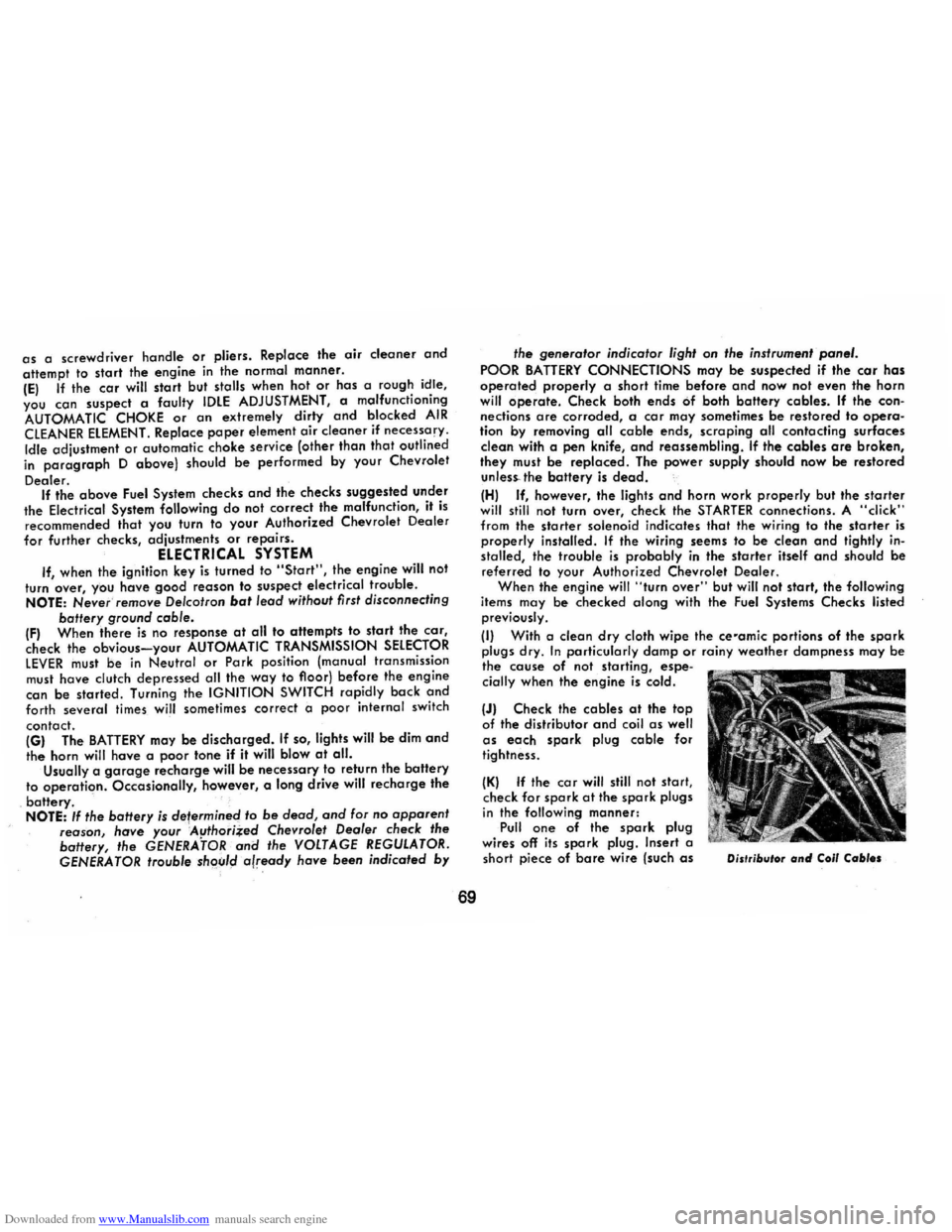
check for spark at the spark plugs in the following manner: Pull one of the spark plug
wires off its spark plug. Insert a
short piece of bare wire (such as Distributor and Coli Cables