fuel CHEVROLET MONTE CARLO 1973 2.G Owners Manual
[x] Cancel search | Manufacturer: CHEVROLET, Model Year: 1973, Model line: MONTE CARLO, Model: CHEVROLET MONTE CARLO 1973 2.GPages: 86, PDF Size: 33.46 MB
Page 15 of 86
Downloaded from www.Manualslib.com manuals search engine •
Operation in Foreign Countries
Your Monte Carlo is designed
to operate on fuel of approximately
91 research octane number or
higher, sold in the United States
and Canada.
If you plan to operate your
Monte Carlo outside the continen
tal limits of the United States
or
Canada, there is a possibility that
the best fuels available in some
countries are so low in anti-knock
quality that excessive knocking and
serious engine damage may result
from their use. To minimize this
possibility, write to Chevrolet Divi-sion,
Service Department, Detroit,
Michigan 48202,
(or in Canada
write to General Motors of Can
ada Limited,
Owner Relations De
partment, Oshawa, Ontario),
giving:
• The vehicle identification num
ber ( on plate
on instrument
panel ahead of the steering
wheel and visible through the
windshield, or from registration
slip
or title).
• The country or countries in
which you plan to traveL
You will be furnished informa-
13
tion on the quality of fuels avail
able in the countries in which you
plan to traveL
It is recommended
that you not operate your Monte
Carlo in any country not having
fuels meeting the requirements of
your Chevrolet engine. Engine
modifications are not available to
compensate for low anti-knock
quality fuels. Operation of your car
under conditions of continuous
or
excessive knocking constitutes mis
use of the engine for which the
Chevrolet Division
is not responsi
ble under the terms of the Chev
rolet New Vehicle Warranty.
Page 18 of 86
Downloaded from www.Manualslib.com manuals search engine 2. Place transmission selector
in uP" or uN" (UP" preferred).
A starter safety switch prevents
starter operation while the trans
mission selector
is in any drive
position.
(If it is necessary to
re-start the engine with the car
moving, place the selector lever
in
"N".)
3. Depress accelerator pedal and
activate starter
as outlined be
low for different conditions.
• Cold Engine -Fully de
press
accelerator pedal and
slowly release.
With foot off
the pedal, crank the engine
by turning the ignition key
to the Start position-release
when engine starts.
If engine starts, but fails to
run, repeat this procedure.
When engine is running
smoothly (approximately 30
seconds), the idle speed may
be reduced by slightly de- pressing
the accelerator pedal
and then slowly releasing.
• Warm Engine -Depress ac
celerator
pedal about halfway
and hold while cranking the
engine.
• Extremely Cold Weather
(Below 0° F.) Or After Car
Has Been Standing
Idle
Several
Oays-
Fully depress and release
accelerator pedal two or three
times before cranking the
engine.
With foot off the ac
celerator pedal,
crank the
engine by turning the key to
the Start position and release
when engine starts.
Manual Transmission Models
1. Apply parking brake and shift
16
transmission to neutral.
2.
Hold clutch pedal to floor
throughout the starting proce
dure.
A starter interlock pre
vents starter operation when
clutch
is not fully depressed.
(Select the proper gear position
before releasing the clutch pedal.)
3. Operate accelerator pedal and
starter
as outlined in step 3
(under Automatic Transmission
Models).
Engine Flooded
Depress accelerator pedal aJ;ld
hold to floor while starting until
engine
is cleared of excess fuel
and
is running smoothly. Never
"pump" the accelerator pedal.
Warm-Up
Always let the engine idle for
20 to 30 seconds after starting
and drive at moderate speeds for
several miles, especially during
cold weather.
Page 19 of 86
Downloaded from www.Manualslib.com manuals search engine Driving with the Chevrolet Automatic Transmissions
The Turbo Hydra-matic 350
and 400 are completely automatic
transmissions which replace the
standard clutch and transmission.
After starting the engine with the
selector lever in N (Neutral) or
P (Park) position, select the range
desired (see table) and depress
the accelerator. A gradual start
with a steady increase in accelera
tor pressure will result in best pos
sible fuel economy. Rapid acceler
ation for fast starts will result
in
greater fuel consumption.
Automatic transmission shift
quadrants of
all GM cars continue
the uniform sequence of selector
positions. This particularly bene
fits multicar families and those who
occasionally drive other cars.
Shift indicators are arranged with
"Park" position at one end, fol
lowed
in sequence by "Reverse",
"Neutral"
and the forward driv
ing ranges. All automatic trans
missions are equipped with a
starter safety switch designed to
permit starting the engine only
when the transmission selector
is
in the "Park" or "Neutral" posi
tion. For additional engine brak
ing effect,
as sometimes needed in
mountainous driving, place the
transmission in an intermediate
or
low range.
Column Shift Lever
The heavy line in the illustra
tions indicates the movement of
17
the shift lever as it is lifted to
shift into Reverse
or Low on the
Turbo Hydra-Matic
350 and 400
and into or out of Park position.
Floor Console Shift Lever
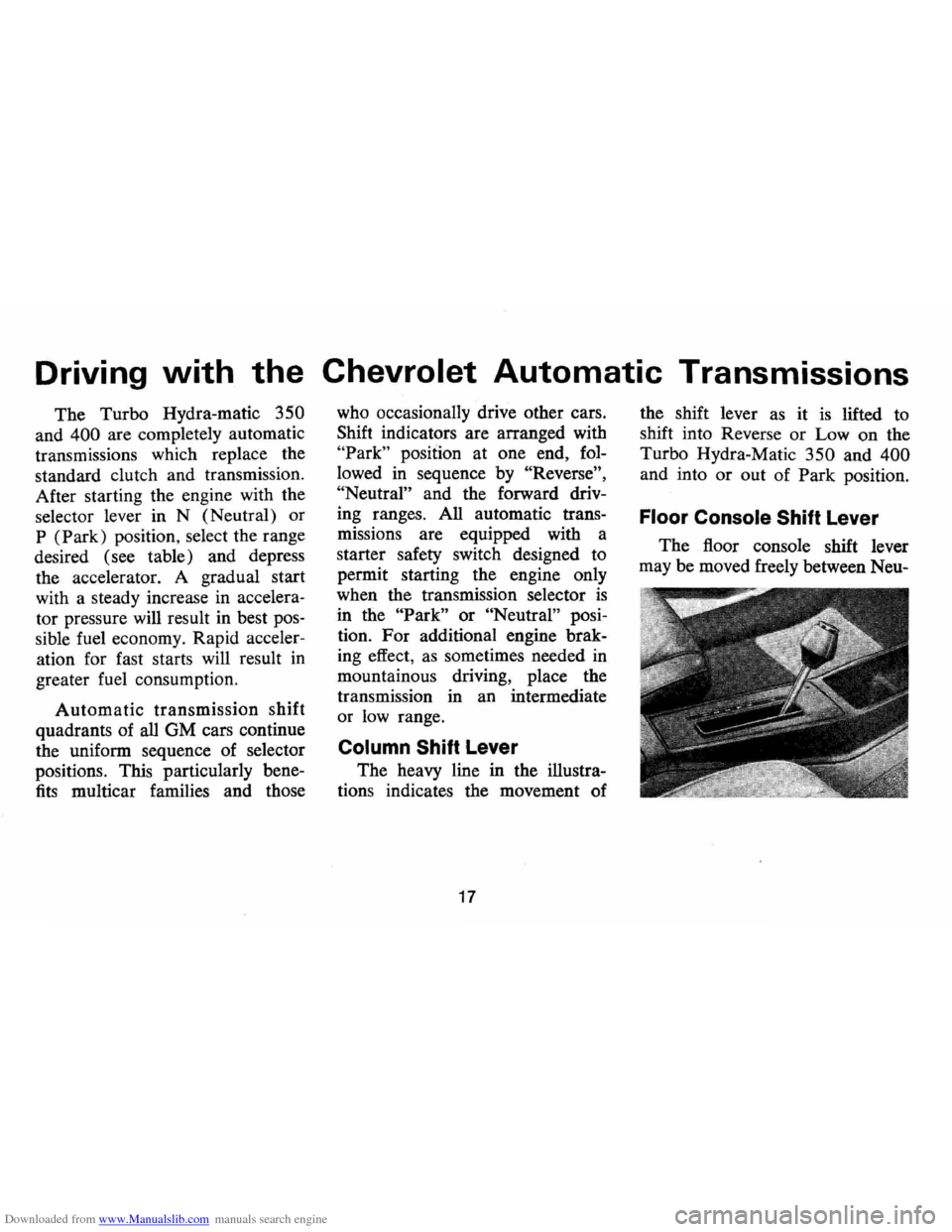
The floor console shift lever
may be moved freely between Neu-
Page 26 of 86
Downloaded from www.Manualslib.com manuals search engine NOTE: "Riding the brake" by rest
ing your foot on the brake pedal
when not intending to brake can
cause abnormally high brake tem
peratures, excessive lining wear
and possible damage to the brakes.
REMINDER: Brake linings should
be inspected for wear by a quali
fied mechanic at least once a year
or every 12 ,000 miles, whichever
occurs first. (Disc brake pads
should
be visually inspected for
wear each time the wheels and
tires are rotated at
6,000 mile in
tervals.) More frequent inspec
tions should be made if driving
conditions in your area, such as a
traffic or terrain, or techniques of
individual drivers result in frequent
brake applications. Your Chevro
let dealer
is best qualified to advise
you as to how often this inspection
should be performed. When brakes require
relining, use those Genuine
General Motors
Parts specified
for your car, and Delco Brake fluid
as required .
Automatic Brake Adjusters
• Brakes on this car (except for
the parking brake) are self
adjusting, designed to eliminate
periodic brake adjustments.
• Drum brake adjustment is made
automatically
as the brakes are
applied while
car is moving
backwards.
• Disc brake adjustment is made
automatically with each brake
application.
• If excess brake pedal travel de
velops, drive alternately back
ward and forward several
times and apply brakes firmly
in each direction.
• See your dealer if normal pedal
24
travel is not restored, or if there
is a rapid increase in pedal
travel, which could be a sign of
other brake trouble.
Headlight Beam Switch
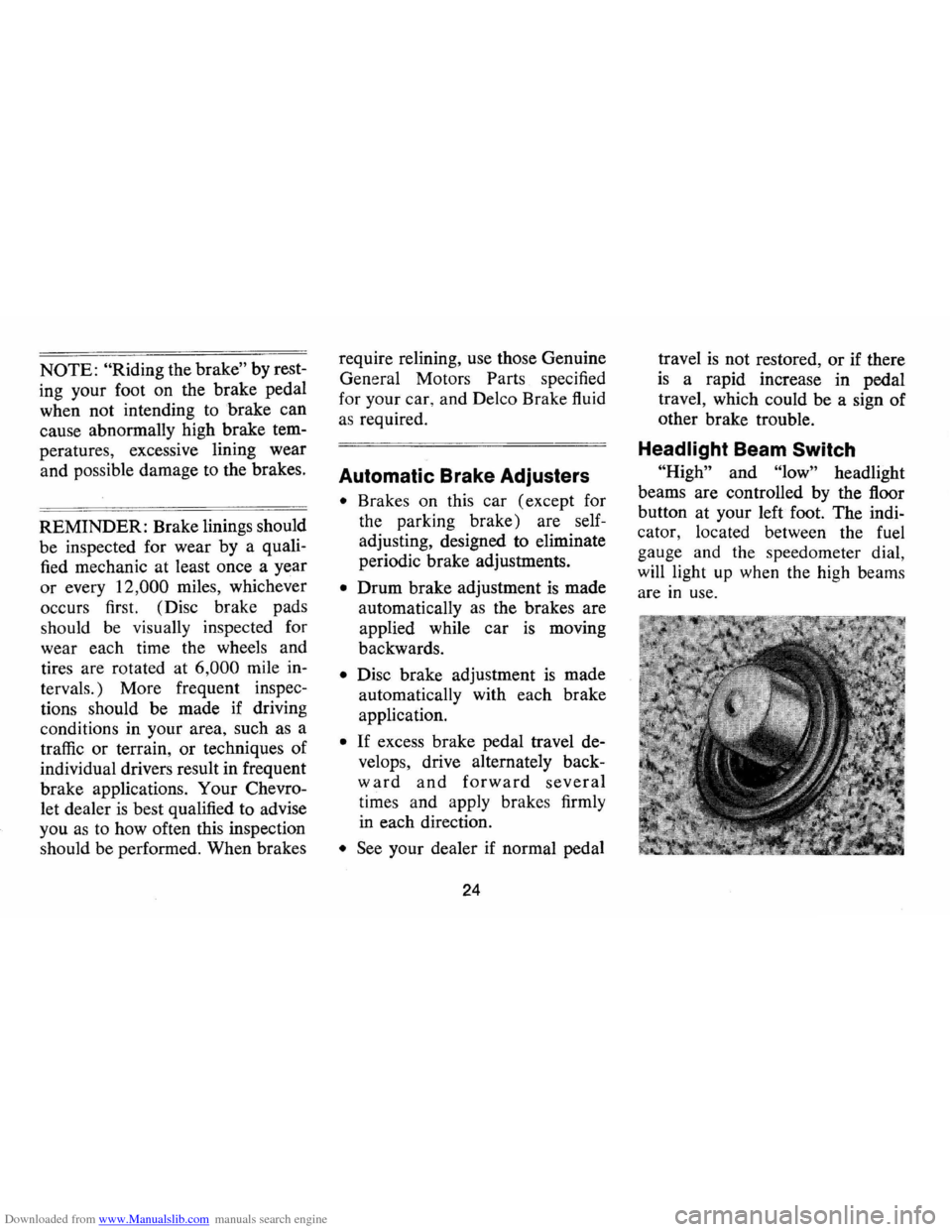
"High" and "low" headlight
beams are controlled by the floor
button at your left foot. The indi
cator, located between the fuel
gauge and the speedometer dial
will light
up when the high beam~
are in use.
Page 27 of 86
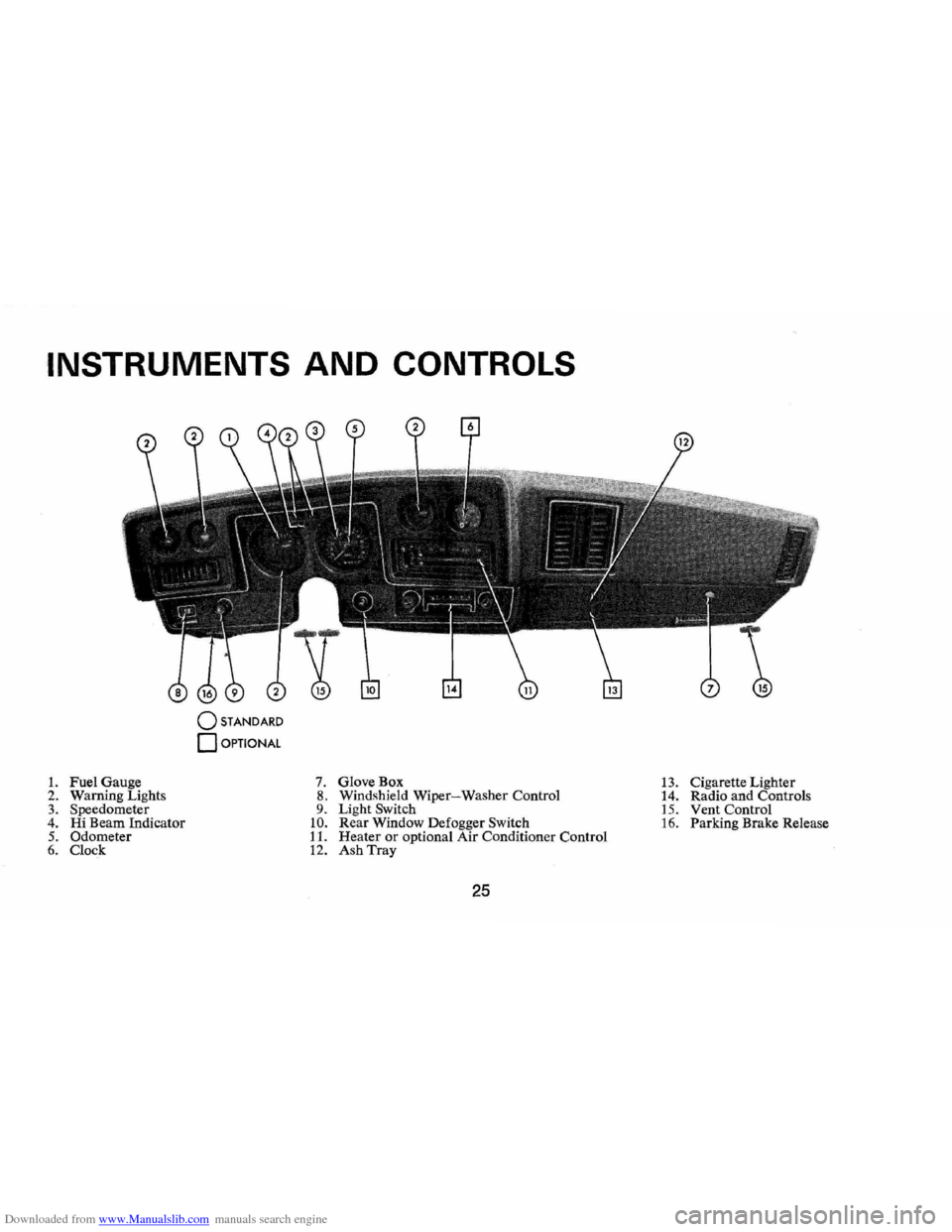
Downloaded from www.Manualslib.com manuals search engine INSTRUMENTS AND CONTROLS
o STANDARD
o OPTIONAL
1. Fuel Gauge 7. GloveBox 13. Cigarette Lighter
2. Warn ing Lights 8. Windshield Wiper-Washer Control
14. Radio and Controls 3. Speedometer 9. Light Switch 15. Vent Control 4. Hi Beam Indicator 10. Rear Window Defogger Switch 16. Parking Brake Release 5. Odometer 11. Heater or optional Air Conditioner Control 6. Clock 12. Ash Tray
25
Page 28 of 86
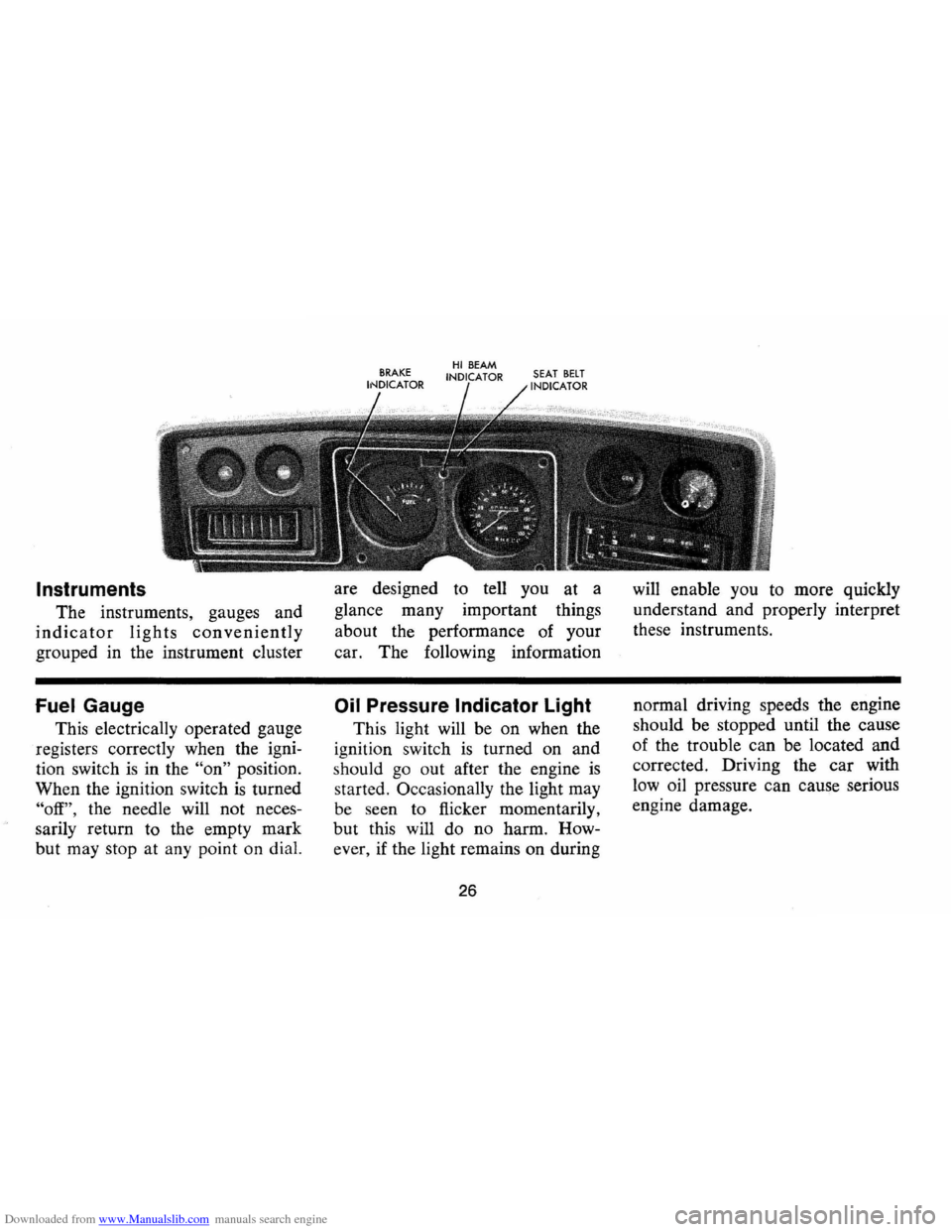
Downloaded from www.Manualslib.com manuals search engine Instruments
The instruments, gauges and
indicator lights conveniently
grouped in the instrument cluster
Fuel Gauge
This electrically operated gauge
registers correctly when the igni
tion switch
is in the "on" position.
When the ignition switch
is turned
"off", the needle will not neces
sarily return to the empty mark
but may stop at any point on dial. are
designed to tell you at a
glance many important things
about the performance of your
car. The foIlowing information
Oil Pressure Indicator Light
This light will be on when the
ignition switch
is turned on and
s hould
go out after the engine is
started. OccasionaIly the light may
be seen to flicker momentarily,
but this will do no harm. How
ever , if the light remains on during
26
will enable you to more quickly
understand and properly interpret
these instruments .
normal driving speeds the engine
should be stopped until the cause
of the trouble ca n be located and
corrected. Driving the
car with
low oil pressure can cause serious
engine damage.
Page 29 of 86
Downloaded from www.Manualslib.com manuals search engine Generator Indicator Light
This light provides a quick
check on the generating system
of your car. The red light will
go on when the ignition key
is
in the "on" position, but before
the engine
is started. After the
engine starts, the light should go
out and remain out.
If the light
remains on when engine
is run
ning , have your Authorized Chev
rolet Dealer locate and correct
the trouble
as soon as possible.
Engine Temperature
Indicator Light
This indicator light is provided
in the
instrument cluster to
quickly warn of an overheated
engine. With the ignition switch
in the
START position, the red
TEMP indicator will light to let
you know that it
is operating
properly. When the engine
is started, the red
light will go out immediately.
It will light up at no other time
unless for some reason the engine
reaches a dangerously high oper
ating temperature.
If the red light
should come on, the engine must
be stopped until the cause of the
overheating
is corrected. Glance
at instrument cluster frequently
as
you drive to see if this light is on.
Brake System Warning Light
The service brake system is
designed so that half of the brake
system will provide some braking
action in the event of a hydraulic
leak in the other half of the
sys
tem. If the warning light located
below the fuel gauge glows con
tinuously when the ignition
is on
and after the brakes have been
firmly applied, it may indicate that
there
is a malfunction in one half
of the brake hydraulic system.
27
• As a check on bulb condition
the light should glow with the
parking brake applied and the
ignition on. (Light
is also a
reminder to release parking
brake) .
• Have system repaired if light
does not come on during check.
• This warning light is not a sub
stitute for the visual check of
brake fluid level required
as
part of normal maintenance.
If the light glows red:
• The parking brake control is not
fully released or,
• The service brake system is
partially inoperative
What to do:
1. Check that the parking brake
is released. If it is ...
2. Pull off the road and stop,
carefully- remembering that:
Page 52 of 86
Downloaded from www.Manualslib.com manuals search engine SERVICE AND MAINTENANCE
The time or mileage intervals
on the following
pages are in
tended as a guide for establishing
regular maintenance and lubrica
tion periods for your car. Sus
tained heavy duty or high speed
operations
or operation under
adverse conditions may necessi
tate more frequent servicing.
To
determine specific recommenda
tions for conditions under which
Fuel
Requirements
Your Monte Carlo is designed
to operate
on a good quality fuel
of approximately
91 Research Oc
tane Number or higher , commonly
sold in the United States and
Canada.
Use of a fuel which is too
low in anti-knock quality will re- you
use your car, consult your
Authorized Chevrolet Dealer.
Maintenance Schedule
For owner convenience, a sepa
rate maintenance folder has been
provided with your car which con
tains a complete schedule and
brief explanation of the safety,
suIt in
"spark knock", a metallic
rapping noise generated during the
combustion process. It should be
noted that Research Octane Num
ber does not completely describe
fuel octane quality. Therefore , if
you hear knock in your engine you
may wish to try a different gaso
line.
If knocking persists consult
your authorized Chevrolet dealer.
In any case, continuous
or exces-
50
emission control, lubrication and
general maintenance it requires.
The maintenance folder informa
tion
is supplemented by this sec
tion of the Owner 's Manual,
as
well as the separate emission con
trol systems folder also furnished
with your car. Read all three pub
lications for a full understanding
of vehicle maintenance require
ments.
sive knocking may result in engine
damage and constitutes misuse of
the engine for which Chevrolet
Motor Division
is not responsible
under the terms of the New Ve
hicle Warranty.
General Motors recommends the
use of unleaded or low-lead
(0 to
0.5 grams per gallon) gasolines
to minimize emissions of hydro
carbons and particulates.
If un-
Page 53 of 86
Downloaded from www.Manualslib.com manuals search engine leaded or low-lead gasolines are
not available, gasolines containing
more than 0.5 grams per gallon
may be used.
In states using the Gasoline Per
formance and Information
System
of fuel designation, unleaded or
low-lead fuels having an anti-knock
designation of
"2" or higher are
recommended.
Gas Cap-The fuel tank filler cap
has a new two-step removal and
installation procedure plus a
pressure-vacuum safety relief.
valve. It is equipped with a double
set of locking tangs.
To remove:
• Rotate cap one-half tum coun
terclockwise to clear the first set
of tangs from the slots inside
the filler neck.
This, will allow
any residual pressure to escape.
• Pull the cap outward and rotate
one-quarter
tum counterclock
wise to clear second set of tangs
and remove the cap.
• To install, reverse this pro
cedure.
NOTE: If this cap requires a re
placement, only a cap with these
same features should be used. Fail
ure to use the correct cap can
result in a serious malfunction of
the system. Correct replacement
caps may be obtained from
your
authorized Chevrolet Dealer.
Engine Oil and Filter
Recommendations
• Use only SE engine oil.
• Change oil each 4 months or
6,000 miles. If more than 6,000
miles are driven in a 4-month
period, change oil each
6,000
miles.
• Change oil each 2 months or
3,000 miles, whichever occurs
51
first, under the following con
ditions:
- driving in dusty conditions
- trailer pulling
- extensive idling
- short-trip operation
at freez-
ing temperatures (engine not
thoroughly warmed-up).
• Operation in dust storms may
require an immediate oil change.
• Replace the oil filter at the first
oil change, and every second oil
change thereafter.
AC oil filters
provide excellent engine pro
tection.
See your Chevrolet dealer for
advice
on the frequency of oil and
filter changes under unusual driv
ing conditions.
The above recommendations
apply to the first change as well as
subsequent oil changes. The oil
change interval for your Monte
Carlo engine
is based on the use of
Page 54 of 86
Downloaded from www.Manualslib.com manuals search engine SE oils and quality oil filters. Oil
change intervals longer than those
listed above will seriously reduce
engine life and may affect Chevro
let's obligation under the provisions
of the New Vehicle Warranty.
A high quality
SE oil was in
stalled in your engine at the factory.
It is not necessary to change this
facory-installed oil prior
to the rec
ommended normal change period.
However, check the oil level more
NOTE: Non-detergent and other
low quality oils are specifically not
recommended.
Only the use of SE
engine oils and proper oil and filter
change intervals assure you of con
tinued proper lubrication of your
Chevrolet engine.
frequently during the break-in pe
riod since higher oil consumption
is normal until the piston rings be
come seated.
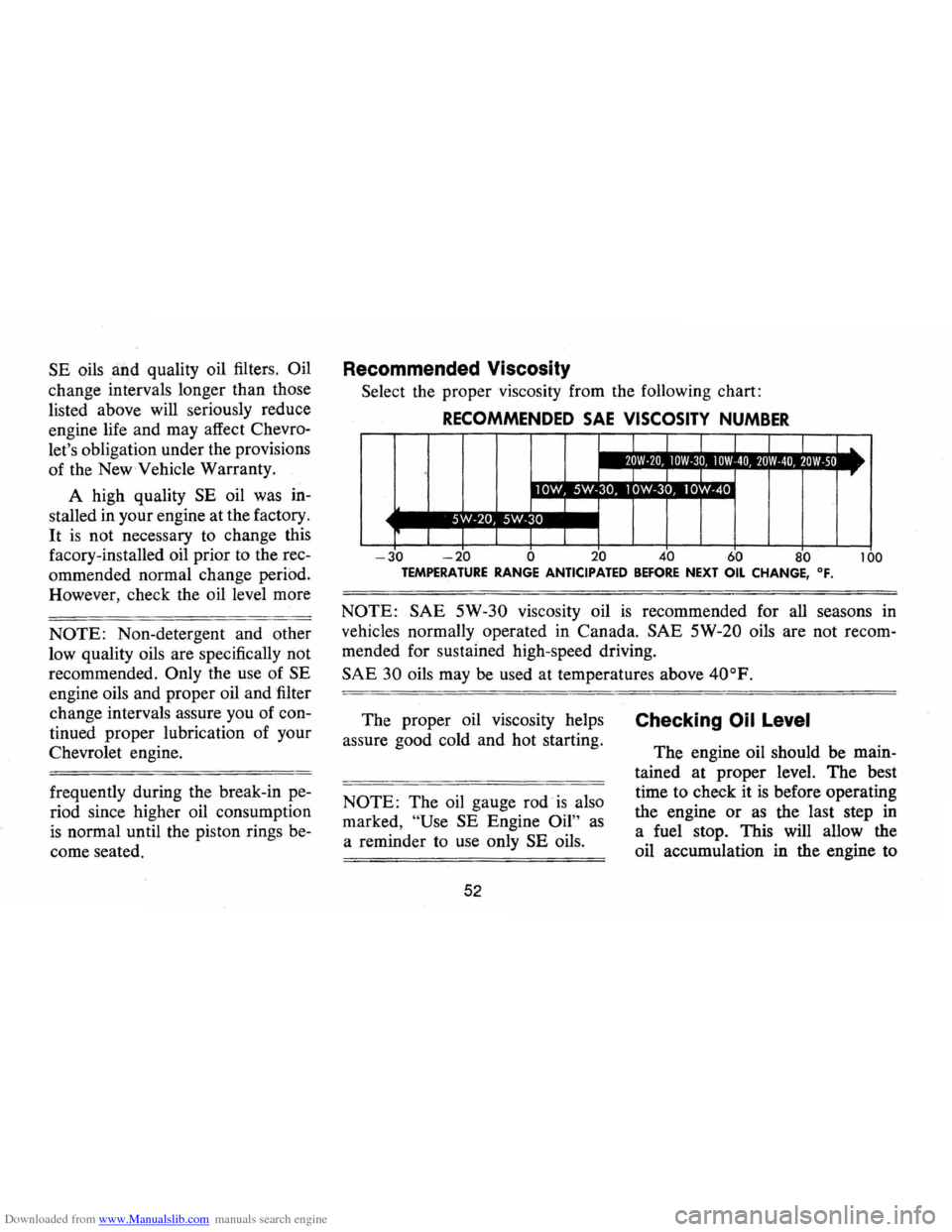
Recommended Viscosity
Select the proper viscosity from the following chart:
RECOMMENDED SAE VISCOSITY NUMBER
I ,.
.... ~.-."'). ... .II ••• :.; I
-30 -20 0 20 40 60 80 100 TEMPERATURE RANGE ANTICIPATED BEFORE NEXT OIL CHANGE, OF.
NOTE: SAE 5W-30 viscosity oil is recommended for all seasons in
vehicles normally operated in Canada.
SAE 5W-20 oils are not recom
mended for sustained high-speed driving.
SAE 30 oils may be used at temperatures above 40oP.
The proper oil viscosity helps
assure good cold and hot starting.
NOTE: The oil gauge rod is also
marked,
"Use SE Engine Oil" as
a reminder to use only SE oils.
52
Checking Oil Level
The engine oil should be main
tained at proper level. The best
time to check it
is before operating
the engine or
as the last step in
a fuel stop. This will allow the
oil accumulation in the engine to