wheel CHEVROLET MONTE CARLO 1981 4.G User Guide
[x] Cancel search | Manufacturer: CHEVROLET, Model Year: 1981, Model line: MONTE CARLO, Model: CHEVROLET MONTE CARLO 1981 4.GPages: 104, PDF Size: 23.92 MB
Page 57 of 104
![CHEVROLET MONTE CARLO 1981 4.G User Guide Downloaded from www.Manualslib.com manuals search engine I
"
JACKING INSTRUCTIONS OJ PARK ON A Lf;VEL SURACE AND SET PARKING BRAKE FIRMLY, [!] SET_ AUTOMATIC TRANSMISSION IN "PARK" (MANUAL TRANS](/img/24/8239/w960_8239-56.png "CHEVROLET MONTE CARLO 1981 4.G User Guide Downloaded from www.Manualslib.com manuals search engine I
\"
JACKING INSTRUCTIONS OJ PARK ON A Lf;VEL SURACE AND SET PARKING BRAKE FIRMLY, [!] SET_ AUTOMATIC TRANSMISSION IN \"PARK\" (MANUAL TRANS")
Downloaded from www.Manualslib.com manuals search engine 'I'
'"
JACKING INSTRUCTIONS OJ PARK ON A Lf;VEL SUR'ACE AND SET PARKING BRAKE FIRMLY, [!] SET_ AUTOMATIC TRANSMISSION IN "PARK" (MANUAL TRANSMISSION IN RIEVERH,_
...0 DO NOT TAa 'tOUI ~ THIOUGH ..... NJroMATtc CAl-WASH WIT" O)III#ACT WAIl INSTAU.ID . THI .... HtC&I' .... T OIl CAIIGHT WHICH COULD .I$UlT ... NONJn D.t.MAGI. .... _._ ...... __ ........ __ •• __ ._ .. II'>
AERO BACK COUPE MODELS Irutan Jack using Upper Hole Location.
LEVER IN DOWN POSITION
-~~ ... /~ ..
TIGHTEN
( " §. = .. :Mt .. : . 0 II .OZ
ill TURN_ON THE HAZARD W.ARNING FLASHER •. o REMOVE JACKING TOOLS AND PARE T IRE FROM STOWAGE. AREA. [!] aLOCK FRONT AND REAR OF WHEEL DIAGONALLY OPPOSITE WHEEL BEING REMOVED IIE"O .. I: OPERATING JACK. [!) LOOSEN, BUT DO NOT REM,OVe: WHEEL NUTS BV TURNING WRENCH COUNTIERCLQCI
' ' L.OAD PAO . N.UT.S IN A C IUSS·C ROSS SEQUENCII.Y TURNING WRENCH CLOCKWISE,. ---~ -~ACK RATCHET MECHANISM SHOULD.II OILED AFTER EACH USE.
"RAMII~~
JACK
Page 58 of 104
Downloaded from www.Manualslib.com manuals search engine ~
I , ,
INSTRUCTIoN
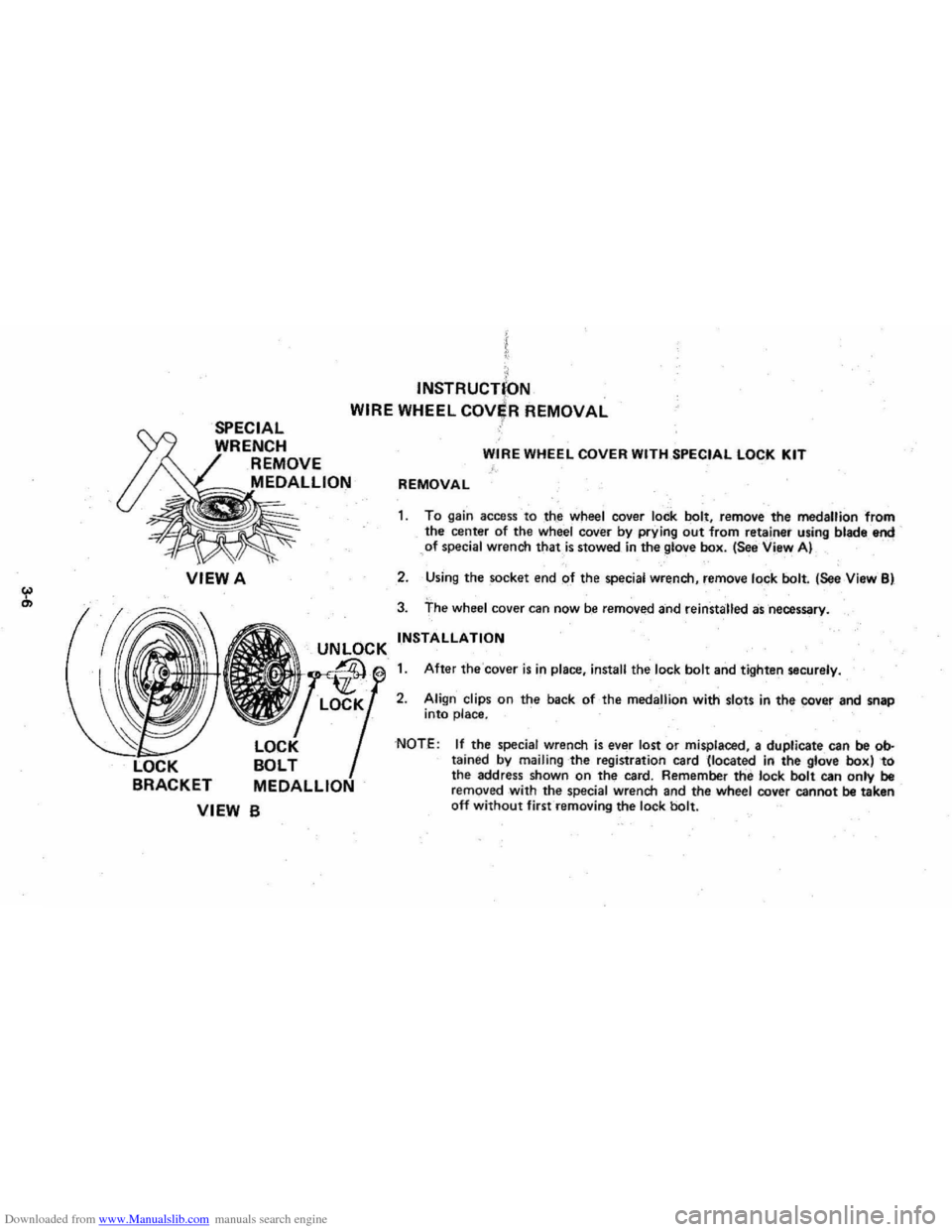
SPECIAL I . WIRE WHEEL COV~R REMOVAL ,t
ENCH
REMOVE
MEDALLION
VIEWA
LOCK
BOLT • BRACKET MEDALLION
VIEW B
WIRE WHEEL COVER WITH SPECIAL LOCK KIT A REMOVAL
1. To gain access to th.~ wheel cover lock bolt, remove the medallion from the center of the wheel cover by prying out from retainer using blade end -
, of special wrench that is stowed . in the glove box. (See View A)
2. Usi'ng the socket end of the special wrench, remove foC;k bolt. (~e View B)
3. The wheel cover can now be removed and reinstalled as 'necessary .
INSTALLATION
1. After the'cover 'is in place, install the lock bolt and tighten securely.
2. Align clips on the back afthe medallion with slots in the cover and snap
into place.
'NOTE : If the specia l wrench is ever lost or misplaced , a duplicate can be 0btained by mailing the registration card (located in the glove bo)t) 'to the address shown on the card. Remember the lock bolt can onty be removed with the special wrench and the wheel cover cannot be taken· off without first removing the lock bolt.
Page 59 of 104
Downloaded from www.Manualslib.com manuals search engine JACKING
CAUTION
To help avoid personal injury:
• Follow air jacking and stowage instructions.
• Use jack only for lifting this vehicle during wheel change.
• Never get . beneath the vehicle, start or run engine while vehicle is supported by jack.
• Always securely restol" sp!.re tire (orflattire) and all jac king equipment.
Wheel Nut Torque .
CAUTION: As soon as possible atter installing a wheel -AND at the intervals stated
In Section 'S of the Maintenanc," Schedule folder --have a technician tighten wheel nuts with a torque wrench to the specifications shown in "Specifications," Section 7 of this manual.
Wheel nuts should be tightened alternately and evenly to the correct torque.
Never use oil or grease on studs Of nuts.. Jrnproperty tightened wheel nuts could eventually aUow the whee! to come off while the veNeta Is moving, -po$$rbty causing
personal injury , damage and/or klss of c_ontrol. (Also see the "Replacement Fasteners" Caution In "Service and Maintenance ," Section 5 01 this m8nu81 regarding the danger of mixing metric and custom,sry fasteners. And, see the "Replacement Fasteners " Caution
under "Tires" in the same seclion regarding the importance of obtaining good metal-to
metsl contact.)
Stowage ·of. Tire . and .!aC;.k,. . .
CAUTION: Always securely restow the spare tire assembfy (or nat tire), all jacking equipm ent, any tire inflator, and any covers or doors, using the means provided. This will help keep such things from being thrown about-and injuring people In the vehicta d.Ufing a sudden maneuver or an accident.
Before stowing
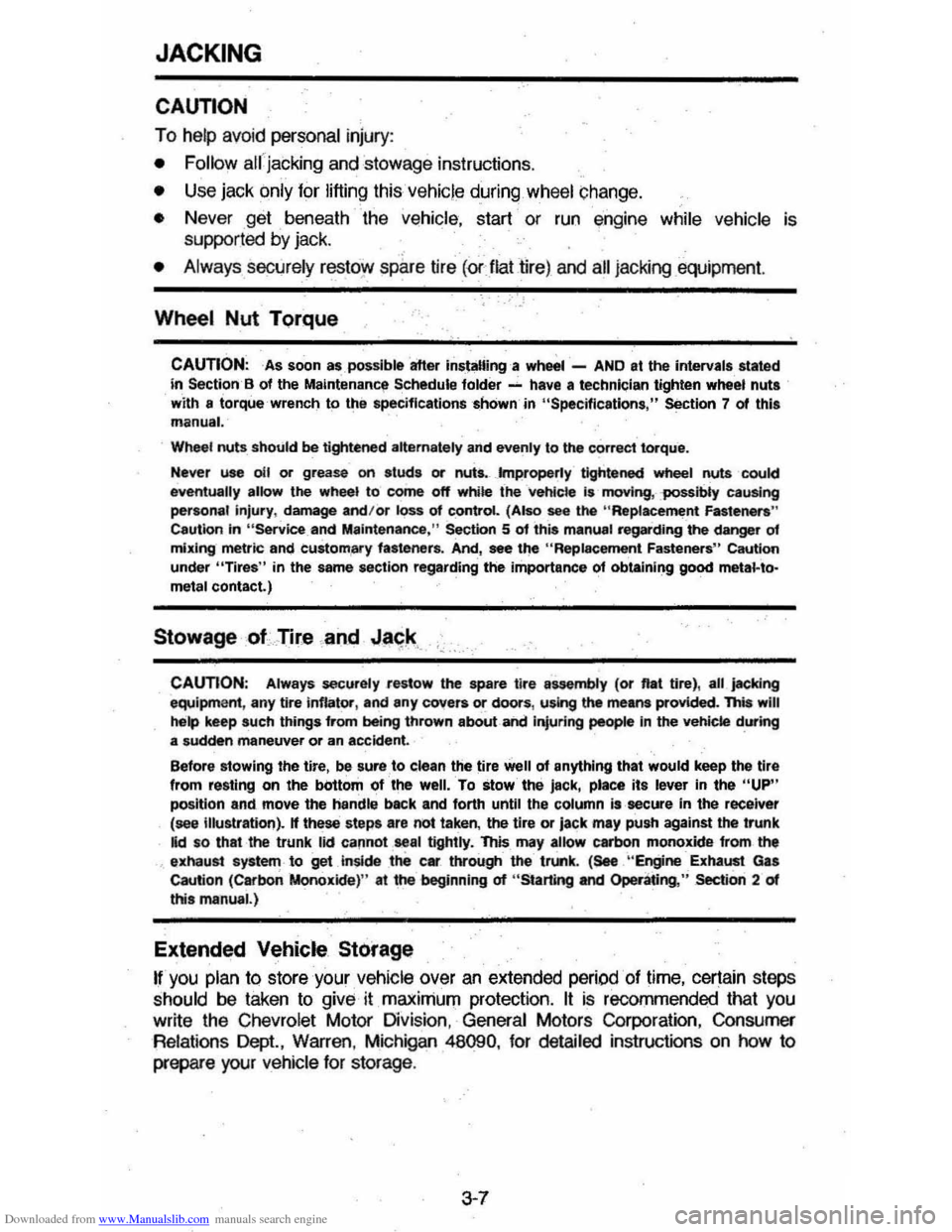
the tire, be sure:to clean the tire well 01 anything that would keep the tlr. from resting on the bOttom of the well. To stow the jack, place its lever in the "UP" position and. move the handle back and forth until the column is ·secure in the receiver (see Illustration). If these steps are not taken, the tire or lack may push against the trunk lid so thai the trunk lid cannot seal tightly. This _ may allOw carbon monoxide from the '. exhaust system -to get _inside tiMt c • . ttvougtl the trunk. (See "Engine -Exhaust Gas Caution (CaroonMonoxkle) " al the beginning of "Starting and Operating,'; Section 2 of this manual .)
Extended Vehicle Storage
If you plan to store your vehicle over an extended periOd of time, certain steps
should be taken to give it maximum protection.
It is recommended that you
write the Chevrolet Motor Division , General Motors Corporation, Consumer
Relations Dept., Warren , Michigan
48090, for detailed instructions on how to
prepare your vehicle for storage .
3-7
Page 60 of 104
Downloaded from www.Manualslib.com manuals search engine Compact Spare
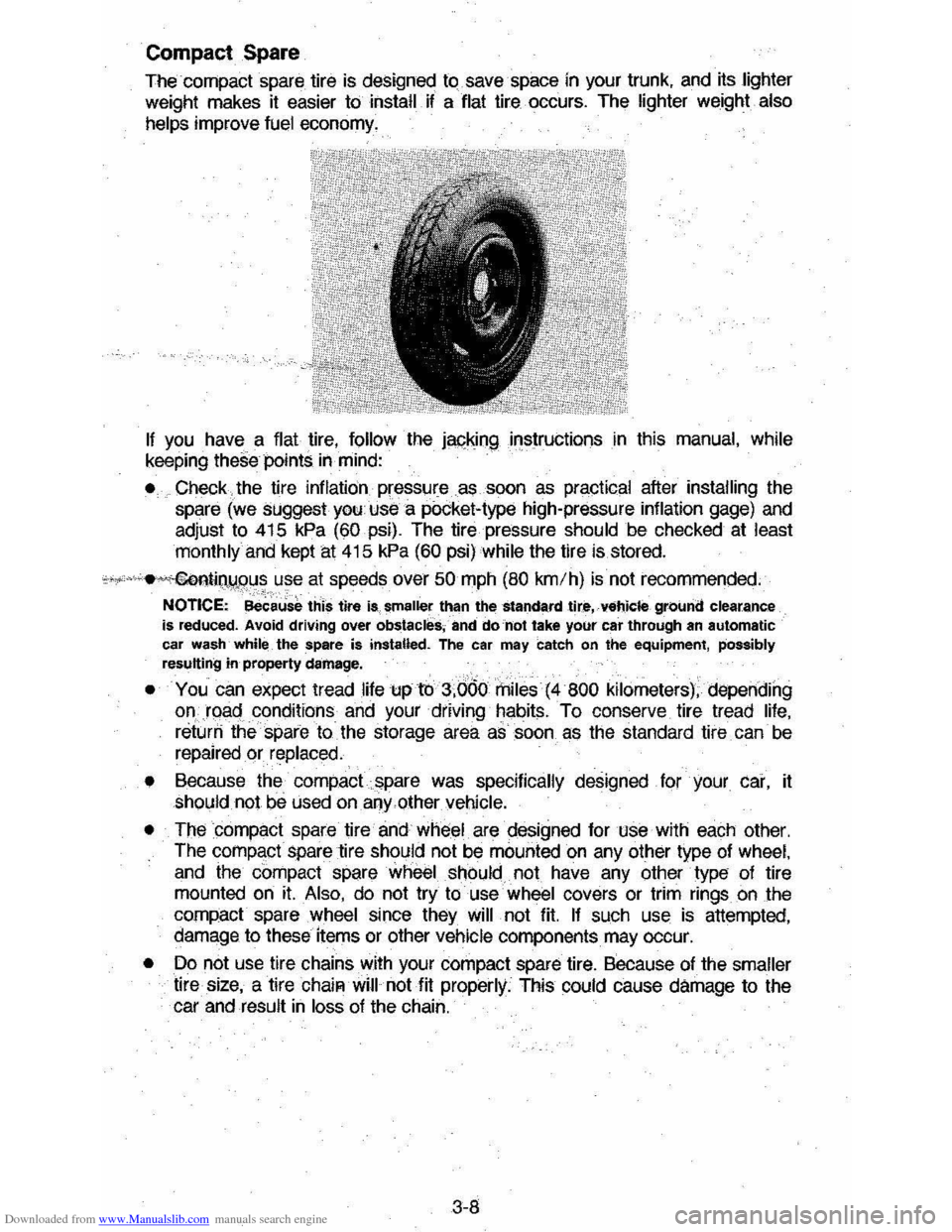
The-compact spare tire is designed to.save-space in your trunk, and its lighter
weight makes it easier to install if a flat tire occurs. The lighter weight also
helps
improve fuel economy.
If you have a flat tire, follow the japking .instructions in this manual, while keeping these points in mind:
• Check the tire inflation pressure as soon as practical after installing the
spare (we suggest you use a pOcket-type high-pressure inflation gage) and
adjust to 415
kPa (60 psi). The tire pressure should be checked at least
monthly and kept at 415 kPa (60 psi) while the tire is stored.
c"""'.M~llijIW.9u~ use at speeds over 50 mph (80 km/h) is not recommended.
NOTICE: -Bec~us~ this tire is, smaller than the standard tire,-vehicle ground clearance is reduced. Avoid driving over obstacles, -and do 'not take your car through an automatic car wash -while _ the spare is installed. The car may catch on the equipment, possibly resulting in property damage.
• You can expect tread ,life up to 3,660 rhiles(4800 kilometers), depending onJqact~ondi~ions and your driving ~~bits. To conserve tire tread life, returri the -spare to _ the storage area as soon as the standard tire _ can be
repaired or replaced.
•
Because the compact spare was specifically designed for your car, it should not be used on any.other vehicle.
• The
compact spare tire and wheel are cfesigned for use with each other.
The comp,,:ct spare tire should not be mounted on any other type of wheel,
and the compact spare wheel should not have any other type of tire mounted on it. Also, do not try to use wheel covers or trim rings on the
compact spare wheel since they will not fit. If such use is attempted,
damage to these items or other vehicle components may occur.
• Do not use tire chains with your compact spare tire. Because of the smaller
tire size, a tire ChaiR will not fit properly. This could cause damage to the car and result in loss of the chain.
3-8
Page 61 of 104
Downloaded from www.Manualslib.com manuals search engine Towing
Proper equipment .must be used to prevent damage to vehicles during any
towing. State (Provincial in Canada) and local laws which apply to vehicles in
tow must be
followed. Get detailed towing instructions from your dealer.
Your vehicle
may be towed on all four wheels, at speeds less than 35 mph (60
km/h), for distances up to 50 miles (80 kilometers), provided the driveline and
steering are normally operable. For such towing, the steering must be unlocked, transmission in neutral and the· parking brake released. Connect to
main structural parts of the vehicle. Do NOT attach to bumpers or brackets.
Remember also that power assist for brakes and steering will not be available when the engine is off.
If the vehicle is to be towed by a wrecker, use only equipment designed for this purpose, following the instructions of the wrecker manufacturer. A safety Chain
system must be used for all towing.
FREEING VEHICLE FROM SAND, MUD, SNOW OR
ICE
If your vehicle gets stuck in sand, mud, snow or ice, move the shift lever on automatic transmission models from "0" (Drive) to "R" (Reverse) in a repeat
pattern.
Apply a light pressure to the accelerator pedal while the transmission is in gear. Remove your foot from the accelerator while shifting. Do not race
the engine. For best traction, avoid spinning the wheels. Incorrect rocking of your vehicle while it is stuck may result in damage to vehicle components.
CAUTION: Do not spin the wheels faster than 35 mph (55 km/h). Personal injury and
damage (inCluding tire, transmission and/or rear axle failure) may result from excessive
wheel spinning.
If the vehicle remains stuck after several rocking attempts, seek other
assistance. Also see the Notice under '(Automatic Transmissions" in "Steering
Column-Controls," Section 2 of this manual.
3-9
Page 65 of 104
Downloaded from www.Manualslib.com manuals search engine Cleaning Rear Glass
tf abrasive cleaners are used on the inside of the rear window, any electric
delogger element may be damaged. Avoid placing decats on the inside rear
window since they may later have to be scraped off. II you use a tempcrary
license, take care not to attach
it across the delogger grid.
Cleaning Glass Roof Panels
Never use abrasive cleaners'''on any glass roof panels, such as Vista~Vent as
they may cause scratches. AI,sQ, if you use such cleaners on the inside
surface , the tinted coating may be damaged. Avoid placing decals on the inside
surfa ce which may
later have to be scraped off.
CARE AND CLEANING OF THE EXTERIOR
Exterior Finish
The paint·lii'ish on your vehicle provides beauty, depth 01 color, gloss retention
and durability.
Washing Your Vehicle
The best way,lo,preserve your vehicle's finish is to keep it clean by frequent washings. Wash the vehide in lukewarm or cold water.
Do not use hot water or wash your vehicle in the direct rays of the sun. Do not
use strong soap or chemical detergents . All cleaning agents should be lIushed
promptly Irom the surface and not allowed to dry on the linish.
J?olis!lil,!9,.~nd Waxing Your Vehicle
Polishing is reCommended to remove built-up residue and eliminate any "weathered" appearanc~.
Your dealer offers several polishes and cleaners which have proven value in
maintaining original finish appearan£e ~ -durabtlity.
Protection of Exterior Bright Metal Parts
Bright metal parts should be cleaned regularly to keep their luster. Washing
with. water is all that is usually needed. However, you may use GM Chrome Polish on CHROME or STAINLESS STEEL trim, il necessary.
Use special care with
ALUMINUM trim. Never use auto or chrome polish, steam or caustic soap to clean aluminum. A coating 01 wax , rubbed to a high polish , is recommended lor all bright metal parts.
Cleaning Aluminum Wheels
Preserve the original appearance of aluminum wheels (il your vehicle has
them) by keeping them clean and Iree lrom build-up 01 road dirt and/or road
salt. Regular cleaning lollowed by a coat
01 paste wax (such as GM 1 050~37 "Finish Guard") is recommended .
Cleaning White Sidew.all Tires
Use GM White Sidewall Tire Cleaner or a tire cleaner which will not harm
aluminum wheel trim. A stiff brush may be used with the cleaner .
4-4
Page 68 of 104
Downloaded from www.Manualslib.com manuals search engine PART NUMBER
1051516
1050017
1052277
1050172
1050173
1050174
1050214
f' 1050237 .... 1050244
1052280
1050427 1050429
1052349
1050729
1051055
1051398
1051515 1051172 1051855 1051858
1052103
1052271 1052272
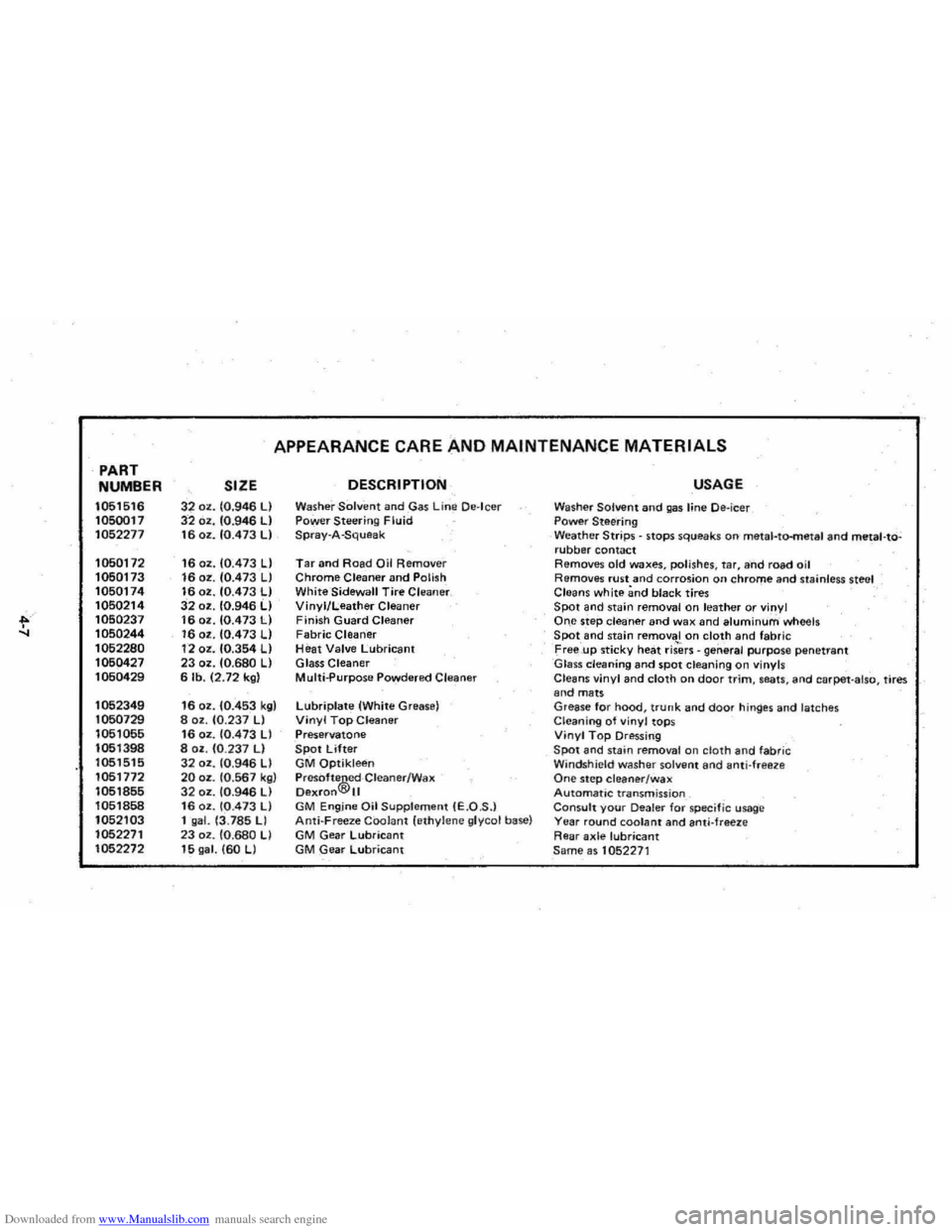
APPEARANCE CARE AND MAINTENANCE MATERIALS
SIZE DESCRIPTION
32 02. 10.946 U Washer -Solvent and Gas Line De-Icer 3 '2 oz, (0.946 LI Power Steering Fluid 16 oz. (0.473 LI Spray-A-Sq ueak
16 oz. (0.473 L) Tar and Road Oil Remove'r 16 oz . (0.473 L) Chrome Cleaner and Polish 1602.10,473 LI WhiteSidewall Tire Cleaner , 32 oz. 10.946 L) Vinyl/Leather Cleaner 16 oz. 10.473 L) Finish Guard Cleaner 16 oz. (0.473 L) Fabric Cleaner 1'2 oz. 10.354 L) Heat Valve Lubricant 23 oz. (0.680 L) Glass Cleaner 6 lb. 12.72 kg) Multi·Purpose Powdered Cleaner
16 oz. (0.453 kg) Lubriplate (White Grease) 8 oz. 10.237 Ll Vinyl Top Cleaner 16 oz. (0.473 LI Preservatone 8 oz. 10.237 L) Spot Lifter 32 oz, 10.946 LI GM Optikleen 20 oz . (0.567 kg) presofl®ed-Cleaner/wax 32 oz. 10.946 U Dexron II 16 oz. (0.473 1I GM Engine Oil Supplement (E.O.sJ 1 gal. 13.785 L) Anti·Free ze Coolant lethylene glycol base) 23 oz. 10.680 L ) GM Gear Lubricant 15 gal. (60 L) GM Gear Lubricant
USAGE
Washer Solvent and gas line Oe-icer Power Steering Weather Strips -stops squeaks on metal-to-metal and metal-to~ rubber contact Removes old waxes, polishes, tar, and road oil Removes rust and corrosion on chrome and stainless steel
Cleans white imd black tires Spot and stain removal on leather or vil'lyl One step cleaner and wax and aluminum· wheels Spot and stain removal on cloth and fabric Free up sticky heat ri;ers -general purpose penetrant Glasscleaning and spot cleaning on vinyls
Cleans vinyl and cloth on door trim, seats, and carpet-also, tires and mats Grease for hood, trunk and door hinges and latches
Cleaning of vinyl tops Viny l Top Dressing SPOt and stain removal on cloth and fabric
W indshield washer solvent and anti-freeze One step c leaner/wax Automatic transmission Consult your Dealer for specific usage
Year round coolant and anti-freeze Rear axle lubricant Same as 1052271
Page 78 of 104
Downloaded from www.Manualslib.com manuals search engine CAUTION': It" the alr 'l;lMner i, ren;oveci during repair or maintenance, bel"'re to put H bl,ck on'eQr~ctly. It the air cleilner Is 'not correctly Inltalled. there could bea fire in the engine compertment (It there ~Id h..,.,en to be a backfire) , or other engitie mallunc1lon .
Front Suspension and Steering Linkage
Lubric;lte fi tngsatlhEj ' intery;>1 showninthe Maintenance Schedule with water
resistant
EP Chassis lUb(icantwhich meets GM SpecifICation 6031M.
NOTICE: ,Ball ' joints, should "not be . lubrieak.d unlesS, their temperature il -12"C (10"f},or higher,During ,coldweather, theyahould" .. ~"al,)c)~ to,warm up al nece ... ry ,before being lubricated or damttge to the baH jOint-Could occur. . , ' '.' "
.. ,. fIRnl 'N. c~~~arings
Clean and repack front wheel bearings with a high melting point wheel bearing
lubricant . at the interval shown in the Maintenance Schecule. Use wheel
' bearing lubricant GM Part No. 10 5~ 344 or equivalent.
NonCE: ," Long fiber " or "vbeou.'-' type"iubricenf ~kI nol be used, Do not mix wheel ~irinQ"lUbricant., Be sure to thoroughly c5aan bearings and hubl of all old lubricant before repacking.
Tapered roller,bearings uaed'h'Hhis 'veh icle have' .. sUghtly looSe teel when properly adjusted, They must never ~ over tightened (preJoaded) or sev .... bearing damage may resuit. Con.utt your,Authorized Deektr or Servi<:e.r.enual tor peper detailed adjustment procedures and specifications. . '~". :...,"" .... ~"";~f>"'~"'-"'''''',','',' ,::, Hood tlltchesand.Hood Hinge
At the interva l shown in the Maintenan ce Schedule lubricate hood latch
assembly
and hood hinge assembly as follows :
1. Wipe off any accumul"ti~!).ofqirt Qfoontaminationon latch Pi1!'ts.
2. Apply Lubriplate . or equivalent to latch pilot bolts and latch locking
plate .
3. Apply light engine oil to all pivot paints in release mechanism, as well
as primary and Secbndary latch mechanisms.
4. Lubricate hood hinges .
5~ Make hood hinge and latch mechanism functional check to assure the assembly is working COfTectiy.
Freedom Battery
Your new vehicle has a Delco FREEOOM battery. It neecs . no periodic
maintenance .
Its top is permanently sealec (except for two small vent holes) and has no filler capS. You will never have to add water.
The hydrometer (test indicator) in the top of the battery provides information for
testing purposes only.
For full power needs at replacement time, a Delco battery wijh the same catalog number as shown on the original battery's labe l is recommended ..
CAUTIQN: ",' FOllOW the precautions listed in the' Jump Starting ' 'Caution (see ' Ihe "In Case of EmergenCy " settlon of this manual) when workmg On or 08. a bMtery. Personal Injury {particularly to eyea} or 'property damage may result from battery e~ battery acid, or electrical (short circuit) burns.
5-10
Page 81 of 104
Downloaded from www.Manualslib.com manuals search engine STANDARD EXTRA B C o
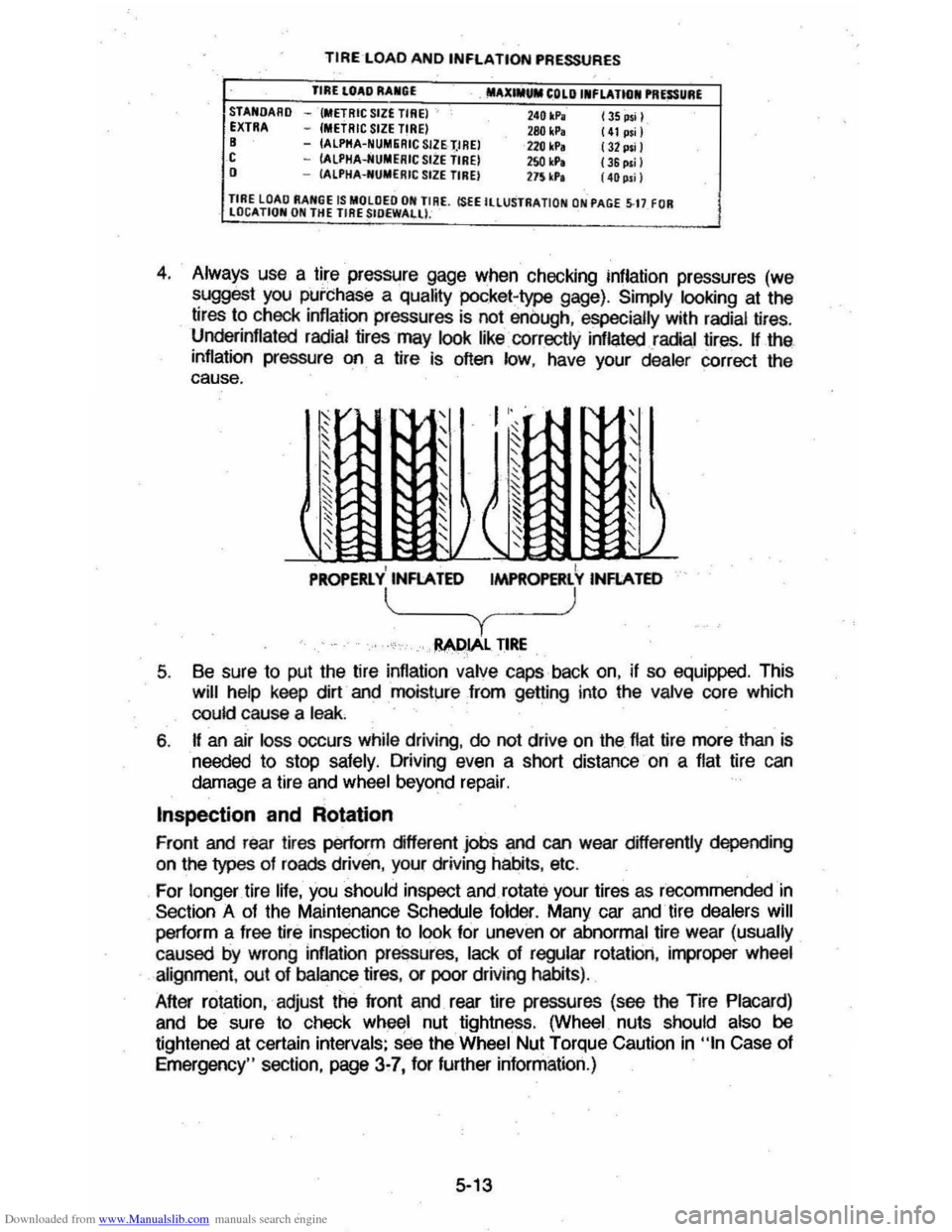
TIRE-LOAD AND INFLATION PRESSURES
TIRE lOAO RAlliGE
-{METRIC SIZE TIRE) " -{METRIC SIZE T!RE) -(ALPKA-NUMIiRIC SJZETIRE) -(ALPHA-NUMERIC SIZE TIRE) -(ALPHA-NUMERIC SIZE TIRE)
MAXIMUM COLO INHATtoN "'E$SURE
2
40 kPI 280 kPa 220 kPa 2M! kPt 27S kP.
t 35 psi J (41 psi) (32 psi) (36 psi) (40 p.JiI
TIRE LOAD RANGE IS MOLDED Off TIRE. !SEE I UUSTRATIOff ON PAGE ,So11 fOR lOCATION ON THE TIRE S IDEWALl! .
4. Always use a tire pressure gage when checking inflation pressures (we
suggest
you purchase a quality pocket-type gage). Simply looking at the
tires to check inftation pressures is not enough , especially with radia l tires .
Underinflated radial tires may
look like correctly inflated radial tires. H the.
inflation pressure on a tire is often low , have your d9aler correct the cause.
) , I" , "
,
~ , ~ , , , , ) ,
,
,
'"
,
~
'"
,
0:: ~ , , ~ :0 , ,
PROPERLY INFlATED IMPROPERLV INRATED
l ___ ~_~)
y IlADIAL TIRE
5. Be sure to put the tire inflation valve caps back on, if so equipped. This
will help keep dirt · and moisture from getting into the valve core which
could cause a leak.
6. If an air loss occurs while driving, do not drive on the flat tire more than is
needed to stop safely. Driving even a short distance
ona flat tire can
damage a tire and wheel beyond repair.
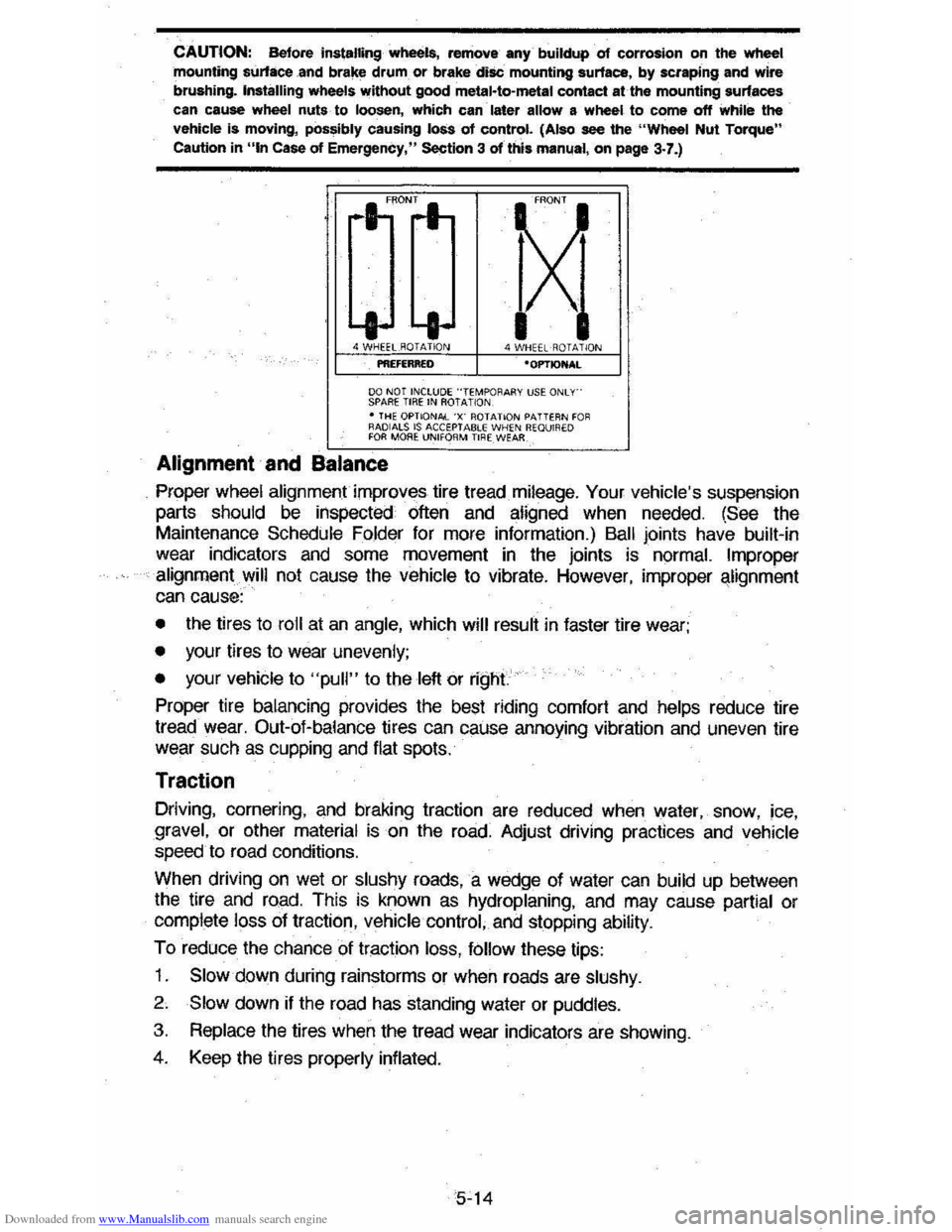
Inspection and Rotation
Front and rear tires perlorm different jobs and can wear differently depending
on the types of roads driven , your driving habits, etc .
For longer tire
life, you should inspect and rotate your tires as recommended in
Section A of the Maintenance Schedule folder. Many car and tire dealers will perform a free tire inspection to look for uneven or abnormal tire wear (usually
caused
by wrong inflation pressures, lack of regular rotation, improper wheel
alignment, out
of balance tires, or poor driving habits).
After rotation , adjust the front
and. rear tire pressures (see the Tire Placard)
and be sure to check wheel nut tightness . (Wheel nuts should also be
tightened at certain intervals; see the Wheel Nut Torque Caution in "In Case of
Emergency" section,
page 3·7, for further information.)
5-13
Page 82 of 104
Downloaded from www.Manualslib.com manuals search engine CAUTION: Before installing wheels, remove any· buildup of corrosion on the wheel mounting surface .and brake drum or brakedilic mounting surface, by scraping and wire
brushing. Installing wheels without good metaHo-metal contact at the mounting surfaces
can cause wheel nuts to loosen, which can . later allow a wheel to come off while the vehicle is moving, possibly causing loss of control. (Also see the "Wheel Nut Torque"
Caution in "In Case of Emergency," Section 3 of this manual, on page 3·7.)
-'-:'O'rt-
P<1 ~ELRo:t 4 WHEHROTATION PREFERRED ·OPTIONAl
DO NOT INCLUDE "TEMPORARY USE ONLY· SPARE TIRE IN ROTATION
• THE OPTIONAL 'X' ROTATION PATTERN FOR RADIALS IS ACCEPTABLE WHEN REQUIRED FOR MORE UNIFORM TIRE WEAR
Alignment and Balance
Proper wheel alignment· improves tire tread. mileage. Your vehicle's suspension
parts should be inspected often and aligned when needed. (See the Maintenance Schedule Folder for more information.) Ball joints have built-in wear indicators and some movement in the joints is normal. Improper
alignrnentwill not cause the vehicle to vibrate. However, improper ~Iignment can cause:
• the tires to roll at an angle, which will result in faster tire wear;
• your tires to wear unevenly;
• your vehicle to "pull" to the left or right. .
Proper tire balancing provides the best riding comfort and helps reduce tire
tread· wear. Out-of-balance tires can cause annoying vibration and uneven tire wear such as cupping and flat spots.
Traction
Driving, cornering, and braking traction are reduced when water, snow, ice,
gravel, or other material is on the road. Adjust driving practices and vehicle speed to road conditions.
When driving on wet or slushy roads,a wedge of water can build up between
the tire and road. This is known as hydroplaning, and may cause partial or complete loss of traction, vehicle control, and stopping ability.
To reduce
the chance of traction loss, follow these tips:
1. Slowdown during rainstorms or when roads are slushy.
2. Slow down if the road has standing water or puddles.
3. Replace the tires when the tread wear indicators are showing.
4. Keep the tires properly inflated.
5-14