instrument panel CHEVROLET MONTE CARLO 1997 5.G Owner's Manual
[x] Cancel search | Manufacturer: CHEVROLET, Model Year: 1997, Model line: MONTE CARLO, Model: CHEVROLET MONTE CARLO 1997 5.GPages: 358, PDF Size: 19.11 MB
Page 122 of 358
Downloaded from www.Manualslib.com manuals search engine Mode Knob
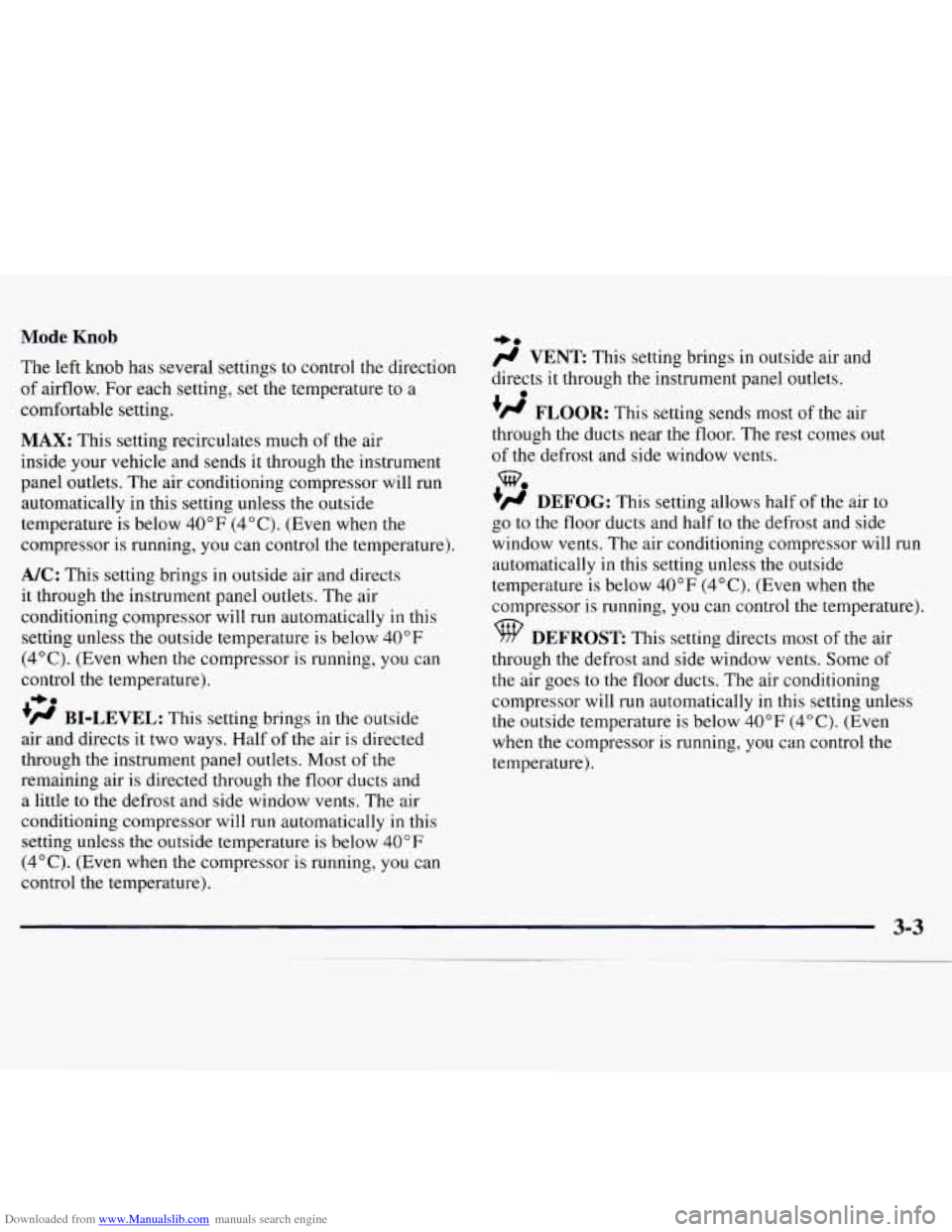
The left knob has several settings to control the direction
of airflow. For each setting,
set the temperature to a
comfortable setting.
MAX: This setting recirculates much of the air
inside your vehicle and sends it through the instrument
panel outlets. The air conditioning compressor will run
automatically in this setting unless the outside
temperature is below 40°F (4°C). (Even when
the
compressor is running, you can control the temperature).
A/C: This setting brings in outside air and directs
it through the instrument panel outlets. The air
conditioning compressor will run automatically
in this
setting unless the outside temperature is below 40°F
(4°C). (Even when the compressor is running, you can
control the temperature).
+' BI-LEVEL: This setting brings in the outside
air and directs it two ways. Half of
the air is directed
through the instrument panel outlets. Most
of the
remaining air is directed through
the floor ducts and
a little to the defrost and side window
vents. The air
conditioning compressor will run automatically
in this
setting unless
the outside temperature is below 40°F
(4°C). (Even when the compressor is running, you can
control the temperature).
+e +e
/J VENT This
setting brings in outside air and
directs
it through the instrument panel outlets.
'# FLOOR: This setting sends most of the air
through the ducts near the floor. The rest comes out
of
the defrost and side window vents.
$/J DEFOG: This setting allows half of the air to
go to the floor ducts and half to the defrost and side
window vents.
The air conditioning compressor will run
automatically
in this setting unless the outside
temperature is below 40°F (4°C). (Even when the
compressor is running, you can control the temperature).
DEFROST This setting directs most of the air
through the defrost and side window vents. Some of
the air goes to the floor ducts. The air conditioning
compressor
will run automatically in this setting unless
the outside temperature is below 40°F
(4°C). (Even
when the compressor is running, you can control the
temperature).
0
we
3-3
Page 175 of 358
Downloaded from www.Manualslib.com manuals search engine Turn Signals When Towing a Trailer
When you tow a trailer, your vehicle may need a
different turn signal flasher and/or extra wiring. Check
with your Chevrolet dealer. The green arrows on your
instrument panel will flash whenever you signal a turn
or lane change. Properly hooked up, the trailer lamps
will also flash, telling other drivers you’re about to turn,
change lanes or stop.
When towing a trailer, the green arrows on your
instrument panel will flash for turns even
if the bulbs on
the trailer are burned out. Thus, you may think drivers
behind you are seeing your signal when they are not. It’s
important to check occasionally to be sure the trailer
bulbs
are still working.
Driving On Grades
Reduce speed and shift to a lower gear before you start
down a long or steep downgrade. If you don’t shift
down, you might have to use your brakes
so much that
they would get hot and no longer work well.
On a long uphill grade, shift down and reduce your
speed
to around 45 mph (70 km/h) to reduce the
possibility of engine and transaxle overheating.
If you are towing a trailer, you may want to drive in
DRIVE
(D) instead of AUTOMATIC OVERDRIVE (0)
(or, as you need to, a lower gear),
Parking on Hills
You really should not park your vehicle, with a trailer
attached, on a hill. If something
goes wrong, your rig
could start to move. People can be injured, and both
your vehicle and the trailer can be damaged.
But if you ever have to park your
rig on a hill, here’s
how to do it:
1.
2.
3.
4.
5.
Apply your regular brakes, but don’t shift into
PARK
(P) yet.
Have someone place chocks under the trailer wheels.
When the wheel chocks are in place, release the
regular brakes until the chocks absorb the load.
Reapply the regular brakes. Then apply your parking
brake, and then shift to PARK
(P).
Release the regular brakes.
Page 190 of 358
Downloaded from www.Manualslib.com manuals search engine Engine Overheating
You will find a coolant temperature gage and the
warning light about a hot engine on your instrument
panel. See “Engine Coolant Temperature Gage” and
“Engine Coolant Temperature Warning Light” in the
Index.
You also have a LOW COOLANT light on your
instrument panel. See “Low Coolant Light” in the Index.
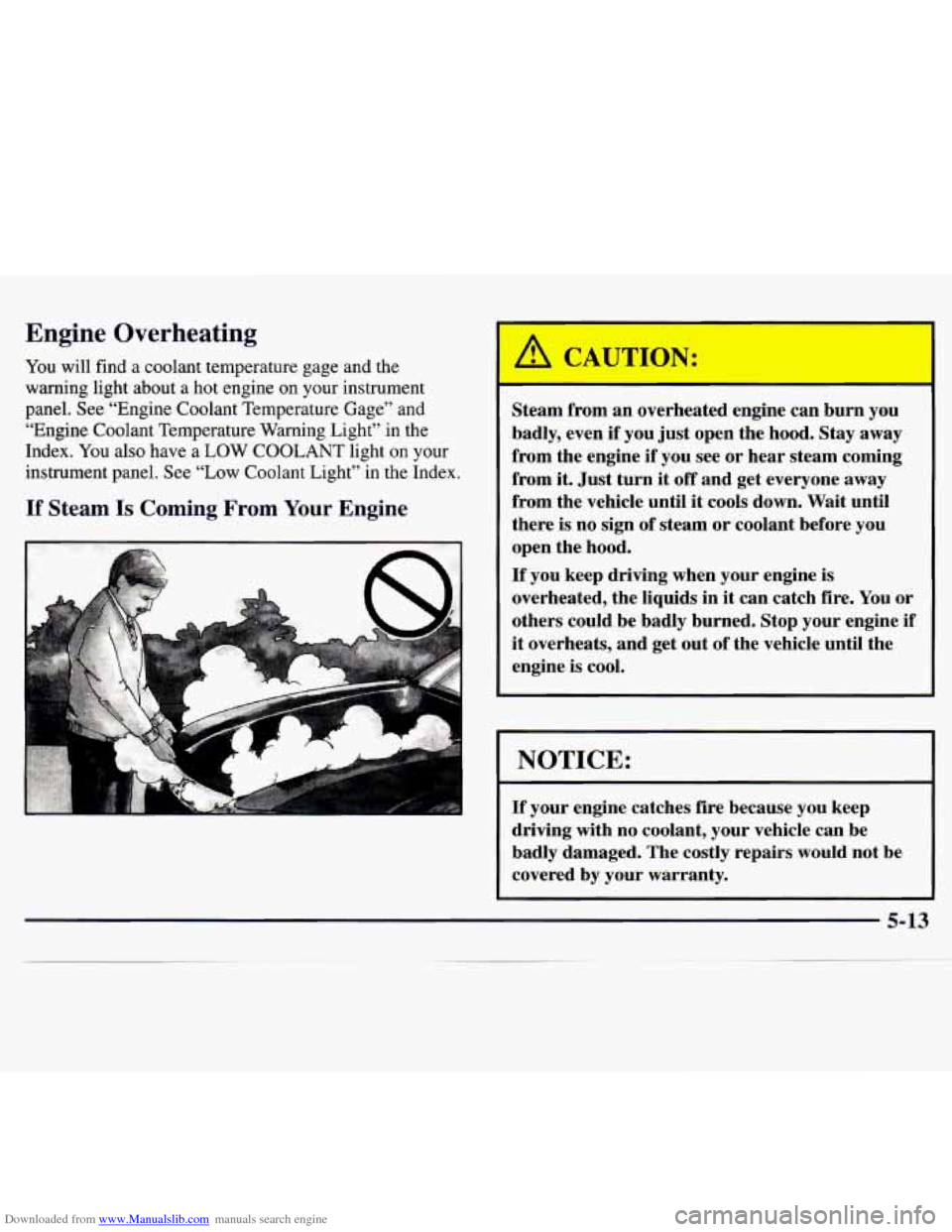
If Steam Is Coming From Your Engine
L
Steam from an overheated engine can burn you
badly, even
if you just open the hood. Stay away
from the engine if you see or hear steam coming
from it. Just turn it
off and get everyone away
from the vehicle until it cools down. Wait until
there
is no sign of steam or coolant before you
open the hood.
If you keep driving when your engine is
overheated, the liquids in it can catch fire. You or
others could be badly burned. Stop your engine
if
it overheats, and pet out of the vehicle until the
engine is cool.
NOTICE:
If your engine catches fire because you keep
driving with no coolant, your vehicle can be
badly damaged. The costly repairs would not be
covered by your warranty.
Page 218 of 358
Downloaded from www.Manualslib.com manuals search engine Adding Equipment to the Outside of
Your Vehicle
Things you might add to the outside of your vehicle can
affect the airflow around it. This may cause wind noise
and affect windshield washer performance. Check with
your Chevrolet dealer before adding equipment to the
outside of your vehicle.
Fuel
Use regular unleaded gasoline rated at 87 octane or
higher. At a minimum, it should meet specifications
ASTM D4814 in the United States and CGSB 3.5-M93
in Canada. Improved gasoline specifications have been
developed
by the American Automobile Manufacturers
Association (AAMA) for better vehicle performance
and engine protection. Gasolines meeting the AAMA
specification could provide improved driveability and
emission control system protection compared to
other gasolines.
Be sure the posted octane is at least
87. If the octane is
less than 87, you may get a heavy knocking noise when
you drive. If it’s bad enough, it can damage your engine.
If you’re using fuel rated at
87 octane or higher and you
hear heavy knocking, your engine needs service. But
don’t worry
if you hear a little pinging noise when
you’re accelerating or driving up a hill. That’s normal, and you don’t
have to buy a higher octane fuel to get rid
of pinging. It’s the heavy, constant knock that means
you have a problem.
If your vehicle is certified to meet California Emission
Standards (indicated
on the underhood tune-up label), it
is designed to operate
on fuels that meet California
specifications. If such fuels
are not available in states
adopting California emissions standards, your vehicle will operate satisfactorily on
fuels meeting federal
specifications, but emission control system performance
may be affected. The malfunction indicator lamp on
your instrument panel may turn on and/or your vehicle
may fail a smog-check
test. If this occurs, return to your
authorized Chevrolet dealer for diagnosis to determine
the cause of failure. In the event it is determined that the
cause
of the condition is the type of fuels used, repairs
may not
be covered by your warranty.
Some gasolines that are not reformulated for low
emissions contain an octane-enhancing additive called
methylcyclopentadienyl manganese tricarbonyl (MMT);
ask your service station operator whether or not his fuel
contains MMT. General Motors does not recommend the
use of such gasolines. If fuels containing MMT are used,
spark plug life may be reduced and your emission
control system performance may be affected. The
malfunction indicator lamp on your instrument panel
Page 225 of 358
Downloaded from www.Manualslib.com manuals search engine Before closing the hood, be sure all the filler caps are on
properly. Then just pull the hood down and close it firmly.
Engine Oil
LOW
OIL
If the LOW OIL light on the
instrument panel comes on,
it means
you need to check
your engine oil level right
away. For more
information, see “Low Oil
Level Light” in the Index.
You should check your
engine oil level regularly;
this is an added reminder.
It’s a good idea to check your engine oil every time
you
get fuel. In order to get an accurate reading, the oil must
be warm and the vehicle must be on level ground.
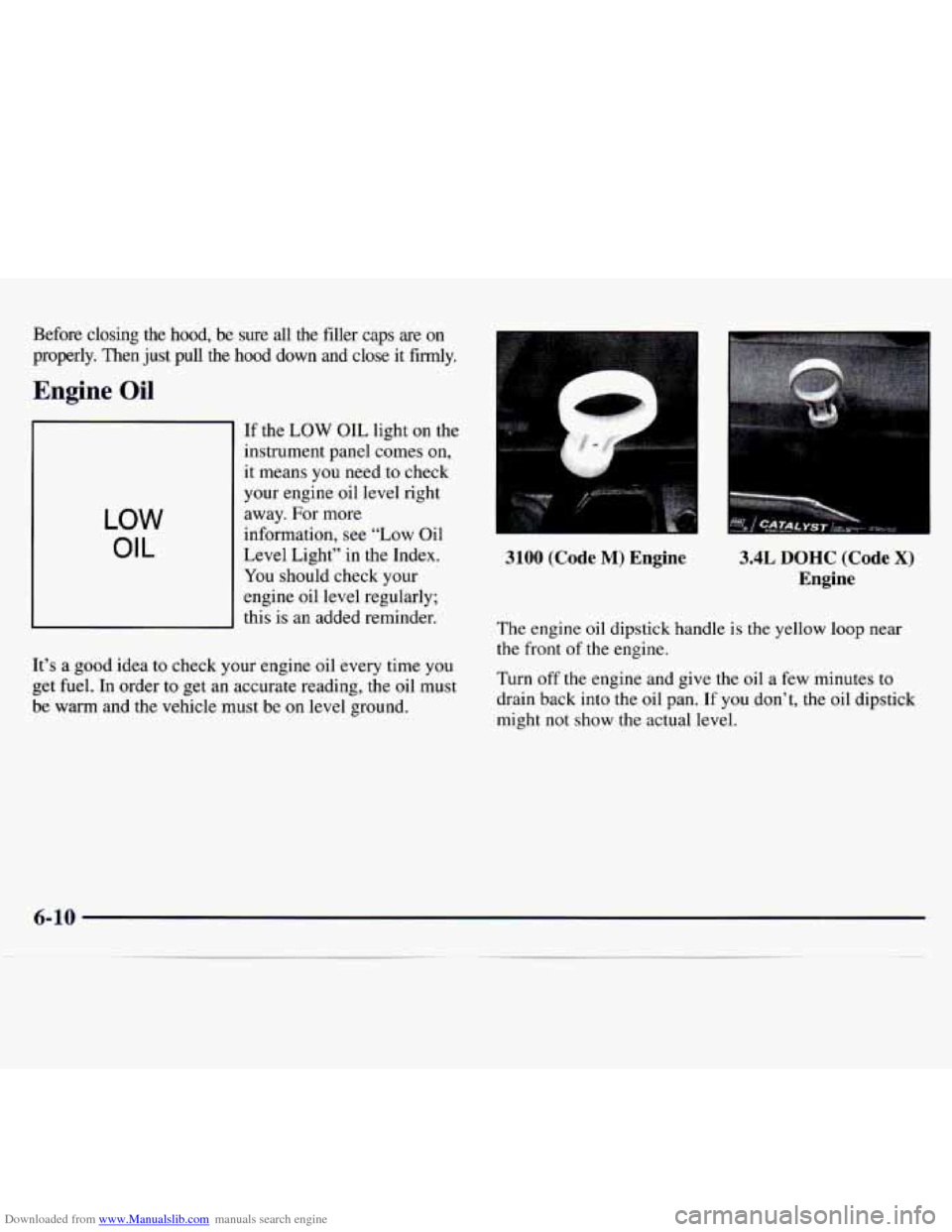
3100 (Code M) Engine 3.4L DOHC (Code X)
Engine
The engine oil dipstick handle is the yellow loop near
the front of the engine.
Turn off the engine and give the oil a few minutes to
drain back into the oil pan. If you don’t, the oil dipstick
might
not show the actual level.
Page 264 of 358
Downloaded from www.Manualslib.com manuals search engine Combination Stains
Stains caused by candy, ice cream, mayonnaise, chili
sauce and unknown stains can be removed as follows:
1. Carefully scrape off excess stain.
2. Clean with cool water and allow to dry.
3. If a stain remains, clean it with solvent-type cleaner.
Cleaning Vinyl
Use warm water and a clean cloth.
Rub with a clean, damp cloth to remove dirt. You
may have to do it more than once.
Things like tar, asphalt and shoe polish will stain if you
don’t get them
off quickly. Use a clean cloth and a
vinyyleather cleaner. See your dealer for this product.
Cleaning Leather
Use a soft cloth with lukewarm water and a mild soap or
saddle soap and wipe dry with a soft cloth. Then, let the
leather dry naturally.
Do not use heat to dry.
For stubborn stains, use a leather cleaner. See your
dealer for this product.
0 Never use oils, varnishes, solvent-based or abrasive
cleaners, furniture polish or shoe polish on leather.
Soiled or stained leather should be cleaned
immediately.
If dirt is allowed to work into the
finish,
it can harm the leather.
Cleaning the Top of the Instrument Panel
Use only mild soap and water to clean the top surfaces
of the instrument panel. Sprays containing silicones or
waxes may cause annoying reflections in the windshield
and even make
it difficult to see through the windshield
under certain conditions.
Page 269 of 358
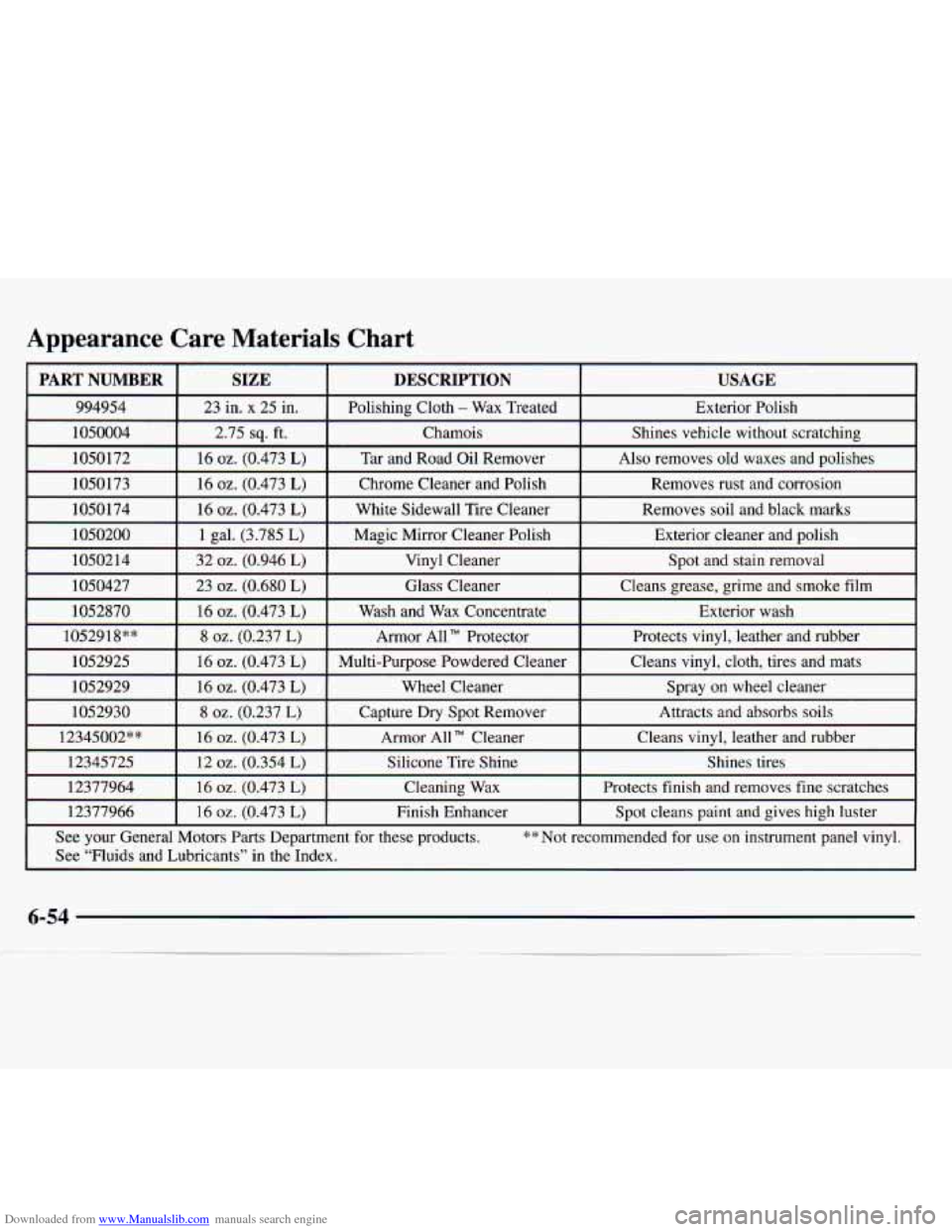
Downloaded from www.Manualslib.com manuals search engine Appearance Care Materials Chart
PART NUMBER USAGE DESCRIPTION SIZE
994954 Exterior Polish Polishing Cloth - Wax Treated 23 in. x 25 in.
105OO04
Removes rust and corrosion
Chrome Cleaner and Polish
16
oz. (0.473 L) 1050173 Also removes old waxes and polishes Tar and Road Oil Remover \
16
oz. (0.473 L) 1050172 Shines vehicle without scratching
Chamois 2.75
sq. ft.
I 1050174 I 16 oz. (0.473 L) I White Sidewall Tire Cleaner I Removes soil and black marks I
1050200
Spot and stain removal
Vinyl Cleaner
32
oz. (0.946 L)
1050214 Exterior cleaner
and polish
Magic Mirror Cleaner Polish
1
gal. (3.785 L)
I 1050427 I 23 oz. (0.680L) I Glass Cleaner I Cleans grease, grime and smoke film I
I
1052870 I 16 oz. (0.473 L) I Wash and Wax Concentrate I Exterior wash I
1052918""
Attracts and absorbs soils
Capture Dry Spot Remover 8
oz. (0.237 L) 1052930 Spray on wheel cleaner Wheel Cleaner
16
oz. (0.473 L)
1052929 Cleans vinyl, cloth, tires and mats Multi-Purpose Powdered Clean\
er
16
oz. (0.473 L) 1052925 Protects vinyl, leather and rubber
Armor All
TM Protector 8 oz. (0.237 L)
12345002"" Cleans vinyl, leather and rubber
Armor All TM Cleaner 16 oz. (0.473 L)
12345725
Spot cleans paint and gives
high luster Finish Enhancer 16 oz. (0.473 L) 12377966 Protects finish and removes
fine scratches Cleaning
Wax
16
oz. (0.473 L) 12377964 Shines tires Silicone Tire Shine
12
oz. (0.354 L)
See your General Motors Parts Department for these products. **Not recommended for use on instrument panel vinyl.
See "Fluids and Lubricants" in the Index.
6-54
Page 270 of 358
Downloaded from www.Manualslib.com manuals search engine Vehicle Identification Number (VIN) Engine Identification
The 8th character in your VIN is the engine code. This
code will help
you identify your engine, specifications
and replacement parts.
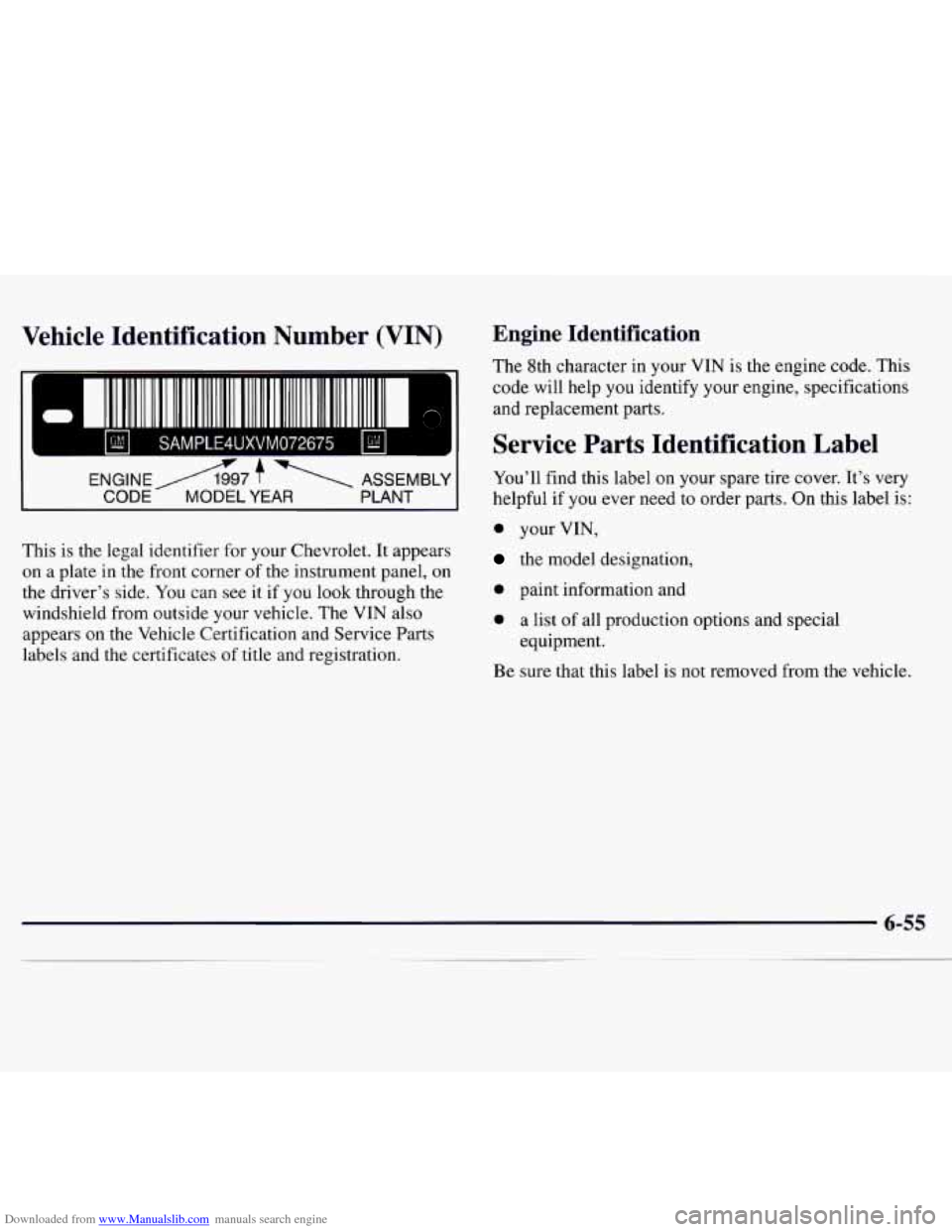
bl SAMPLE4UXVM072675 kl I Service Parts Identification Label
ENGINEA97 f ASSEMBLY You’ll find this label on your spare tire cover. It’s very
CODE MODEL YEAR PLANT helpful if you ever need to order parts. On this label is:
0 your VIN,
This is the legal identifier for your Chevrolet.
It appears the model designation,
on a plate in the front corner of the instrument panel, on
the driver’s side. You can
see it if you look through the 0 paint information and
windshield from outside your vehicle. The VIN also
0 a list of all production options and special
appears on the Vehicle Certification and Service Parts equipment.
labels and the certificates of title and registration.
Be sure that this label is
not removed from the vehicle.
Page 272 of 358
Downloaded from www.Manualslib.com manuals search engine Power Windows and Other Power Options
Circuit breakers in the fuse panel protect the power
windows and other power accessories. When the current
load is too heavy, the circuit breaker opens and closes,
protecting the circuit until the problem
is fixed.
Fuses and Circuit Breakers
The wiring circuits in your vehicle are protected from
short circuits by a combination of fuses, circuit breakers,
and fusible thermal links in the wiring itself. This
greatly reduces the chance of fires caused by
electrical problems.
Look at the silver-colored band inside the fuse. If the
band is broken or melted, replace the fuse. Be sure you
replace a bad fuse with a new one of the identical size
and rating.
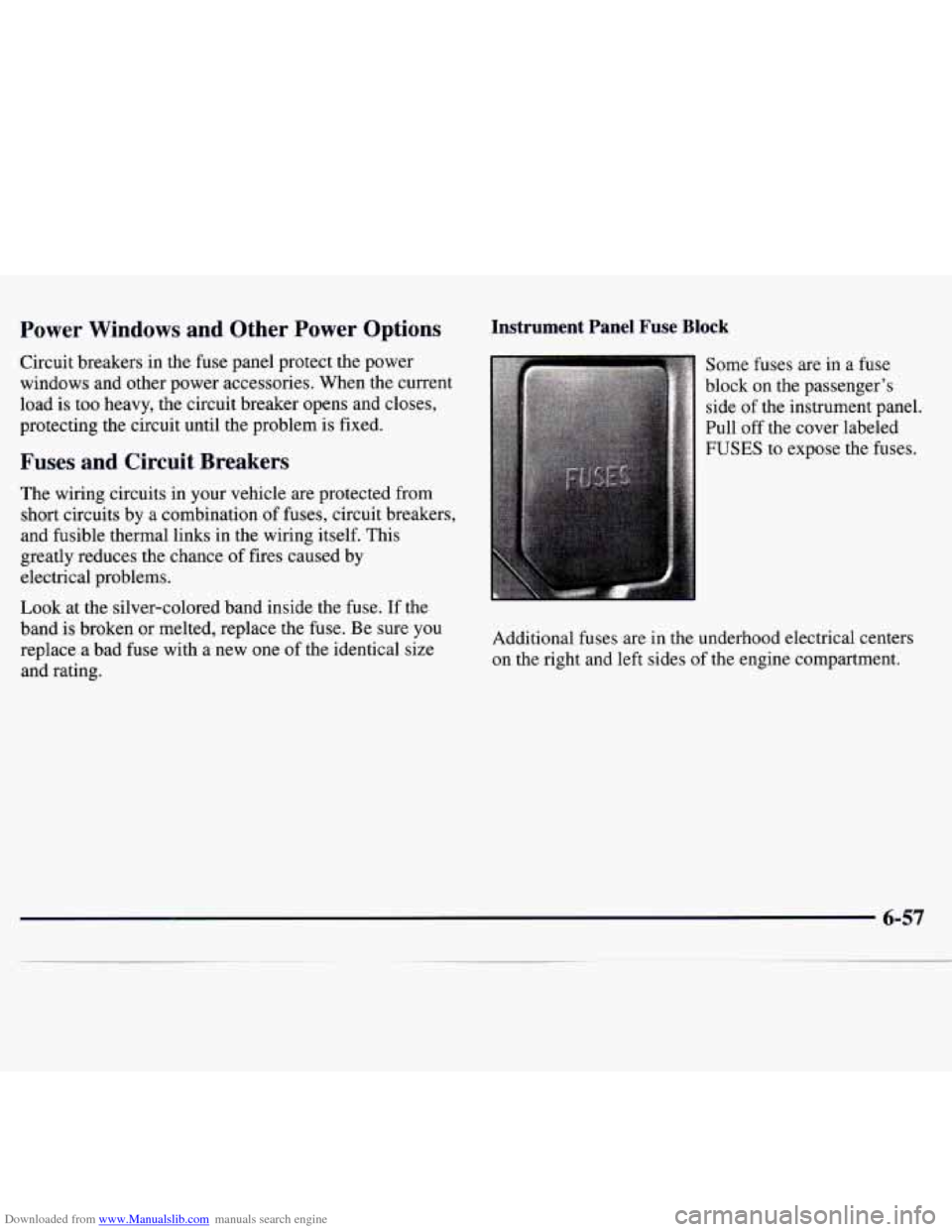
Instrument Panel Fuse Block
Some fuses are in a fuse
block on the passenger’s
i side of the instrument panel.
Pull off the cover labeled
FUSES to expose the fuses.
Additional fuses are in the underhood electrical centers
on the right and left sides of the engine compartment.
Page 273 of 358
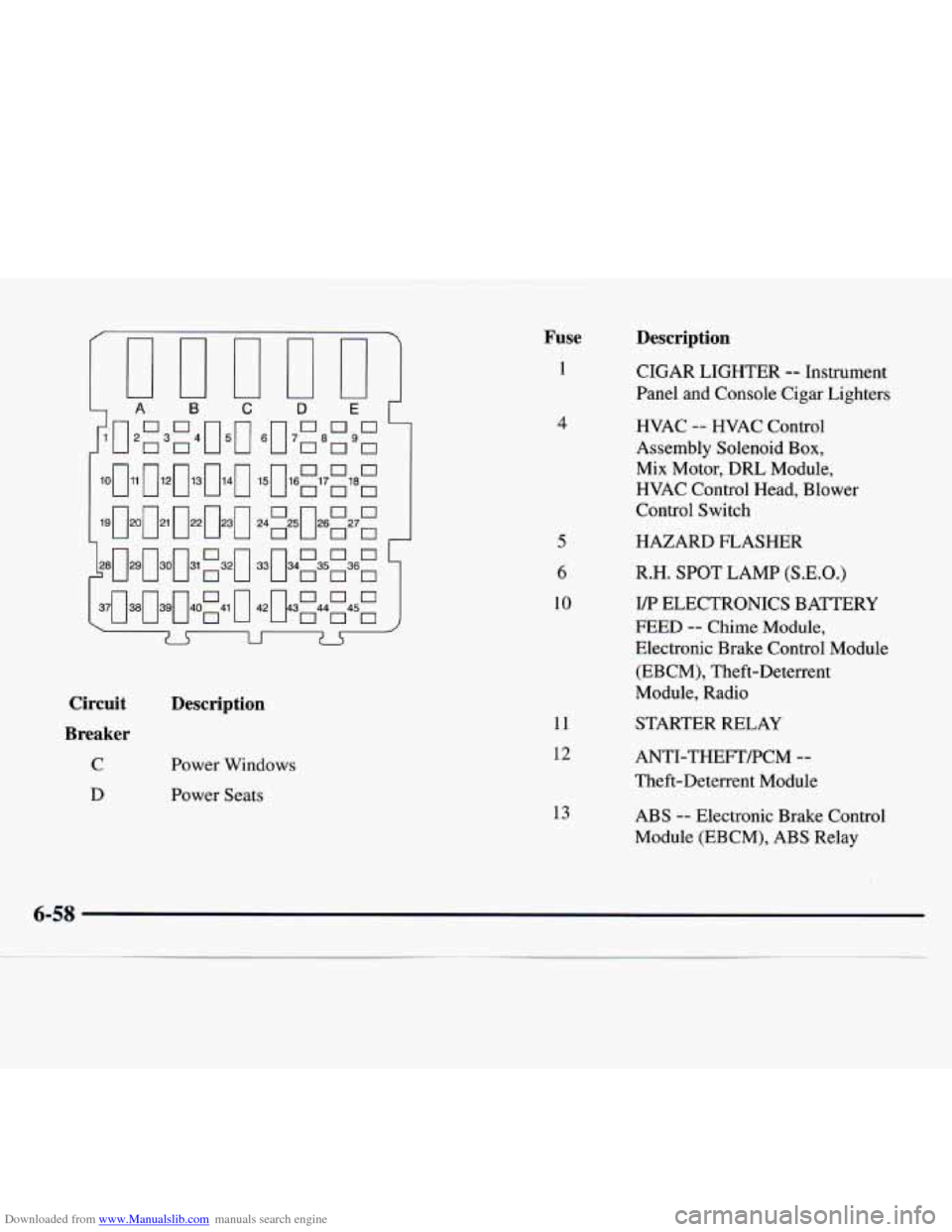
Downloaded from www.Manualslib.com manuals search engine Fuse
1
4
5
6
10
Circuit
Breaker
C
D
Description
11
12 Power Windows
Power Seats
13
Description
CIGAR LIGHTER -- Instrument
Panel and Console Cigar Lighters
HVAC
-- WAC Control
Assembly Solenoid Box,
Mix Motor, DRL Module,
HVAC Control Head, Blower
Control Switch
HAZARD FLASHER
R.H.
SPOT LAMP (S.E.O.)
I/P ELECTRONICS BATTERY
FEED
-- Chime Module,
Electronic Brake Control Module
(EBCM), Theft-Deterrent
Module, Radio
STARTER RELAY
ANTI-THEFTPCM
--
Theft-Deterrent Module
ABS
-- Electronic Brake Control
Module (EBCM), ABS Relay