lock CHEVROLET MONTE CARLO 2004 Owners Manual
[x] Cancel search | Manufacturer: CHEVROLET, Model Year: 2004, Model line: MONTE CARLO, Model: CHEVROLET MONTE CARLO 2004Pages: 416, PDF Size: 4.56 MB
Page 1 of 416
Seats and Restraint Systems........................... 1-1
Front Seats
............................................... 1-2
Rear Seats
............................................... 1-8
Safety Belts
.............................................1-10
Child Restraints
.......................................1-29
Air Bag Systems
......................................1-48
Restraint System Check
............................1-57
Features and Controls..................................... 2-1
Keys
........................................................ 2-2
Doors and Locks
....................................... 2-8
Windows
.................................................2-13
Theft-Deterrent Systems
............................2-15
Starting and Operating Your Vehicle
...........2-17
Mirrors
....................................................2-31
OnStar
®System
......................................2-34
HomeLink®Transmitter
.............................2-36
Storage Areas
.........................................2-40
Sunroof
..................................................2-41
Vehicle Personalization
.............................2-42
Instrument Panel............................................. 3-1
Instrument Panel Overview
.......................... 3-4
Climate Controls
......................................3-21
Warning Lights, Gages and Indicators
.........3-28
Message Center
.......................................3-44Driver Information Center (DIC)
..................3-52
Trip Computer
.........................................3-54
Audio System(s)
.......................................3-55
Driving Your Vehicle....................................... 4-1
Your Driving, the Road, and Your Vehicle
..... 4-2
Towing
...................................................4-31
Service and Appearance Care.......................... 5-1
Service
..................................................... 5-3
Fuel
......................................................... 5-4
Checking Things Under
the Hood
.............................................5-10
Headlamp Aiming
.....................................5-60
Bulb Replacement
....................................5-60
Windshield Wiper Blade Replacement
.........5-64
Tires
......................................................5-65
Appearance Care
.....................................5-94
Vehicle Identication
...............................5-102
Electrical System
....................................5-103
Capacities and Specications
...................5-110
Maintenance Schedule..................................... 6-1
Maintenance Schedule
................................ 6-2
Customer Assistance and Information.............. 7-1
Customer Assistance and Information
........... 7-2
Reporting Safety Defects
...........................7-12
Index................................................................ 1
2004 Chevrolet Monte Carlo Owner ManualM
Page 8 of 416
Front Seats
Manual Seats
{CAUTION:
You can lose control of the vehicle if you try to
adjust a manual driver’s seat while the vehicle
is moving. The sudden movement could startle
and confuse you, or make you push a pedal
when you don’t want to. Adjust the driver’s
seat only when the vehicle is not moving.
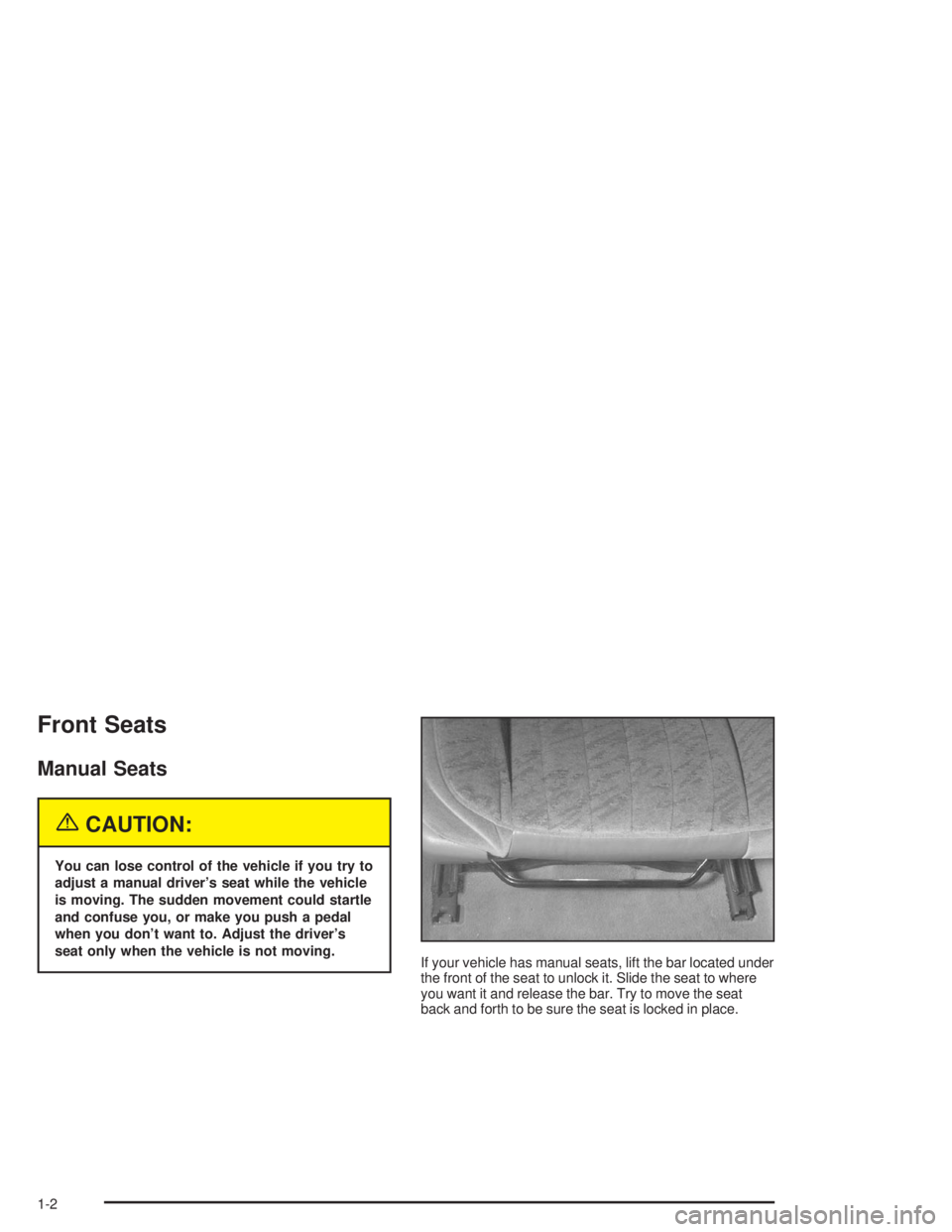
If your vehicle has manual seats, lift the bar located under
the front of the seat to unlock it. Slide the seat to where
you want it and release the bar. Try to move the seat
back and forth to be sure the seat is locked in place.
1-2
Page 10 of 416
Heated Seats
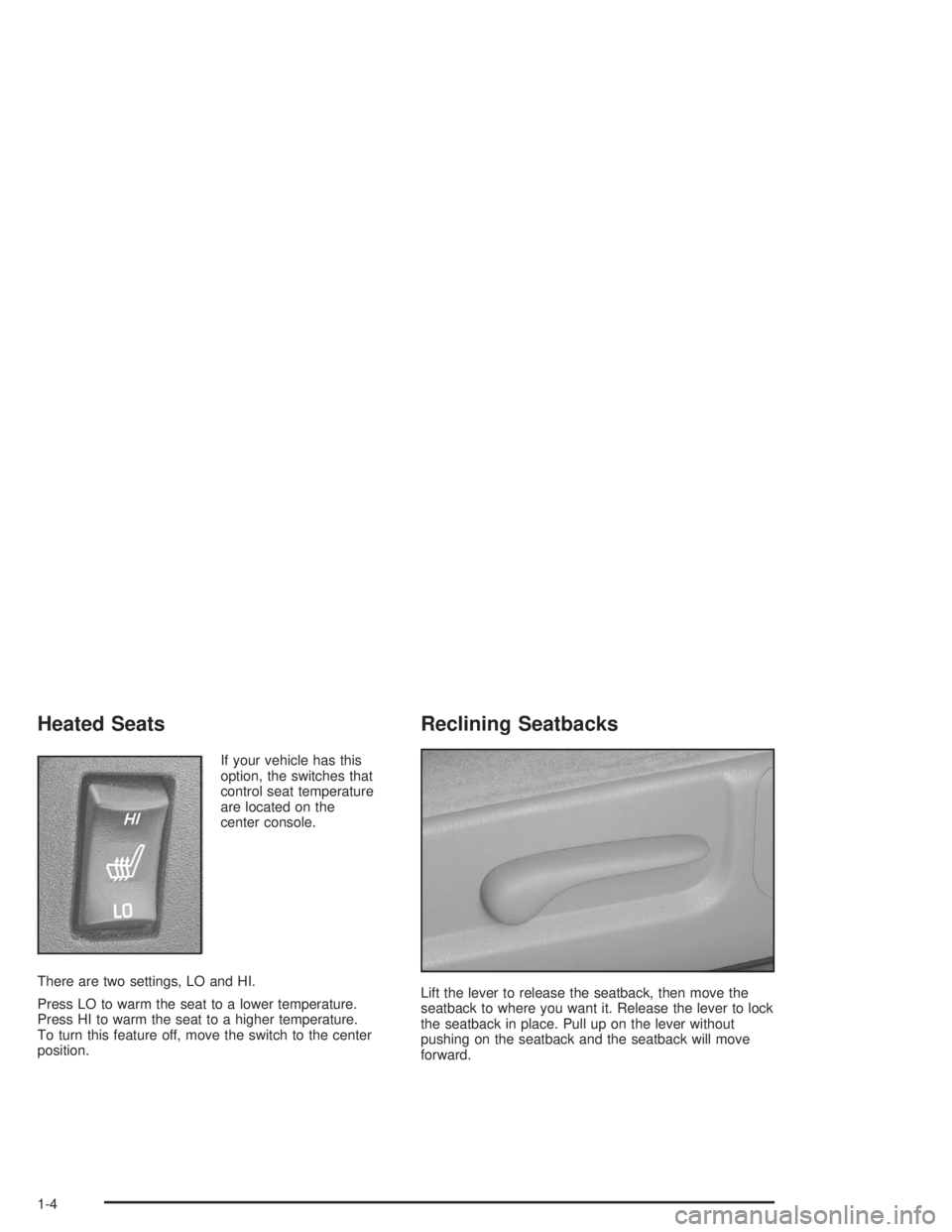
If your vehicle has this
option, the switches that
control seat temperature
are located on the
center console.
There are two settings, LO and HI.
Press LO to warm the seat to a lower temperature.
Press HI to warm the seat to a higher temperature.
To turn this feature off, move the switch to the center
position.
Reclining Seatbacks
Lift the lever to release the seatback, then move the
seatback to where you want it. Release the lever to lock
the seatback in place. Pull up on the lever without
pushing on the seatback and the seatback will move
forward.
1-4
Page 12 of 416
Head Restraints
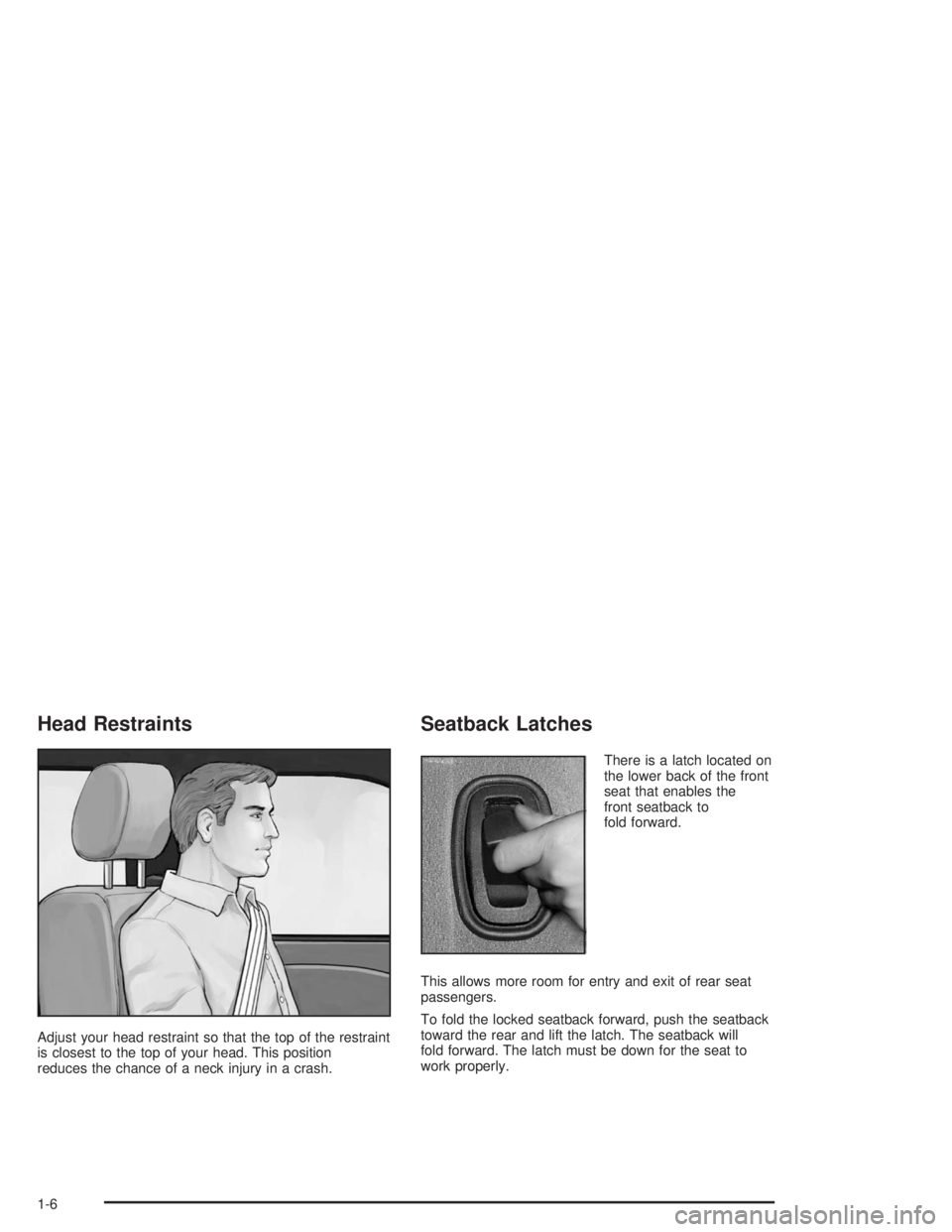
Adjust your head restraint so that the top of the restraint
is closest to the top of your head. This position
reduces the chance of a neck injury in a crash.
Seatback Latches
There is a latch located on
the lower back of the front
seat that enables the
front seatback to
fold forward.
This allows more room for entry and exit of rear seat
passengers.
To fold the locked seatback forward, push the seatback
toward the rear and lift the latch. The seatback will
fold forward. The latch must be down for the seat to
work properly.
1-6
Page 13 of 416
{CAUTION:
If the seatback isn’t locked, it could move
forward in a sudden stop or crash. That could
cause injury to the person sitting there. Always
press rearward on the seatback to be sure it is
locked.
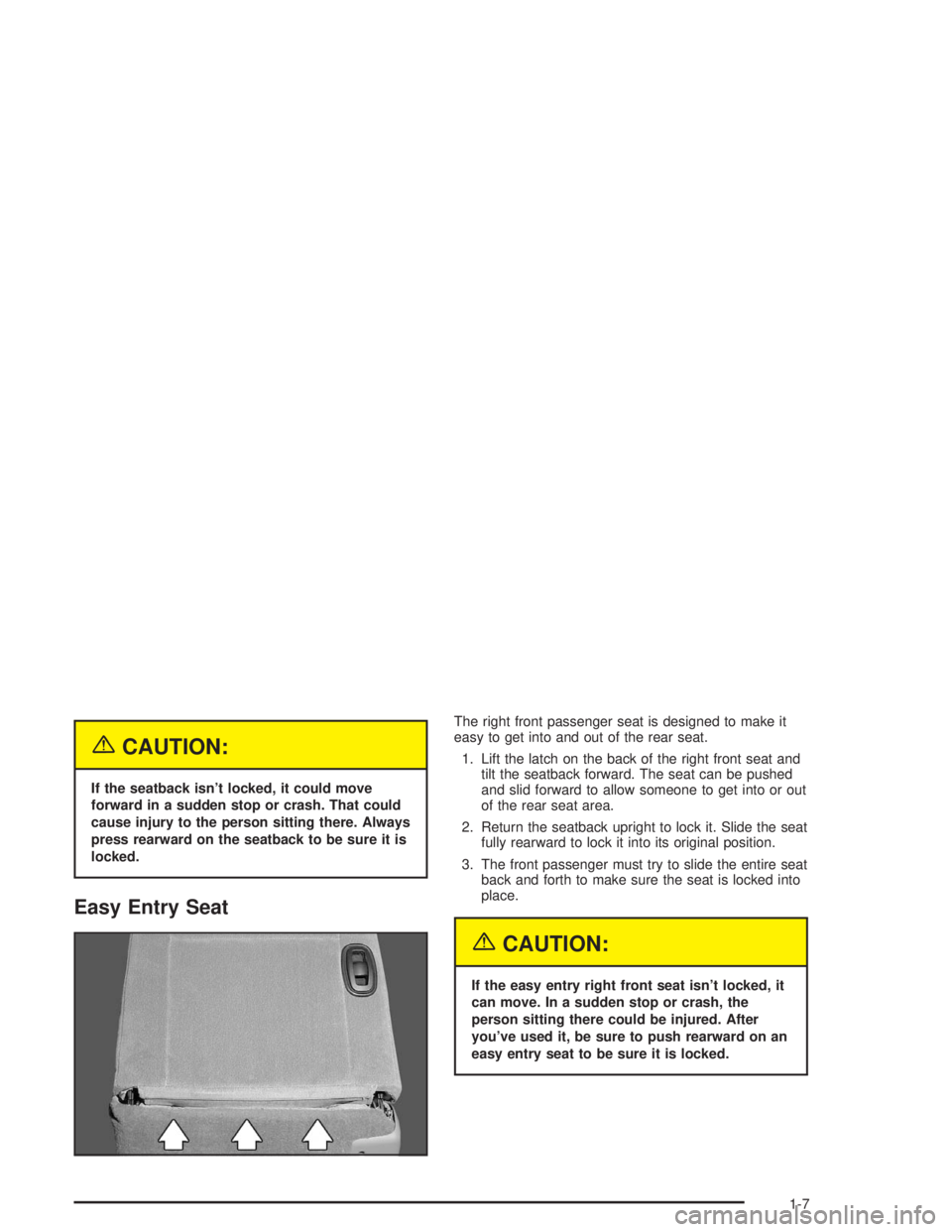
Easy Entry Seat
The right front passenger seat is designed to make it
easy to get into and out of the rear seat.
1. Lift the latch on the back of the right front seat and
tilt the seatback forward. The seat can be pushed
and slid forward to allow someone to get into or out
of the rear seat area.
2. Return the seatback upright to lock it. Slide the seat
fully rearward to lock it into its original position.
3. The front passenger must try to slide the entire seat
back and forth to make sure the seat is locked into
place.
{CAUTION:
If the easy entry right front seat isn’t locked, it
can move. In a sudden stop or crash, the
person sitting there could be injured. After
you’ve used it, be sure to push rearward on an
easy entry seat to be sure it is locked.
1-7
Page 15 of 416
This will allow you direct access to the trunk.
{CAUTION:
If the seatback isn’t locked, it could move
forward in a sudden stop or crash. That could
cause injury to the person sitting there. Always
press rearward on the seatback to be sure it is
locked.
{CAUTION:
A safety belt that is improperly routed, not
properly attached, or twisted won’t provide the
protection needed in a crash. The person
wearing the belt could be seriously injured.
After raising the rear seatback, always check
to be sure that the safety belts are properly
routed and attached, and are not twisted.To raise the rear seatback, follow these steps:
1. Raise the seatback up and make sure it latches.
Push and pull on the seatback to be sure it is
locked in position.
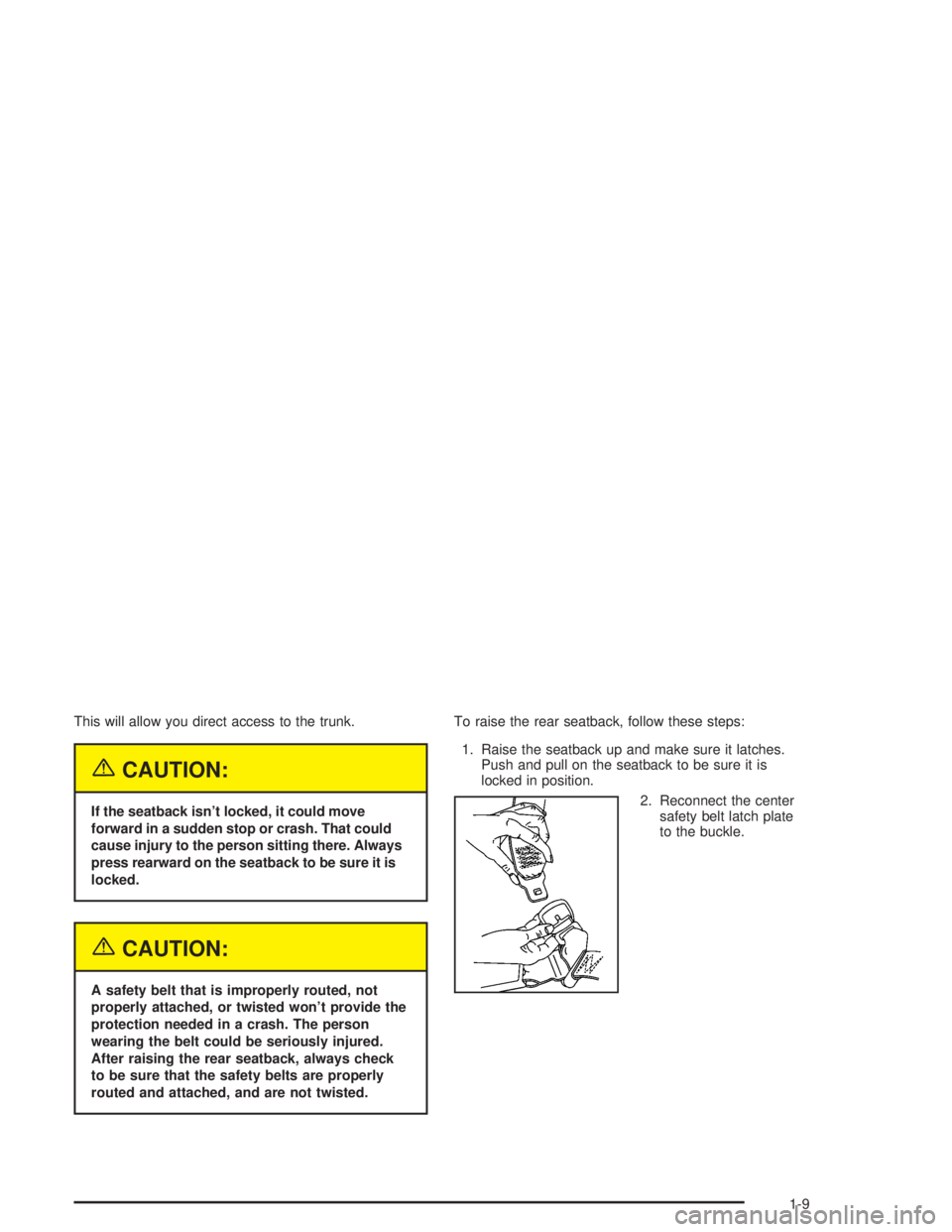
2. Reconnect the center
safety belt latch plate
to the buckle.
1-9
Page 16 of 416
Make sure the safety belt label is pointing to the release
button, and that both are facing the front of the
vehicle. Make sure the belt is not twisted. Push and pull
on the latch plate to be sure it is secure.
{CAUTION:
If the seatback isn’t locked, it could move
forward in a sudden stop or crash. That could
cause injury to the person sitting there. Always
press rearward on the seatback to be sure it is
locked.
When the seat is not in use, the seatback should be
kept in the upright locked position.
Safety Belts
Safety Belts: They Are for Everyone
This part of the manual tells you how to use safety
belts properly. It also tells you some things you should
not do with safety belts.
{CAUTION:
Don’t let anyone ride where he or she can’t
wear a safety belt properly. If you are in a
crash and you’re not wearing a safety belt,
your injuries can be much worse. You can hit
things inside the vehicle or be ejected from it.
You can be seriously injured or killed. In the
same crash, you might not be, if you are
buckled up. Always fasten your safety belt,
and check that your passengers’ belts are
fastened properly too.
1-10
Page 22 of 416
Driver Position
This part describes the driver’s restraint system.
Lap-Shoulder Belt
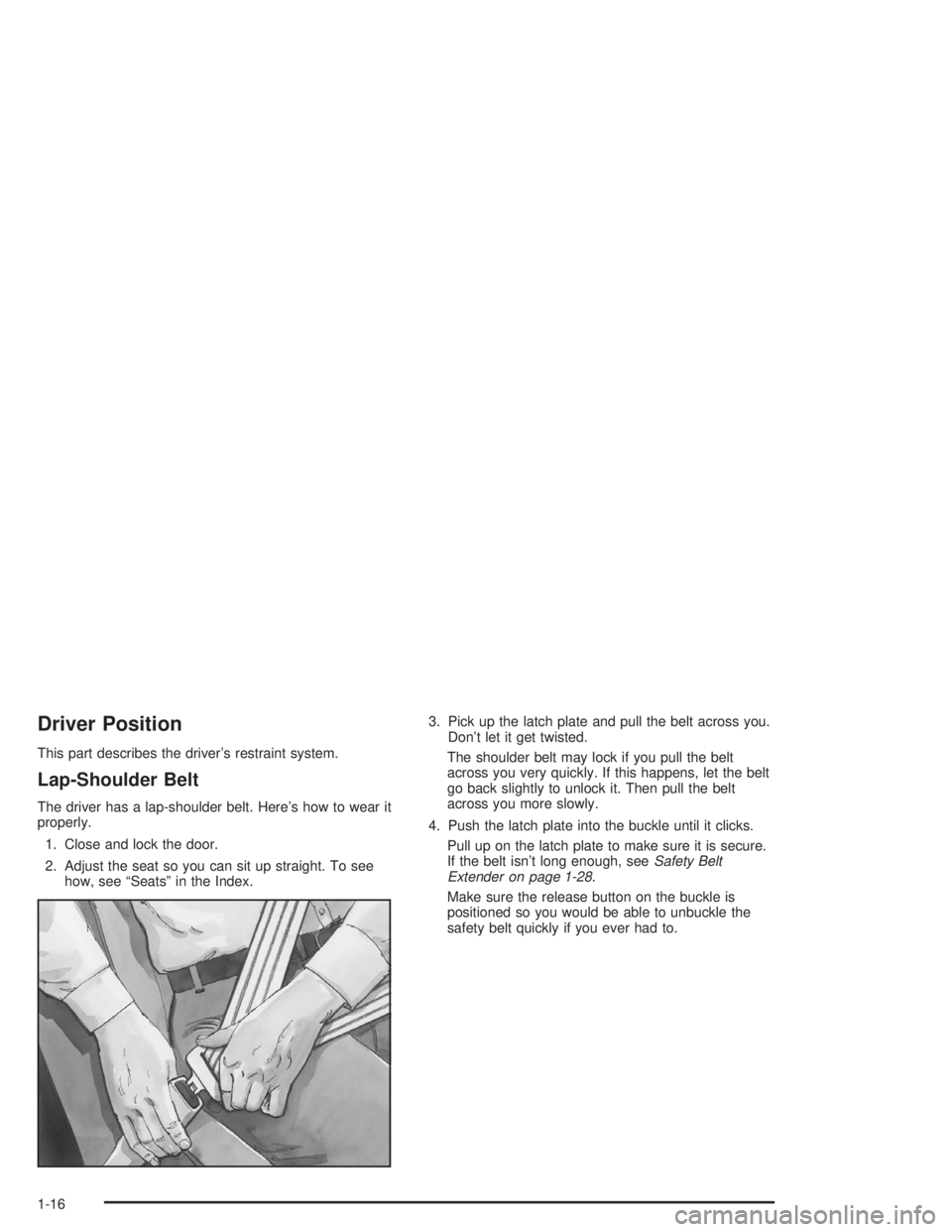
The driver has a lap-shoulder belt. Here’s how to wear it
properly.
1. Close and lock the door.
2. Adjust the seat so you can sit up straight. To see
how, see “Seats” in the Index.3. Pick up the latch plate and pull the belt across you.
Don’t let it get twisted.
The shoulder belt may lock if you pull the belt
across you very quickly. If this happens, let the belt
go back slightly to unlock it. Then pull the belt
across you more slowly.
4. Push the latch plate into the buckle until it clicks.
Pull up on the latch plate to make sure it is secure.
If the belt isn’t long enough, seeSafety Belt
Extender on page 1-28.
Make sure the release button on the buckle is
positioned so you would be able to unbuckle the
safety belt quickly if you ever had to.
1-16
Page 23 of 416
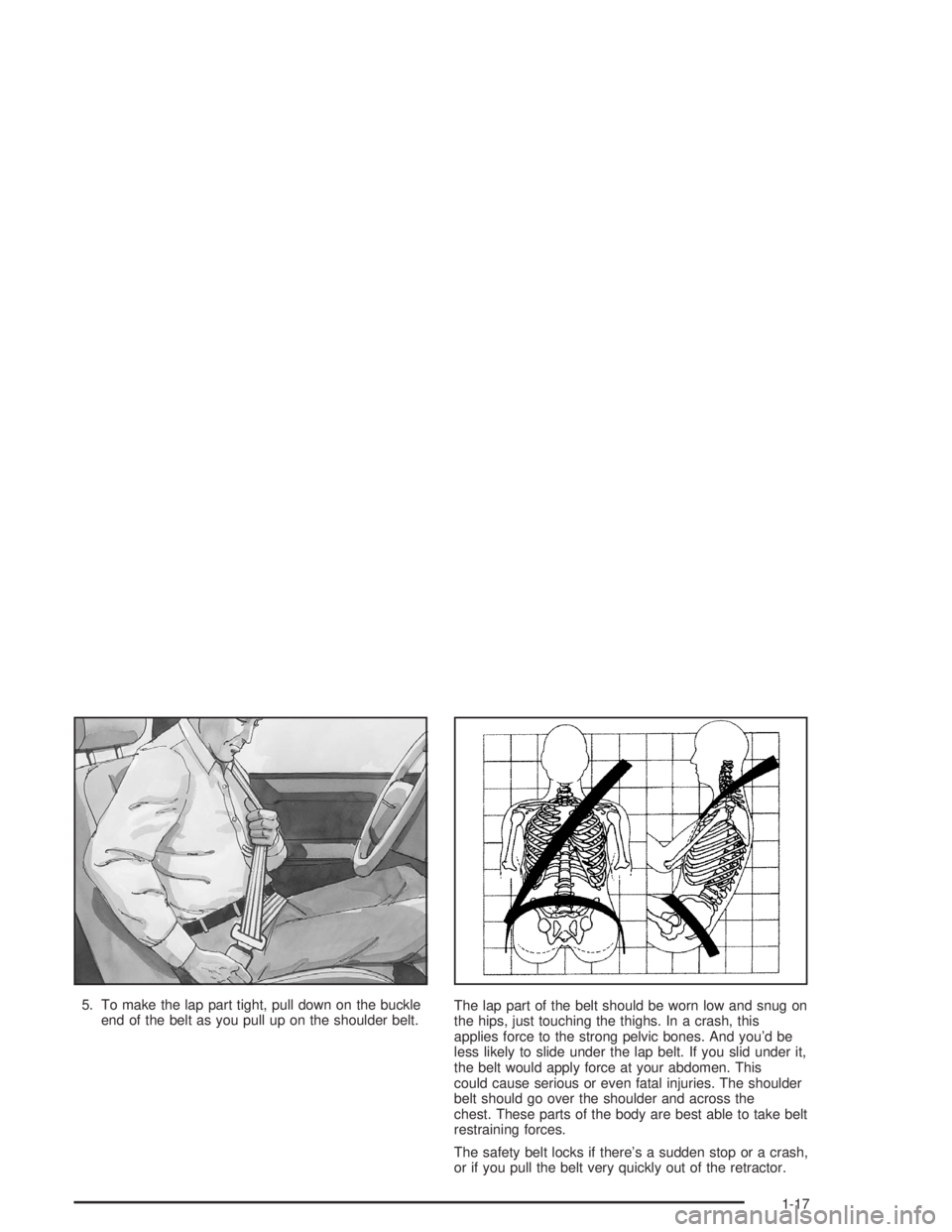
5. To make the lap part tight, pull down on the buckle
end of the belt as you pull up on the shoulder belt.The lap part of the belt should be worn low and snug on
the hips, just touching the thighs. In a crash, this
applies force to the strong pelvic bones. And you’d be
less likely to slide under the lap belt. If you slid under it,
the belt would apply force at your abdomen. This
could cause serious or even fatal injuries. The shoulder
belt should go over the shoulder and across the
chest. These parts of the body are best able to take belt
restraining forces.
The safety belt locks if there’s a sudden stop or a crash,
or if you pull the belt very quickly out of the retractor.
1-17
Page 29 of 416
The best way to protect the fetus is to protect the
mother. When a safety belt is worn properly, it’s more
likely that the fetus won’t be hurt in a crash. For
pregnant women, as for anyone, the key to making
safety belts effective is wearing them properly.
Right Front Passenger Position
To learn how to wear the right front passenger’s safety
belt properly, seeDriver Position on page 1-16.
The right front passenger’s safety belt works the same
way as the driver’s safety belt – except for one thing.
If you ever pull the shoulder portion of the belt out all the
way, you will engage the child restraint locking feature.
If this happens, just let the belt go back all the way
and start again.
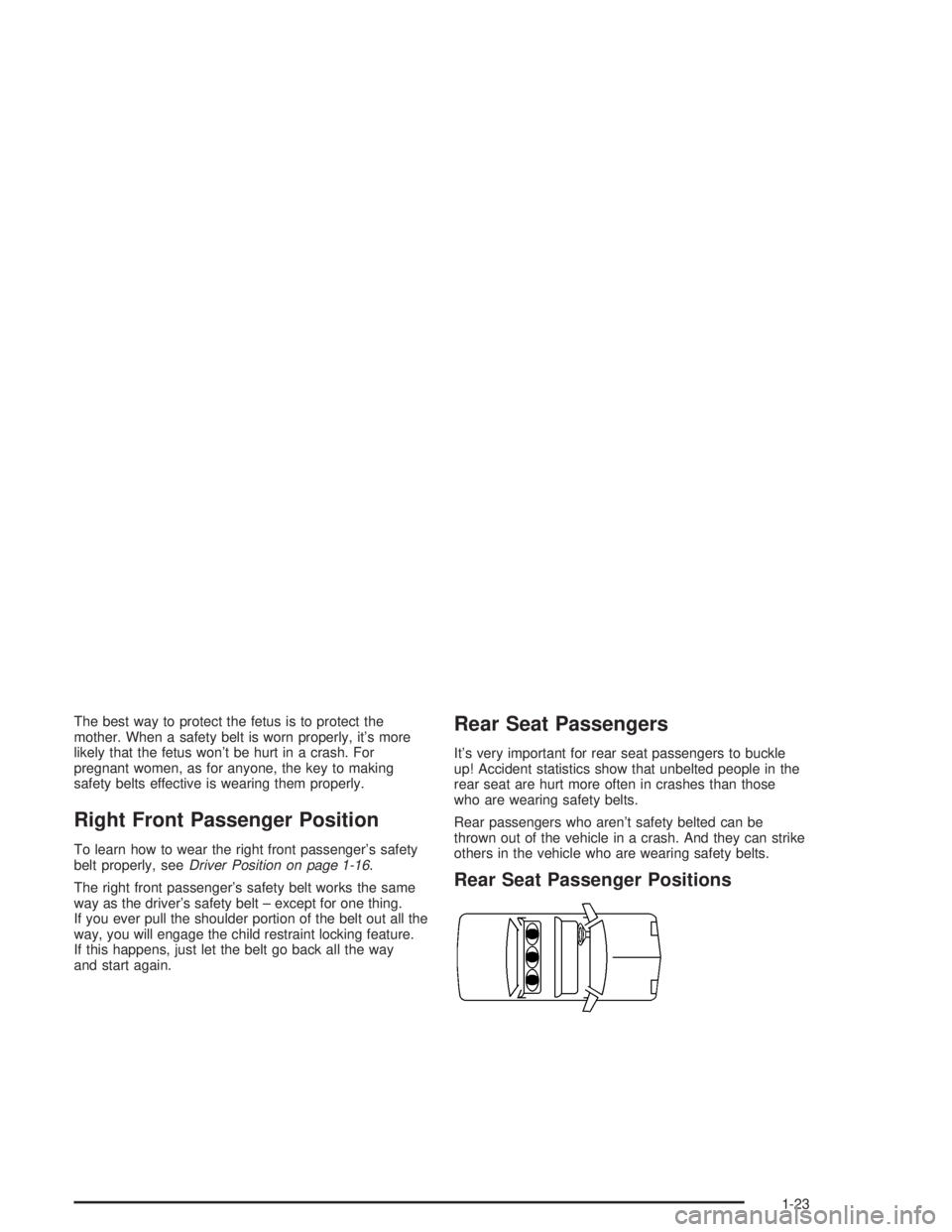
Rear Seat Passengers
It’s very important for rear seat passengers to buckle
up! Accident statistics show that unbelted people in the
rear seat are hurt more often in crashes than those
who are wearing safety belts.
Rear passengers who aren’t safety belted can be
thrown out of the vehicle in a crash. And they can strike
others in the vehicle who are wearing safety belts.
Rear Seat Passenger Positions
1-23