check engine light CHEVROLET MONTE CARLO 2007 6.G User Guide
[x] Cancel search | Manufacturer: CHEVROLET, Model Year: 2007, Model line: MONTE CARLO, Model: CHEVROLET MONTE CARLO 2007 6.GPages: 456, PDF Size: 2.43 MB
Page 251 of 456
Avoid needless heavy braking. Some people drive
in spurts — heavy acceleration followed by
heavy braking — rather than keeping pace with
traffic. This is a mistake. The brakes may not have
time to cool between hard stops. The brakes
will wear out much faster if you do a lot of heavy
braking. If you keep pace with the traffic and
allow realistic following distances, you will
eliminate a lot of unnecessary braking. That means
better braking and longer brake life.
If your vehicle’s engine ever stops while you are
driving, brake normally but do not pump the
brakes. If you do, the pedal may get harder to
push down. If the engine stops, you will still have
some power brake assist. But you will use it
when you brake. Once the power assist is used
up, it may take longer to stop and the brake pedal
will be harder to push.
Adding non-GM accessories can affect your
vehicle’s performance. SeeAccessories and
Modications on page 296.Anti-Lock Brake System (ABS)
Your vehicle may have the Anti-Lock Brake
System (ABS), an advanced electronic braking
system that will help prevent a braking skid.
If your vehicle has ABS,
this warning light on the
instrument panel
cluster will come on
briey when you
start your vehicle.
When you start your engine, or when you begin to
drive away, ABS will check itself. You may hear a
momentary motor or clicking noise while this test is
going on, and you may even notice that your brake
pedal moves or pulses a little. This is normal.
251
Page 267 of 456
Once you are moving on the freeway, make
certain you allow a reasonable following distance.
Expect to move slightly slower at night.
When you want to leave the freeway, move to the
proper lane well in advance. If you miss your
exit, do not, under any circumstances, stop and
back up. Drive on to the next exit.
The exit ramp can be curved, sometimes quite
sharply. The exit speed is usually posted. Reduce
your speed according to your speedometer, not
to your sense of motion. After driving for any
distance at higher speeds, you may tend to think
you are going slower than you actually are.
Before Leaving on a Long Trip
Make sure you are ready. Try to be well rested.
If you must start when you are not fresh — such
as after a day’s work — do not plan to make
too many miles that rst part of the journey.
Wear comfortable clothing and shoes you can
easily drive in.Is your vehicle ready for a long trip? If you keep it
serviced and maintained, it is ready to go. If it needs
service, have it done before starting out. Of course,
you will nd experienced and able service experts
in GM dealerships all across North America. They
will be ready and willing to help if you need it.
Here are some things you can check before a trip:
Windshield Washer Fluid:Is the reservoir
full? Are all windows clean inside and outside?
Wiper Blades:Are they in good shape?
Fuel, Engine Oil, Other Fluids:Have you
checked all levels?
Lamps:Are they all working? Are the lenses
clean?
Tires:They are vitally important to a safe,
trouble-free trip. Is the tread good enough
for long-distance driving? Are the tires
all inated to the recommended pressure?
Weather Forecasts:What is the weather
outlook along your route? Should you
delay your trip a short time to avoid a major
storm system?
Maps:Do you have up-to-date maps?
267
Page 275 of 456
{CAUTION:
Snow can trap exhaust gases under your
vehicle. This can cause deadly CO (carbon
monoxide) gas to get inside. CO could
overcome you and kill you. You cannot see
it or smell it, so you might not know it is in
your vehicle. Clear away snow from around
the base of your vehicle, especially any
that is blocking your exhaust pipe. And
check around again from time to time to be
sure snow does not collect there.
Open a window just a little on the side of
the vehicle that is away from the wind.
This will help keep CO out.Run the engine only as long as you must. This
saves fuel. When you run the engine, make it go
a little faster than just idle. That is, push the
accelerator slightly. This uses less fuel for the heat
that you get and it keeps the battery charged.
You will need a well-charged battery to restart the
vehicle, and possibly for signaling later on with
the headlamps. Let the heater run for a while.
Then, shut the engine off and close the window
almost all the way to preserve the heat. Start
the engine again and repeat this only when you
feel really uncomfortable from the cold. But do it as
little as possible. Preserve the fuel as long as
you can. To help keep warm, you can get out of
the vehicle and do some fairly vigorous exercises
every half hour or so until help comes.
275
Page 299 of 456
If your vehicle has the 5.3L V8 engine (VIN
Code C), use premium unleaded gasoline with a
posted octane rating of 91 or higher. You may
also use regular unleaded gasoline rated at
87 octane or higher, but your vehicle’s acceleration
may be slightly reduced, and you may notice a
slight audible knocking noise, commonly referred
to as spark knock. If the octane is less than
87, you may notice a heavy knocking noise when
you drive. If this occurs, use a gasoline rated
at 87 octane or higher as soon as possible.
Otherwise, you might damage your engine.
If you are using gasoline rated at 87 octane or
higher and you hear heavy knocking, your engine
needs service.
Gasoline Specications
At a minimum, gasoline should meet ASTM
specication D 4814 in the United States or
CAN/CGSB-3.5 in Canada. Some gasolines may
contain an octane-enhancing additive called
methylcyclopentadienyl manganese tricarbonyl
(MMT). General Motors recommends against the
use of gasolines containing MMT. SeeAdditives
on page 300for additional information.
California Fuel
If your vehicle is certied to meet California
Emissions Standards, it is designed to operate
on fuels that meet California specications.
See the underhood emission control label.
If this fuel is not available in states adopting
California emissions standards, your vehicle will
operate satisfactorily on fuels meeting federal
specications, but emission control system
performance may be affected. The malfunction
indicator lamp may turn on and your vehicle may
fail a smog-check test. SeeMalfunction Indicator
Lamp on page 181. If this occurs, return to
your authorized GM dealer for diagnosis. If it is
determined that the condition is caused by the
type of fuel used, repairs may not be covered
by your warranty.
299
Page 301 of 456
Fuel E85 (85% Ethanol)
The 8th digit of your Vehicle Identication
Number (VIN) shows the code letter or number
that identies your engine. You will nd the VIN at
the top left of the instrument panel. SeeVehicle
Identication Number (VIN) on page 394.
If your vehicle has the 3.5L V6 engine (VIN
Code K only), you may use either regular unleaded
gasoline or ethanol fuel containing up to 85%
ethanol (E85); also seeFuel on page 298.Inall
other engines, including the 3.5L V6 (VIN Code N),
use only regular unleaded gasoline.
Only vehicles that have the 3.5L V6 engine
(VIN Code K) may use 85% ethanol fuel (E85).
General Motors encourages the use of E85
in vehicles that are designed to use it. The ethanol
in E85 is a “renewable” fuel, meaning it is made
from renewable sources such as corn and
other crops.Many service stations will not have an 85% ethanol
fuel (E85) pump available. The U. S. Department
of Energy has an alternative fuels website
(www.eere.energy.gov/afdc/infrastructure/
locator.html) that can help you nd E85 fuel. Those
stations that do have E85 should have a label
indicating ethanol content. Do not use the fuel if the
ethanol content is greater than 85%.
At a minimum, E85 should meet ASTM
Specication D 5798. By denition, this means
that fuel labeled E85 will have an ethanol content
between 70% and 85%. Filling the fuel tank
with fuel mixtures that do not meet ASTM
specications can affect driveability and could
cause the check engine light to come on.
301
Page 320 of 456
How to Add Fluid
Refer to the Maintenance Schedule to determine
what kind of transaxle uid to use. See
Recommended Fluids and Lubricants on page 415.
If the uid level is low, add only enough of the
proper uid to bring the level into the
cross-hatched area on the dipstick.
1. Pull out the dipstick.
2. Using a long-neck funnel, add enough uid at
the dipstick hole to bring it to the proper level.
It does not take much uid, generally less
than one pint (0.5 L). Do not overll.
Notice:Use of the incorrect automatic
transaxle uid may damage your vehicle, and
the damages may not be covered by your
warranty. Always use the automatic transaxle
uid listed inRecommended Fluids and
Lubricants on page 415.
3. After adding uid, recheck the uid level as
described under “How to Check Automatic
Transaxle Fluid,” earlier in this section.
4. When the correct uid level is obtained, push
the dipstick back in all the way.
Engine Coolant
The cooling system in your vehicle is lled with
DEX-COOL®engine coolant. This coolant is
designed to remain in your vehicle for ve years or
150,000 miles (240 000 km), whichever occurs
rst, if you add only DEX-COOL
®extended
life coolant.
The following explains your cooling system and
how to add coolant when it is low. If you have
a problem with engine overheating or if you need
to add coolant to the radiator, seeEngine
Overheating on page 323.
A 50/50 mixture of clean, drinkable water and
DEX-COOL
®coolant will:
Give freezing protection down to−34°F (−37°C).
Give boiling protection up to 265°F (129°C).
Protect against rust and corrosion.
Help keep the proper engine temperature.
Let the warning lights and gages work as they
should.
320
Page 323 of 456
{CAUTION:
You can be burned if you spill coolant
on hot engine parts. Coolant contains
ethylene glycol, and it will burn if the
engine parts are hot enough. Do not spill
coolant on a hot engine.
Occasionally check the coolant level in the
radiator. For information on how to add coolant to
the radiator, seeCooling System on page 326.
Pressure Cap
Notice:If the pressure cap is not tightly
installed, coolant loss and possible engine
damage may occur. Be sure the cap is properly
and tightly secured.
SeeEngine Compartment Overview on page 308
for more information on location.
Engine Overheating
There is a coolant temperature gage and a
warning light on the instrument panel that indicate
an overheated engine condition. SeeEngine
Coolant Temperature Gage on page 180
andEngine Coolant Temperature Warning
Light on page 179.
In addition, you will nd an ENGINE
OVERHEATED IDLE ENGINE and an ENGINE
OVERHEATED STOP ENGINE message
displayed on the vehicle’s Driver Information
Center (DIC). SeeDIC Warnings and Messages
on page 195for more information.
323
Page 339 of 456
{CAUTION:
Using a match near a battery can cause
battery gas to explode. People have been
hurt doing this, and some have been
blinded. Use a ashlight if you need
more light.
Be sure the battery has enough water.
You do not need to add water to the
battery installed in your new vehicle. But
if a battery has ller caps, be sure the
right amount of uid is there. If it is low,
add water to take care of that rst. If you
do not, explosive gas could be present.
Battery uid contains acid that can
burn you. Do not get it on you. If you
accidentally get it in your eyes or on your
skin, ush the place with water and get
medical help immediately.
{CAUTION:
Fans or other moving engine parts can
injure you badly. Keep your hands away
from moving parts once the engine is
running.
5. Check that the jumper cables do not have
loose or missing insulation. If they do, you
could get a shock. The vehicles could
be damaged too.
Before you connect the cables, here are some
basic things you should know. Positive (+)
will go to positive (+) or to a remote positive (+)
terminal if the vehicle has one. Negative (−)
will go to a heavy, unpainted metal engine part
or to a remote negative (−) terminal if the
vehicle has one.
Do not connect positive (+) to negative (−), or
you will get a short that would damage the
battery and maybe other parts too. And do
not connect the negative (−) cable to the
negative (−) terminal on the dead battery
because this can cause sparks.
339
Page 445 of 456
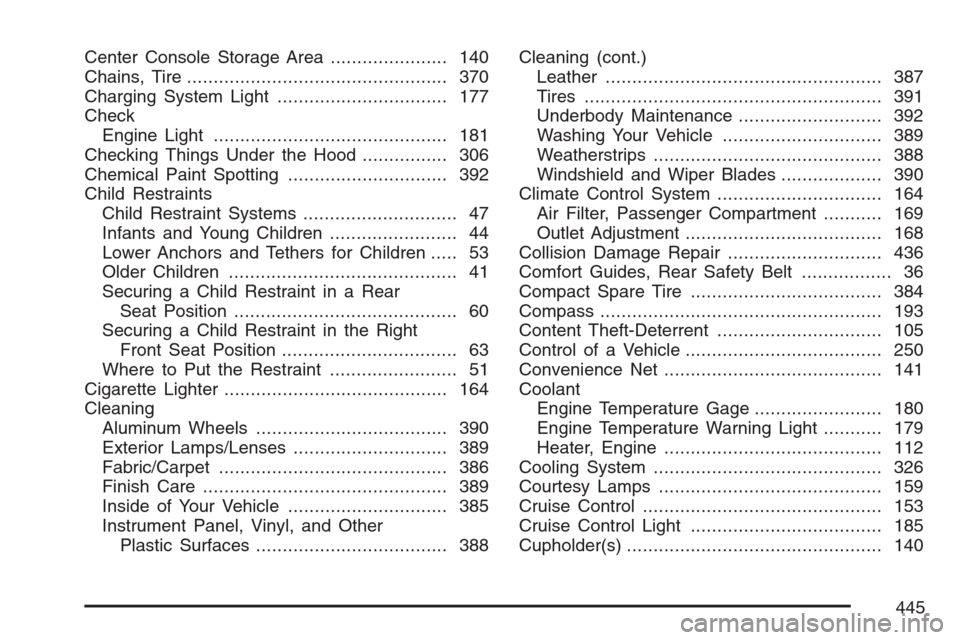
Center Console Storage Area...................... 140
Chains, Tire................................................. 370
Charging System Light................................ 177
Check
Engine Light............................................ 181
Checking Things Under the Hood................ 306
Chemical Paint Spotting.............................. 392
Child Restraints
Child Restraint Systems............................. 47
Infants and Young Children........................ 44
Lower Anchors and Tethers for Children..... 53
Older Children........................................... 41
Securing a Child Restraint in a Rear
Seat Position.......................................... 60
Securing a Child Restraint in the Right
Front Seat Position................................. 63
Where to Put the Restraint........................ 51
Cigarette Lighter.......................................... 164
Cleaning
Aluminum Wheels.................................... 390
Exterior Lamps/Lenses............................. 389
Fabric/Carpet........................................... 386
Finish Care.............................................. 389
Inside of Your Vehicle.............................. 385
Instrument Panel, Vinyl, and Other
Plastic Surfaces.................................... 388Cleaning (cont.)
Leather.................................................... 387
Tires........................................................ 391
Underbody Maintenance........................... 392
Washing Your Vehicle .............................. 389
Weatherstrips........................................... 388
Windshield and Wiper Blades................... 390
Climate Control System............................... 164
Air Filter, Passenger Compartment........... 169
Outlet Adjustment..................................... 168
Collision Damage Repair............................. 436
Comfort Guides, Rear Safety Belt................. 36
Compact Spare Tire.................................... 384
Compass..................................................... 193
Content Theft-Deterrent............................... 105
Control of a Vehicle..................................... 250
Convenience Net......................................... 141
Coolant
Engine Temperature Gage........................ 180
Engine Temperature Warning Light........... 179
Heater, Engine......................................... 112
Cooling System........................................... 326
Courtesy Lamps.......................................... 159
Cruise Control............................................. 153
Cruise Control Light.................................... 185
Cupholder(s)................................................ 140
445
Page 447 of 456
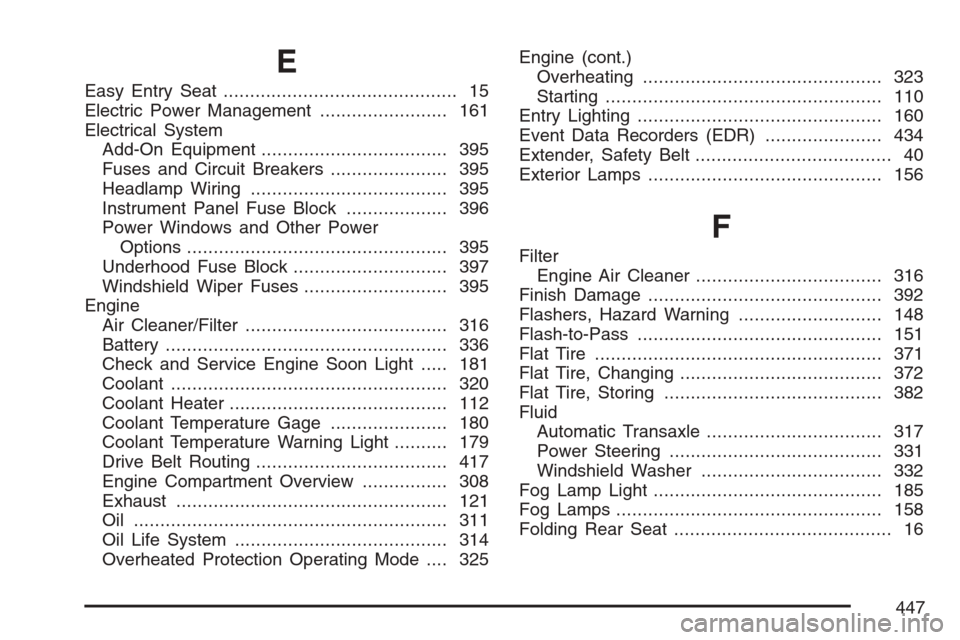
E
Easy Entry Seat............................................ 15
Electric Power Management........................ 161
Electrical System
Add-On Equipment................................... 395
Fuses and Circuit Breakers...................... 395
Headlamp Wiring..................................... 395
Instrument Panel Fuse Block................... 396
Power Windows and Other Power
Options................................................. 395
Underhood Fuse Block............................. 397
Windshield Wiper Fuses........................... 395
Engine
Air Cleaner/Filter...................................... 316
Battery..................................................... 336
Check and Service Engine Soon Light..... 181
Coolant.................................................... 320
Coolant Heater......................................... 112
Coolant Temperature Gage...................... 180
Coolant Temperature Warning Light.......... 179
Drive Belt Routing.................................... 417
Engine Compartment Overview................ 308
Exhaust................................................... 121
Oil ........................................................... 311
Oil Life System........................................ 314
Overheated Protection Operating Mode.... 325Engine (cont.)
Overheating............................................. 323
Starting.................................................... 110
Entry Lighting.............................................. 160
Event Data Recorders (EDR)...................... 434
Extender, Safety Belt..................................... 40
Exterior Lamps............................................ 156
F
Filter
Engine Air Cleaner................................... 316
Finish Damage............................................ 392
Flashers, Hazard Warning........................... 148
Flash-to-Pass.............................................. 151
Flat Tire...................................................... 371
Flat Tire, Changing...................................... 372
Flat Tire, Storing......................................... 382
Fluid
Automatic Transaxle................................. 317
Power Steering........................................ 331
Windshield Washer.................................. 332
Fog Lamp Light........................................... 185
Fog Lamps.................................................. 158
Folding Rear Seat......................................... 16
447