mirror CHEVROLET MONTE CARLO 2007 6.G Owners Manual
[x] Cancel search | Manufacturer: CHEVROLET, Model Year: 2007, Model line: MONTE CARLO, Model: CHEVROLET MONTE CARLO 2007 6.GPages: 456, PDF Size: 2.43 MB
Page 1 of 456
Seats and Restraint Systems
....................... 7
Front Seats
.............................................. 8
Rear Seats
............................................. 16
Safety Belts
............................................ 18
Child Restraints
...................................... 41
Airbag System
........................................ 68
Restraint System Check
......................... 84
Features and Controls
................................ 87
Keys
....................................................... 89
Doors and Locks
.................................... 98
Windows
............................................... 103
Theft-Deterrent Systems
....................... 105
Starting and Operating Your Vehicle
..... 108
Mirrors
.................................................. 123OnStar®System
................................... 125
Universal Home Remote System
.......... 129
Storage Areas
...................................... 140
Sunroof
................................................ 141
Instrument Panel
....................................... 143
Instrument Panel Overview
................... 146
Climate Controls
................................... 164
Warning Lights, Gages, and Indicators
.... 170
Driver Information Center (DIC)
............ 186
Audio System(s)
................................... 210
Driving Your Vehicle
................................. 245
Your Driving, the Road, and Your
Vehicle
.............................................. 246
Towing
................................................. 282
2007 Chevrolet Monte Carlo Owner ManualM
1
Page 87 of 456
Keys.............................................................. 89
Remote Keyless Entry (RKE) System.......... 90
Remote Keyless Entry (RKE)
System Operation.................................... 91
Doors and Locks.......................................... 98
Door Locks................................................. 98
Power Door Locks....................................... 99
Automatic Door Lock................................. 100
Programmable Automatic Door Unlock....... 100
Lockout Protection..................................... 100
Trunk........................................................ 101
Windows...................................................... 103
Power Windows........................................ 104
Sun Visors................................................ 104
Theft-Deterrent Systems............................. 105
Content Theft-Deterrent............................. 105
PASS-Key
®III+......................................... 106
PASS-Key®III+ Operation......................... 107
Starting and Operating Your Vehicle......... 108
New Vehicle Break-In................................ 108
Ignition Positions....................................... 109Retained Accessory Power (RAP)............. 110
Starting the Engine.................................... 110
Engine Coolant Heater.............................. 112
Active Fuel Management™
(5.3L V8 Engine).................................... 113
Automatic Transaxle Operation.................. 113
Parking Brake........................................... 117
Shifting Into Park (P) ................................. 118
Shifting Out of Park (P)............................. 120
Parking Over Things That Burn................. 120
Engine Exhaust......................................... 121
Running the Engine While Parked............. 122
Mirrors......................................................... 123
Manual Rearview Mirror............................. 123
Manual Rearview Mirror with OnStar
®.......... 123
Automatic Dimming Rearview Mirror
with OnStar
®.......................................... 123
Outside Power Mirrors............................... 124
Outside Convex Mirror............................... 124
Outside Heated Mirrors............................. 124
Section 2 Features and Controls
87
Page 104 of 456
Power Windows
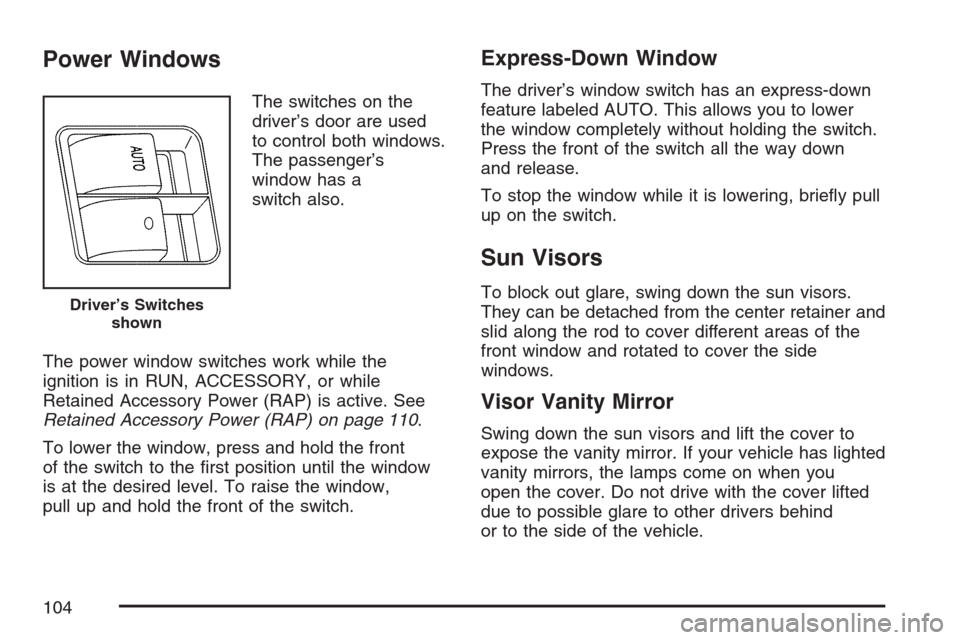
The switches on the
driver’s door are used
to control both windows.
The passenger’s
window has a
switch also.
The power window switches work while the
ignition is in RUN, ACCESSORY, or while
Retained Accessory Power (RAP) is active. See
Retained Accessory Power (RAP) on page 110.
To lower the window, press and hold the front
of the switch to the rst position until the window
is at the desired level. To raise the window,
pull up and hold the front of the switch.
Express-Down Window
The driver’s window switch has an express-down
feature labeled AUTO. This allows you to lower
the window completely without holding the switch.
Press the front of the switch all the way down
and release.
To stop the window while it is lowering, briey pull
up on the switch.
Sun Visors
To block out glare, swing down the sun visors.
They can be detached from the center retainer and
slid along the rod to cover different areas of the
front window and rotated to cover the side
windows.
Visor Vanity Mirror
Swing down the sun visors and lift the cover to
expose the vanity mirror. If your vehicle has lighted
vanity mirrors, the lamps come on when you
open the cover. Do not drive with the cover lifted
due to possible glare to other drivers behind
or to the side of the vehicle.
Driver’s Switches
shown
104
Page 123 of 456
Mirrors
Manual Rearview Mirror
Adjust all the mirrors so you can see clearly when
you are sitting in a comfortable driving position.
To reduce glare from headlamps behind you, pull
the lever at the bottom of the mirror toward you
(to the night position). To return the mirror back to
the day position, push the lever away from you.
There are two lamps located on the bottom of the
mirror. Press the button next to each lamp to
turn it on and off.
Manual Rearview Mirror with OnStar®
If the vehicle has this mirror, it has a lever located
at the bottom of the mirror between the two lamps.
The lever is used to change the mirror from the
day to the night position. To reduce glare from
headlamps behind you while driving at night, pull
the lever toward you. To return the mirror to the day
position, return the lever to its original position.
There are two map lamps located on the bottom
of the mirror. Press the button next to each lamp
to turn it on and off.There are also OnStar
®buttons located at the
bottom of the mirror face. See your dealer for more
information on the system and how to subscribe
to OnStar
®. SeeOnStar®System on page 125
for more information about the services OnStar®
provides.
Automatic Dimming Rearview
Mirror with OnStar
®
The vehicle may have an automatic dimming
rearview mirror with the OnStar®System.
Press the button located below the mirror, on
the far left, for up to three seconds to turn
the automatic dimming feature off and on.
There are two map lamps located on the bottom
of the mirror. Press the button next to each lamp
to turn it on and off.
There are also OnStar
®buttons located at the
bottom of the mirror. See your dealer for
more information on the system and how to
subscribe to OnStar
®. SeeOnStar®System
on page 125for more information about the
service OnStar
®provides.
123
Page 124 of 456
Outside Power Mirrors
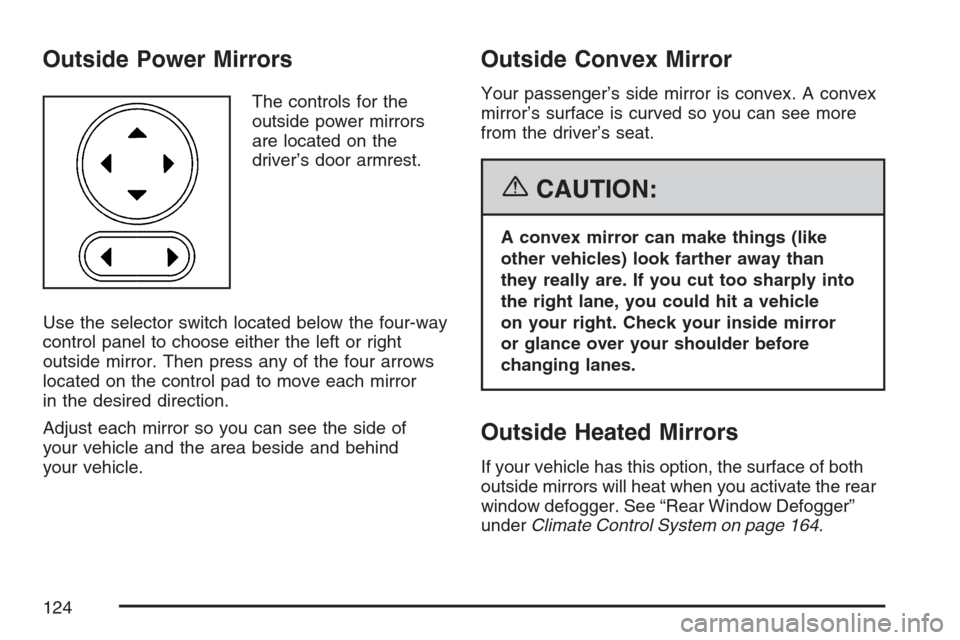
The controls for the
outside power mirrors
are located on the
driver’s door armrest.
Use the selector switch located below the four-way
control panel to choose either the left or right
outside mirror. Then press any of the four arrows
located on the control pad to move each mirror
in the desired direction.
Adjust each mirror so you can see the side of
your vehicle and the area beside and behind
your vehicle.
Outside Convex Mirror
Your passenger’s side mirror is convex. A convex
mirror’s surface is curved so you can see more
from the driver’s seat.
{CAUTION:
A convex mirror can make things (like
other vehicles) look farther away than
they really are. If you cut too sharply into
the right lane, you could hit a vehicle
on your right. Check your inside mirror
or glance over your shoulder before
changing lanes.
Outside Heated Mirrors
If your vehicle has this option, the surface of both
outside mirrors will heat when you activate the rear
window defogger. See “Rear Window Defogger”
underClimate Control System on page 164.
124
Page 159 of 456
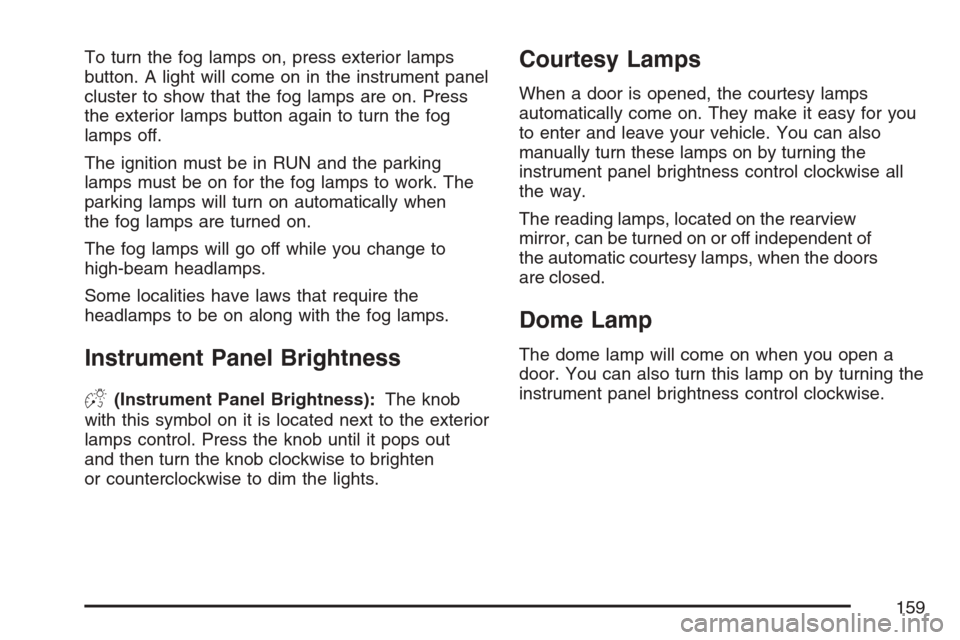
To turn the fog lamps on, press exterior lamps
button. A light will come on in the instrument panel
cluster to show that the fog lamps are on. Press
the exterior lamps button again to turn the fog
lamps off.
The ignition must be in RUN and the parking
lamps must be on for the fog lamps to work. The
parking lamps will turn on automatically when
the fog lamps are turned on.
The fog lamps will go off while you change to
high-beam headlamps.
Some localities have laws that require the
headlamps to be on along with the fog lamps.
Instrument Panel Brightness
D(Instrument Panel Brightness):The knob
with this symbol on it is located next to the exterior
lamps control. Press the knob until it pops out
and then turn the knob clockwise to brighten
or counterclockwise to dim the lights.
Courtesy Lamps
When a door is opened, the courtesy lamps
automatically come on. They make it easy for you
to enter and leave your vehicle. You can also
manually turn these lamps on by turning the
instrument panel brightness control clockwise all
the way.
The reading lamps, located on the rearview
mirror, can be turned on or off independent of
the automatic courtesy lamps, when the doors
are closed.
Dome Lamp
The dome lamp will come on when you open a
door. You can also turn this lamp on by turning the
instrument panel brightness control clockwise.
159
Page 161 of 456
The ignition must be off for delayed exit lighting to
work. When the key is removed, interior
illumination will activate and remain on until one of
the following occurs:
The ignition is in RUN.
The power door locks are activated.
An illumination period of 20 seconds has
elapsed.
If during the illumination period a door is opened,
the timed illumination period will be canceled
and the interior lamps will remain on because a
door is open.
Parade Dimming
The instrument panel has an added feature called
parade dimming. This feature prohibits the
dimming of your instrument panel displays during
the daylight while the headlamps are on so
that you’ll still be able to see the displays.
Reading Lamps
The reading lamps are located on the rearview
mirror. Press the button to turn them on and off.
Electric Power Management
The vehicle has Electric Power Management (EPM)
that estimates the battery’s temperature and state
of charge. It then adjusts the voltage for best
performance and extended life of the battery.
When the battery’s state of charge is low, the
voltage is raised slightly to quickly put the charge
back in. When the state of charge is high, the
voltage is lowered slightly to prevent overcharging.
If the vehicle has a voltmeter gage or voltage
display on the Driver Information Center (DIC), you
may see the voltage move up or down. This is
normal. If there is a problem, an alert will be
displayed.
The battery can be discharged at idle if the
electrical loads are very high. This is true for
all vehicles. This is because the generator
(alternator) may not be spinning fast enough at
idle to produce all the power that is needed
for very high electrical loads.
161
Page 168 of 456
Rear Window Defogger
The rear window defogger uses a warming grid to
remove fog from the rear window.
<:The rear window defogger will turn off
automatically after it has been activated for
10 minutes. It can be turned off manually, by
pressing the button again or by turning the ignition
to the OFF position. If additional window clearing
is required, the rear window defogger can be
turned on again for additional window clearing. The
length of defogger operation will increase if the
vehicle is being driven.
If your vehicle has heated outside rearview
mirrors, the mirrors will heat to help clear fog or
frost from the surface of the mirror when the
rear window defog button is pressed. SeeOutside
Power Mirrors on page 124.
Do not drive the vehicle until all the windows
are clear.
Notice:Do not use anything sharp on the
inside of the rear window. If you do, you could
cut or damage the warming grid, and the repairs
would not be covered by your warranty. Do not
attach a temporary vehicle license, tape, a decal
or anything similar to the defogger grid.
Outlet Adjustment
Use the knob located below or to the side of the
outlet, to change the direction of the air ow.
Operation Tips
Clear away any ice, snow or leaves from the
air inlets at the base of the windshield that
may block the ow of air into your vehicle.
Use of non-GM approved hood deectors may
adversely affect the performance of the system.
Keep the path under the front seats clear of
objects to help circulate the air inside your
vehicle more effectively.
If the airow seems low when the fan is at the
highest setting, the passenger compartment air
lter, if equipped, may need to replaced. For
more information, seePassenger Compartment
Air Filter on page 169andScheduled
Maintenance on page 406.
168
Page 259 of 456
clear. Never cross a solid line on your side of
the lane or a double solid line, even if the road
seems empty of approaching traffic.
Do not get too close to the vehicle you want to
pass while you are awaiting an opportunity. For
one thing, following too closely reduces your
area of vision, especially if you are following a
larger vehicle. Also, you will not have adequate
space if the vehicle ahead suddenly slows or
stops. Keep back a reasonable distance.
When it looks like a chance to pass is coming
up, start to accelerate but stay in the right lane
and do not get too close. Time your move so
you will be increasing speed as the time comes
to move into the other lane. If the way is clear to
pass, you will have a running start that more
than makes up for the distance you would lose
by dropping back. And if something happens to
cause you to cancel your pass, you need only
slow down and drop back again and wait for
another opportunity.
If other vehicles are lined up to pass a slow
vehicle, wait your turn. But take care that
someone is not trying to pass you as you pullout to pass the slow vehicle. Remember to
glance over your shoulder and check the
blind spot.
Check your vehicle’s mirrors, glance over your
shoulder, and start your left lane change signal
before moving out of the right lane to pass.
When you are far enough ahead of the passed
vehicle to see its front in your vehicle’s inside
mirror, activate the right lane change signal and
move back into the right lane. Remember that
your vehicle’s passenger side outside mirror is
convex. The vehicle you just passed may seem
to be farther away from you than it really is.
Try not to pass more than one vehicle at a time
on two-lane roads. Reconsider before passing
the next vehicle.
Do not overtake a slowly moving vehicle too
rapidly. Even though the brake lamps are not
ashing, it may be slowing down or starting
to turn.
If you are being passed, make it easy for the
following driver to get ahead of you. Perhaps
you can ease a little to the right.
259
Page 260 of 456
Loss of Control
Let us review what driving experts say about what
happens when the three control systems — brakes,
steering, and acceleration — do not have enough
friction where the tires meet the road to do what the
driver has asked.
In any emergency, do not give up. Keep trying to
steer and constantly seek an escape route or
area of less danger.
Skidding
In a skid, a driver can lose control of the vehicle.
Defensive drivers avoid most skids by taking
reasonable care suited to existing conditions, and
by not overdriving those conditions. But skids
are always possible.
The three types of skids correspond to your
vehicle’s three control systems. In the braking skid,
your wheels are not rolling. In the steering or
cornering skid, too much speed or steering in a
curve causes tires to slip and lose cornering force.
And in the acceleration skid, too much throttle
causes the driving wheels to spin.A cornering skid and an acceleration skid are
best handled by easing your foot off the
accelerator pedal.
If your vehicle starts to slide, ease your foot off
the accelerator pedal and quickly steer the
way you want the vehicle to go. If you start
steering quickly enough, your vehicle may
straighten out. Always be ready for a second skid
if it occurs.
Of course, traction is reduced when water, snow,
ice, gravel, or other material is on the road.
For safety, you will want to slow down and adjust
your driving to these conditions. It is important
to slow down on slippery surfaces because
stopping distance will be longer and vehicle control
more limited.
While driving on a surface with reduced traction, try
your best to avoid sudden steering, acceleration, or
braking, including reducing vehicle speed by
shifting to a lower gear. Any sudden changes could
cause the tires to slide. You may not realize the
surface is slippery until your vehicle is skidding.
Learn to recognize warning clues — such as
enough water, ice, or packed snow on the road to
make a mirrored surface — and slow down when
you have any doubt.
260