seats CHEVROLET OPTRA 2004 1.G User Guide
[x] Cancel search | Manufacturer: CHEVROLET, Model Year: 2004, Model line: OPTRA, Model: CHEVROLET OPTRA 2004 1.GPages: 346, PDF Size: 2.38 MB
Page 55 of 346
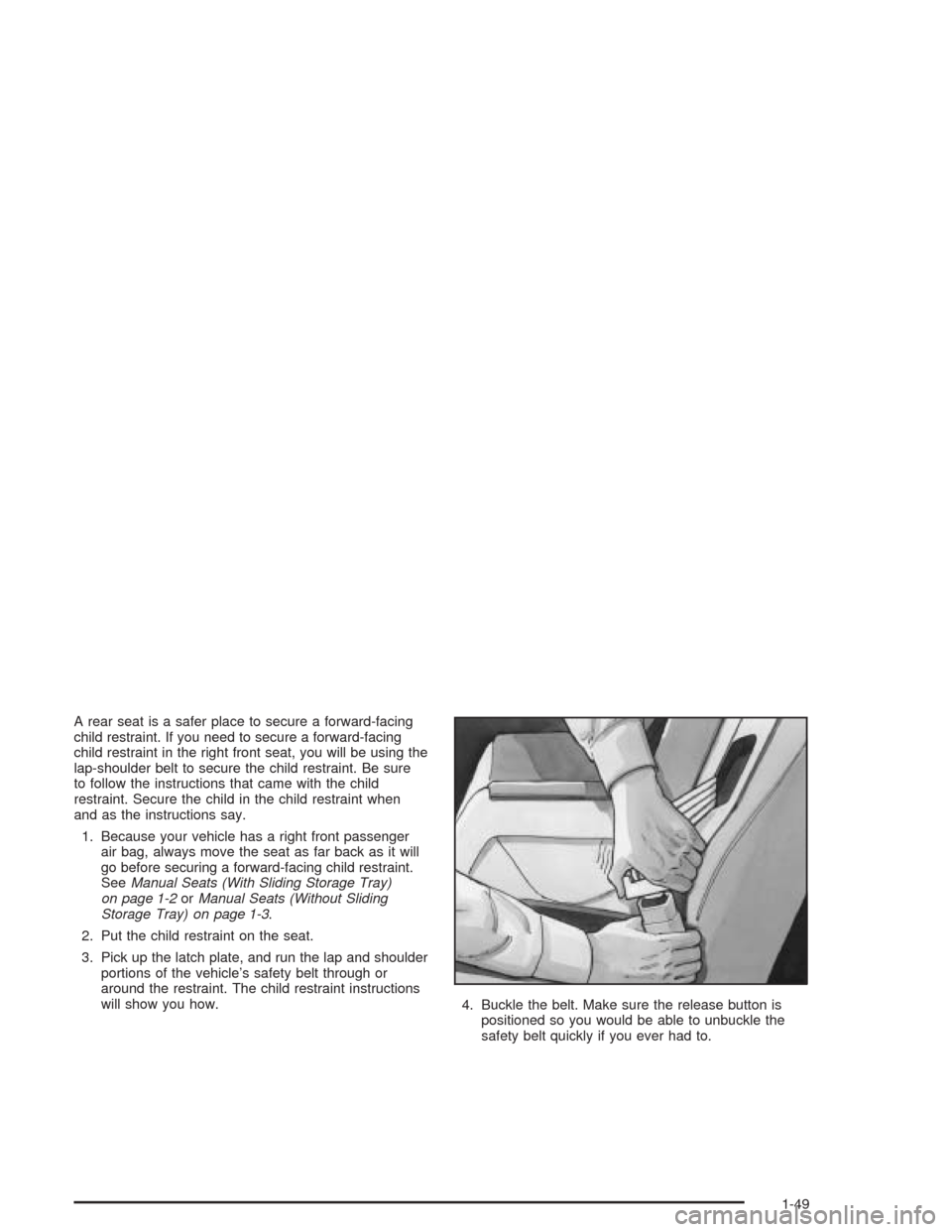
A rear seat is a safer place to secure a forward-facing
child restraint. If you need to secure a forward-facing
child restraint in the right front seat, you will be using the
lap-shoulder belt to secure the child restraint. Be sure
to follow the instructions that came with the child
restraint. Secure the child in the child restraint when
and as the instructions say.
1. Because your vehicle has a right front passenger
air bag, always move the seat as far back as it will
go before securing a forward-facing child restraint.
SeeManual Seats (With Sliding Storage Tray)
on page 1-2orManual Seats (Without Sliding
Storage Tray) on page 1-3.
2. Put the child restraint on the seat.
3. Pick up the latch plate, and run the lap and shoulder
portions of the vehicle’s safety belt through or
around the restraint. The child restraint instructions
will show you how.
4. Buckle the belt. Make sure the release button is
positioned so you would be able to unbuckle the
safety belt quickly if you ever had to.
1-49
Page 91 of 346
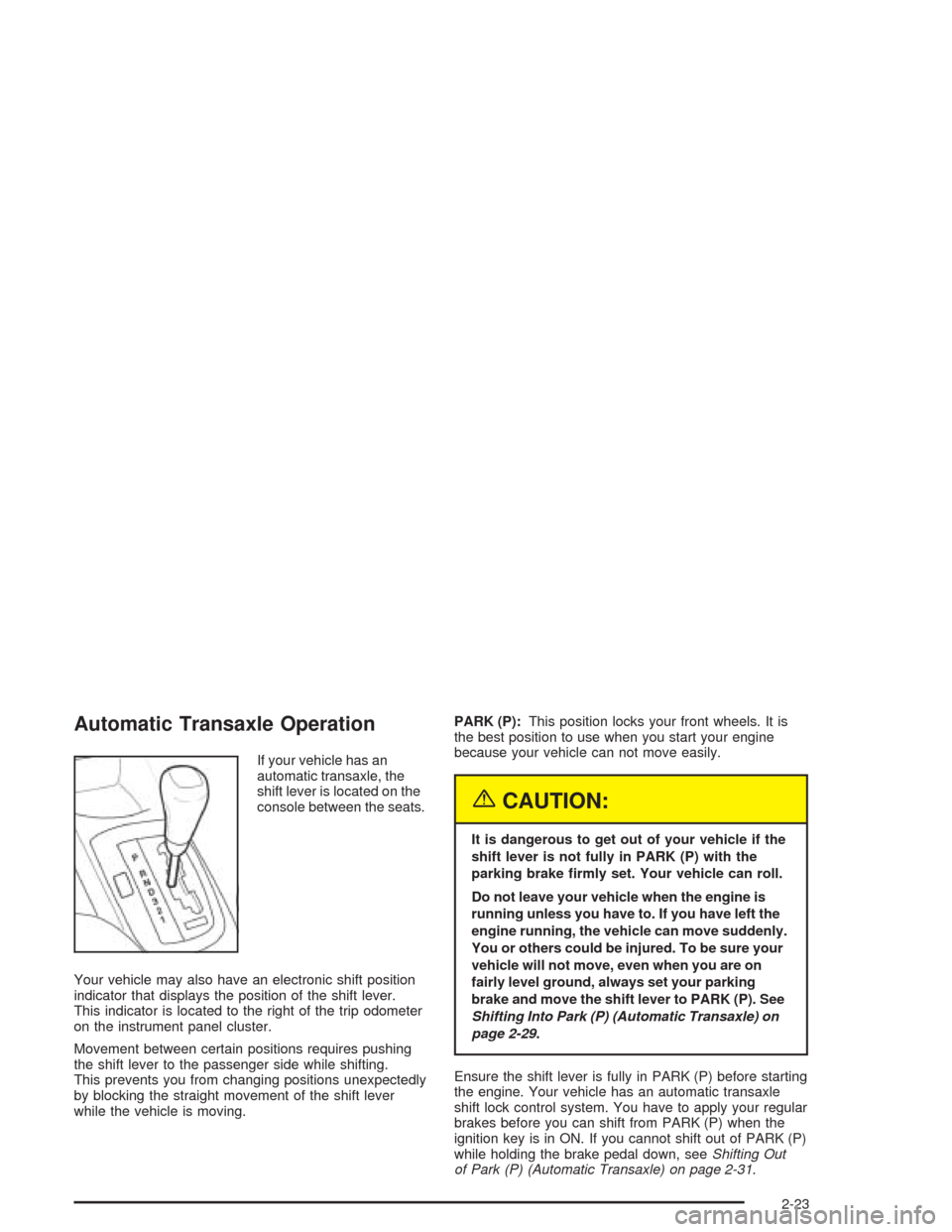
Automatic Transaxle Operation
If your vehicle has an
automatic transaxle, the
shift lever is located on the
console between the seats.
Your vehicle may also have an electronic shift position
indicator that displays the position of the shift lever.
This indicator is located to the right of the trip odometer
on the instrument panel cluster.
Movement between certain positions requires pushing
the shift lever to the passenger side while shifting.
This prevents you from changing positions unexpectedly
by blocking the straight movement of the shift lever
while the vehicle is moving.PARK (P):This position locks your front wheels. It is
the best position to use when you start your engine
because your vehicle can not move easily.
{CAUTION:
It is dangerous to get out of your vehicle if the
shift lever is not fully in PARK (P) with the
parking brake rmly set. Your vehicle can roll.
Do not leave your vehicle when the engine is
running unless you have to. If you have left the
engine running, the vehicle can move suddenly.
You or others could be injured. To be sure your
vehicle will not move, even when you are on
fairly level ground, always set your parking
brake and move the shift lever to PARK (P). See
Shifting Into Park (P) (Automatic Transaxle) on
page 2-29.
Ensure the shift lever is fully in PARK (P) before starting
the engine. Your vehicle has an automatic transaxle
shift lock control system. You have to apply your regular
brakes before you can shift from PARK (P) when the
ignition key is in ON. If you cannot shift out of PARK (P)
while holding the brake pedal down, seeShifting Out
of Park (P) (Automatic Transaxle) on page 2-31.
2-23
Page 96 of 346
Shift Speeds
{CAUTION:
If you skip a gear when you downshift, you
could lose control of your vehicle. You could
injure yourself or others. Don’t shift down
more than one gear at a time when you
downshift.
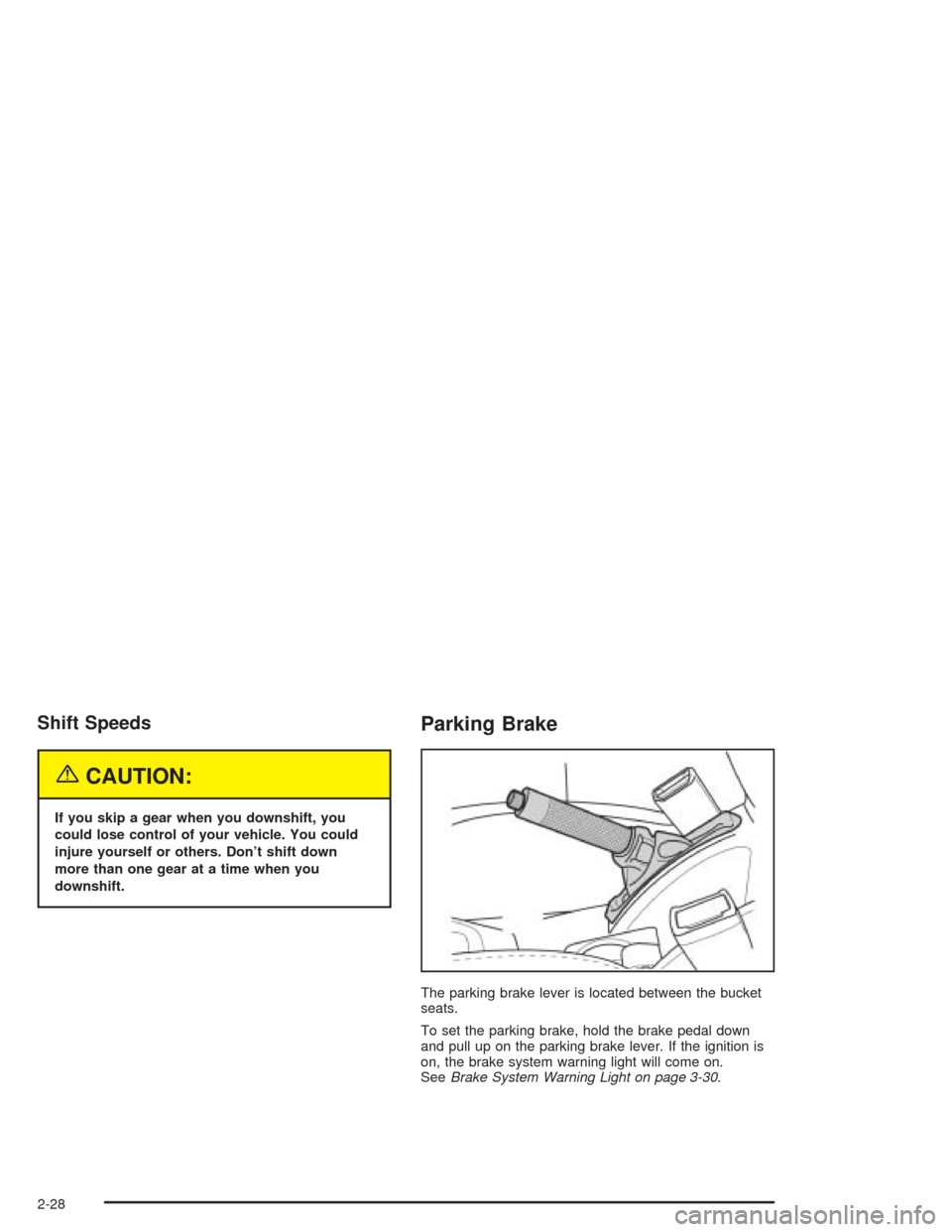
Parking Brake
The parking brake lever is located between the bucket
seats.
To set the parking brake, hold the brake pedal down
and pull up on the parking brake lever. If the ignition is
on, the brake system warning light will come on.
SeeBrake System Warning Light on page 3-30.
2-28
Page 127 of 346
Climate Controls
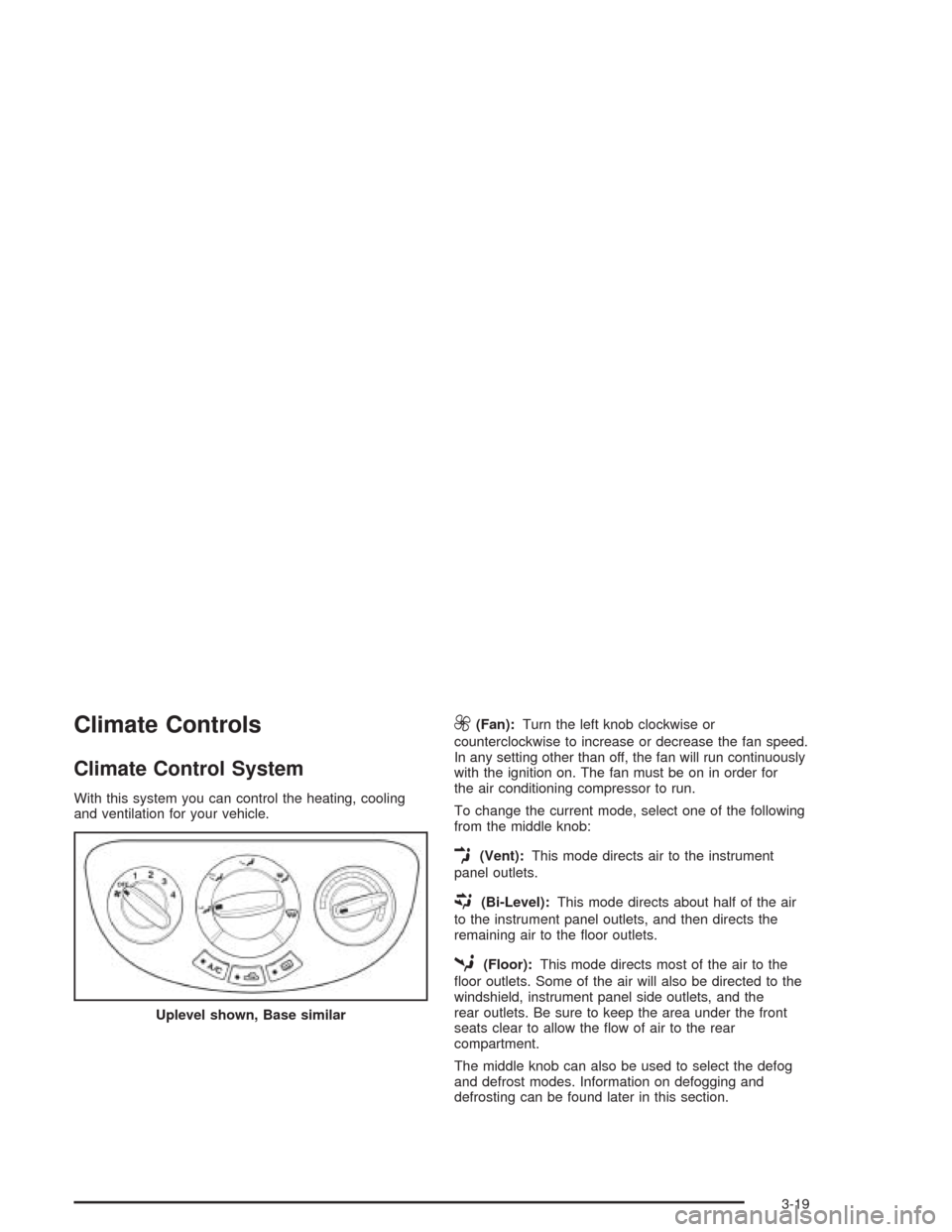
Climate Control System
With this system you can control the heating, cooling
and ventilation for your vehicle.
9(Fan):Turn the left knob clockwise or
counterclockwise to increase or decrease the fan speed.
In any setting other than off, the fan will run continuously
with the ignition on. The fan must be on in order for
the air conditioning compressor to run.
To change the current mode, select one of the following
from the middle knob:
E(Vent):This mode directs air to the instrument
panel outlets.
((Bi-Level):This mode directs about half of the air
to the instrument panel outlets, and then directs the
remaining air to the floor outlets.
5(Floor):This mode directs most of the air to the
floor outlets. Some of the air will also be directed to the
windshield, instrument panel side outlets, and the
rear outlets. Be sure to keep the area under the front
seats clear to allow the flow of air to the rear
compartment.
The middle knob can also be used to select the defog
and defrost modes. Information on defogging and
defrosting can be found later in this section. Uplevel shown, Base similar
3-19
Page 131 of 346
Operation Tips
•
Clear away any ice, snow or leaves from the air
inlets at the base of the windshield that may
block the flow of air into your vehicle.
•Use of non-GM approved hood deflectors may
adversely affect the performance of the system.
•Keep the path under the front seats clear of objects
to help circulate the air inside of your vehicle more
effectively.
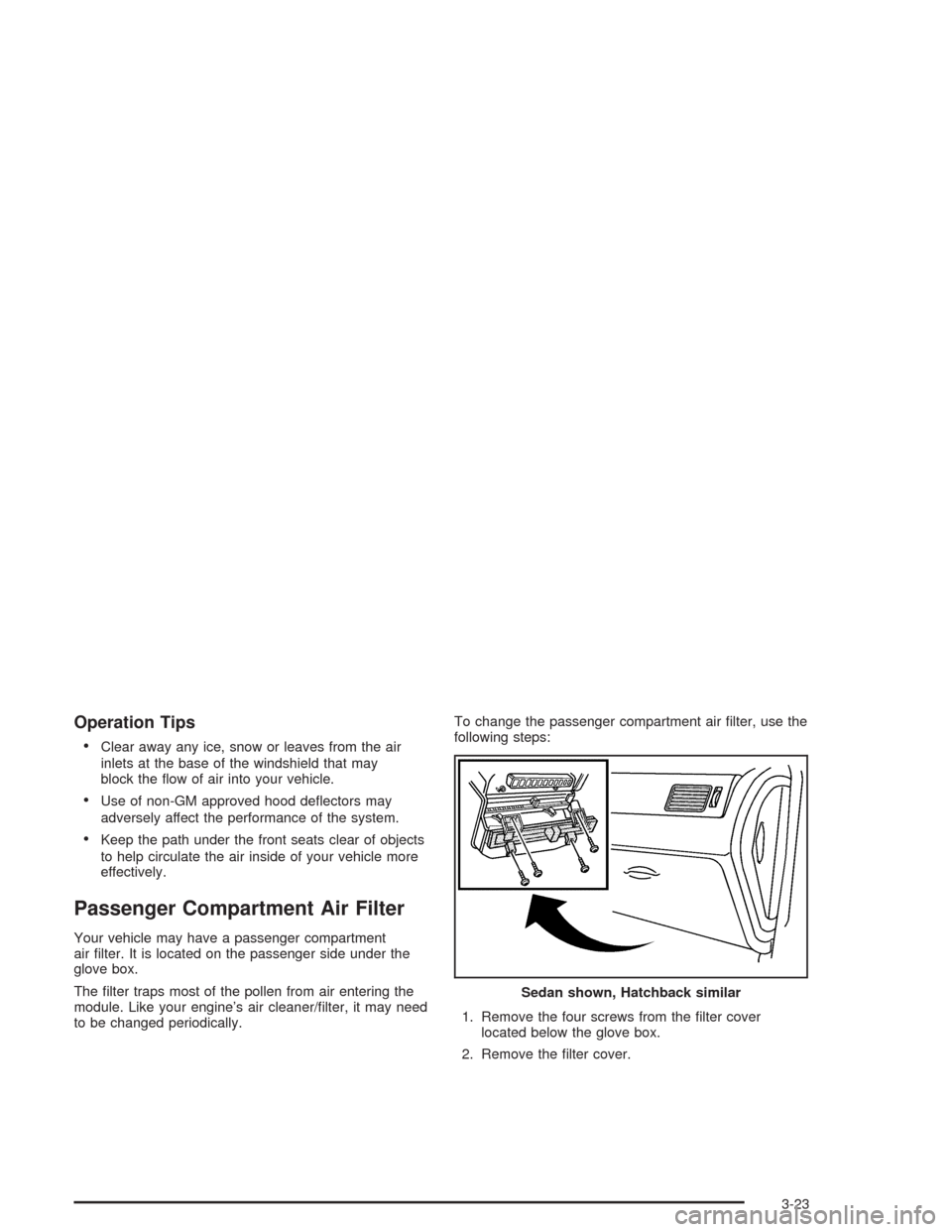
Passenger Compartment Air Filter
Your vehicle may have a passenger compartment
air filter. It is located on the passenger side under the
glove box.
The filter traps most of the pollen from air entering the
module. Like your engine’s air cleaner/filter, it may need
to be changed periodically.To change the passenger compartment air filter, use the
following steps:
1. Remove the four screws from the filter cover
located below the glove box.
2. Remove the filter cover.Sedan shown, Hatchback similar
3-23
Page 197 of 346
{CAUTION:
Things you put inside your vehicle can strike
and injure people in a sudden stop or turn, or
in a crash.
Put things in the trunk of your vehicle. In a
trunk, put them as far forward as you can.
Try to spread the weight evenly.
Never stack heavier things, like suitcases,
inside the vehicle so that some of them
are above the tops of the seats.
Do not leave an unsecured child restraint
in your vehicle.
CAUTION: (Continued)
CAUTION: (Continued)
When you carry something inside the
vehicle, secure it whenever you can.
Do not leave a seat folded down unless
you need to.
Towing a Trailer
Do not use your vehicle to tow a trailer. The vehicle is not
designed or intended for such a use. Towing a trailer can
adversely affect handling, durability and fuel economy.
4-37
Page 253 of 346
Tire Terminology and Denitions
Air Pressure:The amount of air inside the tire pressing
outward on each square inch of the tire. Air pressure
is expressed in pounds per square inch (psi) or
kilopascal (kPa).
Accessory Weight:This means the combined weight
of optional accessories. Some examples of optional
accessories are, automatic transmission, power steering,
power brakes, power windows, power seats, and air
conditioning.
Aspect Ratio:The relationship of a tire’s height to
its width.
Belt:A rubber coated layer of cords that is located
between the plies and the tread. Cords may be made
from steel or other reinforcing materials.
Bead:The tire bead contains steel wires that hold the
tire onto the rim.
Bias Ply Tire:A pneumatic tire in which the plies are
laid at alternate angles, less than 90 degrees to the
centerline of the tread.
Cold Ination Pressure:The amount of air pressure in
a tire, measured in pounds per square inch (psi) or
kilopascal (kPa), before a tire has built up heat
from driving. SeeInflation - Tire Pressure on page 5-57.Curb Weight:This means the weight of a motor
vehicle with standard and optional equipment including
the maximum capacity of fuel, oil and coolant, but
without passengers and cargo.
DOT Markings:A code molded into the sidewall of a
tire signifying that the tire is in compliance with the U.S.
Department of Transportation motor vehicle safety
standards. The DOT code includes the Tire Identification
Number (TIN), an alphanumeric designator which can
also identify the tire manufacturer, production plant,
brand and date of production.
GVWR:Gross Vehicle Weight Rating, seeLoading
Your Vehicle on page 4-33.
GAWR FRT:Gross Axle Weight Rating for the front
axle, seeLoading Your Vehicle on page 4-33.
GAWR RR:Gross Axle Weight Rating for the rear axle,
seeLoading Your Vehicle on page 4-33.
Intended Outboard Sidewall:The side of an
asymmetrical tire that must always face outward when
mounted on a vehicle.
Kilopascal (kPa):The metric unit for air pressure.
There are 6.9 kPa’s to one psi.
Light Truck (LT-Metric) Tire:A tire used on light duty
trucks and some multipurpose passenger vehicles.
5-55
Page 341 of 346
Malfunction Indicator Light................................3-33
Manual Lumbar Controls.................................... 1-4
Manual Seats............................................1-2, 1-3
Manual Transaxle............................................2-19
Fluid..........................................................5-20
Operation...................................................2-27
Manual Transaxle Check..................................6-19
Manual Windows............................................2-15
Map Lamps....................................................3-15
Matching Transmitter(s) to Your Vehicle............... 2-5
Mexico, Central America and Caribbean Islands/
Countries (Except Puerto Rico and U.S. Virgin
Islands) – Customer Assistance....................... 7-5
Mirrors
Manual Rearview Mirror................................2-35
Outside Convex Mirror.................................2-36
Outside Heated Mirrors................................2-37
Outside Manual Mirrors................................2-35
Outside Power Mirrors..................................2-36
MyGMLink.com................................................ 7-3
N
New Vehicle Break-In......................................2-18
Normal Maintenance Replacement Parts............5-91
O
Odometer......................................................3-27
Off-Road Recovery..........................................4-11
Oil
Engine.......................................................5-14
Pressure Light.............................................3-36
Older Children, Restraints................................1-29
Online Owner Center........................................ 7-3
Opening a Rear Door When the Security
Lock is On.................................................2-10
Other Warning Devices...................................... 3-5
Outlet Adjustment............................................3-22
Outside
Convex Mirror.............................................2-36
Heated Mirrors............................................2-37
Manual Mirrors............................................2-35
Power Mirrors.............................................2-36
Overseas – Customer Assistance........................ 7-5
Owners, Canadian............................................... ii
Owner’s Information........................................7-13
P
Park (P)
Shifting Into................................................2-29
Shifting Out of............................................2-31
9
Page 343 of 346
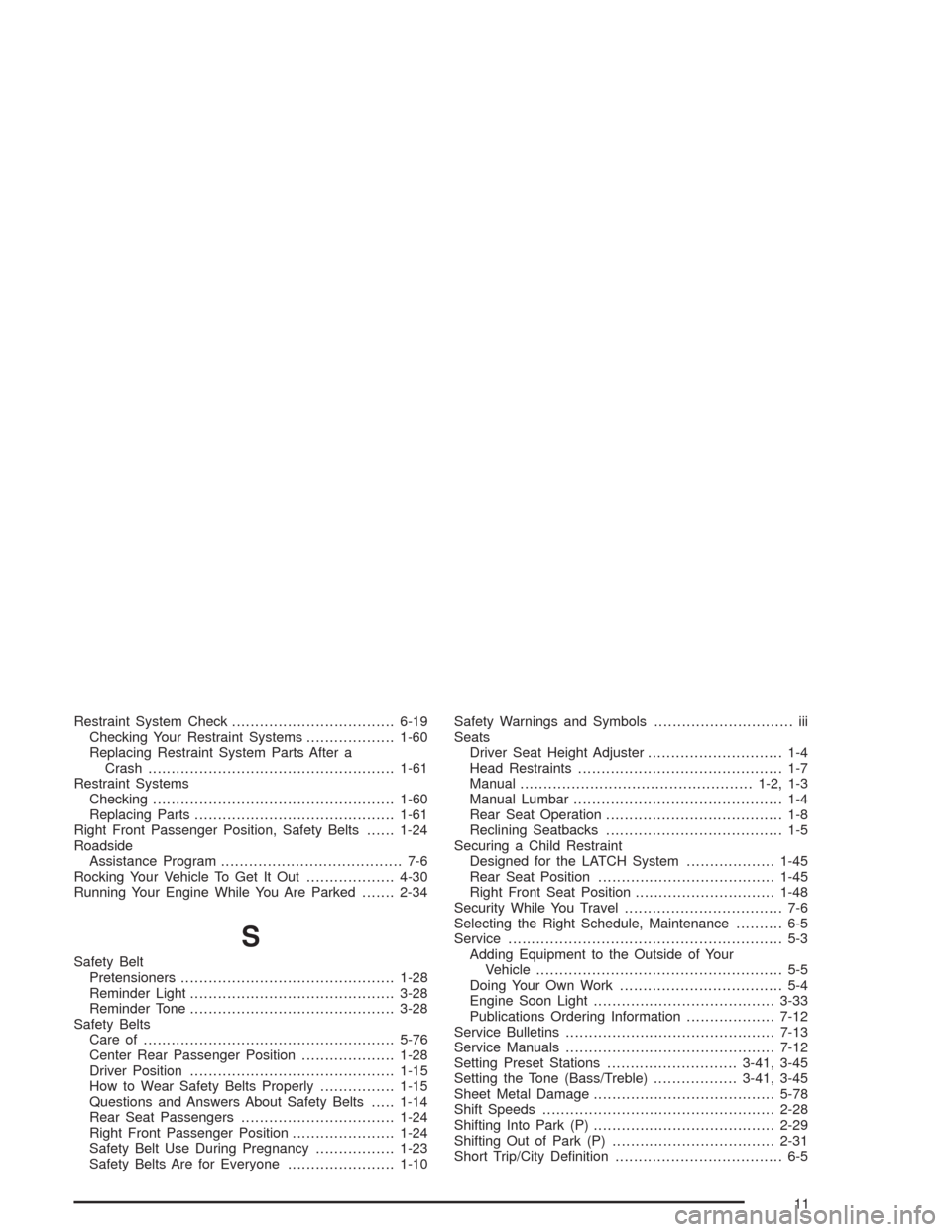
Restraint System Check...................................6-19
Checking Your Restraint Systems...................1-60
Replacing Restraint System Parts After a
Crash.....................................................1-61
Restraint Systems
Checking....................................................1-60
Replacing Parts...........................................1-61
Right Front Passenger Position, Safety Belts......1-24
Roadside
Assistance Program....................................... 7-6
Rocking Your Vehicle To Get It Out...................4-30
Running Your Engine While You Are Parked.......2-34
S
Safety Belt
Pretensioners..............................................1-28
Reminder Light............................................3-28
Reminder Tone............................................3-28
Safety Belts
Care of......................................................5-76
Center Rear Passenger Position....................1-28
Driver Position............................................1-15
How to Wear Safety Belts Properly................1-15
Questions and Answers About Safety Belts.....1-14
Rear Seat Passengers.................................1-24
Right Front Passenger Position......................1-24
Safety Belt Use During Pregnancy.................1-23
Safety Belts Are for Everyone.......................1-10Safety Warnings and Symbols.............................. iii
Seats
Driver Seat Height Adjuster............................. 1-4
Head Restraints............................................ 1-7
Manual..................................................1-2, 1-3
Manual Lumbar............................................. 1-4
Rear Seat Operation...................................... 1-8
Reclining Seatbacks...................................... 1-5
Securing a Child Restraint
Designed for the LATCH System...................1-45
Rear Seat Position......................................1-45
Right Front Seat Position..............................1-48
Security While You Travel.................................. 7-6
Selecting the Right Schedule, Maintenance.......... 6-5
Service........................................................... 5-3
Adding Equipment to the Outside of Your
Vehicle..................................................... 5-5
Doing Your Own Work................................... 5-4
Engine Soon Light.......................................3-33
Publications Ordering Information...................7-12
Service Bulletins.............................................7-13
Service Manuals.............................................7-12
Setting Preset Stations............................3-41, 3-45
Setting the Tone (Bass/Treble)..................3-41, 3-45
Sheet Metal Damage.......................................5-78
Shift Speeds..................................................2-28
Shifting Into Park (P).......................................2-29
Shifting Out of Park (P)...................................2-31
Short Trip/City Definition.................................... 6-5
11