cruise control CHEVROLET OPTRA 2004 1.G Owners Manual
[x] Cancel search | Manufacturer: CHEVROLET, Model Year: 2004, Model line: OPTRA, Model: CHEVROLET OPTRA 2004 1.GPages: 346, PDF Size: 2.38 MB
Page 109 of 346
Instrument Panel Overview...............................3-2
Hazard Warning Flashers................................3-4
Other Warning Devices...................................3-5
Horn.............................................................3-5
Tilt Wheel.....................................................3-5
Turn Signal/Multifunction Lever.........................3-6
Windshield Wiper Lever...................................3-8
Cruise Control................................................3-9
Exterior Lamps.............................................3-12
Interior Lamps..............................................3-14
Accessory Power Outlets...............................3-16
Ashtrays and Cigarette Lighter........................3-17
Clock..........................................................3-18
Climate Controls............................................3-19
Climate Control System.................................3-19
Outlet Adjustment.........................................3-22
Passenger Compartment Air Filter...................3-23
Warning Lights, Gages, and Indicators............3-24
Instrument Panel Cluster................................3-26
Speedometer and Odometer...........................3-27
Tachometer.................................................3-27
Safety Belt Reminder Light.............................3-28
Safety Belt Reminder Tone............................3-28
Air Bag Readiness Light................................3-28Charging System Light..................................3-29
Brake System Warning Light..........................3-30
Anti-Lock Brake System Warning Light.............3-31
Speed Sensitive Power Steering (SSPS)
Warning Light...........................................3-31
Hold Mode Light...........................................3-32
Engine Coolant Temperature Gage..................3-32
Malfunction Indicator Lamp.............................3-33
Oil Pressure Light.........................................3-36
Fog Lamp Light............................................3-37
Cruise Control Light......................................3-37
Highbeam On Light.......................................3-38
Daytime Running Lamps Indicator Light...........3-38
Door Ajar Light.............................................3-38
Fuel Gage...................................................3-39
Low Fuel Warning Light.................................3-39
Audio System(s).............................................3-40
Radio with CD (Base Level)...........................3-40
Radio with CD (MP3)....................................3-44
Theft-Deterrent Feature..................................3-51
Radio Reception...........................................3-51
Care of Your CDs.........................................3-52
Care of Your CD Player................................3-52
Backglass Antenna.......................................3-52
Section 3 Instrument Panel
3-1
Page 117 of 346
Windshield Washer
To wash your windshield, pull the windshield wiper/
washer lever toward you with the ignition turned to ON.
{CAUTION:
In freezing weather, do not use your washer
until the windshield is warmed. Otherwise the
washer uid can form ice on the windshield,
blocking your vision.
When you release the lever, the washers will stop, but
the wipers will continue to wipe for about two or
three cycles and will either stop or will resume at the
speed you were using before.
Rear Window Washer/Wiper
Your vehicle may have a rear window washer/wiper.
Operate the rear window washer/wiper system by
pushing the windshield wiper/washer lever away from
you. The wiper operates continuously when the lever is
in the first position. Washer fluid sprays onto the rear
window and the wiper operates continuously when
the lever is pushed to the second position.
Cruise Control
If your vehicle has cruise control, you can maintain a
speed of about 24 mph (39 km/h) or more without
keeping your foot on the accelerator. This can really
help on long trips. Cruise control does not work at
speeds below 24 mph (39 km/h).
When you apply your brakes, or the clutch pedal if you
have a manual transaxle, the cruise control shuts off.
{CAUTION:
Cruise control can be dangerous where you
can not drive safely at a steady speed. So, do
not use your cruise control on winding roads
or in heavy traffic.
Cruise control can be dangerous on slippery
roads. On such roads, fast changes in tire
traction can cause needless wheel spinning,
and you could lose control. Do not use cruise
control on slippery roads.
3-9
Page 118 of 346
Setting Cruise Control
{CAUTION:
If you leave your cruise control on when you
are not using cruise, you might hit a button
and go into cruise when you do not want to.
You could be startled and even lose control.
Keep the cruise control switch off until you
want to use cruise control.
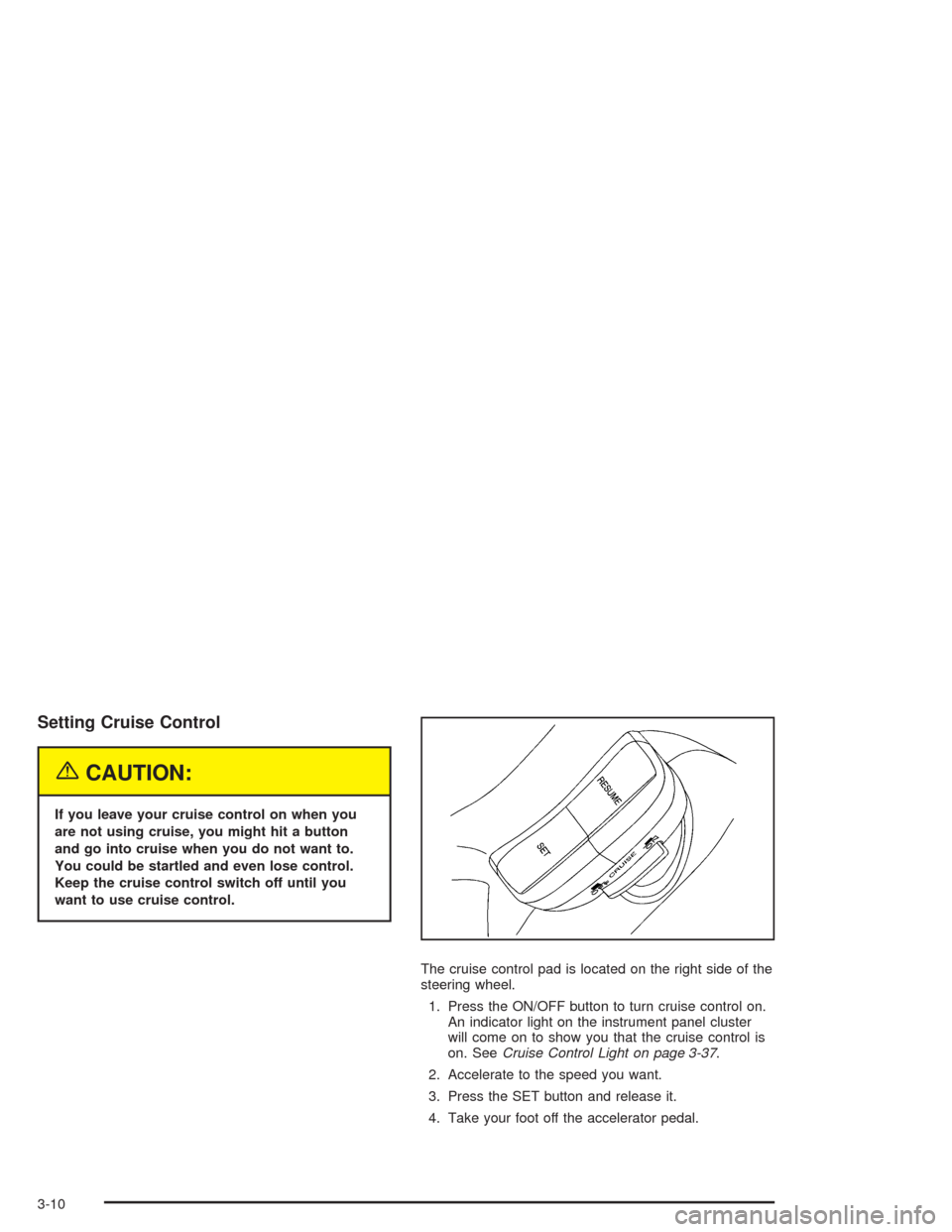
The cruise control pad is located on the right side of the
steering wheel.
1. Press the ON/OFF button to turn cruise control on.
An indicator light on the instrument panel cluster
will come on to show you that the cruise control is
on. SeeCruise Control Light on page 3-37.
2. Accelerate to the speed you want.
3. Press the SET button and release it.
4. Take your foot off the accelerator pedal.
3-10
Page 119 of 346
Resuming a Set Speed
Suppose you set your cruise control at a desired speed
and then you apply the brake pedal, or the clutch
pedal if you have a manual transaxle. This, of course,
shuts off the cruise control. But you do not need to reset
it. Once you are going about 24 mph (39 km/h) or
more, you can briefly press the RESUME button.
You will go right back up to your chosen speed and stay
there.
If you hold in the RESUME button longer, the vehicle
will keep going faster until you release the button
or apply the brake pedal. So unless you want to go
faster, do not hold in the RESUME button.
Increasing Speed While Using Cruise
Control
There are two ways to go to a higher speed.
•Use the accelerator pedal to get to a higher speed.
Press the SET button, then release the button and
the accelerator pedal. You will now cruise at the
higher speed.
•Press the RESUME button. Hold it there until you
get up to the speed you want, and then release
the button. To increase your speed in very
small amounts, briefly press the RESUME button
and then release it. Each time you do this, your
vehicle will go about 1 mph (1.6 km/h) faster.
The accelerate feature will only work after you turn on
the cruise control by pressing the SET button.
Reducing Speed While Using Cruise
Control
There are two ways to reduce your speed while using
cruise control:
•Press the SET button until you reach the lower
speed you want, then release it.
•To slow down in very small amounts, briefly press
the SET button. Each time you do this, you will go
about 1 mph (1.6 km/h) slower.
Passing Another Vehicle While Using
Cruise Control
Use the accelerator pedal to increase your speed.
When you take your foot off the pedal, your vehicle will
slow down to the cruise control speed you set earlier.
3-11
Page 120 of 346
Using Cruise Control on Hills
How well your cruise control will work on hills depends
upon your speed, load and the steepness of the
hills. When going up steep hills, you may have to step
on the accelerator pedal to maintain your speed.
When going downhill, you may have to brake or shift to
a lower gear to keep your speed down. Of course,
applying the brake pedal takes you out of cruise control.
Many drivers find this to be too much trouble and do
not use cruise control on steep hills.
Ending Cruise Control
There are two ways to turn off the cruise control:
•Step lightly on the brake pedal, or press the clutch
pedal, if you have a manual transaxle.
•Press the ON/OFF button on the cruise control pad.
Erasing Speed Memory
When you turn off the cruise control or the ignition, your
cruise control set speed memory is erased.
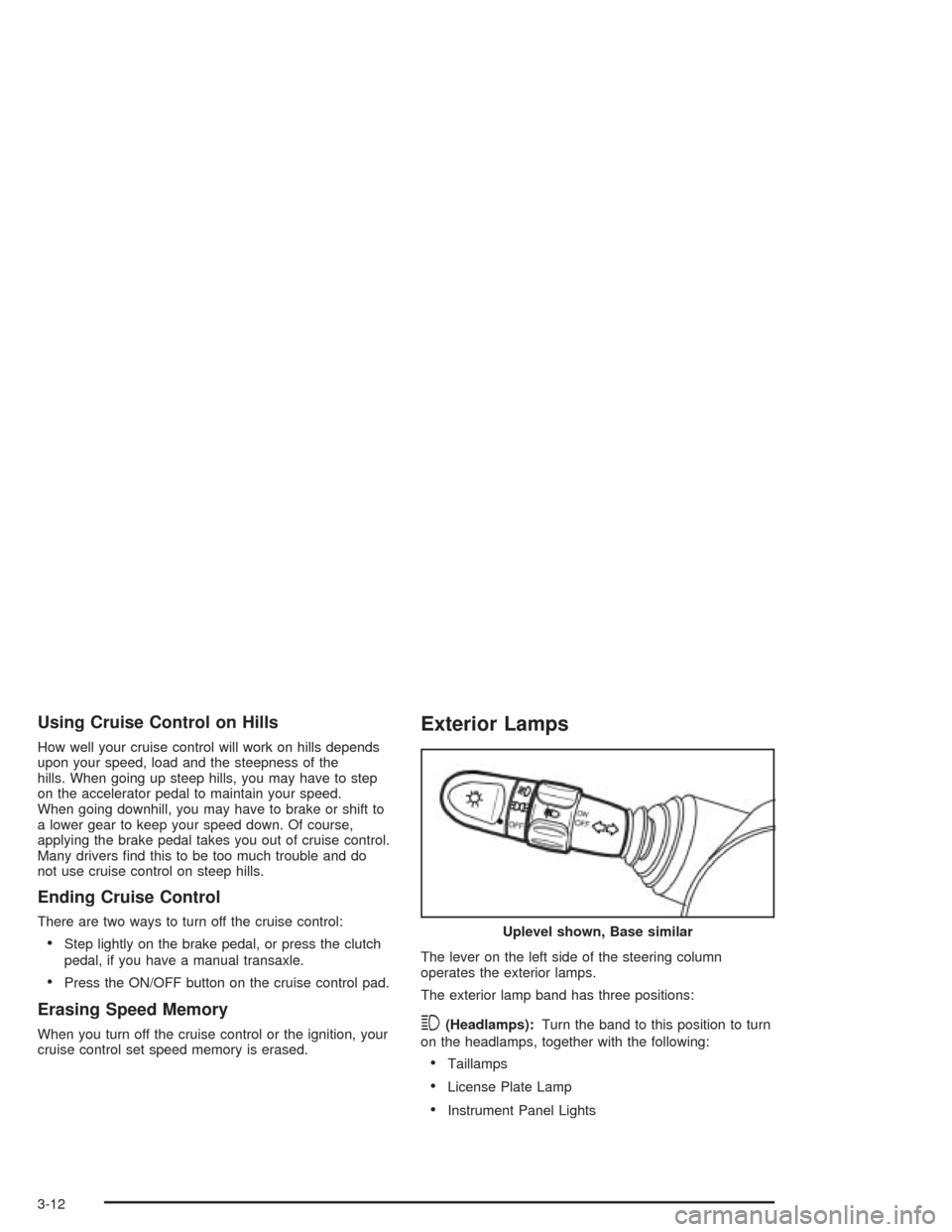
Exterior Lamps
The lever on the left side of the steering column
operates the exterior lamps.
The exterior lamp band has three positions:
3(Headlamps):Turn the band to this position to turn
on the headlamps, together with the following:
•Taillamps
•License Plate Lamp
•Instrument Panel LightsUplevel shown, Base similar
3-12
Page 145 of 346
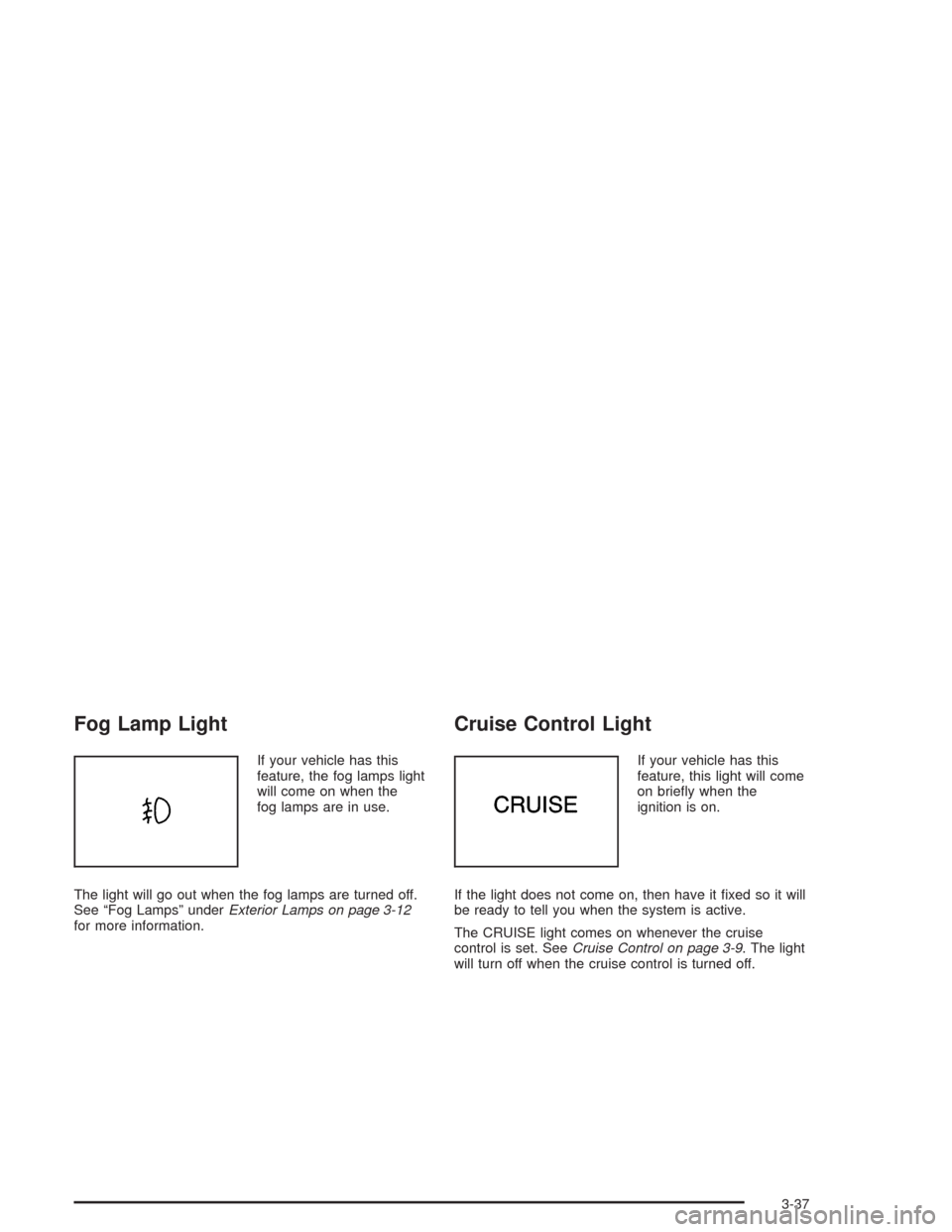
Fog Lamp Light
If your vehicle has this
feature, the fog lamps light
will come on when the
fog lamps are in use.
The light will go out when the fog lamps are turned off.
See “Fog Lamps” underExterior Lamps on page 3-12
for more information.
Cruise Control Light
If your vehicle has this
feature, this light will come
on briefly when the
ignition is on.
If the light does not come on, then have it fixed so it will
be ready to tell you when the system is active.
The CRUISE light comes on whenever the cruise
control is set. SeeCruise Control on page 3-9. The light
will turn off when the cruise control is turned off.
3-37
Page 283 of 346
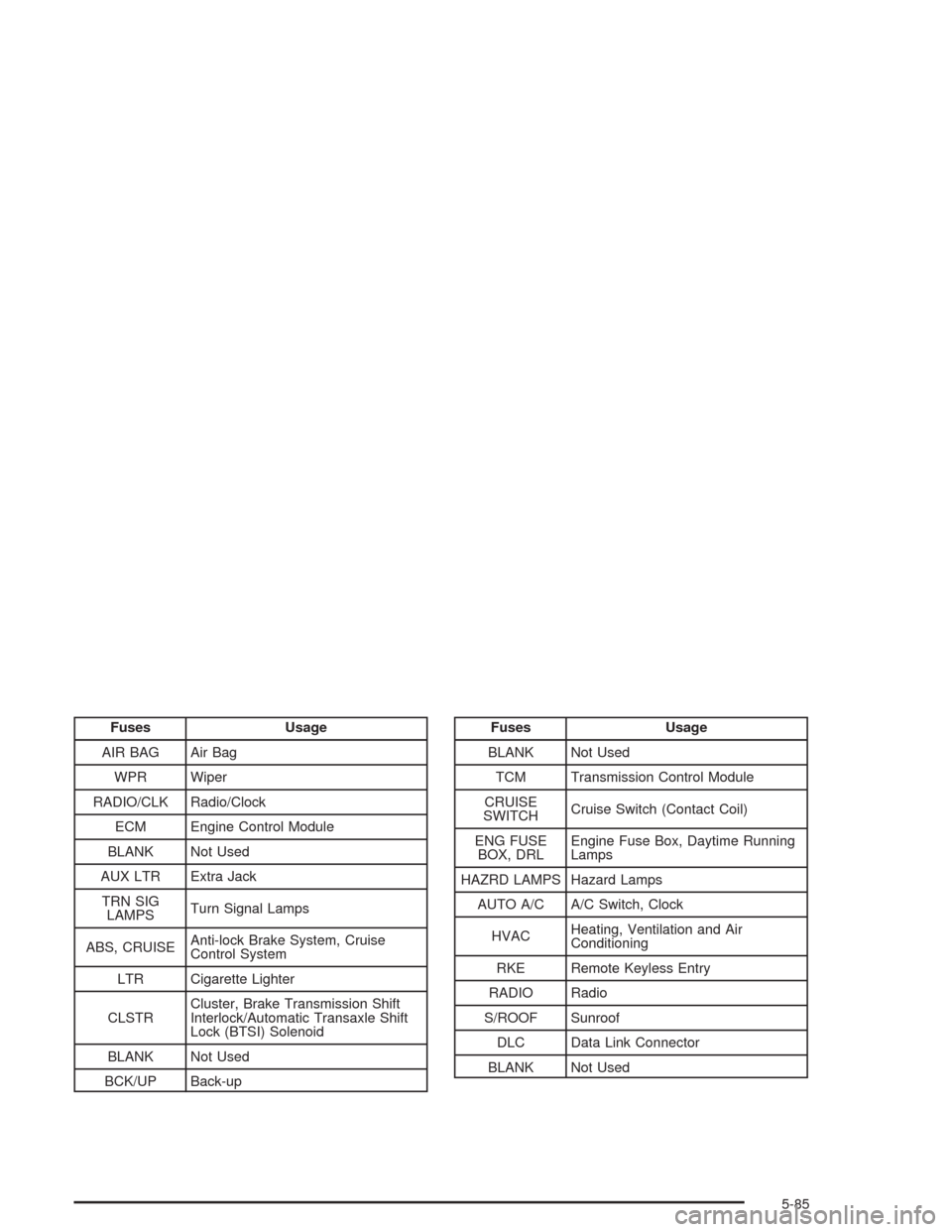
Fuses Usage
AIR BAG Air Bag
WPR Wiper
RADIO/CLK Radio/Clock
ECM Engine Control Module
BLANK Not Used
AUX LTR Extra Jack
TRN SIG
LAMPSTurn Signal Lamps
ABS, CRUISEAnti-lock Brake System, Cruise
Control System
LTR Cigarette Lighter
CLSTRCluster, Brake Transmission Shift
Interlock/Automatic Transaxle Shift
Lock (BTSI) Solenoid
BLANK Not Used
BCK/UP Back-upFuses Usage
BLANK Not Used
TCM Transmission Control Module
CRUISE
SWITCHCruise Switch (Contact Coil)
ENG FUSE
BOX, DRLEngine Fuse Box, Daytime Running
Lamps
HAZRD LAMPS Hazard Lamps
AUTO A/C A/C Switch, Clock
HVACHeating, Ventilation and Air
Conditioning
RKE Remote Keyless Entry
RADIO Radio
S/ROOF Sunroof
DLC Data Link Connector
BLANK Not Used
5-85
Page 314 of 346
Throttle System Inspection
Inspect the throttle system for interference or binding,
and for damaged or missing parts. Replace parts
as needed. Replace any components that have high
effort or excessive wear. Do not lubricate accelerator
and cruise control cables.
Brake System Inspection
Inspect the complete system. Inspect brake lines and
hoses for proper hook-up, binding, leaks, cracks,
chafing, etc. Inspect disc brake pads for wear and rotors
for surface condition. Also inspect drum brake linings
for wear and cracks. Inspect other brake parts, including
drums, wheel cylinders, calipers, parking brake, etc.
Check parking brake adjustment. You may need to have
your brakes inspected more often if your driving
habits or conditions result in frequent braking.
Part D: Recommended Fluids and
Lubricants
Fluids and lubricants identified below by name, part
number or specification may be obtained from your
dealer.
Usage Fluid/Lubricant
Engine OilEngine oil which meets GM Standard
GM6094M and displays the
American Petroleum Institute
Certified for Gasoline Engines
starburst symbol. To determine the
proper viscosity for your vehicle’s
engine, seeEngine Oil on page 5-14.
Engine Coolant50/50 mixture of clean, drinkable
water (preferably distilled) and good
quality Ethylene Glycol Base Coolant
(GM Part No. U.S. 12378560, in
Canada 993089) and conforming to
GM Specification 1825M or recycled
coolant conforming to GM
Specification 1825M. SeeEngine
Coolant on page 5-21.
Hydraulic Brake
SystemDelco Supreme 11 Brake Fluid or
equivalent DOT-3 brake fluid.
6-24
Page 335 of 346
Child Restraints (cont.)
Securing a Child Restraint in a Rear Seat
Position..................................................1-45
Securing a Child Restraint in the Right Front
Seat Position...........................................1-48
Top Strap...................................................1-39
Top Strap Anchor Location............................1-41
Where to Put the Restraint...........................1-38
Cigarette Lighter.............................................3-17
Cleaning
Inside of Your Vehicle..................................5-73
Outside of Your Vehicle................................5-76
Underbody Maintenance...............................5-79
Weatherstrips..............................................5-76
Cleaning Aluminum Wheels..............................5-78
Cleaning Exterior Lamps/Lenses.......................5-77
Cleaning Fabric/Carpet....................................5-73
Cleaning Glass Surfaces..................................5-75
Cleaning Interior Plastic Components.................5-75
Cleaning Leather............................................5-75
Cleaning the Top of the Instrument Panel...........5-75
Cleaning Tires................................................5-78
Cleaning Vinyl................................................5-75
Cleaning Windshield and Wiper Blades..............5-77
Climate Control System...................................3-19
Air Filter, Passenger Compartment.................3-23
Outlet Adjustment........................................3-22
Clock............................................................3-18Clutch and Brake Pedal Free Play Check...........6-19
Clutch, Hydraulic.............................................5-20
Compact Spare Tire........................................5-72
Control of a Vehicle.......................................... 4-5
Coolant
Engine Temperature Gage............................3-32
Heater, Engine............................................2-21
Surge Tank Pressure Cap.............................5-24
Cooling System..............................................5-27
Cruise Control.................................................. 3-9
Cruise Control Light........................................3-37
Cupholder(s)..................................................2-37
Current and Past Model Order Forms................7-13
Customer Assistance Information
Courtesy Transportation.................................. 7-7
Customer Assistance for Text Telephone (TTY)
Users....................................................... 7-4
Customer Assistance Offices........................... 7-4
Customer Satisfaction Procedure..................... 7-2
GM Mobility Program for Persons with
Disabilities................................................ 7-5
Reporting Safety Defects to General Motors.......7-12
Reporting Safety Defects to the Canadian
Government............................................7-12
Reporting Safety Defects to the United States
Government............................................7-11
Roadside Assistance Program......................... 7-6
Service Publications Ordering Information........7-12
3
Page 339 of 346
If the Light Is On Steady.................................3-34
If You Are Caught in a Blizzard.........................4-27
If You Are Stuck in Sand, Mud, Ice or Snow.......4-30
Ignition Positions.............................................2-18
Ignition Transaxle Lock Check..........................6-21
Infants and Young Children, Restraints...............1-31
Inflation - Tire Pressure...................................5-57
Inspection
Brake System.............................................6-24
Engine Cooling System................................6-23
Exhaust System..........................................6-23
Fuel System...............................................6-23
Part C - Periodic Maintenance.......................6-23
Steering, Suspension and Front Drive Axle
Boot and Seal.........................................6-23
Throttle System...........................................6-24
Instrument Panel
Cluster.......................................................3-26
Overview..................................................... 3-2
Instrument Panel Brightness.............................3-14
Instrument Panel Fuse Block............................5-83
Interior Lamps................................................3-14
J
Jump Starting.................................................5-39
K
Key Lock Cylinders Service..............................6-20
Keyless Entry System....................................... 2-3
Keys............................................................... 2-2
L
Lamps
Exterior......................................................3-12
Fog Lamps.................................................5-46
Interior.......................................................3-14
Lamps On Reminder.......................................3-13
Lap-Shoulder Belt...................................1-16, 1-25
LATCH System
Child Restraints...........................................1-42
Securing a Child Restraint Designed for the
LATCH System........................................1-45
Leaving Your Vehicle.......................................2-10
Leaving Your Vehicle With the Engine Running......2-30
Liftgate..........................................................2-13
Light
Air Bag Readiness.......................................3-28
Anti-Lock Brake System Warning...................3-31
Brake System Warning.................................3-30
Charging System.........................................3-29
Cruise Control.............................................3-37
Daytime Running Lamps Indicator..................3-38
7