Engine CHEVROLET OPTRA 2005 1.G Manual PDF
[x] Cancel search | Manufacturer: CHEVROLET, Model Year: 2005, Model line: OPTRA, Model: CHEVROLET OPTRA 2005 1.GPages: 336, PDF Size: 2.21 MB
Page 246 of 336
Tire Size
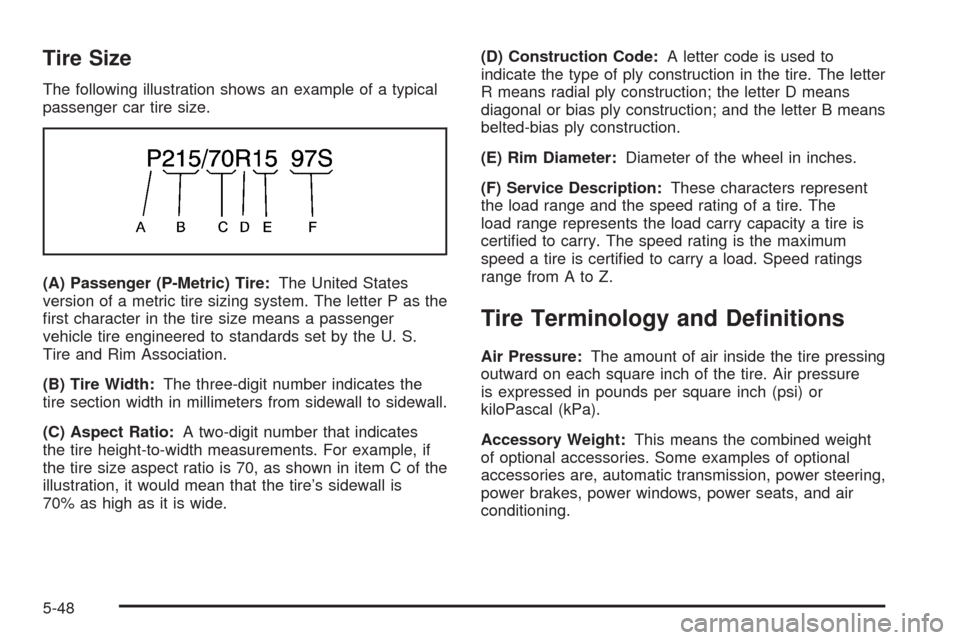
The following illustration shows an example of a typical
passenger car tire size.
(A) Passenger (P-Metric) Tire:The United States
version of a metric tire sizing system. The letter P as the
first character in the tire size means a passenger
vehicle tire engineered to standards set by the U. S.
Tire and Rim Association.
(B) Tire Width:The three-digit number indicates the
tire section width in millimeters from sidewall to sidewall.
(C) Aspect Ratio:A two-digit number that indicates
the tire height-to-width measurements. For example, if
the tire size aspect ratio is 70, as shown in item C of the
illustration, it would mean that the tire’s sidewall is
70% as high as it is wide.(D) Construction Code:A letter code is used to
indicate the type of ply construction in the tire. The letter
R means radial ply construction; the letter D means
diagonal or bias ply construction; and the letter B means
belted-bias ply construction.
(E) Rim Diameter:Diameter of the wheel in inches.
(F) Service Description:These characters represent
the load range and the speed rating of a tire. The
load range represents the load carry capacity a tire is
certified to carry. The speed rating is the maximum
speed a tire is certified to carry a load. Speed ratings
range from A to Z.
Tire Terminology and Denitions
Air Pressure:The amount of air inside the tire pressing
outward on each square inch of the tire. Air pressure
is expressed in pounds per square inch (psi) or
kiloPascal (kPa).
Accessory Weight:This means the combined weight
of optional accessories. Some examples of optional
accessories are, automatic transmission, power steering,
power brakes, power windows, power seats, and air
conditioning.
5-48
Page 257 of 336
Changing a Flat Tire
If a tire goes flat, avoid further tire and wheel damage
by driving slowly to a level place. Turn on your
hazard warning flashers.
{CAUTION:
Changing a tire can be dangerous. The vehicle
can slip off the jack and roll over or fall on you
or other people. You and they could be badly
injured or even killed. Find a level place to
change your tire. To help prevent the vehicle
from moving:
1. Set the parking brake rmly.
2. Put an automatic transaxle shift lever in
PARK (P), or shift a manual transaxle to
FIRST (1) or REVERSE (R).
3. Turn off the engine and do not restart
while the vehicle is raised.
4. Do not allow passengers to remain in
the vehicle.
CAUTION: (Continued)
CAUTION: (Continued)
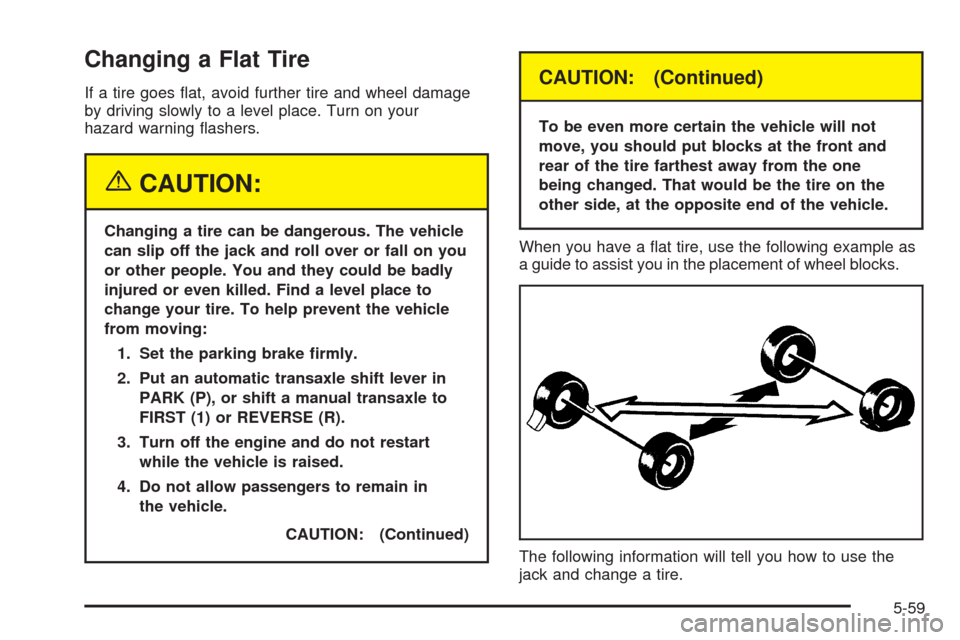
To be even more certain the vehicle will not
move, you should put blocks at the front and
rear of the tire farthest away from the one
being changed. That would be the tire on the
other side, at the opposite end of the vehicle.
When you have a flat tire, use the following example as
a guide to assist you in the placement of wheel blocks.
The following information will tell you how to use the
jack and change a tire.
5-59
Page 273 of 336
Vehicle Identication
Vehicle Identication Number (VIN)
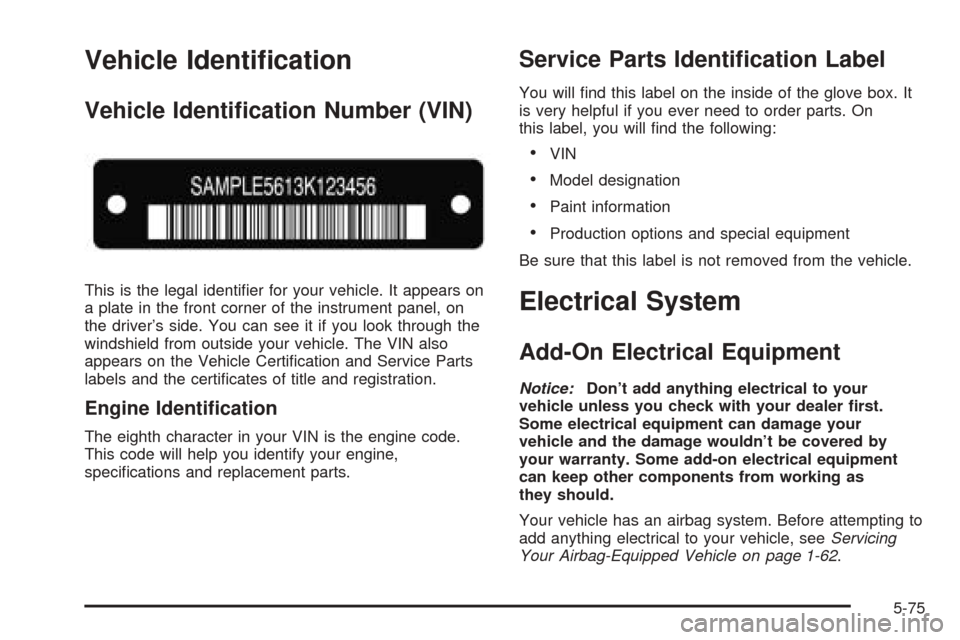
This is the legal identifier for your vehicle. It appears on
a plate in the front corner of the instrument panel, on
the driver’s side. You can see it if you look through the
windshield from outside your vehicle. The VIN also
appears on the Vehicle Certification and Service Parts
labels and the certificates of title and registration.
Engine Identication
The eighth character in your VIN is the engine code.
This code will help you identify your engine,
specifications and replacement parts.
Service Parts Identication Label
You will find this label on the inside of the glove box. It
is very helpful if you ever need to order parts. On
this label, you will find the following:
•VIN
•Model designation
•Paint information
•Production options and special equipment
Be sure that this label is not removed from the vehicle.
Electrical System
Add-On Electrical Equipment
Notice:Don’t add anything electrical to your
vehicle unless you check with your dealer rst.
Some electrical equipment can damage your
vehicle and the damage wouldn’t be covered by
your warranty. Some add-on electrical equipment
can keep other components from working as
they should.
Your vehicle has an airbag system. Before attempting to
add anything electrical to your vehicle, seeServicing
Your Airbag-Equipped Vehicle on page 1-62.
5-75
Page 275 of 336
There are spare fuses provided in the engine
compartment fuse block. If you ever have a problem on
the road and do not have a spare fuse, you can
borrow one that has the same amperage. Just pick
a feature of your vehicle that you can get along
without — like the radio or cigarette lighter — and use
its fuse, if it is the correct amperage. Replace it as soon
as you can.
There are two fuse blocks in your vehicle: the
instrument panel fuse block and the engine compartment
fuse block.
There is a fuse puller located on the engine
compartment fuse block. It can be used to easily
remove fuses from the fuse block.Instrument Panel Fuse Block
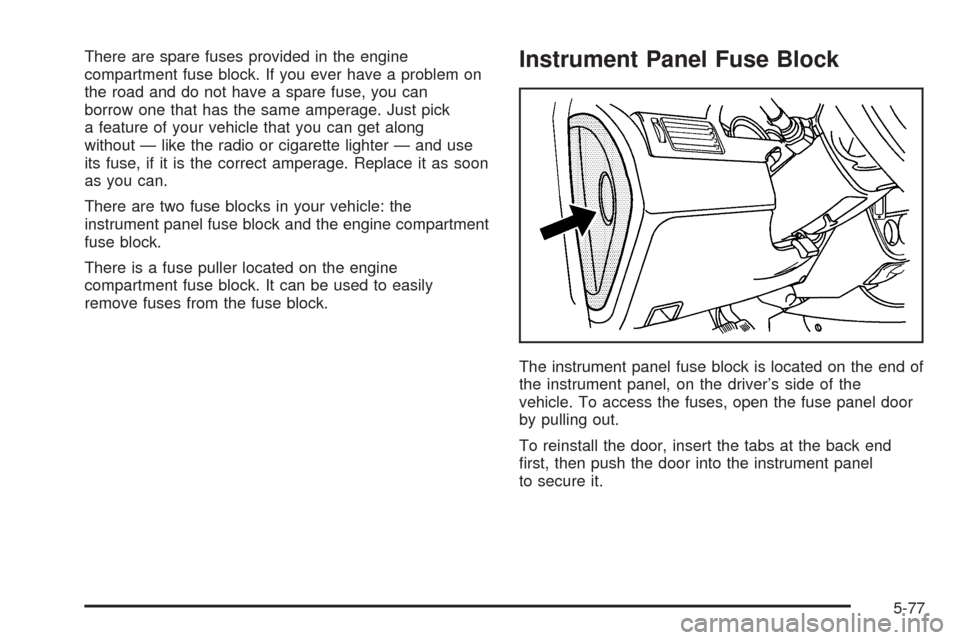
The instrument panel fuse block is located on the end of
the instrument panel, on the driver’s side of the
vehicle. To access the fuses, open the fuse panel door
by pulling out.
To reinstall the door, insert the tabs at the back end
first, then push the door into the instrument panel
to secure it.
5-77
Page 276 of 336
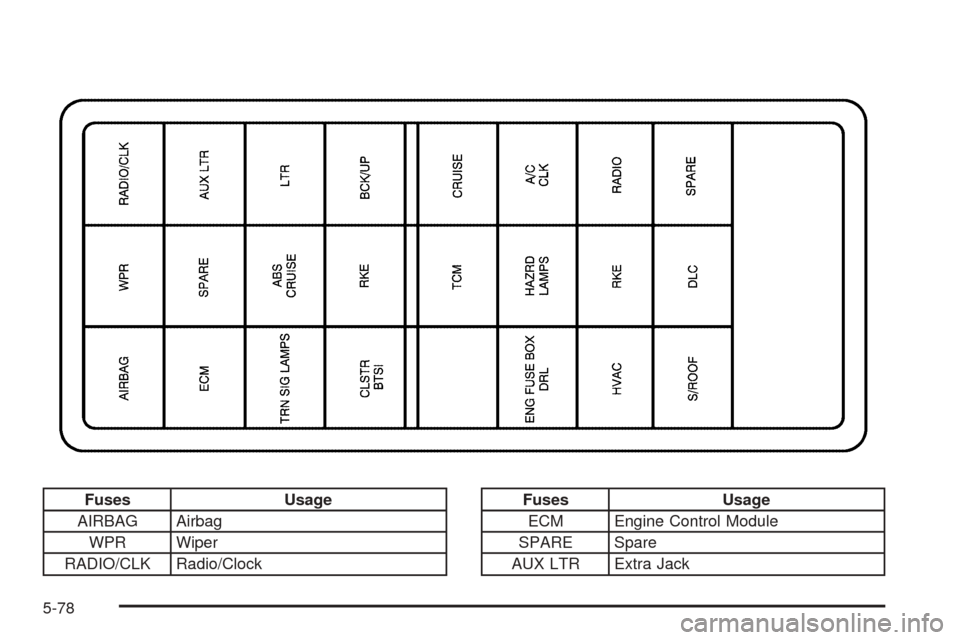
Fuses Usage
AIRBAG Airbag
WPR Wiper
RADIO/CLK Radio/ClockFuses Usage
ECM Engine Control Module
SPARE Spare
AUX LTR Extra Jack
5-78
Page 277 of 336
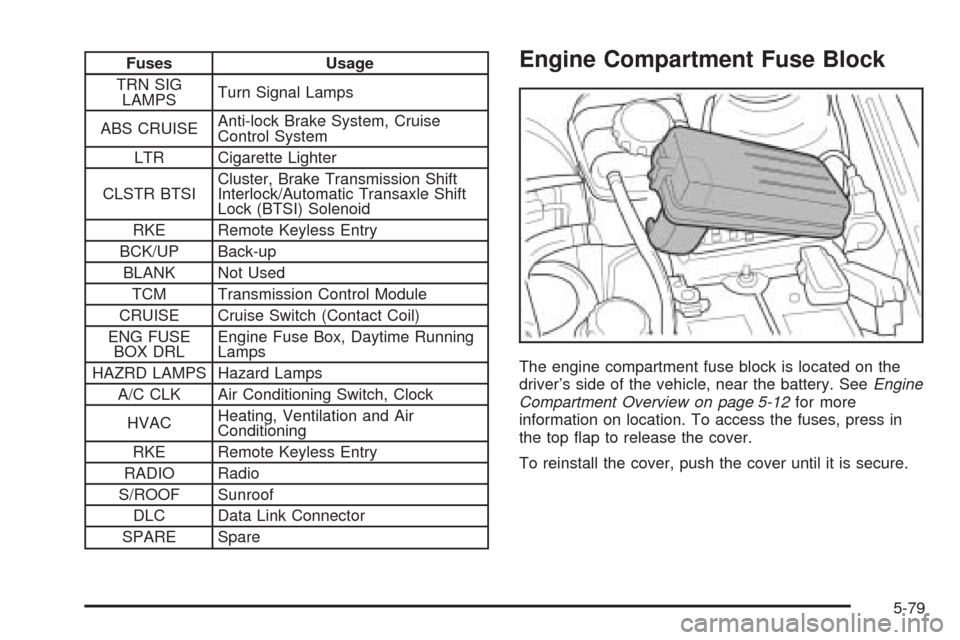
Fuses Usage
TRN SIG
LAMPSTurn Signal Lamps
ABS CRUISEAnti-lock Brake System, Cruise
Control System
LTR Cigarette Lighter
CLSTR BTSICluster, Brake Transmission Shift
Interlock/Automatic Transaxle Shift
Lock (BTSI) Solenoid
RKE Remote Keyless Entry
BCK/UP Back-up
BLANK Not Used
TCM Transmission Control Module
CRUISE Cruise Switch (Contact Coil)
ENG FUSE
BOX DRLEngine Fuse Box, Daytime Running
Lamps
HAZRD LAMPS Hazard Lamps
A/C CLK Air Conditioning Switch, Clock
HVACHeating, Ventilation and Air
Conditioning
RKE Remote Keyless Entry
RADIO Radio
S/ROOF Sunroof
DLC Data Link Connector
SPARE SpareEngine Compartment Fuse Block
The engine compartment fuse block is located on the
driver’s side of the vehicle, near the battery. SeeEngine
Compartment Overview on page 5-12for more
information on location. To access the fuses, press in
the top flap to release the cover.
To reinstall the cover, push the cover until it is secure.
5-79
Page 278 of 336
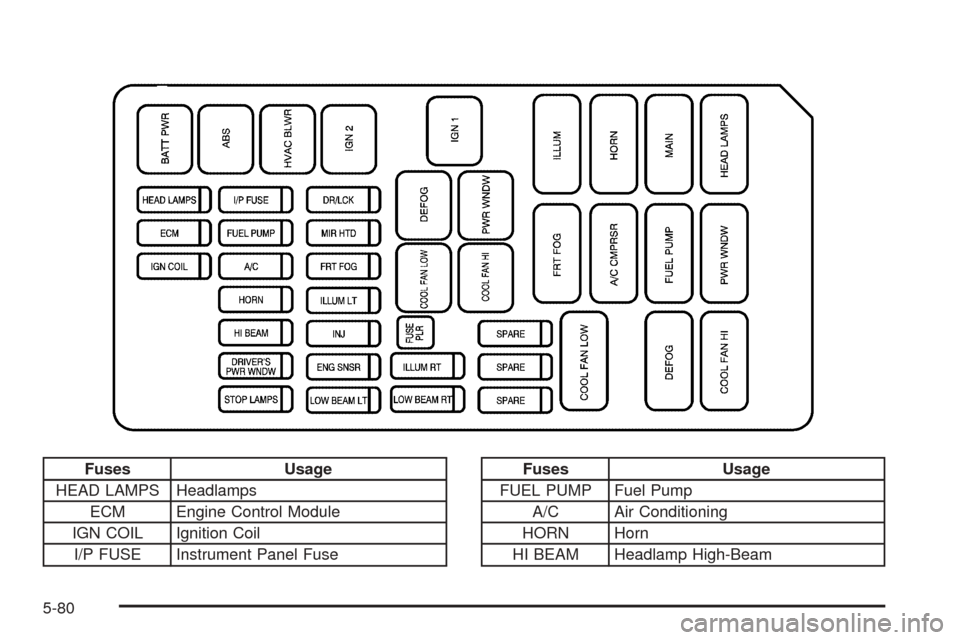
Fuses Usage
HEAD LAMPS Headlamps
ECM Engine Control Module
IGN COIL Ignition Coil
I/P FUSE Instrument Panel FuseFuses Usage
FUEL PUMP Fuel Pump
A/C Air Conditioning
HORN Horn
HI BEAM Headlamp High-Beam
5-80
Page 280 of 336
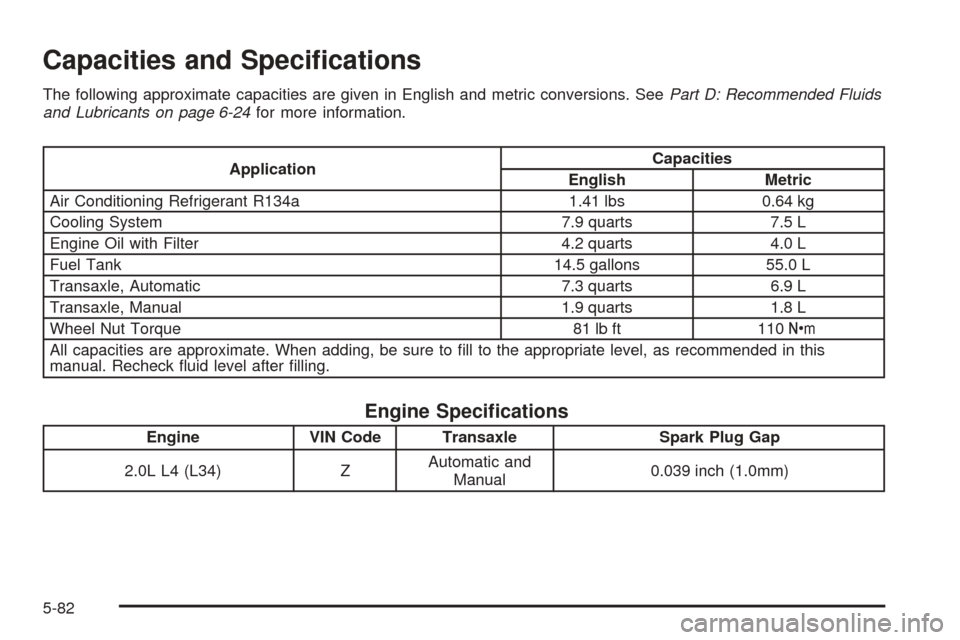
Capacities and Specications
The following approximate capacities are given in English and metric conversions. SeePart D: Recommended Fluids
and Lubricants on page 6-24for more information.
ApplicationCapacities
English Metric
Air Conditioning Refrigerant R134a 1.41 lbs 0.64 kg
Cooling System 7.9 quarts 7.5 L
Engine Oil with Filter 4.2 quarts 4.0 L
Fuel Tank 14.5 gallons 55.0 L
Transaxle, Automatic 7.3 quarts 6.9 L
Transaxle, Manual 1.9 quarts 1.8 L
Wheel Nut Torque 81 lb ft 110Y
All capacities are approximate. When adding, be sure to fill to the appropriate level, as recommended in this
manual. Recheck fluid level after filling.
Engine Specications
Engine VIN Code Transaxle Spark Plug Gap
2.0L L4 (L34) ZAutomatic and
Manual0.039 inch (1.0mm)
5-82
Page 281 of 336
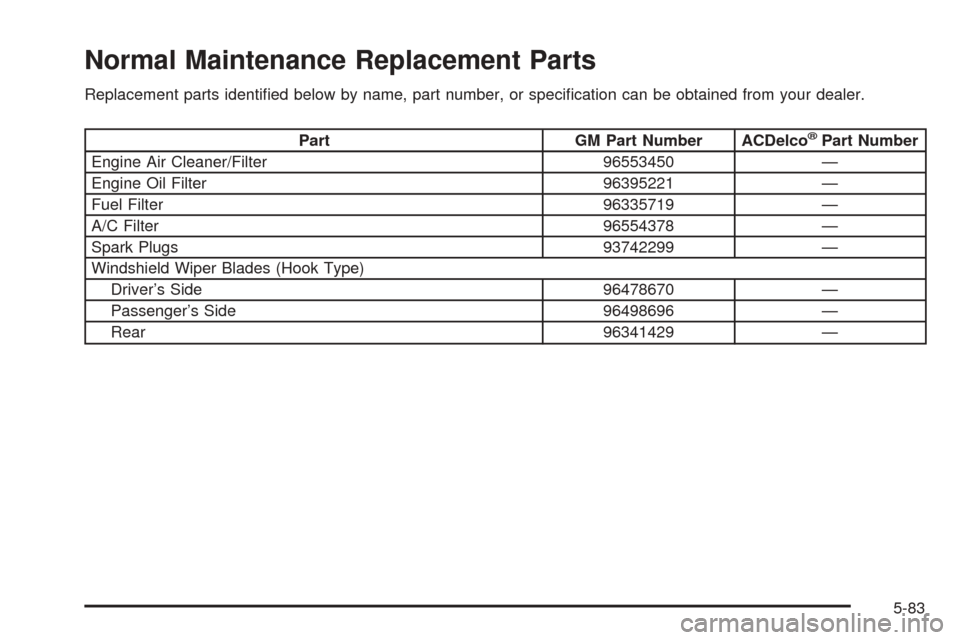
Normal Maintenance Replacement Parts
Replacement parts identified below by name, part number, or specification can be obtained from your dealer.
Part GM Part Number ACDelco®Part Number
Engine Air Cleaner/Filter 96553450 —
Engine Oil Filter 96395221 —
Fuel Filter 96335719 —
A/C Filter 96554378 —
Spark Plugs 93742299 —
Windshield Wiper Blades (Hook Type)
Driver’s Side 96478670 —
Passenger’s Side 96498696 —
Rear 96341429 —
5-83
Page 283 of 336
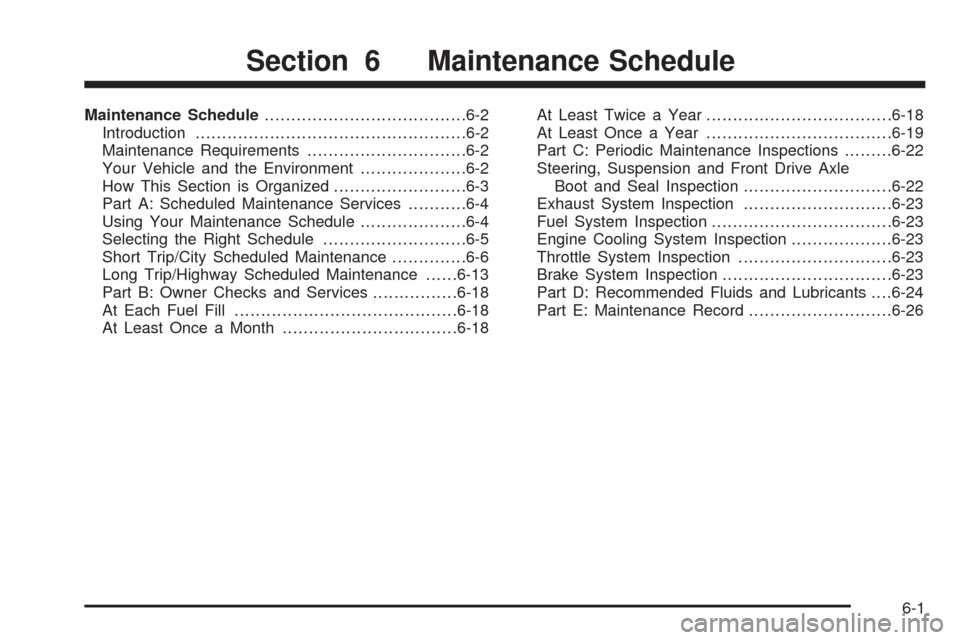
Maintenance Schedule......................................6-2
Introduction...................................................6-2
Maintenance Requirements..............................6-2
Your Vehicle and the Environment....................6-2
How This Section is Organized.........................6-3
Part A: Scheduled Maintenance Services...........6-4
Using Your Maintenance Schedule....................6-4
Selecting the Right Schedule...........................6-5
Short Trip/City Scheduled Maintenance..............6-6
Long Trip/Highway Scheduled Maintenance......6-13
Part B: Owner Checks and Services................6-18
At Each Fuel Fill..........................................6-18
At Least Once a Month.................................6-18At Least Twice a Year...................................6-18
At Least Once a Year...................................6-19
Part C: Periodic Maintenance Inspections.........6-22
Steering, Suspension and Front Drive Axle
Boot and Seal Inspection............................6-22
Exhaust System Inspection............................6-23
Fuel System Inspection..................................6-23
Engine Cooling System Inspection...................6-23
Throttle System Inspection.............................6-23
Brake System Inspection................................6-23
Part D: Recommended Fluids and Lubricants. . . .6-24
Part E: Maintenance Record...........................6-26
Section 6 Maintenance Schedule
6-1