Top 1 CHEVROLET OPTRA 5 2005 1.G Owners Manual
[x] Cancel search | Manufacturer: CHEVROLET, Model Year: 2005, Model line: OPTRA 5, Model: CHEVROLET OPTRA 5 2005 1.GPages: 336, PDF Size: 2.21 MB
Page 4 of 336
Vehicle Damage Warnings
Also, in this manual you will find these notices:
Notice:These mean there is something that could
damage your vehicle.
A notice tells about something that can damage the
vehicle. Many times, this damage would not be covered
by your vehicle’s warranty, and it could be costly. But
the notice will tell what to do to help avoid the damage.
When you read other manuals, you might see
CAUTION and NOTICE warnings in different colors
or in different words.
There are also warning labels on the vehicle. They use
the same words, CAUTION or NOTICE.
Vehicle Symbols
The vehicle has components and labels that use
symbols instead of text. Symbols are shown along with
the text describing the operation or information
relating to a specific component, control, message,
gage, or indicator.
If you need help figuring out a specific name of a
component, gage, or indicator, reference the
following topics:
•Seats and Restraint Systems in Section 1
•Features and Controls in Section 2
•Instrument Panel Overview in Section 3
•Climate Controls in Section 3
•Warning Lights, Gages, and Indicators in Section 3
•Audio System(s) in Section 3
•Engine Compartment Overview in Section 5
iv
Page 7 of 336
Front Seats......................................................1-2
Manual Seats (With Sliding Storage Tray)..........1-2
Manual Seats (Without Sliding Storage Tray)......1-3
Driver Seat Tilt Adjuster..................................1-3
Manual Lumbar..............................................1-4
Reclining Seatbacks........................................1-4
Head Restraints.............................................1-6
Rear Seats.......................................................1-7
Rear Seat Operation.......................................1-7
Safety Belts.....................................................1-8
Safety Belts: They Are for Everyone.................1-8
Questions and Answers About Safety Belts......1-13
How to Wear Safety Belts Properly.................1-13
Driver Position..............................................1-14
Shoulder Belt Height Adjustment.....................1-20
Safety Belt Use During Pregnancy..................1-21
Right Front Passenger Position.......................1-21
Rear Seat Passengers..................................1-21
Center Rear Passenger Position.....................1-24
Safety Belt Pretensioners...............................1-24
Safety Belt Extender.....................................1-24
Child Restraints.............................................1-25
Older Children..............................................1-25
Infants and Young Children............................1-27
Child Restraint Systems.................................1-31Where to Put the Restraint.............................1-34
Top Strap....................................................1-35
Top Strap Anchor Location.............................1-36
Lower Anchorages and Top Tethers for
Children (LATCH System)...........................1-39
Securing a Child Restraint Designed for
the LATCH System....................................1-41
Securing a Child Restraint in a Rear
Seat Position............................................1-41
Securing a Child Restraint in the Right
Front Seat Position....................................1-43
Airbag System...............................................1-48
Where Are the Airbags?................................1-51
When Should an Airbag Inflate?.....................1-53
What Makes an Airbag Inflate?.......................1-55
How Does an Airbag Restrain?.......................1-55
What Will You See After an Airbag Inflates?.....1-56
Passenger Sensing System............................1-58
Servicing Your Airbag-Equipped Vehicle...........1-62
Adding Equipment to Your Airbag-Equipped
Vehicle....................................................1-62
Restraint System Check..................................1-63
Checking Your Restraint Systems...................1-63
Replacing Restraint System Parts
After a Crash............................................1-63
Section 1 Seats and Restraint Systems
1-1
Page 12 of 336
Head Restraints
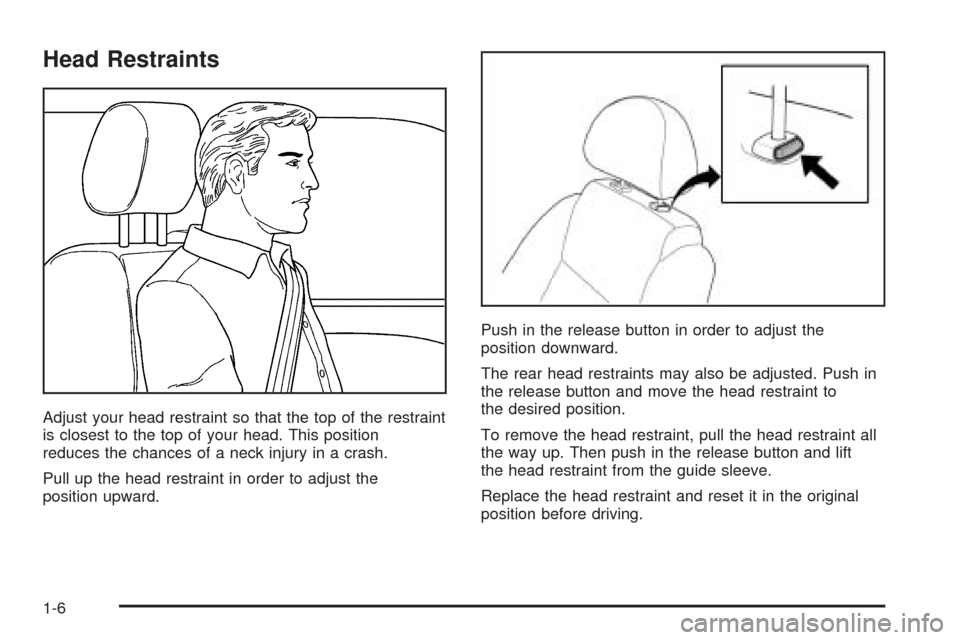
Adjust your head restraint so that the top of the restraint
is closest to the top of your head. This position
reduces the chances of a neck injury in a crash.
Pull up the head restraint in order to adjust the
position upward.Push in the release button in order to adjust the
position downward.
The rear head restraints may also be adjusted. Push in
the release button and move the head restraint to
the desired position.
To remove the head restraint, pull the head restraint all
the way up. Then push in the release button and lift
the head restraint from the guide sleeve.
Replace the head restraint and reset it in the original
position before driving.
1-6
Page 13 of 336
Rear Seats
Rear Seat Operation
Your vehicle has rear seatbacks that can be folded
down to increase cargo space.
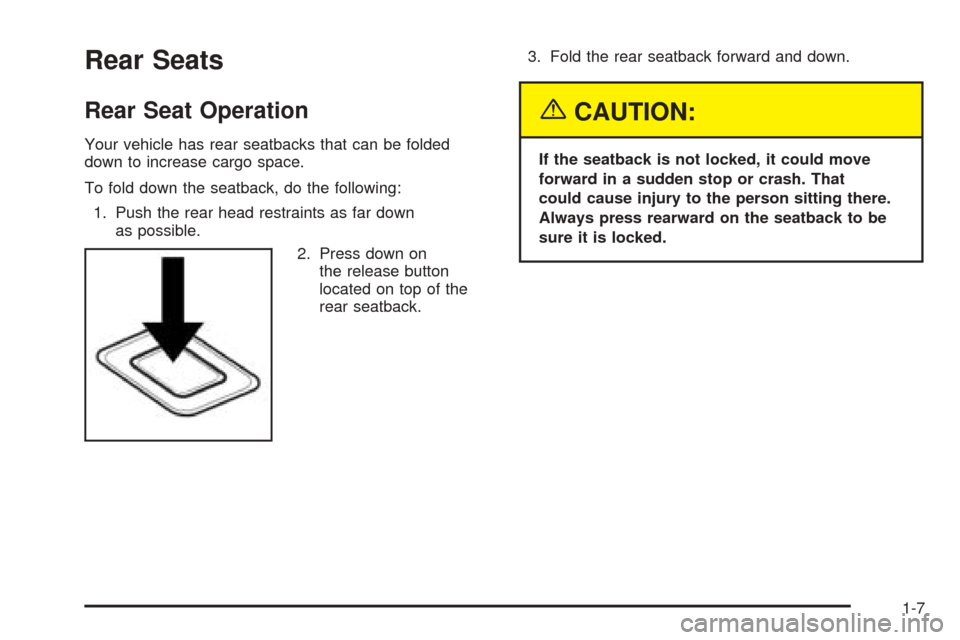
To fold down the seatback, do the following:
1. Push the rear head restraints as far down
as possible.
2. Press down on
the release button
located on top of the
rear seatback.3. Fold the rear seatback forward and down.
{CAUTION:
If the seatback is not locked, it could move
forward in a sudden stop or crash. That
could cause injury to the person sitting there.
Always press rearward on the seatback to be
sure it is locked.
1-7
Page 14 of 336
{CAUTION:
A safety belt that is improperly routed, not
properly attached, or twisted will not provide
the protection needed in a crash. The person
wearing the belt could be seriously injured.
After raising the rear seatback, always check
to be sure that the safety belts are properly
routed and attached, and are not twisted.
To return the seatback to the upright position, do the
following:
1. Lift up the seatback and push it to its original
position. Ensure that the safety belts are not twisted
or caught under the seatback.
2. Push rearward firmly on the top of the seatback
until it latches securely in the fully upright position.
Safety Belts
Safety Belts: They Are for Everyone
This part of the manual tells you how to use safety
belts properly. It also tells you some things you should
not do with safety belts.
{CAUTION:
Do not let anyone ride where he or she can not
wear a safety belt properly. If you are in a
crash and you are not wearing a safety belt,
your injuries can be much worse. You can hit
things inside the vehicle or be ejected from it.
You can be seriously injured or killed. In the
same crash, you might not be, if you are
buckled up. Always fasten your safety belt,
and check that your passengers’ belts are
fastened properly too.
1-8
Page 17 of 336
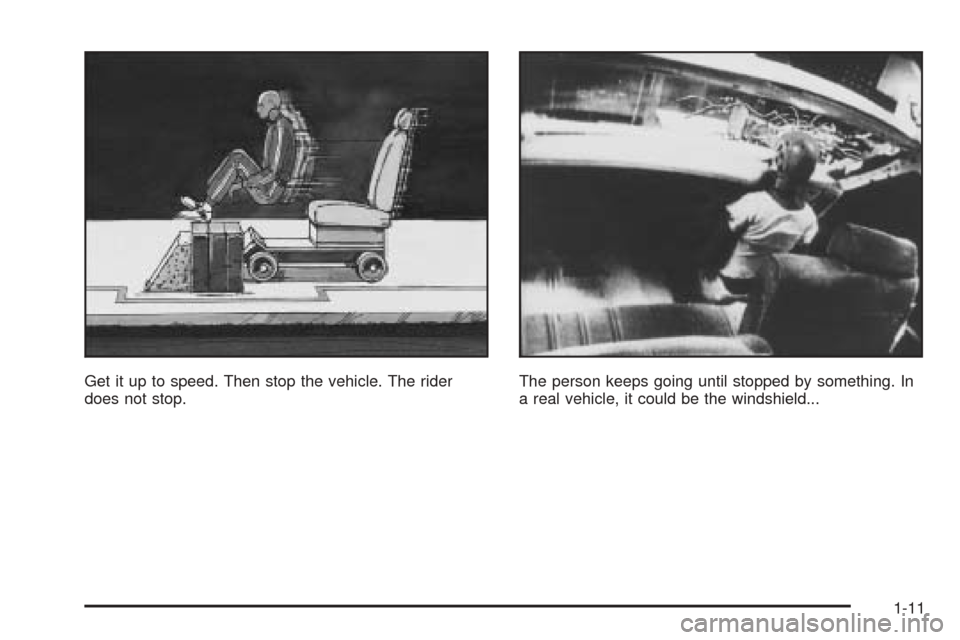
Get it up to speed. Then stop the vehicle. The rider
does not stop.The person keeps going until stopped by something. In
a real vehicle, it could be the windshield...
1-11
Page 18 of 336
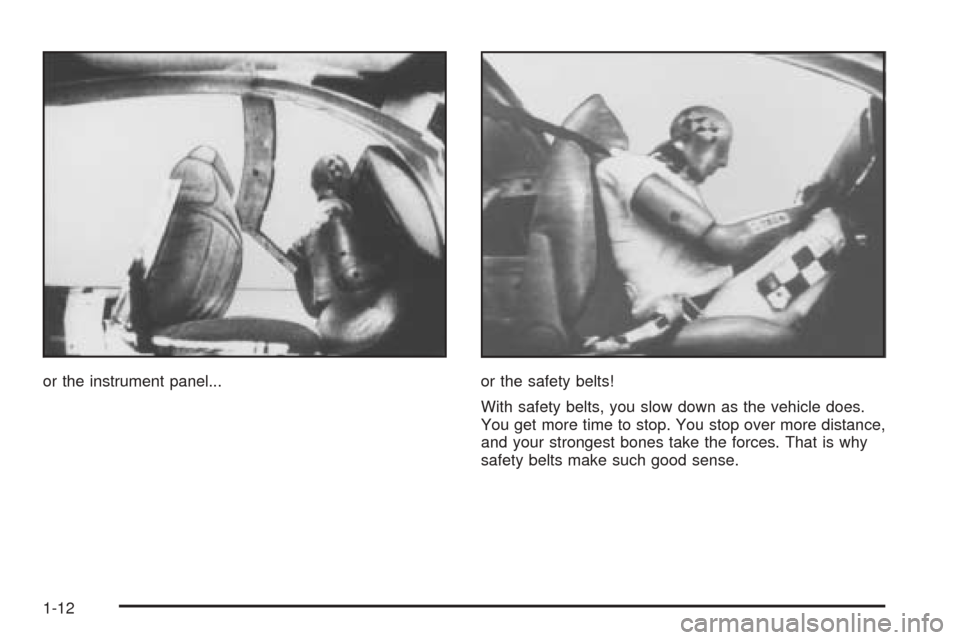
or the instrument panel... or the safety belts!
With safety belts, you slow down as the vehicle does.
You get more time to stop. You stop over more distance,
and your strongest bones take the forces. That is why
safety belts make such good sense.
1-12
Page 21 of 336
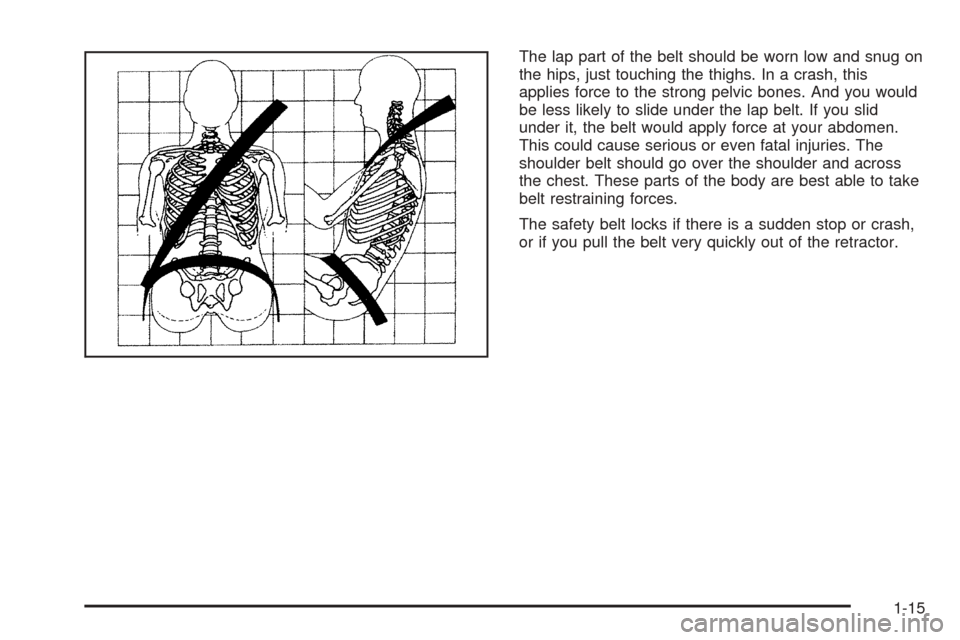
The lap part of the belt should be worn low and snug on
the hips, just touching the thighs. In a crash, this
applies force to the strong pelvic bones. And you would
be less likely to slide under the lap belt. If you slid
under it, the belt would apply force at your abdomen.
This could cause serious or even fatal injuries. The
shoulder belt should go over the shoulder and across
the chest. These parts of the body are best able to take
belt restraining forces.
The safety belt locks if there is a sudden stop or crash,
or if you pull the belt very quickly out of the retractor.
1-15
Page 29 of 336
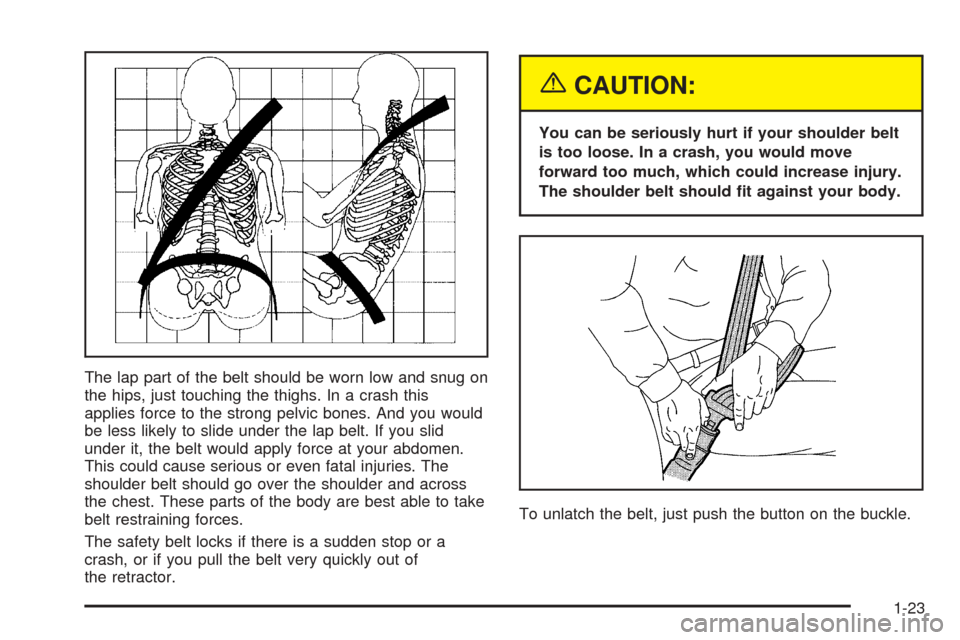
The lap part of the belt should be worn low and snug on
the hips, just touching the thighs. In a crash this
applies force to the strong pelvic bones. And you would
be less likely to slide under the lap belt. If you slid
under it, the belt would apply force at your abdomen.
This could cause serious or even fatal injuries. The
shoulder belt should go over the shoulder and across
the chest. These parts of the body are best able to take
belt restraining forces.
The safety belt locks if there is a sudden stop or a
crash, or if you pull the belt very quickly out of
the retractor.
{CAUTION:
You can be seriously hurt if your shoulder belt
is too loose. In a crash, you would move
forward too much, which could increase injury.
The shoulder belt should t against your body.
To unlatch the belt, just push the button on the buckle.
1-23
Page 31 of 336
Child Restraints
Older Children
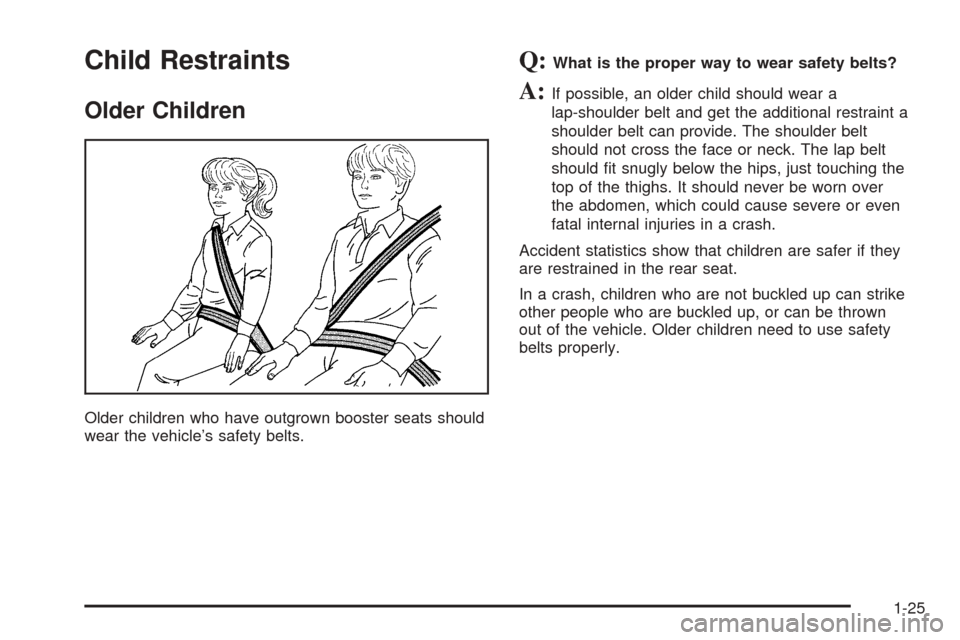
Older children who have outgrown booster seats should
wear the vehicle’s safety belts.
Q:What is the proper way to wear safety belts?
A:If possible, an older child should wear a
lap-shoulder belt and get the additional restraint a
shoulder belt can provide. The shoulder belt
should not cross the face or neck. The lap belt
should fit snugly below the hips, just touching the
top of the thighs. It should never be worn over
the abdomen, which could cause severe or even
fatal internal injuries in a crash.
Accident statistics show that children are safer if they
are restrained in the rear seat.
In a crash, children who are not buckled up can strike
other people who are buckled up, or can be thrown
out of the vehicle. Older children need to use safety
belts properly.
1-25