Maintain CHEVROLET OPTRA 5 2007 1.G User Guide
[x] Cancel search | Manufacturer: CHEVROLET, Model Year: 2007, Model line: OPTRA 5, Model: CHEVROLET OPTRA 5 2007 1.GPages: 422, PDF Size: 2.39 MB
Page 303 of 422
Tires
Your new vehicle comes with high-quality tires
made by a leading tire manufacturer. If you ever
have questions about your tire warranty and where
to obtain service, see your GM Warranty booklet
for details. For additional information refer to
the tire manufacturer’s booklet included with your
vehicle.
{CAUTION:
Poorly maintained and improperly used
tires are dangerous.
Overloading your vehicle’s tires can
cause overheating as a result of too
much friction. You could have an
air-out and a serious accident. See
Loading Your Vehicle on page 236.
CAUTION: (Continued)
CAUTION: (Continued)
Underinated tires pose the same
danger as overloaded tires. The
resulting accident could cause serious
injury. Check all tires frequently to
maintain the recommended pressure.
Tire pressure should be checked when
your vehicle’s tires are cold. See
Inflation - Tire Pressure on page 311.
Overinated tires are more likely to be
cut, punctured, or broken by a sudden
impact — such as when you hit a
pothole. Keep tires at the
recommended pressure.
Worn, old tires can cause accidents.
If the tire’s tread is badly worn, or if
your vehicle’s tires have been
damaged, replace them.
303
Page 313 of 422
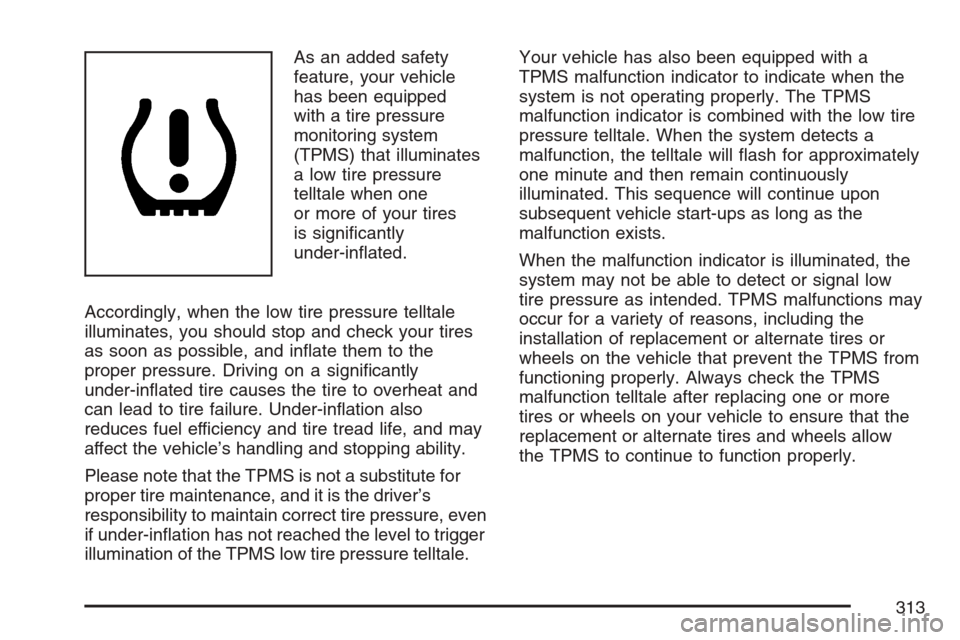
As an added safety
feature, your vehicle
has been equipped
with a tire pressure
monitoring system
(TPMS) that illuminates
a low tire pressure
telltale when one
or more of your tires
is significantly
under-inflated.
Accordingly, when the low tire pressure telltale
illuminates, you should stop and check your tires
as soon as possible, and inflate them to the
proper pressure. Driving on a significantly
under-inflated tire causes the tire to overheat and
can lead to tire failure. Under-inflation also
reduces fuel efficiency and tire tread life, and may
affect the vehicle’s handling and stopping ability.
Please note that the TPMS is not a substitute for
proper tire maintenance, and it is the driver’s
responsibility to maintain correct tire pressure, even
if under-inflation has not reached the level to trigger
illumination of the TPMS low tire pressure telltale.Your vehicle has also been equipped with a
TPMS malfunction indicator to indicate when the
system is not operating properly. The TPMS
malfunction indicator is combined with the low tire
pressure telltale. When the system detects a
malfunction, the telltale will flash for approximately
one minute and then remain continuously
illuminated. This sequence will continue upon
subsequent vehicle start-ups as long as the
malfunction exists.
When the malfunction indicator is illuminated, the
system may not be able to detect or signal low
tire pressure as intended. TPMS malfunctions may
occur for a variety of reasons, including the
installation of replacement or alternate tires or
wheels on the vehicle that prevent the TPMS from
functioning properly. Always check the TPMS
malfunction telltale after replacing one or more
tires or wheels on your vehicle to ensure that the
replacement or alternate tires and wheels allow
the TPMS to continue to function properly.
313
Page 324 of 422
If a Tire Goes Flat
It is unusual for a tire to blowout while you are
driving, especially if you maintain your vehicle’s
tires properly. If air goes out of a tire, it is
much more likely to leak out slowly. But if you
should ever have a blowout, here are a few tips
about what to expect and what to do:
If a front tire fails, the flat tire will create a drag
that pulls the vehicle toward that side. Take your
foot off the accelerator pedal and grip the
steering wheel firmly. Steer to maintain lane
position, and then gently brake to a stop well out
of the traffic lane.
A rear blowout, particularly on a curve, acts much
like a skid and may require the same correction
you would use in a skid. In any rear blowout
remove your foot from the accelerator pedal. Get
the vehicle under control by steering the way
you want the vehicle to go. It may be very bumpy
and noisy, but you can still steer. Gently brake
to a stop, well off the road if possible.{CAUTION:
Lifting a vehicle and getting under it to do
maintenance or repairs is dangerous
without the appropriate safety equipment
and training. The jack provided with your
vehicle is designed only for changing a
at tire. If it is used for anything else, you
or others could be badly injured or killed
if the vehicle slips off the jack. Use the
jack provided with your vehicle only for
changing a at tire.
If a tire goes flat, the next part shows how to use the
jacking equipment to change a flat tire safely.
Changing a Flat Tire
If a tire goes flat, avoid further tire and wheel
damage by driving slowly to a level place.
Turn on your hazard warning flashers.
324
Page 336 of 422
Many cleaners contain solvents that may become
concentrated in your vehicle’s breathing space.
Before using cleaners, read and adhere to
all safety instructions on the label. While cleaning
your vehicle’s interior, maintain adequate
ventilation by opening your vehicle’s doors and
windows.
Dust may be removed from small buttons and
knobs using a small brush with soft bristles.
Your dealer has a product for cleaning your
vehicle’s glass. Should it become necessary, you
can also obtain a product from your dealer to
remove odors from your vehicle’s upholstery.
Do not clean your vehicle using the following
cleaners or techniques:
•Never use a knife or any other sharp object to
remove a soil from any interior surface.
•Never use a stiff brush. It can cause damage
to your vehicle’s interior surfaces.
•Never apply heavy pressure or rub
aggressively with a cleaning cloth. Use of
heavy pressure can damage your interior and
does not improve the effectiveness of soil
removal.
•Use only mild, neutral-pH soaps. Avoid laundry
detergents or dishwashing soaps with
degreasers. Using too much soap will leave a
residue that leaves streaks and attracts dirt.
For liquid cleaners, about 20 drops per gallon
(3.78 L) of water is a good guide.
•Do not heavily saturate your upholstery while
cleaning.
•Damage to your vehicle’s interior may result
from the use of many organic solvents such as
naptha, alcohol, etc.
336
Page 342 of 422
Tires
To clean the tires, use a stiff brush with tire
cleaner.
Notice:Using petroleum-based tire dressing
products on your vehicle may damage the
paint nish and/or tires. When applying a tire
dressing, always wipe off any overspray
from all painted surfaces on your vehicle.
Sheet Metal Damage
If the vehicle is damaged and requires sheet metal
repair or replacement, make sure the body
repair shop applies anti-corrosion material to parts
repaired or replaced to restore corrosion
protection.
Original manufacturer replacement parts will
provide the corrosion protection while maintaining
the warranty.
Finish Damage
Any stone chips, fractures or deep scratches in
the finish should be repaired right away. Bare
metal will corrode quickly and may develop into
major repair expense.
Minor chips and scratches can be repaired with
touch-up materials available from your dealer.
Larger areas of finish damage can be corrected in
your dealer’s body and paint shop.
Underbody Maintenance
Chemicals used for ice and snow removal and
dust control can collect on the underbody. If these
are not removed, corrosion and rust can develop
on the underbody parts such as fuel lines, frame,
floor pan, and exhaust system even though
they have corrosion protection.
342
Page 356 of 422
Maintenance Schedule
Introduction
Important: Keep engine oil at the proper level
and change as recommended.
Have you purchased the GM Protection Plan? The
Plan supplements your new vehicle warranties.
See your Warranty and Owner Assistance booklet
or your dealer for details.
Maintenance Requirements
Maintenance intervals, checks, inspections and
recommended fluids and lubricants as prescribed
in this manual are necessary to keep your
vehicle in good working condition. Any damage
caused by failure to follow scheduled maintenance
may not be covered by warranty.
Your Vehicle and the Environment
Proper vehicle maintenance not only helps to keep
your vehicle in good working condition, but also
helps the environment. Improper vehicle
maintenance can even affect the quality of the air
we breathe. Improper fluid levels or the wrong
tire inflation can increase the level of emissions
from your vehicle. To help protect our environment,
and to keep your vehicle in good condition, be
sure to maintain your vehicle properly.
How This Section is Organized
This maintenance schedule is divided into
five parts:
“Part A: Scheduled Maintenance Services”
explains what to have done and how often. Some
of these services can be complex, so unless
you are technically qualified and have the
necessary equipment, you should let your
GM dealer’s service department do these jobs.
Your GM dealer has GM-trained and supported
service people that will perform the work using
genuine GM parts.
356
Page 357 of 422
{CAUTION:
Performing maintenance work on a
vehicle can be dangerous. In trying to do
some jobs, you can be seriously injured.
Do your own maintenance work only if
you have the required know-how and the
proper tools and equipment for the job.
If you have any doubt, have a qualied
technician do the work. SeeDoing Your
Own Service Work on page 250.
If you want to purchase service information, see
Service Publications Ordering Information on
page 406.“Part B: Owner Checks and Services”tells you
what should be checked and when. It also
explains what you can easily do to help keep your
vehicle in good condition.
“Part C: Periodic Maintenance Inspections”
explains important inspections that your dealer’s
service department can perform for you.
“Part D: Recommended Fluids and Lubricants”
lists some recommended products necessary to
help keep your vehicle properly maintained. These
products, or their equivalents, should be used
whether you do the work yourself or have it done.
“Part E: Maintenance Record”is a place for
you to record and keep track of the maintenance
performed on your vehicle. Keep your
maintenance receipts. They may be needed to
qualify your vehicle for warranty repairs.
357
Page 391 of 422
Online Owner Center
Online Owner Center
(United States only)
The Owner Center is a resource for your
GM ownership needs. Specific vehicle information
can be found in one place.
The Online Owner Center allows you to:
•Get e-mail service reminders.
•Access information about your specific
vehicle, including tips and videos and
an electronic version of this owner manual.
•Keep track of your vehicle’s service history
and maintenance schedule.
•Find GM dealers for service nationwide.
•Receive special promotions and privileges
only available to members.
Refer to www.MyGMLink.com on the web for
updated information and to register your vehicle.
My GM Canada (Canada only)
My GM Canada is a password-protected section
of gmcanada.com where you can save information
on GM vehicles, get personalized offers, and
use handy tools and forms with greater ease.
Here are a few of the valuable tools and services
you will have access to:
- My Showroom: Find and save information on
vehicles and current offers in your area.
- My Dealers/Retailers: Save details such as
address and phone number for each of
your preferred GM Dealers or Retailers.
- My Driveway: Receive service reminders and
helpful advice on owning and maintaining
your vehicle.
- My Preferences: Manage your profile,
subscribe to E-News and use tools and forms
with greater ease.
To sign up to My GM Canada, visit the My
GM Canada section within www.gmcanada.com.
391
Page 401 of 422
To read this information, special equipment is
needed and access to the vehicle or the device
that stores the data is required. GM will not access
information about a crash event or share it with
others other than:
•with the consent of the vehicle owner or,
if the vehicle is leased, with the consent of
the lessee,
•in response to an official request of police or
similar government office,
•as part of GM’s defense of litigation through
the discovery process, or
•as required by law.
In addition, once GM collects or receives data,
GM may:
•use the data for GM research needs,
•make it available for research where
appropriate confidentiality is to be maintained
and need is shown, or
•share summary data which is not tied to a
specific vehicle with non-GM organizations
for research purposes.Others, such as law enforcement, may have
access to the special equipment that can read the
information if they have access to the vehicle
or the device that stores the data.
If your vehicle has OnStar
®, please check the
OnStar®subscription service agreement or owner
manual for information on its operations and
data collection.
Collision Damage Repair
If your vehicle is involved in a collision and it is
damaged, have the damage repaired by a qualified
technician using the proper equipment and
quality replacement parts. Poorly performed
collision repairs will diminish your vehicle’s resale
value, and safety performance can be
compromised in subsequent collisions.
Collision Parts
Genuine GM Collision parts are new parts made
with the same materials and construction methods
as the parts with which your vehicle was
originally built.
401
Page 402 of 422
Genuine GM Collision parts are your best choice to
assure that your vehicle’s designed appearance,
durability, and safety are preserved. The use of
Genuine GM parts can help maintain your GM New
Vehicle Warranty.
Recycled original equipment parts may also be
used for repair. These parts are typically removed
from vehicles that were total losses in prior
accidents. In most cases, the parts being recycled
are from undamaged sections of the vehicle.
A recycled original equipment GM part, may be
an acceptable choice to maintain your vehicle’s
originally designed appearance and safety
performance, however, the history of these parts
is not known. Such parts are not covered by
your GM New Vehicle Limited Warranty, and any
related failures are not covered by that warranty.
Aftermarket collision parts are also available. These
are made by companies other than GM and may
not have been tested for your vehicle. As a result,
these parts may fit poorly, exhibit premature
durability/corrosion problems, and may not perform
properly in subsequent collisions. Aftermarket parts
are not covered by your GM New Vehicle Limited
Warranty, and any vehicle failure related to such
parts are not covered by that warranty.Repair Facility
GM also recommends that you choose a collision
repair facility that meets your needs before you
ever need collision repairs. Your GM dealer
may have a collision repair center with GM-trained
technicians and state of the art equipment, or
be able to recommend a collision repair center that
has GM-trained technicians and comparable
equipment.
Insuring Your Vehicle
Protect your investment in your GM vehicle with
comprehensive and collision insurance coverage.
There are significant differences in the quality
of coverage afforded by various insurance policy
terms. Many insurance policies provide reduced
protection to your GM vehicle by limiting
compensation for damage repairs by using
aftermarket collision parts. Some insurance
companies will not specify aftermarket collision
parts. When purchasing insurance, we recommend
that you assure your vehicle will be repaired
with GM original equipment collision parts. If such
insurance coverage is not available from your
current insurance carrier, consider switching
to another insurance carrier.
402