ECU CHEVROLET OPTRA 5 2007 1.G Service Manual
[x] Cancel search | Manufacturer: CHEVROLET, Model Year: 2007, Model line: OPTRA 5, Model: CHEVROLET OPTRA 5 2007 1.GPages: 422, PDF Size: 2.39 MB
Page 231 of 422
Winter Driving
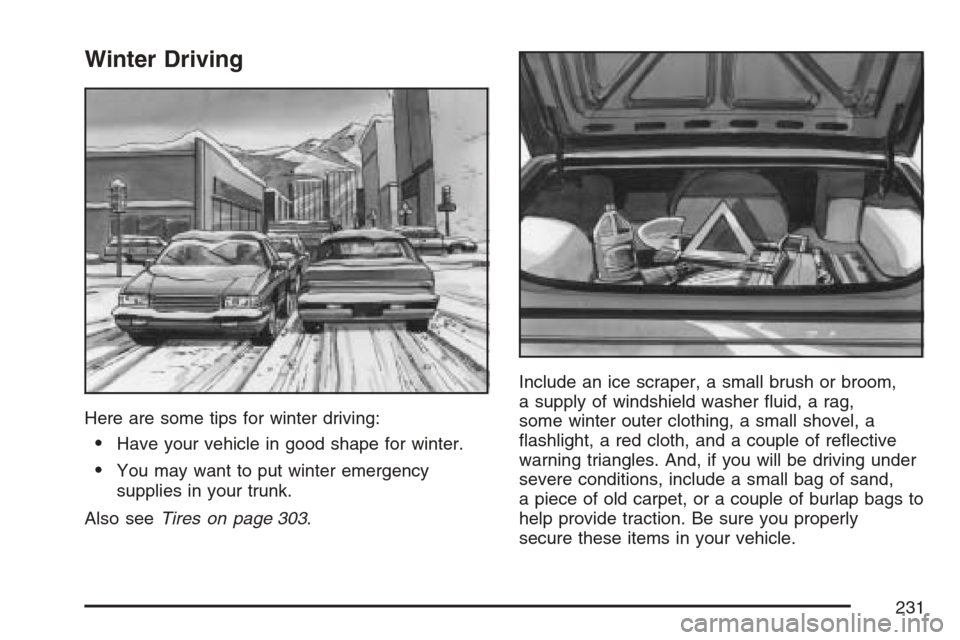
Here are some tips for winter driving:
•Have your vehicle in good shape for winter.
•You may want to put winter emergency
supplies in your trunk.
Also seeTires on page 303.Include an ice scraper, a small brush or broom,
a supply of windshield washer fluid, a rag,
some winter outer clothing, a small shovel, a
flashlight, a red cloth, and a couple of reflective
warning triangles. And, if you will be driving under
severe conditions, include a small bag of sand,
a piece of old carpet, or a couple of burlap bags to
help provide traction. Be sure you properly
secure these items in your vehicle.
231
Page 241 of 422
{CAUTION:
Things you put inside your vehicle can
strike and injure people in a sudden stop
or turn, or in a crash.
Put things in the trunk of your vehicle.
In a trunk, put them as far forward as
you can. Try to spread the weight
evenly.
Never stack heavier things, like
suitcases, inside the vehicle so that
some of them are above the tops of
the seats.
Do not leave an unsecured child
restraint in your vehicle.
When you carry something inside the
vehicle, secure it whenever you can.
Do not leave a seat folded down
unless you need to.
Towing
Towing Your Vehicle
Consult your dealer or a professional towing
service if you need to have your disabled vehicle
towed. SeeRoadside Assistance Program on
page 394.
If you want to tow your vehicle behind another
vehicle for recreational purposes (such as
behind a motorhome), see “Recreational Vehicle
Towing” following.
241
Page 271 of 422
Adding Coolant
If you need more coolant, add the proper
DEX-COOL®coolant mixture at the coolant surge
tank, but only when the engine is cool. If the
coolant surge tank is empty, a special fill
procedure is necessary. SeeEngine Overheating
on page 271for instructions on “How to Add
Coolant to the Coolant Surge Tank.”
{CAUTION:
You can be burned if you spill coolant on
hot engine parts. Coolant contains
ethylene glycol, and it will burn if the
engine parts are hot enough. Do not spill
coolant on a hot engine.
When replacing the pressure cap, make sure it is
hand-tight and fully seated.
Coolant Surge Tank Pressure Cap
Notice:If the pressure cap is not tightly
installed, coolant loss and possible engine
damage may occur. Be sure the cap is properly
and tightly secured.
Engine Overheating
You will find a coolant temperature gage on your
vehicle’s instrument panel cluster. SeeEngine
Coolant Temperature Gage on page 171.
271
Page 297 of 422
Center High-Mounted Stoplamp
(CHMSL) (Wagon)
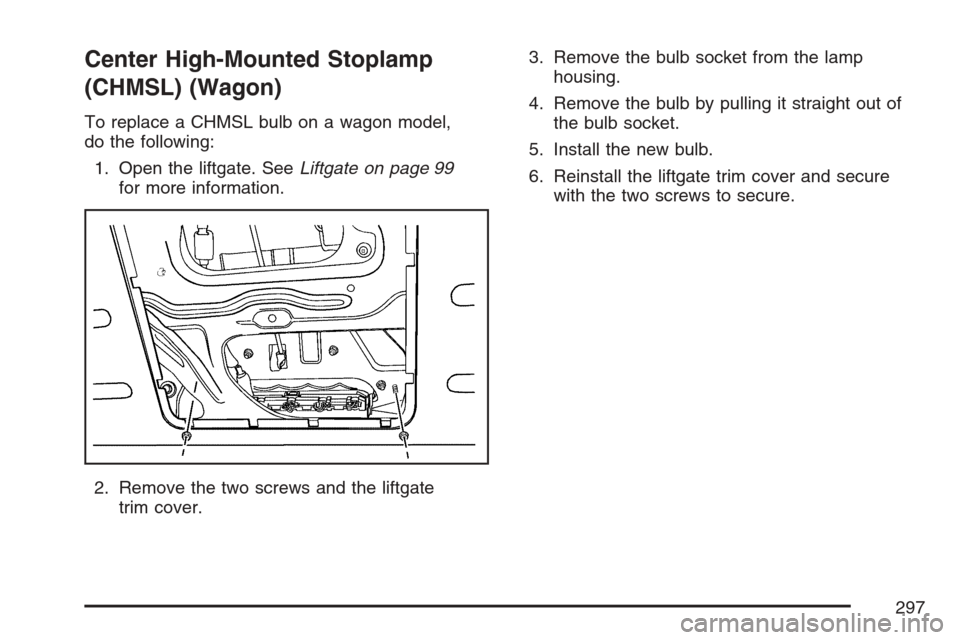
To replace a CHMSL bulb on a wagon model,
do the following:
1. Open the liftgate. SeeLiftgate on page 99
for more information.
2. Remove the two screws and the liftgate
trim cover.3. Remove the bulb socket from the lamp
housing.
4. Remove the bulb by pulling it straight out of
the bulb socket.
5. Install the new bulb.
6. Reinstall the liftgate trim cover and secure
with the two screws to secure.
297
Page 323 of 422
Used Replacement Wheels
{CAUTION:
Putting a used wheel on your vehicle is
dangerous. You cannot know how it has
been used or how far it has been driven.
It could fail suddenly and cause a crash.
If you have to replace a wheel, use a new
GM original equipment wheel.
Tire Chains
Notice:Use tire chains only where legal and
only when you must. Use only SAE Class
“S” type chains that are the proper size for
your tires. Install them on the front tires
and tighten them as tightly as possible with
the ends securely fastened. Drive slowly
and follow the chain manufacturer’s
instructions. If you can hear the chains
contacting your vehicle, stop and retighten
them. If the contact continues, slow down
until it stops. Driving too fast or spinning
the wheels with chains on will damage your
vehicle.
323
Page 333 of 422
Storing a Flat or Spare Tire
and Tools
{CAUTION:
Storing a jack, a tire, or other equipment
in the passenger compartment of the
vehicle could cause injury. In a sudden
stop or collision, loose equipment could
strike someone. Store all these in the
proper place.To store a flat or spare tire, do the following:
1. Put the flat or spare tire in the compact spare
tire compartment, then secure the retainer.
2. Store the jack in its housing in the cargo area.
Secure the jack by turning the retainer
clockwise.
3. Store the tools securely in the foam tray and
place the tray on top of the tire.
4. Replace the trim cover.
The compact spare tire is for temporary use only.
Replace the compact spare tire with a full-size
tire as soon as you can. SeeCompact Spare Tire
on page 334.
333
Page 347 of 422
There are spare fuses provided in the engine
compartment fuse block. If you ever have a problem
on the road and do not have a spare fuse, you can
borrow one that has the same amperage. Just pick
a feature of your vehicle that you can get along
without — like the radio or cigarette lighter — and
use its fuse, if it is the correct amperage. Replace it
as soon as you can.
There are two fuse blocks in your vehicle: the
instrument panel fuse block and the engine
compartment fuse block.
There is a fuse puller located on the engine
compartment fuse block. It can be used to easily
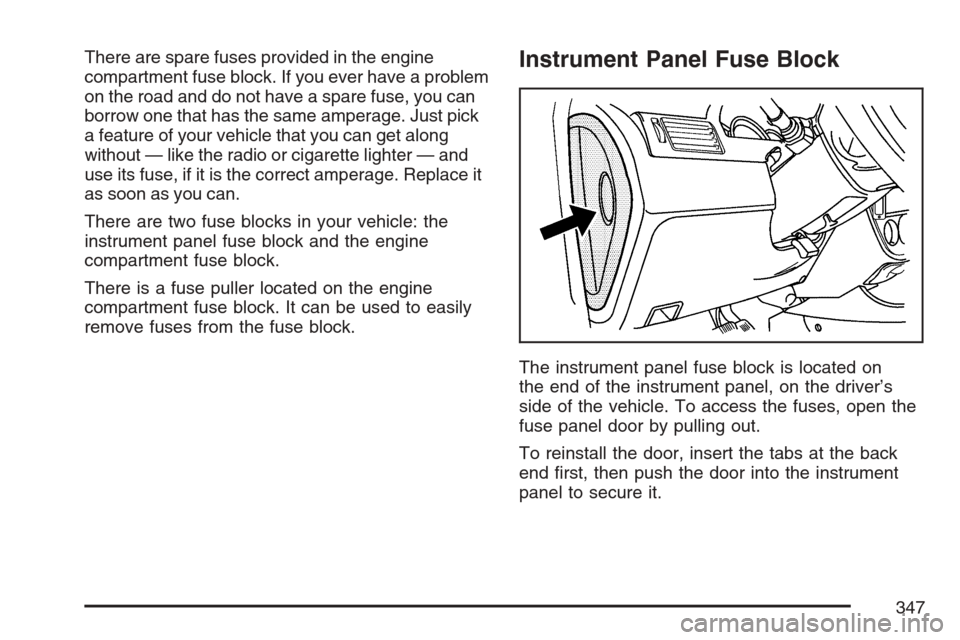
remove fuses from the fuse block.Instrument Panel Fuse Block
The instrument panel fuse block is located on
the end of the instrument panel, on the driver’s
side of the vehicle. To access the fuses, open the
fuse panel door by pulling out.
To reinstall the door, insert the tabs at the back
end first, then push the door into the instrument
panel to secure it.
347
Page 349 of 422
Fuses Usage
LTR Cigarette Lighter
CLSTR BTSICluster, Brake Transmission Shift
Interlock/Automatic Transaxle Shift
Lock (BTSI) Solenoid
RKE Remote Keyless Entry
BCK/UP Back-up
BLANK Not Used
TCM Transmission Control Module
BLANK Not Used
ENG FUSE
BOX DRLEngine Fuse Box, Daytime Running
Lamps
HAZRD LAMPS Hazard Lamps
A/C CLK Air Conditioning Switch, Clock
HVACHeating, Ventilation and Air
Conditioning
RKE Remote Keyless Entry
RADIO Radio
S/ROOF Sunroof
DLC Data Link Connector
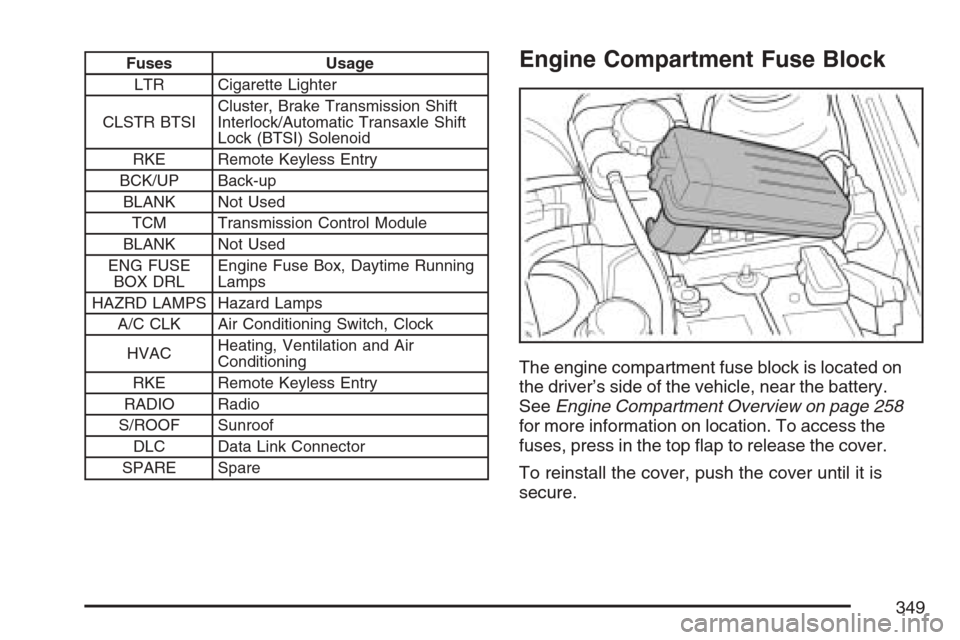
SPARE SpareEngine Compartment Fuse Block
The engine compartment fuse block is located on
the driver’s side of the vehicle, near the battery.
SeeEngine Compartment Overview on page 258
for more information on location. To access the
fuses, press in the top flap to release the cover.
To reinstall the cover, push the cover until it is
secure.
349
Page 395 of 422
Who is Covered?
Roadside Assistance coverage is for the vehicle
operator, regardless of ownership. A person driving
this vehicle without the consent of the owner is
not eligible for coverage.
The following services are provided in the U.S.
during the Bumper-to-Bumper warranty period and,
in Canada, during the Base Warranty coverage
period of the New Vehicle Limited Warranty, up to
a maximum coverage of $100.
•Fuel Delivery:Delivery of enough fuel for the
customer to get to the nearest service station
(about $5 in the U.S. and 10 litres in Canada).
Service to provide diesel may be restricted. For
safety reasons, propane and other alternative
fuels will not be provided through this service.
•Lock-out Service:To ensure security, the
driver must present the vehicle registration and
personal ID before lock-out service is provided.
Lock-out service will be covered at no charge if
you are unable to gain entry into your vehicle.If your vehicle will not start, Roadside
Assistance will arrange to have your vehicle
towed to the nearest authorized dealership. In
the U.S., replacement keys made at the
customer’s expense will be covered within
10 miles (16 km).
•Emergency Tow From a Public Roadway or
Highway:Tow to the nearest dealership for
warranty service or in the event of a
vehicle-disabling accident. Winch-out
assistance when the vehicle is mired in sand,
mud, or snow.
•Flat Tire Change:If your vehicle has a spare
tire, installation of the tire in good condition will
be covered at no charge. The customer is
responsible for the repair or replacement of the
tire if not covered by a warrantable failure.
•Jump Start:No-start occurrences which
require a battery jump start will be covered at
no charge.
395
Page 396 of 422
Additional Services for Canadian
Customers
•
Trip Routing Service:Upon Request,
Roadside Assistance will send you detailed,
computer-personalized maps, highlighting
your choice of either the most direct route or
the most scenic route to your destination,
anywhere in North America, along with any
helpful travel information we may have
pertaining to your trip. To request this service,
please call us toll-free at 1-800-268-6800.
We will make every attempt to send your
personalized trip routing as quickly as possible,
but it is best to allow three weeks before your
planned departure date. Trip routing requests
will be limited to six per calendar year.
•Trip Interruption Benets and Assistance:
In the event of a warranty related vehicle
disablement, while en route and over
250 kilometres from original point of departure,
you may qualify for trip interruption expense
assistance. This assistance covers reasonable
reimbursement of up to a maximum of
$500 (Canadian) for (A) meals (maximum of
$50/day), (B) lodging (maximum of $100/night)and (C) alternate ground transportation
(maximum of $40/day). This benefit is to assist
you with some of the unplanned expense you
may incur while waiting for your vehicle to be
repaired.
Pre-authorization, original detailed receipts and
a copy of the repair order are required.
Once authorization has been given, your
advisor will help you make any necessary
arrangements and explain how to claim for trip
interruption expense assistance.
•Alternative Service:There may be times,
when Roadside Assistance cannot provide
timely assistance, your advisor may authorize
you to secure local emergency road service,
and you will be reimbursed up to $100 upon
submission of the original receipt to Roadside
Assistance.
In many instances, mechanical failures are
covered under Chevrolet’s Bumper-to-Bumper
warranty, and the duration of the Base Warranty
Coverage for Canadian customers of the new
Vehicle Limited Warranty. However, any cost for
parts and labor for non-warranty repairs are
the responsibility of the driver.
396