transaxle CHEVROLET PLYMOUTH ACCLAIM 1993 Manual Online
[x] Cancel search | Manufacturer: CHEVROLET, Model Year: 1993, Model line: PLYMOUTH ACCLAIM, Model: CHEVROLET PLYMOUTH ACCLAIM 1993Pages: 2438, PDF Size: 74.98 MB
Page 1899 of 2438
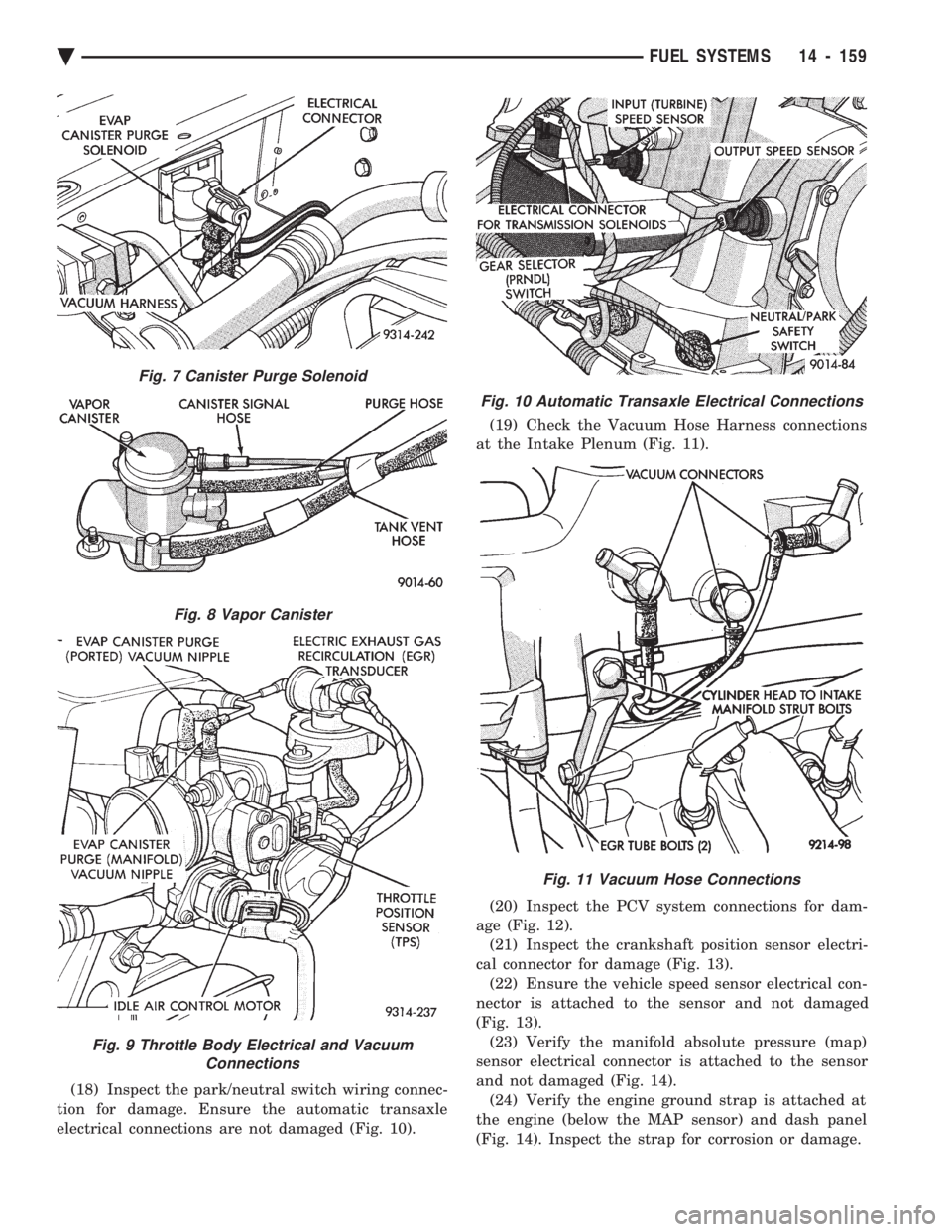
(18) Inspect the park/neutral switch wiring connec-
tion for damage. Ensure the automatic transaxle
electrical connections are not damaged (Fig. 10). (19) Check the Vacuum Hose Harness connections
at the Intake Plenum (Fig. 11).
(20) Inspect the PCV system connections for dam-
age (Fig. 12). (21) Inspect the crankshaft position sensor electri-
cal connector for damage (Fig. 13). (22) Ensure the vehicle speed sensor electrical con-
nector is attached to the sensor and not damaged
(Fig. 13). (23) Verify the manifold absolute pressure (map)
sensor electrical connector is attached to the sensor
and not damaged (Fig. 14). (24) Verify the engine ground strap is attached at
the engine (below the MAP sensor) and dash panel
(Fig. 14). Inspect the strap for corrosion or damage.
Fig. 10 Automatic Transaxle Electrical Connections
Fig. 11 Vacuum Hose Connections
Fig. 7 Canister Purge Solenoid
Fig. 8 Vapor Canister
Fig. 9 Throttle Body Electrical and Vacuum Connections
Ä FUEL SYSTEMS 14 - 159
Page 1903 of 2438
line. However, these could result in a rich or lean
condition causing an oxygen sensor fault to be stored in
the PCM. Secondary Ignition Circuit - The PCM cannot
detect an inoperative ignition coil, fouled or worn spark
plugs, ignition cross firing, or open spark plug cables. Engine Timing - The PCM cannot detect an incor-
rectly indexed timing chain, camshaft sprocket and
crankshaft sprocket. However, these could result in a
rich or lean condition causing an oxygen sensor fault to
be stored in the PCM. Cylinder Compression - The PCM cannot detect
uneven, low, or high engine cylinder compression. Exhaust System - The PCM cannot detect a
plugged, restricted or leaking exhaust system. Fuel Injector Malfunctions - The PCM cannot
determine if a fuel injector is clogged, the needle is
sticking or the wrong injector is installed. However,
these could result in a rich or lean condition causing an
oxygen sensor fault to be stored in the PCM. Excessive Oil Consumption - Although the PCM
monitors exhaust stream oxygen content when the
system is in closed loop, it cannot determine excessive
oil consumption. Throttle Body Air Flow - The PCM cannot detect a
clogged or restricted air cleaner inlet or filter element. Evaporative System - The PCM will not detect a
restricted, plugged or loaded evaporative purge canis-
ter. Vacuum Assist - Leaks or restrictions in the
vacuum circuits of vacuum assisted engine control
system devices are not monitored by the PCM. How-
ever, these could result in a MAP sensor fault being
stored in the PCM. PCM System Ground - The PCM cannot determine
a poor system ground. However, a diagnostic trouble
code may be generated as a result of this condition. PCM Connector Engagement - The PCM cannot
determine spread or damaged connector pins. How-
ever, a diagnostic trouble code may be generated as a
result of this condition.
HIGH AND LOW LIMITS
The powertrain control module (PCM) compares in-
put signal voltages from each input device with estab-
lished high and low limits for the device. If the input
voltage is not within limits and other diagnostic
trouble code criteria are met, a diagnostic trouble code
will be stored in memory. Other diagnostic trouble code
criteria might include engine RPM limits or input
voltages from other sensors or switches that must be
present before a fault condition can be verified.
DIAGNOSTIC TROUBLE CODE DESCRIPTION
A diagnostic trouble code indicates that the power-
train control module (PCM) has recognized an abnor- mal condition in the system. Diagnostic trouble codes
can be obtained from the malfunction indicator lamp
(Check Engine lamp on the instrument panel) or from
the DRBII scan tool. Diagnostic trouble codes indicate
the results of a failure but do not identify the failed
component directly.
SYSTEM TESTS
WARNING: APPLY PARKING BRAKE AND/OR BLOCK
WHEELS BEFORE PERFORMING ANY TEST ON AN
OPERATING ENGINE.
OBTAINING DIAGNOSTIC TROUBLE CODES
(1) Connect the DRBII scan tool to the data link
connector located in the engine compartment near the
driver side strut tower (Fig. 1). (2) Start the engine if possible, cycle the transaxle
selector and the A/Cswitch if applicable. Shut off the
engine. (3) Turn the ignition switch on, access Read Fault
Screen. Record all the fault messages shown on the
DRBII scan tool. Observe the malfunction indicator
lamp (check engine lamp on the instrument panel). The
lamp should light for 2 seconds then go out (bulb
check). Diagnostic trouble code erasure; access erase
diagnostic trouble code data
STATE DISPLAY TEST MODE
The switch inputs used by the powertrain control
module (PCM) have only two recognized states, HIGH
and LOW. For this reason, the PCM cannot recognize
the difference between a selected switch position ver-
sus an open circuit, a short circuit, or a defective
switch. If the change is displayed, it can be assumed
that the entire switch circuit to the PCM is functional.
From the state display screen access either State
Display Inputs and Outputs or State Display Sensors.
STATE DISPLAY INPUTS AND OUTPUTS
Connect the DRBII scan tool to the vehicle and access
the State Display screen. Then access Inputs and
Outputs. The following is a list of the engine control
system functions accessible through the Inputs and
Outputs screen. Park/Neutral Switch
Speed Control Resume
Brake Switch
Speed Control On/Off
Speed Control Set
A/C Switch Sense
S/C Vent Solenoid
Ä FUEL SYSTEMS 14 - 163
Page 1916 of 2438
(5) Reverse the above procedure for installation.
CRANKSHAFT POSITION SENSOR
REMOVAL
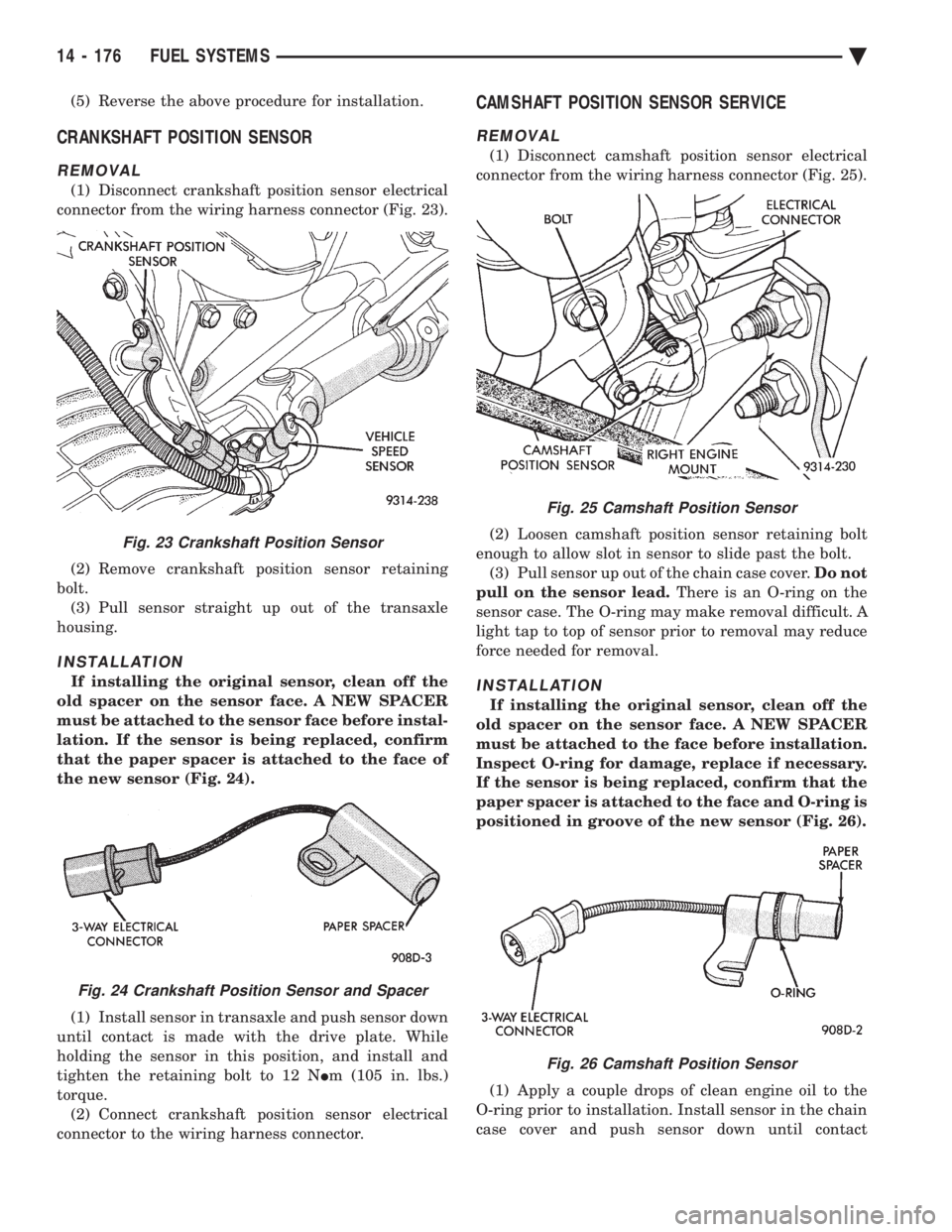
(1) Disconnect crankshaft position sensor electrical
connector from the wiring harness connector (Fig. 23).
(2) Remove crankshaft position sensor retaining
bolt. (3) Pull sensor straight up out of the transaxle
housing.
INSTALLATION
If installing the original sensor, clean off the
old spacer on the sensor face. A NEW SPACER
must be attached to the sensor face before instal-
lation. If the sensor is being replaced, confirm
that the paper spacer is attached to the face of
the new sensor (Fig. 24).
(1) Install sensor in transaxle and push sensor down
until contact is made with the drive plate. While
holding the sensor in this position, and install and
tighten the retaining bolt to 12 N Im (105 in. lbs.)
torque. (2) Connect crankshaft position sensor electrical
connector to the wiring harness connector.
CAMSHAFT POSITION SENSOR SERVICE
REMOVAL
(1) Disconnect camshaft position sensor electrical
connector from the wiring harness connector (Fig. 25).
(2) Loosen camshaft position sensor retaining bolt
enough to allow slot in sensor to slide past the bolt. (3) Pull sensor up out of the chain case cover. Do not
pull on the sensor lead. There is an O-ring on the
sensor case. The O-ring may make removal difficult. A
light tap to top of sensor prior to removal may reduce
force needed for removal.
INSTALLATION
If installing the original sensor, clean off the
old spacer on the sensor face. A NEW SPACER
must be attached to the face before installation.
Inspect O-ring for damage, replace if necessary.
If the sensor is being replaced, confirm that the
paper spacer is attached to the face and O-ring is
positioned in groove of the new sensor (Fig. 26).
(1) Apply a couple drops of clean engine oil to the
O-ring prior to installation. Install sensor in the chain
case cover and push sensor down until contact
Fig. 23 Crankshaft Position Sensor
Fig. 24 Crankshaft Position Sensor and Spacer
Fig. 25 Camshaft Position Sensor
Fig. 26 Camshaft Position Sensor
14 - 176 FUEL SYSTEMS Ä
Page 1961 of 2438
TRANSAXLE
CONTENTS
page page
41TE FOUR SPEED AUTOMATIC TRANSAXLE . 85
41TE FOUR SPEED TRANSAXLE HYDRAULICSCHEMATICS ........................ 170
41TE ON-BOARD DIAGNOSTICS .......... 145
A-523, A-543, and A-568 MANUAL TRANSAXLE ........................... 1 SPECIFICATIONS
...................... 183
THREE SPEED TORQUEFLITE AUTOMATIC TRANSAXLE .......................... 35
THREE SPEED TRANSAXLE HYDRAULIC SCHEMATICS ........................ 162
A-523, A-543, and A-568 MANUAL TRANSAXLE INDEX
page page
Bearing Adjustment Procedure .............. 31
Differential Bearing Preload Adjustment ........ 33
Gearshift Linkage Adjustment (Cable Operated) . . 2
General Information ........................ 1 In-Car Transaxle Disassemble/Assemble
........ 4
Out of Car TransaxleÐDisassemble and Assemble . 6
Subassembly-Recondition .................. 15
Transaxle Removal and Installation ............ 5
GENERAL INFORMATION
Safety goggles should be worn at all times
when working on these transaxles. All manual
transaxles use SAE 5W-30 engine oil, meeting SG
and/or SG-CC qualifications, as the lubricant in order
to reduce wear. This 5-speed manual transaxles combine gear reduc-
tion, ratio selection, and differential functions in one
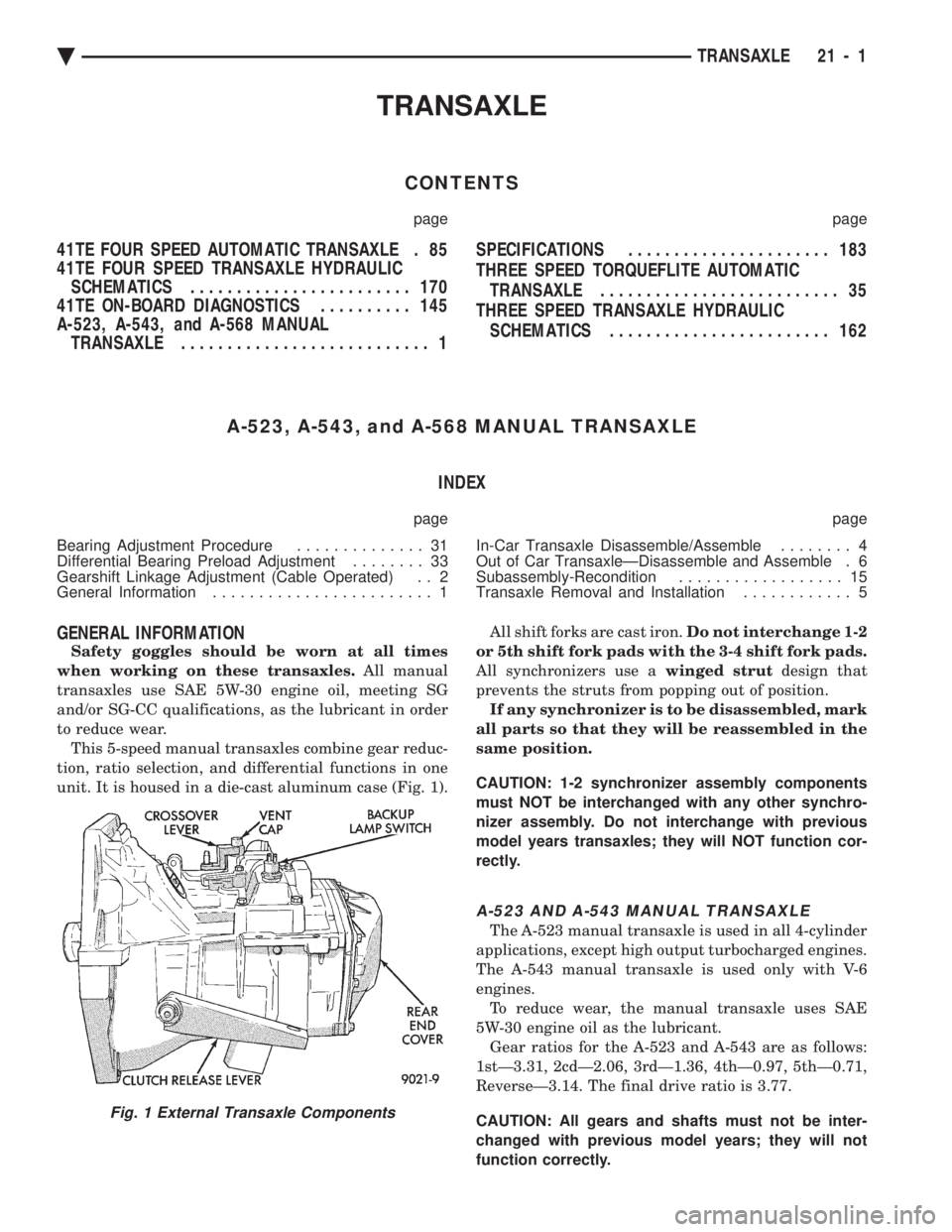
unit. It is housed in a die-cast aluminum case (Fig. 1). All shift forks are cast iron.
Do not interchange 1-2
or 5th shift fork pads with the 3-4 shift fork pads.
All synchronizers use a winged strutdesign that
prevents the struts from popping out of position. If any synchronizer is to be disassembled, mark
all parts so that they will be reassembled in the
same position.
CAUTION: 1-2 synchronizer assembly components
must NOT be interchanged with any other synchro-
nizer assembly. Do not interchange with previous
model years transaxles; they will NOT function cor-
rectly.
A-523 AND A-543 MANUAL TRANSAXLE
The A-523 manual transaxle is used in all 4-cylinder
applications, except high output turbocharged engines.
The A-543 manual transaxle is used only with V-6
engines. To reduce wear, the manual transaxle uses SAE
5W-30 engine oil as the lubricant. Gear ratios for the A-523 and A-543 are as follows:
1stÐ3.31, 2cdÐ2.06, 3rdÐ1.36, 4thÐ0.97, 5thÐ0.71,
ReverseÐ3.14. The final drive ratio is 3.77.
CAUTION: All gears and shafts must not be inter-
changed with previous model years; they will not
function correctly.
Fig. 1 External Transaxle Components
Ä TRANSAXLE 21 - 1
Page 1962 of 2438
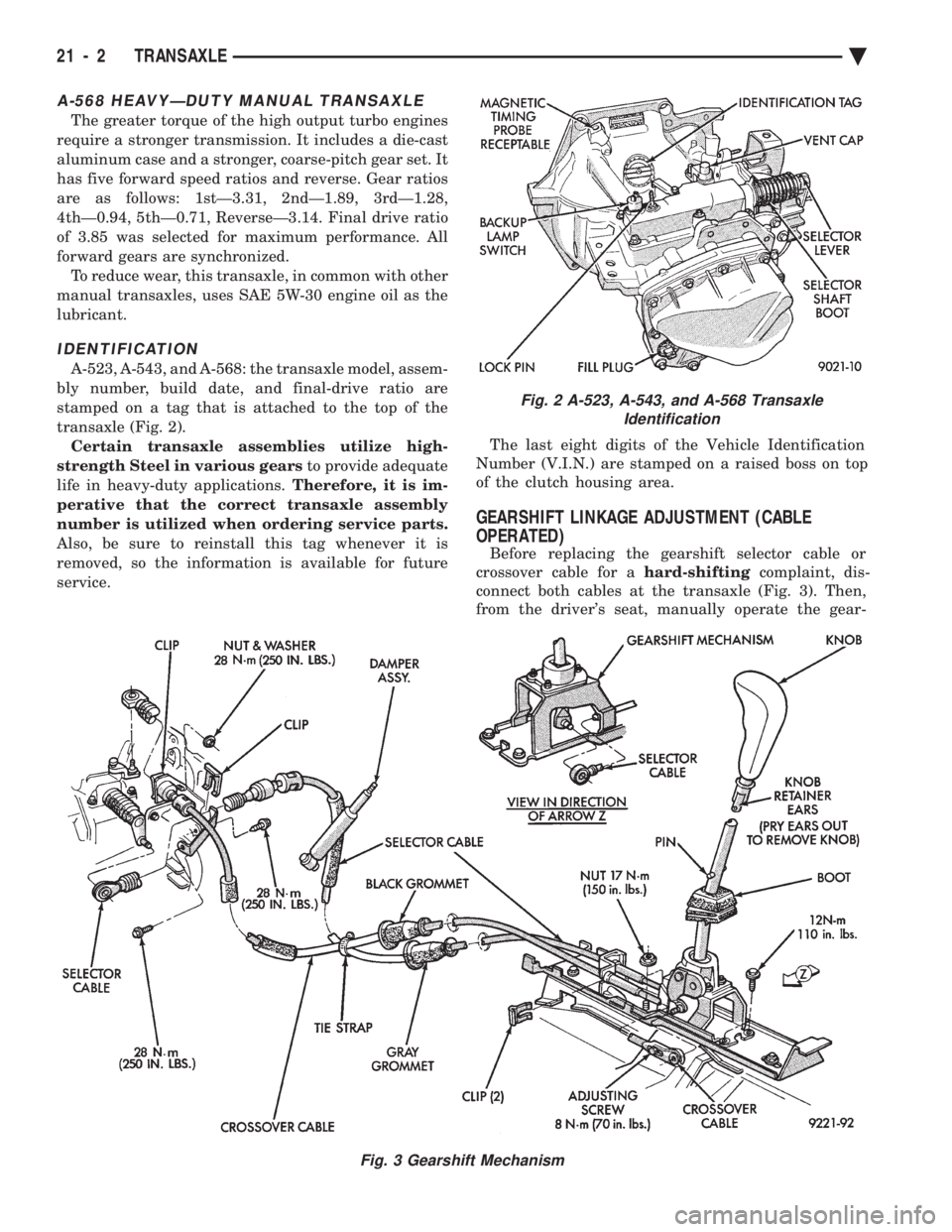
A-568 HEAVYÐDUTY MANUAL TRANSAXLE
The greater torque of the high output turbo engines
require a stronger transmission. It includes a die-cast
aluminum case and a stronger, coarse-pitch gear set. It
has five forward speed ratios and reverse. Gear ratios
are as follows: 1stÐ3.31, 2ndÐ1.89, 3rdÐ1.28,
4thÐ0.94, 5thÐ0.71, ReverseÐ3.14. Final drive ratio
of 3.85 was selected for maximum performance. All
forward gears are synchronized. To reduce wear, this transaxle, in common with other
manual transaxles, uses SAE 5W-30 engine oil as the
lubricant.
IDENTIFICATION
A-523, A-543, and A-568: the transaxle model, assem-
bly number, build date, and final-drive ratio are
stamped on a tag that is attached to the top of the
transaxle (Fig. 2). Certain transaxle assemblies utilize high-
strength Steel in various gears to provide adequate
life in heavy-duty applications. Therefore, it is im-
perative that the correct transaxle assembly
number is utilized when ordering service parts.
Also, be sure to reinstall this tag whenever it is
removed, so the information is available for future
service. The last eight digits of the Vehicle Identification
Number (V.I.N.) are stamped on a raised boss on top
of the clutch housing area.
GEARSHIFT LINKAGE ADJUSTMENT (CABLE
OPERATED)
Before replacing the gearshift selector cable or
crossover cable for a hard-shiftingcomplaint, dis-
connect both cables at the transaxle (Fig. 3). Then,
from the driver's seat, manually operate the gear-
Fig. 2 A-523, A-543, and A-568 Transaxle Identification
Fig. 3 Gearshift Mechanism
21 - 2 TRANSAXLE Ä
Page 1963 of 2438
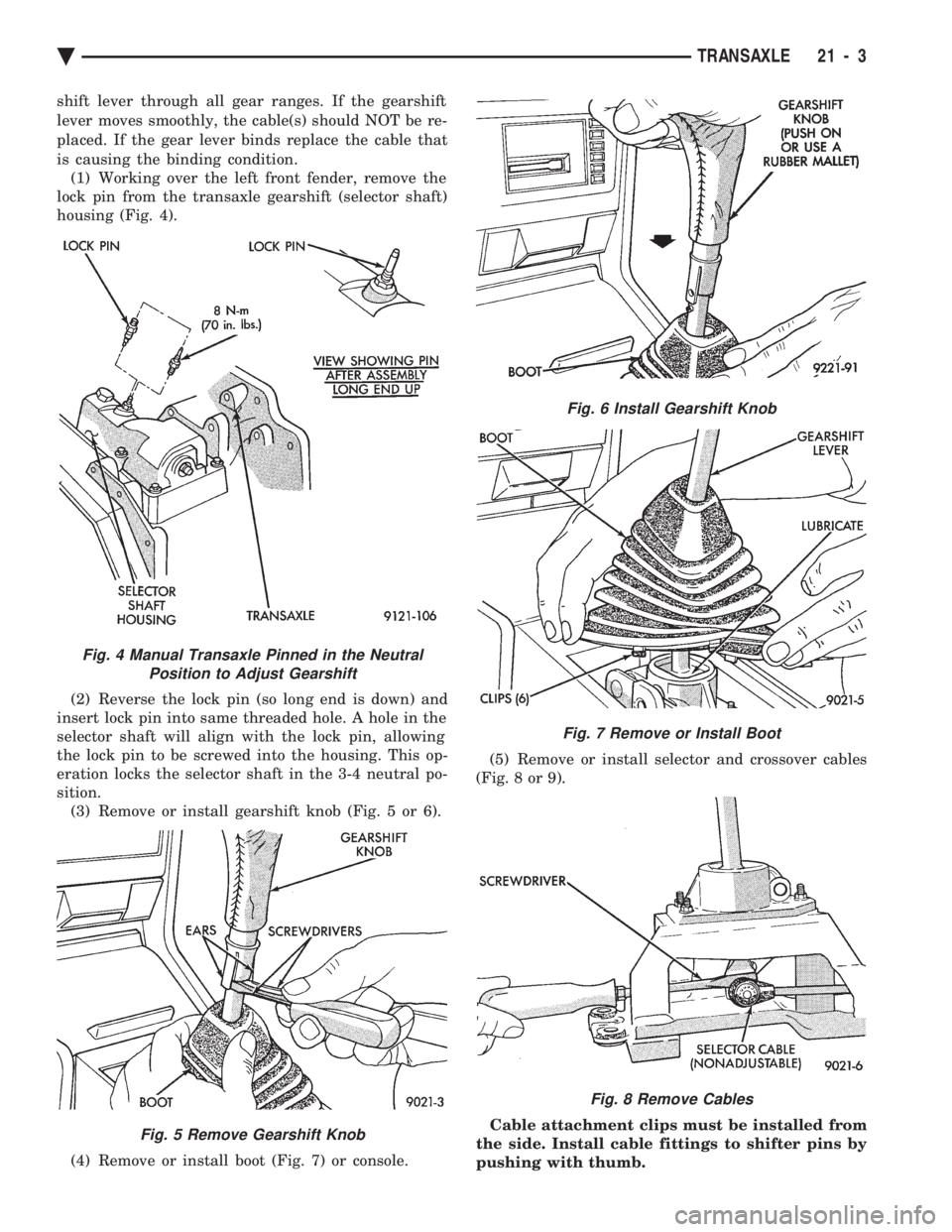
shift lever through all gear ranges. If the gearshift
lever moves smoothly, the cable(s) should NOT be re-
placed. If the gear lever binds replace the cable that
is causing the binding condition. (1) Working over the left front fender, remove the
lock pin from the transaxle gearshift (selector shaft)
housing (Fig. 4).
(2) Reverse the lock pin (so long end is down) and
insert lock pin into same threaded hole. A hole in the
selector shaft will align with the lock pin, allowing
the lock pin to be screwed into the housing. This op-
eration locks the selector shaft in the 3-4 neutral po-
sition. (3) Remove or install gearshift knob (Fig. 5 or 6).
(4) Remove or install boot (Fig. 7) or console. (5) Remove or install selector and crossover cables
(Fig. 8 or 9).
Cable attachment clips must be installed from
the side. Install cable fittings to shifter pins by
pushing with thumb.
Fig. 4 Manual Transaxle Pinned in the Neutral Position to Adjust Gearshift
Fig. 5 Remove Gearshift Knob
Fig. 6 Install Gearshift Knob
Fig. 7 Remove or Install Boot
Fig. 8 Remove Cables
Ä TRANSAXLE 21 - 3
Page 1964 of 2438
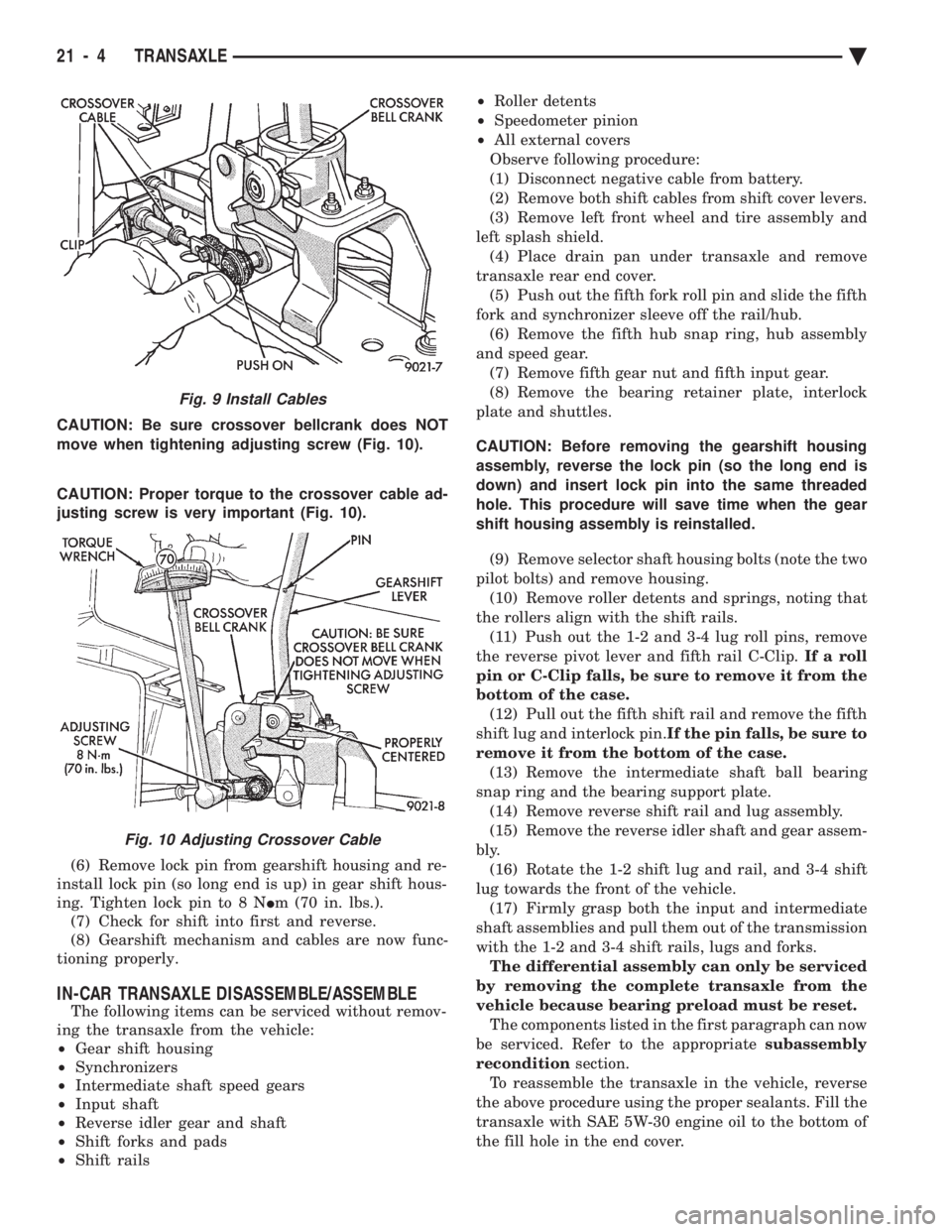
CAUTION: Be sure crossover bellcrank does NOT
move when tightening adjusting screw (Fig. 10).
CAUTION: Proper torque to the crossover cable ad-
justing screw is very important (Fig. 10).
(6) Remove lock pin from gearshift housing and re-
install lock pin (so long end is up) in gear shift hous-
ing. Tighten lock pin to 8 N Im (70 in. lbs.).
(7) Check for shift into first and reverse.
(8) Gearshift mechanism and cables are now func-
tioning properly.
IN-CAR TRANSAXLE DISASSEMBLE/ASSEMBLE
The following items can be serviced without remov-
ing the transaxle from the vehicle:
² Gear shift housing
² Synchronizers
² Intermediate shaft speed gears
² Input shaft
² Reverse idler gear and shaft
² Shift forks and pads
² Shift rails ²
Roller detents
² Speedometer pinion
² All external covers
Observe following procedure:
(1) Disconnect negative cable from battery.
(2) Remove both shift cables from shift cover levers.
(3) Remove left front wheel and tire assembly and
left splash shield. (4) Place drain pan under transaxle and remove
transaxle rear end cover. (5) Push out the fifth fork roll pin and slide the fifth
fork and synchronizer sleeve off the rail/hub. (6) Remove the fifth hub snap ring, hub assembly
and speed gear. (7) Remove fifth gear nut and fifth input gear.
(8) Remove the bearing retainer plate, interlock
plate and shuttles.
CAUTION: Before removing the gearshift housing
assembly, reverse the lock pin (so the long end is
down) and insert lock pin into the same threaded
hole. This procedure will save time when the gear
shift housing assembly is reinstalled. (9) Remove selector shaft housing bolts (note the two
pilot bolts) and remove housing. (10) Remove roller detents and springs, noting that
the rollers align with the shift rails. (11) Push out the 1-2 and 3-4 lug roll pins, remove
the reverse pivot lever and fifth rail C-Clip. If a roll
pin or C-Clip falls, be sure to remove it from the
bottom of the case. (12) Pull out the fifth shift rail and remove the fifth
shift lug and interlock pin. If the pin falls, be sure to
remove it from the bottom of the case. (13) Remove the intermediate shaft ball bearing
snap ring and the bearing support plate. (14) Remove reverse shift rail and lug assembly.
(15) Remove the reverse idler shaft and gear assem-
bly. (16) Rotate the 1-2 shift lug and rail, and 3-4 shift
lug towards the front of the vehicle. (17) Firmly grasp both the input and intermediate
shaft assemblies and pull them out of the transmission
with the 1-2 and 3-4 shift rails, lugs and forks. The differential assembly can only be serviced
by removing the complete transaxle from the
vehicle because bearing preload must be reset. The components listed in the first paragraph can now
be serviced. Refer to the appropriate subassembly
recondition section.
To reassemble the transaxle in the vehicle, reverse
the above procedure using the proper sealants. Fill the
transaxle with SAE 5W-30 engine oil to the bottom of
the fill hole in the end cover.
Fig. 9 Install Cables
Fig. 10 Adjusting Crossover Cable
21 - 4 TRANSAXLE Ä
Page 1965 of 2438
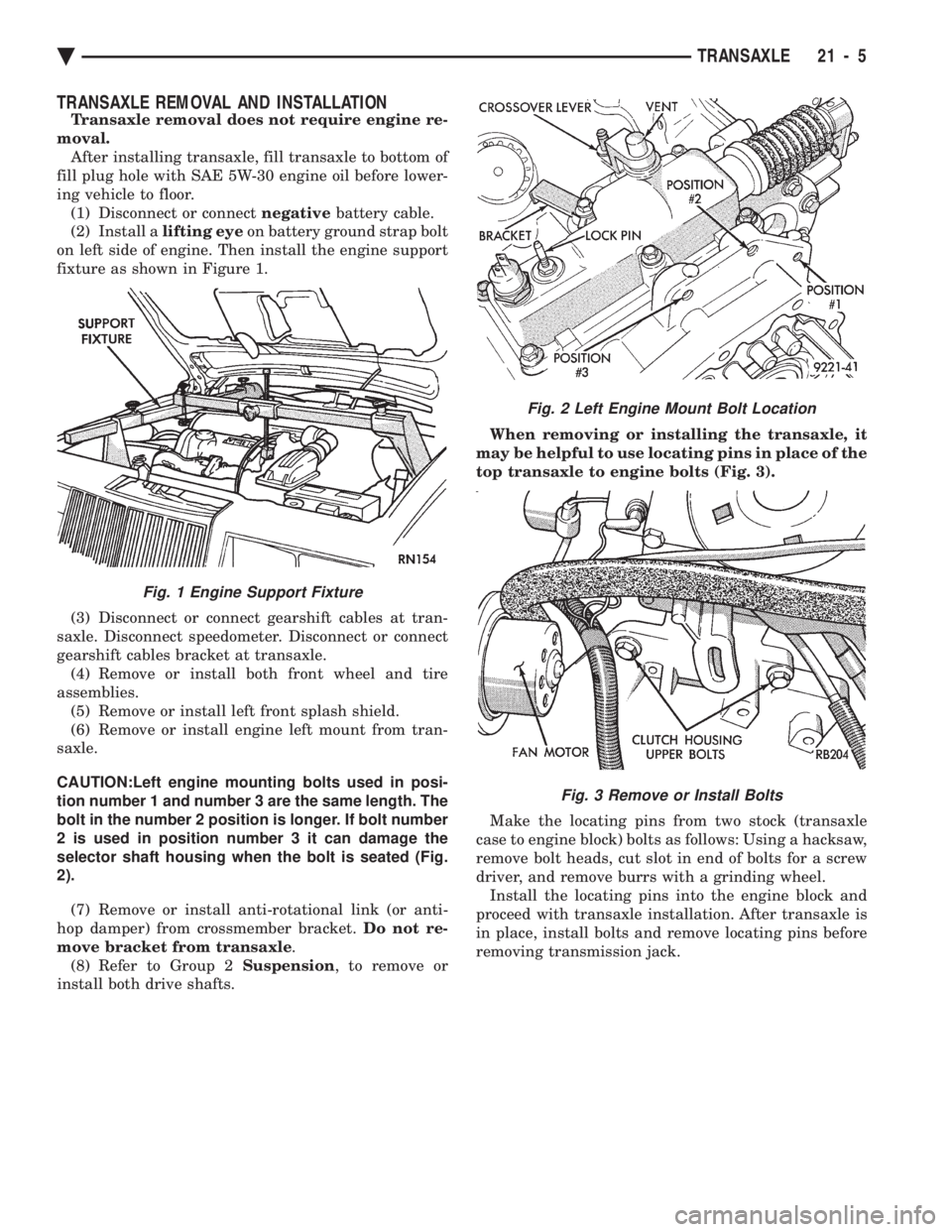
TRANSAXLE REMOVAL AND INSTALLATION
Transaxle removal does not require engine re-
moval. After installing transaxle, fill transaxle to bottom of
fill plug hole with SAE 5W-30 engine oil before lower-
ing vehicle to floor. (1) Disconnect or connect negativebattery cable.
(2) Install a lifting eyeon battery ground strap bolt
on left side of engine. Then install the engine support
fixture as shown in Figure 1.
(3) Disconnect or connect gearshift cables at tran-
saxle. Disconnect speedometer. Disconnect or connect
gearshift cables bracket at transaxle. (4) Remove or install both front wheel and tire
assemblies. (5) Remove or install left front splash shield.
(6) Remove or install engine left mount from tran-
saxle.
CAUTION:Left engine mounting bolts used in posi-
tion number 1 and number 3 are the same length. The
bolt in the number 2 position is longer. If bolt number
2 is used in position number 3 it can damage the
selector shaft housing when the bolt is seated (Fig.
2).
(7) Remove or install anti-rotational link (or anti-
hop damper) from crossmember bracket. Do not re-
move bracket from transaxle .
(8) Refer to Group 2 Suspension, to remove or
install both drive shafts. When removing or installing the transaxle, it
may be helpful to use locating pins in place of the
top transaxle to engine bolts (Fig. 3).
Make the locating pins from two stock (transaxle
case to engine block) bolts as follows: Using a hacksaw,
remove bolt heads, cut slot in end of bolts for a screw
driver, and remove burrs with a grinding wheel. Install the locating pins into the engine block and
proceed with transaxle installation. After transaxle is
in place, install bolts and remove locating pins before
removing transmission jack.
Fig. 1 Engine Support Fixture
Fig. 2 Left Engine Mount Bolt Location
Fig. 3 Remove or Install Bolts
Ä TRANSAXLE 21 - 5
Page 1966 of 2438
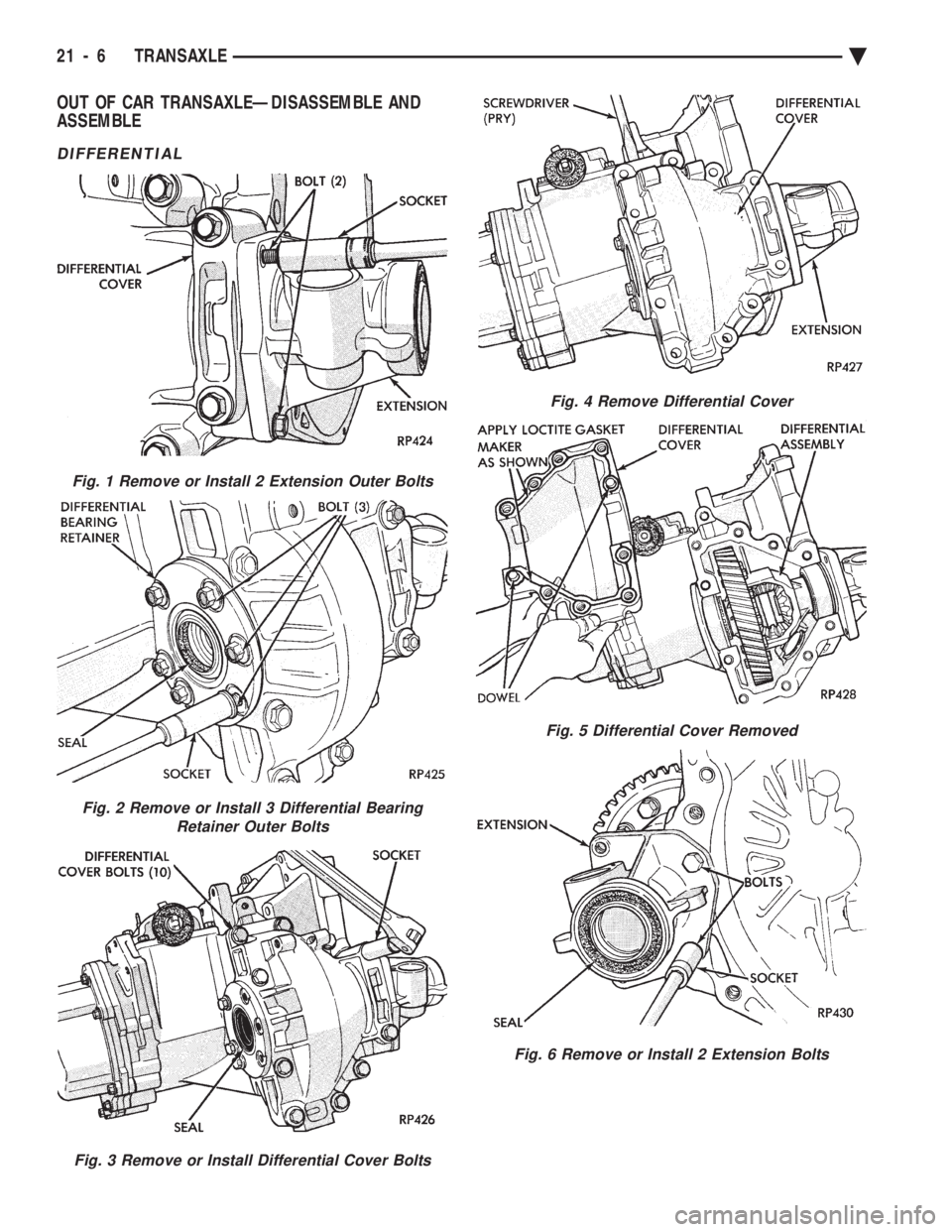
OUT OF CAR TRANSAXLEÐDISASSEMBLE AND
ASSEMBLE
DIFFERENTIAL
Fig. 1 Remove or Install 2 Extension Outer Bolts
Fig. 2 Remove or Install 3 Differential Bearing Retainer Outer Bolts
Fig. 3 Remove or Install Differential Cover Bolts
Fig. 4 Remove Differential Cover
Fig. 5 Differential Cover Removed
Fig. 6 Remove or Install 2 Extension Bolts
21 - 6 TRANSAXLE Ä
Page 1967 of 2438
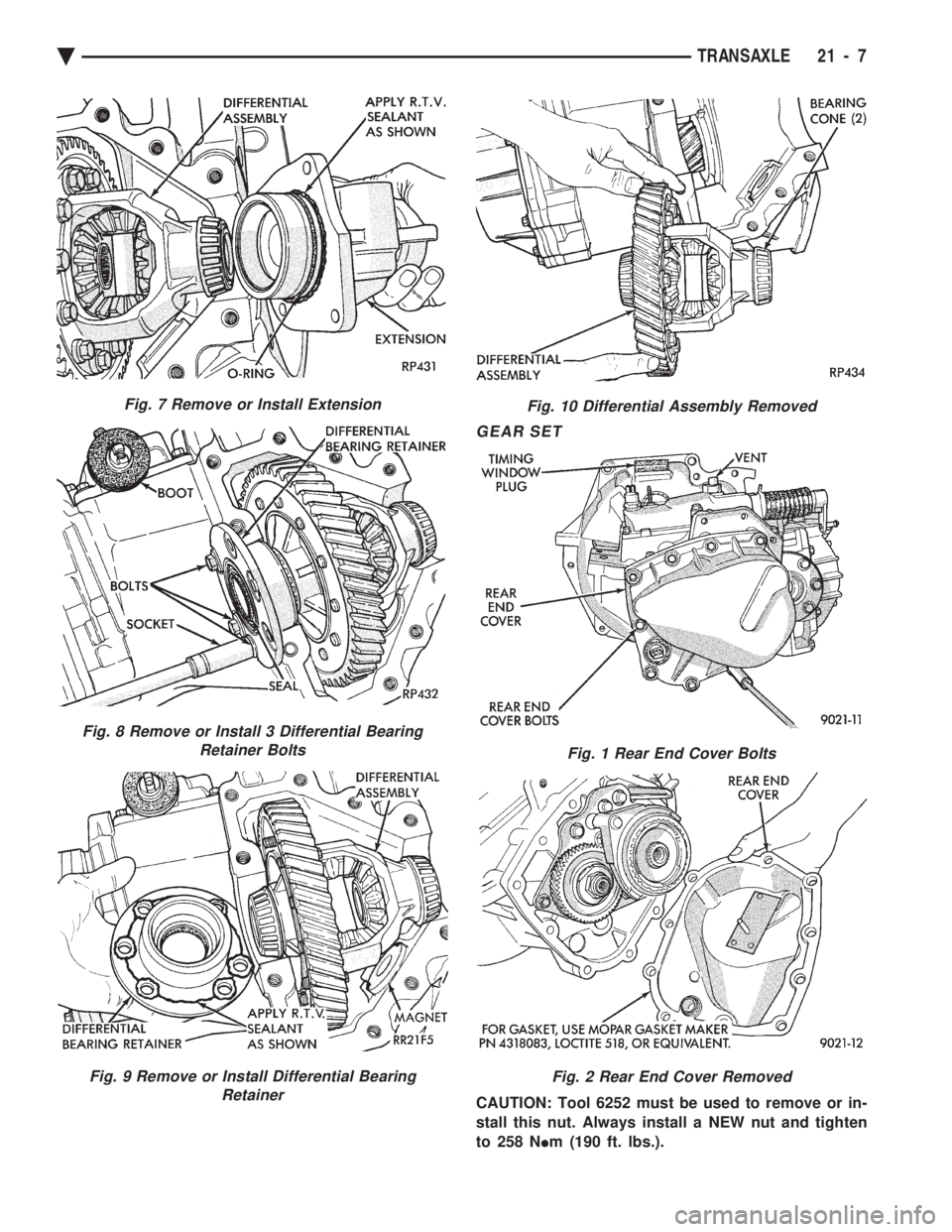
GEAR SET
CAUTION: Tool 6252 must be used to remove or in-
stall this nut. Always install a NEW nut and tighten
to 258 N Im (190 ft. lbs.).
Fig. 7 Remove or Install Extension
Fig. 8 Remove or Install 3 Differential Bearing
Retainer Bolts
Fig. 9 Remove or Install Differential Bearing Retainer
Fig. 10 Differential Assembly Removed
Fig. 1 Rear End Cover Bolts
Fig. 2 Rear End Cover Removed
Ä TRANSAXLE 21 - 7