check engine CHEVROLET PRIZM 1998 3.G Service Manual
[x] Cancel search | Manufacturer: CHEVROLET, Model Year: 1998, Model line: PRIZM, Model: CHEVROLET PRIZM 1998 3.GPages: 364, PDF Size: 18.79 MB
Page 243 of 364
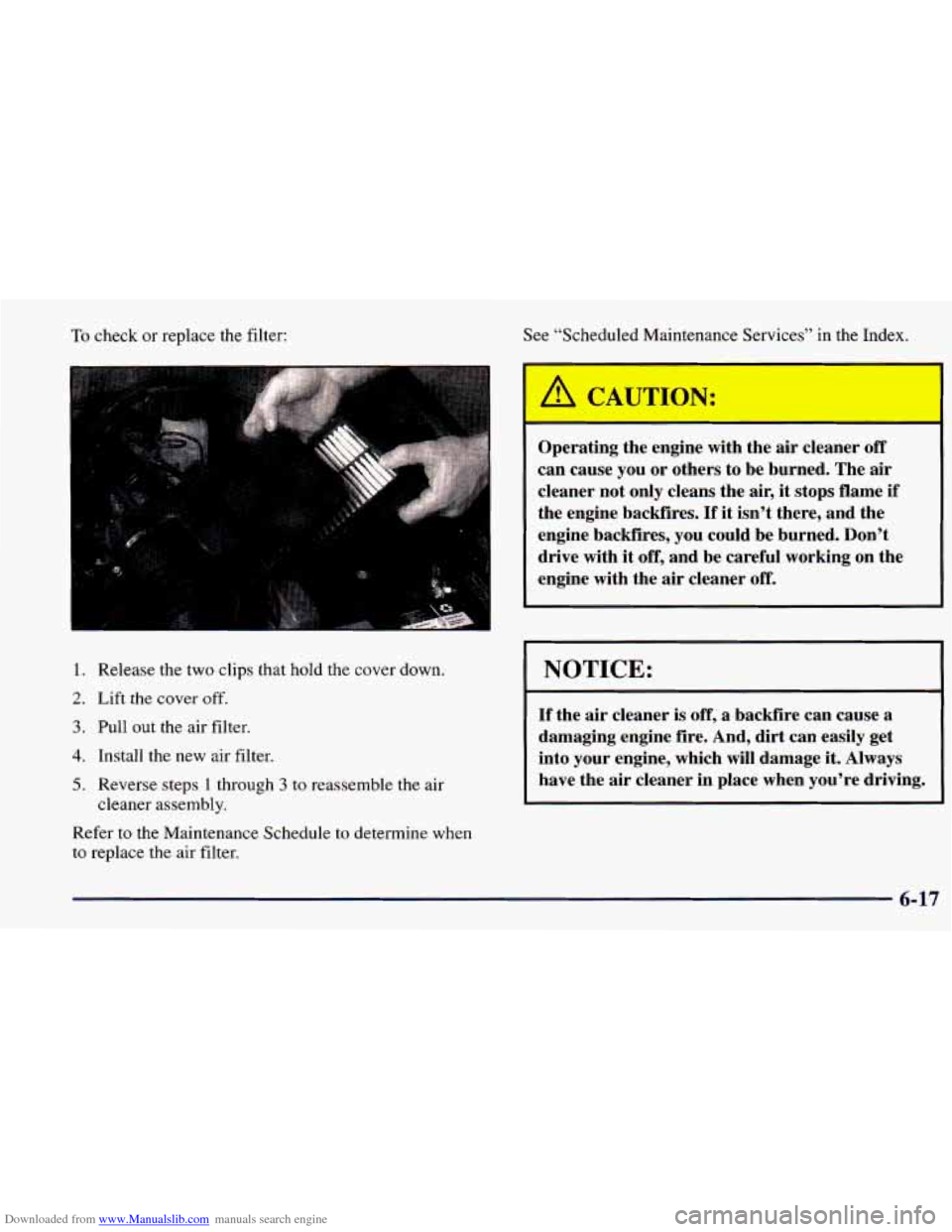
Downloaded from www.Manualslib.com manuals search engine To check or replace the filter:
1. Release the two clips that hold the cover down.
2. Lift the cover off.
3. Pull out the air filter.
4. Install the new air filter.
5. Reverse steps 1 through 3 to reassemble the air
cleaner assembly.
Refer to the Maintenance Schedule to determine when
to replace the air filter. See
“Scheduled Maintenance Services” in the Index.
I-
Operating the engine with the air cleaner off
can cause you or others to be burned. The air
cleaner not only cleans the air, it stops flame if
the engine backfires.
If it isn’t there, and the
engine backfires, you could be burned. Don’t
drive with it
off, and be careful working on the
engine with the
air cleaner off.
I NOTICE: I
r
~~
If the air cleaner is off, a backfire can cause a
damaging engine fire. And, dirt can easily get
into your engine, which will damage
it. Always
have the air cleaner in place when you’re driving.
Page 244 of 364
Downloaded from www.Manualslib.com manuals search engine Automatic Transaxle Fluid
When to Check and Change
A good time to check your automatic transaxle fluid
level is when the engine oil is changed.
Change fluid in the transaxle and differential every
15,000 miles (25 000 km) if the vehicle is mainly
driven under one or more of these conditions:
In heavy city traffic where the outside temperature
regularly reaches
90°F (32°C) or higher.
0 In hilly or mountainous terrain.
When doing frequent trailer towing.
Uses such as found in taxi, police or delivery service.
If you do not use your vehicle under any of these
conditions, check the fluid.
See “Scheduled Maintenance Services’’ in the Index.
How to Check
Because this operation can be a little difficult, you may choose
to have this done at your Chevrolet dealership
Service Department.
If you do it yourself, be sure to follow all the
instructions here, or you could get a false reading
on the dipstick.
I NOTICE:
Too much or too little fluid can damage your
transaxle.
Too much can mean that some of the
fluid could come out and fall on hot engine parts
or exhaust system parts, starting a fire. Be sure to
get an accurate reading if you check your
transaxle fluid.
6-18 .-
Page 245 of 364
Downloaded from www.Manualslib.com manuals search engine Wait at least 30 minutes before checking the transaxle
fluid level if you have been driving:
0 When outside temperatures are above 90°F (32°C).
0 At high speed for quite a while.
0 In heavy traffic -- especially in hot weather.
0 While pulling a trailer.
To get the right reading, the fluid should be at
normal operating temperature, which is
180°F to
200°F (82°C to 93°C).
Get the vehicle warmed up by driving about 15 miles
(24 km) when outside temperatures are above
50°F (10°C). If it's colder than 50°F ( 10°C), you
may have to drive longer.
Checking the Fluid Level
0 Park your vehicle on a level place. Keep the
0 With the parking brake applied, place the shift lever
0 With your foot on the brake pedal, move the shift
lever through each gear range, pausing for about
three seconds
in each range. Then, position the
shift lever
in PARK (P).
engine running.
in PARK (P)
.
Let the engine run at idle for three to five minutes.
Then, without shutting
off the engine, follow these steps:
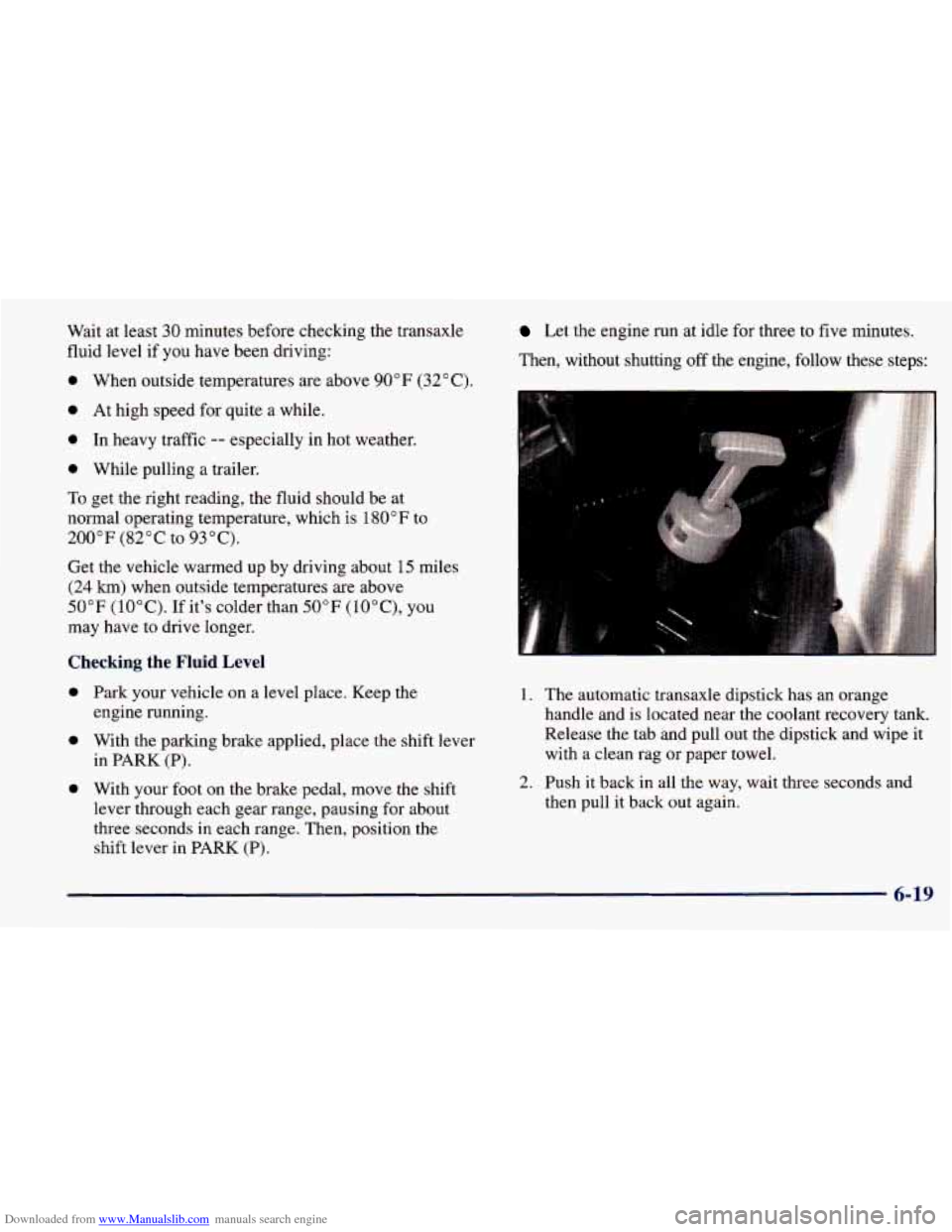
1. The automatic transaxle dipstick has an orange
handle and
is located near the coolant recovery tank.
Release the tab and pull
out the dipstick and wipe it
with a clean rag or paper towel.
then pull it back out again.
2. Push it back in all the way, wait three seconds and
6-19
Page 246 of 364
Downloaded from www.Manualslib.com manuals search engine 3,
4.
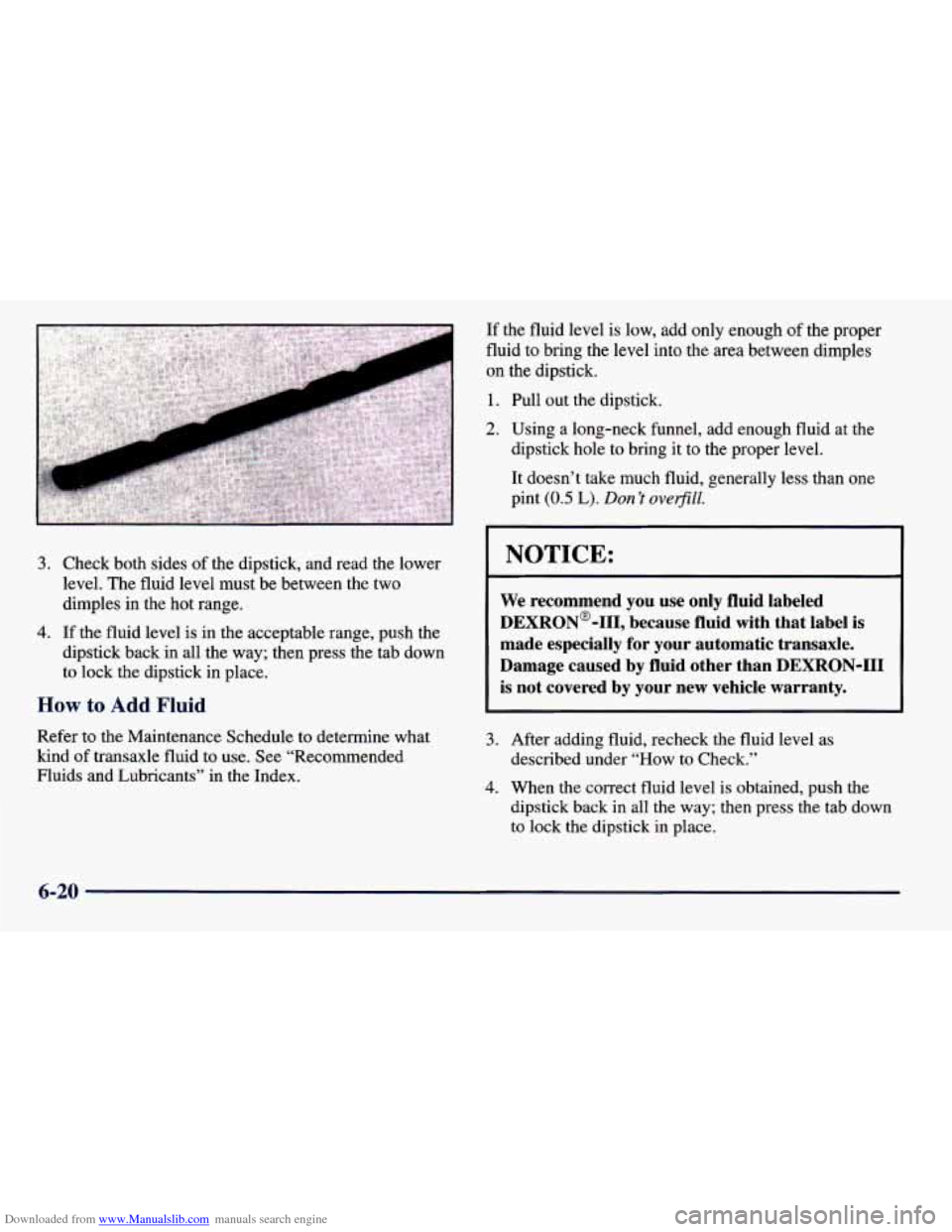
Check both sides of the dipstick, and read the lower
level.
The fluid level must be between the two
dimples
in the hot range.
If the fluid level is in the acceptable range, push the
dipstick back in all the way; then press the tab down
to lock the dipstick in place.
How to Add Fluid
Refer to the Maintenance Schedule to determine what
kind
of transaxle fluid to use. See “Recommended
Fluids
and Lubricants” in the Index. If
the fluid level is low, add only enough
of the proper
fluid to bring the level into the area between dimples
on the dipstick.
1. Pull out the dipstick.
2. Using a long-neck funnel, add enough fluid at the
dipstick hole to bring it to the proper level.
It doesn’t take much fluid, generally less than one
pint
(0.5 L). Don’t overfill.
NOTICE:
We recommend you use only fluid labeled
DEXRON@-111, because fluid with that label is
made especially for your automatic transaxle. Damage caused by fluid other than
DEXRON-111
~ is not covered by your new vehicle warranty.
3. After adding fluid, recheck the fluid level as
described under “How to Check.”
4. When the correct fluid level is obtained, push the
dipstick back
in all the way; then press the tab down
to lock the dipstick
in place.
6-20
Page 247 of 364
Downloaded from www.Manualslib.com manuals search engine Manual Transaxle Fluid
When to Check
A good time to have it checked is when the engine oil
is changed. However, the fluid
in your manual
transaxle doesn’t require changing.
How to Check
Because this operation can be difficult, you may
choose to have this done at your Chevrolet dealership
Service Department.
If you do it yourself, be sure to follow all the
instructions here, or you could get a false reading.
I NOTICE:
Too much or too little fluid can damage your
transaxle.
Too much can mean that some of the
fluid could come out and fall on hot engine parts
or exhaust system parts, starting a
fire. Be sure
to get an accurate reading if you check your
transaxle fluid.
Check the fluid level only when your engine is off,
the vehicle is parked on a level place and the transaxle
is cool enough for
you to rest your fingers on the
transaxle case.
Then, follow these steps:
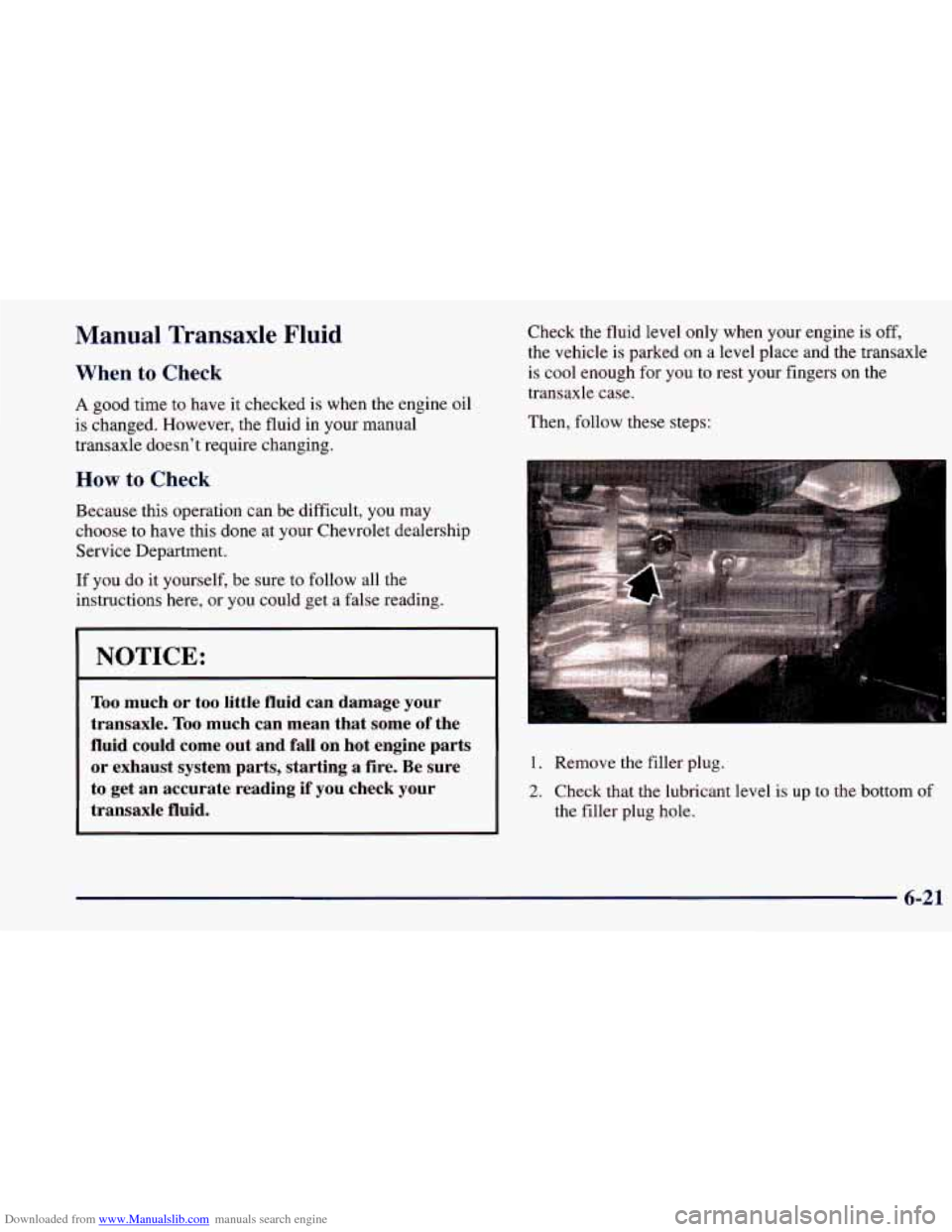
1. Remove the filler plug.
2. Check that the lubricant level is up to the bottom of
the filler plug hole.
6-21
Page 248 of 364
Downloaded from www.Manualslib.com manuals search engine 3. If the fluid level is good, install the plug and be sure
it is fully seated.
If the fluid level is low, add more
fluid as described in the next steps.
How to Add Fluid
Here’s how to add fluid. Refer to the Maintenance
Schedule to determine what kind of fluid to use. See
“Recommended Fluids and Lubricants” in the Index.
1. Remove the filler plug.
2. Add fluid at the filler plug hole. Add only enough
fluid to bring the fluid level up
to the bottom of the
filler plug hole.
3. Install the filler plug. Be sure the plug is fully seated.
Hydraulic Clutch
The hydraulic clutch linkage in your vehicle is
self-adjusting. The clutch master cylinder reservoir
is
filled with hydraulic clutch fluid.
It isn’t a good idea to “top off’ your clutch fluid. Adding
fluid won’t correct a leak.
A fluid loss in this system could indicate a problem.
Have the system inspected and repaired.
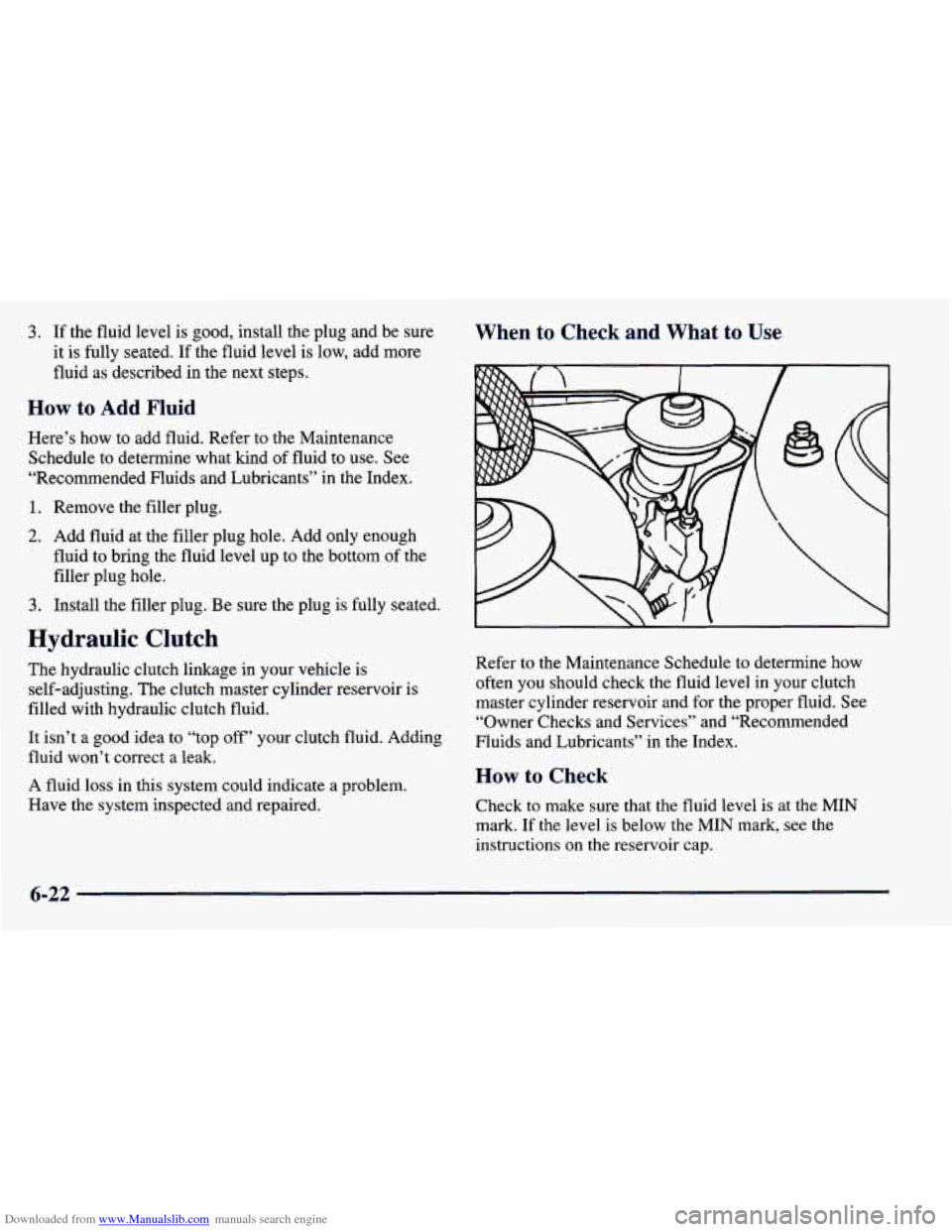
When to Check and What to Use
Refer to the Maintenance Schedule to determine how
often you should check the fluid level in your clutch
master cylinder reservoir and for the proper fluid. See
“Owner Checks and Services” and “Recommended
Fluids and Lubricants’’ in the Index.
How to Check
Check to make sure that the fluid level is at the MIN
mark. If the level is below the MIN mark, see the
instructions on the reservoir cap.
6-22
Page 250 of 364
Downloaded from www.Manualslib.com manuals search engine NOTICE:
If you use an improper coolant mixture, your
engine could overheat and be badly damaged.
The repair cost wouldn’t be covered
by your
warranty. Too much water in the mixture can
freeze and crack the engine, radiator, heater
core and other parts.
If you have to add coolant more than four times a year,
lave
your dealer check your cooling system.
I NOTICE:
If you use the proper coolant, you don’t have to
add extra inhibitors or additives which claim to
improve the system. These can be harmful.
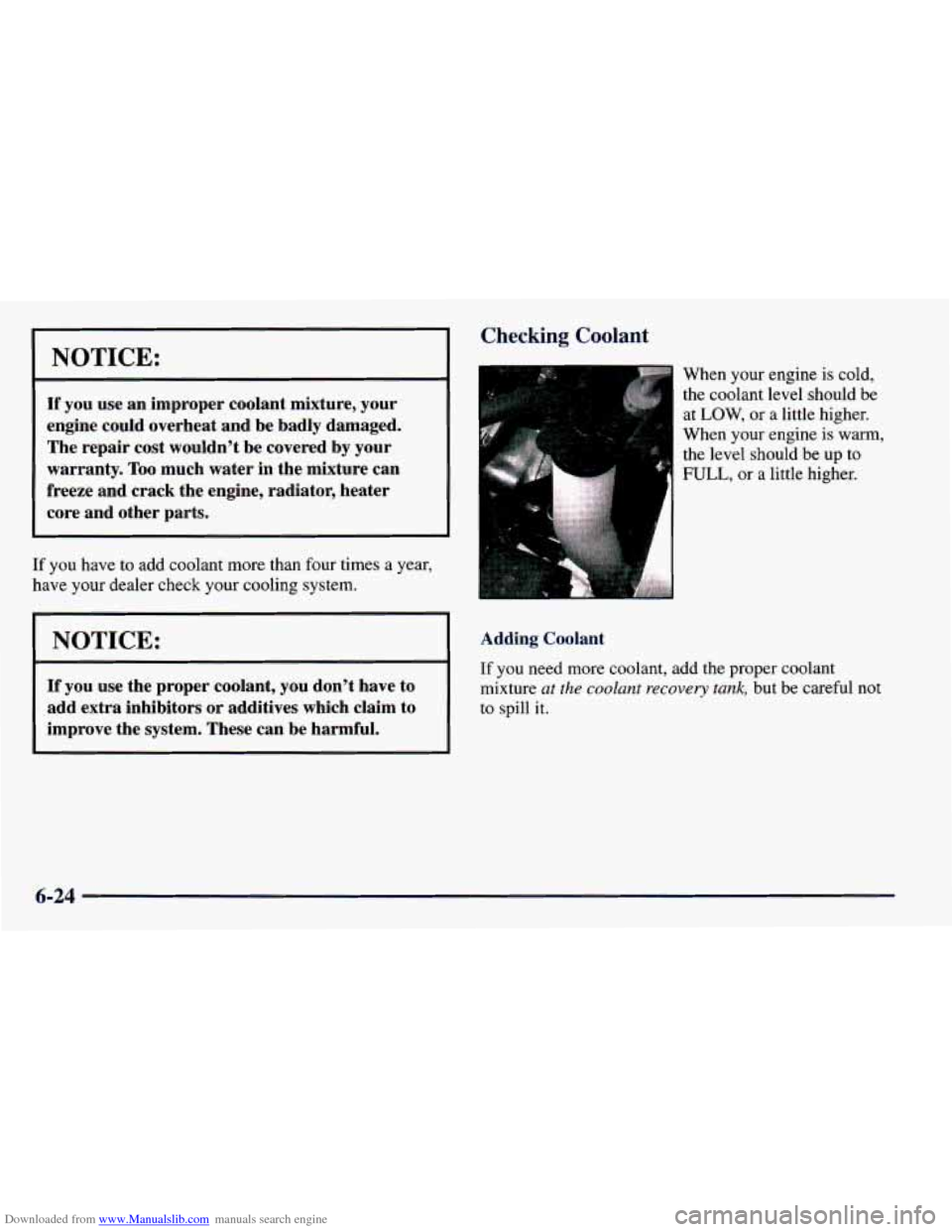
Checking Coolant
When your engine is cold,
the coolant level should be
at
LOW, or a little higher.
When your engine is warm,
the level should be up to
FULL, or a little higher.
Adding Coolant
If you need more coolant, add the proper coolant
mixture
at the coolant recovery tank, but be careful not
to spill it.
6-24
Page 252 of 364
Downloaded from www.Manualslib.com manuals search engine Power Steering Fluid
1
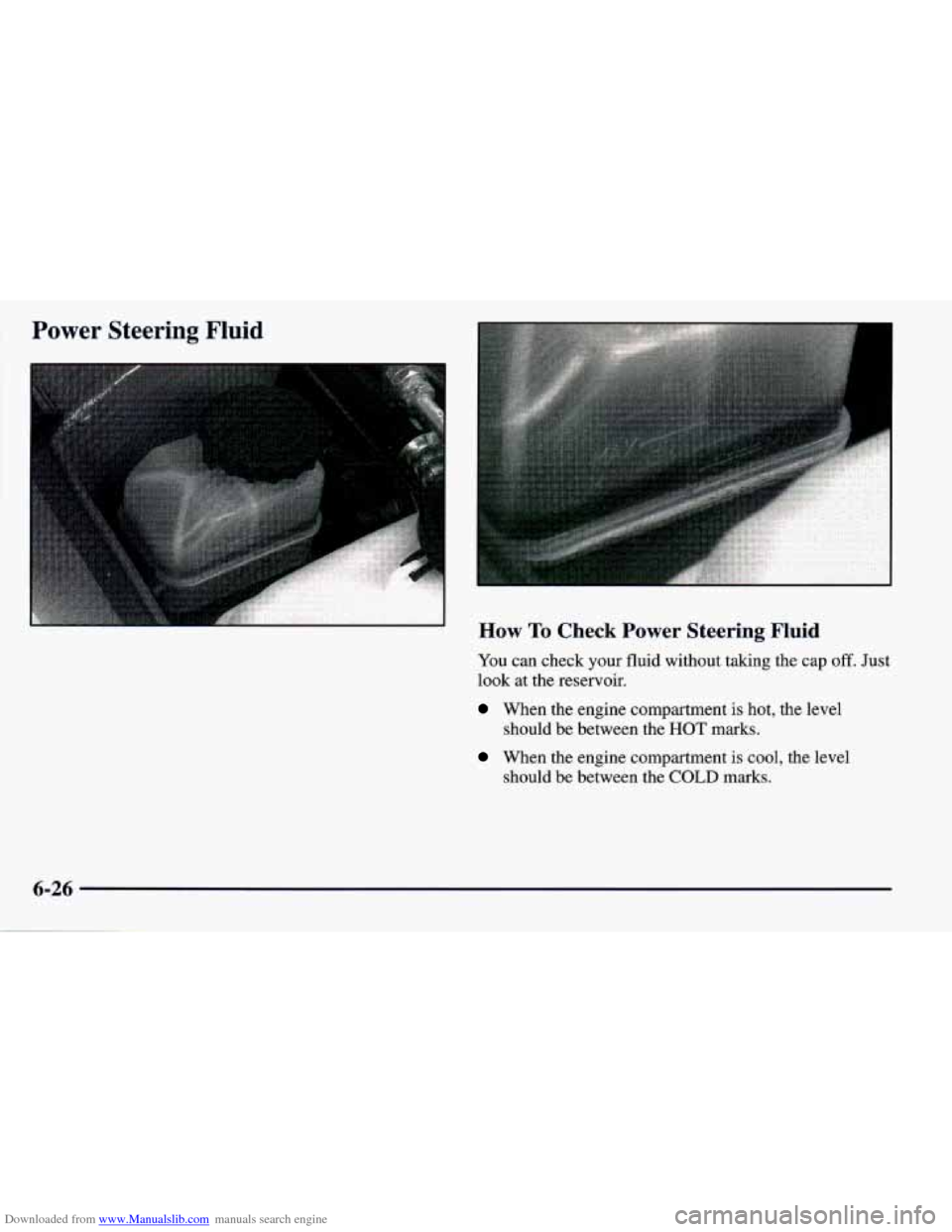
How To Check Power Steering Fluid
You can check your fluid without taking the cap off. Just
look at the reservoir.
When the engine compartment is hot, the level
should be between the
HOT marks.
When the engine compartment is cool, the level
should be between the
COLD marks.
6-26
Page 259 of 364
Downloaded from www.Manualslib.com manuals search engine Bulb Replacement
See “Replacement Bulbs” in the Index to check the size
and type
of bulb you need to use.
H-’-;er Sulbs
-
Halogen bulbs have pressurized gas inside and
can burst if you drop or scratch the bulb.
You or
others could be injured. Be sure to read and
follow the instructions on the bulb package.
Headlamps/Sidemarker/Turn Signal Lamps
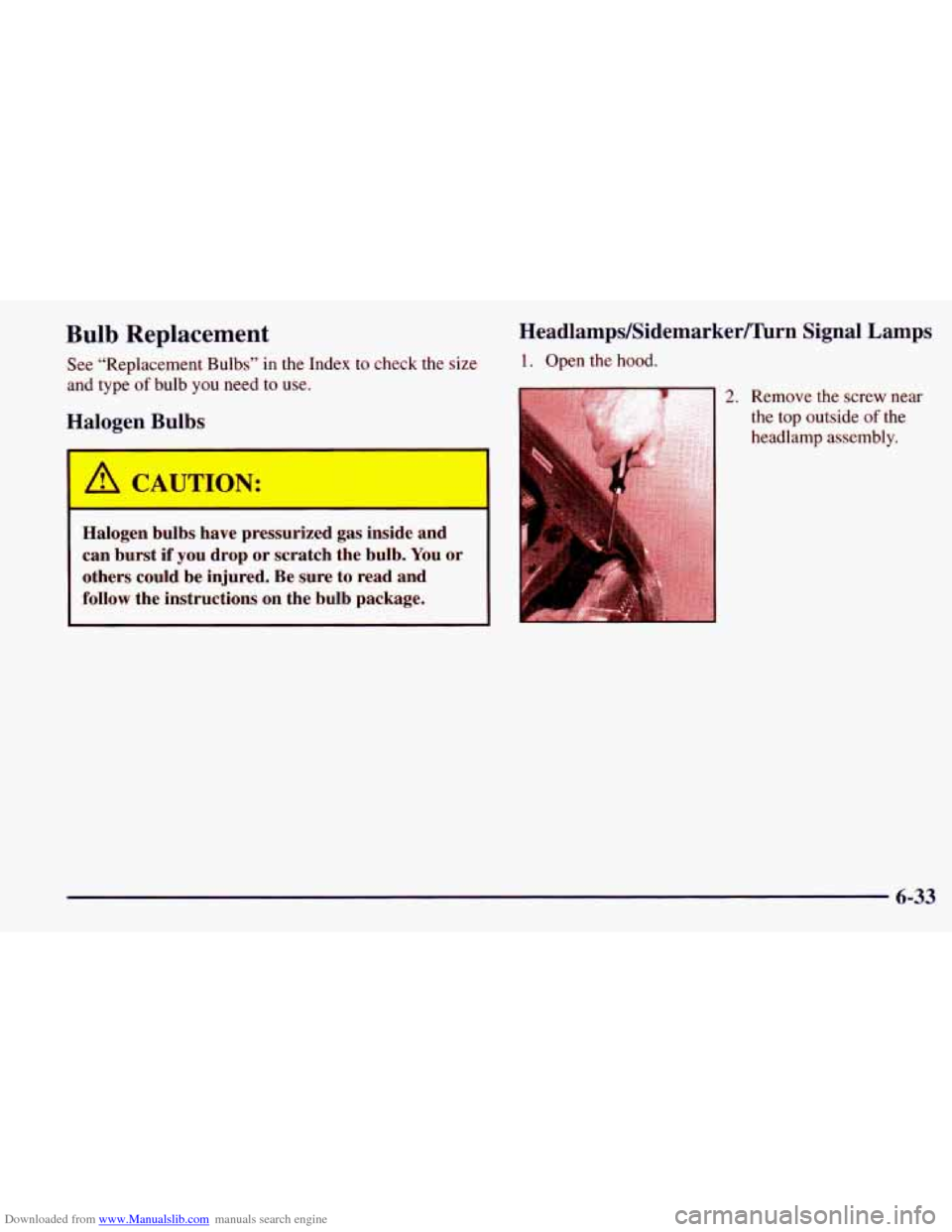
1. Open the hood.
2. Remove the screw near
the top outside
of the
headlamp assembly.
6-33
Page 263 of 364
Downloaded from www.Manualslib.com manuals search engine To replace the rear combination lamps:
1. Open the trunk.
2. Remove the three plastic screws.
3. Pull back the access panel.
4. Turn the bulb socket to the left and pull it out.
5. To remove the tail/stop or turn signal lamps, turn the
bulb socket in, to remove it from the housing. Then
push in and turn the bulb to the left.
6. To remove the sidemarker socket, turn it to the left to
remove the housing. Then pull the bulb straight out from the socket.
7. Reverse the steps to install a new bulb.
Tires
Your new vehicle comes with high-quality tires made by
a leading tire manufacturer.
If you ever have questions
about your tire warranty and where to obtain service, see
your Chevrolet Warranty booklet for details.
I - xlJ _____ nk-led ar-- imprc, xly used ti- ,s
are dangerous.
a
a
a
a
Overloading your tires can cause
overheating
as a result of too much friction.
You could have an air-out and
a serious
accident. See “Loading Your Vehicle” in
the Index.
Underinflated tires pose the same danger
as
overloaded tires. The resulting accident
could cause serious injury. Check all tires
frequently to maintain the recommended
pressure. Tire pressure should be checked
when your tires are cold.
Overinflated
tires are more likely to be
cut, punctured or broken by
a sudden
impact
-- such as when you hit a pothole.
Keep tires
at the recommended pressure.
Worn, old tires can cause accidents.
If your
tread
is badly worn, or if your tires have
been damaged, replace them.
6-37