change time CHEVROLET S10 1993 2.G User Guide
[x] Cancel search | Manufacturer: CHEVROLET, Model Year: 1993, Model line: S10, Model: CHEVROLET S10 1993 2.GPages: 356, PDF Size: 20.85 MB
Page 261 of 356
Downloaded from www.Manualslib.com manuals search engine Energy Conserving II
Oils with these words on the container will help you save fuel.
This doughnut-shaped logo (symbol) is used
on most oil containers to help
you select the correct oil.
You should look for this on the oil container, and use
only those oils that
display the logo.
GM Goodwrench@ oil (in Canada, GM Engine Oil) meets all the requirements
for your vehicle.
Engine Oil Additives:
Don’t add anything to your oil. Your GM dealer is ready to advise if you think
something should be added.
When to Change Engine c)k
See if any one of these is true for you:
Most trips are less than 4 miles (6 km).
It’s below freezing outside and most trips are less than 10 miles
(16 km).
The engine is at low speed most of the time (as in door-to-door delivery,
You tow a trailer often.
or in stop-and-go traffic).
Most trips are through dusty places.
The vehicle is frequently operated off-road.
If any one of these is true for your vehicle, you need to chang\
e your oil and
filter every 3,000 miles (5000 km) or 3 months-whichever comes first.
If none of them are true, change the oil every 7,500 miles (12 500 km) or
12 months-whichever comes first. Change the filter at the first oil change
and at every other oil change after that.
If your vehicle has 4-wheel drive, you ,will have a remote oil filter located
under the hood.
It is mounted to the front left inner fender, behind the
headlights.
Engine Block Heater:
An engine block heater can be a big help if you have to park outside in very
cold weather,
-0°F (-18°C) or colder. If your vehicle has this option, see
“Engine Block Heater” in the Index.
6-1 3
Page 264 of 356
Downloaded from www.Manualslib.com manuals search engine Service & Appearance Care
Automatic Transmission Fluid
When to Check and Change:
A good time to check your automatic transmission fluid level is when the
engine oil is changed. Refer to the Maintenance Schedule to de\
termine when
to change your fluid. See “Scheduled Maintenance Services” \
in the Index.
How to Check:
Because this operation can be a little difficult, you may choo\
se to have this
done at a dealership Service Department.
If you
do it yourself, be sure to follow all the instructions here, or \
you could
get a false reading on the dipstick.
I NOTICE
Wait at least 30 minutes before checking the transmission fluid level if you
have been driving:
When outside temperatures are above 90°F (32°C).
At high speed for quite a while.
In heavy traffic-especially in hot weather.
While pulling a trailer.
To get the right reading, the fluid must be at normal operating \
temperature,
which is 180°F to 200°F (82°C to 93°C).
To check transmission fluid hot: Get the vehicle warmed up by driving
about
15 miles (24 km) when outside temperatures are above 50°F (10°C). If
it’s colder then 50°F (IO’C), drive the vehicle in D (3rd gear) until the
temperature gage moves and then remains steady for ten minutes.\
Then
follow the hot check procedures.
To check transmission fluid cold: A cold check is made after the vehicle
has been sitting for eight hours or more with the engine off and is used
only
as a reference. Let the engine run at idle for five minutes if outside
temperatures are
50°F (10°C) or more. If it’s colder than 50°F (lO°C), you
may have to idle the engine longer. A hot check must follow when fluid is
added during a cold check.
6-1 6
I
Page 272 of 356
Downloaded from www.Manualslib.com manuals search engine t
..-
.I
Service & Appearance Care
What to Use:
Use a mixture of clean water (preferably distilled) and antifreeze that meets
“GM Specification 6038-M,” which won’t damage aluminum parts. Also use
GM Engine Coolant Supplement (sealer) with
a complete coolant change. If
you use these, you don’t need to add anything else.
I
Adding only plain water to your cooling system can be dangerous.
proper coolant mix will. Your vehicle’s coolant warning system is set
for the proper coolant mix. With plain water or the wrong mix, your
engine could get
too hot but you wouldn’t get the overheat warning.
Your engine could catch fire and you or others could be burned. Use
- Plain water, or some other liquid like alcohol, can boil before the
II a 50/50 mix of clean water and a proper antifreeze.
NOTICE
J use an improper coolant mix, your engine could overheat and be
badly damaged. The repair cost wouldn’t be covered by your warrant\
y
much water
in the mix can freeze and crack the engine, radiator, hea
core and other
part
Some conditions, such as air trapped in the cooling system, can affect the
coolant level in the radiator. Check the coolant level when th\
e engine is cold
and follow the steps under “Adding Coolant” for the prope\
r way to add
coolant.
If you have to add coolant more than four times a year, have your dealer
check your cooling system.
’‘ you use the proper coolant, you don’t have to add extra inhibitors c-
auditives which claim to improve the system. These can be harmful. ~ ~~~~~
6-24
Page 293 of 356
Downloaded from www.Manualslib.com manuals search engine K2655
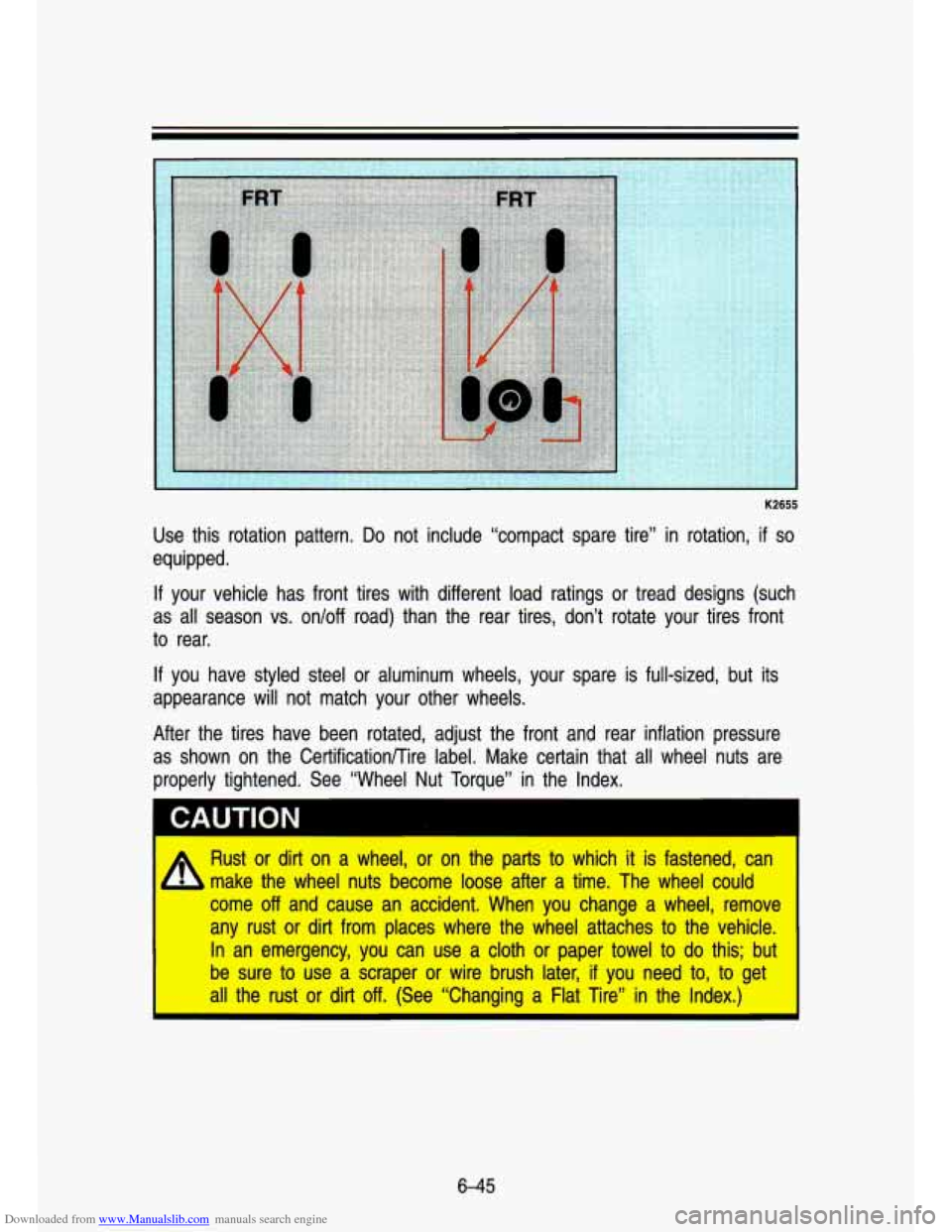
Use this rotation pattern. Do not include “compact spare tire” in rotation, if so
equipped.
If your vehicle has front tires with different load ratings or tr\
ead designs (such
as all season vs. on/off road) than the rear tires, don’t \
rotate your tires front
to rear.
If you have styled steel or aluminum wheels, your spare is full-s\
ized, but its
appearance will not match your other wheels.
After the tires have been rotated, adjust the front and rear \
inflation pressure as shown on the CertificationRire label. Make certain that
all wheel nuts are
properly tightened. See “Wheel Nut Torque” in the Index.
A
Rust or dirt on a wheel, or on the parts to which it is fastened, can
make the wheel nuts become loose after a time. The wheel coul\
d
come off and cause an accident. When you change a wheel, remove
any rust or dirt from places where the wheel attaches to the \
vehicle.
In an emergency, you can use a cloth or paper towel to
do this; but
be sure to use a scraper or wire brush later, if you need to, to get
all the rust or dirt off. (See “Changing a Flat Tire” in t\
he Index.)
6-45
Page 309 of 356
Downloaded from www.Manualslib.com manuals search engine Be sure to use the correct fuse. If you ever have a problem on the road and
don’t have a spare fuse, you can “borrow” one of the correct value. Just pick
some feature of your vehicle that you can get along without-like the radio or
cigarette lighter-and use its fuse,
if it is of the value you need. Replace it
as soon as you can. See “Fuses and Circuit Breakers” in this section.
Cap cities and Specification Charts
Replac -merit Parts
Replacement part numbers listed in this section are based on the latest
information available at the time of printing, and are subject to change.
If a
part listed in this manual is not the same as the part used in your vehicle
when
it was built, or if you have any questions, please contact your GM truck
dealer.
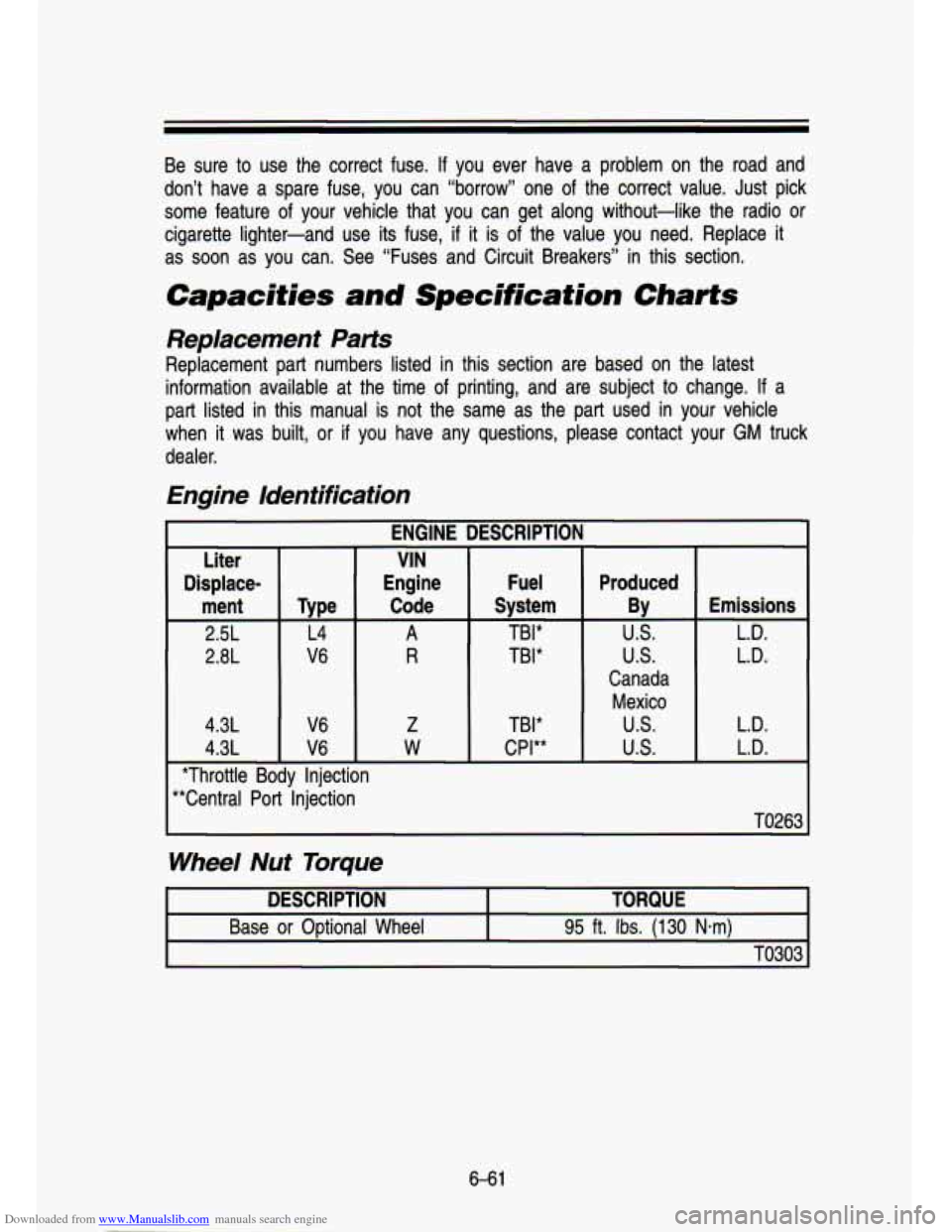
Engine Identification
ENGINE DESCRIPTION I
Liter VJN
Displace- Engine ment Type Cde
2.5L L4
A
2.8L V6 R
4.3L
V6 Z
4.3L V6 W
*Throttle Body Injection
“Central Port Injection Fuel
Svstem
TBI*
TBI*
TBI*
CPI**
Produced
BY
U.S.
us.
Canada Mexico
US.
U.S.
Emissions
L.D.
L.D.
L.D.
L.D.
TO263
Wheel Nut Torque
DESCRIPTION TORQUE
Base or Optional Wheel
95 ft. Ibs. (1 30 Nam)
TO303
6-61
Page 324 of 356
Downloaded from www.Manualslib.com manuals search engine Scheduled Maintenance Services
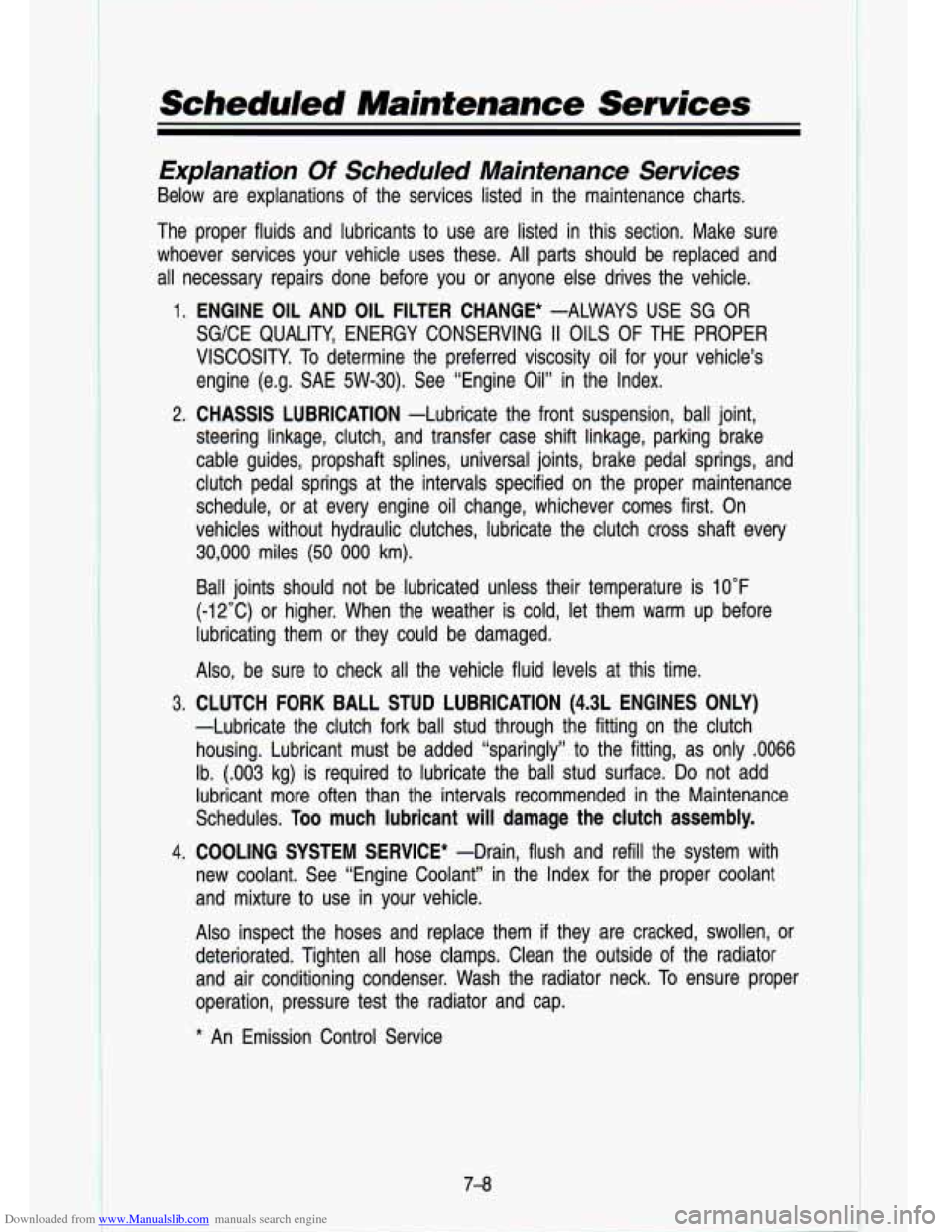
Explanation Of Scheduled Maintenance Services
Below are explanations of the services listed in the maintenance charts.
The proper fluids and lubricants to use are listed in this se\
ction. Make sure whoever services your vehicle uses these. All parts should be \
replaced and all necessary repairs done before you or anyone else drives th\
e vehicle.
1. ENGINE OIL AND OIL FILTER CHANGE* -ALWAYS USE SG OR SG/CE QUALITY, ENERGY CONSERVING
II OILS OF THE PROPER
VISCOSITY. To determine the preferred viscosity oil for your vehicle’s
engine (e.g. SAE 5W-30). See “Engine Oil” in the Index.\
2. CHASSIS LUBRICATION -Lubricate the front suspension, ball joint,
steering linkage, clutch, and transfer case shift linkage, parki\
ng brake
cable guides, propshaft splines, universal joints, brake pedal s\
prings, and
clutch pedal springs at the intervals specified on the proper \
maintenance
schedule, or at every engine oil change, whichever comes first.\
On
vehicles without hydraulic clutches, lubricate the clutch cross \
shaft every
30,000 miles
(50 000 km).
Ball joints should not be lubricated unless their temperature i\
s 10°F
(-12°C) or higher. When the weather is cold, let them war\
m up before
lubricating them or they could be damaged.
Also, be sure to check all the vehicle fluid levels at this \
time.
3. CLUTCH FORK BALL STUD LUBRICATION (4.3L ENGINES ONLY)
-Lubricate the clutch fork ball stud through the fitting on th\
e clutch housing. Lubricant must be added “sparingly” to the fittin\
g, as only
.0066
Ib. (.003 kg) is required to lubricate the ball stud surface\
. Do not add
lubricant more often than the intervals recommended in the Main\
tenance
Schedules. Too much lubricant
will damage the clutch assembly.
4. COOLING SYSTEM SERVICE* -Drain, flush and refill the system wit\
h
new coolant. See “Engine Coolant’’ in the Index for th\
e proper coolant
and mixture to use in your vehicle.
Also inspect the hoses and replace them
if they are cracked, swollen, or
deteriorated. Tighten all hose clamps. Clean the outside of the radiator
and air conditioning condenser. Wash the radiator neck. To ensure proper
operation, pressure test the radiator and cap.
* An Emission Control Service
7-8
Page 326 of 356
Downloaded from www.Manualslib.com manuals search engine Scheduled Maintenance Services
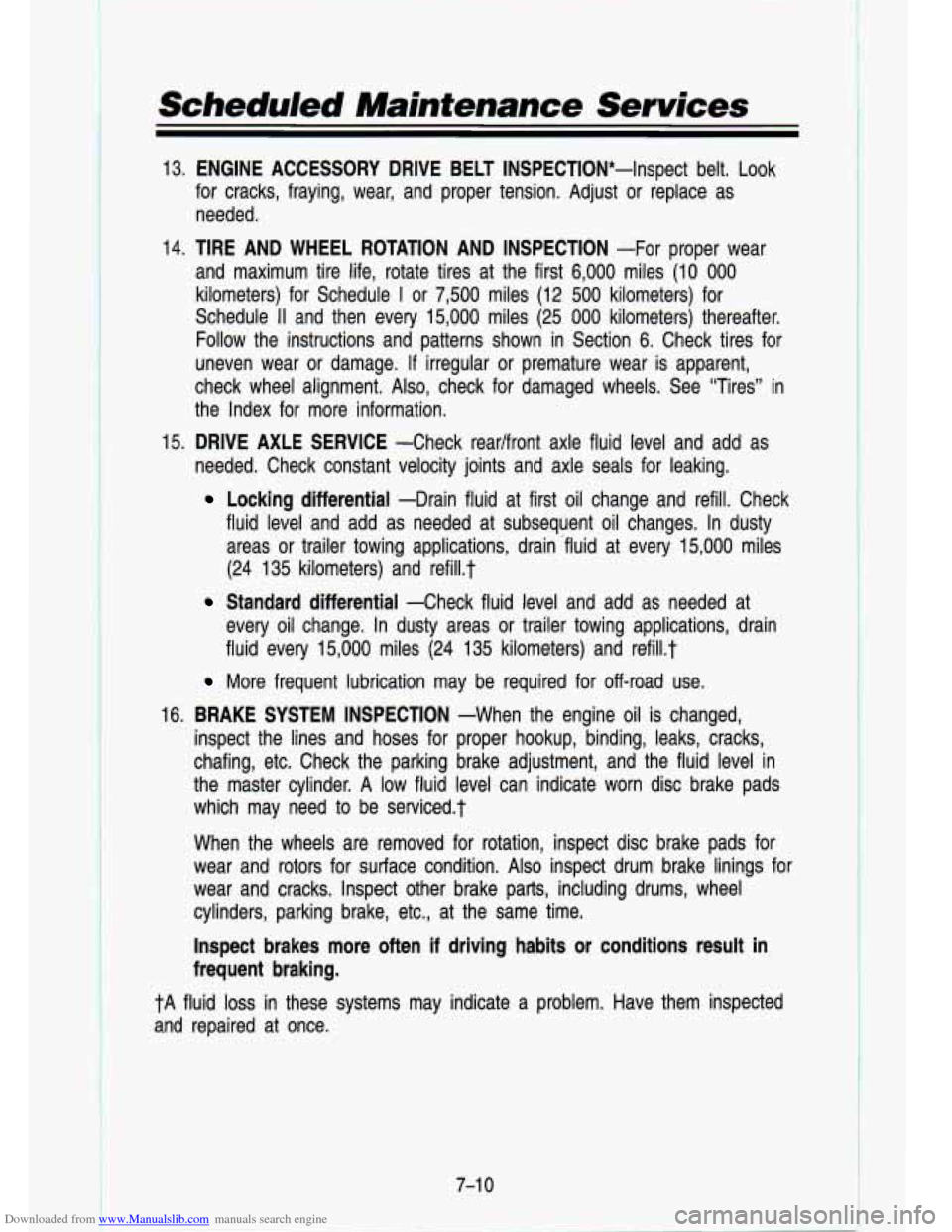
13. ENGINE ACCESSORY DRIVE BELT INSPECTION*-Inspect belt. Look
for cracks, fraying, wear, and proper tension. Adjust or replac\
e as needed.
14. TIRE AND WHEEL ROTATION AND INSPECTION -For proper wear and maximum tire life, rotate tires at the first
6,000 miles (10 000
kilometers) for Schedule I or 7,500 miles (12 500 kilometers) for
Schedule
II and then every 15,000 miles (25 000 kilometers) thereafter.
Follow the instructions and patterns shown in Section
6. Check tires for
uneven wear or damage.
If irregular or premature wear is apparent,
check wheel alignment. Also, check for damaged wheels. See “\
Tires” in
the Index for more information.
15. DRIVE AXLE SERVICE -Check rear/front axle fluid level and add \
as
needed. Check constant velocity joints and axle seals for leaki\
ng.
Locking differential -Drain fluid at first oil change and refill. Check
fluid level and add as needed at subsequent oil changes. In d\
usty areas
or trailer towing applications, drain fluid at every 15,000 miles
(24
135 kilometers) and refi1l.t
Standard differential -Check fluid level and add as needed at
every oil change. In dusty areas or trailer towing applications\
, drain
fluid every
15,000 miles (24 135 kilometers) and refil1.t
More frequent lubrication may be required for off-road use.
16. BRAKE SYSTEM INSPECTION -When the engine oil is changed,
inspect the lines and hoses for proper hookup, binding, leaks, \
cracks,
chafing, etc. Check the parking brake adjustment, and the fluid\
level in
the master cylinder. A low fluid level can indicate worn disc \
brake pads
which may need to be serviced.t
When the wheels are removed for rotation, inspect disc brake p\
ads for
wear and rotors for surface condition. Also inspect drum brake \
linings for
wear and cracks. Inspect other brake parts, including drums, wh\
eel cylinders, parking brake, etc., at the same time.
Inspect brakes more often if driving habits or conditions resul\
t
in
frequent braking.
tA fluid
loss in these systems may indicate a problem. Have them inspected
and repaired at once.
7-1 0
Page 337 of 356

Downloaded from www.Manualslib.com manuals search engine When contacting Chevrolet, please remember that your concern wil\
l likely be resolved in the dealership, using the dealership's facilities, e\
quipment and
personnel. That is why we suggest you follow Step One first
if you have a
concern.
Customer Assistance for the Hearing or
Speech Impaired (TDD)
To assist owners who have hearing difficulties, Chevrolet has installed special
TDD (Telecommunications Devices for the Deaf) equipment at its\
Customer Assistance Center. Any hearing or speech impaired customer who \
has access
to a TDD or conventional teletypewriter (TTY) can communicate \
with Chevrolet by dialing:
In the United States
..................................................................... 1 -800-TDD-CHEV
In Canada
........................................................................\
.................. 1-800-263-3830
GM Participation in Better Business
Bureau Mediation/Arbitration Program"
*This program may not be available in all states, depending on state law.
Canadian owners refer to your warranty booklet.
General Motors reserves the right to change eligibility limitations. and/or to
discontinue its participation in this program.
Our experience has shown that the Customer Satisfaction Procedur\
e
described earlier in this section has been very successful in achieving
customer satisfaction. However,
if you have not been substantially satisfied,
Chevrolet wants you to be aware of GM's voluntary participation in a no-charge mediationlarbitration program called BBB AUTO LINE. This program
is administered by the Council of Better Business Bureaus through local
Better Business Bureaus. The program can resolve individual disp\
utes
involving vehicle repairs and the interpretation of your New Vehicle Limited
Warranty.
We prefer that you not resort to BBB AUTO LINE until after a final decision
is made under the Customer Satisfaction Procedure. However, you \
may file a
claim at any time by contacting your local Better Business Bur\
eau (BBB) at
the following toll-free number: 1-800-955-5100. For further information about
filing a claim, you may
also write to: BBB AUTO HOTLINE, Council of Better
Business Bureaus, 4200 Wilson Boulevard, Suite
800, Arlington, Virginia
22203.
8-3