coolant CHEVROLET S10 1993 2.G User Guide
[x] Cancel search | Manufacturer: CHEVROLET, Model Year: 1993, Model line: S10, Model: CHEVROLET S10 1993 2.GPages: 356, PDF Size: 20.85 MB
Page 272 of 356
Downloaded from www.Manualslib.com manuals search engine t
..-
.I
Service & Appearance Care
What to Use:
Use a mixture of clean water (preferably distilled) and antifreeze that meets
“GM Specification 6038-M,” which won’t damage aluminum parts. Also use
GM Engine Coolant Supplement (sealer) with
a complete coolant change. If
you use these, you don’t need to add anything else.
I
Adding only plain water to your cooling system can be dangerous.
proper coolant mix will. Your vehicle’s coolant warning system is set
for the proper coolant mix. With plain water or the wrong mix, your
engine could get
too hot but you wouldn’t get the overheat warning.
Your engine could catch fire and you or others could be burned. Use
- Plain water, or some other liquid like alcohol, can boil before the
II a 50/50 mix of clean water and a proper antifreeze.
NOTICE
J use an improper coolant mix, your engine could overheat and be
badly damaged. The repair cost wouldn’t be covered by your warrant\
y
much water
in the mix can freeze and crack the engine, radiator, hea
core and other
part
Some conditions, such as air trapped in the cooling system, can affect the
coolant level in the radiator. Check the coolant level when th\
e engine is cold
and follow the steps under “Adding Coolant” for the prope\
r way to add
coolant.
If you have to add coolant more than four times a year, have your dealer
check your cooling system.
’‘ you use the proper coolant, you don’t have to add extra inhibitors c-
auditives which claim to improve the system. These can be harmful. ~ ~~~~~
6-24
Page 273 of 356
Downloaded from www.Manualslib.com manuals search engine Adding Coolant
KO625
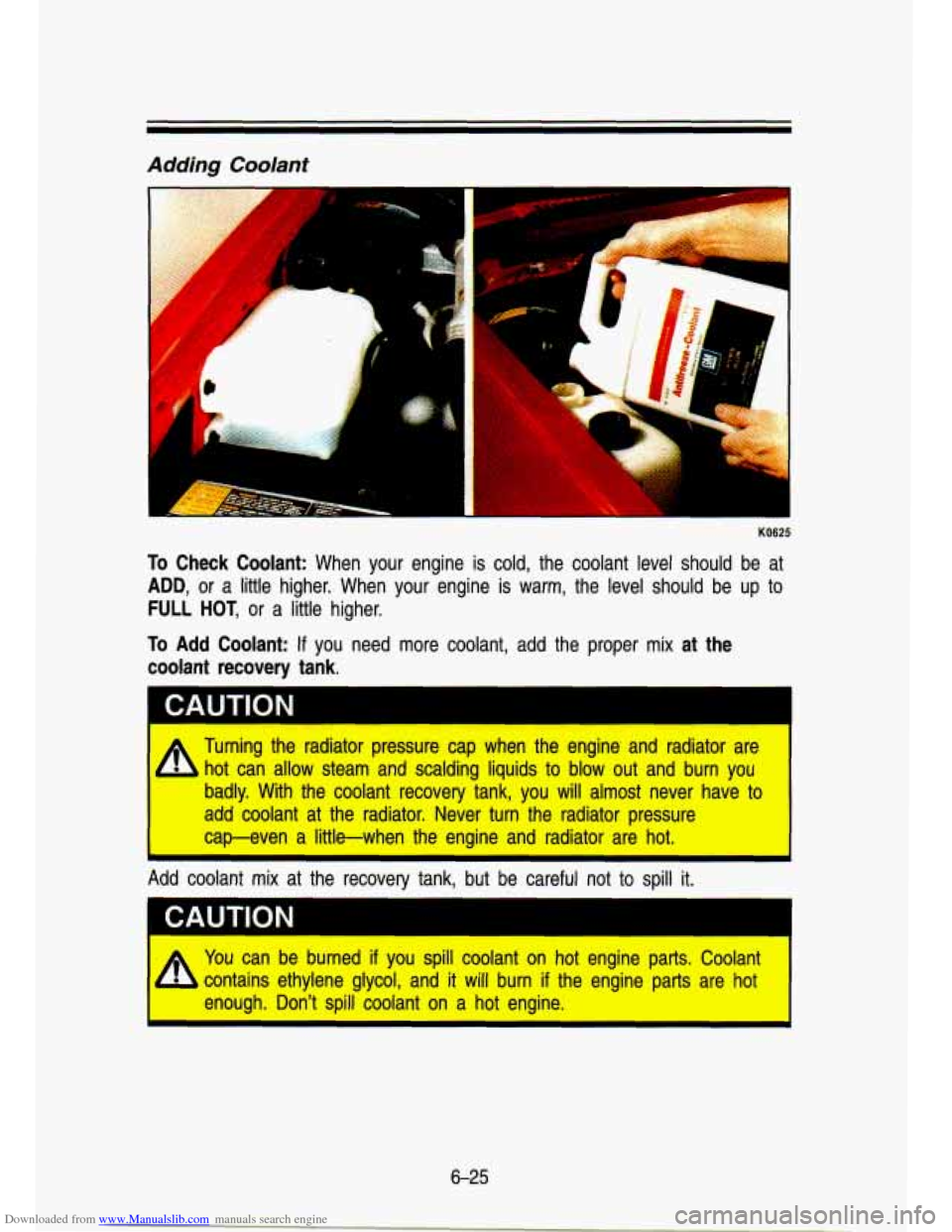
To Check Coolant: When your engine is cold, the coolant level should be at
ADD, or a little higher. When your engine is warm, the level should be up to
FULL HOT, or a little higher.
To Add Coolant: If you need more coolant, add the proper mix at the
coolant recovery tank.
A
Turning the radiator pressure cap when the engine and radiator \
are
hot can allow steam and scalding liquids to blow out and burn you
badly. With the coolant recovery tank, you will almost never have to
add coolant at the radiator. Never turn the radiator pressure
cap-even a little-when the engine and radiator are hot.
Add coolant mix at the recovery tank, but be careful not to spill\
it.
A
You can be burned if you spill coolant on hot engine parts. Coolant
contains ethylene glycol, and it will burn
if the engine parts are hot
enough. Don’t spill coolant on a hot engine.
6-25
Page 274 of 356
Downloaded from www.Manualslib.com manuals search engine Service & Appearance Care
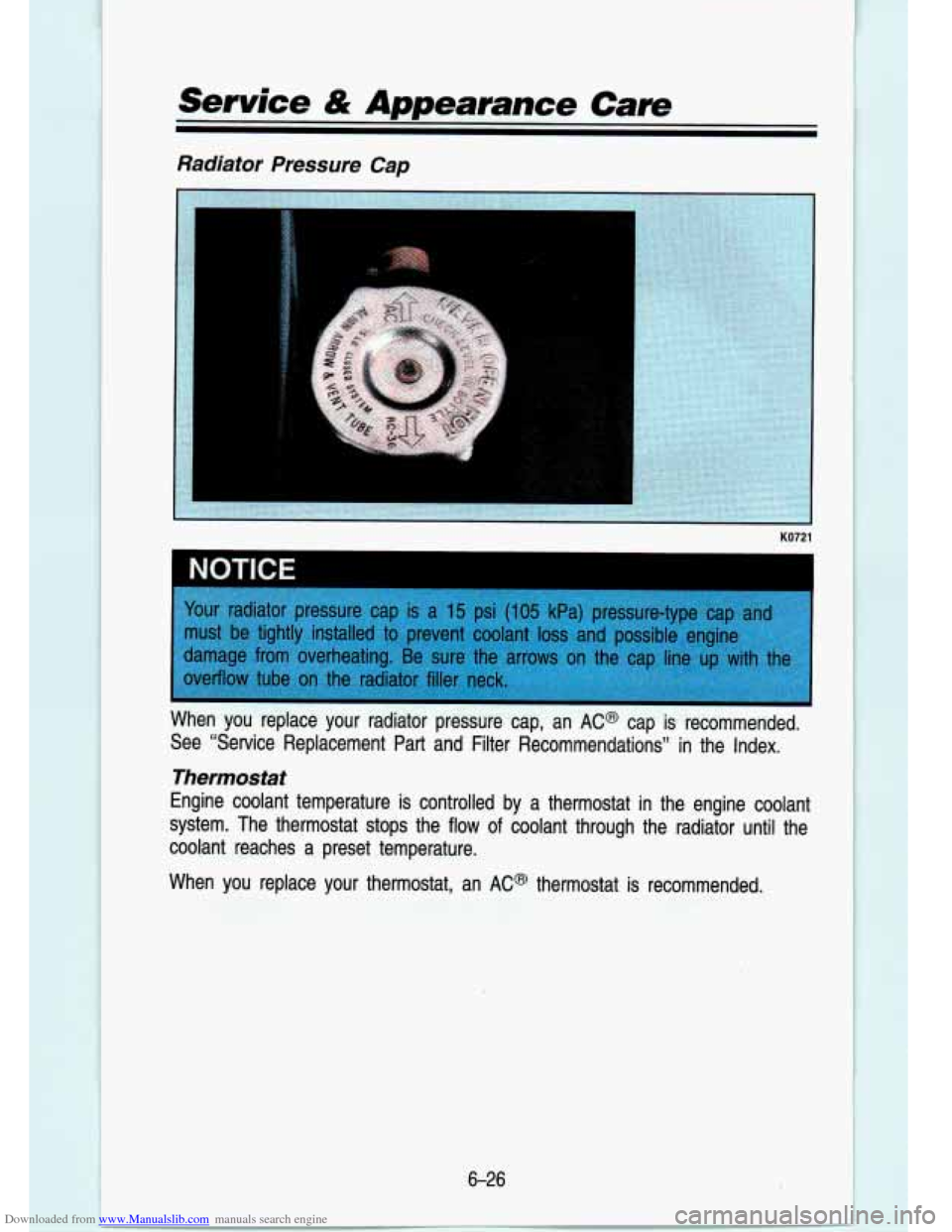
Radiator Pressure Cap
KO721
When you replace your radiator pressure cap, an AC@ cap is recommended.
See “Service Replacement Part and Filter Recommendations” in the Index.
Thermostat
Engine coolant temperature is controlled by a thermostat in the engine coolant
system. The thermostat stops the
flow of coolant through the radiator until the
coolant reaches a preset. temperature.
When you replace your thermostat, an
AC@ thermostat is recommended.
6-26
Page 324 of 356
Downloaded from www.Manualslib.com manuals search engine Scheduled Maintenance Services
Explanation Of Scheduled Maintenance Services
Below are explanations of the services listed in the maintenance charts.
The proper fluids and lubricants to use are listed in this se\
ction. Make sure whoever services your vehicle uses these. All parts should be \
replaced and all necessary repairs done before you or anyone else drives th\
e vehicle.
1. ENGINE OIL AND OIL FILTER CHANGE* -ALWAYS USE SG OR SG/CE QUALITY, ENERGY CONSERVING
II OILS OF THE PROPER
VISCOSITY. To determine the preferred viscosity oil for your vehicle’s
engine (e.g. SAE 5W-30). See “Engine Oil” in the Index.\
2. CHASSIS LUBRICATION -Lubricate the front suspension, ball joint,
steering linkage, clutch, and transfer case shift linkage, parki\
ng brake
cable guides, propshaft splines, universal joints, brake pedal s\
prings, and
clutch pedal springs at the intervals specified on the proper \
maintenance
schedule, or at every engine oil change, whichever comes first.\
On
vehicles without hydraulic clutches, lubricate the clutch cross \
shaft every
30,000 miles
(50 000 km).
Ball joints should not be lubricated unless their temperature i\
s 10°F
(-12°C) or higher. When the weather is cold, let them war\
m up before
lubricating them or they could be damaged.
Also, be sure to check all the vehicle fluid levels at this \
time.
3. CLUTCH FORK BALL STUD LUBRICATION (4.3L ENGINES ONLY)
-Lubricate the clutch fork ball stud through the fitting on th\
e clutch housing. Lubricant must be added “sparingly” to the fittin\
g, as only
.0066
Ib. (.003 kg) is required to lubricate the ball stud surface\
. Do not add
lubricant more often than the intervals recommended in the Main\
tenance
Schedules. Too much lubricant
will damage the clutch assembly.
4. COOLING SYSTEM SERVICE* -Drain, flush and refill the system wit\
h
new coolant. See “Engine Coolant’’ in the Index for th\
e proper coolant
and mixture to use in your vehicle.
Also inspect the hoses and replace them
if they are cracked, swollen, or
deteriorated. Tighten all hose clamps. Clean the outside of the radiator
and air conditioning condenser. Wash the radiator neck. To ensure proper
operation, pressure test the radiator and cap.
* An Emission Control Service
7-8
Page 330 of 356
Downloaded from www.Manualslib.com manuals search engine i
I
Scheduled Maintenance Services
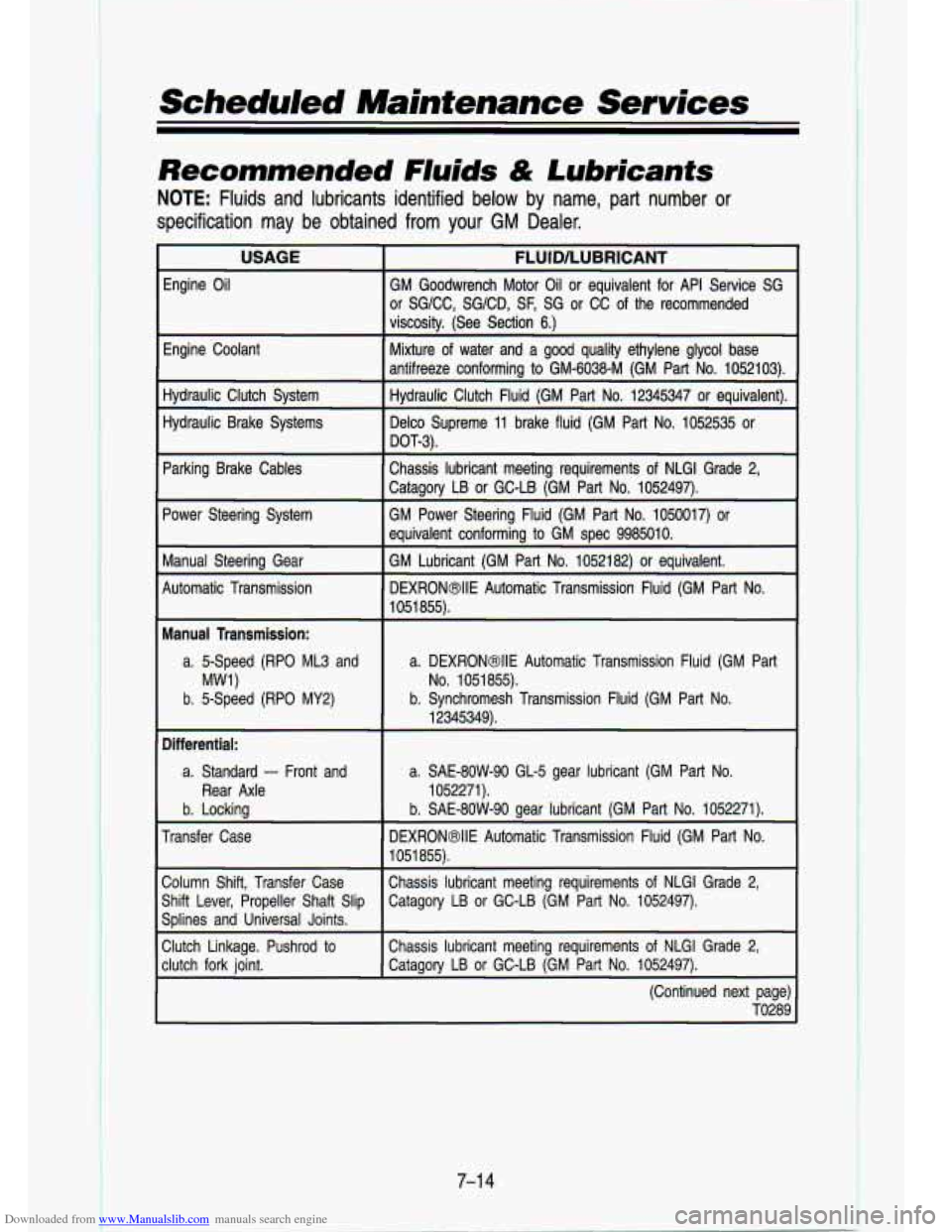
Recommended FIuids & Lubricants
NOTE: Fluids and lubricants identified below by name, part number or \
specification may be obtained from your
GM Dealer.
USAGE FLUlD/LUBRICANT
Engine Oil GM Goodwrench Motor Oil or equivalent for API Service SG
or SGICC, SG/CD, SF, SG or CC
of the recommended
viscosity. (See Section 6.)
Engine Coolant Mixture
of water and a good quality ethylene glycol base
antifreeze conforming
to GM-6038-M (GM Part No. 1052103).
Hydraulic Clutch System Hydraulic Clutch Fluid (GM Part No. 12345347 or equivalent).
Hydraulic Brake Systems Delco Supreme 11 brake fluid (GM Part No. 1052535 or
Parking Brake Cables Chassis lubricant meeting requirements
of NLGl Grade 2,
Power Steering System GM Power Steering Fluid (GM Part No. 10\
50017) or
Manual Steering Gear GM Lubricant (GM Part
No. 1052182) or equivalent.
Automatic Transmission DEXRONBIIE Automatic Transmission Fluid (GM Part No.
Manual Transmission:
DOT-3).
Catagoty LB or GC-LB (GM Part No. 1052497).
equivalent conforming
to GM spec 9985010.
1051
RKK).
a. 5-Speed (RPO ML3 and a. DEXRONBIIE Automatic Transmission Fluid (GM Part
b. 5-Speed (RPO MY2) b. Synchromesh Transmission Fluid (GM P\
art No. 12345349).
MW1) No. 1051855).
Differential:
a. Standard - Front and
a. SAE-80W-90 GL-5 gear lubricant (GM Part No.
b. Locking
b. SAE-80W-90 gear lubricant (GM Part No. 1052271).
Transfer Case DEXRONBIIE
Automatic Transmission Fluid (GM Part No.
Column Shift, Transfer Case Chassis lubricant meeting requirement\
s of NLGI Grade 2,
Shift Lever, Propeller Shaft Slip Catagory LB or GC-LB (GM Part No.\
1052497).
Splines and Universal Joints.
Clutch Linkage. Pushrod
to Chassis lubricant meeting requirements of NLGl Grade 2,
clutch fork joint. Catagory LB or GC-LB (GM Part No. 1052497).
Rear Axle 1052271).
1051 855).
(Continued next page) TO289
7-1 4
1
Page 333 of 356
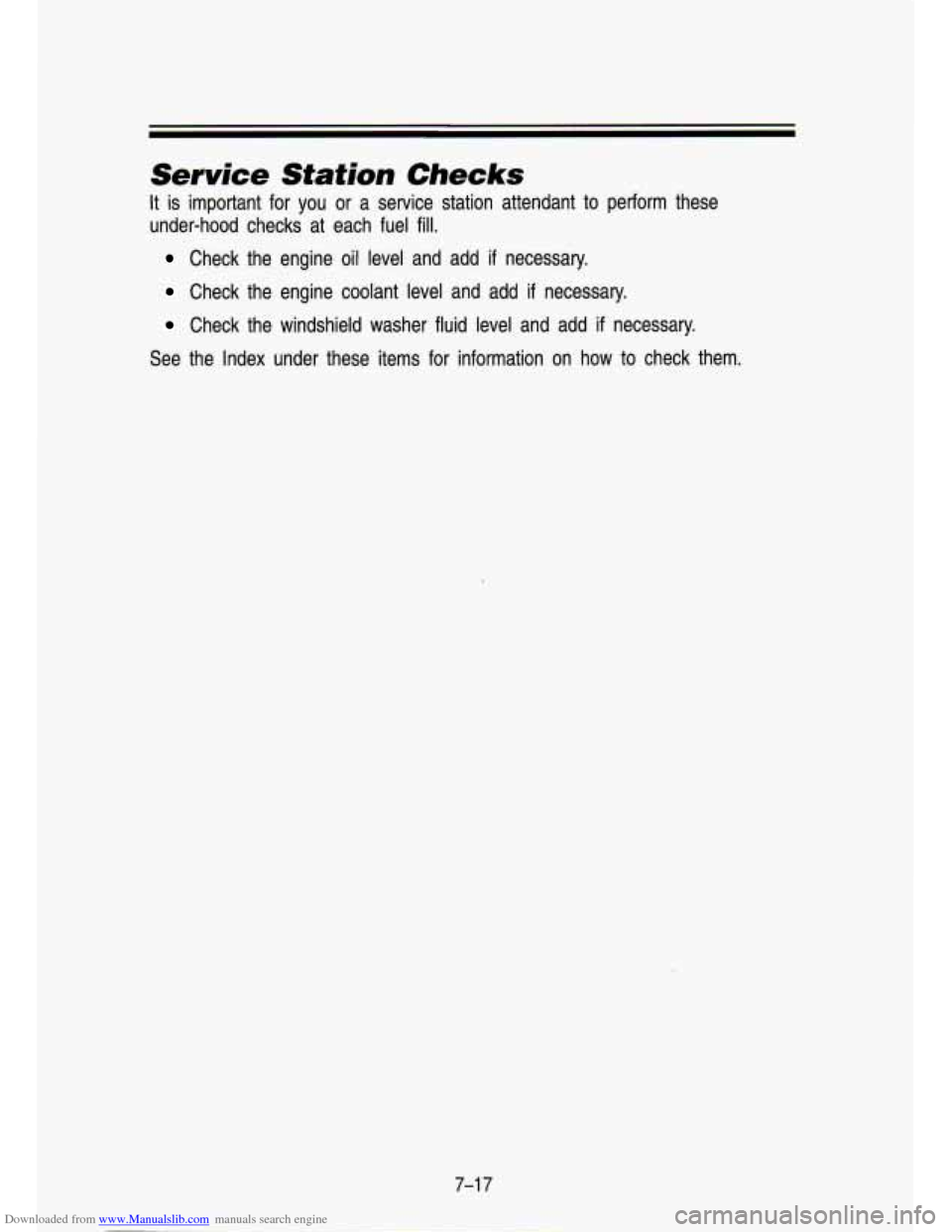
Downloaded from www.Manualslib.com manuals search engine Service Station Checks
It is important for you or a service station attendant to perform these
under-hood checks at each fuel
fill.
Check the engine oil level and add if necessary.
Check the engine coolant level and add if necessary.
Check the windshield washer fluid level and add if necessary.
See the Index under these items for information on how to che\
ck them.
7-17
Page 348 of 356
Downloaded from www.Manualslib.com manuals search engine INDEX
Catalytic Converter ......... ...... ..._. 6-37
CertificationlTire Label
................. 6-38
Changing A Flat Tire
........ 5-16, 5-21
Chemical Paint Spotting
.............. 6-56
Child Restraints
Cigarette LighterlAshtrays
........... 2-54
Circuit Breakers (See “Fuses”)
Cleaning (See “Safety
Belts”)
Finish Care
................................ 6-54
Glass
.......................................... 6-53
Inside of Vehicle
....................... 6-51
Instrument Panel, Top
............. 6-53
Outside
of Vehicle .................... 6-54
Special Problems
...................... 6-52
Vinyl or Leather
................-...... 6-53
Wheels and Tires
..................... 6-55
Windshield
................................ 6-54
Convenience Net
.......................... 2-57
Conversion
to Chassis Cab ........ 6-43
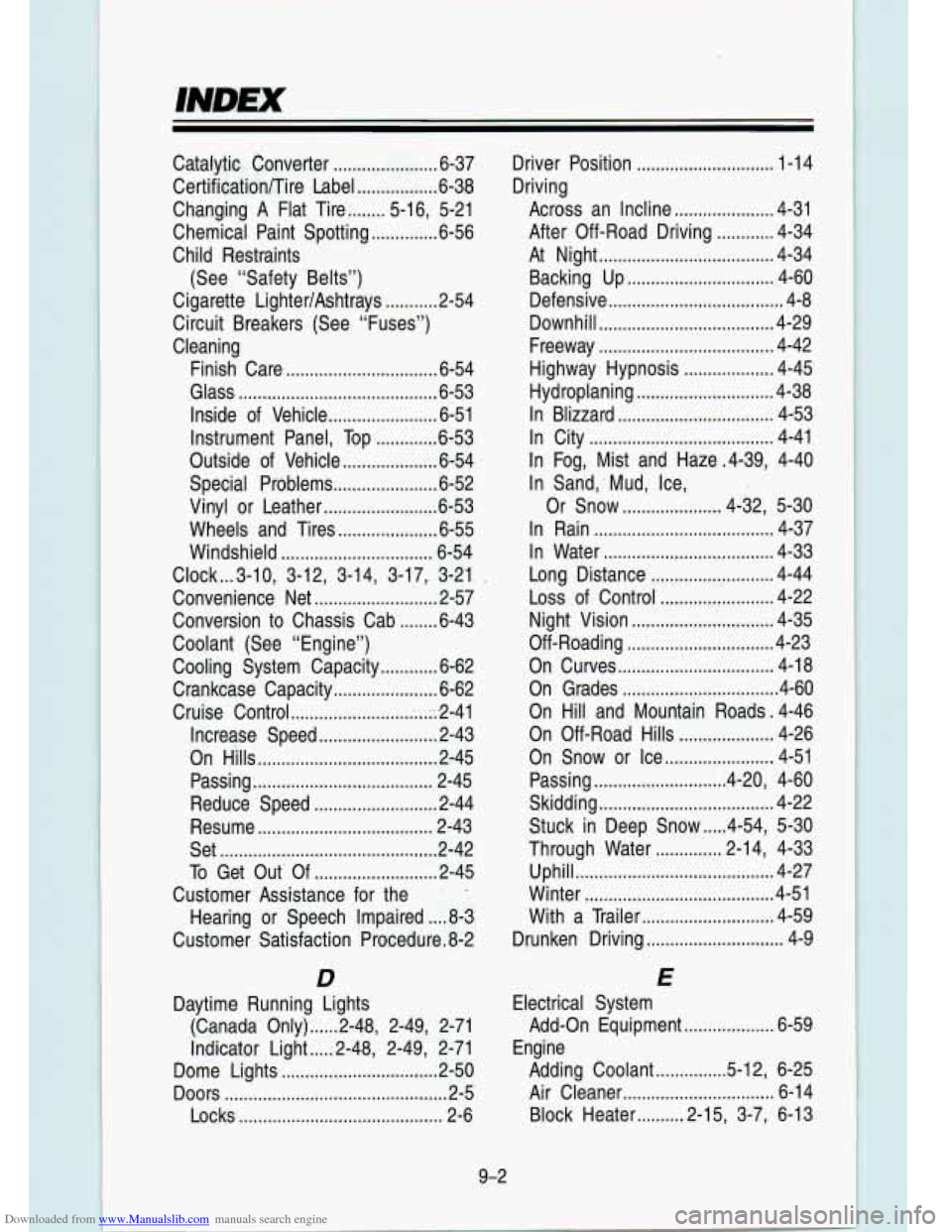
Coolant (See “Engine”)
Cooling System Capacity
............ 6-62
Crankcase Capacity
...................... 6-62
Cruise Control
................................ 2-41
Increase Speed
......................... 2-43
On Hills
...................................... 2-45
Passing
...................................... 2-45
Reduce Speed
......................... -2-44
Resume
..................................... 2-43
Set
.............................................. 2-42
To Get Out Of .......................... 2-45
Clock
... 3-10, 3-12,
3-14, 3-17, 3-21
Customer Assistance for the Hearing or Speech Impaired
.... 8-3
Customer Satisfaction Procedure.8-2
D
(Canada Only) ...... 2-48, 2-49, 2-71
Indicator Light
..... 2-48, 2-49, 2-71
Dome Lights
................................. 2-50
Doors
............................................... 2-5
Daytime Running Lights
Locks
........................................... 2-6 9-2 Driver Position
............................. 1-14
Driving Across an Incline
..................... 4-31
After Off-Road Driving
............ 4-34
At Night
..................................... 4-34
Backing Up
............................... 4-60
Defensive
..................................... 4-8
Downhill
..................................... 4-29
Freeway
..................................... 4-42
Highway Hypnosis
................... 4-45
Hydroplaning
............................. 4-38
In Blizzard
................................. 4-53
In City
....................................... 4-41
In Fog, Mist and Haze .4-39, 4-40
In Sand,
. Mud, Ice,
Or Snow
..................... 4-32, 5-30
In Rain
...................................... 4-37
In Water .................................... 4-33
Long Distance
.......................... 4-44
Loss of Control
........................ 4-22
Night Vision
.............................. 4-35
Off-Roading
............................... 4-23
On Curves
................................. 4-18
On Grades
................................. 4-60
On Hill and Mountain Roads
. 4-46
On Off-Road Hills
.................... 4-26
On Snow or Ice
....................... 4-51
Passing
............................ 4-20, 4-60
Skidding
..................................... 4-22
Stuck in Deep Snow
..... 4-54, 5-30
Through Water
.............. 2-14, 4-33
Uphill
.......................................... 4-27
Winter
........................................ 4-51
With a Trailer
............................ 4-59
Drunken Driving
............................. 4-9
E
Electrical System
Engine Add-on
Equipment
................... 6-59
Adding Coolant
............... 5-1 2, 6-25
Air Cleaner
................................ 6-14
Block Heater
.......... 2-15, 3-7, 6-13