instrument panel CHEVROLET S10 1993 2.G User Guide
[x] Cancel search | Manufacturer: CHEVROLET, Model Year: 1993, Model line: S10, Model: CHEVROLET S10 1993 2.GPages: 356, PDF Size: 20.85 MB
Page 132 of 356
Downloaded from www.Manualslib.com manuals search engine Comfort Controls & Audio Systems
Air Vents
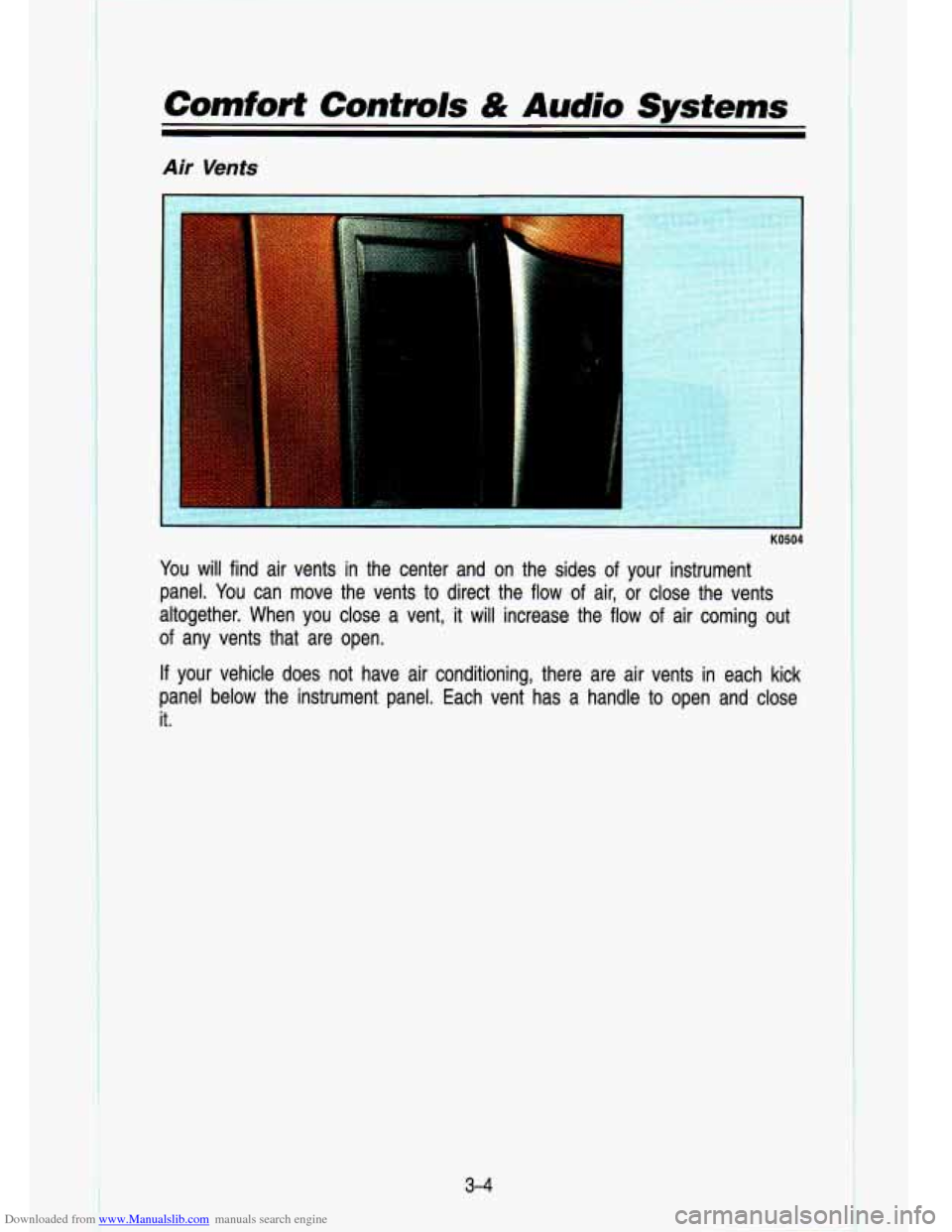
You will find air vents in the center and on the sides of your instrument
panel. You can move the vents to direct the flow of air, or close the vents
altogether. When
you close a vent, it will increase the flow of air coming out
of any vents that are open.
If your vehicle does not have air conditioning, there are air vents in each kick
panel below the instrument panel. Each vent has
a handle to open and close
it.
3-4
t
I
Page 133 of 356
Downloaded from www.Manualslib.com manuals search engine Fan Lever
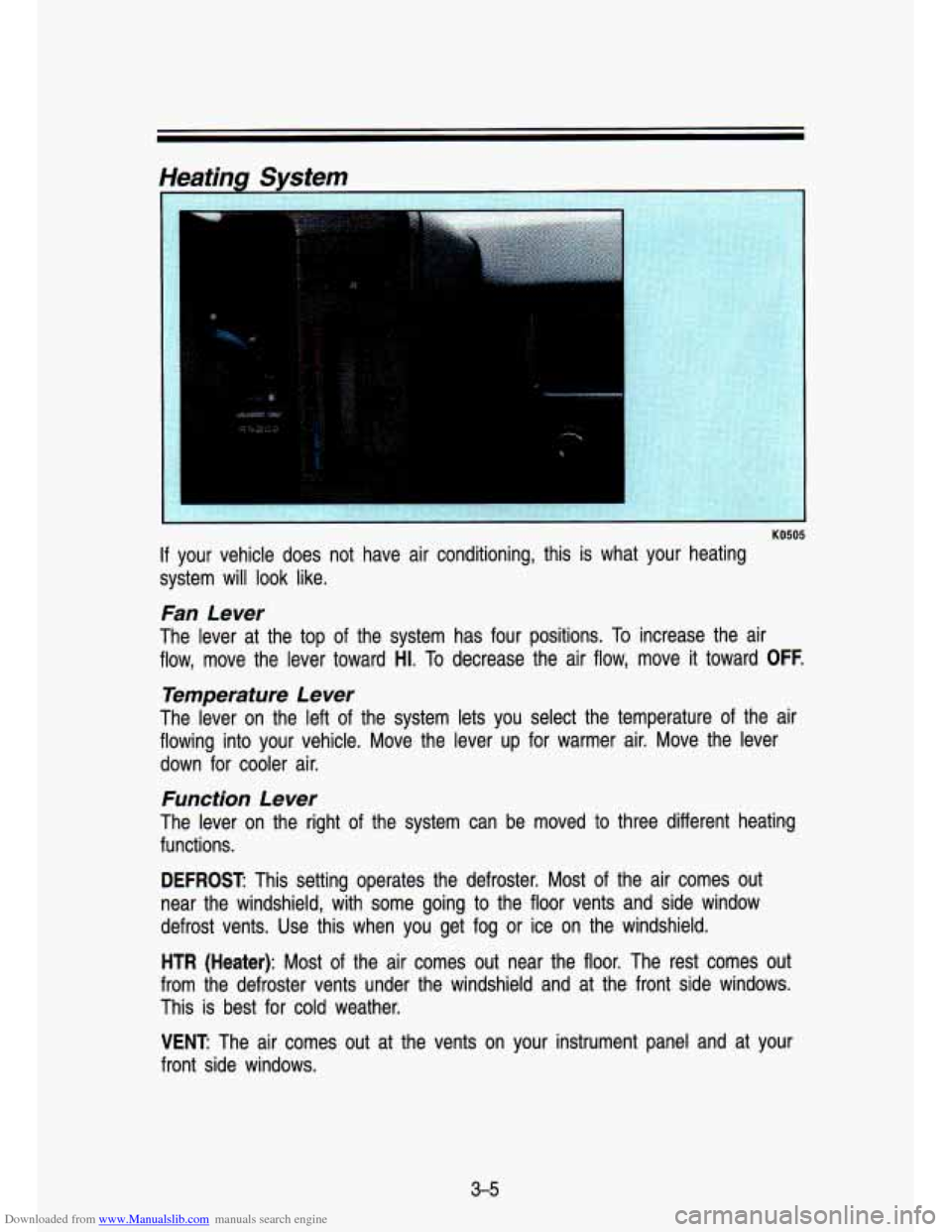
The lever at the top of the system has four positions. To increase the air
flow, move the lever toward
HI. To decrease the air flow, move it toward OFF.
Temperature Lever
The lever on the left of the system lets you select the temperature of the air
flowing into your vehicle. Move the lever up for warmer air. Move the leve\
r
down for cooler air.
Function Lever
The lever on the right of the system can be moved to three different heating
functions.
DEFROST: This setting operates the defroster. Most of the air comes out
near the windshield, with some going to the floor vents and side window
defrost vents. Use this when you get fog or ice on the windshield.
HTR (Heater): Most of the air comes out near the floor. The rest comes out
from the defroster vents under the windshield and at the front\
side windows.
This is best for cold weather.
VENT: The air comes out at the vents on your instrument panel and \
at your
front side windows.
3-5
Page 135 of 356

Downloaded from www.Manualslib.com manuals search engine VENT: The air comes out at the vents on your instrument panel and \
at your
front side windows.
BI-LEV NC: With this, outside air comes in through the heater floor vent and
the instrument panel vents. This setting is useful in cool weather with bright
sunlight.
NORM
NC: This setting cools the outside air. If you first used MAX, use
NORM as soon as the vehicle has cooled down,
so outside air will be going
through your vehicle.
MAX NC: This cools the air the fastest. Move the other lever all the \
way to
Cold. MAX lets in only a little air from the outside. You can use MAX at first
when it’s really hot outside and you need to cool
off quickly.
OFF: The blower is off, but air still will come from outlets at the front of your
vehicle. The system will try
to keep the air at the chosen temperature.
Engine Block Heater
If you use the optional engine block heater before starting your \
engine, your
heating system will produce warmer air faster, to heat the pas\
senger
compartment in cold weather. See “Engine Block Heater” in the Index.
Audio Systems
I CAUTION
A
Hearing damage frolm lloud noise is almost undetectable until it is too
late. Your
hearing can adapt to higher volmes of sound. So’und that
seems normal can
be loud an’d harmfull to your hearing. Jake
precaution’s by adjusting the volume control
on your radio to a safe
sound level before your hearing adapts to
it.
To help avoid hearing IOSS or damage:
* Adjust the volume control to the lowest setting.
Increase volume SliOWly until you hear comfortably and
clearlv.
- -
Your L-.CO@ audio system has been designed to operate easily and give
years of listening pleasure. But you will get the most enjoyment out of it if
you acquaint yourself with
it first. Find out what your Delco@ system can do
and how to operate all its controls, to be sure you’re getting the most out of
the advanced engineering that went into it.
3-7
Page 214 of 356

Downloaded from www.Manualslib.com manuals search engine Your Driving and the Road
Following Distance
Stay at least twice as far behind the vehicle ahead as you w\
ould when
driving your vehicle without a trailer. This can help you avoi\
d situations that require heavy braking and sudden turns.
Passing
You’ll need more passing distance up ahead when you’re to\
wing a trailer.
And, because you’re a good deal longer, you’ll need
to go much farther
beyond the passed vehicle before you can return
to your lane.
Backing Up
Hold the bottom of the steering wheel with one hand. Then, to move the
trailer left, just move your hand to the left. To move the trailer to the right,
move your hand
to the right. Always back up slowly and, if possible, have
someone guide you.
Making Turns
When you’re turning with a trailer, make wider turns than n\
ormal. Do this so
your trailer wheels won’t strike soft shoulders, curbs, road \
signs, trees, or
other objects. Avoid jerky or sudden maneuvers. Signal well in advance.
Turn Signals When Towing a Trailer
When you tow a trailer, your vehicle has to have a different turn signal
flasher and extra wiring. The green arrows on your instrument \
panel will flash
whenever you signal a turn or lane change. Properly hooked up,\
the trailer lights will also flash, telling other drivers you’re about
to turn, change lanes,
or stop.
When towing a trailer, the green arrows on your instrument pan\
el will flash for
turns even
if the bulbs on the trailer are burned out. Thus, you may think \
drivers behind you are seeing your signal when they are not.
It’s important to
check occasionally to be sure the trailer bulbs are still work\
ing.
Driving on Grades
Reduce speed and shift to a lower gear before you start down a long or
steep downgrade.
If you don’t shift down, you might have to use your brakes
so much that they would get hot and no longer work well.
On a long uphill grade, shift down and reduce your speed to \
around
45 mph
(70 km/h) to reduce the possibility of engine and transmission ove\
rheating.
If you have an automatic transmission, you should use D when towing a
trailer. Operating your vehicle in
D when towing a trailer will minimize heat
buildup and extend the life of your transmission. Or, if you have a manual
transmission with fifth gear, it’s better not to use fifth \
gear, just drive in fourth
gear (or, as you need
to, a lower gear).
4-60
Page 256 of 356

Downloaded from www.Manualslib.com manuals search engine Service & Appearance Care
Hood Release
To open the hood, first pull the handle inside the vehicle on th\
e lower left
side of the instrument panel. Then
go to the front of the vehicle and release
the secondary hood release. Lift the hood, release the hood pr\
op from its
retainer and put the hood prop into the slot in the hood. You may have a
light that comes on when you lift the hood.
L
Thing's that burn can .get on hot engine parts and s'hrt a fire. These I
include liqwids like gasoline, oil, coolant, brake fluid, windshiield
washer and .other fluids, and plastic oir rubber. You or others could
be blurned. Be careful not
to drop or spill thing.s that will bum onto a
hot eng,ine.
L
Before closing the hood, be sure all the filler caps are on properly. Then lift
the hood to relieve pressure on the hood prop.
Remove the hood prop from the slot in the hood and return th\
e prop to its
retainer. Then just pull the hood down and close
it firmly.
6-8
Page 285 of 356
Downloaded from www.Manualslib.com manuals search engine Refer to the Maintenance Schedule to determine how often to lubricate them
and what type
of lubricant to use.
Exhaust System
To help prevent damage to your exhaust system, do not continue to drive
your vehicle if you notice:
Engine misfiring
* Loss of performance
Other unusual operating conditions
Have your engine and exhaust system serviced regularly.
Three- Way Catalytic Converter
Your vehicle’s three-way catalytic converter is designed to reduce \
the
pollutants in your vehicle’s exhaust. Use only unleaded fuel \
in your vehicle.
If
you use leaded fuel, you could damage your three-way catalytic \
converter, and other engine components.
The Malfunction Indicator (SERVICE ENGINE SOON) lamp on your instrument panel lets you know when your emission system needs \
service.
The light will come on briefly when you start your engine to let you know
that the system is working.
If it does not come on when you start your
engine, or
if it comes on and stays on while you’re driving, your system \
may
need service. Your vehicle should still be driveable, but you should have your
system serviced right away.
6-37
Page 301 of 356
 of bak")
Downloaded from www.Manualslib.com manuals search engine If an odor lingers after cleaning vomit or urine, treat the area \
with a
watedbaking soda solution:
1 teaspoon (5 ml) of baking soda to 1 cup
(250 ml) of lukewarm water.
Finally, if needed, clean lightly with solvent-type cleaner.
Combination Stains: Like candy, ice cream, mayonnaise,
c i sauce and
unknown stains.
Carefully scrape off excess stain, then clean with cool water and allow to
dry.
If a stain remains, clean it with solvent-type cleaner.
Cleaning Vinyl or Leather
Just use warm water and a clean cloth.
Rub with a clean, damp cloth to remove dirt. You may have to do it
more than once.
Things like tar, asphalt and shoe polish will stain if you^ don’t get them
off quickly. Use a clean cloth and solvent-type vinylheather cleaner.
Cleaning the Top of the Instrument Panel
Use only mild soap and water to clean the top surfaces of the instrument
panel. Sprays containing silicones or waxes may cause annoying \
reflections in
the windshield and even make it difficult to see through the windshield under
certain conditions.
Care of Safety Belts
Keep belts clean and dry.
I
CAUTION
I
A
Do not bleach or dye safety kits. If you do, it may severely weaken
them. In a crash they might not be able to provide adequate
protection. Clean safety belts only with mild
soap and lukewarm
water.
Glass
Glass should be cleaned often. GM Glass Cleaner (GM Part No. 1050427) or
a liquid household glass cleaner will remove normal tobacco smo\
ke and dust
films.
Don’t use abrasive cleaners
on glass, because they may cause scratches.
Avoid placing decals on the inside rear window, since they may have to be
scraped off later.
6-53
Page 305 of 356
Downloaded from www.Manualslib.com manuals search engine Vehicle Identification Number (VIN)
KO641
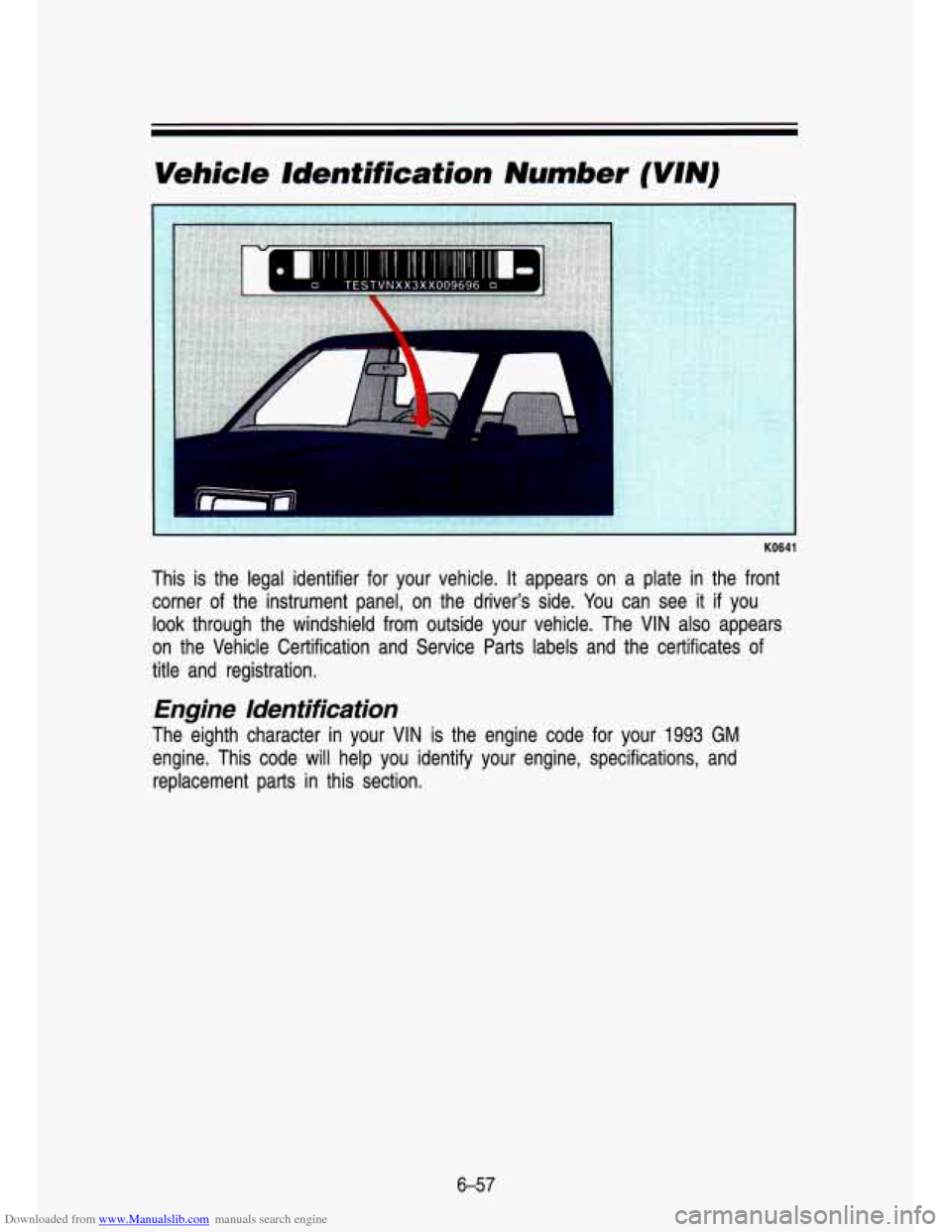
This is the legal identifier for your vehicle. It appears on a plate in the front
corner of the instrument panel, on the driver's side. You can see it
if you
look through the windshield from outside your vehicle. The VIN also \
appears
on the Vehicle Certification and Service Parts labels and the \
certificates of
title and registration.
Engine ldenfification
The eighth character in your VIN is the engine code for your 1993 GM
engine. This code will help you identify your engine, specifica\
tions, and
replacement parts in this section.
6-57
Page 308 of 356

Downloaded from www.Manualslib.com manuals search engine I
Service & Appearance Cave
Headlights
The headlight wiring is protected by a circuit breaker in the \
light switch. An electrical overload will cause the lights to go on and
off, or in some cases to
remain
off. If this happens, have your headlight wiring checked right away.
Windshield Wipers
The windshield wiper motor is protected by a circuit breaker a\
nd a fuse. If
the motor overheats due to heavy snow, etc., the wiper will s\
top until the
motor cools. If the overload is caused by some electrical problem and not
snow, etc., be sure to get it fixed.
Power Windows and Other Power Options
Circuit breakers in the fuse panel protect the power windows a\
nd other power
accessories. When the current load is
too heavy, the circuit breaker opens
and closes, protecting the circuit until the problem is fixed \
or goes away.
Trailer Wiring Harness
The optional seven-wire trailer wiring I ;s is protected by an in-line fuse
in the battery feed wire. This fuse is near rhe junction bloc\
k. See “Trailer
Wiring Harness” in the “Features
& Controls’’ section.
Fuse Block
KO631
The fuse block is in the instrument panel on the driver’s side.
- .: .-: 1
.- .
Remove the cover with a screwdriver and then you can remove f\
uses with a
fuse extractor.
6-60
Page 315 of 356
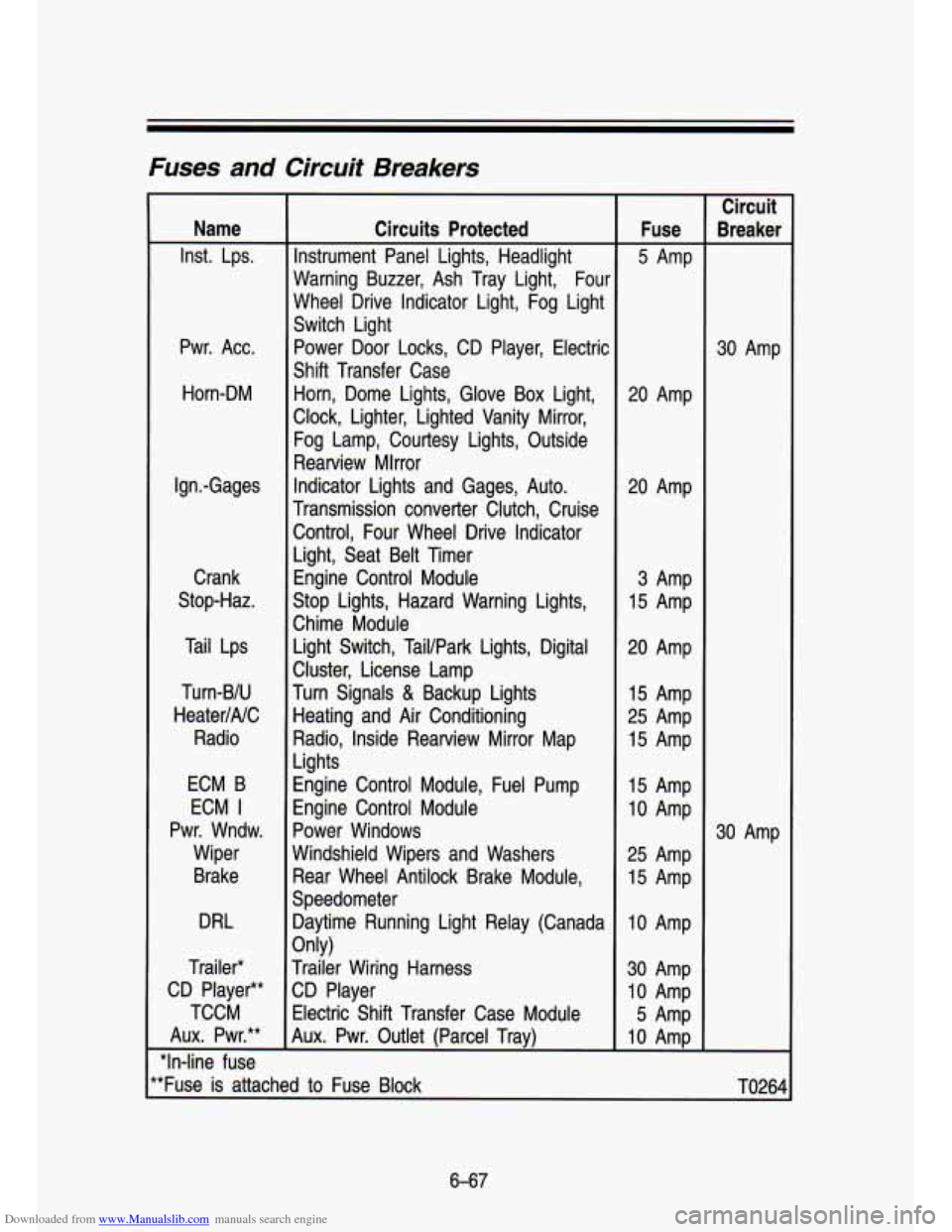
Downloaded from www.Manualslib.com manuals search engine Fuses and Circuit Breakers
Name
Inst. Lps.
Pwr. Acc. Horn-DM
Ign.-Gages Crank
Stop-Haz.
Tail Lps
Turn-BIU
HeaterINC Radio
ECM B
ECM
I
Pwr. Wndw. Wiper
Brake
DRL
Trailer*
CD Player**
TCCM
Aux. Pwr.**
"In-line fuse Circuits Protected
Instrument Panel Lights, Headlight
Warning Buzzer, Ash Tray Light, Four
Wheel Drive Indicator Light, Fog Light
Switch Light Power Door Locks, CD Player, Electric
Shift Transfer Case Horn, Dome Lights, Glove Box Light,
Clock, Lighter, Lighted Vanity Mirror,
Fog Lamp, Courtesy Lights, Outside
Rearview Mlrror
Indicator Lights and Gages, Auto.
Transmission converter Clutch, Cruise Control, Four Wheel Drive Indicator
Light, Seat Belt Timer Engine Control Module
Stop Lights, Hazard Warning Lights,
Chime Module Light Switch, Tail/Park Lights, Digital
Cluster, License Lamp
Turn Signals
& Backup Lights
Heating and Air Conditioning
Radio, Inside Rearview Mirror Map
Lights
Engine Control Module, Fuel Pump
Engine Control Module
Power Windows
Windshield Wipers and Washers Rear Wheel Antilock Brake Module,
Speedometer Daytime Running Light Relay (Canada
Trailer Wiring Harness
CD Player
Electric Shift Transfer Case Module
Aux. Pwr. Outlet (Parcel Trav)
Only) Fuse
5 Amp
20 Amp
20 Amp
3 Amp
15 Amp
20 Amp 15 Amp
25 Amp
15 Amp
15 Amp
10 Amp
25 Amp
15 Amp
10 Amp
30 Amp
10 Amp
5 Amp
10 AmD Circuit
kea ker
30 Amp
30 Amp
'*Fuse is attached to Fuse Block
TO264
6-67