towing CHEVROLET S10 1993 2.G User Guide
[x] Cancel search | Manufacturer: CHEVROLET, Model Year: 1993, Model line: S10, Model: CHEVROLET S10 1993 2.GPages: 356, PDF Size: 20.85 MB
Page 210 of 356

Downloaded from www.Manualslib.com manuals search engine Your Driving and the Road
Towing a mailer
CAUTION I
A
If you don’t use the correct equipment and drive properly, you \
can
lose control when you pull a trailer.
For example, if the trailer is too
heavy, the brakes may not work well-or even at all. You and your
passengers could be seriously injured. Pull a trailer only
if you have
followed all the steps in this section.
Every vehicle is ready for some trailer towing.
If it was t t with trailering
options, as many are, it’s ready for heavier trailers. But \
trailering is different
than just driving your vehicle by itself. Trailering means chan\
ges in handling,
durability, and fuel economy. Successful, safe trailering takes \
correct
equipment, and it has
to be used properly.
That’s the reason for this section. In it are many time-tested, important
trailering tips and safety rules. Many of these are important for your safety
and that of your passengers.
So please read this section carefully before you
pull a trailer.
If You Do Decide To Pull A Trailer
If you do, here are some important points.
e
e
e
e There are many different laws having to do with trailering. Make sure
your rig will be legal, not only where you live but also whe\
re you’ll be
driving.
A good source for this information can be state or provincial
police.
Consider using a sway control
if your trailer will weigh 2,000 pounds
(900 kg) or less. You should always use a sway control if your trailer will
weigh more than
2,000 pounds (900 kg). You can ask a hitch dealer
about sway controls.
Don’t tow a trailer at all during the first
500 miles (800 km) your new
vehicle
is driven. Your engine, axle, or other parts could be damaged.
Then, during the first
500 miles (800 km) that you tow a trailer, don’t
drive over
50 mph (80 kdh) and don’t make starts at full throttle. This
helps your engine and other parts of your vehicle wear in at the heavier
loads.
4-56
Page 213 of 356

Downloaded from www.Manualslib.com manuals search engine Safety Chains
You should always attach chains between your vehicle and your trail\
er. Cross
the safety chains under the tongue of the trailer
so that the tongue will not
drop to the road if
it becomes separated from the hitch. Instructions about
safety chains may be provided by the hitch manufacturer or by the trailer
manufacturer. Follow the manufacturer’s recommendation for atta\
ching safety
chains. Always leave just enough slack
so you can turn with your rig. And,
never allow safety chains to drag on the ground.
Trailer Brakes
If your trailer weighs more than 1,000 pounds (450 kg) loaded, then it needs
its own brakes-and they must be adequate. Be sure to read and follow the
instructions for the trailer brakes to install, adjust and maintain them properly.
And:
Don’t tap into your vehicle’s brake system if the trailer’s brake system
will use more than
0.02 cubic inch (0.3~~) of fluid from your vehicle’s
- master cylinder. If it does, both braking systems won’t work well. You
could even lose your brakes.
Will the trailer brake parts take 3,000 psi (20 650 kPa) of pressure? If
not, the trailer brake system must not be used with your vehi\
cle.
If everything checks out this far, then make the brake fluid tap \
at the
port on the master cylinder that sends fluid to the rear brak\
es. But don’t use copper tubing for this.
If you do, it will bend and finally break off.
Use steel brake tubing.
Driving with a Trailer
Towing a trailer requires a certain amount of experience. Before setti\
ng out
for the open road, you’ll want to get to know your rig. A\
cquaint yourself with
the feel of handling and braking with the added weight
of the trailer. And
always keep in mind that the vehicle you are driving is now a good deal
longer and not nearly
so responsive as your vehicle is by itself.
Before you start, check the trailer hitch and platform, safety \
chains, electrical
connector, lights, tires and mirror adjustment.
If the trailer has electric brakes,
start your vehicle and trailer moving and then apply the trail\
er brake controller
by hand to be sure the brakes are working. This lets you che\
ck your electrical
connection at the same time.
During your trip, check occasionally to be sure that the load \
is secure, and
that the lights and any trailer brakes are still working.
4-59
Page 214 of 356

Downloaded from www.Manualslib.com manuals search engine Your Driving and the Road
Following Distance
Stay at least twice as far behind the vehicle ahead as you w\
ould when
driving your vehicle without a trailer. This can help you avoi\
d situations that require heavy braking and sudden turns.
Passing
You’ll need more passing distance up ahead when you’re to\
wing a trailer.
And, because you’re a good deal longer, you’ll need
to go much farther
beyond the passed vehicle before you can return
to your lane.
Backing Up
Hold the bottom of the steering wheel with one hand. Then, to move the
trailer left, just move your hand to the left. To move the trailer to the right,
move your hand
to the right. Always back up slowly and, if possible, have
someone guide you.
Making Turns
When you’re turning with a trailer, make wider turns than n\
ormal. Do this so
your trailer wheels won’t strike soft shoulders, curbs, road \
signs, trees, or
other objects. Avoid jerky or sudden maneuvers. Signal well in advance.
Turn Signals When Towing a Trailer
When you tow a trailer, your vehicle has to have a different turn signal
flasher and extra wiring. The green arrows on your instrument \
panel will flash
whenever you signal a turn or lane change. Properly hooked up,\
the trailer lights will also flash, telling other drivers you’re about
to turn, change lanes,
or stop.
When towing a trailer, the green arrows on your instrument pan\
el will flash for
turns even
if the bulbs on the trailer are burned out. Thus, you may think \
drivers behind you are seeing your signal when they are not.
It’s important to
check occasionally to be sure the trailer bulbs are still work\
ing.
Driving on Grades
Reduce speed and shift to a lower gear before you start down a long or
steep downgrade.
If you don’t shift down, you might have to use your brakes
so much that they would get hot and no longer work well.
On a long uphill grade, shift down and reduce your speed to \
around
45 mph
(70 km/h) to reduce the possibility of engine and transmission ove\
rheating.
If you have an automatic transmission, you should use D when towing a
trailer. Operating your vehicle in
D when towing a trailer will minimize heat
buildup and extend the life of your transmission. Or, if you have a manual
transmission with fifth gear, it’s better not to use fifth \
gear, just drive in fourth
gear (or, as you need
to, a lower gear).
4-60
Page 216 of 356
Downloaded from www.Manualslib.com manuals search engine Your Driving and the Road
2. Let up on the brake pedal.
3. Drive slowly until the trailer is clear of the chocks.
4. Stop and have someone pick up and store the chocks.
Maintenance When Trailer Towing
Your vehicle will need service more often when you’re pulling a \
trailer. See
the Maintenance Schedule for more on this. Things that are esp\
ecially important in trailer operation are automatic transmission fluid (don’t ove\
rfill),
engine oil, axle lubricant, belt, cooling system, and brake adj\
ustment. Each of
these is covered in this manual, and the Index will help you find them
quickly.
If you’re trailering, it’s a good idea to review these sections before
you start your trip.
Check periodically to see that all hitch nuts and bolts are tight.
Trailer Light Wiring
See “Trailer Wiring Harness” in the Index.
Power Winches
If you wish to use a power winch on your vehicle, only use it when your
vehicle is stationary or anchored.
NOTICE
Use the regular brakes, set the parking brake Or UIWK ihe wheels IW keep
your vehicle from rolling.
4-62
Page 217 of 356
Downloaded from www.Manualslib.com manuals search engine prOb/ems on the Road
. .-
r
7
Here you’ll find what to do about some problems that can occur on the road .
Hazard Warning Flashers ........................................................................\
............. 5-2
Other Warning Devices ........................................................................\
................. 5-3
Jump Starting ........................................................................\
................................ 5-3
Towing Your Vehicle ........................................................................\
...................... 5-7
Engine Overheating ........................................................................\
....................... 5-9
If a Tire Goes Flat ........................................................................\
...................... 5-15
Changing a Flat Tire ........................................................................\
................... 5-16
Compact Spare Tire ........................................................................\
.................... 5-28
If You’re Stuck: In Sand, Mud, Ice or Snow ................................................... 5-30
Page 223 of 356
Downloaded from www.Manualslib.com manuals search engine Towing Your Vehicle
Try to have a GM dealer or a professional towing service tow your vehicle.
They can provide the right equipment and know how to tow it without
damage.
If your vehicle has been changed since it was factory-new, by adding things
like fog lamps, aero skirting, or special tires and wheels, th\
ese things could
be damaged during towing.
Before you do anything, turn on the hazard warning flashers.
When you call, tell the towing service:
That your vehicle has rear-wheel drive, or that it has the fo\
ur-wheel drive
0 The make, model, and year of your vehicle.
Whether you can move the shift lever for the transmission and \
shift the
If there was an accident, what was damaged.
option.
transfer case,
if you have one.
I CAUTION
To help avoid injury to you or others:
A * Never let passengers ride ‘in a vehicle that is being towed.
Never tow faster than safe or posted speeds.
0 Never tow with damaged pads not fully secured.
Never get under your vehide after it has been lifted by the tow
. 0 Always use separate safety chains on each side when towing a
truck.
vehicle.
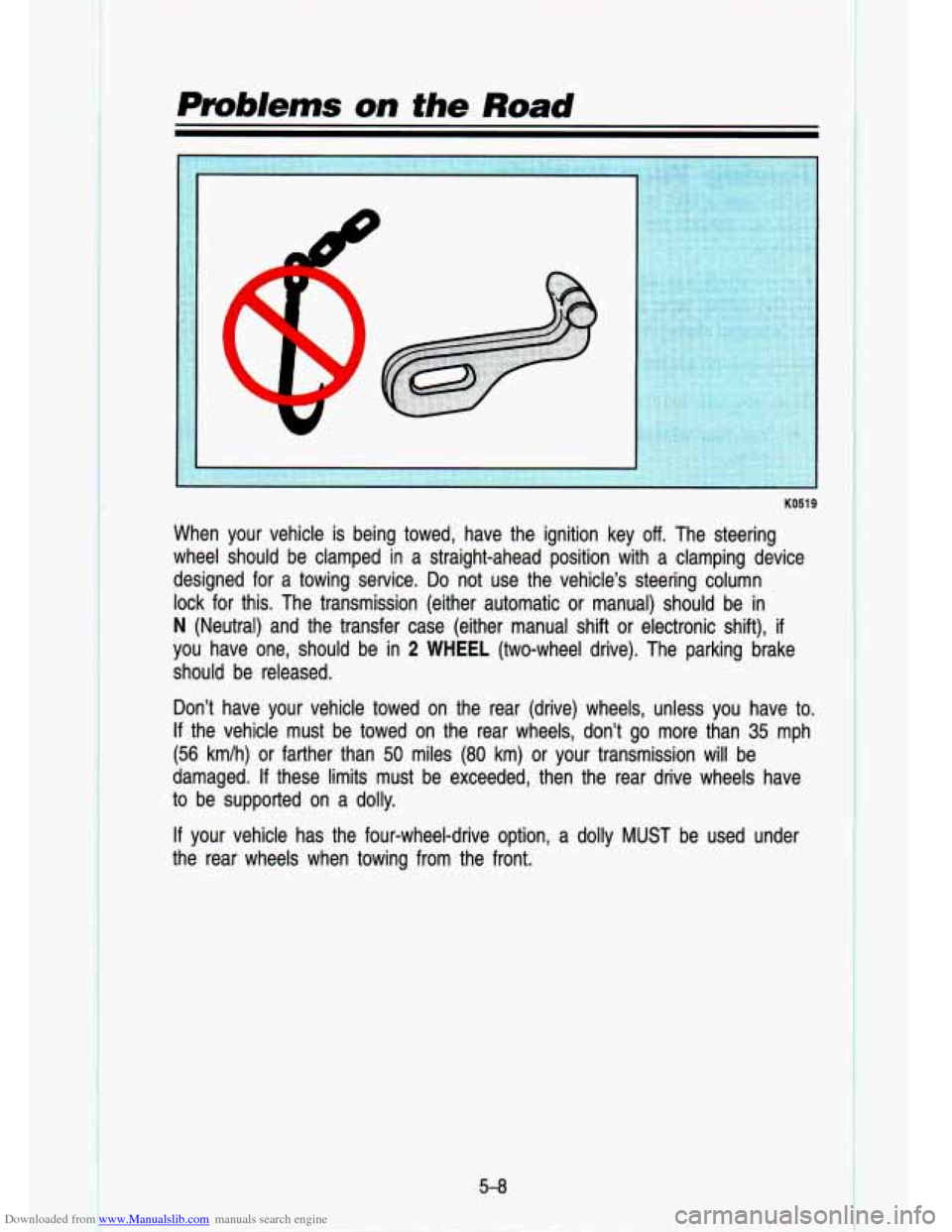
Never use “J” hooks. Use T-hooks instead.
5-7
Page 224 of 356
Downloaded from www.Manualslib.com manuals search engine , vr
KO51 9
When your vehicle is being towed, have the ignition key off. The steering
wheel should be clamped in a straight-ahead position with a clamping device
designed for a towing service. Do not use the vehicle's steeri\
ng column
lock for this. The transmission (either automatic or manual) should\
be in
N (Neutral) and the transfer case (either manual shift or elec\
tronic shift), if
you have one, should be in 2 WHEEL (two-wheel drive). The parking brake
should be released.
Don't have your vehicle towed on the rear (drive) wheels, un\
less you have
to,
If the vehicle must be towed on the rear wheels, don't go more than 35 mph
(56 km/h) or farther than 50 miles (80 km) or your transmission will be
damaged.
If these limits must be exceeded, then the rear drive wheels have\
to be supported on a dolly.
If your vehicle has the four-wheel-drive option, a dolly
MUST be used under
the rear wheels when towing from the front.
5-8
Page 231 of 356

Downloaded from www.Manualslib.com manuals search engine KO721
8. Then replace the pressure cap. Be sure the arrows on the pres\
sure cap line up like this.
Engine Fan Noise
This vehicle has a clutched engine cooling fan. When the clutch is engaged,
the fan spins faster to provide more air to cool the engine. In most every day
driving conditions the clutch is not engaged. This improves fue\
l economy and
reduces fan noise. Under heavy vehicle loading, trailer towing andlor high
outside temperatures, the fan speed increases when the clutch e\
ngages.
So
you may hear an increase in fan noise. This is normal and should not be
mistaken as the transmission slipping or making extra shifts.
It is merely the
cooling system functioning properly. The fan will slow down whe\
n additional
cooling is not required and the clutch disengages.
You may also hear this fan noise when you start the engine. It will go away
as the fan clutch disengages.
If a Tire Goes Flat
It’s unusual for a tire to “blowout” while you’re d\
riving, especially if you
maintain your tires properly.
If air goes out of a tire, it’s much more likely to
leak out slowly. But if you should ever have a “blowout,”\
here are a few tips
about what to expect and what to do:
If a front tire fails, the flat tire will create a drag that pu\
lls the vehicle toward
that side. Take your foot off the accelerator pedal and grip the steering wheel
firmly. Steer to maintain lane position, then gently brake to \
a stop well out of
the traffic lane.
5-1 5
Page 235 of 356
Downloaded from www.Manualslib.com manuals search engine Spare Tire
1
KO744
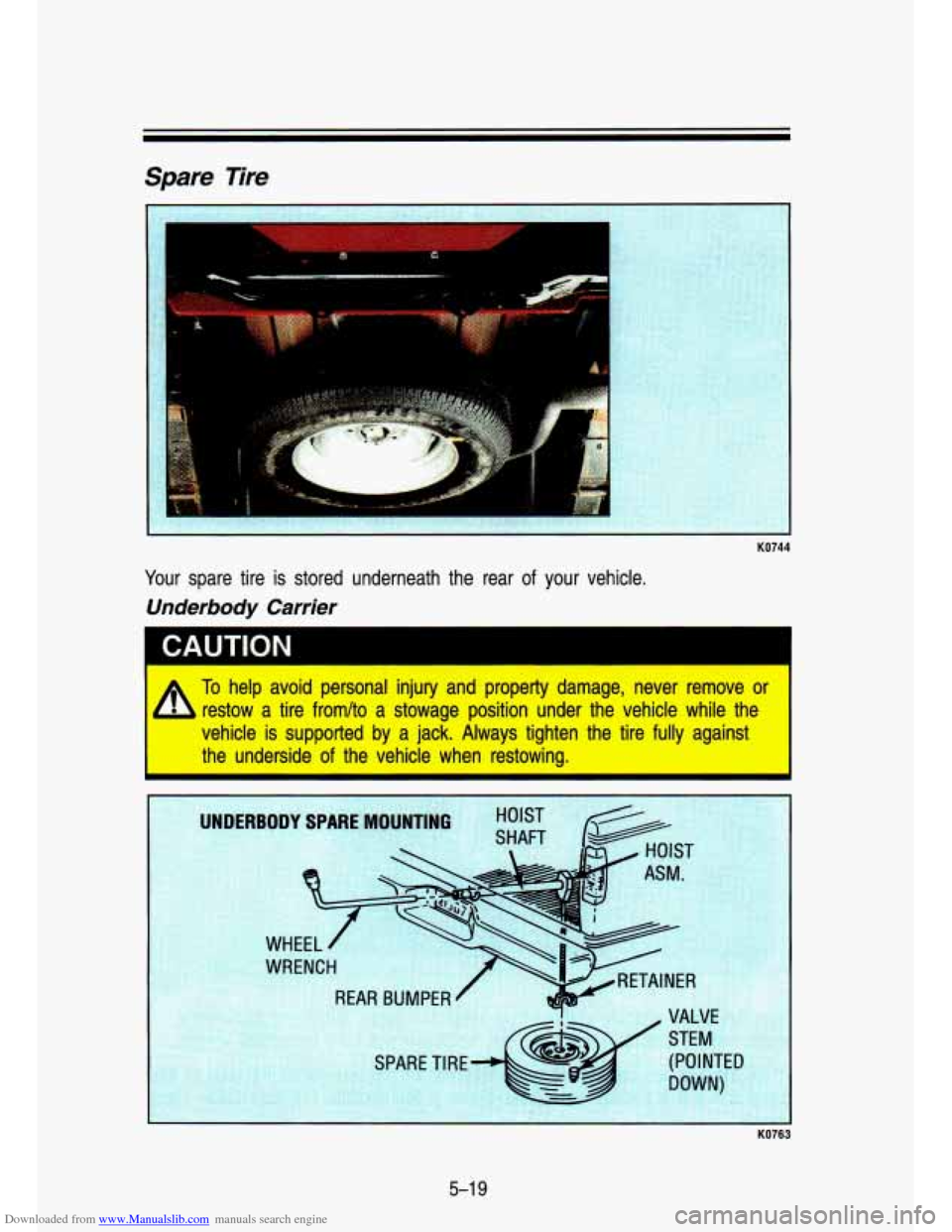
Your spare tire is stored underneath the rear of your vehicle.
Underbody Carrier
To help avoid personal injury and property damage, never remove or
restow a tire fromlto a stowage position under the vehicle while the
vehicle is supported
by a jack. Always tighten the tire fully against
the underside
of the vehicle when restowing. I
KOi - '63
5-1 9
Page 246 of 356
Downloaded from www.Manualslib.com manuals search engine Pm6/ems on the Road
If You’re Stuck: In Sand, Mud, Ice or
snow
What you don’t want to do when your vehicle is stuck is to spin your
wheels. The method known as “rocking” can help you get o\
ut when you’re
stuck, but you must use caution.
~
fi If you let your tires spin at high speed, they can explode and you1 or
others could be injured. And, the transmiss’ion or other parts of the
vehicle
can overheat. That could cause an engine comparlme’nt fire
or other damage. When you’re
stuck, spin the wheels as little as
possible.
Don’t spin the wheels above 35 rnph 1(55 krn/h) as shown
oln the speedometer.
Rocking Your Vehicle To Get It Out:
First, turn your steering wheel left and right. That will clear the area \
around
your front wheels. Then shift back and forth between
R (Reverse) and a
forward gear (or with a manual transmission, between
1 (First) or 2 (Second)
gear and
R (Reverse), spinning the wheels as little as possible. Release \
the
accelerator pedal while you shift, and press lightly on the accelerator pedal
when the transmission is in gear.
If that doesn’t get you out after a few tries,
you may need to be towed
out. Or, you can use your recovery hooks, if your
vehicle has them.
If you do need to be towed out, see “Towing Your Vehicle’’
in the Index.
5-30