parking brake CHEVROLET S10 1993 2.G Owner's Manual
[x] Cancel search | Manufacturer: CHEVROLET, Model Year: 1993, Model line: S10, Model: CHEVROLET S10 1993 2.GPages: 356, PDF Size: 20.85 MB
Page 215 of 356

Downloaded from www.Manualslib.com manuals search engine Parking on Hills
You really should not park your vehicle, with a trailer attached, \
on a hill. If
something goes wrong, your rig could start to move. People can be injured,
and both your vehicle and the trailer can be damaged.
But
if you ever have to park your rig on a hill, here’s how to \
do it:
1. Apply your regular brakes, but don’t shift into P (Park) yet, or into gear
2. Have someone place chocks under the trailer wheels.
3. When the wheel chocks are in place, release the regular brakes until the
chocks absorb the load.
4. Reapply the regular brakes. Then apply your parking brake, and \
then
shift to
P (Park), or R (Reverse) for a manual transmission.
5. If you have a four-wheel-drive vehicle with a manual transfer case\
shift
lever, be sure the transfer case is in a drive gear-not in
N (Neutral).
6. Release the regular brakes.
for a manual transmission.
A
It can be dangerous to get out of your vehicle if the shift lever is not
fully in
P (Park) with the parking brake firmly set. Your vehicle can
roll.
If you have left the engine running, the vehicle can move suddenl\
y.
You
or others could be injured. To be sure your vehicle won’t move,
even when you’re on fairly level ground, use the steps that\
follow.
If you have four-wheel drive with a manual transfer case shift le\
ver
and your transfer case is in
N (Neutral), your vehicle will be free to
roll, even if your shift lever is in
P (Park). So be sure the transfer
case is in a drive gear-not in
N (Neutral). If you are parking on a
hill, or if you’re pulling a trailer, see also “Parking On Hills” in the
Index.
When You Are Ready to Leave After Parking on a Hill
1. Apply your regular brakes and hold the pedal down while you:
Start your engine.
Shift into a gear; and
Release the parking brake.
4-61
Page 216 of 356
Downloaded from www.Manualslib.com manuals search engine Your Driving and the Road
2. Let up on the brake pedal.
3. Drive slowly until the trailer is clear of the chocks.
4. Stop and have someone pick up and store the chocks.
Maintenance When Trailer Towing
Your vehicle will need service more often when you’re pulling a \
trailer. See
the Maintenance Schedule for more on this. Things that are esp\
ecially important in trailer operation are automatic transmission fluid (don’t ove\
rfill),
engine oil, axle lubricant, belt, cooling system, and brake adj\
ustment. Each of
these is covered in this manual, and the Index will help you find them
quickly.
If you’re trailering, it’s a good idea to review these sections before
you start your trip.
Check periodically to see that all hitch nuts and bolts are tight.
Trailer Light Wiring
See “Trailer Wiring Harness” in the Index.
Power Winches
If you wish to use a power winch on your vehicle, only use it when your
vehicle is stationary or anchored.
NOTICE
Use the regular brakes, set the parking brake Or UIWK ihe wheels IW keep
your vehicle from rolling.
4-62
Page 220 of 356
Downloaded from www.Manualslib.com manuals search engine 2. Get the vehicles close enough so the jumper cables can reach, but be
sure the vehicles aren’t touching each other. If they are, \
it could cause
a
ground connection you don’t want. You wouldn’t be able to start your
vehicle, and the bad grounding could damage the electrical syst\
ems.
1 CAUTION
* You could be injured if the vehicles roll. Set the parking brake \
firmly I
on each vehicle. Put an automatic transmission in P (Park) or a
manual transmission in
N (Neutral).
If you have a four-wheel-drive vehicle with a manual transfer case\
shift lever, be sure the tra-fer case is not in
N (Neut--’).
3. Turn off the ignition on both vehicles. Turn off all lights that aren’t
I
needed, and radios. This will avoid sparks and help save both \
batteries.
And it could save your radio!
4. Open the hoods and locate the batteries. Find the positive (t) arlu
negative
(-) terminals on each battery.
* Using a match near a battery can cause battery gas to explode. I
People have been hurt doing this, and some have been blinded. \
Use
a flashlight if you need more light.
You don’t need to add water to the Delco Freedom@ battery \
installer’
in every new
GM vehicle. But if a battery has filler caps, be sure thG
right amount of fluid is there.
If it is low, add water to take care of
that first.
If you don’t, explosive gas could be present.
Battery fluid contains acid that can burn you. Don’t get it on you.
If
you accidentally get it in your eyes or on your skin, flush the place
I with water and get medical help immediately.
5. Check that the jumper cables don’t have loose or missing insulation. If
they do, you could get a shock. The vehicles could be damaged, too.
5-4
I
Page 224 of 356
Downloaded from www.Manualslib.com manuals search engine , vr
KO51 9
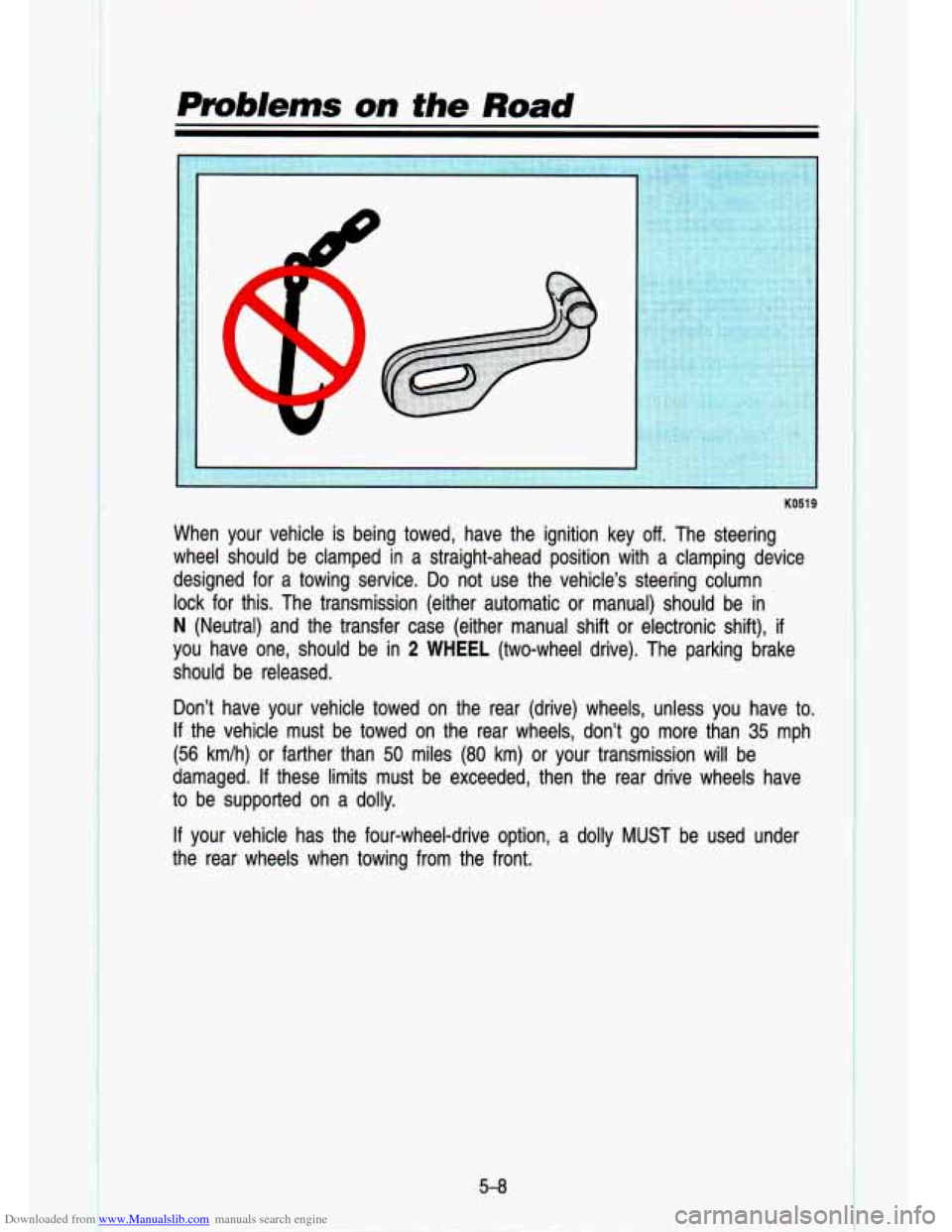
When your vehicle is being towed, have the ignition key off. The steering
wheel should be clamped in a straight-ahead position with a clamping device
designed for a towing service. Do not use the vehicle's steeri\
ng column
lock for this. The transmission (either automatic or manual) should\
be in
N (Neutral) and the transfer case (either manual shift or elec\
tronic shift), if
you have one, should be in 2 WHEEL (two-wheel drive). The parking brake
should be released.
Don't have your vehicle towed on the rear (drive) wheels, un\
less you have
to,
If the vehicle must be towed on the rear wheels, don't go more than 35 mph
(56 km/h) or farther than 50 miles (80 km) or your transmission will be
damaged.
If these limits must be exceeded, then the rear drive wheels have\
to be supported on a dolly.
If your vehicle has the four-wheel-drive option, a dolly
MUST be used under
the rear wheels when towing from the front.
5-8
Page 232 of 356
Downloaded from www.Manualslib.com manuals search engine Problems on the Road
A rear blowout, particularly on a curve, acts much like a skid and may,
require the same correction you'd use in a skid. In any rear blowout, remove
your foot from the accelerator pedal. Get the vehicle under co\
ntrol by steering
the way you want the vehicle
to go. It may be very bumpy and noisy, but
you can still steer. Gently brake
to a stop, well off the road if possible.
If your tire goes flat, the next part shows how to use your jac\
king equipment
to change a flat tire safely.
Changing a Flat Tire
If a tire goes flat, avoid further tire and wheel damage by driving slowly to a
level place. Turn on your hazard warning flashers.
I CAUTION I
A Changing a tire can cause an injury. The vehicle can slip off the jack
A and roll over you or other people. You and they coulld be badly
injured. Fin'd a level place to change your tire. To help prevent the
vehicle from moving:
I. Set the parking brake firmly.
2. Put the shift lever in P (Park).
3. Shift a manual transmission to 1 (First) or R (Reverse).
4. If you have a four-wheel-drive vehicle with a manu'al transfer
case
shift lever, be sure the transfer case is in a drive
gear-not
in ' N (Neutral).
5- Turn off the engine.
To be even more certain the. vehick won't move, you can put blocks
at
the front and rear of the tire farthest away from the one being
changed. That would be the tire
on the other side of the vehicle, at
the opposite end.
5-1 6
Page 265 of 356
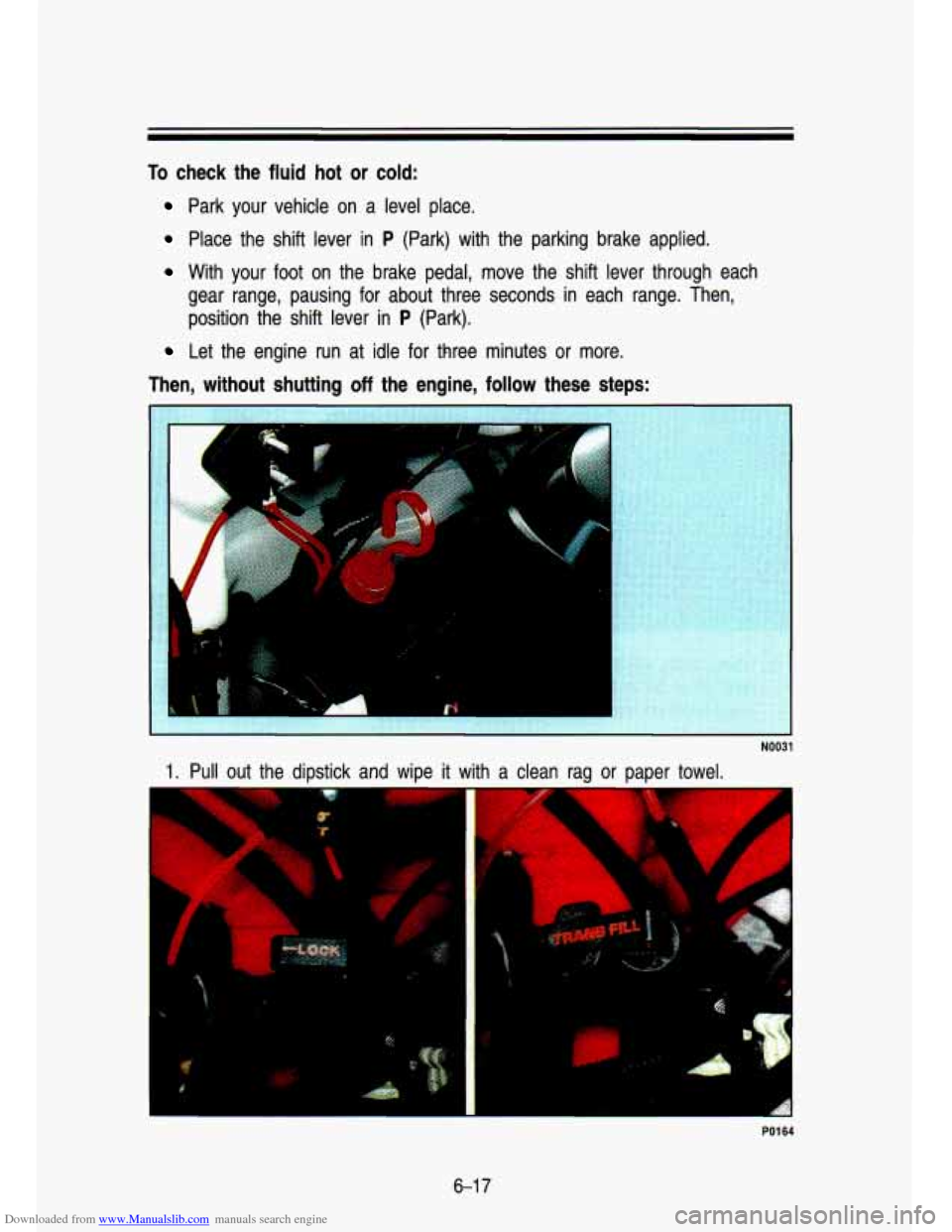
Downloaded from www.Manualslib.com manuals search engine To check the fluid hot or cold:
Park your vehicle on a level place.
Place the shift lever in P (Park) with the parking brake applied.
With your foot on the brake pedal, move the shift lever through each
gear range, pausing for about three seconds in each range. Then,
position the shift lever in
P (Park).
Let the engine run at idle for three minutes or more.
Then, without shutting
off the engine, follow these steps:
NO031
I------
1. Pull out the dipstick and wipe it with a clean rag or paper towel.
PO1 64
6-1 7
Page 326 of 356
Downloaded from www.Manualslib.com manuals search engine Scheduled Maintenance Services
13. ENGINE ACCESSORY DRIVE BELT INSPECTION*-Inspect belt. Look
for cracks, fraying, wear, and proper tension. Adjust or replac\
e as needed.
14. TIRE AND WHEEL ROTATION AND INSPECTION -For proper wear and maximum tire life, rotate tires at the first
6,000 miles (10 000
kilometers) for Schedule I or 7,500 miles (12 500 kilometers) for
Schedule
II and then every 15,000 miles (25 000 kilometers) thereafter.
Follow the instructions and patterns shown in Section
6. Check tires for
uneven wear or damage.
If irregular or premature wear is apparent,
check wheel alignment. Also, check for damaged wheels. See “\
Tires” in
the Index for more information.
15. DRIVE AXLE SERVICE -Check rear/front axle fluid level and add \
as
needed. Check constant velocity joints and axle seals for leaki\
ng.
Locking differential -Drain fluid at first oil change and refill. Check
fluid level and add as needed at subsequent oil changes. In d\
usty areas
or trailer towing applications, drain fluid at every 15,000 miles
(24
135 kilometers) and refi1l.t
Standard differential -Check fluid level and add as needed at
every oil change. In dusty areas or trailer towing applications\
, drain
fluid every
15,000 miles (24 135 kilometers) and refil1.t
More frequent lubrication may be required for off-road use.
16. BRAKE SYSTEM INSPECTION -When the engine oil is changed,
inspect the lines and hoses for proper hookup, binding, leaks, \
cracks,
chafing, etc. Check the parking brake adjustment, and the fluid\
level in
the master cylinder. A low fluid level can indicate worn disc \
brake pads
which may need to be serviced.t
When the wheels are removed for rotation, inspect disc brake p\
ads for
wear and rotors for surface condition. Also inspect drum brake \
linings for
wear and cracks. Inspect other brake parts, including drums, wh\
eel cylinders, parking brake, etc., at the same time.
Inspect brakes more often if driving habits or conditions resul\
t
in
frequent braking.
tA fluid
loss in these systems may indicate a problem. Have them inspected
and repaired at once.
7-1 0
Page 327 of 356

Downloaded from www.Manualslib.com manuals search engine Owner Checks and Services
Listed below are owner checks and services which would be made at th\
e
time period specified to help ensure proper safety, emission performance, and
dependability of your vehicle.
Be sure any necessary repairs are completed at once. Whenever \
any fluids
or lubricants are added to your vehicle, make sure they are the proper ones,
as shown in this section.
At Least Once a Month
Tire inflation pressure check -Check the tires for proper inflation. If they
are low, inflate them to the level specified on the Certification label. See
“Inflation-Tire Pressure” in the Index.
At Least Once a Year
Key lock cylinder lubrication -Lubricate key lock cylinders with\
one of the
lubricants recommended in this Section.
Transmission neutral or clutch start switch operation
-
1 CAUTION
When you are doing this check, the vehicle could move suddenly. If
it does, you or others could be injured. Follow the steps below. \
I
1. Before you start, be sure you have enough room around the veh\
icle.
2. Firmly apply both the manual parking brake. and the regular brake. See
“Brakes” and “Parking Brake” in the Index.
Do not use the accelerator
pedal.
3. Be ready to turn off the engine immediately if it starts.
4. On automatic transmission vehicles, try to start the engine in each gear.
The starter should work only in
P (Park) or N (Neutral).
On manual transmission vehicles, put the shift lever in N (Neutral), push
the clutch down halfway, and try to start the engine. The starter should
work only when the clutch is pushed down all the way to the floor.
7-1 1
Page 328 of 356

Downloaded from www.Manualslib.com manuals search engine Scheduled Maintenance Services
Steering column lock operation -While parked, try to turn the \
key to Lock
in each gear shift position.
With an automatic transmission, the key should turn to LOCK only when
the gear shift is in P (Park).
With manual shift, the key should turn to LOCK only when you’re in R
(Reverse).
On vehicles with a key release lever, try
to turn the key to LOCK without
pressing the lever. The key should turn to LOCK only with the key lever
depressed.
On all vehicles, the key should come out only in LOCK.
Parking brake and transmission
P (Park) mechanism operation -
CAUTION
A When you are doing this check, your vehicle could begin to move.
You or others could be injured and property could be damaged.
Make sure there is room in front of your vehicle in case you begin
to roll. Be ready to apply the regular brake at once should the
vehicle begin to move.
Park on a fairly steep hill, with the vehicle facing downhill.\
1.- )ping your foot
on the regular brake, set the manual parking brake.
To check the parking brake: With the engine running and the
transmission in
N (Neutral), slowly remove foot pressure from the regular
brake pedal.
Do this until the vehicle is held by the parking brake only.
To check the P (Park) mechanism’s holding ability: Apply the \
regular
brake and shift to
P (Park). Release the manual parking brake, then
slowly release the regular brake.
Lap and shoulder belts condition and operation -Inspect belt sy\
stem,
including: webbing, buckles, latch plates, retractors, guide loop\
s and anchors. Have a belt assembly replaced
if the webbing has been cut or otherwise
damaged.
Body Lubrication Service -Lubricate all body door hinges including th\
e
tailgate, tailgate handle pivot points, and tailgate mounted spa\
re tire carrier (if equipped), lubricate the body hood, fuel door and rear compartment hinges,
latches and locks including interior glove box and console door\
s, and any
moving seat hardware. Lubricate the hood safety lever pivot and\
prop rod
pivot. More frequent lubrication may be required when exposed to a corrosive
environment.
7-1 2
Page 330 of 356
Downloaded from www.Manualslib.com manuals search engine i
I
Scheduled Maintenance Services
Recommended FIuids & Lubricants
NOTE: Fluids and lubricants identified below by name, part number or \
specification may be obtained from your
GM Dealer.
USAGE FLUlD/LUBRICANT
Engine Oil GM Goodwrench Motor Oil or equivalent for API Service SG
or SGICC, SG/CD, SF, SG or CC
of the recommended
viscosity. (See Section 6.)
Engine Coolant Mixture
of water and a good quality ethylene glycol base
antifreeze conforming
to GM-6038-M (GM Part No. 1052103).
Hydraulic Clutch System Hydraulic Clutch Fluid (GM Part No. 12345347 or equivalent).
Hydraulic Brake Systems Delco Supreme 11 brake fluid (GM Part No. 1052535 or
Parking Brake Cables Chassis lubricant meeting requirements
of NLGl Grade 2,
Power Steering System GM Power Steering Fluid (GM Part No. 10\
50017) or
Manual Steering Gear GM Lubricant (GM Part
No. 1052182) or equivalent.
Automatic Transmission DEXRONBIIE Automatic Transmission Fluid (GM Part No.
Manual Transmission:
DOT-3).
Catagoty LB or GC-LB (GM Part No. 1052497).
equivalent conforming
to GM spec 9985010.
1051
RKK).
a. 5-Speed (RPO ML3 and a. DEXRONBIIE Automatic Transmission Fluid (GM Part
b. 5-Speed (RPO MY2) b. Synchromesh Transmission Fluid (GM P\
art No. 12345349).
MW1) No. 1051855).
Differential:
a. Standard - Front and
a. SAE-80W-90 GL-5 gear lubricant (GM Part No.
b. Locking
b. SAE-80W-90 gear lubricant (GM Part No. 1052271).
Transfer Case DEXRONBIIE
Automatic Transmission Fluid (GM Part No.
Column Shift, Transfer Case Chassis lubricant meeting requirement\
s of NLGI Grade 2,
Shift Lever, Propeller Shaft Slip Catagory LB or GC-LB (GM Part No.\
1052497).
Splines and Universal Joints.
Clutch Linkage. Pushrod
to Chassis lubricant meeting requirements of NLGl Grade 2,
clutch fork joint. Catagory LB or GC-LB (GM Part No. 1052497).
Rear Axle 1052271).
1051 855).
(Continued next page) TO289
7-1 4
1