trailer CHEVROLET S10 1993 2.G Owner's Manual
[x] Cancel search | Manufacturer: CHEVROLET, Model Year: 1993, Model line: S10, Model: CHEVROLET S10 1993 2.GPages: 356, PDF Size: 20.85 MB
Page 261 of 356
Downloaded from www.Manualslib.com manuals search engine Energy Conserving II
Oils with these words on the container will help you save fuel.
This doughnut-shaped logo (symbol) is used
on most oil containers to help
you select the correct oil.
You should look for this on the oil container, and use
only those oils that
display the logo.
GM Goodwrench@ oil (in Canada, GM Engine Oil) meets all the requirements
for your vehicle.
Engine Oil Additives:
Don’t add anything to your oil. Your GM dealer is ready to advise if you think
something should be added.
When to Change Engine c)k
See if any one of these is true for you:
Most trips are less than 4 miles (6 km).
It’s below freezing outside and most trips are less than 10 miles
(16 km).
The engine is at low speed most of the time (as in door-to-door delivery,
You tow a trailer often.
or in stop-and-go traffic).
Most trips are through dusty places.
The vehicle is frequently operated off-road.
If any one of these is true for your vehicle, you need to chang\
e your oil and
filter every 3,000 miles (5000 km) or 3 months-whichever comes first.
If none of them are true, change the oil every 7,500 miles (12 500 km) or
12 months-whichever comes first. Change the filter at the first oil change
and at every other oil change after that.
If your vehicle has 4-wheel drive, you ,will have a remote oil filter located
under the hood.
It is mounted to the front left inner fender, behind the
headlights.
Engine Block Heater:
An engine block heater can be a big help if you have to park outside in very
cold weather,
-0°F (-18°C) or colder. If your vehicle has this option, see
“Engine Block Heater” in the Index.
6-1 3
Page 264 of 356
Downloaded from www.Manualslib.com manuals search engine Service & Appearance Care
Automatic Transmission Fluid
When to Check and Change:
A good time to check your automatic transmission fluid level is when the
engine oil is changed. Refer to the Maintenance Schedule to de\
termine when
to change your fluid. See “Scheduled Maintenance Services” \
in the Index.
How to Check:
Because this operation can be a little difficult, you may choo\
se to have this
done at a dealership Service Department.
If you
do it yourself, be sure to follow all the instructions here, or \
you could
get a false reading on the dipstick.
I NOTICE
Wait at least 30 minutes before checking the transmission fluid level if you
have been driving:
When outside temperatures are above 90°F (32°C).
At high speed for quite a while.
In heavy traffic-especially in hot weather.
While pulling a trailer.
To get the right reading, the fluid must be at normal operating \
temperature,
which is 180°F to 200°F (82°C to 93°C).
To check transmission fluid hot: Get the vehicle warmed up by driving
about
15 miles (24 km) when outside temperatures are above 50°F (10°C). If
it’s colder then 50°F (IO’C), drive the vehicle in D (3rd gear) until the
temperature gage moves and then remains steady for ten minutes.\
Then
follow the hot check procedures.
To check transmission fluid cold: A cold check is made after the vehicle
has been sitting for eight hours or more with the engine off and is used
only
as a reference. Let the engine run at idle for five minutes if outside
temperatures are
50°F (10°C) or more. If it’s colder than 50°F (lO°C), you
may have to idle the engine longer. A hot check must follow when fluid is
added during a cold check.
6-1 6
I
Page 288 of 356
Downloaded from www.Manualslib.com manuals search engine .-
.. .. -. .- -. -. .
Service & Appearance Care
Trailering Package
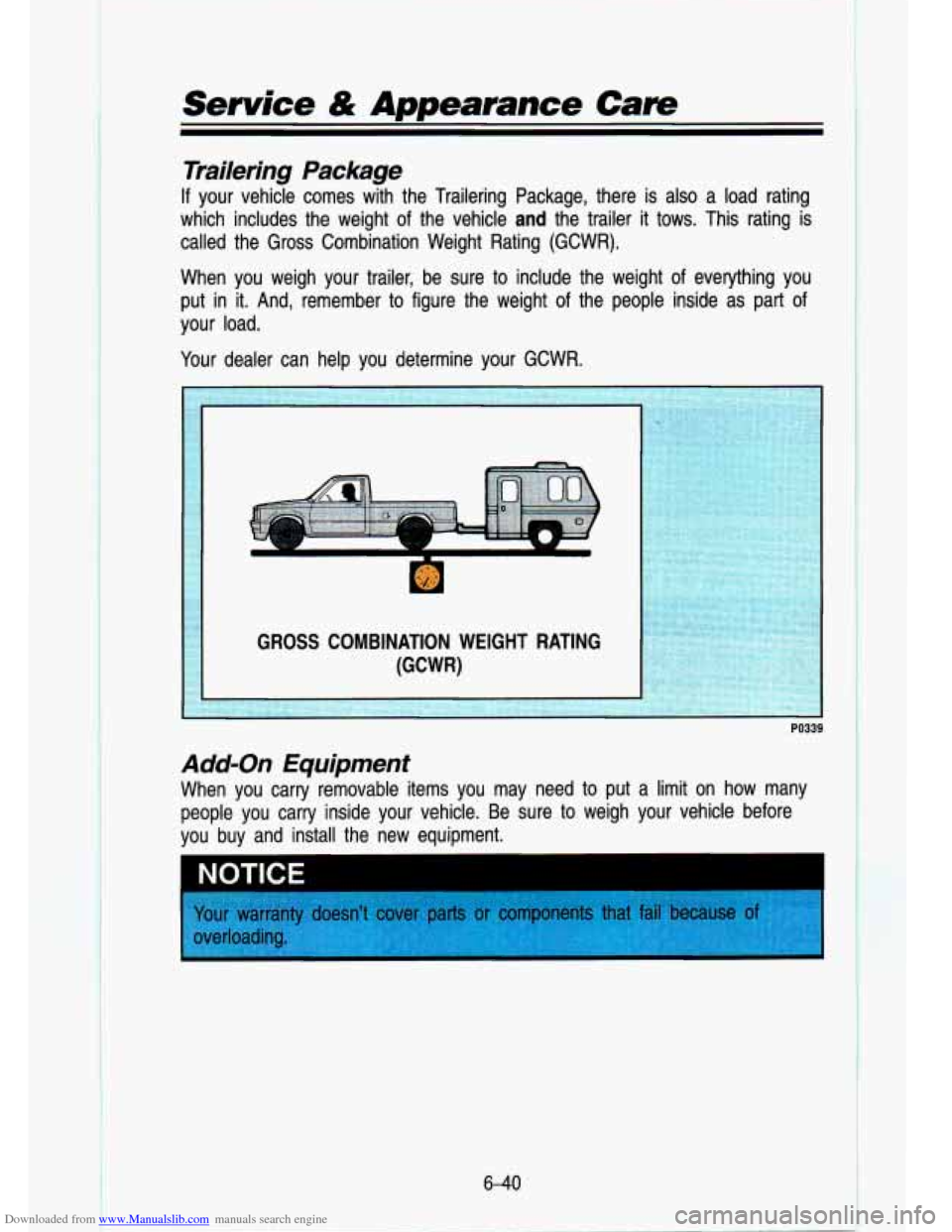
If your vehicle comes with the Trailering Package, there is also a load rating
which includes the weight of the vehicle
and the trailer it tows. This rating is
called the Gross Combination Weight Rating (GCWR).
When you weigh your trailer, be sure to include the weight of everything you
put in it. And, remember to figure the weight
of the people inside as part of
your load.
Your dealer can help you ?-‘ermine your GCWR.
Page 290 of 356
Downloaded from www.Manualslib.com manuals search engine I
Service & Appearance Care
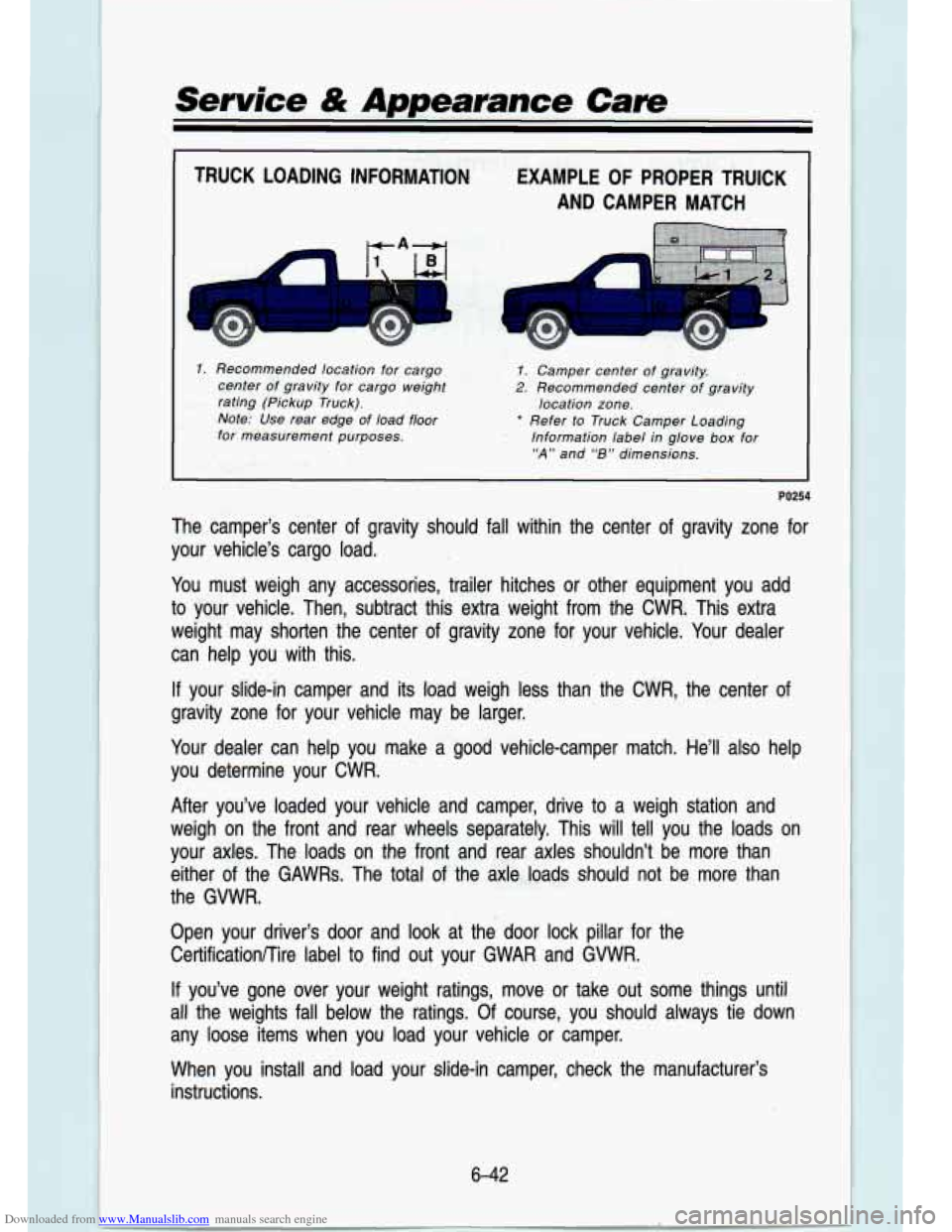
TRUCK LOADING INFORMATION EXAMPLE OF PROPER TRUICK
AND CAMPER MATCH
1. Recommended location for cargo 7. Camper center of gravity.
center
of gravity for cargo weight 2. Recommended center of gravity
rating (Pickup Truck).
K-L.<:- location zone.
Note: Use rear edge of load floor : .‘$Ti: * .Refer to Truck Camper Loading
for measurement purposes.
- - Information label in glove box for
“A” and “B” dimensions.
.Y %!, -
PO254
The camper’s center of gravity should fall within the center of gravity zone for
your vehicle’s cargo load.
You must weigh any accessories, trailer hitches or other equipment you add
to your vehicle. Then, subtract this extra weight from the CWR,
This extra
weight may shotten the center of gravity zone for your vehicle. Your dealer
can help you with this.
If your slide-in camper and its load weigh less than the CWR, the center of
gravity zone for your vehicle may be larger.
Your dealer can help you make
a good vehicle-camper match. He’ll also help
you determine your CWR.
After you’ve loaded your vehicle and camper, drive to a weigh station and
weigh on the front and rear wheels separately. This will tell you the loads on
your
axles. The loads on the front and rear axles shouldn’t be more th\
an
either
of the GAWRs. The total of the axie..loads should not be more than
the GVWR.
Open your driver’s door and look at the door lock pillar f\
or the CertificationKire label to find out your GWAR and GWVR.
If you’ve gone over your weight ratings, move or take out some\
things until
all the weights fall below the ratings. Of course, you should always tie down
any loose items when you load your vehicle or camper.
When you install and load your slide-in camper, check the manufacturer’s
instructions.
6-42
Page 308 of 356

Downloaded from www.Manualslib.com manuals search engine I
Service & Appearance Cave
Headlights
The headlight wiring is protected by a circuit breaker in the \
light switch. An electrical overload will cause the lights to go on and
off, or in some cases to
remain
off. If this happens, have your headlight wiring checked right away.
Windshield Wipers
The windshield wiper motor is protected by a circuit breaker a\
nd a fuse. If
the motor overheats due to heavy snow, etc., the wiper will s\
top until the
motor cools. If the overload is caused by some electrical problem and not
snow, etc., be sure to get it fixed.
Power Windows and Other Power Options
Circuit breakers in the fuse panel protect the power windows a\
nd other power
accessories. When the current load is
too heavy, the circuit breaker opens
and closes, protecting the circuit until the problem is fixed \
or goes away.
Trailer Wiring Harness
The optional seven-wire trailer wiring I ;s is protected by an in-line fuse
in the battery feed wire. This fuse is near rhe junction bloc\
k. See “Trailer
Wiring Harness” in the “Features
& Controls’’ section.
Fuse Block
KO631
The fuse block is in the instrument panel on the driver’s side.
- .: .-: 1
.- .
Remove the cover with a screwdriver and then you can remove f\
uses with a
fuse extractor.
6-60
Page 315 of 356
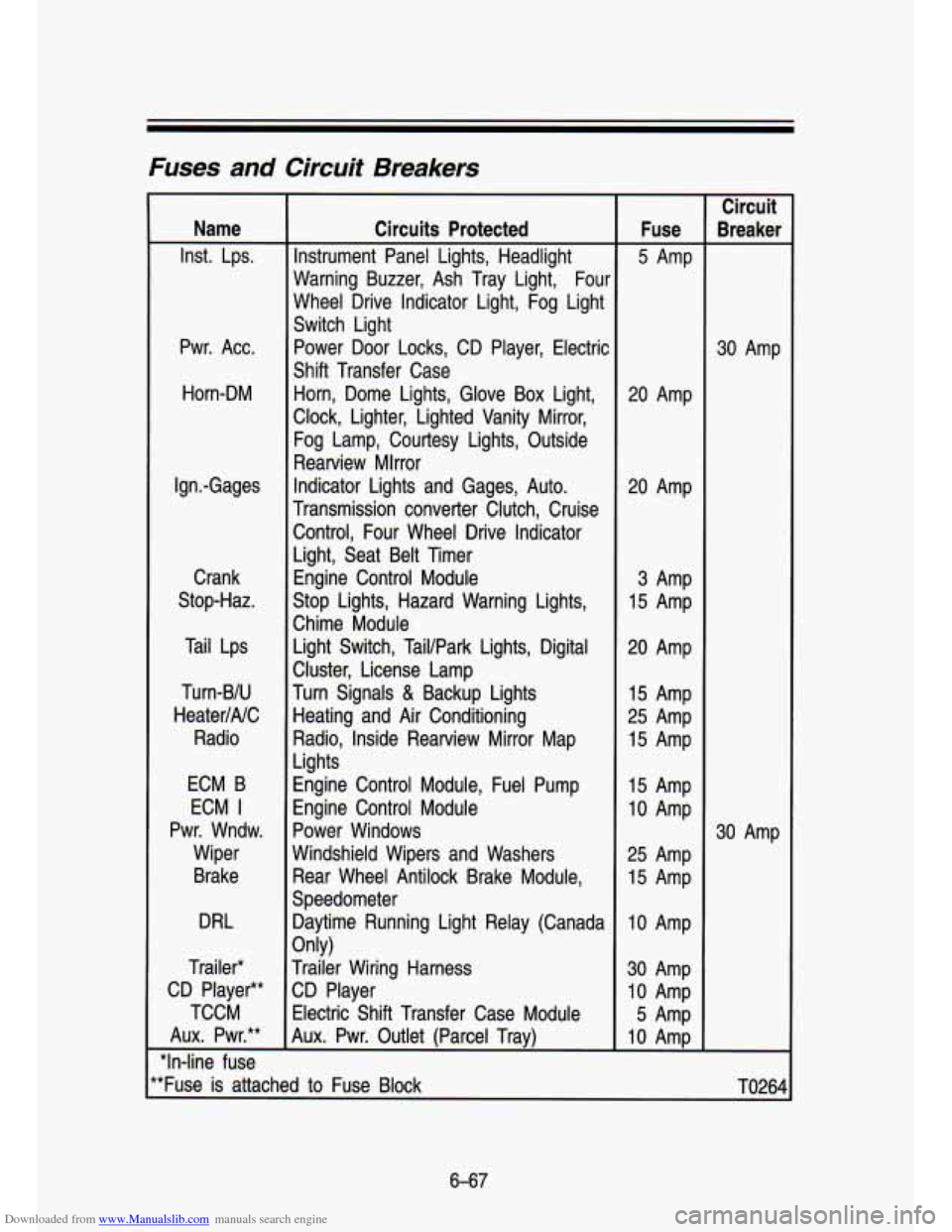
Downloaded from www.Manualslib.com manuals search engine Fuses and Circuit Breakers
Name
Inst. Lps.
Pwr. Acc. Horn-DM
Ign.-Gages Crank
Stop-Haz.
Tail Lps
Turn-BIU
HeaterINC Radio
ECM B
ECM
I
Pwr. Wndw. Wiper
Brake
DRL
Trailer*
CD Player**
TCCM
Aux. Pwr.**
"In-line fuse Circuits Protected
Instrument Panel Lights, Headlight
Warning Buzzer, Ash Tray Light, Four
Wheel Drive Indicator Light, Fog Light
Switch Light Power Door Locks, CD Player, Electric
Shift Transfer Case Horn, Dome Lights, Glove Box Light,
Clock, Lighter, Lighted Vanity Mirror,
Fog Lamp, Courtesy Lights, Outside
Rearview Mlrror
Indicator Lights and Gages, Auto.
Transmission converter Clutch, Cruise Control, Four Wheel Drive Indicator
Light, Seat Belt Timer Engine Control Module
Stop Lights, Hazard Warning Lights,
Chime Module Light Switch, Tail/Park Lights, Digital
Cluster, License Lamp
Turn Signals
& Backup Lights
Heating and Air Conditioning
Radio, Inside Rearview Mirror Map
Lights
Engine Control Module, Fuel Pump
Engine Control Module
Power Windows
Windshield Wipers and Washers Rear Wheel Antilock Brake Module,
Speedometer Daytime Running Light Relay (Canada
Trailer Wiring Harness
CD Player
Electric Shift Transfer Case Module
Aux. Pwr. Outlet (Parcel Trav)
Only) Fuse
5 Amp
20 Amp
20 Amp
3 Amp
15 Amp
20 Amp 15 Amp
25 Amp
15 Amp
15 Amp
10 Amp
25 Amp
15 Amp
10 Amp
30 Amp
10 Amp
5 Amp
10 AmD Circuit
kea ker
30 Amp
30 Amp
'*Fuse is attached to Fuse Block
TO264
6-67
Page 319 of 356

Downloaded from www.Manualslib.com manuals search engine Scheduled Maintenance Services
This part tells you the maintenance services you should have d\
one ana when
you should schedule them. Your
GM dealer knows your vehicle best and
wants you to be happy with
it. If you go to your dealer for all your service
needs, you’ll know that GM-trained and supported service peop\
le will perform
the work using genuine GM parts.
These schedules are for vehicles that:
carry passengers and cargo within the recommended limits. You will find
these limits on your vehicle’s Certification Label. See “L\
oading Your
Vehicle’’ in the Index.
are driven on regular road surfaces, and within legal driving \
limits, as
are driven off-road in the recommended manner. See “Off Road Driving
use the proper fuel. See “Fuel” in the Index.
described in Section
4, “Your
Driving and the Road”.
With Your Four-wheel Drive Vehicle” in the Index.
Selecting The Proper Maintenant- ~ Schedule
Your driving conditions and how you use your vehicle will help you \
determine
which schedule to use. The schedules are found later in this section.
MAINTENANCE SCHEDULE
I
Is any one of these’ true for your vehicle?
Most trips are less than 4 miles (6 kilometers).
Most trips are less than 10 miles (16 kilometers) and the outside
The engine is at low speed most of the time (as in stop-and-go traffic,
temperatures are below freezing.
door-to-door delivery, or other commercial uses).
You
operate in dusty areas or off-road frequently.
You tow a trailer.
If any one (or more) of these is true for your driving, follow Schedule I. The
chart for Schedule
I has plus signs (t).
MAINTENANCE SCHEDULE II
Follow Schedule II ONLY if none of the above conditions are true. The chart
for Schedule
II has dots (e).
7-3
Page 325 of 356
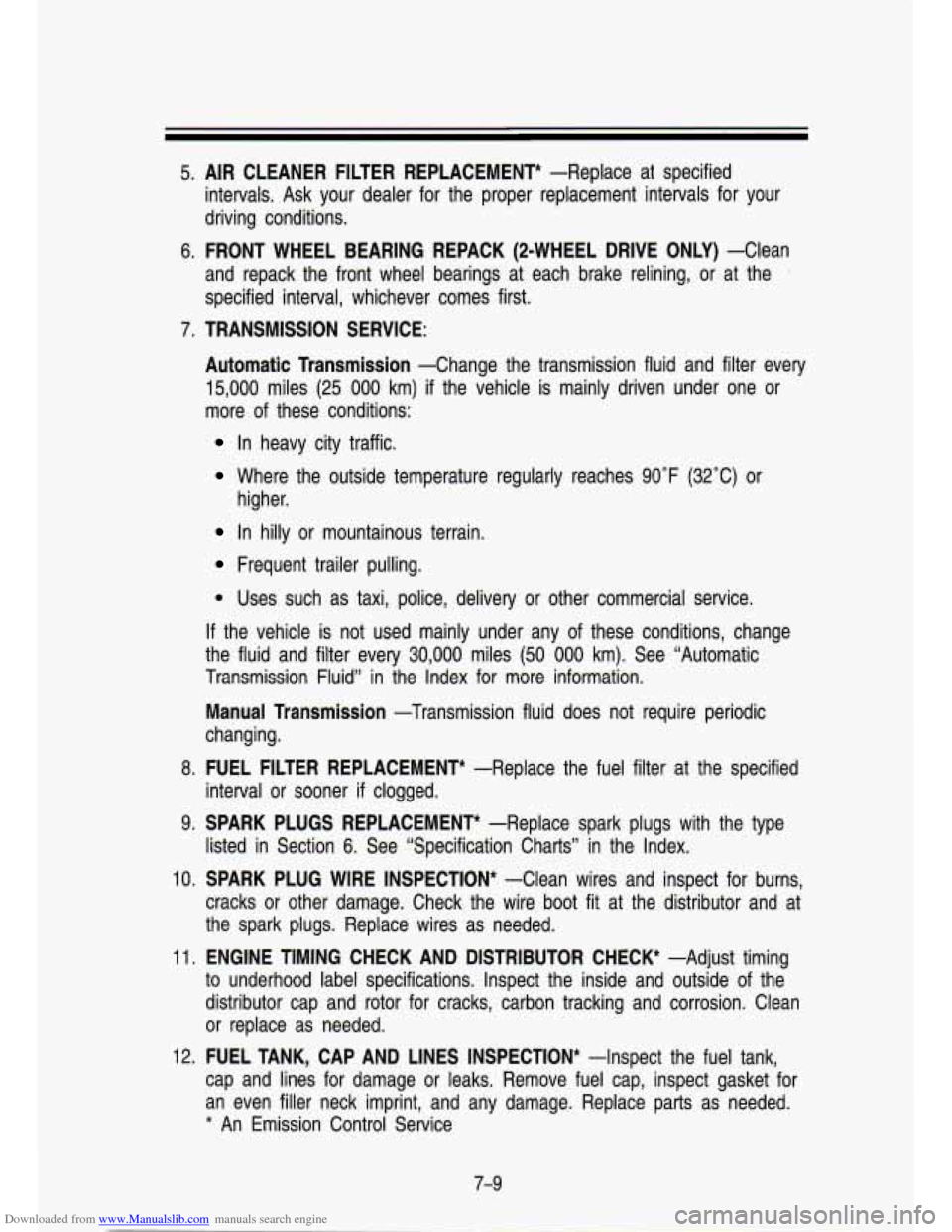
Downloaded from www.Manualslib.com manuals search engine 5. AIR CLEANER FILTER REPLACEMENT* -Replace at specified
intervals. Ask your dealer for the proper replacement intervals for your
driving conditions.
6. FRONT WHEEL BEARING REP1 -;< (2-WHEEL DRIVE ONLY) -Clean
and repack the front wheel bearings at each brake relining, or at the
specified interval, whichever comes first.
7. TRANSMISSION SERVICE:
Automatic Transmission -Change the transmission fluid and filter \
every 15,000 miles (25
000 km) if the vehicle is mainly driven under one or
more of these conditions:
In heavy city traffic.
Where the outside temperature regularly reaches 90°F (32°C) or
In hilly or mountainous terrain.
Frequent trailer pulling.
higher.
0 Uses such as taxi, police, delivery or other commercial service\
.
If the vehicle is not used mainly under any
of these conditions, change
the fluid and filter every 30,000 miles
(50 000 km). See “Automatic
Transmission Fluid” in the Index for more information.
Manual Transmission -Transmission fluid does not require periodic\
changing.
8. FUEL FILTER REPLACEMENT* -Replace the fuel filter at the specified
9. SPARK PLUGS REPLACEMENT* -Replace spark plugs with the type
interval
or sooner
if clogged.
listed in Section
6. See “Specification Charts” in the Index.
10. SPARK PLUG WIRE INSPECTION* -Clean wires and inspect for b\
urns, cracks or other damage. Check the wire boot fit at the distributor and \
at
the spark plugs. Replace wires as needed.
11. ENGINE TIMING CHECK AND DISTRIBUTOR CHECK* -Adjust timing to underhood label specifications. Inspect the inside and outsid\
e of the
distributor cap and rotor for cracks, carbon tracking and corro\
sion. Clean or replace as needed.
12. FUEL TANK, CAP AND LINES INSPECTION* -Inspect the fuel tan\
k, cap and lines for damage or leaks. Remove fuel cap, inspect g\
asket for
an even filler neck imprint, and any damage. Replace parts as \
needed.
* An Emission Control Service
7-9
Page 326 of 356
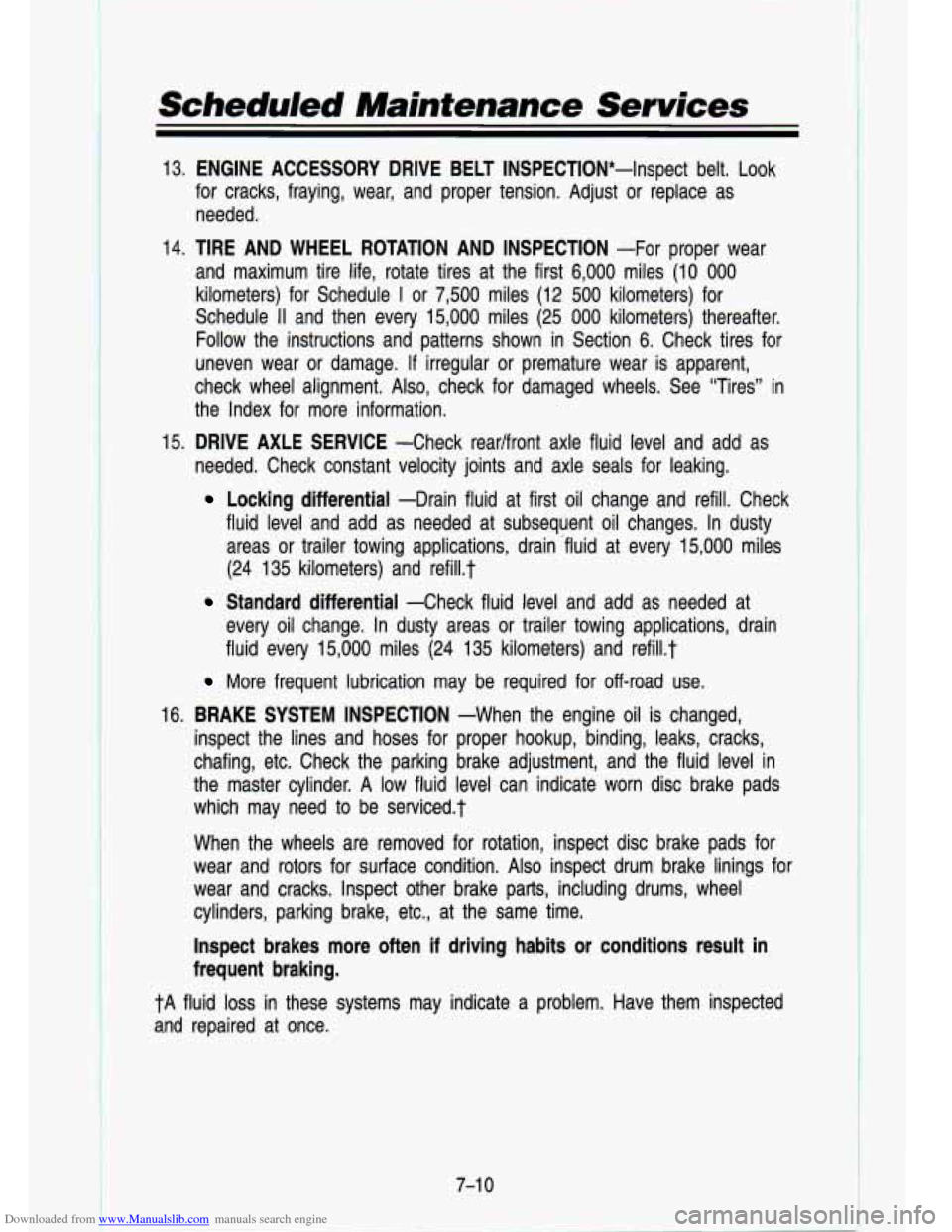
Downloaded from www.Manualslib.com manuals search engine Scheduled Maintenance Services
13. ENGINE ACCESSORY DRIVE BELT INSPECTION*-Inspect belt. Look
for cracks, fraying, wear, and proper tension. Adjust or replac\
e as needed.
14. TIRE AND WHEEL ROTATION AND INSPECTION -For proper wear and maximum tire life, rotate tires at the first
6,000 miles (10 000
kilometers) for Schedule I or 7,500 miles (12 500 kilometers) for
Schedule
II and then every 15,000 miles (25 000 kilometers) thereafter.
Follow the instructions and patterns shown in Section
6. Check tires for
uneven wear or damage.
If irregular or premature wear is apparent,
check wheel alignment. Also, check for damaged wheels. See “\
Tires” in
the Index for more information.
15. DRIVE AXLE SERVICE -Check rear/front axle fluid level and add \
as
needed. Check constant velocity joints and axle seals for leaki\
ng.
Locking differential -Drain fluid at first oil change and refill. Check
fluid level and add as needed at subsequent oil changes. In d\
usty areas
or trailer towing applications, drain fluid at every 15,000 miles
(24
135 kilometers) and refi1l.t
Standard differential -Check fluid level and add as needed at
every oil change. In dusty areas or trailer towing applications\
, drain
fluid every
15,000 miles (24 135 kilometers) and refil1.t
More frequent lubrication may be required for off-road use.
16. BRAKE SYSTEM INSPECTION -When the engine oil is changed,
inspect the lines and hoses for proper hookup, binding, leaks, \
cracks,
chafing, etc. Check the parking brake adjustment, and the fluid\
level in
the master cylinder. A low fluid level can indicate worn disc \
brake pads
which may need to be serviced.t
When the wheels are removed for rotation, inspect disc brake p\
ads for
wear and rotors for surface condition. Also inspect drum brake \
linings for
wear and cracks. Inspect other brake parts, including drums, wh\
eel cylinders, parking brake, etc., at the same time.
Inspect brakes more often if driving habits or conditions resul\
t
in
frequent braking.
tA fluid
loss in these systems may indicate a problem. Have them inspected
and repaired at once.
7-1 0
Page 347 of 356
Downloaded from www.Manualslib.com manuals search engine INDEX
Section
A
Accessory Power Outlet .............. 2-53
Air Cleaner
.................................... 6-14
Air Conditioning
................... 3-6, 6-35
Fan Lever
..................................... 3-6
Function Lever
............................ 3-6
Refrigerant Capacity
................. 6-65
Temperature Lever
...................... 3-6
Antenna, Fixed Mast
................... 3-26
Antilock Brakes (See “Brakes”)
Appearance Care
.......................... 6-50
Materials
.................................... 6-56
Arbitration Program
........................ 8-3
Audio Systems
............................... 3-7
AM Radio
..................................... 3-9
AM-FM Stereo Audio Compact
Disc (CD) System
................... 3-20
AM-FM Stereo Audio System
........................ 3-1 1
AM-FM Stereo Audio System with Cassette Deck
............ >.3-13
AM-FM Stereo Audio System
with Cassette Deck and Equalizer
................................. 3-1 6
Anti-Theft System
.................... 3-23
Compact Disc Care
.................. 3-25
Automatic Transmission
............... 2-1 6
Fluid
............................................ 6-1 6
Axle
Front
........................................... 6-22
Rear
............................................ 6-2 1
A
B
Battery ........................................... 6-31
Belts (See “Safety Belts”)
Better Business Bureau Mediation
.................................... -8-3
Blizzard
.......................................... 4.53
Brakes
Adjustment
................................. 4-17
Antilock
...................................... 4-14
Fluid
........................................... 6-29
Leak Check
............................... 6-30
Master Cylinder
........................ 6-29
Parking
....................................... 2-21
Pedal Travel
.............................. 4-17
Rear Drum Brakes
................... 4-17
Replacing Parts
........................ 6-30
System Warning Light .2-66, 4-16
Trailer
......................................... 4-59
Wear Indicators
........................ 4-16
Braking
.......................................... 4-12
In Emergencies
........................ 4-17
Break-In, New Vehicle
................... 2-9
Bulb Replacement
....................... 6-31
Replacement Chart
.................. 6-63
C
Capacities and Specification
Charts
........................................ 6-61
Carbon Monoxide
... 2.26. 2.27. 4-53
Cassette Tape Player
(See “Audio Systems”)
9-1