weight CHEVROLET S10 1993 2.G Owners Manual
[x] Cancel search | Manufacturer: CHEVROLET, Model Year: 1993, Model line: S10, Model: CHEVROLET S10 1993 2.GPages: 356, PDF Size: 20.85 MB
Page 74 of 356
Downloaded from www.Manualslib.com manuals search engine Featums & Controls
To release the parking brake:
Hold the regular brake pedal down. Pull the brake release lever.
I NOTICE
If you are on a hill:
See “Parking on Hills” in the Index. That part shows how\
to turn your front
wheels.
If you are towing a trailer and are parking on any hill:
See “Towing a Trailer” in the Index. That part shows what to
do first to keep
the trailer from moving.
Torque Lock
The parking brake should be set first whenever leaving the driver’s seat. If
you are parked on a hill and the transmission is placed in P (Park) before
the parking brake is set, the weight of the vehicle may put too much force
on the parking pawl in the transmission.
It may be difficult to pull the selector
lever out of
P (Park). This is called “torque lock.” To prevent this, the parking
brake should be set BEFORE moving the selector lever
to P (Park).
When preparing to move the vehicle, the selector lever should \
be moved out of
P (Park) BEFORE releasing the parking brake. Set the parking br\
ake first,
Then release the transmission from
P (Park), even on level surfaces.
If “torque lock” does occur, you may need to have another vehicle nudge this
vehicle uphill to take some
of the pressure off the transmission while you pull
the selector lever out of
P (Park).
2-22
~
Page 163 of 356

Downloaded from www.Manualslib.com manuals search engine maneuver, in both city and rural driving. You never know when \
the vehicle in
front of you is going to brake or turn suddenly.
Here’s a final bit of information about defensive driving. T\
he most dangerous
time for driving in the
U.S. is very early on Sunday morning. In fact, GM
Research studies show that the most and the least dangerous ti\
mes for
driving, every week, fall on the same day. That day is Sunday. The most
dangerous time is Sunday from 3 a.m. to 4 a.m. The safest time is Sunday
from
10 a.m. to 11 a.m. Driving the same distance on a Sunday at 3 a.m.
isn’t just a little more dangerous than
it is at 10 a.m. It’s about 134 times
more dangerous! That leads to the next part.
Drunken Driving
Death and injury associated with drinking and driving is a nat\
ional tragedy. It’s
the number one contributor to the highway death toll, claiming \
thousands of
victims every year. Alcohol takes away three things that anyone\
needs to
drive a vehicle:
Judgment
0 Muscular Coordination
Vision
Police records show that half of all motor vehicle-related deaths involve
alcohol-a driver, a passenger or someone else, such as a pedestrian, had
been drinking. In most cases, these deaths are the result of someone who
was drinking and driving. Over
25,000 motor vehicle-related deaths occur
each year because of alcohol, and thousands
of people are injured.
Just how much alcohol is too much
if a person plans to drive? Ideally, no
one should drink alcohol and then drive. But
if one does, then what’s “too
much’’ can be a lot less than many might think. Although
it depends on each
person and situation, here is some general information on the \
problem.
The Blood Alcohol Content (BAC) of someone who is drinking d\
epends upon
four things:
How much alcohol is in the drink.
The drinker’s body weight.
The amount of food that is consumed before and during drinking\
.
The length of time it has taken the drinker to consume the alcohol.
4-9
Page 185 of 356
Downloaded from www.Manualslib.com manuals search engine Driving Across an Incline
Sooner or later, an off-road trail will probably go across the incline of a hill. If
this happens, you have to decide whether to try to drive acro\
ss the incline.
Here are some things to consider:
A hill that can be driven straight up or down may be too steep to drive
across. When you go straight up or down a hill, the length of the wheel
base (the distance from the front wheels to the rear wheels)\
reduces the
likelihood the vehicle will tumble end over end. But when you \
drive
across an incline, the much more narrow track width (the dist\
ance
between the left and right wheels) may not prevent the vehicle from
tilting and rolling over.
Also, driving across an incline puts more weight
on the downhill wheels. This could cause a downhill slide or a r\
ollover.
Surface conditions can be a problem when you drive across a h\
ill. Loose
gravel, muddy spots, or even wet grass can cause your tires to slip
sideways, downhill.
If the vehicle slips sideways, it can hit something that
will trip it (a rock, a rut, etc.) and
roll over.
Hidden obstacles can make the steepness of the incline even worse. If
you drive across a rock with the uphill wheels, or if the downhill wheels
drop into a rut or depression, your vehicle can tilt even mor\
e.
For reasons like these, you need to decide carefully whether to try
to drive
across an incline. Just because the trail goes across the incline doesn’t mean
you have to drive
it. The last vehicle to try it might have rolled over.
CAUTION
Driving across an incline that’s too steep will make your vehicle roll
over. Yolu could ble seriously injured or killed. If you h’ave any doubt
about the steepness of the incline, don’t drive
across it. Find another
route instead.
Q: What if I’m driving across an incline that’s not too steep, but I hit
some loose gravel and start to slide downhill. What should
I do?
A: If you feel your vehicle starting to slide sideways, turn downhill. This
should help straighten out the vehicle and prevent the side sl\
ipping. However,
a much better .way to prevent this
is to get out and “walk the course” so you
know what the surface is like before you drive
it.
4-31
Page 204 of 356
Downloaded from www.Manualslib.com manuals search engine Your Driving and the Road
I ~~~~~~~~~~~~~~~~~~~~~~~~~~~~~~~~~~~~~
",.*,lcG~2*"*w" "* .**b;.. "~~" nl ~ -; *_ -~ ,,-,., ',.".~
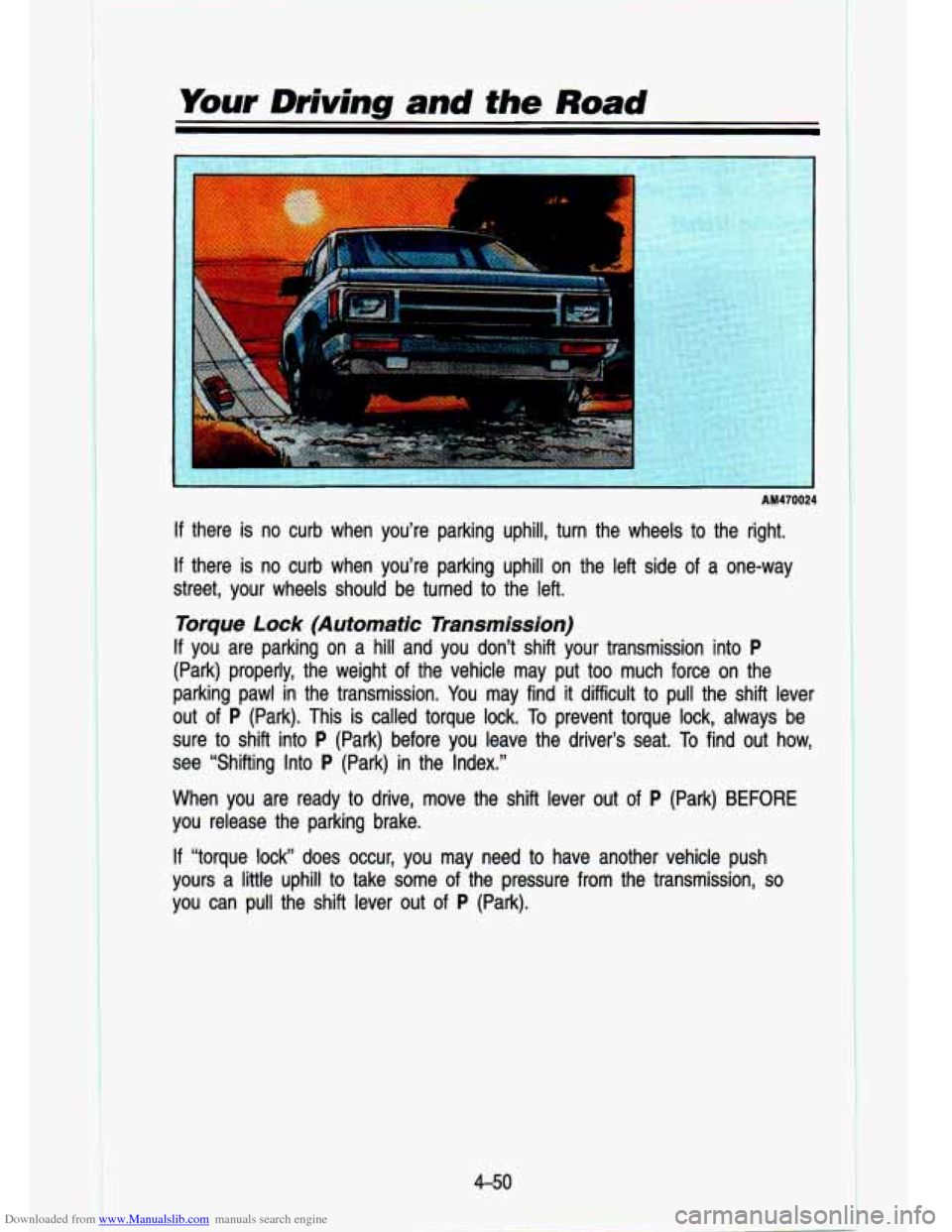
If there is no curb when you're parking uphill, turn the wheels to the right.
If there is no curb when you're parking uphill on the left side \
of a one-way
street, your wheels should be turned
to the left.
Torque Lock (Automatic Transmission)
If you are parking on a hill and you don't shift your transmissi\
on into P
(Park) properly, the weight of the vehicle may put too much \
force on the
parking pawl in the transmission.
You may find it difficult to pull the shift lever
out of
P (Park). This is called torque lock. To prevent torque lock, always be
sure to shift into
P (Park) before you leave the driver's seat. To find out how,
see "Shifting Into
P (Park) in the Index."
When you are ready
to drive, move the shift lever out of P (Park) BEFORE
you release the parking brake.
AM470024
If "torque lock" does occur, you may need to have another vehicle push
yours a little uphill
to take some of the pressure from the transmission, so
you can pull the shift lever out of P (Park).
4-50
Page 211 of 356
Downloaded from www.Manualslib.com manuals search engine Three important considerations have to do with weight:
Weight
of the Trailer
How heavy can a trailer safely be? It depends on how you plan to\
use your
rig. For example, speed, altitude, road grades, outside temperat\
ure, and how
much your vehicle is used
to pull a trailer are all important. And, it can also
depend on any special equipment that you have on your vehicle.\
You can
ask your dealer for our trailering information or advice, or y\
ou can write
us at
the address listed in your Warranty and Owner Assistance Information
Booklet.
In Canada, write to:
General Motors of Canada, Limited
Customer Assistance Center 1908 Colonel Sam Drive
Oshawa, Ontario L1H 8P7
Weight
of the Trailer Tongue
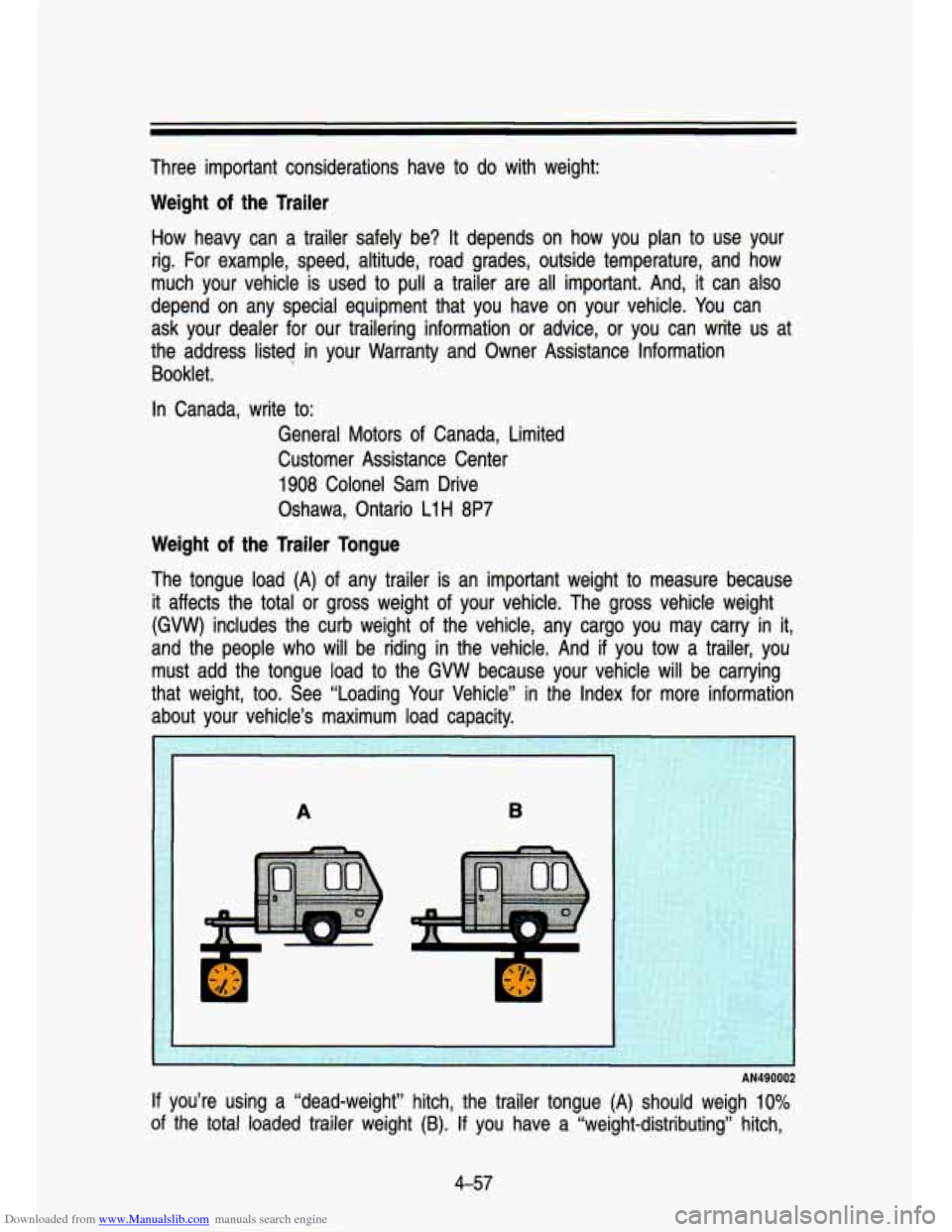
The tongue load
(A) of any trailer is an important weight to measure because
it affects the total or gross weight of your vehicle. The gross vehicle weight
(GVW) includes the curb weight of the vehicle, any cargo you may carry in it,
and the people who will be riding in the vehicle. And if you tow a trailer, you
must add the tongue load to the GVW because your vehicle will be carrying
that weight, too. See “Loading Your Vehicle” in the Index for more information
about your vehicle’s maximum load capaci’
AN490002
If you’re using a “dead-weight” hitch, the trailer tongue (A) should weigh 10%
of the total loaded trailer weight (B). If you have a “weight-distributing” hitch,
4-57
Page 212 of 356
Downloaded from www.Manualslib.com manuals search engine Your Driving and the Road
the trailer tongue (A) should weigh 12% of the total loaded trailer weight (B).
After you’ve loaded your trailer, weigh the trailer and then\
the tongue,
separately,
to see if the weights are proper. If they aren’t, you may be able
to get them right simply by moving some items around in the trai\
ler.
Total Weight
on Your Vehicle’s Tires
Be sure your vehicle’s tires are inflated
to the limit for cold tires. You’ll find
these numbers on the Certification Label on the driver’s doo\
r lock pillar (or see “Tire-Loading” in the Index). Then be sure you don’\
t go over the GVW
limit for your vehicle.
Hitches
It’s important to have the correct hitch equipment. Crosswind\
s, large trucks
going by, and rough roads are a few reasons why you’ll need the right hitch.
Here are some rules to follow:
If you’ll be pulling a trailer that, when loaded, will weigh more than 2,000
pounds (900 kg) be sure to use a properly mounted weight-distributing
hitch and sway control
of the proper size. This equipment is very
important for proper vehicle loading and good handling when you\
’re
driving.
You can tow trailers up to
2,000 pounds (900 kg) with a step bumper hitch,
but
if your trailer tongue has a V-shaped foot, your bumper could be
damaged in sharp turns. Check the distance from the front edge of the fo\
ot
to the middle of the hitch ball socket. If the distance is less than 12 inches,
take the foot
off the trailer tongue.
Page 213 of 356

Downloaded from www.Manualslib.com manuals search engine Safety Chains
You should always attach chains between your vehicle and your trail\
er. Cross
the safety chains under the tongue of the trailer
so that the tongue will not
drop to the road if
it becomes separated from the hitch. Instructions about
safety chains may be provided by the hitch manufacturer or by the trailer
manufacturer. Follow the manufacturer’s recommendation for atta\
ching safety
chains. Always leave just enough slack
so you can turn with your rig. And,
never allow safety chains to drag on the ground.
Trailer Brakes
If your trailer weighs more than 1,000 pounds (450 kg) loaded, then it needs
its own brakes-and they must be adequate. Be sure to read and follow the
instructions for the trailer brakes to install, adjust and maintain them properly.
And:
Don’t tap into your vehicle’s brake system if the trailer’s brake system
will use more than
0.02 cubic inch (0.3~~) of fluid from your vehicle’s
- master cylinder. If it does, both braking systems won’t work well. You
could even lose your brakes.
Will the trailer brake parts take 3,000 psi (20 650 kPa) of pressure? If
not, the trailer brake system must not be used with your vehi\
cle.
If everything checks out this far, then make the brake fluid tap \
at the
port on the master cylinder that sends fluid to the rear brak\
es. But don’t use copper tubing for this.
If you do, it will bend and finally break off.
Use steel brake tubing.
Driving with a Trailer
Towing a trailer requires a certain amount of experience. Before setti\
ng out
for the open road, you’ll want to get to know your rig. A\
cquaint yourself with
the feel of handling and braking with the added weight
of the trailer. And
always keep in mind that the vehicle you are driving is now a good deal
longer and not nearly
so responsive as your vehicle is by itself.
Before you start, check the trailer hitch and platform, safety \
chains, electrical
connector, lights, tires and mirror adjustment.
If the trailer has electric brakes,
start your vehicle and trailer moving and then apply the trail\
er brake controller
by hand to be sure the brakes are working. This lets you che\
ck your electrical
connection at the same time.
During your trip, check occasionally to be sure that the load \
is secure, and
that the lights and any trailer brakes are still working.
4-59
Page 286 of 356
Downloaded from www.Manualslib.com manuals search engine Service & Appearance Care
Loading Your Vehicle
K3651
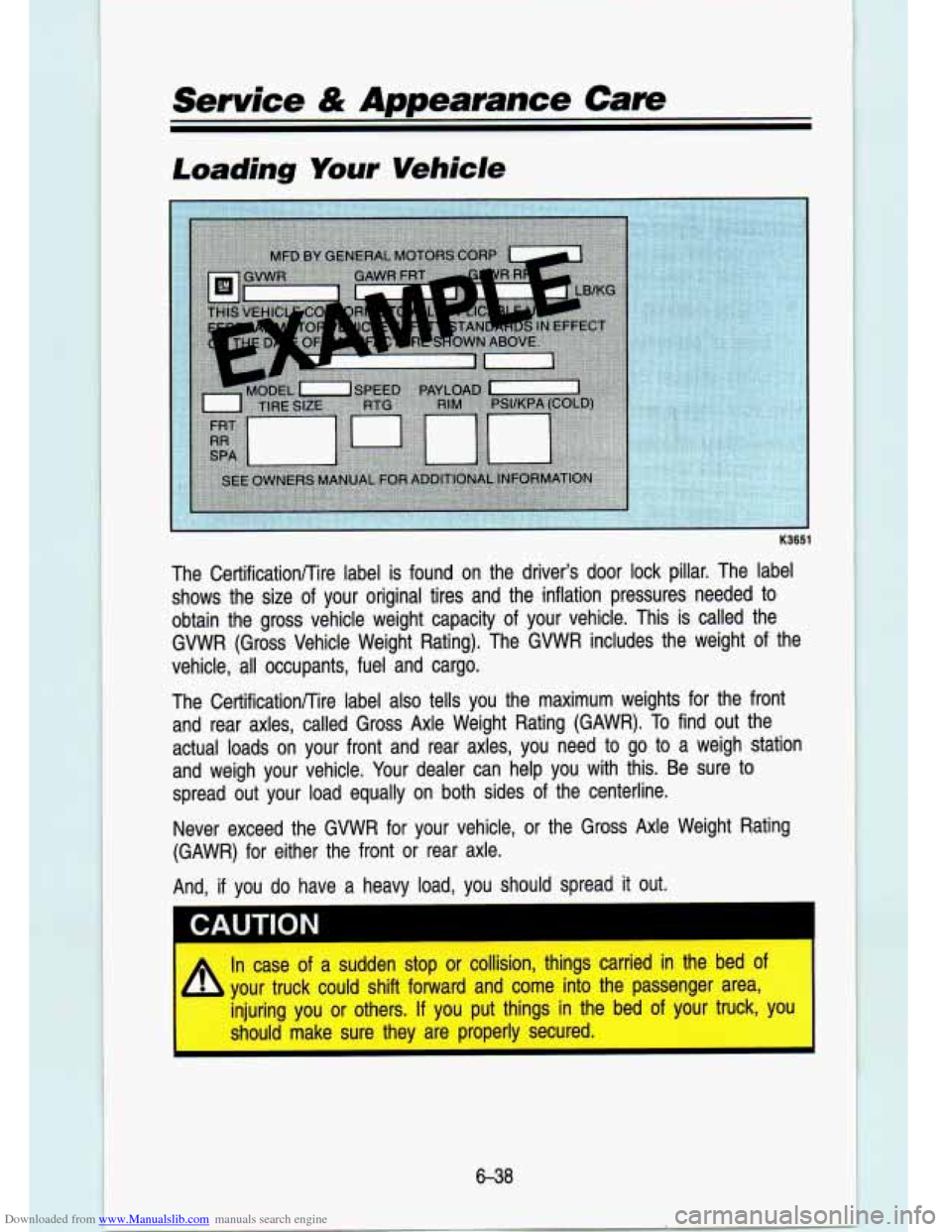
The CertificationRire label is found on the drive~r's door lock pillar. The label
shows t'he size of your original t'ires and the inflation pressu8res ne-eded to
obtain the gross vehicle weight capac-ity of your vehicle. This
is called the
GVWR (Gross Vehicle Weight Rating). The- GVWR includes the weight of the
vehlicle, all occupants, fuel and cargo.
The Certifi'cationKtre label also tells you the maximum weights for the front
and rear axles, called Gross
Axle Weight Rating (GAWR). To find out the
actual
loads on your front and rear axles, you need to go to a weigh station
and weigh your vehicle. Your dealer can help you with this. Be sure to
spread out your load equally
on both sides of the centerline.
Never exceed the GVWR for your vehicle, or the Gross Axle Wei\
ght Rating
(GAWR) for either the front or rear axle.
And,
if you do have a heavy load, you should spread it out.
I CAUTION
In case of a sudden stop or collision, things carried in the bed\
of
I [I! your truck could shift forward and come into the passenger are\
a
injuring you or others.
If you put things in the bed of your truck,
should make sure they are properly secured.
1
6-38
Page 287 of 356
Downloaded from www.Manualslib.com manuals search engine I I
CAUTION
Do not load your vehidle any heavier than tRle GVWR or tlhe
maximum
front and rear GAWRs. If you do, parts on your vehicle
can break, or it can change the way yolur vehicle hand;les. These
could cause
you to lose eonltrol. Also, overloading can shorten the
life
of your vehicle.
Using heavier suspension components
to get added durability might not
change your weight ratings. Ask your dealer
to help you load your vehicle the
right way.
I m
I NOriCE
-
II you put things inside your vehicle-like suitcases, tools, packages, or
anything else-they
will go as fast as the vehicle goes. If you have to stop
or turn quickly, or if there is a crash, they’ll keep going.
1 CAUTION
A Things you gut inside your vehicle can strike and injure peopl\
e in a
1 sudden stop or turn, or ita a ‘crash.
* Put things in the cargo area of your vehicle. Try to spread the
weight evenly.
Never stack heavier things, like suitcases, inside the vehicle so
that some of them are above the tops of the seats.
0 When you carry something inside the vehicle, secure it
whenever you can;
Don’t leave a seat folded down unless you need to.
Payload
The Payload Capacity is shown on the Certificationnire label. This is the
maximum load capacity that your vehicle can carry. Be sure to include the
weight of the people inside as part of your load.
If you added any
accessories or equipment after your vehicle
left the factory, remember to
subtract the weight of these things from the payload. Your dealer can help
you with this.
6-39
Page 288 of 356
Downloaded from www.Manualslib.com manuals search engine .-
.. .. -. .- -. -. .
Service & Appearance Care
Trailering Package
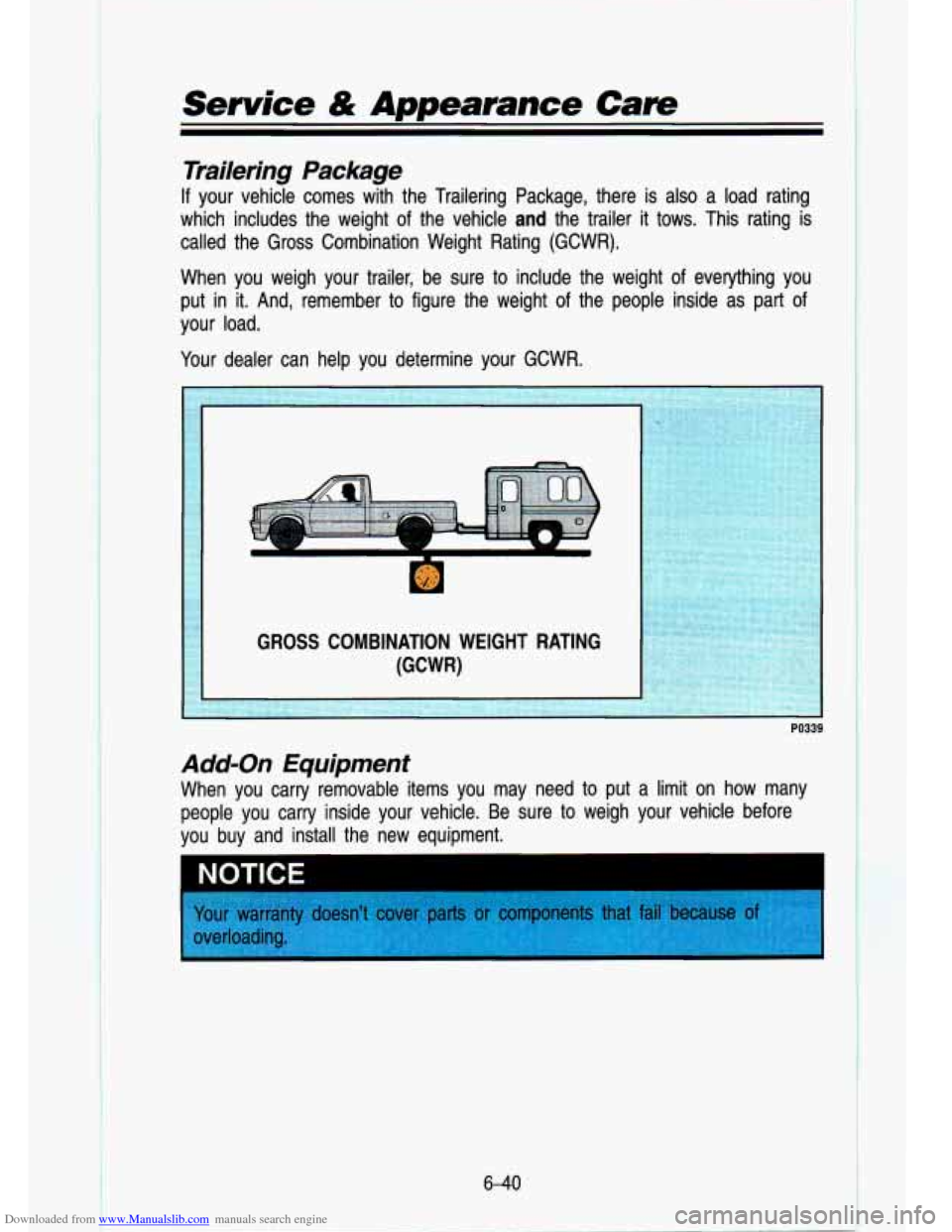
If your vehicle comes with the Trailering Package, there is also a load rating
which includes the weight of the vehicle
and the trailer it tows. This rating is
called the Gross Combination Weight Rating (GCWR).
When you weigh your trailer, be sure to include the weight of everything you
put in it. And, remember to figure the weight
of the people inside as part of
your load.
Your dealer can help you ?-‘ermine your GCWR.