instrument panel CHEVROLET S10 1994 2.G User Guide
[x] Cancel search | Manufacturer: CHEVROLET, Model Year: 1994, Model line: S10, Model: CHEVROLET S10 1994 2.GPages: 340, PDF Size: 18.45 MB
Page 117 of 340
Downloaded from www.Manualslib.com manuals search engine Air Vents
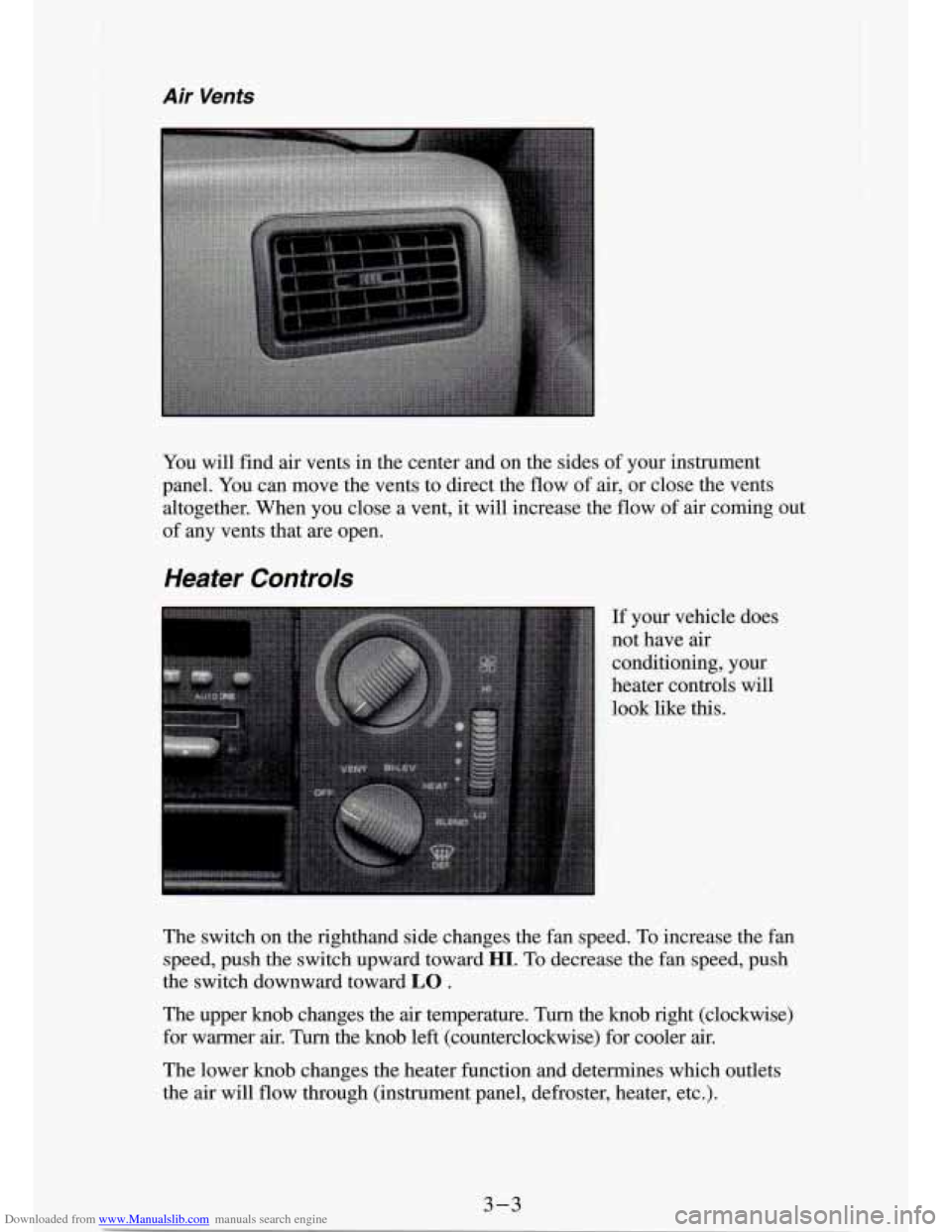
You will find air vents in the center and on the sides of your instrument
panel. You can move the vents to direct the flow
of air, or close the vents
altogether. When you close a vent,
it will increase the flow of air coming out
of any vents that are open.
Heater Controls
If your vehicle does
not have
air
conditioning, your
heater controls will
look like this.
The switch on the righthand side changes the fan speed. To increase the
fan
speed, push the switch upward toward HI. To decrease the fan speed, push
the switch downward toward
LO .
The upper knob changes the air temperature. Turn the knob right (clockwise)
for warmer
air. Turn the knob left (counterclockwise) for cooler air.
The lower knob changes the heater function and determines which\
outlets
the
air will flow through (instrument panel, defroster, heater, etc.).
3-3
Page 118 of 340
Downloaded from www.Manualslib.com manuals search engine OFF: This setting turns off all heating functions. Some outside air will still
come out of the heater outlet whenever the vehicle is moving forward.
VENT Airflow is through the instrument panel vents. Set the upper knob to
the temperature desired. This setting is useful for mild outside temperatures,
when little heating
or cooling is desired.
BI-LEV: Outside air comes in through the heater floor vents and the
instrument panel vents. This setting is useful in cool weather \
with bright sunlight.
HEAT Heated air comes out through the heater floor vents and windsh\
ield
defroster vents. This setting is useful for cold weather.
BLEND: Airflow is divided equally between the heater floor vent and t\
he
windshield defroster vents. This setting is useful in cool weather when you
have fog or ice on the windshield or side windows.
DEF: This setting directs most air through the windshield defroster \
vents
and some through the heater vents. This setting is useful when\
you have fog
or ice on the windshield.
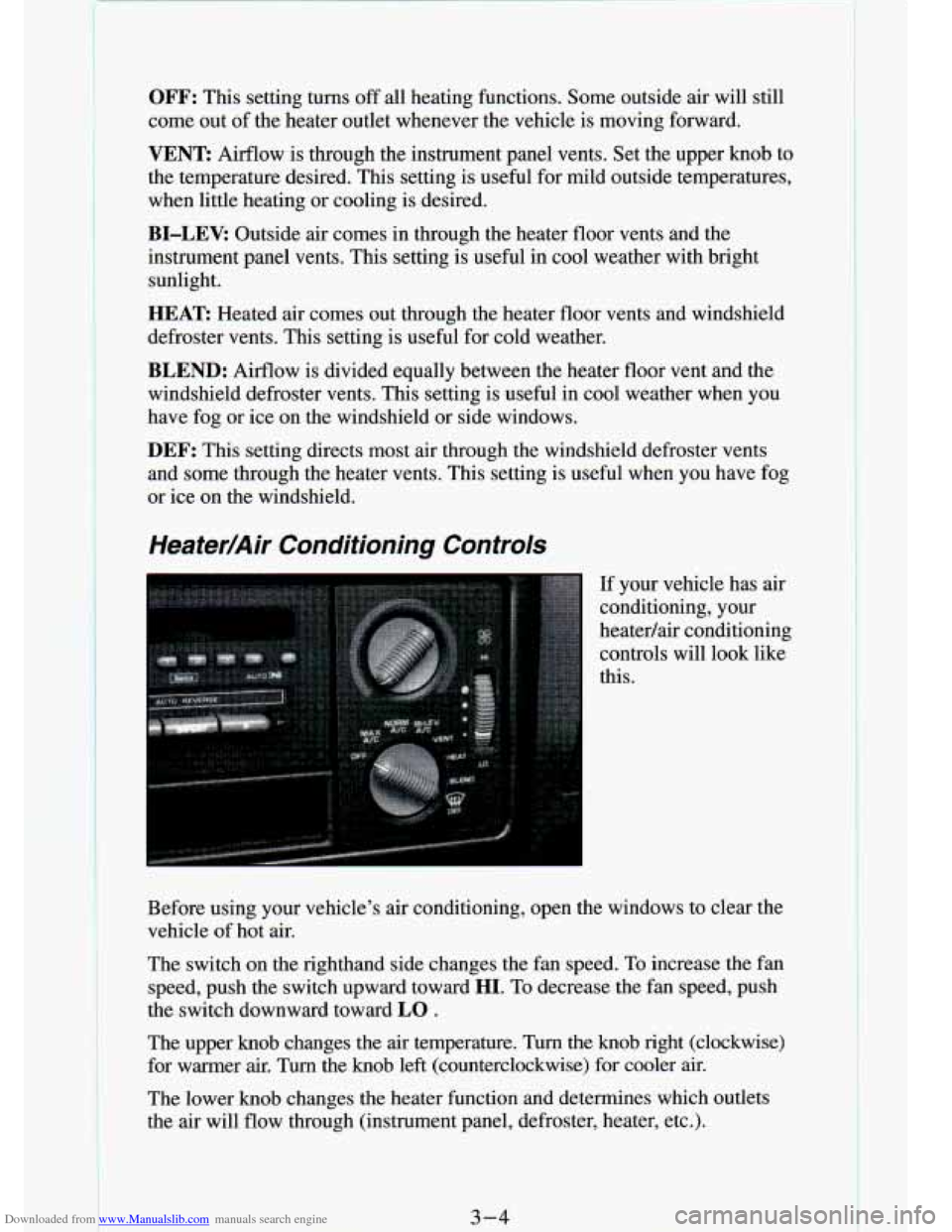
Heater/Air Conditioning Controls
If your vehicle has air
conditioning, your
heatedair conditioning
controls will look like
this.
Before using your vehicle's air conditioning, open the windows \
to clear the vehicle
of hot air.
The switch on the righthand side changes the fan speed. To increase the fan
speed, push the switch upward toward
HI. To decrease the fan speed, push
the switch downward toward
LO .
The upper knob changes the air temperature. Turn the knob righ\
t (clockwise)
for warmer air. Turn the knob left (counterclockwise) for coo\
ler air.
The lower knob changes the heater function and determines which out\
lets
the air will flow through (instrument panel, defroster, heater, etc\
.).
3-4
Page 142 of 340
Downloaded from www.Manualslib.com manuals search engine 1
Avoid needless heavy braking. Some people drive in spurts - heavy
acceleration followed by heavy braking
- rather than keeping pace with
traffic. This is a mistake. Your brakes may not have time to cool between
hard stops. Your brakes will wear out much faster if you do a lot of heavy
braking.
If you keep pace with the traffic and allow realistic following
distances, you will eliminate a lot of unnecessary braking. That means better
braking and longer brake life.
If your engine ever stops while you’re driving, brake normally \
but don’t
pump your brakes. If you do, the pedal may get harder to push down. If
your engine stops, you will still have some power brake assist. But you
will
use it when you brake. Once the power assist is used up, it may take longer
to stop and the brake pedal will be harder to push.
Anti-Lock Brakes (ABS)
Your vehicle has an advanced electronic braking system that can help\
you
keep it under control.
If your vehicle has an anti-lock brake system warning light on th\
e
instrument panel, it has four-wheel anti-lock brakes. Otherwise, it has
rear-wheel anti-lock brakes. When you start a vehicle that has \
four-wheel anti-lock brakes and begin to drive away, you may hear
a momentary motor
or clicking noise. This is the ABS system testing itself.
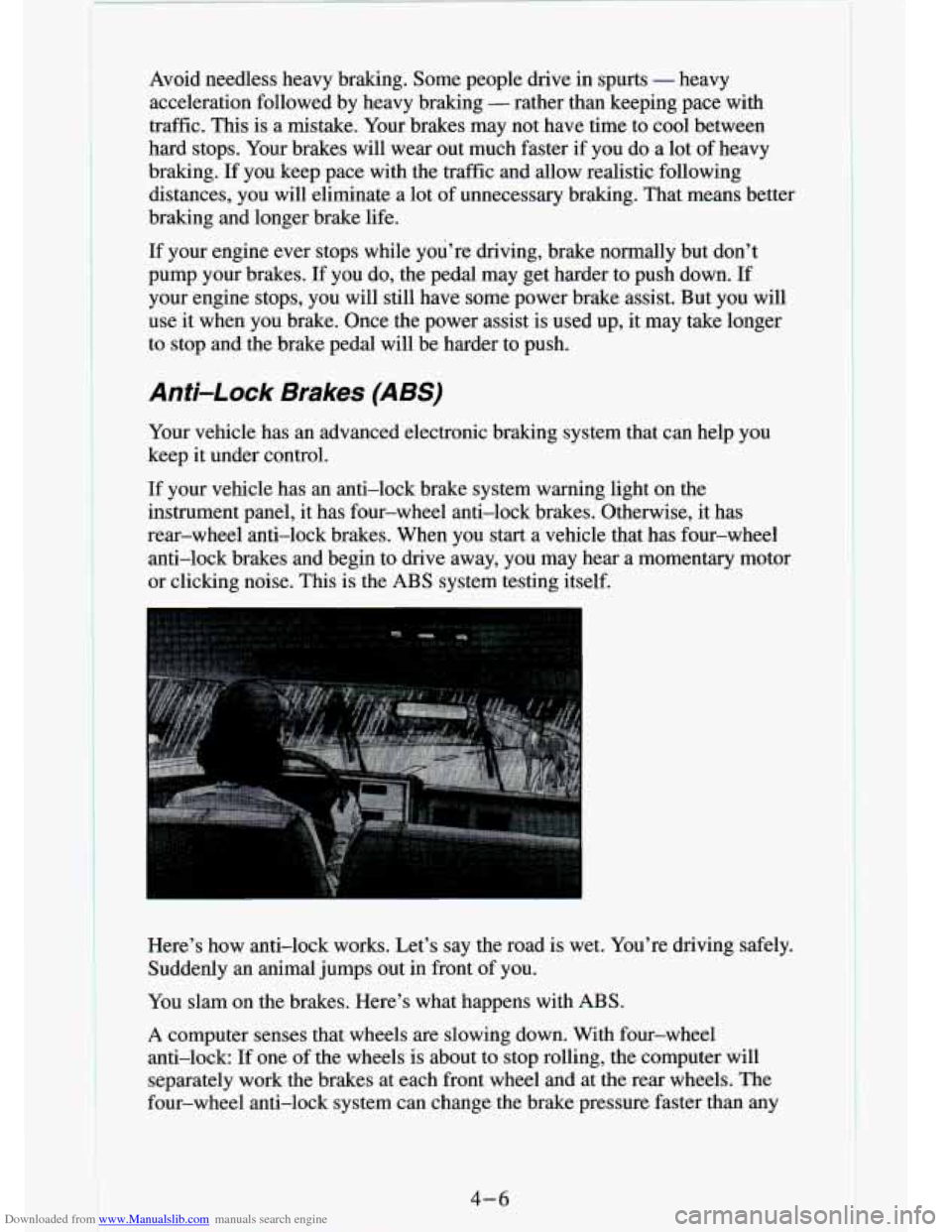
Here’s how anti-lock works. Let’s say the road is wet. Y\
ou’re driving safely. Suddenly an animal jumps out in front of you.
You slam on the brakes. Here’s what happens with ABS.
A computer senses that wheels are slowing down. With four-wheel
anti-lock:
If one of the wheels is about to stop rolling, the computer will
separately work the brakes at each front wheel
and at the rear wheels. The
four-wheel anti-lock system can change the brake pressure faster\
than any
4-6
Page 178 of 340
Downloaded from www.Manualslib.com manuals search engine trailer brake controller by hand to be sure the brakes are working. This lets
you check your electricql connection at the same time.
During your trip, check occasionally to be sure that the load \
is secure, and
that the lights and any trailer brakes
are still working.
Following Distance
Stay at least twice as far behind the vehicle ahead as you would when
driving your vehicle without a trailer. This can help you avoid situations \
that
require heavy braking apd sudden turns.
Passing
You’ll need more passing distance up ahead when you’re to\
wing a trailer.
And, because you’re a good deal longer, you’ll need to g\
o much farther
beyond the passed vehicle before you can return to your lane. \
Backing Up
Hold the bottom of the steering wheel with one hand. Then, to move the
trailer to the left, just move that hand to the left. To move the trailer to the
right, move your hand to the right. Always back up slowly and\
, if possible,
have someone guide you.
Making Turns
When you’re turning with a trailer, make wider turns than n\
ormal. Do this
so your trailer won’t strike soft shoulders, curbs, road signs, \
trees, or other
objects. Avoid jerky or sudden maneuvers. Signal well in advance.
Turn Signals When Towing a Trailer
When you tow a trailer, your vehicle has to have a different \
turn signal
flasher and extra wiring. The green arrows on your instrument panel wi\
ll
flash whenever you signal a turn or lane change. Properly hooked up, the
trailer lights will also flash, telling other drivers you’re \
about
to turn,
change lanes or stop.
When towing a trailer, the green arrows on your instrument pan\
el will flash
€or
turns even if the bulbs on the trailer are burned out. Thus, you may think
drivers behind you are seeing your signal when they are not. It’s importan\
t
to check occasionally to be sure the trailer bulbs are still \
working.
4-42
Page 224 of 340
Downloaded from www.Manualslib.com manuals search engine Be careful not to spill gasoline. Clean gasoline from painted surfaces as
soon as possible. See “Cleaning the Outside of Your Vehicle” in the Index.
When
you put the cap back on, turn it to the right until you hear a clicking
noise.
NOTICE:
If you need a new cap, be sure to get the right type. Your dea\
ler
can get one for you. If you get the wrong type, it may not fit or
have proper venting, and your fuel tank and emissions system
might be damaged.
Checking Things Under fhe Hood
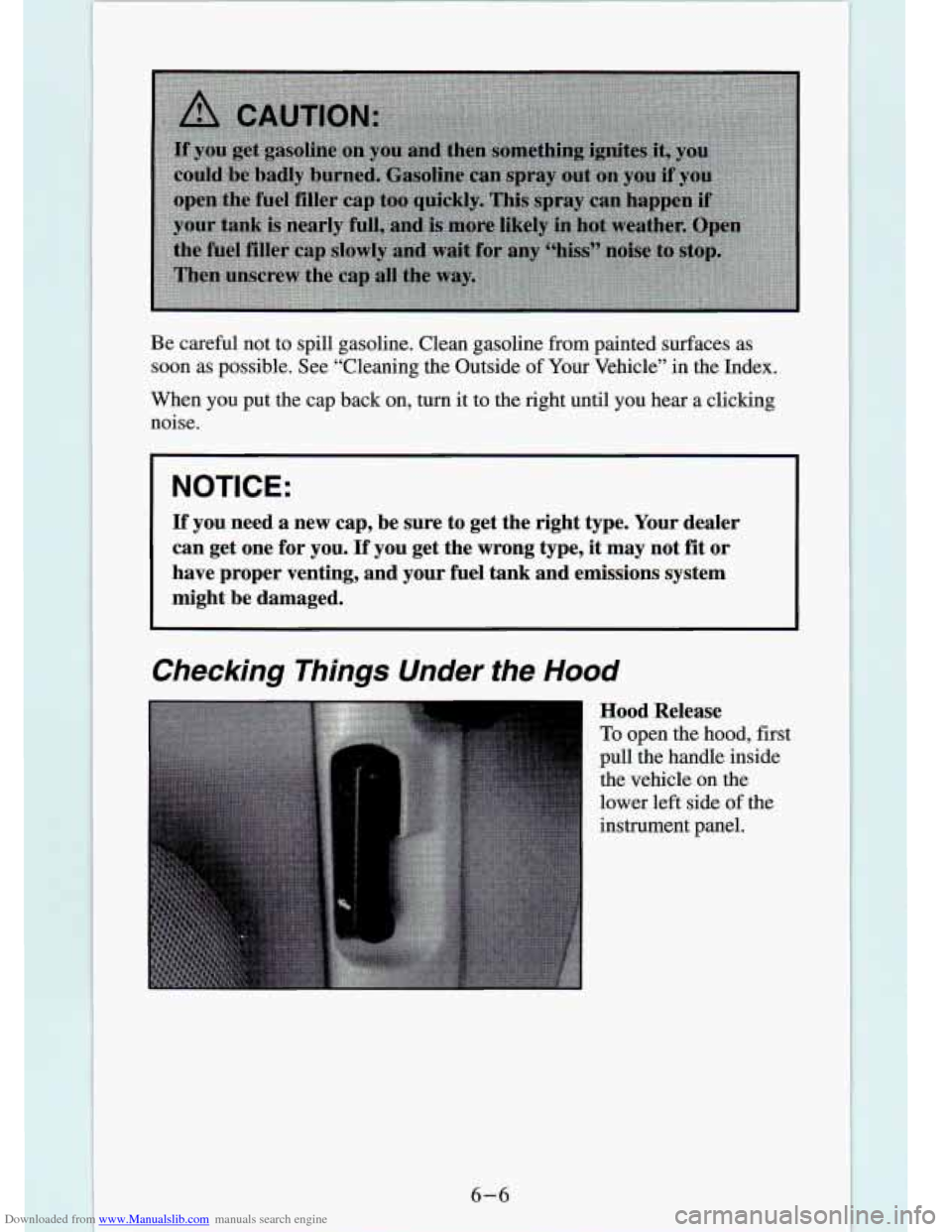
Hood Release
To open the hood, first
pull the handle inside
the vehicle on the
, lower left side of the
~ instrument panel.
6-6
Page 262 of 340
Downloaded from www.Manualslib.com manuals search engine Lock Cylinders
To be sure your locks operate properly, they must be lubricated.
Refer to the Maintenance Schedule to determine
how often to lubricate them
and what type
of lubricant to use.
You should not use penetrating oils because they could wash out the factory
installed lubricant and cause
the lock to bind. De-icers which contain
alcohol could
also wash away the lubricant, so be sure to lubricate the lock
after using a de-icer of this type.
Tailgate Handle
The tailgate handle pivot points on your vehicle should be lubricated to keep
the handle working smoothly.
Refer to the Maintenance Schedule to determine
how often to lubricate them
and what type
of lubricant to use.
Exhaust System
To help prevent damage to your exhaust system, do not continue to drive
your vehicle if you notice:
Engine misfiring
Loss of performance
Other unusual operating conditions
Have your engine and exhaust system serviced regularly.
Three- Way Catalytic Converter
Your vehicle's three-way catalytic converter is designed to reduce the
pollutants in your vehicle's exhaust. Use only unleaded fuel in your vehicle.
If you use leaded fuel, you could damage your three-way catalytic converter
and other engine components.
Malfunction Indicator Lamp (SERVICE ENGINE SOON )
This light on your instrument panel lets you know when your emission
system needs service. The light will come on briefly when you start your
engine to let you know that the system
is working. If it does not come on
when you start your engine, or if it comes on and stays on while you're
driving, your system may
need service. Your vehicle should still be
driveable, but you should have your system serviced right away.
6-44
Page 281 of 340
Downloaded from www.Manualslib.com manuals search engine Gleaning Vinyl
Use warm water and a clean cloth.
Rub with a clean, damp cloth to remove dirt. You may have to do it
more than once.
Things like tar, asphalt and shoe polish will stain if you don’t get t\
hem
off quickly. Use a clean cloth and a solvent-type vinyl cleaner.
Cleaning Leather
Use a soft cloth with lukewarm water and a mild soap or sadd\
le soap.
For stubborn stains, use a mild solution of 10% isopropyl alcohol
Never use oils, varnishes, solvent-based or abrasive cleaners, furnitur\
e
(rubbing alcohol) and
90% water.
polish
or shoe polish on leather.
into finish, it can harm the leather.
Soiled leather should be cleaned immediately. If dirt is allowed to work
Cleaning the Top of the Instrument Panel
Use only rmld soap and water to clean the top surfaces of the instrument
panel. Sprays containing silicones or waxes may cause annoying \
reflections
in the windshield and even make it difficult to see through the windshield
under certain conditions.
Care of Safety Belts
Keep belts clean and dry.
6-63
Page 286 of 340
Downloaded from www.Manualslib.com manuals search engine PART
NUMBER
1050427
SIZE DESCRIPTION
23 oz. (0.680L) Glass Cleaner
1050429 6 lbs. (2.72 kg) Multi-Purpose Powder Cleaner
1050729
USAGE
Glass cleaning and spot cleaning on
vinyls
Cleans vinyl and
cloth on door
trim,
seats, and
carpet-also tires
and mats
8 oz. (0.237L) Vinyl Top Cleaner Cleaning of vinyl
tops
1051055 16
oz. (0.473L) Preservatone
1051398
8 oz. (0.237L) Spot Lifter Vinyl top dressing
Spot and stain
removal on cloth
and fabric
1052870 16
oz. (0.473L) Wash-Wax (conc.) Exterior wash
1050201 16
oz. (0.473L) Magic Mirror Cleaner-Polish Exterior cleaner
and polish
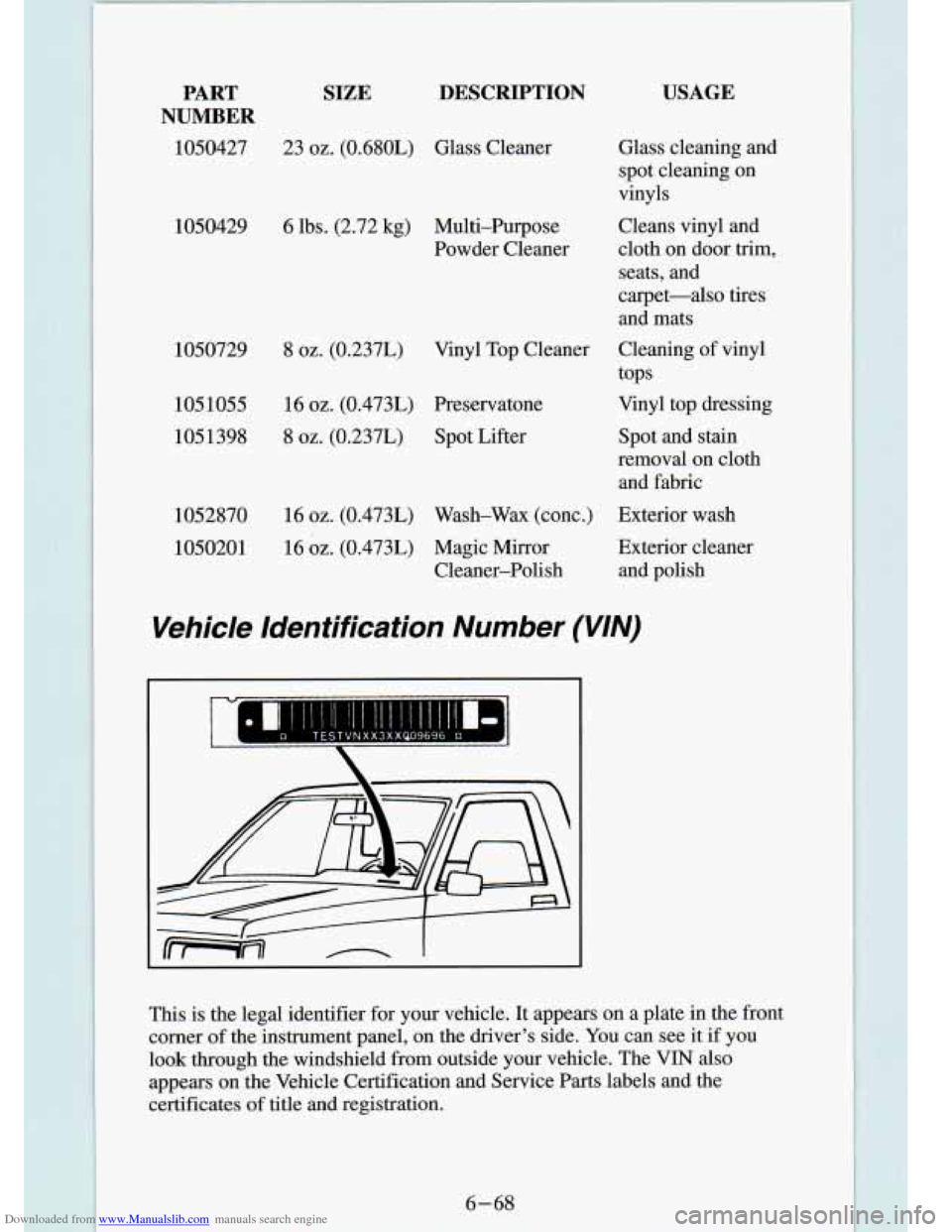
Vehicle Identification Number (VIN)
I
This is the legal identifier for your vehicle. It appears on a plate in the front
corner
of the instrument panel, on the driver's side. You can see it if you
look through the windshield from outside your vehicle. The
VIN also
appears on the Vehicle Certification and Service Parts labels a\
nd the
certificates of title and registration.
Page 290 of 340
Downloaded from www.Manualslib.com manuals search engine Fuse Block
..
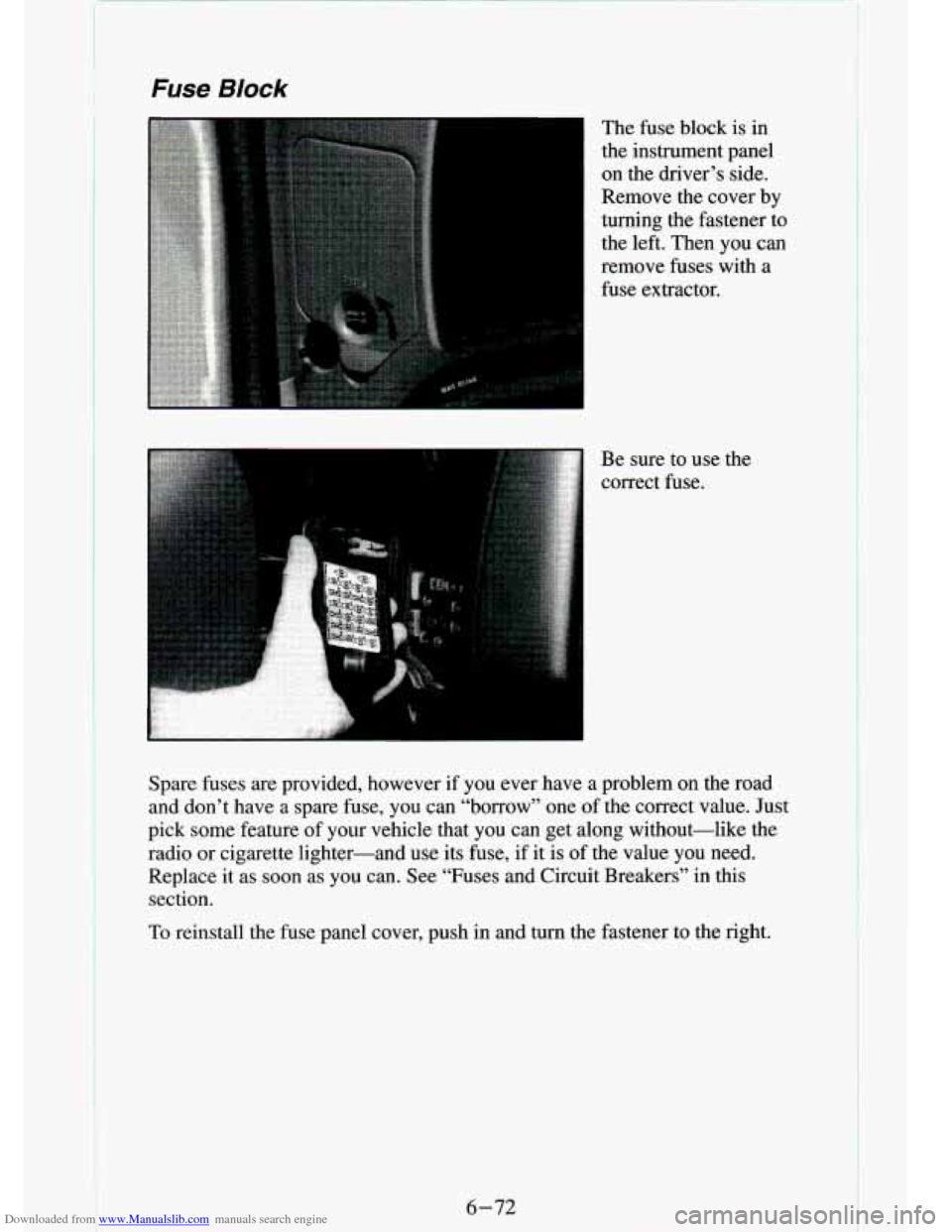
The fuse block is in
the instrument panel
on the driver’s side.
Remove the cover by
turning the fastener to
the left. Then you can
remove fuses with a
fuse extractor.
Spare fuses are provided, however if you ever have a problem on the road
and don’t have a spare fuse, you can “borrow” one of the correct value. Just
pick some feature of your vehicle that you can get along without-like the
radio or cigarette lighter-and use its fuse, if it is of the value you need.
Replace
it as soon as you can. See “Fuses and Circuit Breakers” in this
section.
i
c
TO reinstall the fuse panel cover, push in and turn the fastener to the right.
6-72
Page 293 of 340
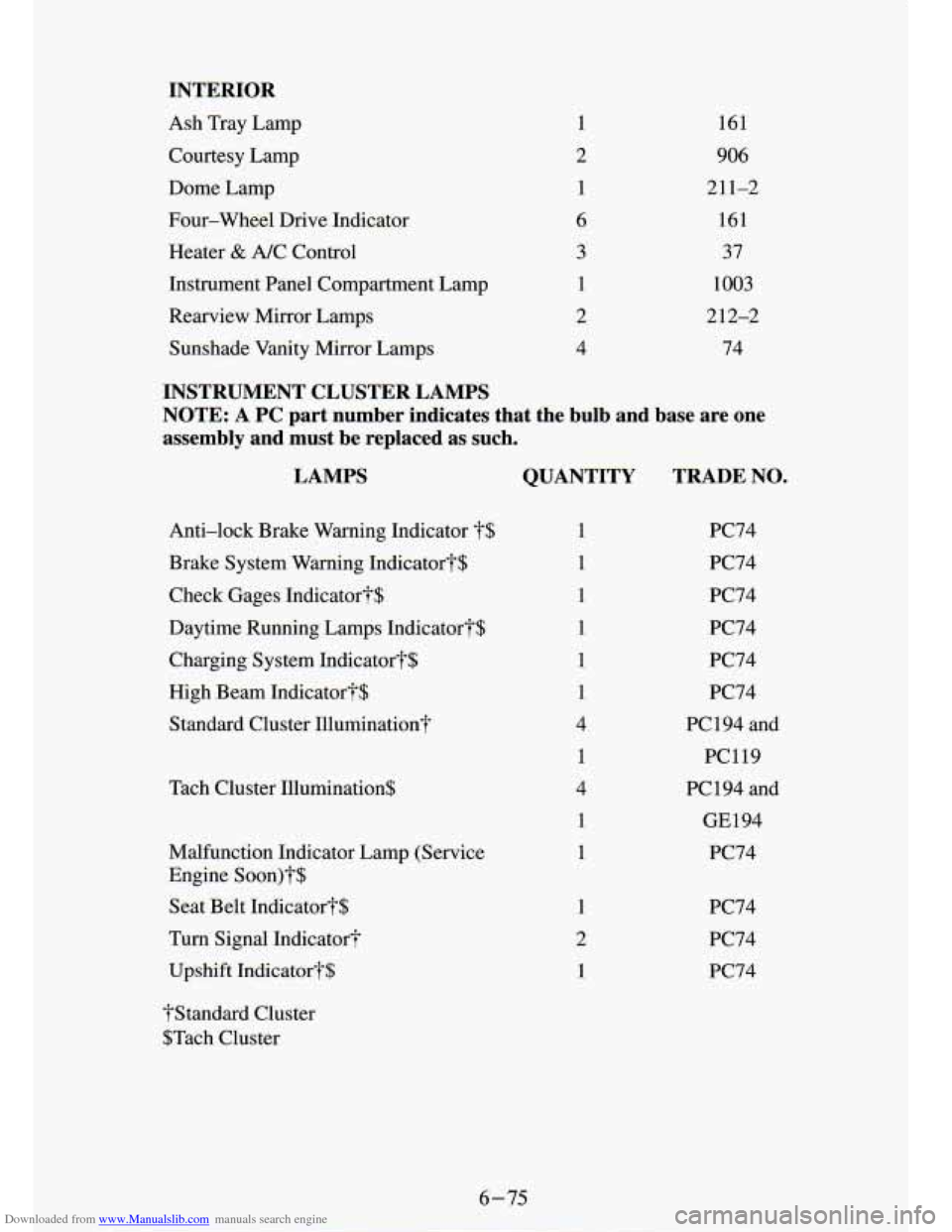
Downloaded from www.Manualslib.com manuals search engine INTERIOR
Ash Tray Lamp
Courtesy Lamp
Dome Lamp
Fol -Wheel Drive - lit, lr
Hearer & A/C Controi
Instrument Panel Compartment Lamp
Rearview Mirror Lamps Sunshade Vanity Mirror Lamps 1
2 1
4 161
906
211-2 161
37
1003
2 12-2
74
INSTRUMENT CLUSTER LAMPS NOTE:
A PC part number indicates that the bulb and base are one
assembly
and must be replaced as such.
LAMPS QUANTITY
TRADE NO.
Anti-lock Brake Warning Indicator ?$
Brake System Warning Indicator?$
Check Gages Indicator?$
Daytime Running Lamps Indicator?$
Charging System Indicator?$ High Beam Indicator?$
Standard Cluster Illumination?
Tach Cluster Illumination$
Malfunction Indicator Lamp (Service
Engine
Soon)?$
Seat Belt Indicator?$
Turn Signal Indicator?
Upshift Indicator?$
?Standard Cluster
$Tach Cluster 1
1
1
1
1
1
4
1
4
1
1
PC74
PC74
PC74
PC74
PC74
PC74
PC 194 and
PC119
PC194 and
GE 194
PC74
PC74
PC74
PC74