maintenance CHEVROLET S10 1994 2.G User Guide
[x] Cancel search | Manufacturer: CHEVROLET, Model Year: 1994, Model line: S10, Model: CHEVROLET S10 1994 2.GPages: 340, PDF Size: 18.45 MB
Page 236 of 340
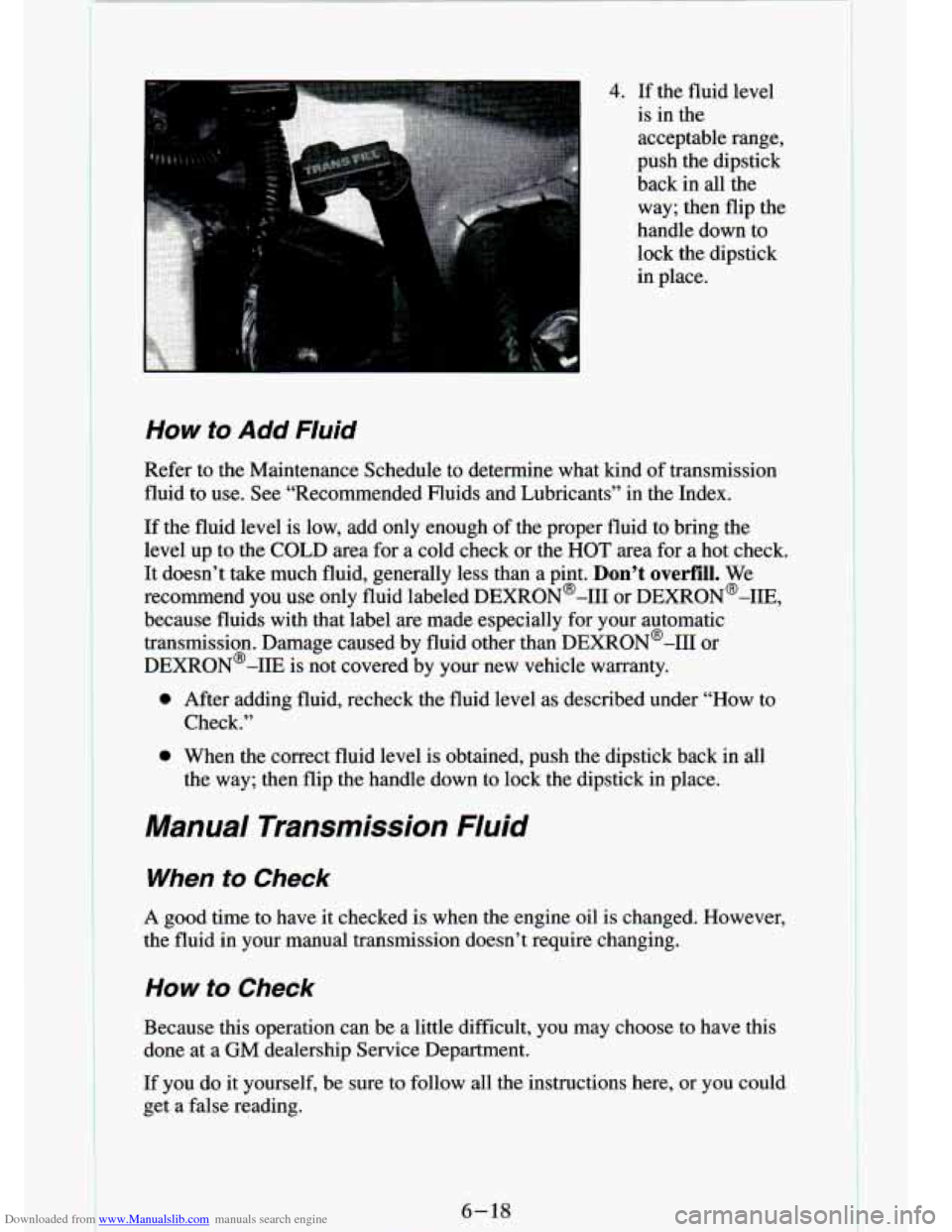
Downloaded from www.Manualslib.com manuals search engine 4. If the fluid level
is in the
acceptable range,
push the dipstick
back in all the
way; then flip the
handle down to
lock the dipstick
in place.
How to Add Fluid
Refer to the Maintenance Schedule to determine what kind of transmission
fluid to use. See “Recommended Fluids and Lubricants”
in the Index.
If the fluid level is low, add only enough of the proper fluid to bring the
level up to the COLD area for a cold check or the
HOT area for a hot check.
It doesn’t take much fluid, generally less than a pint.
Don’t overfill. We
recommend you use only fluid labeled DEXRON@-I11 or DEXRON@-IIE,
because fluids with that label are made especially for your automatic
transmission. Damage caused by fluid other than DEXRON@-I11 or
DEXR0N’-IIE is not covered by your new vehicle warranty.
0 After adding fluid, recheck the fluid level as described under “How to
Check.”
0 When the correct fluid level is obtained, push the dipstick ba\
ck in all
the way; then flip the handle down to lock the dipstick in place.
Manual Transmission Fluid
When to Check
A good time to have it checked is when the engine oil is changed. However,
the fluid in your manual transmission
doesn’t require changing.
How to Check
Because this operation can be a little difficult, you may choose to have this
done at a
GM dealership Service Department.
If you do it yourself, be sure to follow all the instructions\
here, or you could get a false reading.
6-18
Page 237 of 340
Downloaded from www.Manualslib.com manuals search engine NOTICE:
Too much or too little fluid cm damage your transmission. Too
much can mean that some of the’fluid could come out and fall on
hot engine parts or exhaust systm, starting a fire. Be sure to get
an accurate reading
if you check your transmission fluid.
Check the fluid level only ‘when your engine is off, the vehicle is parked on
a level place and the transmission is cool enough for you to rest your fingers
on the transmission case.
Then, follow these steps:
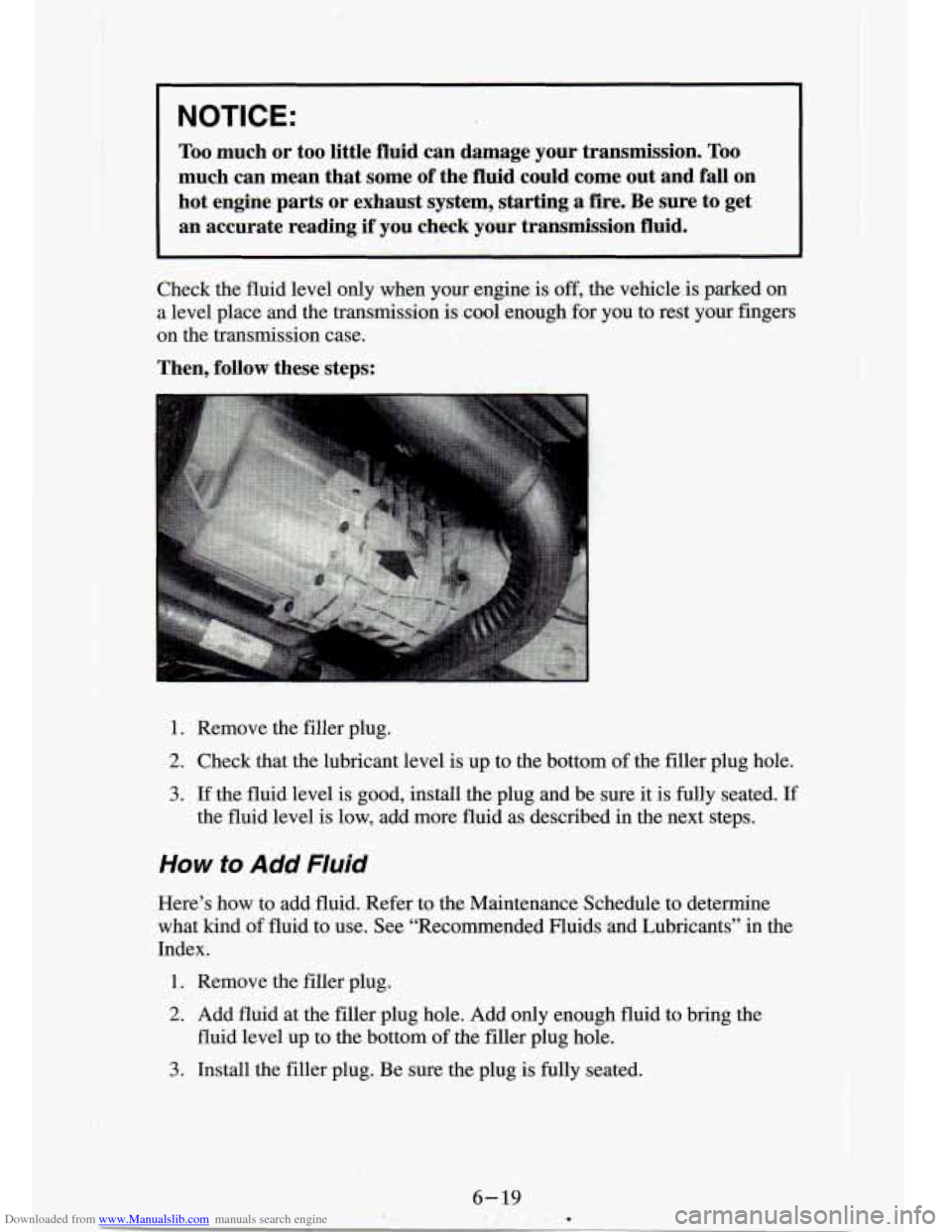
1. Remove the filler plug.
2. Check that the lubricant level is up to the bottom of the filler plug hole.
3. If the fluid level is good, install the plug and be sure it is fully seated. If
the fluid level is low, add more fluid as described in the next steps.
How to Add Fluid
Here’s how to add fluid. Refer to the Maintenance Schedule \
to determine
what
kind of fluid to use. See “Recommended Fluids and Lubricants” in the
Index.
1. Remove the filler plug.
2. Add fluid’at the filler plug hole. Add only enough fluid to bring the
fluid level up to the bottom
of the filler plug hole.
3. Install the filler plug. Be sure the plug is fully seated.
Page 238 of 340
Downloaded from www.Manualslib.com manuals search engine Hydraulic Clutch
The hydraulic clutch in your vehicle is self-adjusting. A slight amount of
play
(1/4 inch to 1/2 inch) in the pedal is normal.
When to Check and What to Use
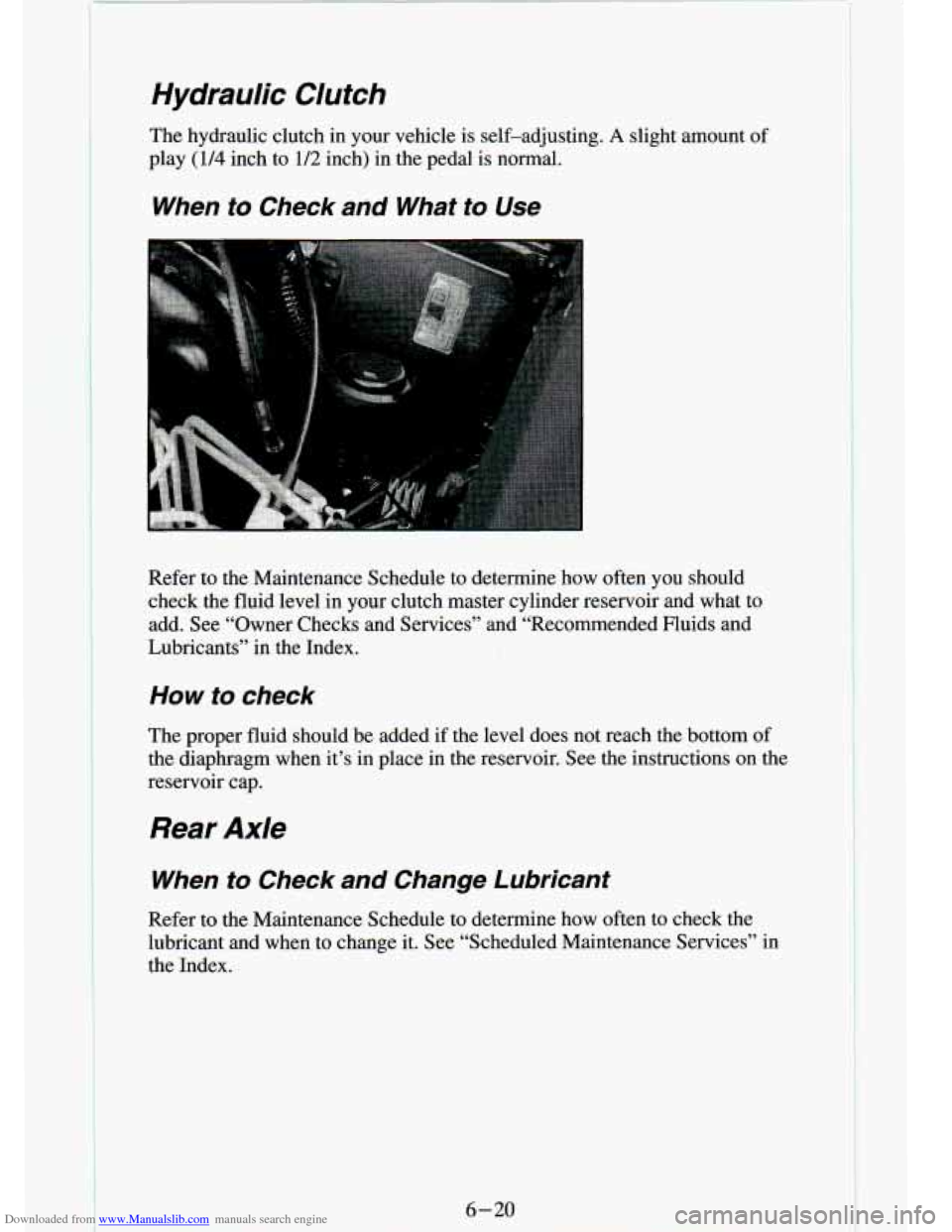
Refer to the Maintenance Schedule to determine how often you should
check the fluid level in your clutch master cylinder reservoir and what to
add. See “Owner Checks and Services” and “Recommended F\
luids and
Lubricants” in the Index.
How to check
The proper fluid should be added if the level does not reach the bottom of
the diaphragm when it’s in place in the reservoir. See the \
instructions on the
reservoir cap.
Rear Axle
When to Check and Change Lubricant
Refer to the Maintenance Schedule to determine how often to ch\
eck the
lubricant and when to change it. See “Scheduled Maintenance Services” in
the Index.
6-20 I i
Page 239 of 340
Downloaded from www.Manualslib.com manuals search engine How to Check Lubricant
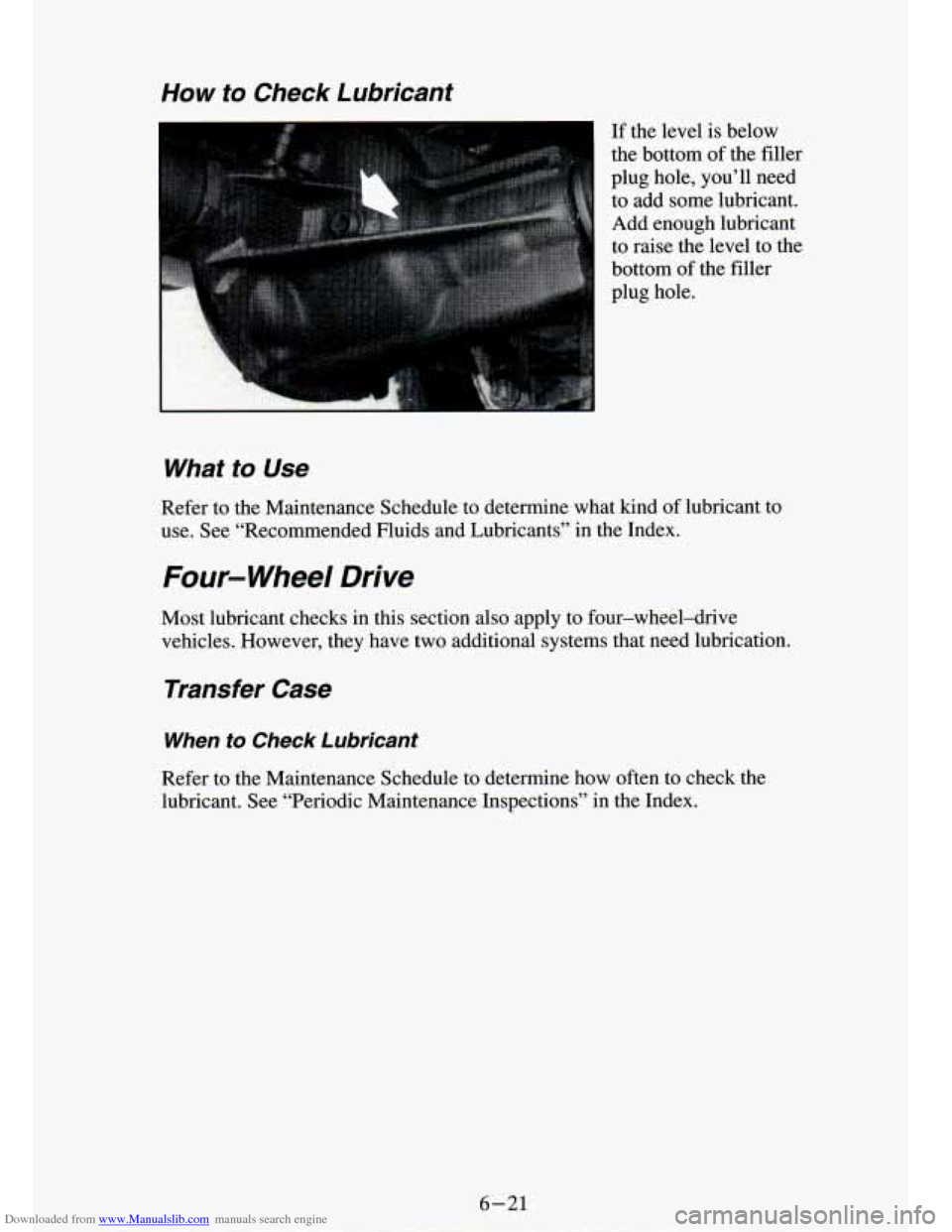
If the level is below
the bottom of the filler
plug hole, you’ll need to add some lubricant.
Add enough lubricant
to raise the level to the
bottom of the filler
plug hole.
What to Use
Refer to the Maintenance Schedule to determine what kind of lubricant to
use. See “Recommended Fluids and Lubricants” in the Index.
Four- Wheel Drive
Most lubricant checks in this section also apply to four-wheel-drive
vehicles. However, they have two additional systems that need l\
ubrication.
Transfer Case
When to Check Lubricant
Refer to the Maintenance Schedule to determine how often to ch\
eck the lubricant. See “Periodic Maintenance Inspections” in the Index.
6-21
Page 240 of 340
Downloaded from www.Manualslib.com manuals search engine How to Check Lubricant
6-22
I
Refer to the Maintenance Schedule to determine how often to check the
lubricant and when to change
it. See “Scheduled Maintenance Services” in
the Index.
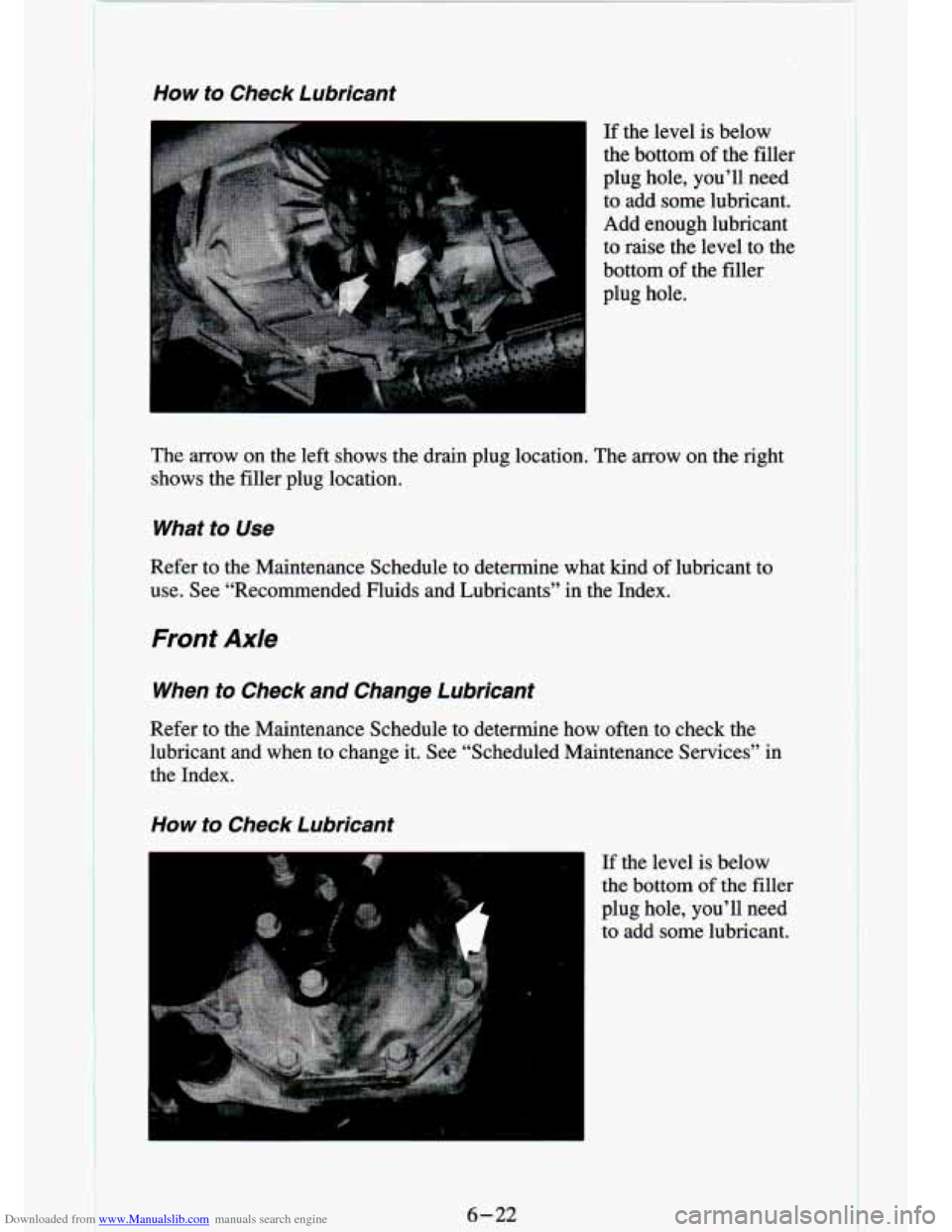
How to Check Lubricant
If the level is below
the bottom of the filler
plug hole, you’ll need
to add some lubricant.
Add enough lubricant
to raise the level to the
bottom
of the filler
plug hole.
The arrow on the left shows the drain plug location. The arrow
on the right
shows the filler plug location.
What to Use
Refer to the Maintenance Schedule to determine what kind of lubricant to
use. See “Recommended Fluids and Lubricants” in the Index.
Front Axle
When to Check and Change Lubricant
If the level is below
the bottom of the filler
plug hole, you’ll need to add some lubricant.
Page 241 of 340
, add enou\
gh lubricant
to raise the level to the bottom of the filler")
Downloaded from www.Manualslib.com manuals search engine If the differential is at operating temperature (w,arm), add enou\
gh lubricant
to raise the level to the bottom of the filler plug hole.
If the differential is cold, add enough lubricant to raise the level to 1/2 inch
(12
mm) below the filler plug hole.
What to use
Refer to the Maintenance Schedule to determine what kind of lubricant to
use. See “Recommended Fluids and Lubricants” in the Index.
Engine Coolant
The following explains your cooling system and how to add coolant \
when it
is low.
If you have a problem with engine overheating, see “Engine
Overheating” in the Index.
The proper coolant for your vehicle will:
Give freezing protection down to -20 “F (-29” C), or -34°F (-37 “C) in
Canada and for vehicles with the cold climate option.
e Give boiling protection up to 258°F (125°C).
Protect against rust and corrosion.
Help keep the proper engine temperature.
Let the warning lights and gages work as they should.
What to Use
Use a mi,xture of one-half clean water (preferably distilled) and one-half
antifreeze that meets “GM Specification 603%” or “GM Specification
6043-M ”for the 2.2L (LN2) Code 4 engine, which won’t damage
aluminum parts. You can also use
a recycled coolant conforming to “GM
Specification 603%” or “GM Specification 6043-M ”for the 2.2L (LN2)
Code 4 engine with a complete coolant flush and refill.
If you use this
mixture, you don’t need to add anything else.
6-23
Page 245 of 340
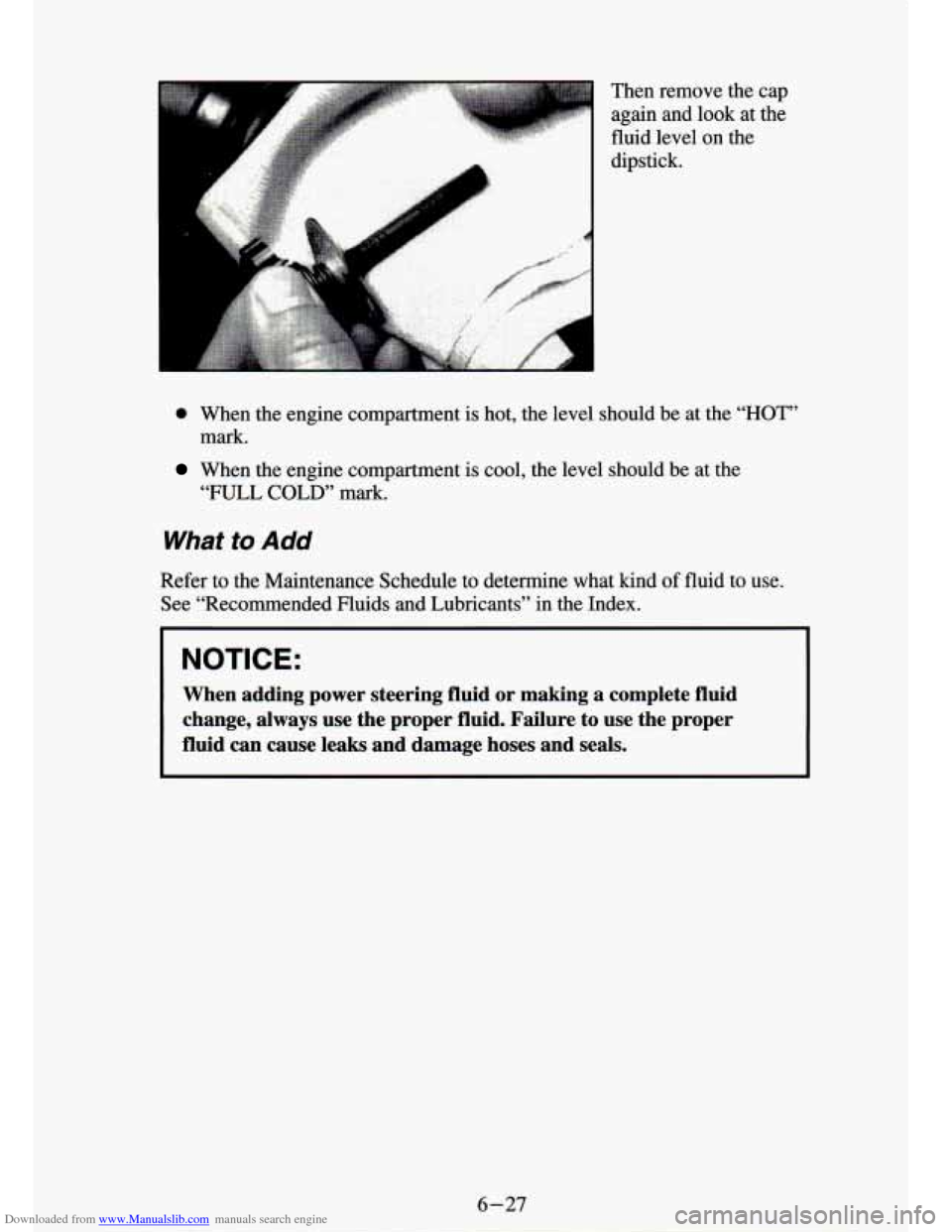
Downloaded from www.Manualslib.com manuals search engine A Then remove the again and look at
fluid level on the
dipstick. cap
the
0 When the engine compartment is hot, the level should be at the “HOT”
mark.
When the engine compartment is cool, the level should be at the
“FULL COLD” mark.
What to Add
Refer to the Maintenance Schedule to determine what kind of fluid to use.
See “Recommended Fluids and Lubricants”
in the Index.
NOTICE:
When adding power steering fluid or making a complete fluid
change, always use the proper fluid. Failure to use the proper\
fluid can cause leaks and damage hoses and seals.
6-27
Page 247 of 340

Downloaded from www.Manualslib.com manuals search engine Brakes
Brake Master Cylnder
Your brake master
cylinder is here. It is
filled with
DOT-3
brake fluid.
There are only two reasons why the brake fluid level
in your master cylinder
might go down, The first is that the brake fluid goes down to an acceptable
level during normal brake lining wear. When new linings are pu\
t in, the
fluid level goes back up. The other reason is that fluid is leaking out of the
brake system.
If it is, you should have your brake system fixed, since a leak
means that sooner or later your brakes won’t work well, or \
won’t work at all.
So, it isn’t a good idea to “top off’ your brake fluid. Adding brake fluid
won’t correct a leak.
If you add fluid when your linings are worn, then
you’ll have too much fluid when you get new brake linings.
You should add
(or remove) brake fluid, as necessary, only when work is done on the brake
hydraulic system.
Refer to the Maintenance Schedule to determine when to check y\
our brake fluid. See “Periodic Maintenance Inspections” in the Index.
6-29
Page 257 of 340
Downloaded from www.Manualslib.com manuals search engine Other Maintenance Items
Front Suspension and Steering Linkage
Refer to the Maintenance Schedule to determine how often to lubricate the
fittings and what type
of lubricant to use.
Front Wheel Bearings (Two-Wheel Drive)
If your vehicle is two-wheel drive, it has wheel bearings that must be
cleaned and repacked.
Refer to the Maintenance Schedule to determine how often this must be
done.
Single Belt Accessory Drive
Your new vehicle uses a serpentine belt that is lighter, and more durable
than systc
.s with several belts.
The belt runs over or around the pulleys on the engine. A tensioner is used
to keep the belt tight at all times. The tensioner also makes replacing the
belt easier if you need to replace the belt, be sure
to get the correct
replacement belt. Your dealership or parts supplier can help you with this.
The Accessory Drive Belt Routing label on your vehicle will show y\
ou how
to route the belt your vehicle uses.
Windshield Wiper Blade Replacement
NOTICE:
Use care when removing or installing a blade assembly.
Accidental bumping can cause the arm to fall back and strike
the windshield.
6-39
Page 261 of 340

Downloaded from www.Manualslib.com manuals search engine Lubrication
Accelerator Control System
Refer to the Maintenance Schedule to determine how often the a\
ccelerator linkage pivot points must be lubricated and what type
of lubricant to use.
Accelerator cables and cruise control cables should not be lubr\
icated. Any
cables that are worn or are hard
to pull should be replaced.
When cleaning the engine compartment with water or steam, avoid\
directing the flow onto the throttle linkage
in a manner that would cause moisture to
enter the cables.
Hood Latches and Hood Hinge
Refer to the Maintenance Schedule to determine how to lubricate\
the hood
latch and hood hinge assembly.
Propeller Shaft Slip Splines/Universal Joints
Refer to the Maintenance Schedule to determine how often the slip and
universal joints must be lubricated and what type
of lubricant to use.
Body
Normal use of your vehicle will cause metal to metal wear at some points on
the cab and body if they are not lubricated.
For exposed surfaces, such as door checks, door lock bolts, lock s\
triker
plates, dovetail bumper wedges, etc., a thin film
of engine oil should be
applied.
Where oil holes are provided in the body or cab, a dripless oil can be used.
The seat adjusters and seat track should be lubricated with chassis\
grease.
Door weatherstrips and rubber hood bumpers should be wiped clea\
n with a wet cloth and lightly coated with a rubber lubricant.
Never use too much
of any lubricant and be sure to wipe up any extra
lubricant when you are finished.
Window regulators and controls are inside the doors. They are lubricated
with a long lasting grease.
If lubrication is required your dealer should
perform this service.
Refer to the Maintenance Schedule to determine how often to lubricate
these items and what type of lubricant to use.