belt CHEVROLET S10 1994 2.G Owner's Manual
[x] Cancel search | Manufacturer: CHEVROLET, Model Year: 1994, Model line: S10, Model: CHEVROLET S10 1994 2.GPages: 340, PDF Size: 18.45 MB
Page 40 of 340
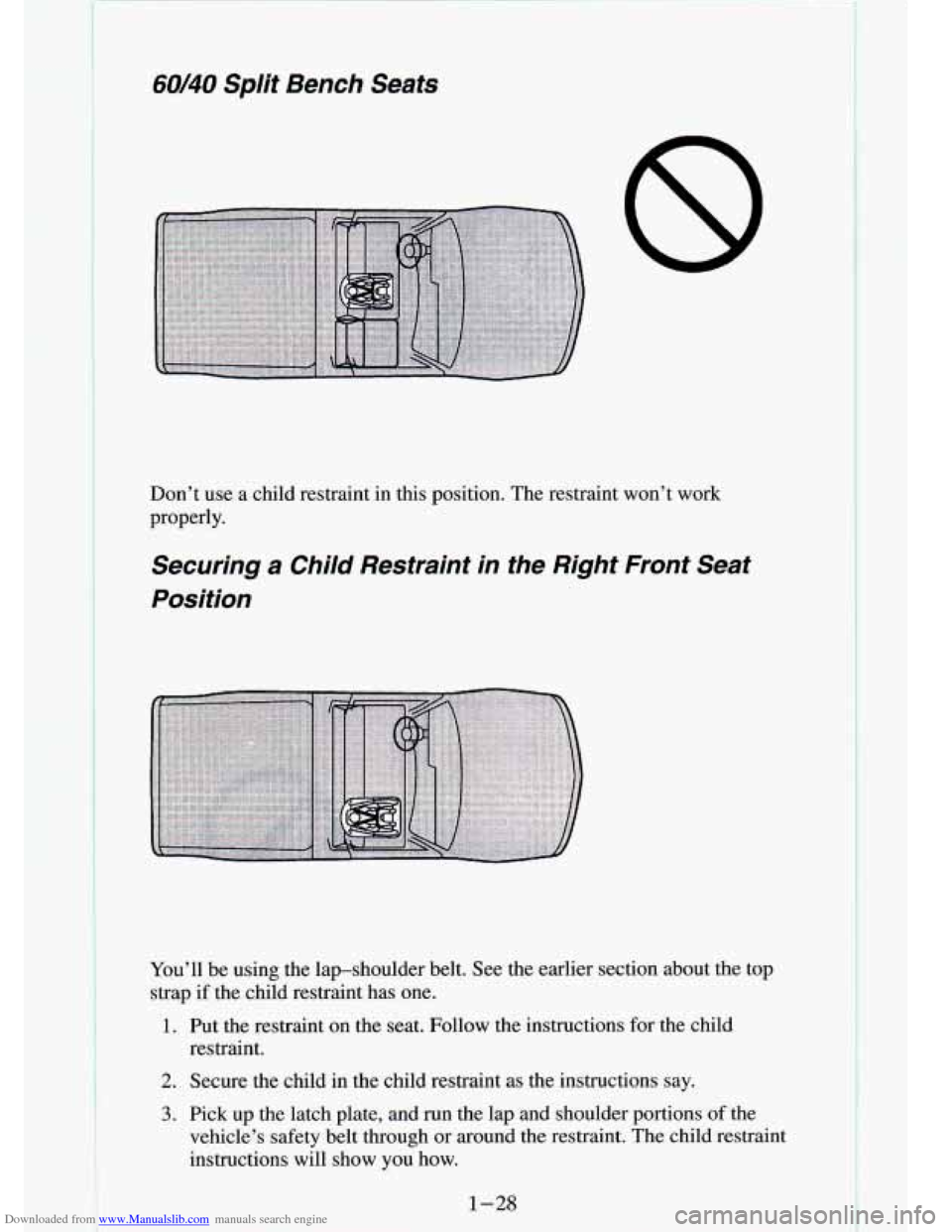
Downloaded from www.Manualslib.com manuals search engine 60/40 Split Bench Seats
8
Don’t use a child restraint in this position. The restraint won’t work
properly.
Securing a Child Restraint in the Right Front Seat
Position
You’ll be using the lap-shoulder belt. See the earlier secti\
on about the top
strap if the child restraint has one.
1.
2.
3. Put
the restraint on the seat. Follow the instructions for the child
restraint.
Secure the child in the child restraint as the instructions say.
Pick up the latch plate, and run the lap and shoulder portions of the
vehicle’s safety belt through or around the restraint. The c\
hild restraint
instructions will show you how.
1-28
1 f
Page 41 of 340
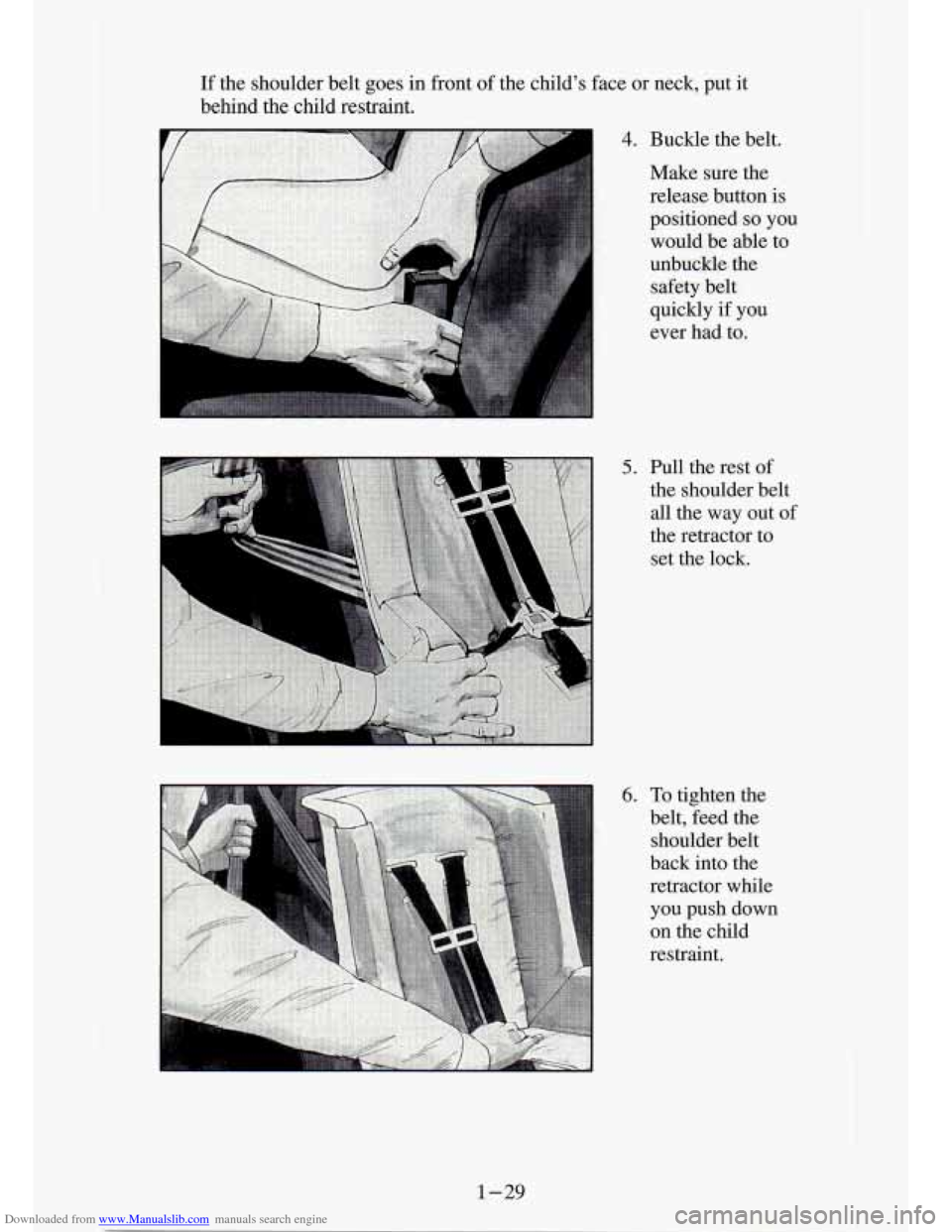
Downloaded from www.Manualslib.com manuals search engine If the shoulder belt goes in front of the child’s face or neck, put it
behind the child restraint.
4. Buckle the belt.
Make sure the
release button
is
positioned so you
would be able
to
unbuckle the
safety belt
quickly
if you
ever had to.
5. Pull the rest of
the shoulder belt
all the way out of
the retractor to
set the lock.
6. To tighten the
belt,
feed the
shoulder belt
back into the
retractor while
you push down
on the child
restraint.
1-29
Page 42 of 340
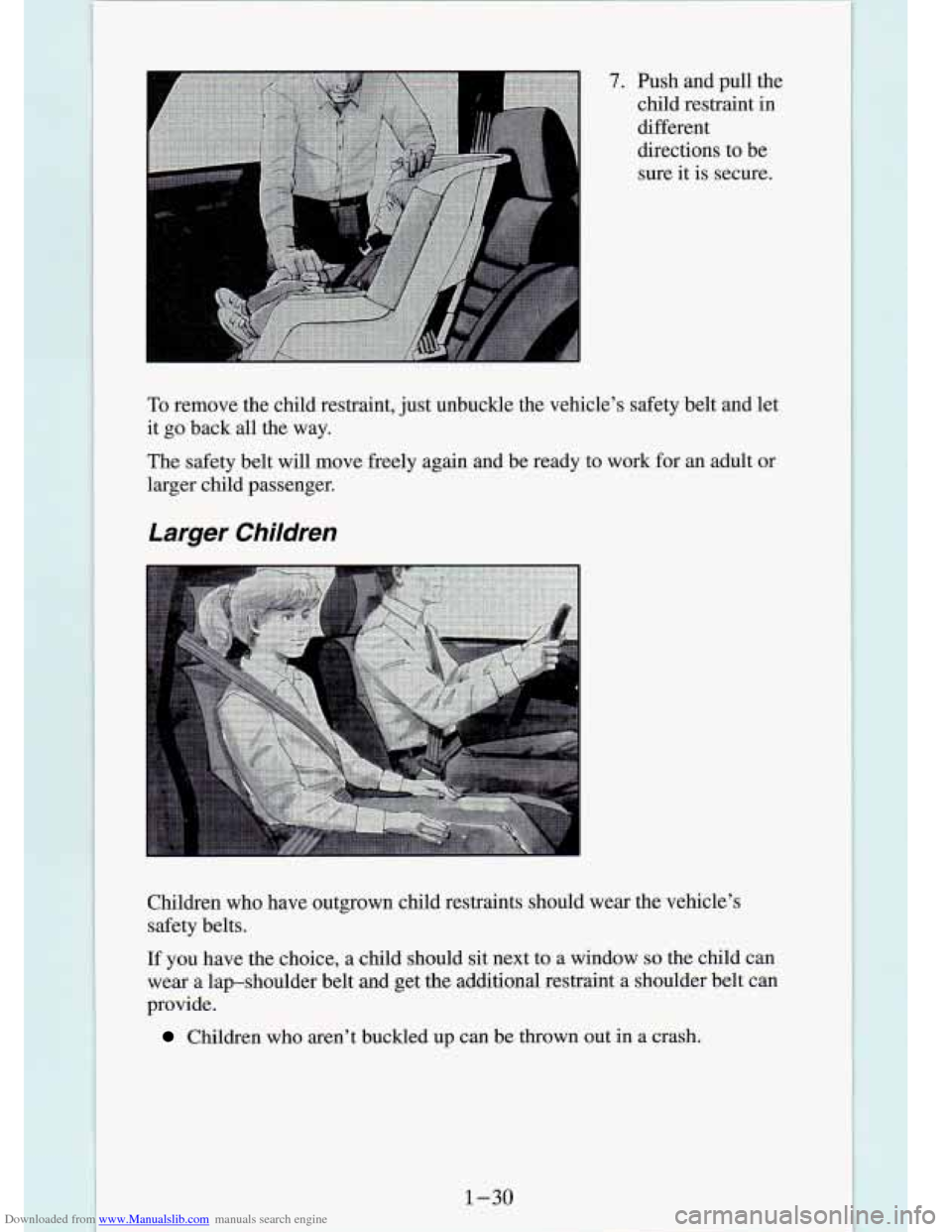
Downloaded from www.Manualslib.com manuals search engine 7. Push and pull the child restraint in
different
directions to be
sure it is secure.
To remove the child restraint, just unbuckle the vehicle’s safety belt and let
it go back all the way.
The safety belt will move freely again and be ready to work for an adult or
larger child passenger.
Larger Children
Children who have outgrown child restraints should wear the veh\
icle’s
safety belts.
If you have the choice, a child should sit next to a window so the child can
wear a lap-shoulder belt and get the additional restraint a sh\
oulder belt can
provide.
1-30
Children who aren’t buckled up can be thrown out in a crash.
Page 44 of 340
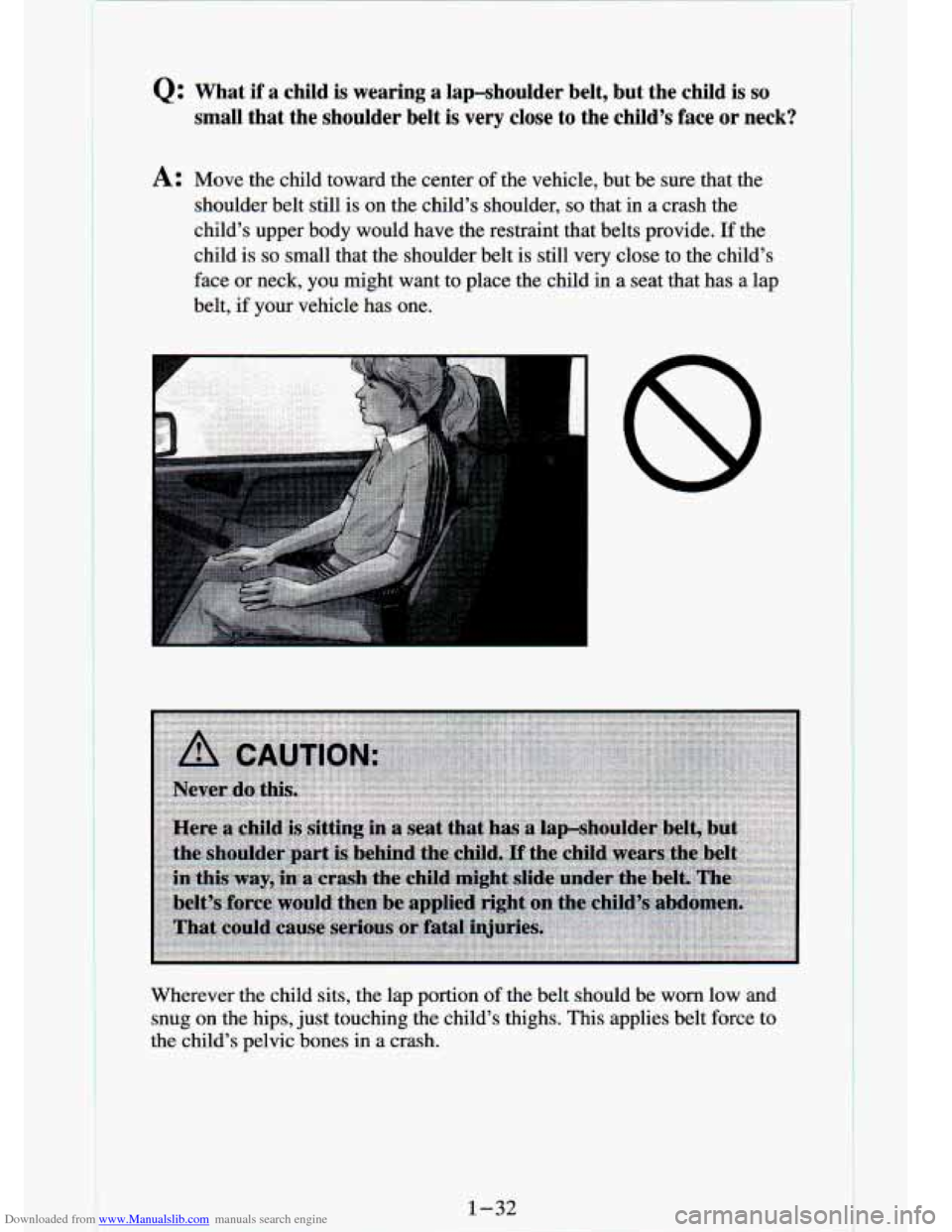
Downloaded from www.Manualslib.com manuals search engine Q: What if a child is wearing a lap-shoulder belt, but the child is so
small that the shoulder belt is very close to the child’s \
face or neck?
A: Move the child toward the center of the vehicle, but be sure that the
shoulder belt still
is on the child’s shoulder, so that in a crash the
child’s upper body would have the restraint that belts provi\
de.
If the
child is
so small that the shoulder belt is still very close to the child’s
face
or neck, you might want to place the child in a seat that has a lap
belt,
if your vehicle has one.
Wherever the child sits, the lap portion of the belt should be worn
low and
snug on the hips, just touching the child’s thighs. This applies belt force to
the child’s pelvic bones
in a crash.
1-32
f
Page 45 of 340
Downloaded from www.Manualslib.com manuals search engine Safety Belt Extender
If the vehicle’s safety belt will fasten around you, you should use it.
But
if a safety belt isn’t long enough to fasten, your dealer will order you an
extender. It’s free. When you go in to order it, take the heaviest coat you
will wear,
so the extender will be long enough for you. The extender will be
just for you, and just for the seat
in your vehicle that you choose. Don’t let
someone else use it, and use it only
for the seat it is made to fit. To wear it,
just attach it to the regular safety belt.
Checking Your Restraint Systems
Now and then, make sure all your belts, buckles, latch plates, retractors,
anchorages and reminder systems are working properly.
Look for any loose
parts or damage. If you see anything that might keep a restraint system from
doing
its job, have it repaired.
Replacing Safety Belts After a Crash
If you’ve had a crash, do you need new belts?
After a
very minor collision, nothing may be necessary. But if the belts were
stretched, as they would be if worn during a more severe crash, then you
need new belts.
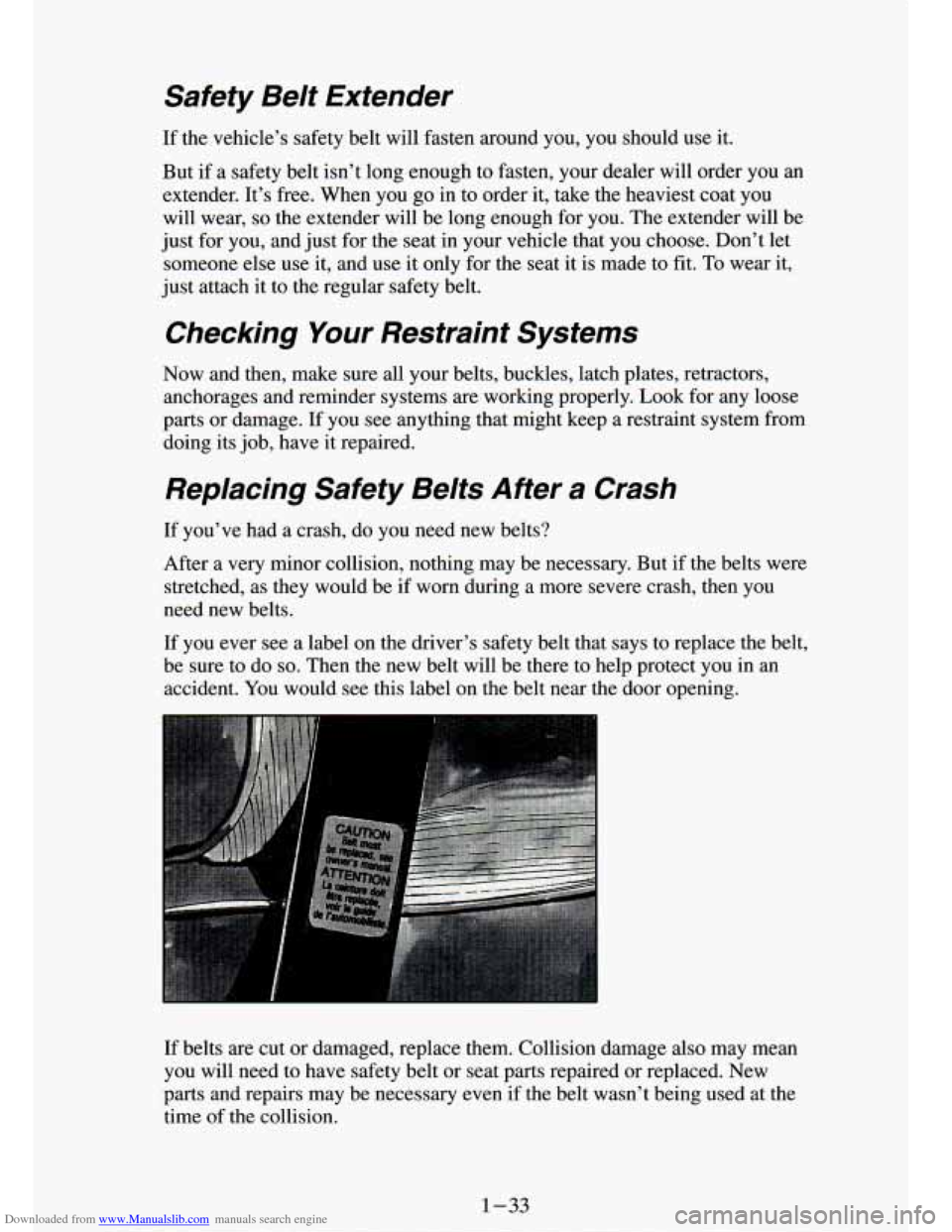
If you ever see a label on the driver’s safety belt that says to replace the belt,
be sure to do
so. Then the new belt will be there to help protect you in an
accident. You would see this label on the belt near the door opening.
If belts are cut or damaged, replace them. Collision damage also may mean
you will need to have safety belt or seat parts repaired or \
replaced. New
parts and repairs may be necessary even if the belt wasn’t \
being used at the time of the collision.
1- 33
Page 46 of 340

Downloaded from www.Manualslib.com manuals search engine Q: What’s wrong with this?
A: The belt is torn.
Torn or frayed belts may not protect you in a crash. They ca\
n rip apart under impact forces. If a belt is torn
or frayed, get a new one right away.
Before replacing any safety belt, see your dealer for the corr\
ect part number.
You’ll need the model year and model number for your vehicl\
e. The model
year is on your title and registration. And you can find the model number on
the CertificatiodTire label of your vehicle. See “CertificatiodTire Label” in
the Index.
The model number on the replacement belt must be listed on the safety belt
you want to replace.
Pull shoulder belt all the way out
to see this label.
Page 109 of 340
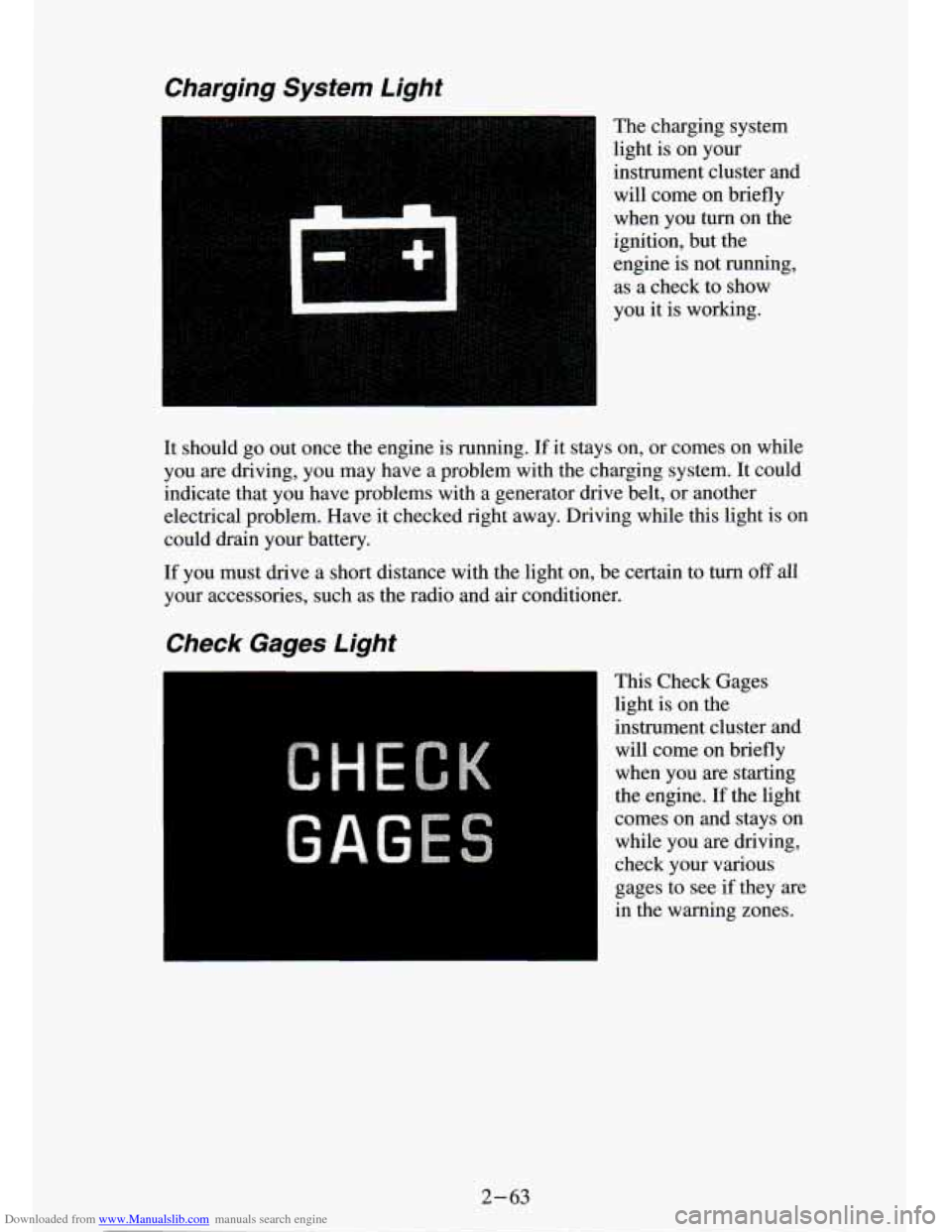
Downloaded from www.Manualslib.com manuals search engine Charging System Light
The charging system
light is on your
instrument cluster and will come on briefly
when you turn on the
ignition, but the
engine is not running,
as a check to show
you it is working.
It should
go out once the engine is running. If it stays on, or comes on while
you are driving, you may have a problem with the charging system.
It could
indicate that you have problems with a generator drive belt, or another
electrical problem. Have it checked right away. Driving while this light is on
could drain your battery.
If you must drive a short distance with the light on, be certain to turn off all
your accessories, such as the radio and air conditioner.
Check Gages Light
This Check Gages
light is on the
instrument cluster and
will come on briefly
when you are starting
the engine.
If the light
comes on and stays on while you are driving,
check your various
gages to see
if they are
in the warning zones.
2-63
Page 138 of 340

Downloaded from www.Manualslib.com manuals search engine Defensive Driving
:c. 1-
1 -- ,- -. , ..
The best advice anyone can give about driving is: Drive defensively\
,
Please start with a
very important safety device in your vehicle: Buckle up.
(See “Safety Belts”
in the Index.)
Defensive driving really means “be ready for anything.” On city streets,
rural roads, or freeways, it means “always expect the unexpected.”
Assume that pedestrians or other drivers are going to be carel\
ess and make
mistakes. Anticipate what they might do. Be ready for their mistakes.
Rear-end collisions are about the most preventable
of accidents. Yet they
are common. Allow enough following distance. It’s the best d\
efensive
driving maneuver, in both city and rural driving. You never know when the
vehicle
in front of you is going to brake or turn suddenly.
Drunken Driving
Death and injury associated with drinking and driving is a nat\
ional tragedy.
It’s the number one contributor to the highway death toll, \
claiming
thousands
of victims every year. Alcohol takes away three things that
anyone needs to drive a vehicle:
Judgment
Muscular Coordination
Vision
Police records show mar almost half
of all motor vehicle-related deaths
involve alcohol
- a driver, a passenger or someone else, such as a
pedestrian, had been drinking. In most cases, these deaths are \
the result of
someone who was drinking and driving. About
20,000 motor
vehicle-related deaths occur each year because of alcohol, and \
thousands
01
people are injured.
Just how much alcohol is too much if a person plans to drive\
? Ideally, no one should drink alcohol and then drive. But
if one does, then what’s “too
much”? It can be a lot less than many might think. Although it depends on
each person and situation, here is some.genera1 information
on the problem.
The Blood Alcohol Content (BAC)
of someone who is drinking depends
upon four things:
How much alcohol is in the drink.
0 The drinker’s body weight.
The amount of food that is consumed before and during drinking.
The length of time it has taken the drinker to consume the alcohol.
4-2
Page 180 of 340
Downloaded from www.Manualslib.com manuals search engine - . ?
-. “C ^.
When You Are Ready to Leave After Parking on a Hill
1. Apply your regular brakes and hold the pedal down while you:
Start your engine;
Shift into a gear; and
Release the parking brake.
2. Let up on the brake pedal.
3. Drive slowly until the trailer is clear of the chocks.
4. Stop and have someone pick up and store the chocks.
Maintenance When Trailer Towing
Your vehicle will need service more often when you’re pulling a trailer. See
the Maintenance Schedule for more on this. Things that are especially
important in trailer operation are automatic transmission fluid (don’t
overfill), engine oil, axle lubricant, belt, cooling system, an\
d brake
adjustment. Each
of these is covered in this manual, and the Index will help
you find them quickly.
If you’re trailering, it’s a good idea to review these
sections before you
start your trip.
Check periodically to see that all hitch nuts and bolts are tight.
Trailer Light Wiring
See “Trailer Wiring Harness” in the Index.
4-44
I b
Page 257 of 340
Downloaded from www.Manualslib.com manuals search engine Other Maintenance Items
Front Suspension and Steering Linkage
Refer to the Maintenance Schedule to determine how often to lubricate the
fittings and what type
of lubricant to use.
Front Wheel Bearings (Two-Wheel Drive)
If your vehicle is two-wheel drive, it has wheel bearings that must be
cleaned and repacked.
Refer to the Maintenance Schedule to determine how often this must be
done.
Single Belt Accessory Drive
Your new vehicle uses a serpentine belt that is lighter, and more durable
than systc
.s with several belts.
The belt runs over or around the pulleys on the engine. A tensioner is used
to keep the belt tight at all times. The tensioner also makes replacing the
belt easier if you need to replace the belt, be sure
to get the correct
replacement belt. Your dealership or parts supplier can help you with this.
The Accessory Drive Belt Routing label on your vehicle will show y\
ou how
to route the belt your vehicle uses.
Windshield Wiper Blade Replacement
NOTICE:
Use care when removing or installing a blade assembly.
Accidental bumping can cause the arm to fall back and strike
the windshield.
6-39