fuel CHEVROLET S10 1994 2.G Owner's Manual
[x] Cancel search | Manufacturer: CHEVROLET, Model Year: 1994, Model line: S10, Model: CHEVROLET S10 1994 2.GPages: 340, PDF Size: 18.45 MB
Page 224 of 340
Downloaded from www.Manualslib.com manuals search engine Be careful not to spill gasoline. Clean gasoline from painted surfaces as
soon as possible. See “Cleaning the Outside of Your Vehicle” in the Index.
When
you put the cap back on, turn it to the right until you hear a clicking
noise.
NOTICE:
If you need a new cap, be sure to get the right type. Your dea\
ler
can get one for you. If you get the wrong type, it may not fit or
have proper venting, and your fuel tank and emissions system
might be damaged.
Checking Things Under fhe Hood
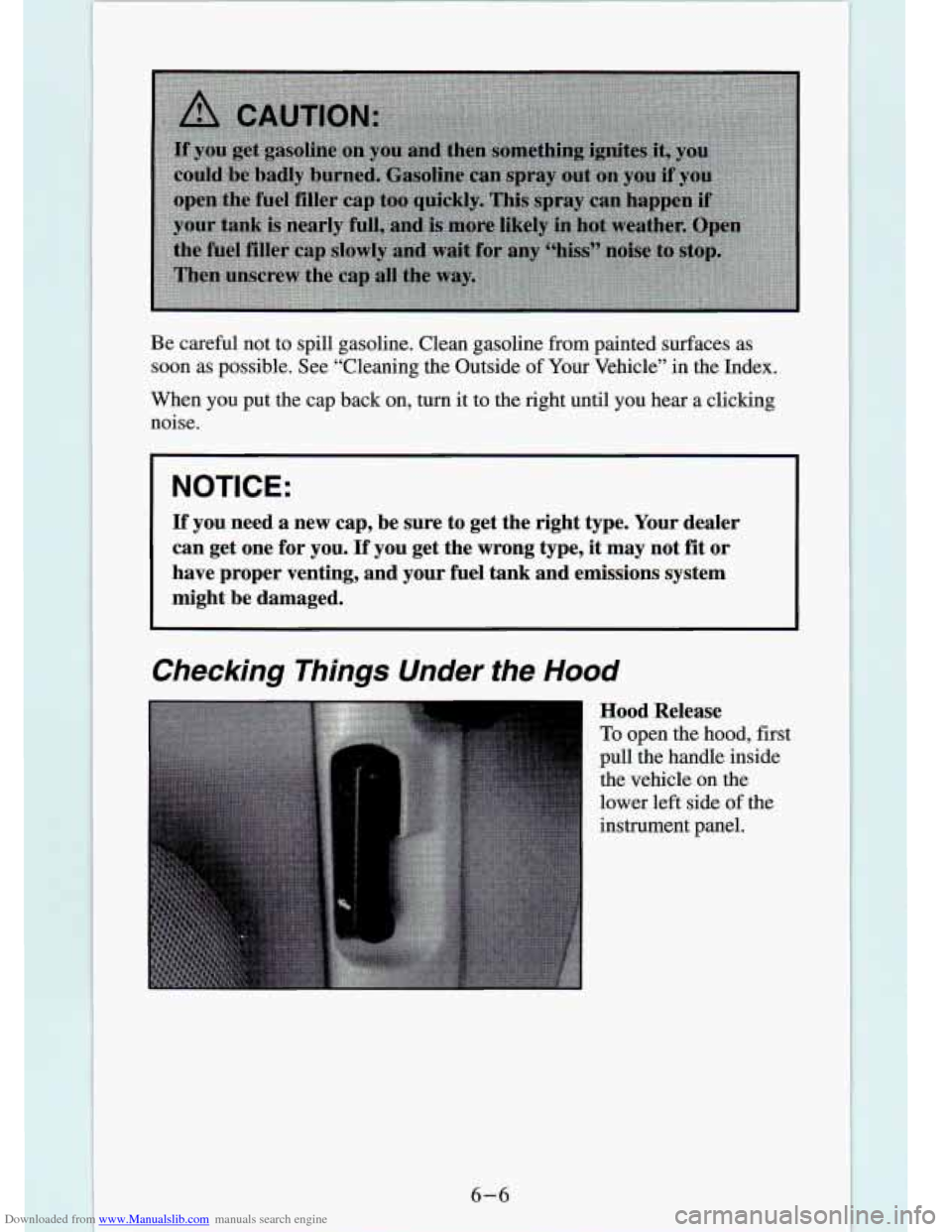
Hood Release
To open the hood, first
pull the handle inside
the vehicle on the
, lower left side of the
~ instrument panel.
6-6
Page 227 of 340
Downloaded from www.Manualslib.com manuals search engine Engine Oil
It’s a good idea to check your engine oil every time you get fuel. In order to
get an accurate reading, the oil must be warm
and the vehicle must be on
level ground.
Turn
off the engine
and give the oil a
few
rninutes to drain back
into the
oil pan. If you
don’t, the oil dipstick
might not show the
actual level.
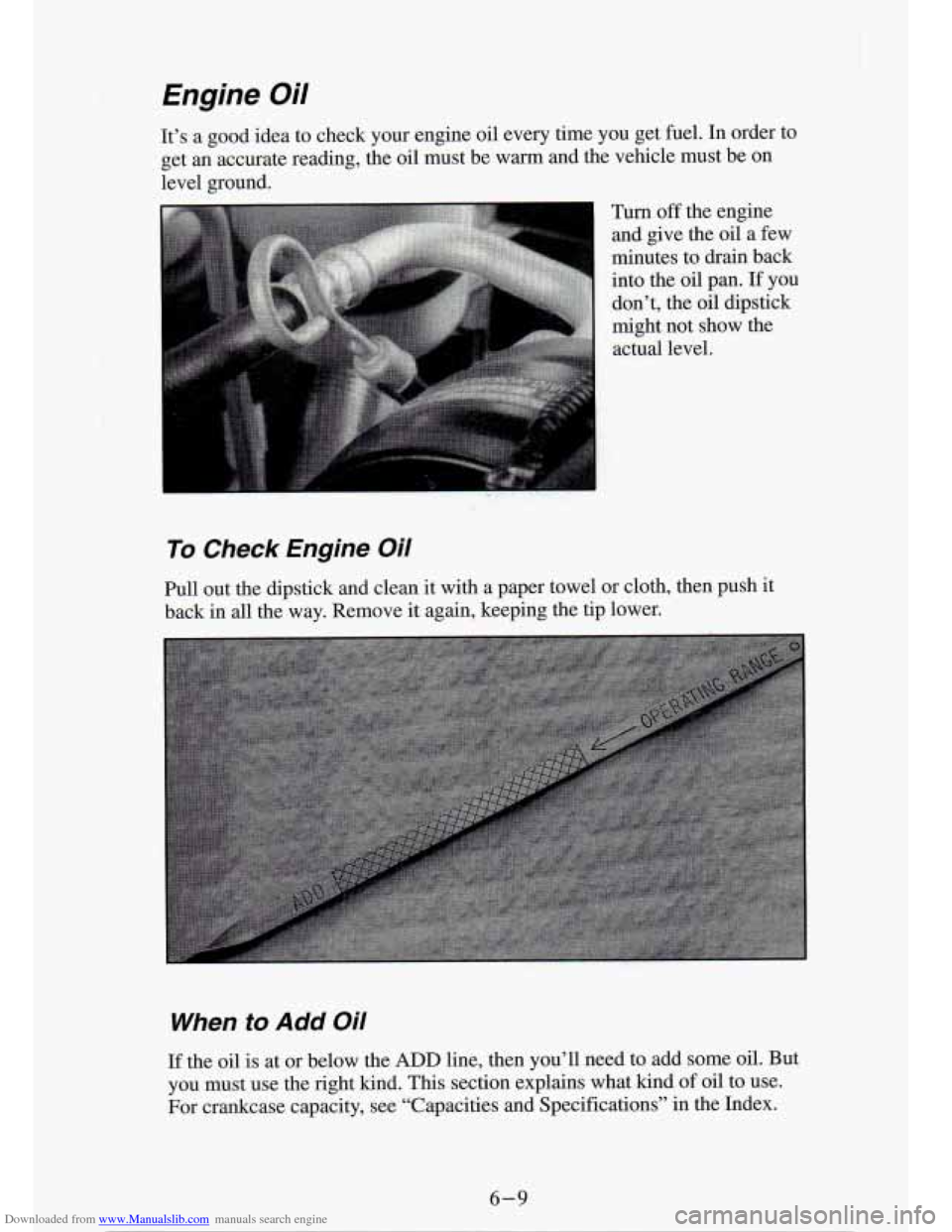
To Check Engine Oil
Pull out the dipstick and clean it with a paper towel or cloth, then push it
back in all the way. Remove it again, keeping the tip lower.
When to Add Oil
If the oil is at or below the ADD line, then you’ll need to add some oil. But
you must use the right kind.
This section explains what kind of oil to use.
For crankcase capacity, see “Capacities and Specifications” in the Index.
6-9
Page 229 of 340
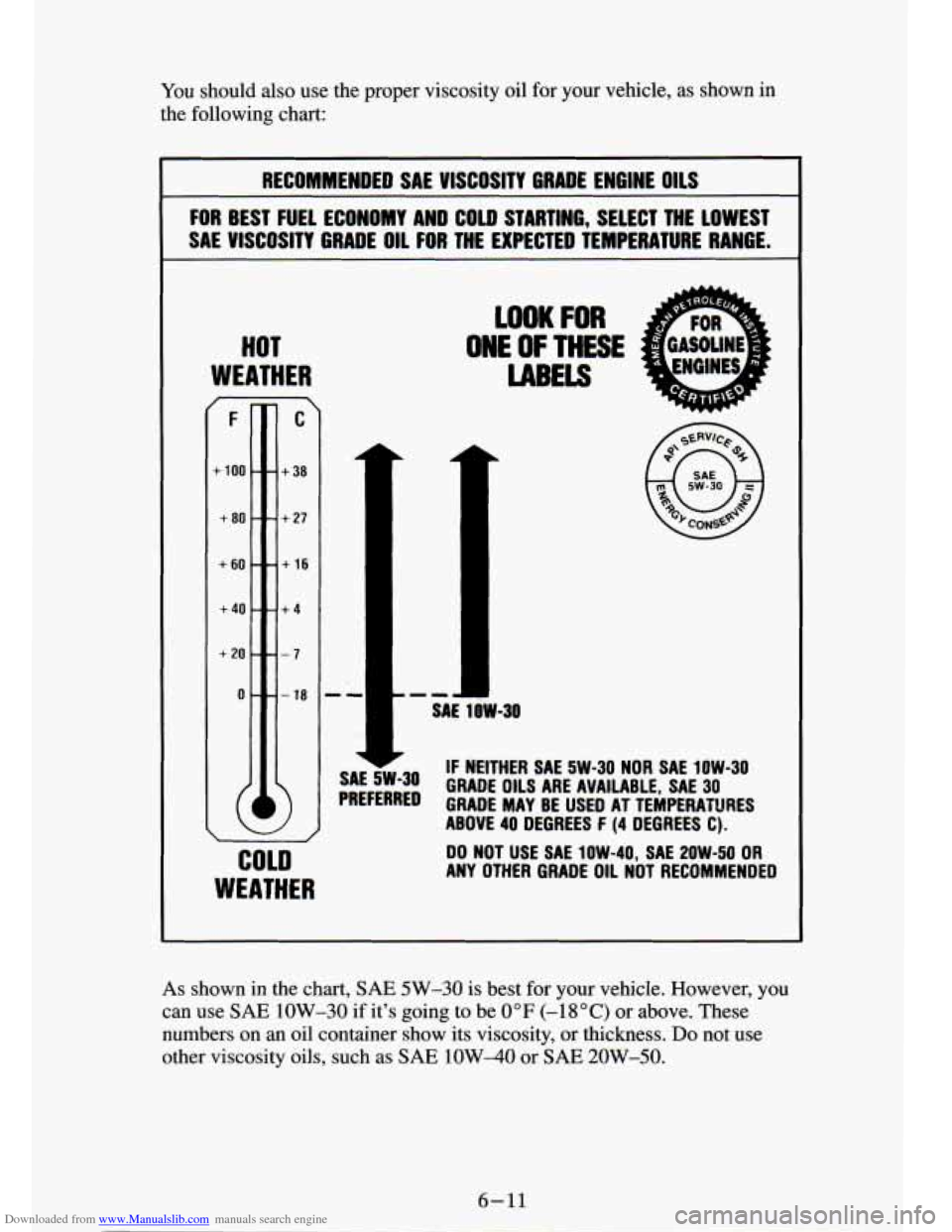
Downloaded from www.Manualslib.com manuals search engine You should also use me proper viscosity oil for your vehicle, as shown in
the following chart:
RECOMMENDED SAE VISCOSITY GRADE ENGINE OILS
FOR BEST FUEL ECONOMY AND COLD STARTING, SELECT THE LOWEST
SAE VISCOSITY GRADE
OIL FOR THE €XPECTED TEMPERATURE RANGE.
HOT
WEATHER
/F
-
+loo - -
+80 --
+60 --
+40 - -
+20 - -
O--
1
C
- +38
- + 27
- +16
-+4
- -7
- -18
COLD
WEATHER
SAE SW-30
PREFERRED
LOOK FOR
ONE OF THESE
LABELS
SA! 1OW-30
IF NEITHER SAE 5W-30 NOR SAE 1OW-30
GRADE
OILS ARE AVAILABLE, SAE 30
GRADE MAY BE USED AT TEMPERATURES
ABOVE
40 DEGRfES F (4 DEGREES C).
ANY OTHER GRADE OIL NOT RECOMMENDED
DO
NOT USE SAE 1OW-40, SAE
2OW-50 OR
As shown in the chart, SAE 5W-30 is best for your vehicle. However, you
can use
SAE 1OW-30 if it's going to be 0°F (-18 "C) or above. These
numbers on an
oil container show its viscosity, or thickness. Do not use
other viscosity oils, such as
SAE 1OW-40 or SAE 20W-50.
6-11
Page 230 of 340
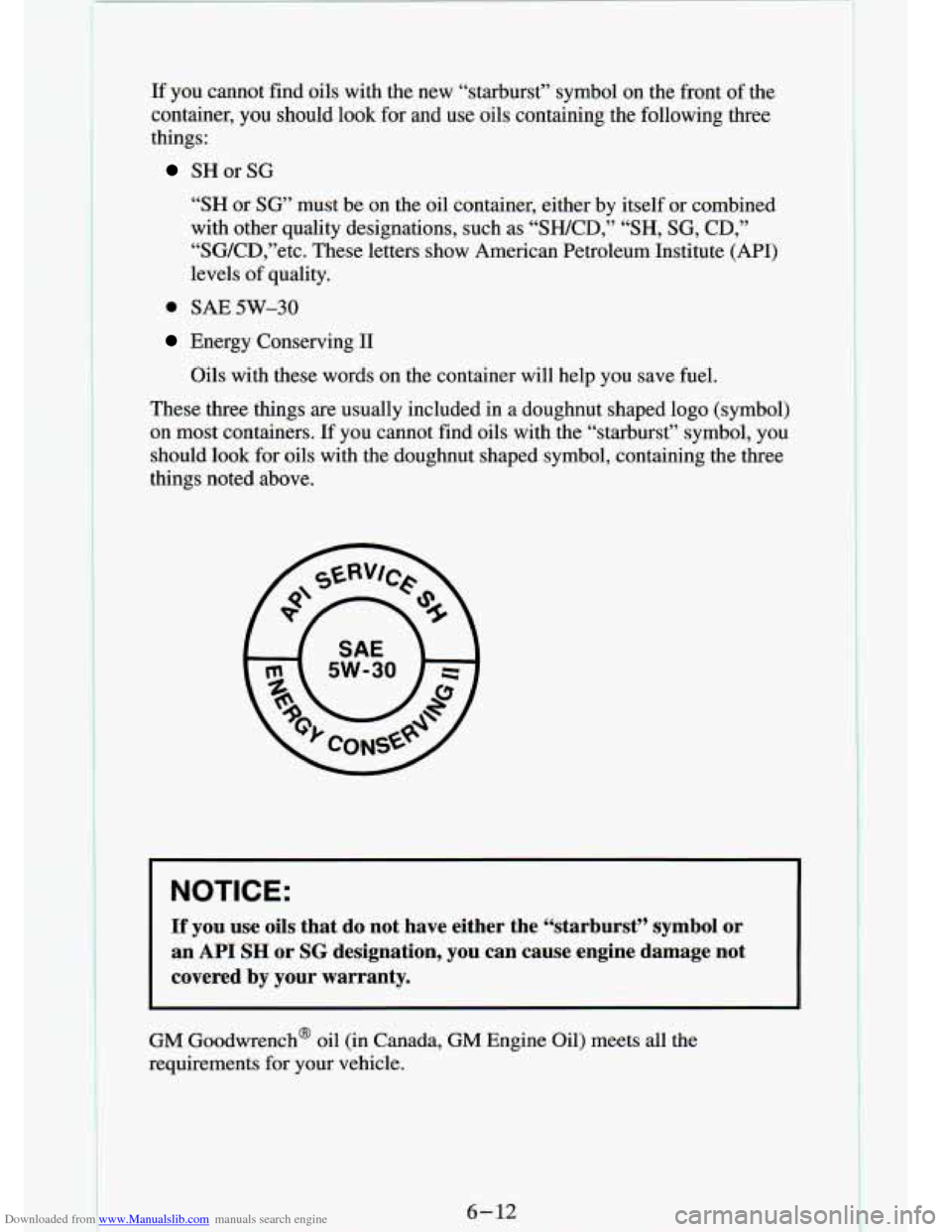
Downloaded from www.Manualslib.com manuals search engine If you cannot find oils with the new “starburst” symbol on the front of the
container,
you should look for and use oils containing the following three
things:
SHor SG
“SH or SG” must be on the oil container, either by itself or combined
with other quality designations, such as “SWCD,”
“SH, SG, CD,”
“SG/CD,”etc. These letters show American Petroleum Institute\
(API)
levels of quality.
0 SAE 5W-30
Energy Conserving I1
Oils with these words on the container will help you save fuel.
These three things are usually included in a doughnut shaped logo (\
symbol)
on most containers.
If you cannot find oils with the “starburst” symbol, you
should look for oils with the doughnut shaped symbol, containing the three
things noted above.
NOTICE:
If you use oils that do not have either the “starburst” symbol or
an
API SH or SG designation, you can cause engine damage not
covered by your warranty.
GM Goodwrench@ oil (in Canada, GM Engine Oil) meets all the
requirements for your vehicle.
1
6- 12
Page 246 of 340
Downloaded from www.Manualslib.com manuals search engine Windshield Washer Fluid
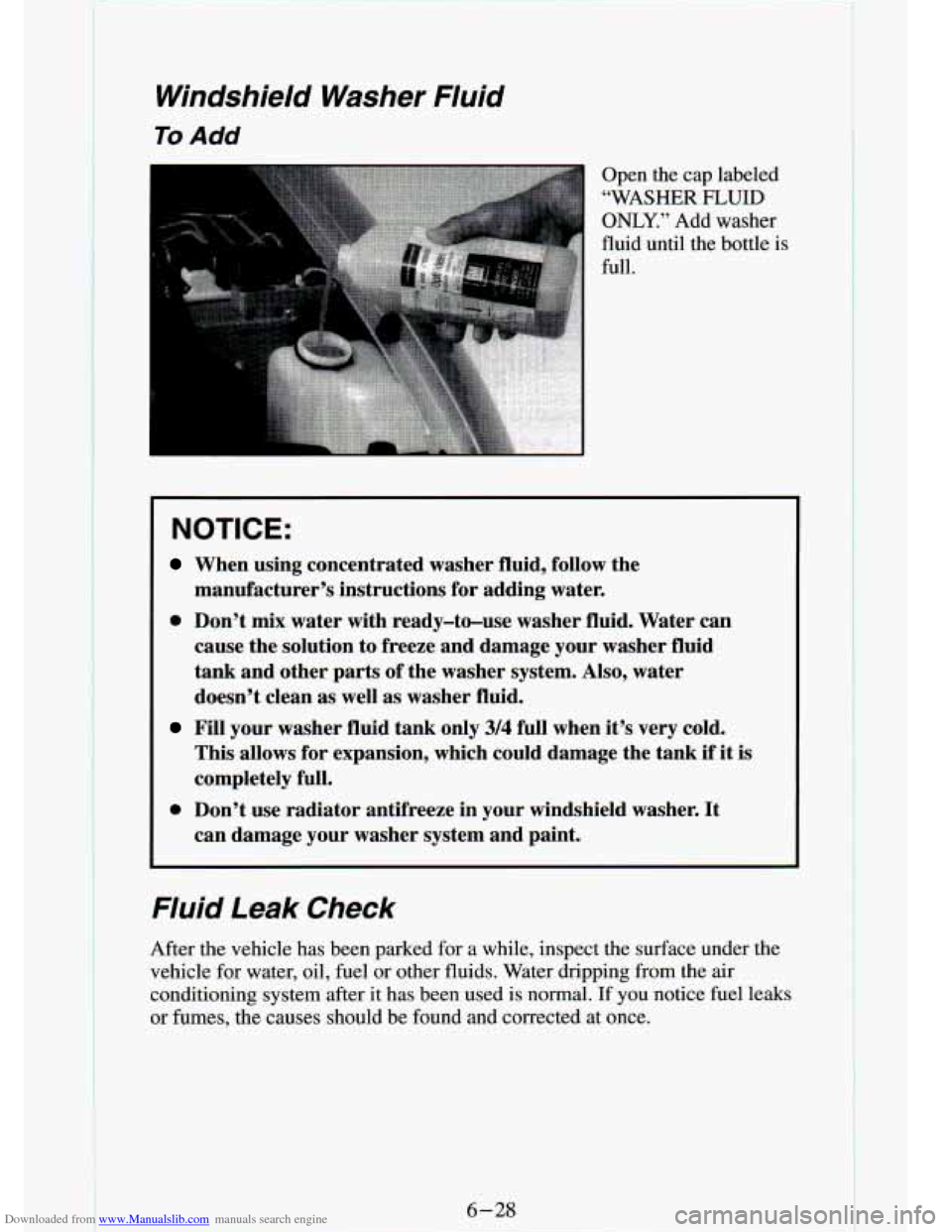
To Add
I Open the cap labeled
“WASHER
FLUID
ONLY.” Add washer
fluid until the bottle
is
full.
NOTICE:
When using concentrated washer fluid, follow the
manufacturer’s instructions for adding water.
0 Don’t mix water with ready-to-use washer fluid. Water can
cause the solution
to freeze and damage your washer fluid
tank and other parts
of the washer system, AIso, water
doesn’t clean as well as washer fluid.
Fill your washer fluid tank only 3/4 full when it’s very cold.
This allows for expansion, which could damage the tank
if it is
completely full.
can damage your washer system and paint.
0 Don’t use radiator antifreeze in your windshield washer. It
Fluid Leak Check
After the vehicle has been parked for a while, inspect the su\
rface under the
vehicle for water, oil, fuel or other fluids. Water dripping from the air
conditioning system after it has been used is normal. If you notice fuel leaks
or fumes, the causes should be found and corrected at once.
6-28
Page 251 of 340
Downloaded from www.Manualslib.com manuals search engine Fluid Leak Check
After the vehcle has been parked for awhile, inspect the surface under the
vehicle
for water, oil, fuel OX other fluids. Water dripping from the air
conditioning system after it has been used is normal. If you notice fuel leaks
or fumes, the causes should be found and corrected at once.
Bulb Replacement
Before you replace any bulbs, be sure that all the lights are off and the
engine isn’t running.
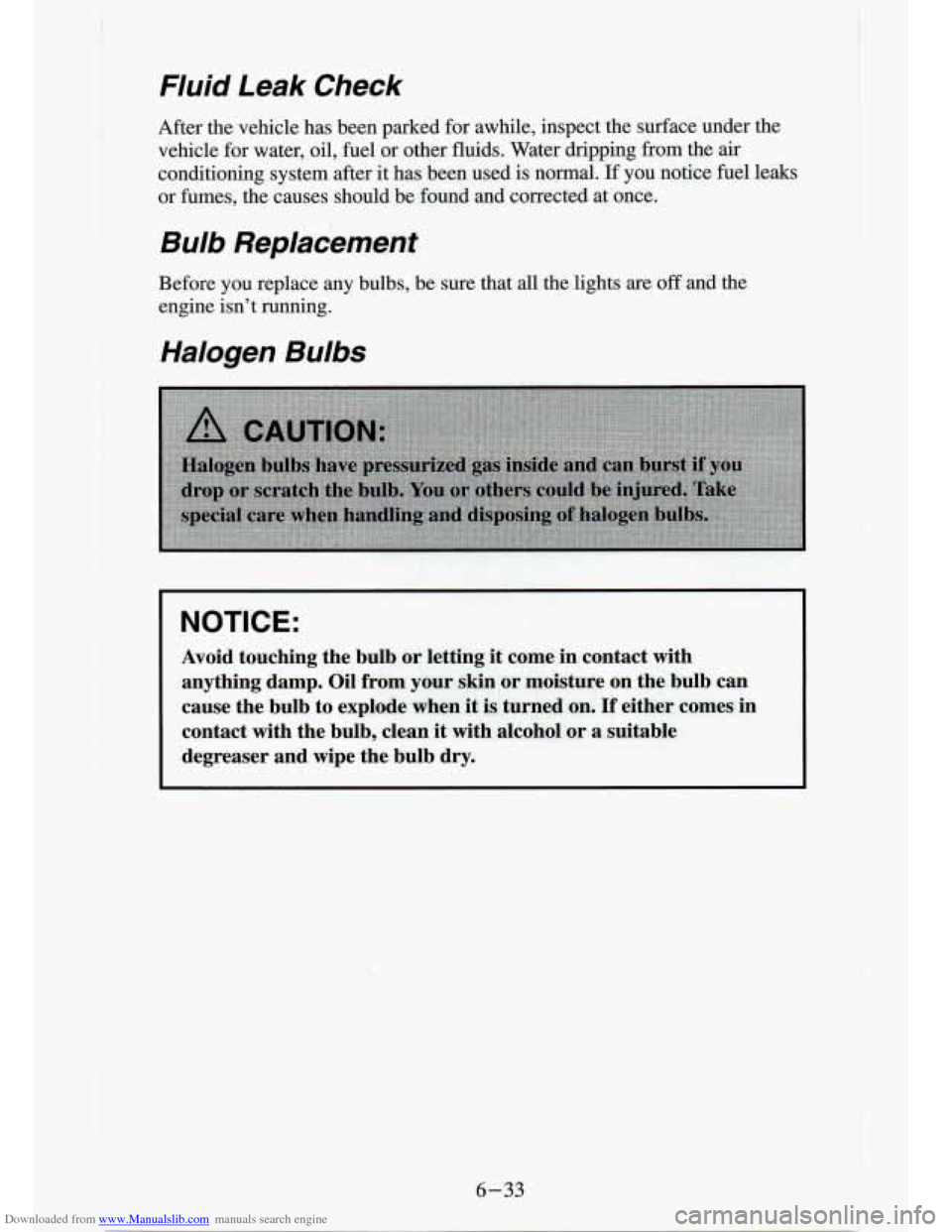
Halogen Bulbs
NOTICE:
Page 262 of 340
Downloaded from www.Manualslib.com manuals search engine Lock Cylinders
To be sure your locks operate properly, they must be lubricated.
Refer to the Maintenance Schedule to determine
how often to lubricate them
and what type
of lubricant to use.
You should not use penetrating oils because they could wash out the factory
installed lubricant and cause
the lock to bind. De-icers which contain
alcohol could
also wash away the lubricant, so be sure to lubricate the lock
after using a de-icer of this type.
Tailgate Handle
The tailgate handle pivot points on your vehicle should be lubricated to keep
the handle working smoothly.
Refer to the Maintenance Schedule to determine
how often to lubricate them
and what type
of lubricant to use.
Exhaust System
To help prevent damage to your exhaust system, do not continue to drive
your vehicle if you notice:
Engine misfiring
Loss of performance
Other unusual operating conditions
Have your engine and exhaust system serviced regularly.
Three- Way Catalytic Converter
Your vehicle's three-way catalytic converter is designed to reduce the
pollutants in your vehicle's exhaust. Use only unleaded fuel in your vehicle.
If you use leaded fuel, you could damage your three-way catalytic converter
and other engine components.
Malfunction Indicator Lamp (SERVICE ENGINE SOON )
This light on your instrument panel lets you know when your emission
system needs service. The light will come on briefly when you start your
engine to let you know that the system
is working. If it does not come on
when you start your engine, or if it comes on and stays on while you're
driving, your system may
need service. Your vehicle should still be
driveable, but you should have your system serviced right away.
6-44
Page 263 of 340
Downloaded from www.Manualslib.com manuals search engine Engine Control Module System
This system has an oxygen (02) sensor that helps keep your engine’s
air-fuel mixture at a proper level. Use only unleaded fuel in your vehicle.
If
you use leaded fuel, you could damage your oxygen (02) sensor and affect
your vehicle’s emissions.
Loading Your Vehicle
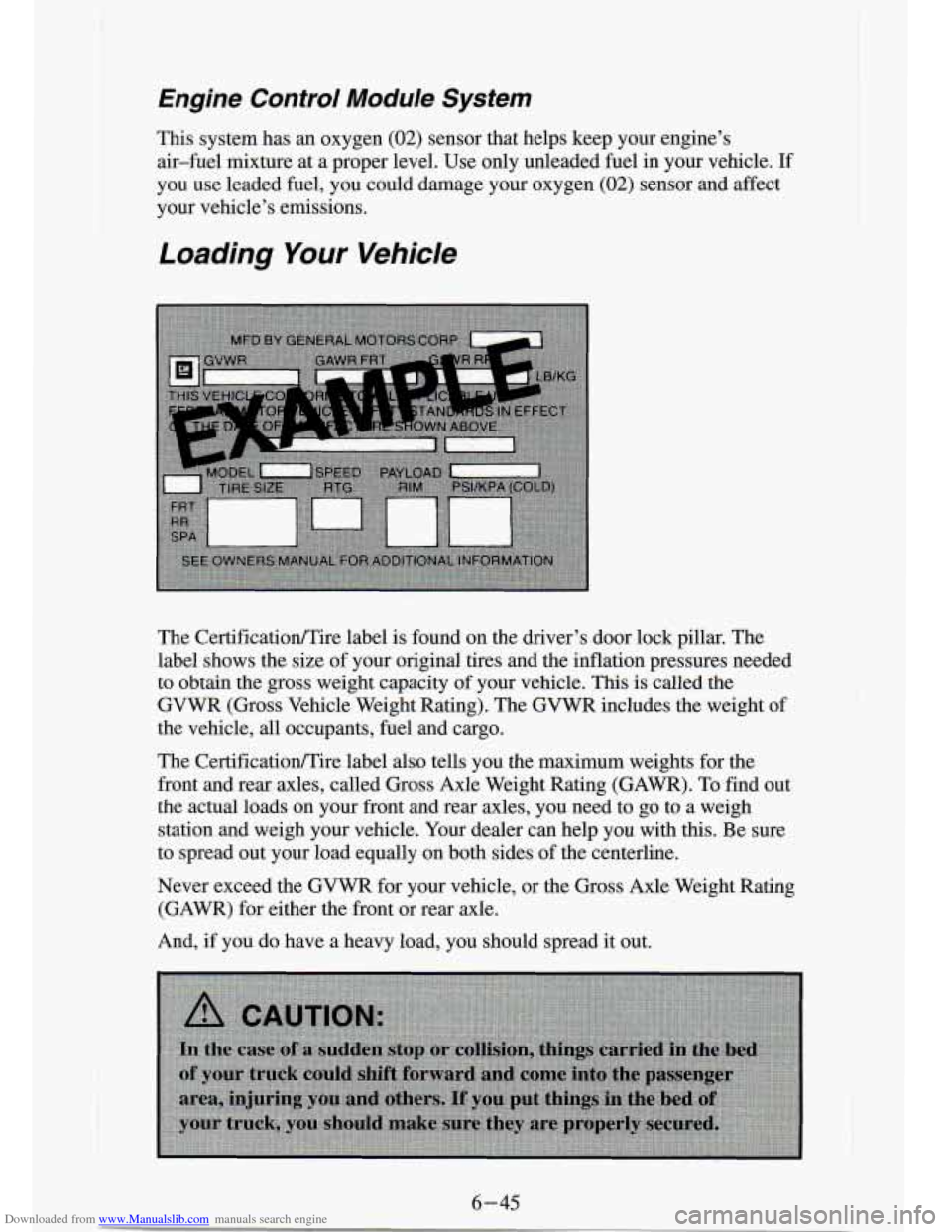
The CertificatiodTire label is found on the driver’s door lock pillar. The
label shows the size of your original tires and the inflation pressures needed
to obtain the
gross weight capacity of your vehicle. This is called the
GVWR (Gross Vehicle Weight Rating). The GVWR includes the weight of
the vehicle,
all occupants, fuel and cargo.
The CertificatiodTire label
also tells you the maximum weights for the
front and rear axles, called Gross Axle Weight Rating
(GAWR). To find out
the actual
loads on your front and rear axles, you need to go to a weigh
station and weigh
your vehicle. Your dealer can help you with this. Be sure
to spread out your load equally
on both sides of the centerline.
Never exceed the GVWR for your vehicle, or the Gross Axle Weight Rating
(GAWR) for either the front or rear axle.
And, if you do have a heavy load, you should spread it out.
6-45
Page 270 of 340
Downloaded from www.Manualslib.com manuals search engine Inflation - Tire Pressure
The CertificatiodTire label which is on the driver’s door lock pillar, shows
the correct inflation pressures for your tires, when they’re cold. ‘‘C01d’~
means your vehicle has been sitting for at least three hours or driven no
more than a mile.
NOTICE:
Don’t let anyone tell you that underinflation or overinflation is
all right. It’s not. If your tires don’t have enough air
(underinflation) you can get:
0 Too much flexing
0 Too much heat
0 Tire overloading
Bad wear
Bad handling
Bad fuel economy.
If your tires have too much air (overinflation), you can get:
Unusual wear
0 Bad handling
Rough ride
0 Needless damage from road hazards.
Page 285 of 340
Downloaded from www.Manualslib.com manuals search engine Underbody Maintenance
Chemicals used for ice and snow removal and dust control can collect on
the underbody. If these are not removed, accelerated corrosion \
(rust) can
occur on the underbody parts such as fuel lines, frame, floor \
pan, and
exhaust system even though they have corrosion protection.
At least every spring, flush these materials from the underbody\
with plain water. Clean any areas where mud and other debris can collect.\
Dirt packed
in closed areas of the frame should be loosened before being flushed.
Your
dealer or an underbody vehicle washing system can do this for you.
Chemical Paint Spotting
Some weatherand atmospheric conditions can cre; a chemical fallout.
Airborne pollutants can fall upon and attack paintea surfaces on your
vehicle. This damage can take two forms: blotchy, ringlet-shape \
discolorations, and small irregular dark spots etched into the \
paint
sur - :e.
Although no defect in the paint job causes
this, GM will repair, at no charge
to the owner, the surfaces of new vehicles damaged by this fallout condition
within 12 months or 12,000 miles (20
000 km) of purchase, whichever
comes first.
-'
This applies only to materials manufactured and sold by General Motors.
Bodies, body conversions or equipment not made or sold by Gene\
ral Motors are not covered.
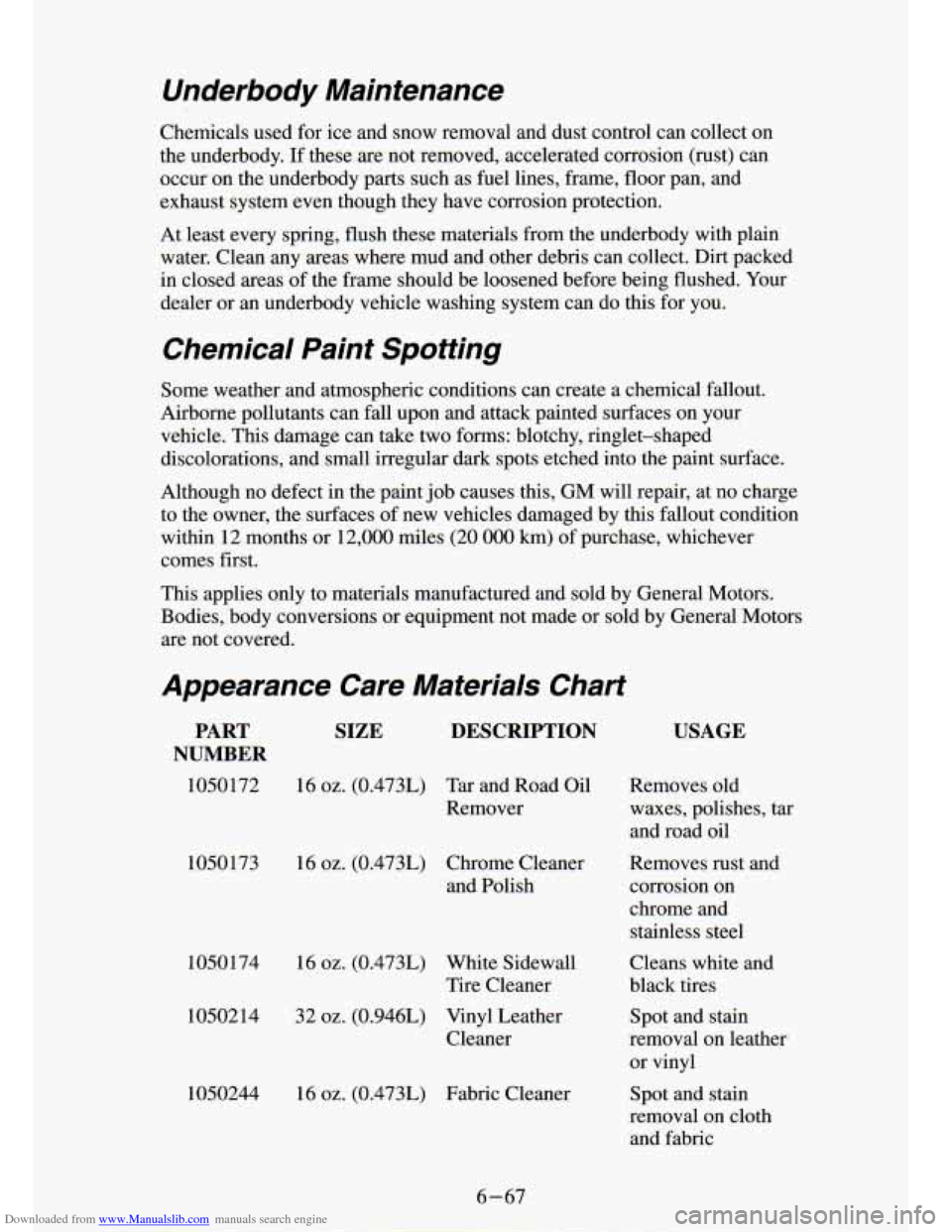
Appearance Care Materials Chart
PART SIZE DESCRIPTION
NUMBER
1050172 16 oz. (0.473L) Tar and Road Oil Removes old
Remover waxes, polishes, tar and road oil
16
oz. (0.473L) Chrome Cleaner Removes rust and and Polish corrosion on
chrome and
sta ess steel
1050173
1050174 16
oz. (0.473L) White Sidewall
Tire Cleaner
1050214 32
oz. (0.946L) Vinyl Leather
Cleaner
1050244 16
oz. (0.473L) Fabric Cleaner
USAGE
Spot and stain
removal on leather
or vinyl
Spot and stain
removal on cloth and fabric
6- 67