towing CHEVROLET S10 1994 2.G Owner's Manual
[x] Cancel search | Manufacturer: CHEVROLET, Model Year: 1994, Model line: S10, Model: CHEVROLET S10 1994 2.GPages: 340, PDF Size: 18.45 MB
Page 193 of 340
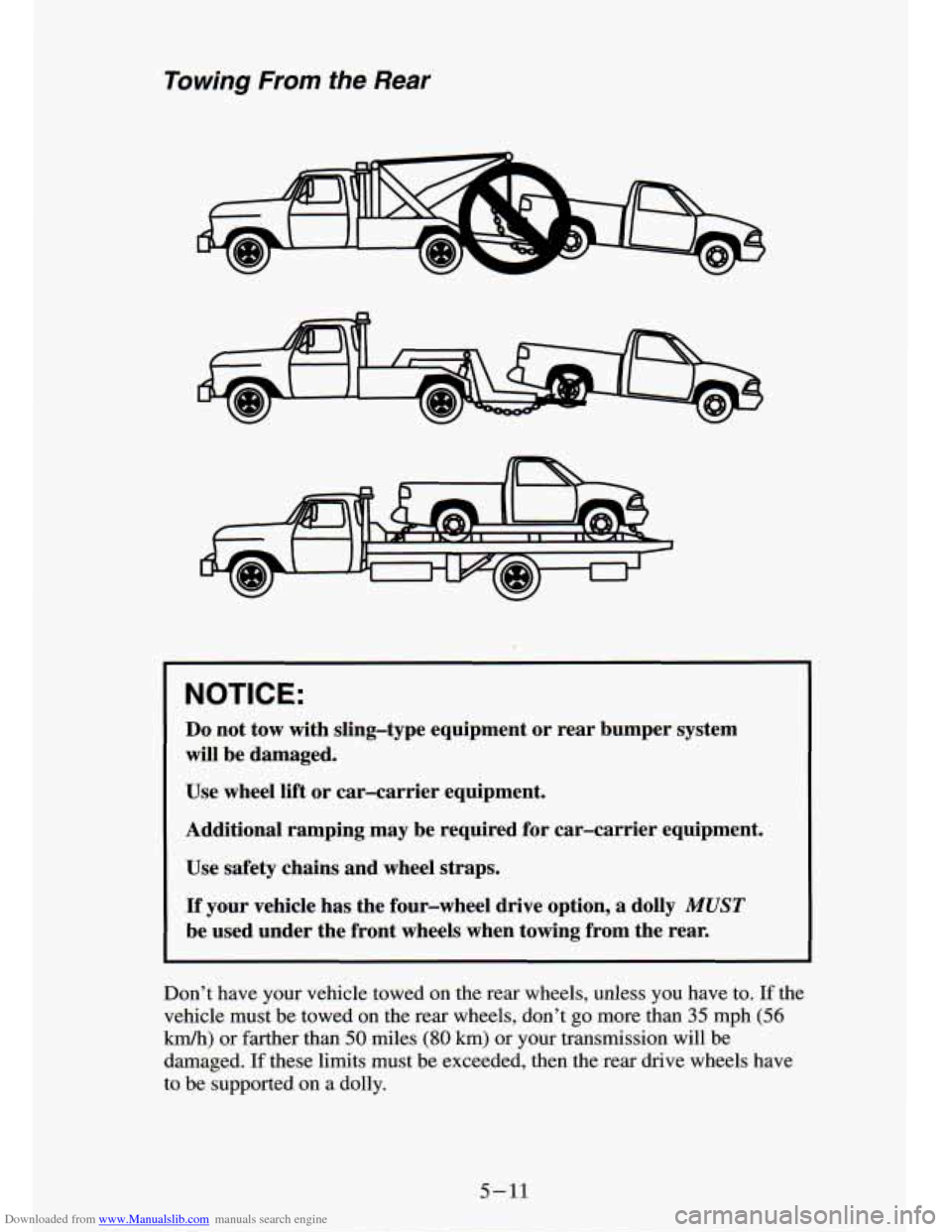
Downloaded from www.Manualslib.com manuals search engine Towing From the Rear
NOTICE:
Do not tow with sling-type equipment or rear bumper system
will be damaged.
Use wheel lift or car-carrier equipment.
Additional ramping may be required for car-carrier equipment.
: . .A. :i.-.
Use safety chains and wheel straps.
If your vehicle has the four-wheel drive option, a dolly MUST
be used under the front wheels when towing from the rear.
Don’t have your vehicle towed on the rear wheels, unless you have to. If the
vehicle must be towed on the rear wheels, don’t go more th\
an
35 mph (56
km/h) or farther than 50 miles (80 km) or your transmission will be
damaged.
If these limits must be exceeded, then the rear drive wheels have
to be supported on a dolly.
5-11
Page 201 of 340
Downloaded from www.Manualslib.com manuals search engine 7. By this time the coolant level inside the filler neck may be lower. If the
level is lower, add more of the proper
mix through the filler neck until
the level reaches the base of the filler neck.
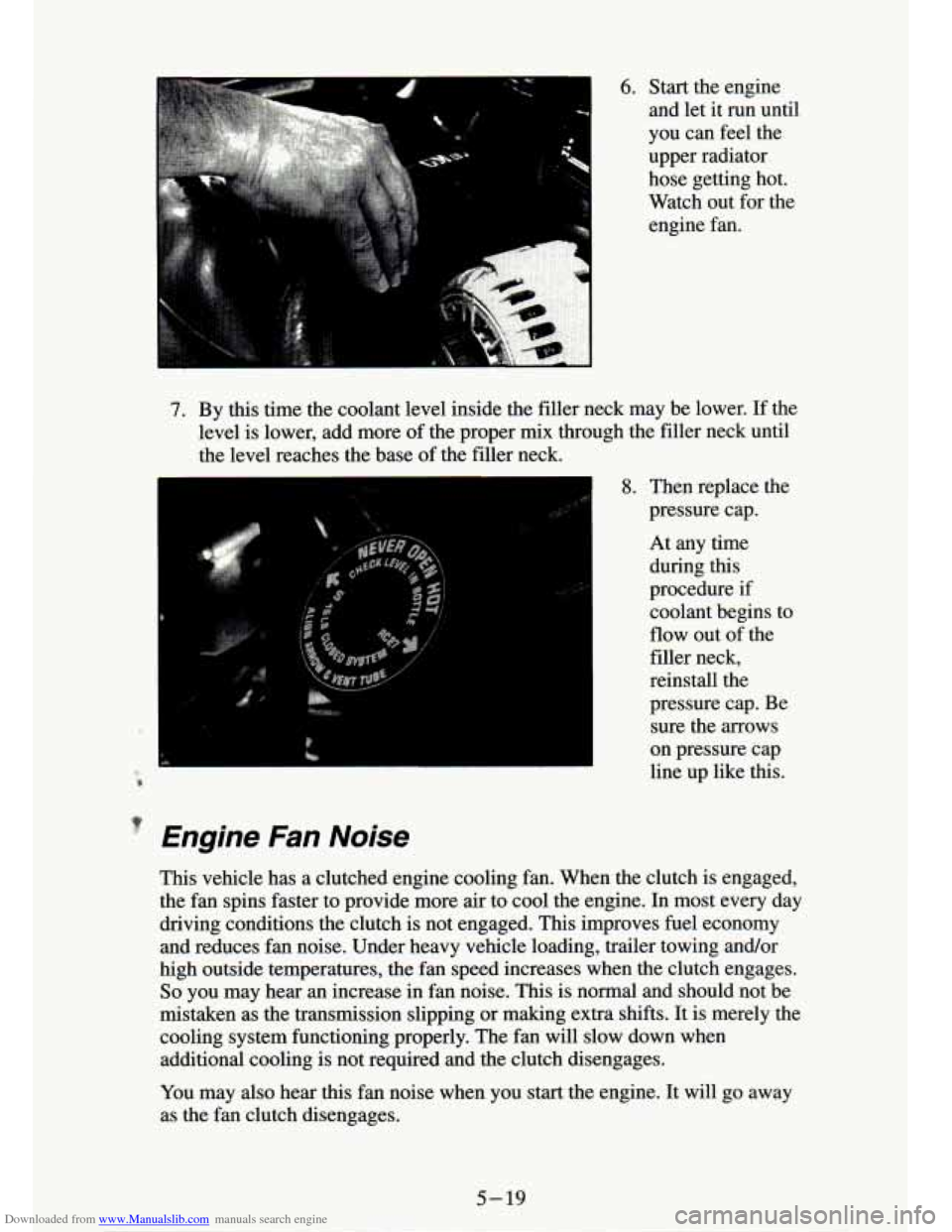
8. Then replace the
pressure cap.
At any time during
this
procedure if coolant begins to
flow out of the
filler neck,
reinstall the
pressure cap. Be sure the arrows
on pressure cap
line up like this.
P
' Engine Fan Noise
This vehicle has a clutched engine cooling fan. When the clutch is engaged,
the fan spins faster to provide more air
to cool the engine. In most every day
driving conditions the clutch is not engaged. This improves fuel economy
and reduces fan noise. Under heavy vehicle loading, trailer towing and/or
high outside temperatures, the fan speed increases when the clutch engages.
So you may hear an increase in fan noise. This is normal and should not be
mistaken as the transmission slipping or making extra shifts. It is merely the
cooling system functioning properly. The fan will slow down when
additional cooling is not required and the clutch disengages.
You may also hear this fan noise when you
start the engine. It will go away
as the
fan clutch disengages.
5-19
Page 206 of 340
Downloaded from www.Manualslib.com manuals search engine Underbody Carrier
NOTICE:
Never remove or restow a tire from/to a stowage position under
the vehicle while the vehicle is supported
by a jack. Always
tighten the tire fully against the underside
of the vehicle when
restowing.
I
5
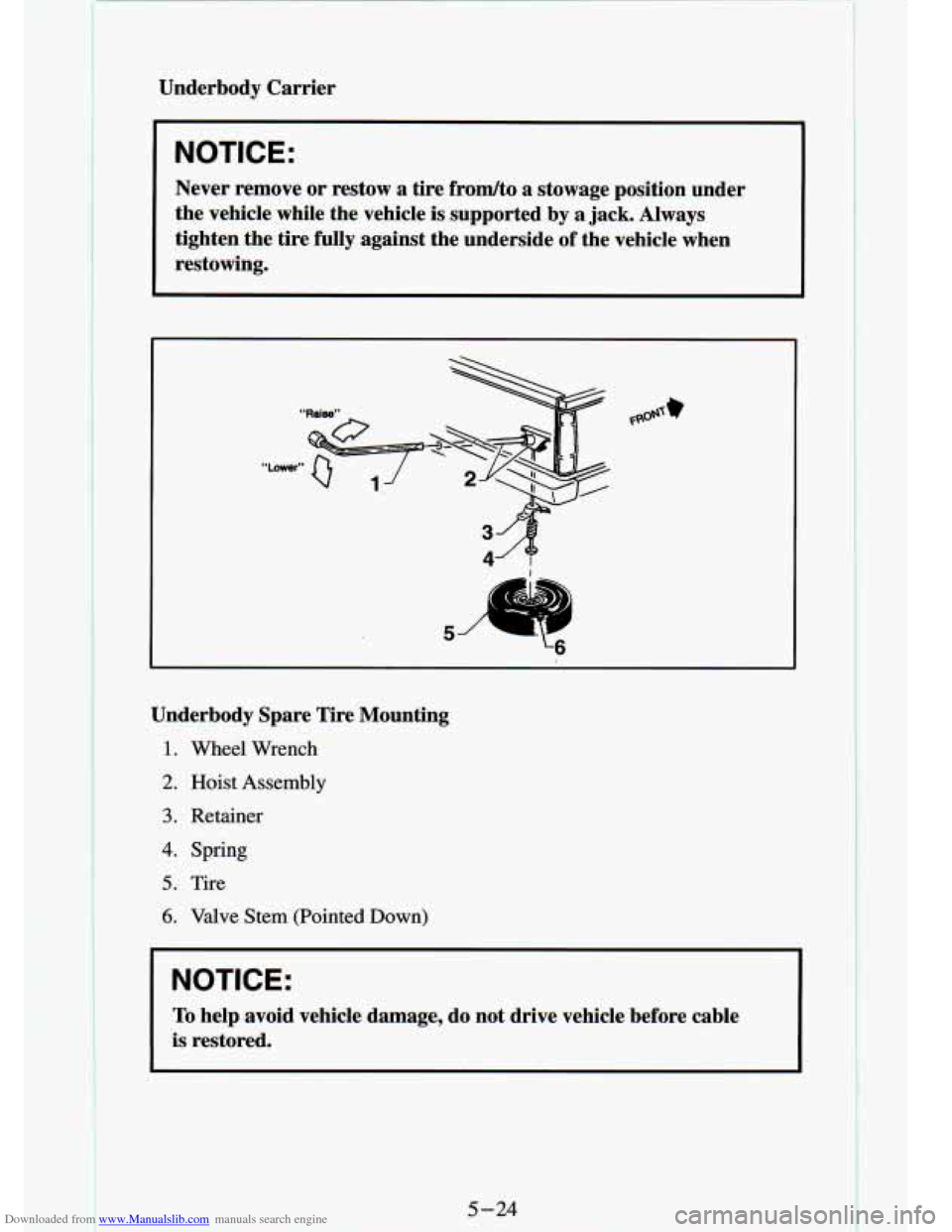
Underbody Spare Tire Mounting
1. Wheel Wrench
2. Hoist Assembly
3. Retainer
4. Spring
5. Tire
6. Valve Stem (Pointed Down)
NOTICE:
To help avoid vehicle damage, do not drive vehicle before cable
is restored.
5-24
I
Page 217 of 340
Downloaded from www.Manualslib.com manuals search engine Rocking your vehicle to get it out:
First, turn your steering wheel left and right. That will clear the area around
your front wheels. Then shift back and forth between
“R’ (Reverse) and a
forward gear (or with a manual transmission, between First or \
Second gear and Reverse), spinning the wheels as little as possible. Release the
accelerator pedal while you shift, and press lightly on the accelerator pedal
when the transmission is
in gear. If that doesn’t get you out after a few .tries,
you may need to be towed out. Or, you can use your recovery hooks, if your
vehicle has them.
If you do need to be towed out, see “Towing Your
Vehicle” in the Index.
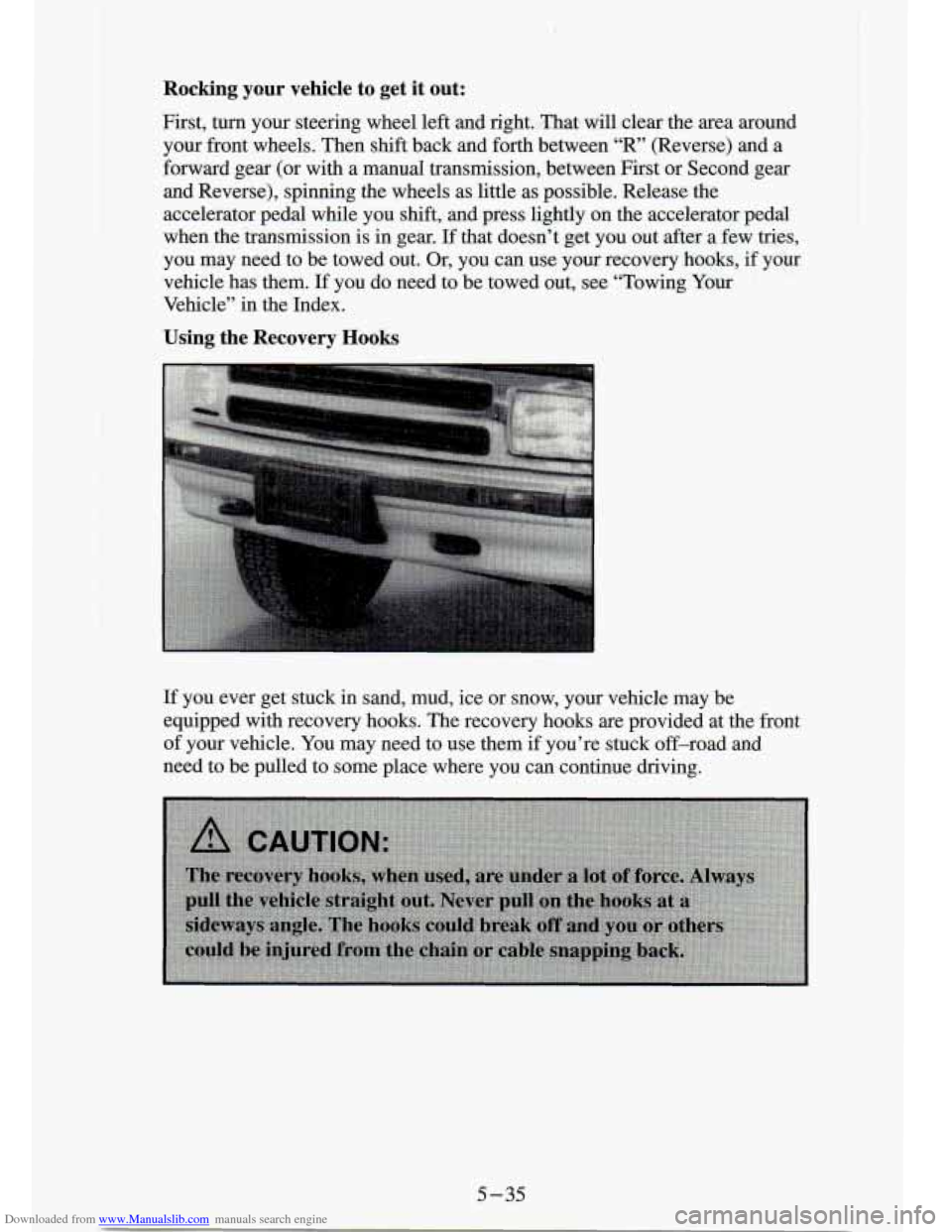
Using the Recovery Hooks
If you ever get stuck in sand, mud, ice or snow, your vehicle may be
equipped with recovery hooks. The recovery hooks are provided at the front
of your vehicle. You may need to use them if you’re stuck off-road and
need to be pulled to some place where you can continue driving.
5-35
Page 268 of 340

Downloaded from www.Manualslib.com manuals search engine You must weigh any accessories, trailer hitches or other equipment you a\
dd
to your vehicle. Then, subtract this extra weight from the CWR\
. This extra weight may shorten the center of gravity zone for your vehicle. Your dealer
can help you with this.
If your slide-in camper and its load weigh less than the CWR, the center of
gravity zone
for your vehicle may be larger.
Your dealer can help you make a good vehicle-camper match. He’ll also
help you determine your CWR.
After you’ve loaded your vehicle and camper, drive to a wei\
gh station and weigh on the front and rear wheels separately. This will tell you the loads on
your axles. The loads on the front and rear axles shouldn’t be more than
either
of the GAWRs. The total of the axle loads should not be more than
the GVWR.
Open your driver’s door and look at the door lock pillar for the
CertificationD‘ire label to find out your GAWR and GVWR.
11 you ve gone over ; Jr weight ratings, move or take out some things until
all the weights fall below the ratings. Of course, you should always tie down
any loose items when you load your vehicle or camper.
When you install and load your slide-in camper, check the manu\
facturer’s instructions.
If you want more information on curb weights, cargo weights, cargo weight
rating and the correct center of gravity zone for your vehicle, your dealer
can help you. Just ask for a copy of “Consumer Information, Truck
-
Camper Loading.”
Trailer Recommendations
You must subtract your hitch loads from the CWR for your vehicle. Weigh
your vehicle with your trailer attached,
so that you won’t go over the
GVWR or the GAWR.
You’ll get the best performance if you spread out the weight of your load
the right way, and if you choose the correct hitch and trailer brakes.
For more information, see “Trailer Towing’’ in the Index.
Pickup Conversion To Chassis Cab
General Motors is aware that some vehicle owners may consider having the
pickup
box removed and a commercial or recreational body installed.
However, we recommend that conversions of this type not be done to this
pickup. Owners should be aware that, as manufactured, there are differences
between a chassis cab and a pickup with the box removed which\
may affect vehicle safety.
For further information, contact the GM Zone Office for your
area. (See the “Warranty and Owner Assistance” booklet fo\
r Zone Office.)
6 --50
Page 320 of 340

Downloaded from www.Manualslib.com manuals search engine Chevrolet Rc rdside Assistance Program
To enhance Chevrolet’s strong commitment to customer satisfaction,\
Chevrolet is excited to provide the services
of the ChevroletIGeo Roadside
Assistance Center.
q-Hour Roadside Assistance Number
Koadside Assistance is available 24 hours a day, 365 days a year, by calling
1-800-CHEV USA (1-800-243-8872). This toll-free number will provide
you over-the-phone roadside assistance with minor mechanical problems.
If your problem cannot be resolved over the phone, our advisors have a\
ccess
to a nationwide network of dealer recommended service providers. The
following services are available:
0 Towing
0 Locksmith
Tire repair
0 Rental car or taxi
Additional services as necessary
The Roadside Assistance Center uses companies that will provide you \
with
quality and priority service. When roadside services are require\
d, our
advisors will explain any payment obligations that may be incurred for
utilizing outside services.
For prompt assistance when calling, please have the following a\
vailable to give to the advisor:
0 Vehicle Identification Number
License plate number
0 Vehicle color
0 Vehicle location
0 Telephone number where you can be reached
Vehicle mileage
0 Description of problem
Canadian Roadside Assistance
Vehicles purchased in Canada have an extensive Roadside Assistan\
ce
program accessible from anywhere in Canada or the U.S.A. Please refer to
the separate brochure provided by the dealer
or call 1-800-268-6800 for
emergency services.
;L .- .I
--
I 8-6
Page 332 of 340
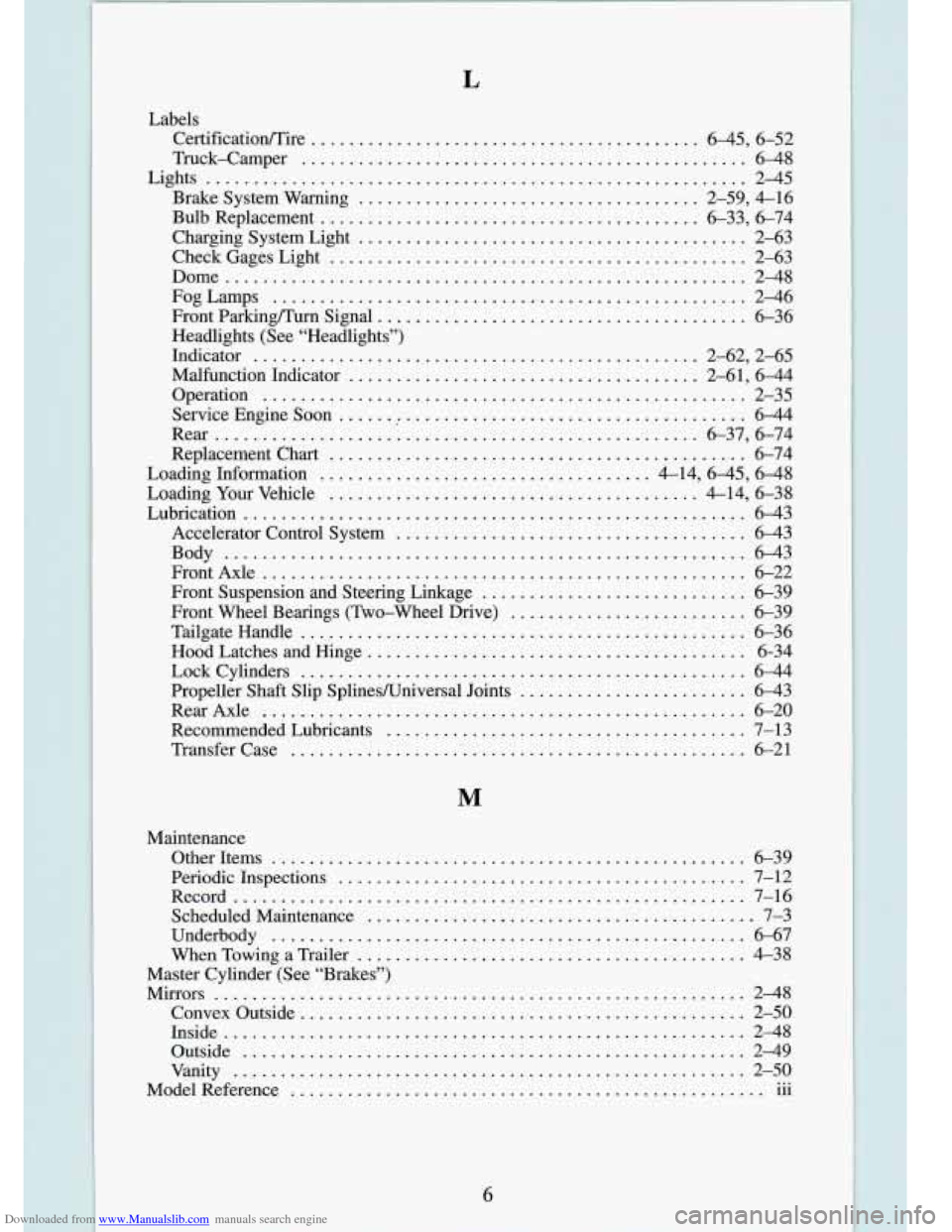
Downloaded from www.Manualslib.com manuals search engine L
Labels CertificatiodI‘ire
......................................... 6-45. 6.52
Truck-Camper
............................................... 6-48
Lights
......................................................... 2-45
Brake System Warning
.................................... 2.59. 4-16
Bulb Replacement
........................................ 6.33. 6-74
Charging System Light
......................................... 2-63
CheckGagesLight
............................................ 2-63
Dome
....................................................... 2-48
FogLamps
.................................................. 2-46
Front ParkingEurn Signal
....................................... 6-36
Headlights (See “Headlights”)
InQcator
............................................... 2.62. 2.65
Malfunction Indicator
..................................... 2.61. 6-44
Operation
................................................... 2-35
ServiceEngineSoon
........................................... 6-44
Rear
................................................... 6-37, 6-74
Replacement Chart
............................................ 6-74
Loading Information
................................... 4-14,645, 6-48
Loading Your Vehicle
....................................... 4-14, 6-38
Lubrication
..................................................... 6-43
Accelerator Control System
..................................... 6-43
Body
....................................................... 6-43
FrontAxle
................................................... 6-22
Front Suspension and Steering Linkage
............................ 6-39
Front Wheel Bearings (Two-Wheel Drive)
......................... 6-39
TailgateHandle
............................................... 6-36
HoodLatchesandHinge
........................................ 6-34
Lock Cylinders
............................................... 6-44
Propeller Shaft Slip SplinesNniversal Joints
........................ 6-43
RearAxle
................................................... 6-20
RecommendedLubricants
...................................... 7-13
Transfer Case
................................................ 6-21
M
Maintenance OtherItems
.................................................. 6-39
Record
...................................................... 7-16
ScheduledMaintenance
......................................... 7-3
Underbody
.................................................. 6-67
WhenTowingaTrailer
......................................... 4-38
Master Cylinder (See “Brakes”) Mirrors
........................................................ 2-48
Convexoutside
............................................... 2-50
Inside
....................................................... 2-48
Outside
..................................................... 2-49
Vanity
...................................................... 2-50
ModelReference
.................................................. 111
Periodic Inspections ........................................... 7-12
...
6