wheel CHEVROLET S10 1994 2.G Repair Manual
[x] Cancel search | Manufacturer: CHEVROLET, Model Year: 1994, Model line: S10, Model: CHEVROLET S10 1994 2.GPages: 340, PDF Size: 18.45 MB
Page 231 of 340
Downloaded from www.Manualslib.com manuals search engine Engine Oil Additives
Don’t add anything to your oil. Your GM dealer is ready to advise if you
think something should be added.
When to Change Engine Oil
See if any one of these is true for you:
Most trips are less than 4 miles (6 km).
0 It’s below freezing outside and most trips are less than 10 miles (16
km).
The engine is at low speed most of the time (as in door-to-door
delivery, or in stop-and-go traffic).
You tow a trailer often.
Most trips are through dusty places.
0 The vehicle is frequently operated off-road.
If any one of these is true for your vehicle, then you need to change your oil
andfilter every 3,000 miles (5 000 km) or 3 months - whichever comes
first.
If none of them is true, change the oil every
7,500 miles (12 500 km) or 12
months - whichever comes first. Change the filter at the first oil change
and at every other oil change after that.
Four-wheel Drive Remote Oil Filter
If your vehicle has four-wheel drive, you will have a remote oil filter
located under the radiator support. There is a special access \
door in the
vehicle body skirt shield.
Engine Coolant Heater (Engine Block Heater)
An engine coolant heater can be a big help if you have to park outside in
very cold weather,
0 “F (-1 8 O C) or colder. If your vehicle has this option,
see “Engine Coolant Heater
” in the Index.
What to Do with Used Oil
Did you know that used engine oil contains certain elements that may be
unhealthy for your skin and could even cause cancer? Don’t let used oil stay
on your skin for very long. Clean your skin and nails with soap and water,
or a good hand cleaner. Wash or properly throw away clothing or rags
containing wed engine oil. (See the manufacturer’s warnings about the use
and disposal of oil products.)
6-13
Page 239 of 340
Downloaded from www.Manualslib.com manuals search engine How to Check Lubricant
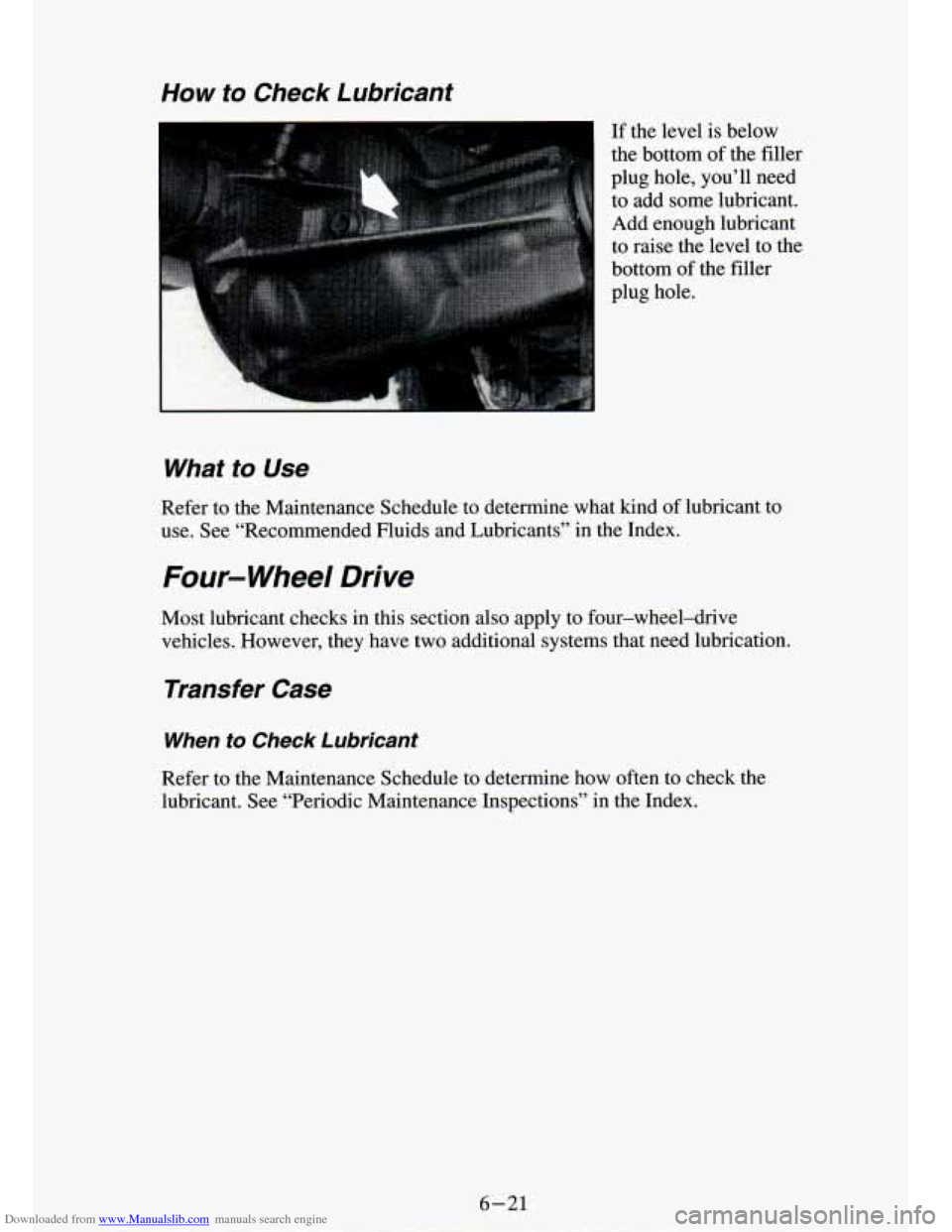
If the level is below
the bottom of the filler
plug hole, you’ll need to add some lubricant.
Add enough lubricant
to raise the level to the
bottom of the filler
plug hole.
What to Use
Refer to the Maintenance Schedule to determine what kind of lubricant to
use. See “Recommended Fluids and Lubricants” in the Index.
Four- Wheel Drive
Most lubricant checks in this section also apply to four-wheel-drive
vehicles. However, they have two additional systems that need l\
ubrication.
Transfer Case
When to Check Lubricant
Refer to the Maintenance Schedule to determine how often to ch\
eck the lubricant. See “Periodic Maintenance Inspections” in the Index.
6-21
Page 257 of 340
Downloaded from www.Manualslib.com manuals search engine Other Maintenance Items
Front Suspension and Steering Linkage
Refer to the Maintenance Schedule to determine how often to lubricate the
fittings and what type
of lubricant to use.
Front Wheel Bearings (Two-Wheel Drive)
If your vehicle is two-wheel drive, it has wheel bearings that must be
cleaned and repacked.
Refer to the Maintenance Schedule to determine how often this must be
done.
Single Belt Accessory Drive
Your new vehicle uses a serpentine belt that is lighter, and more durable
than systc
.s with several belts.
The belt runs over or around the pulleys on the engine. A tensioner is used
to keep the belt tight at all times. The tensioner also makes replacing the
belt easier if you need to replace the belt, be sure
to get the correct
replacement belt. Your dealership or parts supplier can help you with this.
The Accessory Drive Belt Routing label on your vehicle will show y\
ou how
to route the belt your vehicle uses.
Windshield Wiper Blade Replacement
NOTICE:
Use care when removing or installing a blade assembly.
Accidental bumping can cause the arm to fall back and strike
the windshield.
6-39
Page 268 of 340

Downloaded from www.Manualslib.com manuals search engine You must weigh any accessories, trailer hitches or other equipment you a\
dd
to your vehicle. Then, subtract this extra weight from the CWR\
. This extra weight may shorten the center of gravity zone for your vehicle. Your dealer
can help you with this.
If your slide-in camper and its load weigh less than the CWR, the center of
gravity zone
for your vehicle may be larger.
Your dealer can help you make a good vehicle-camper match. He’ll also
help you determine your CWR.
After you’ve loaded your vehicle and camper, drive to a wei\
gh station and weigh on the front and rear wheels separately. This will tell you the loads on
your axles. The loads on the front and rear axles shouldn’t be more than
either
of the GAWRs. The total of the axle loads should not be more than
the GVWR.
Open your driver’s door and look at the door lock pillar for the
CertificationD‘ire label to find out your GAWR and GVWR.
11 you ve gone over ; Jr weight ratings, move or take out some things until
all the weights fall below the ratings. Of course, you should always tie down
any loose items when you load your vehicle or camper.
When you install and load your slide-in camper, check the manu\
facturer’s instructions.
If you want more information on curb weights, cargo weights, cargo weight
rating and the correct center of gravity zone for your vehicle, your dealer
can help you. Just ask for a copy of “Consumer Information, Truck
-
Camper Loading.”
Trailer Recommendations
You must subtract your hitch loads from the CWR for your vehicle. Weigh
your vehicle with your trailer attached,
so that you won’t go over the
GVWR or the GAWR.
You’ll get the best performance if you spread out the weight of your load
the right way, and if you choose the correct hitch and trailer brakes.
For more information, see “Trailer Towing’’ in the Index.
Pickup Conversion To Chassis Cab
General Motors is aware that some vehicle owners may consider having the
pickup
box removed and a commercial or recreational body installed.
However, we recommend that conversions of this type not be done to this
pickup. Owners should be aware that, as manufactured, there are differences
between a chassis cab and a pickup with the box removed which\
may affect vehicle safety.
For further information, contact the GM Zone Office for your
area. (See the “Warranty and Owner Assistance” booklet fo\
r Zone Office.)
6 --50
Page 272 of 340
Downloaded from www.Manualslib.com manuals search engine lire Inspection and Rotation
To make your tires last longer, have them inspected and rotated at the
mileages recommended in the Maintenance Schedule. See “Schedul\
ed
Maintenance Services” in the Index.
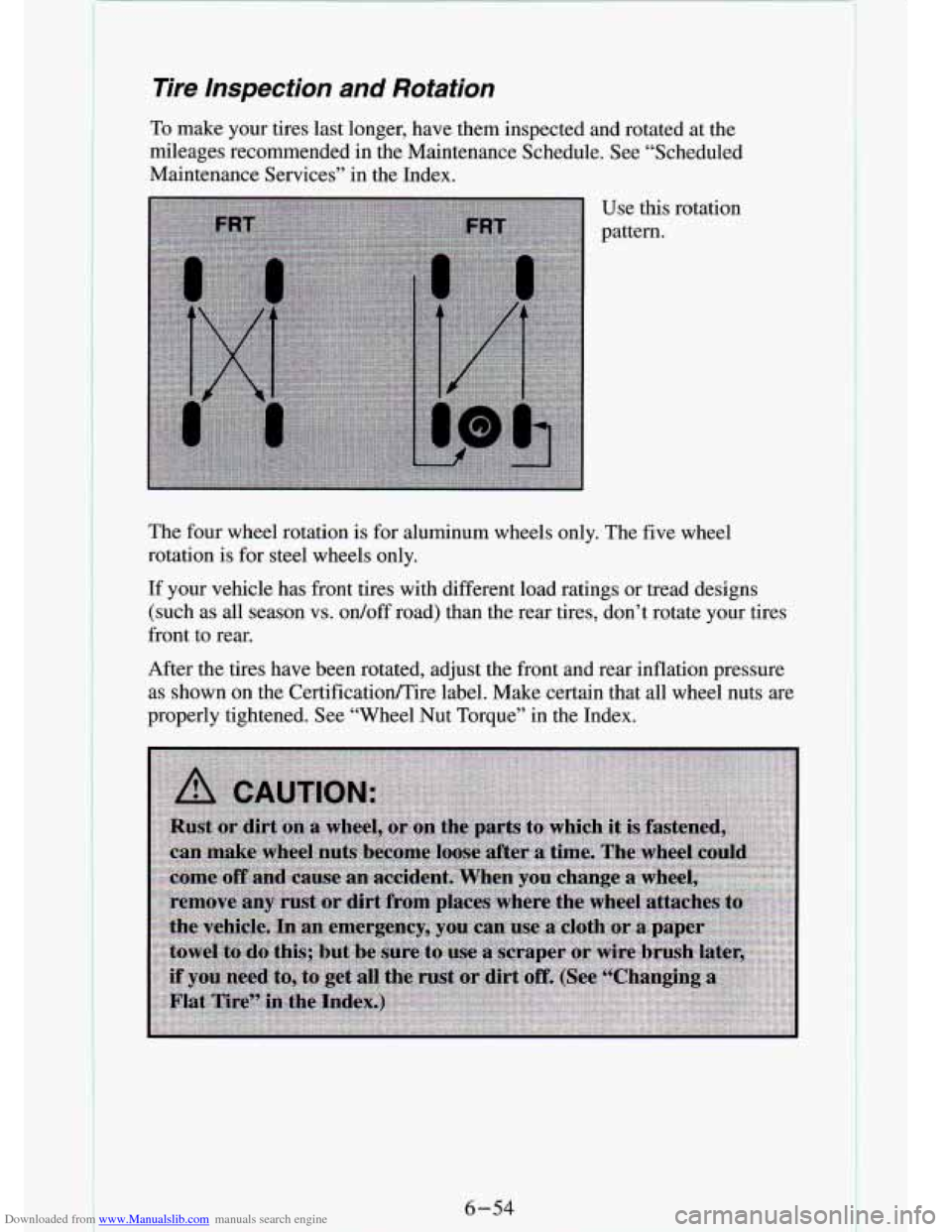
Use this rotation
pattern.
The four wheel rotation is for aluminum wheels only. The five wheel
rotation is for steel wheels only.
If your vehicle has front tires with different load ratings or tr\
ead designs
(such as all season vs. ordoff road) than the rear tires, d\
on’t rotate your tires
front to rear.
After the tires have been rotated, adjust the front and rear inflation pressure
as shown on the CertificatiodTire label. Make certain that all wheel nuts are
properly tightened. See “Wheel Nut Torque” in the Index.
6-54
Page 275 of 340
Downloaded from www.Manualslib.com manuals search engine Temperature -A, By C
The temperature grades are A (the highest), B, and C, representing the tire’s
resistance to the generation of heat and its ability
to dissipate heat when tested
under controlled conditions on a specified indoor laboratory tes\
t wheel.
Sustained high temperature can cause the material of the tire to degenerate
and reduce tire life, and excessive temperature can lead to su\
dden tire failure.
The grade
C corresponds to a level of performance which all passenger car
tires must meet under the Federal Motor Vehicle Safety Standard\
No. 109.
Grades B and A represent higher levels of performance on the laboratory test
wheel than the minimum required by law.
Warning: The temperature grade for
this tire is established for a tire that is
properly inflated and not overloaded. Excessive speed, underinfla\
tion, or
excessive loading, either separately or in combination, can cause heat
buildup and possible tire failure.
These grades are molded on
the sidewalls of passenger car tires.
While the tires available as standard or optional equipment on General
Motors vehicles may vary with respect to these grades, all such tires meet
General Motors performance standards and have been approved for use on
General Motors vehicles. All passenger type
(P Metric) tires must conform
to Federal safety requirements in addition to these grades.
Wheel Alignment and Tire Balance
The wheels on your vehicle were aligned and balanced carefully at the
factory to give you the longest tire life and best overall performance.
In most cases, you will not need to have your wheels aligned again.
However,
if you notice unusual tire wear or your vehicle pulling one way \
or
the other, the alignment may need to be reset. If you notice your vehicle
vibrating when driving
on a smooth road, your wheels may need to be
rebalanced.
Wheel Replacement
Replace any wheel that is bent, cracked or badly rusted. If wheel nuts keep
coming loose, the wheel, wheel bolts, and wheel nuts should be replaced.
If
the wheel leaks air, replace it (except some aluminum wheels, \
which can
sometimes be repaired). See your GM dealer if any of these conditions exist.
Your dealer will know the kind of wheel you need,
Each new wheel should have the same load carrying capacity, diameter,
width, offset, and be mounted the same way as the one it replaces.
6-57
Page 276 of 340
Downloaded from www.Manualslib.com manuals search engine If you need to replace any of your wheels, wheel bolts, or wheel nuts,
replace them only with new
GM original equipment parts. This way, you
will be sure to have the right wheel, wheel bolts, and wheel \
nuts for your
GM model.
NOTICE:
The wrong wheel can also cause problems with bearing life,
brake cooling, speedometer/odometer calibration, headlight aim,
bumper height, vehicle ground clearance, and tire or tire chain\
clearance to the body and chassis.
Used Replacement Wheels
6-58
Page 277 of 340
Downloaded from www.Manualslib.com manuals search engine Tire Chains
NOTICE:
If your vehicle has P235/75R15 or 31xlOSOR15LT/C size tires,
don’t use tire chains; they can damage your vehicle.
If you have other size tires, use tire chains only where legal and
only when you must. Use only SAE Class “S” type chains that
are the proper size for your tires. Install them on the drive axle
tires (four-wheel-drive vehicles can use chains on both axles)
and tighten them as tightly
as possible with the ends securely
fastened. Drive slowly and follow the chain manufacturer’s
instructions.
If you can hear the chains contacting your vehicle,
stop and retighten them.
If the contact continues, slow down
until
it stops. Driving too fast with chains on will damage your
vehicle.
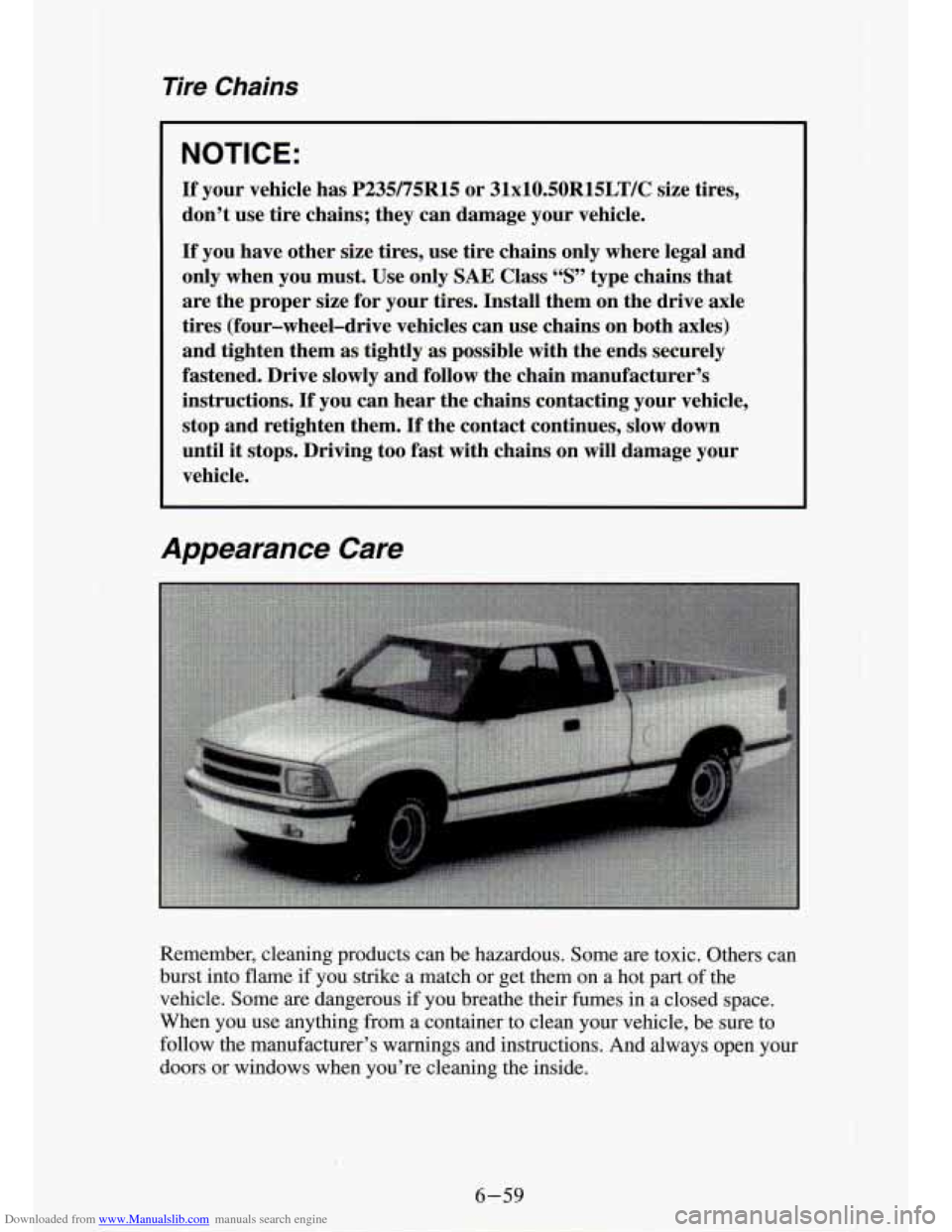
Appearance Care
Remember, cleaning’ products can be hazardous. Some are toxic\
. Others can
burst into flame
if you strike a match or get them on a hot part of the
vehicle. Some are dangerous
if you breathe their fumes in a closed space.
When you use anything from
a container to clean your vehicle, be sure to
follow the manufacturer’s warnings and instructions. And always open your\
doors or windows when you’re cleaning the inside.
6-59
Page 283 of 340
Downloaded from www.Manualslib.com manuals search engine Finish Care
Occasional waxing or mild polishing of your vehicle may be necessary to
remove residue from the paint finish. You can get GM approved cleaning
products from your dealer. (See “Appearance Care and Materials” in the
Index
.)
Your vehicle has a “basecoatlclearcoat” paint finish. The clearcoat gives
more depth and gloss to the colored basecoat. Always use waxes and
polishes that are non-abrasive and made
for a basecoatlclearcoat paint
finish.
NOTICE:
Machine compounding or aggressive polishing on a
basecoatdclearcoat paint finish may dull the finish or leave sw\
irl
marks.
Protecting Exterior Bright Metal Parts
Bright metal parts should be cleaned regularly to keep their luster. Washing
with water is all that
is usually needed. However, you may use GM Chrome
Polish on chrome or stainless steel
trim, if necessary.
Use special care with aluminum
trim. To avoid damaging protective trim,
never use auto or chrome polish, steam or caustic soap to clean aluminum.
A coating of wax, rubbed to high polish, is recommended for all bright
metal parts.
Aluminum Wheels (If So Equipped)
Your aluminum wheels have a protective coating similar to the painted
surface of your vehicle. Don’t
use strong soaps, chemicals, chrome polish,
abrasive cleaners or abrasive cleaning brushes
on them because you could
damage this coating. After rinsing thoroughly, a wax may be applied.
1 NOTICE:
If you have aluminum wheels, don’t use an automatic vehicle
wash that has hard silicon carbide cleaning brushes. These
brushes can take
off the protective coating.
6-65
Page 288 of 340
Downloaded from www.Manualslib.com manuals search engine - :
-.
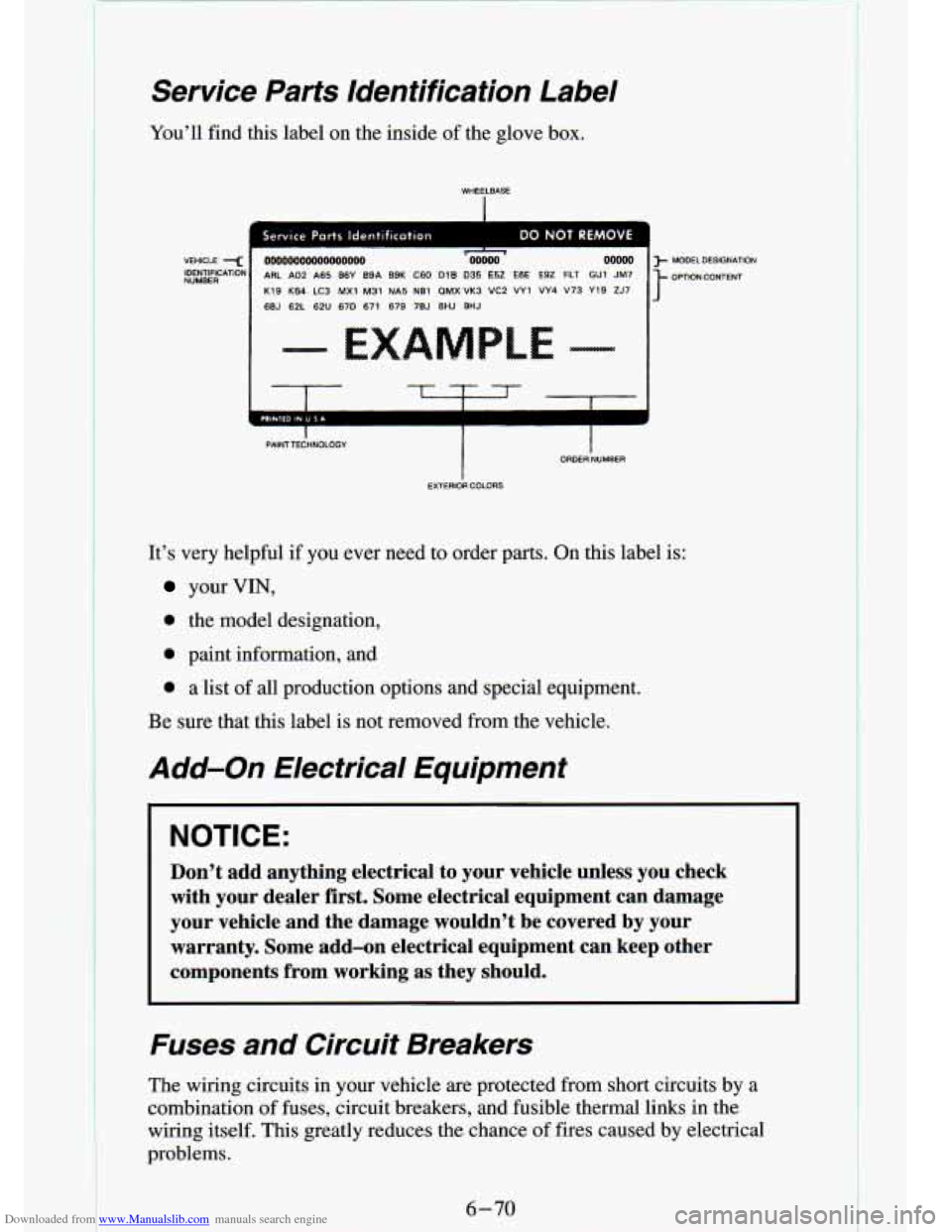
Service Parts Identification Label
You’ll find this label on the inside of the glove box.
WHEELBASE
I
I
Service Parts ldentificotion DO NOT REMOVE I
VEHICLE < ~~0~0000000
NUMBER IDENTlFlCATlON ARL
A02 A65 B6Y BSA B9K C60 D1B 035 €52 E6E E92 FLT GUl JM7 OPTION CONTENT
7 00000 ooooo )- MODELDESIGNATION
K19 K64 LC3 MXl M31 NA5 NE1 QMXVK3 VC2 VY1 VY4 V73 Y19 ZJ7
6BJ 62L
62U 67D 671 679 7BJ 8HJ SHJ
I PAINTTECHNOLOGY I ORDER I NUMBER
EXTERIOR
COLORS
It’s very helpful if you ever need to order parts. On this label is:
your VIN,
0 the model designation,
0 paint information, and
0 a list of all production options and special equipment.
Be sure that this label is not removed from the vehicle.
Add-on Electrical Equipment
NOTICE:
Don’t add anything electrical to your vehicle unless you che\
ck
with your dealer first.
Some electrical equipment can damage
your vehicle and the damage wouldn’t be covered by your warranty. Some add-on electrical equipment can keep other
components from working as they should.
Fuses and Circuit Breakers
The wiring circuits in your vehicle are protected from short c\
ircuits by a
combination of fuses, circuit breakers, and fusible thermal links in the
wiring itself.
This greatly reduces the chance of fires caused by electrical
problems.