tow CHEVROLET S10 1994 2.G Owners Manual
[x] Cancel search | Manufacturer: CHEVROLET, Model Year: 1994, Model line: S10, Model: CHEVROLET S10 1994 2.GPages: 340, PDF Size: 18.45 MB
Page 16 of 340

Downloaded from www.Manualslib.com manuals search engine Front Seatback Latches
The front seatback folds forward to let people get into the b\
ack seat or reach
the storage area behind the seat. Your seatback will move back and forth
freely, unless you come to
a sudden stop. Then it will lock in place.
There’s one time the seatback may not fold without some hel\
p from you.
That’s if your vehicle is parked going down a fairly steep \
hill. To fold a front
seatback forward,
push the seatback toward the rear as you
lift this latch. Then the
seatback will
fold
forward. The latch
must be down for the
seat to work properly.
1-4
Page 44 of 340
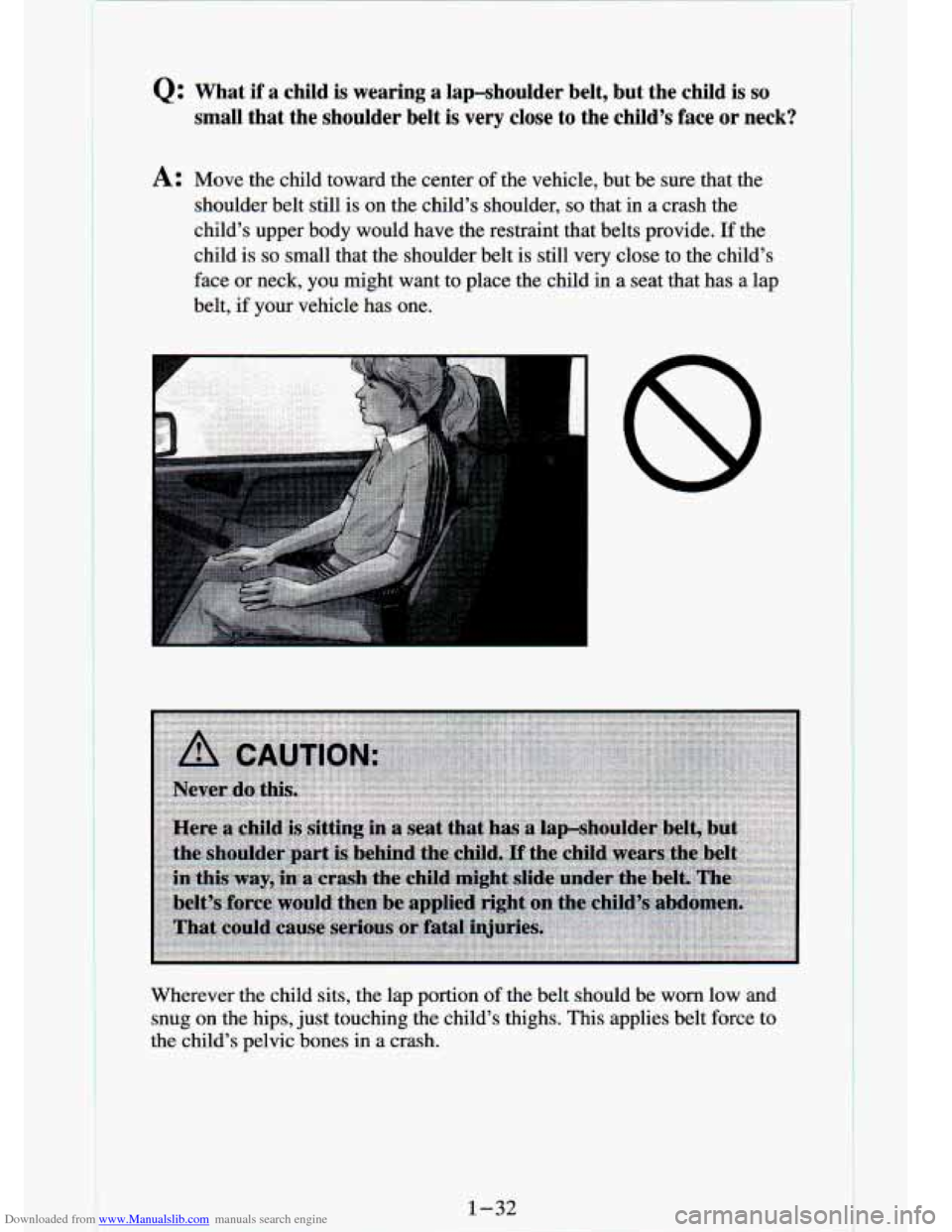
Downloaded from www.Manualslib.com manuals search engine Q: What if a child is wearing a lap-shoulder belt, but the child is so
small that the shoulder belt is very close to the child’s \
face or neck?
A: Move the child toward the center of the vehicle, but be sure that the
shoulder belt still
is on the child’s shoulder, so that in a crash the
child’s upper body would have the restraint that belts provi\
de.
If the
child is
so small that the shoulder belt is still very close to the child’s
face
or neck, you might want to place the child in a seat that has a lap
belt,
if your vehicle has one.
Wherever the child sits, the lap portion of the belt should be worn
low and
snug on the hips, just touching the child’s thighs. This applies belt force to
the child’s pelvic bones
in a crash.
1-32
f
Page 51 of 340
Downloaded from www.Manualslib.com manuals search engine Your Doors And How They Work
Side Doors
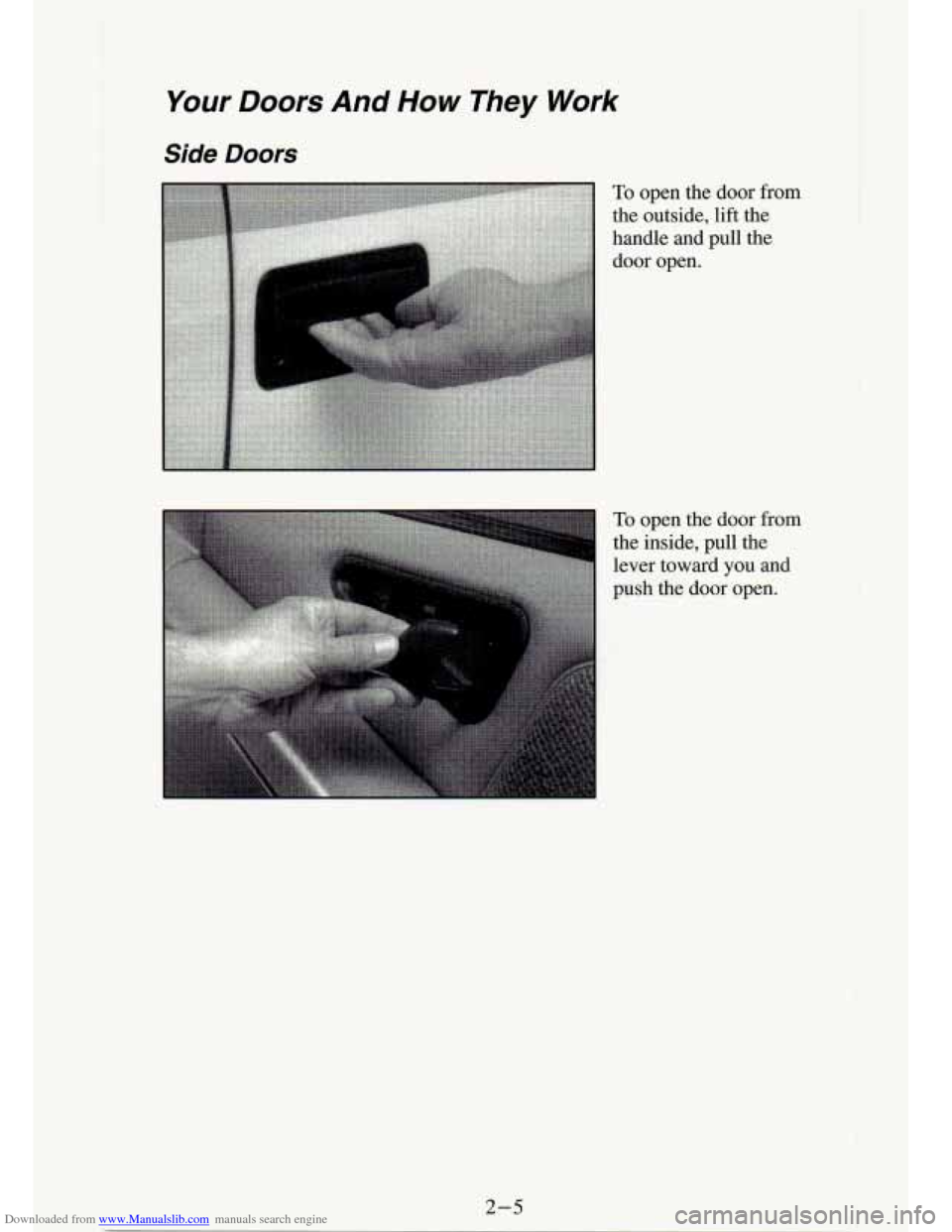
To open the door from
the outside, lift the
handle and pull the door open.
To open the door from
the inside, pull the
lever toward
you and
push the door open.
2-5
Page 52 of 340
Downloaded from www.Manualslib.com manuals search engine I Door Locks
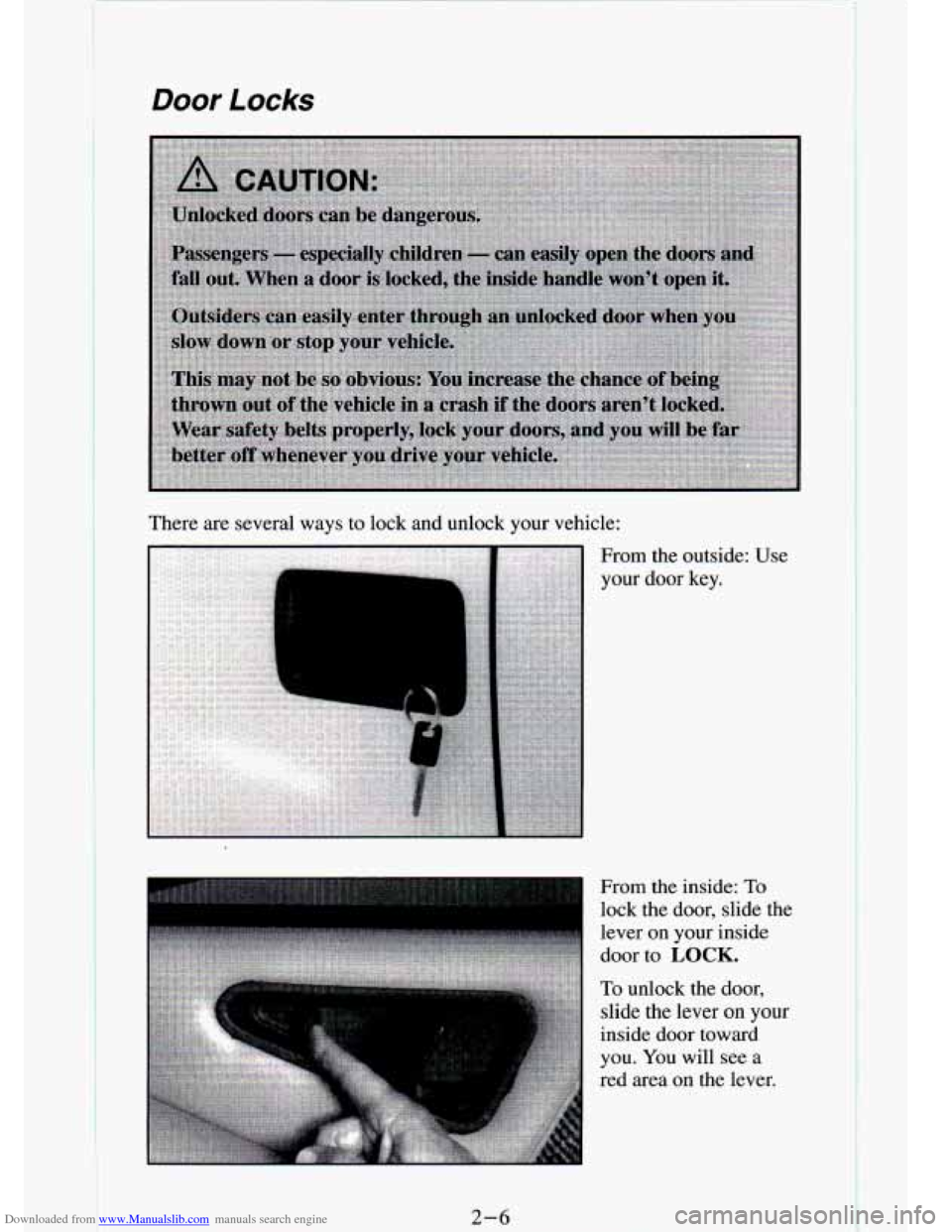
There are several ways to lock and unlock your vehicle:
1
From the outside: Use
your door key.
From the inside:
To
lock the door, slide the
lever on your inside
door
to LOCK.
To unlock the door,
slide the lever on your
inside door toward
you. You will see a
red area on the lever.
I
2-6 t
Page 56 of 340

Downloaded from www.Manualslib.com manuals search engine Ignition Switch
Use your ignition key to start your vehicle. The ignition key \
lets you turn
the ignition switch to five different positions.
2
3
1. OFF
2. RUN
3. START
4. ACC
5. LOCK
ACC (Accessory): ACC lets you use things like the radio and the
windshield wipers when the engine is
off. To get into ACC, push in the key
and turn it toward you. Your steering wheel will remain locked, just as it
was before you inserted the key.
NOTICE:
Prolonged operation of accessories in the ACC position could
drain vour battery and prevent you
from starting your vehicle.
LOCK: This position locks your ignition, steering wheel and transmissi\
on.
It’s a theft deterrent feature. You will only be able to remove your key when
the ignition is turned to
LOCK.
OFF: This position lets you turn off the engine but still turn the steering
wheel. Use
OFF if you must have your vehicle in motion while the engine
is off (for example,
if your vehicle is being pushed).
RUN: This is the position for driving.
START: This starts your engine.
Page 59 of 340
Downloaded from www.Manualslib.com manuals search engine NOTICE:
Your engine is designed to work with the electronics in your
vehicle.
If you add electrical parts or accessories, you could
change the way the fuel injection system operates. Before adding
electrical equipment, check
with your dealer. If you don’t, your
engine might not perform properly.
If you ever have to have your vehicle towed, see the part of this
manual that tells how to do it without damaging your vehicle.
See “Towing Your Vehicle” in the Index.
To start your 4.3 Liter engine:
1. Without pushing the accelerator pedal, turn your ignition key t\
o “Start.”
When the engine starts, let go of the key. The idle speed will go down
as your engine gets warm.
NOTICE:
Holding your key in “Start” for longer than 15 seconds at a time
will cause your battery to be drained much sooner.
And the
excessive heat can damage your starter motor.
2. If it doesn’t start right away, hold your key in “Start.” If
it doesn’t start
in three seconds, push the accelerator pedal about one-quarter
of the
way down for 12 more seconds, or until
it starts.
flooded with too much gasoline.
Try this:
3. If your engine still won’t start (or starts but then stops), it could be
Wait 15 seconds to let the starter motor cool down. Then push\
your accelerator pedal all the way to the floor.
Hold it there. Then, hold the
key in “Start” for no more than ten seconds. This clears the extra
gasoline from the engine.
If the engine still doesn’t start, wait another 15 seconds and do it all
again.
When the engine starts, let go of the key and the accelerator pedal.
2-13
Page 60 of 340
Downloaded from www.Manualslib.com manuals search engine NOTICE:
Your engine is designed to work with the electronics in your
vehicle.
If you add electrical parts or accessories, you could
change the
way the fuel injection system operates. Before adding
electrical equipment, check with your dealer.
If you don’t, your
engine might not perform properly.
If you ever have to have your vehicle towed, see the part of this
manual that tells how to do it without damaging your vehicle.
See “Towing Your Vehicle” in the Index.
Driving Through Deep Standing Water
NOTICE:
If you drive too quickly through deep puddles or standing water,
water can come in through your engine’s air intake and badly
damage your engine.
If you can’t avoid deep puddles or standing
water, drive through them very slowly.
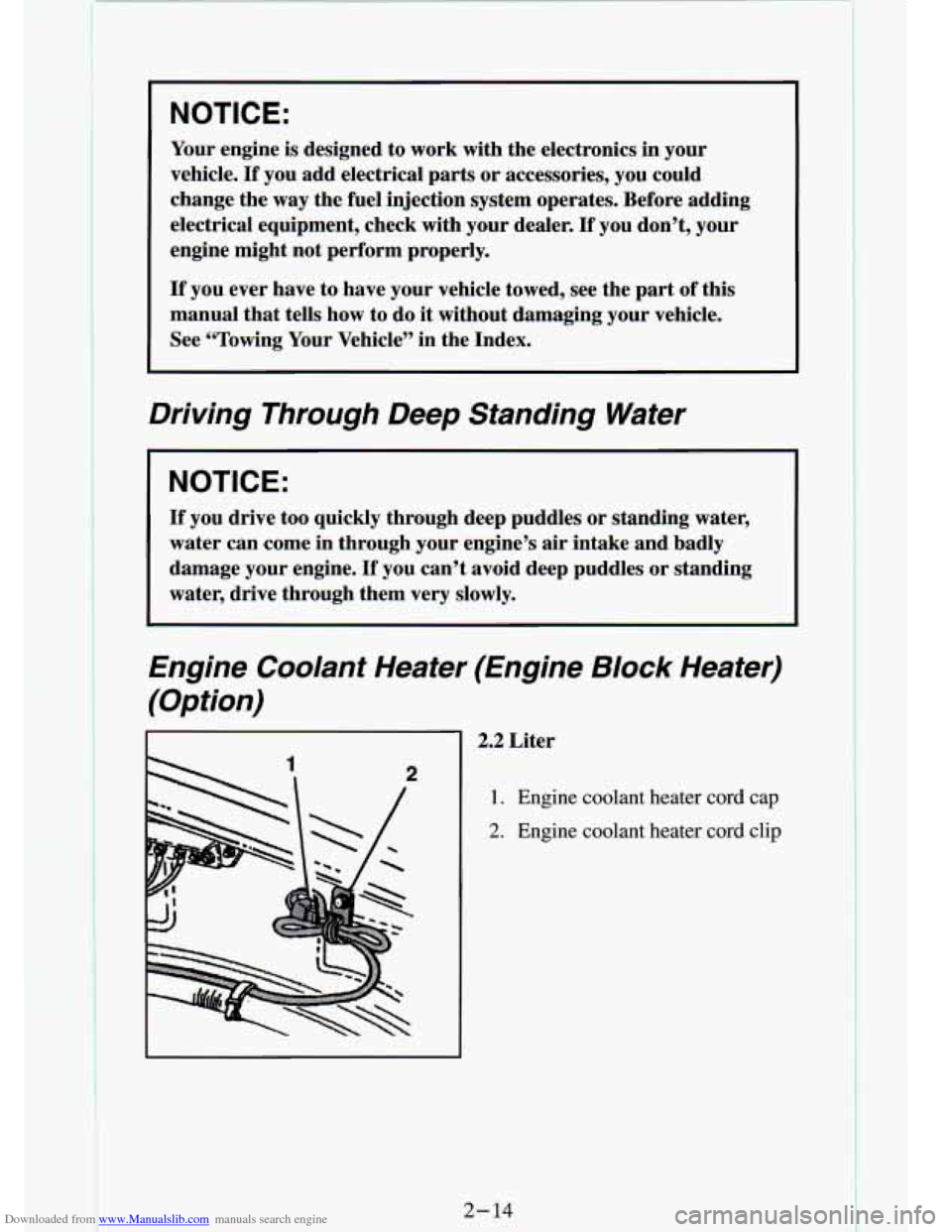
Engine Coolant Heater (Engine Block Heater)
(Option)
2.2 Liter
1. Engine coolant heater cord cap
2. Engine coolant heater cord clip
i
2- 14
Page 63 of 340
Downloaded from www.Manualslib.com manuals search engine R (Reverse)
Use this gear to back up.
NOTICE:
Shifting to “R” (Reverse) while your vehicle is moving forward
could damage your transmission. Shift to
“R” (Reverse) only
after your vehicle is stopped.
To rock your vehicle back and forth to get out of snow, ice or sand
without damaging your transmission, see
Tf You’re Stuck In Sand,
Mud, Ice
or Snow” in the hdex.
N (Neutral)
In this position, your engine doesn’t connect with the wheels. To restart
when you’re already moving, use
“N’ (Neutral) only. Also, use “N”
(Neutral) when your vehicle is being towed.
2- 17
Page 64 of 340
Downloaded from www.Manualslib.com manuals search engine NOTICE:
Damage to your transmission caused by shifting out of “P”
(Park) or “N” (Neutral) with the engine racing isn’t covered by
your warranty.
@ (Overdrive)
This position is for normal driving. If you need more p . rer f_ r
passing, and you’re:
- Going less than about 35 mph (56 ludh), push your accelerator
- Going about 35 mph (56 km/h) or more, push the accelerator all
pedal about halfway down.
the
way down.
You’ll shift down to the next gear and have more power.
@ should not be used when towing a trailer, carrying a heavy
load, driving on steep hills, or for off-road driving. Select
“D”
(Third Gear) when operating the vehicle under any of these
conditions.
D (Third Gear)
This is like @, but you never go into Overdrive. You should use “D”
(Third Gear) when towing a trailer, carrying a heavy load, driving on
steep hills, or for off-road driving.
2 (Second Gear)
This position gives you more power but lower fuel economy. You can
use
“2” (Second Gear) on hills. It can help control your speed as y\
ou go
down steep mountain roads, but then you would also want to use your
brakes
off and on.
If you manually select “2” (Second Gear), the transmission will drive
in second gear. You may use this feature for reducing torque to the rear
wheels when you are trying to start your vehicle from a stop on
slippery road surfaces.
1 (First Gear)
This position gives you even more power (but lower fuel economy)
than
“2” (Second Gear). You can use it on very steep hills, or in deep
snow or mud. If the selector lever is put in
“1” (First Gear), the
transmission won’t shift into
“1” (First Gear) until the vehicle is going
slowly enough.
2- 18
Page 68 of 340

Downloaded from www.Manualslib.com manuals search engine ..
NOTICE:
Driving with the parking brake on can cause your rear brakes \
to overheat. You may have to replace them, and you could also
damage other parts
of your vehicle.
If you are on a hill: See “Parking on Hills” in the Index. That section
shows how
to turn your front wheels.
If you are towing a trailer and are parking on any hill: See “Towing a
Trailer” in the Index. That section shows what to
do first to keep the trailer
from moving.
Shifting Into ‘6P’’ (Park)
(A utomaticTransmission Models Only)
1. Hold the brake pedal down with your right foot and set the parking
brake.
2-22
I I