key CHEVROLET S10 1995 2.G Owner's Manual
[x] Cancel search | Manufacturer: CHEVROLET, Model Year: 1995, Model line: S10, Model: CHEVROLET S10 1995 2.GPages: 354, PDF Size: 18.92 MB
Page 128 of 354
Downloaded from www.Manualslib.com manuals search engine RCL - Press RCL to see what track is playing. Press it again within 5
seconds to see how long it has been playing. The track number also appears
when
you change the volume or when a new track starts to play.
COMP
- Press the COMP button to make soft and loud passages more
nearly equal in volume. “COMP’ will appear in the display while using this
control.
RDM
- The RDM button means random and when it is pressed, it causes
the CD mechanism to play the tracks
in a random order rather than in the
sequential 1,2,
3 order. “RDM” will appear in the display while using this
control.
To return to normal sequence, press RDM again.
REV
- Press and hold the REV button to quickly return to a favorite
passage. Release it
to display the passage. The counter reading will be
displayed while using this control.
FWD
- Press and hold the FWD button to advance quickly within a track.
Release it to resume playing. Watch the display to stop at
a specific passage.
SCAN
- Press SCAN to sample each track for approximately 10 seconds.
Scanning will continue until the RDM, SCAN or any other motion button is
pressed again.
PREV
- Hold the PREV (4 SEEK) button, or press it more than once, and
the disc will return to previous tracks.
NEXT
- Press NEXT (SEEK ,) to hear the next track now instead of
waiting until the present track is finished. If you hold this button or press it
more than once, the disc will advance further.
ST-PL
- Press ST-PL (Stop-Play) to make the disc stop and the radio
play. Press ST-PL again to restart the disc at the point where it stopped.
Press PWR or turn the ignition key
off to stop the disc player. The disc stays
in the player and will resume playing at the point where it stopped.
Press EJCT to eject the disc and make the radio play. The disc will start at
track
I when you reinsert it.
Anti-Theft Feature
Delco LOC II@ is an Anti-Theft feature for the compact disc player. It can
be used or ignored. If ignored, the system plays normally. If it is used, your
player won’t be usable if it is ever stolen, because it won’t turn
on.
The instructions below tell you how to enter a secret code into the system. If
your car loses battery power for any reason,
you must unlock the system
with the secret code before the radio will turn on.
3-15
Page 136 of 354
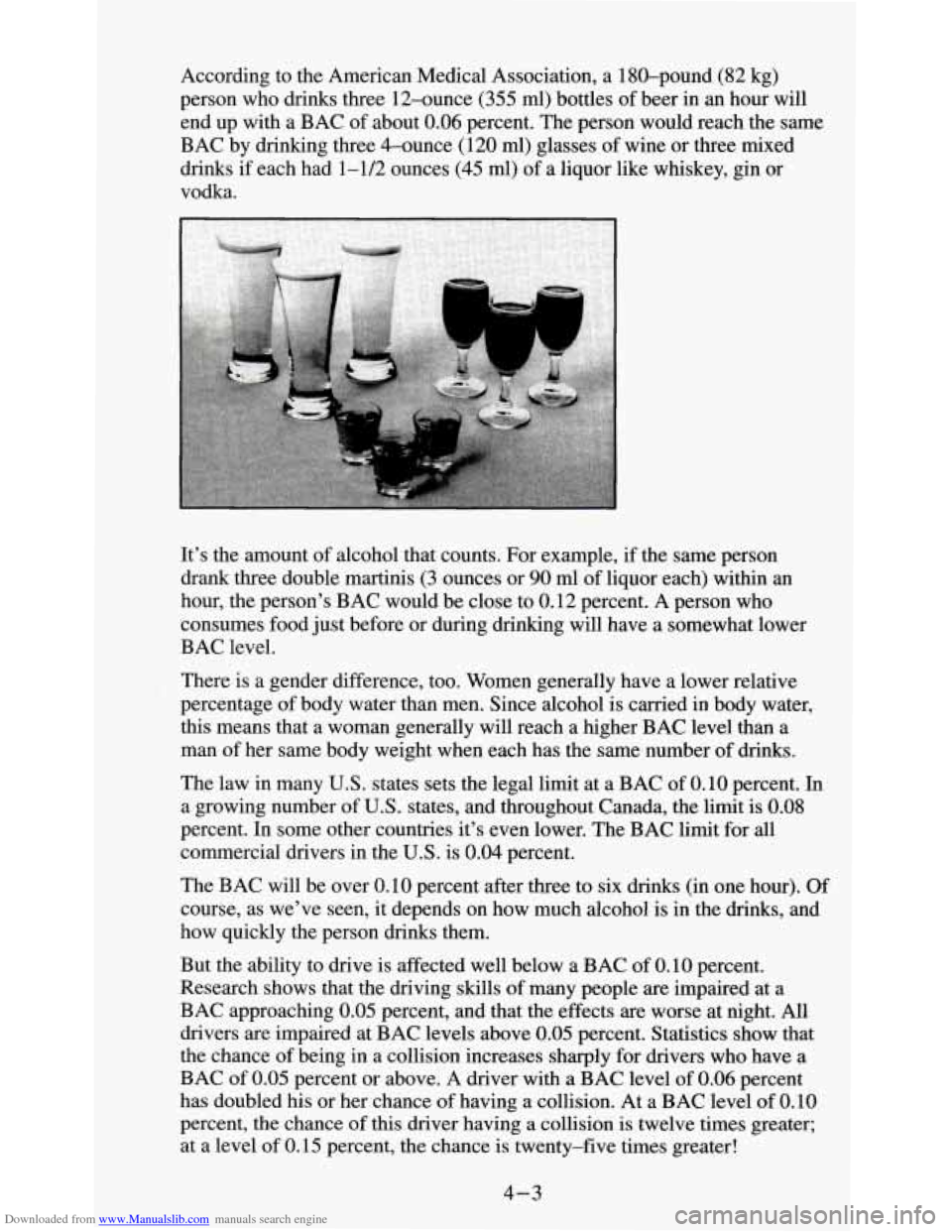
Downloaded from www.Manualslib.com manuals search engine According to the American Medical Association, a 180-pound (82 kg)
person who drinks three 12-ounce
(355 ml) bottles of beer in an hour will
end up with a BAC of about
0.06 percent. The person would reach the same
BAC by drinking three 4-ounce (120
ml) glasses of wine or three mixed
drinks if each had 1-1/2 ounces
(45 ml) of a liquor like whiskey, gin or
vodka.
J
It’s the amount of alcohol that counts. For example, if the same person
drank three double martinis
(3 ounces or 90 ml of liquor each) within an
hour, the person’s BAC would be close to 0.12 percent. A person who
consumes food just before or during drinking will have a somewhat lower
BAC level.
There is a gender difference, too. Women generally have a lower relative
percentage of body water than men. Since alcohol is carried in body water,
this means that a woman generally will reach a higher BAC level than a
man of her same body weight when each has the same number of drinks.
The law in many
U.S. states sets the legal limit at a BAC of 0.10 percent. In
a growing number
of U.S. states, and throughout Canada, the limit is 0.08
percent. In some other countries it’s even lower. The BAC limit for all
commercial drivers in the
U.S. is 0.04 percent.
The BAC will be over 0.10 percent after three to six drinks (in one hour). Of
course, as we’ve seen, it depends on how much alcohol is in the drinks, and
how quickly the person drinks them.
But the ability to drive is affected well below a BAC
of 0.10 percent.
Research shows that the driving skills of many people are impaired at a
BAC approaching
0.05 percent, and that the effects are worse at night. All
drivers are impaired at BAC levels above
0.05 percent. Statistics show that
the chance of being in a collision increases sharply for drivers who have a
BAC of
0.05 percent or above, A driver with a BAC level of 0.06 percent
has doubled his or her chance
of having a collision. At a BAC level of 0.10
percent, the chance
of this driver having a collision is twelve times greater;
at a level of
0.15 percent, the chance is twenty-five times greater!
4-3
Page 147 of 354
Downloaded from www.Manualslib.com manuals search engine Getting Familiar with Off-Road Driving
It’s a good idea to practice in an area that’s safe and close to home before
you go into the wilderness. Off-road driving does require some new and
different driving skills. Here’s what we mean.
Tune your senses to different kinds
of signals. Your eyes, for example, need
to constantly sweep the terrain for unexpected obstacles. Your ears need to
listen for unusual tire or engine sounds. With your arms, hands, feet, and
body you’ll need to respond to vibrations and vehicle bounce.
Controlling your vehicle is the key to successful off-road driving. One
of
the best ways to control your vehicle is to control your speed. Here are some
things to keep in mind.
At higher speeds:
you approach things faster and you have less time to scan the terrain for
obstacles.
you have less time to react.
you have more vehicle bounce when you drive over obstacles.
you’ll need more distance for braking, especially since you’re on an
unpaved surface.
Scanning the Terrain
Off-road driving can take you over many different kinds of terrain. You
need to be familiar with the terrain and its many different features. Here are
some things to consider.
Sugace Conditions. Off-roading can take you over hard-packed dirt,
gravel, rocks, grass, sand, mud, snow or ice. Each of these surfaces affects
the steering, acceleration, and braking
of your vehicle in different ways.
Depending upon the kind of surface you are on, you may experience
slipping, sliding, wheel spinning, delayed acceleration, poor traction, and
longer braking distances.
4- 14
Page 169 of 354
Downloaded from www.Manualslib.com manuals search engine 5. Release the parking brake only after the vehicle being towed is firmly
attached to the tow vehicle.
6. Insert the ignition key into the ignition switch and turn it one notch
forward of the
LOCK position. This places the key into the OFF
position, which unlocks the steering column while preventing battery
drain. Unlocking the steering column will allow for proper movement
of the front wheelshires during towing.
NOTICE:
You should exercise extra care whenever towing another vehicle.
Loading Your Vehicle
PAYLOAD =I-1
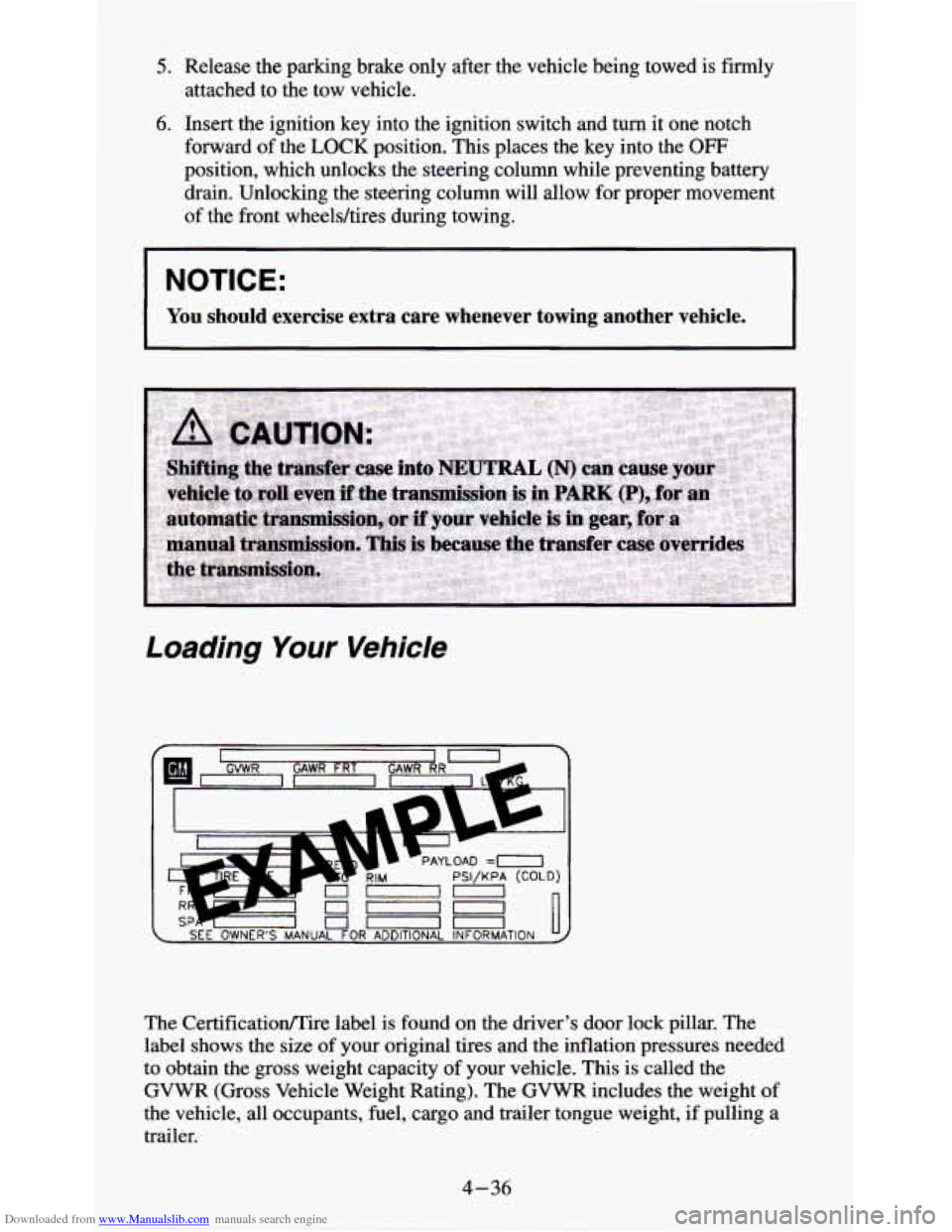
The Certificatioflire label is found on the driver’s door lock pillar. The
label shows the size of your original tires and the inflation pressures needed
to obtain the gross weight capacity of your vehicle. This is called the
GVWR (Gross Vehicle Weight Rating). The GVWR includes the weight of
the vehicle, all occupants, fuel, cargo and trailer tongue weight, if pulling a
trailer.
4-36
Page 185 of 354
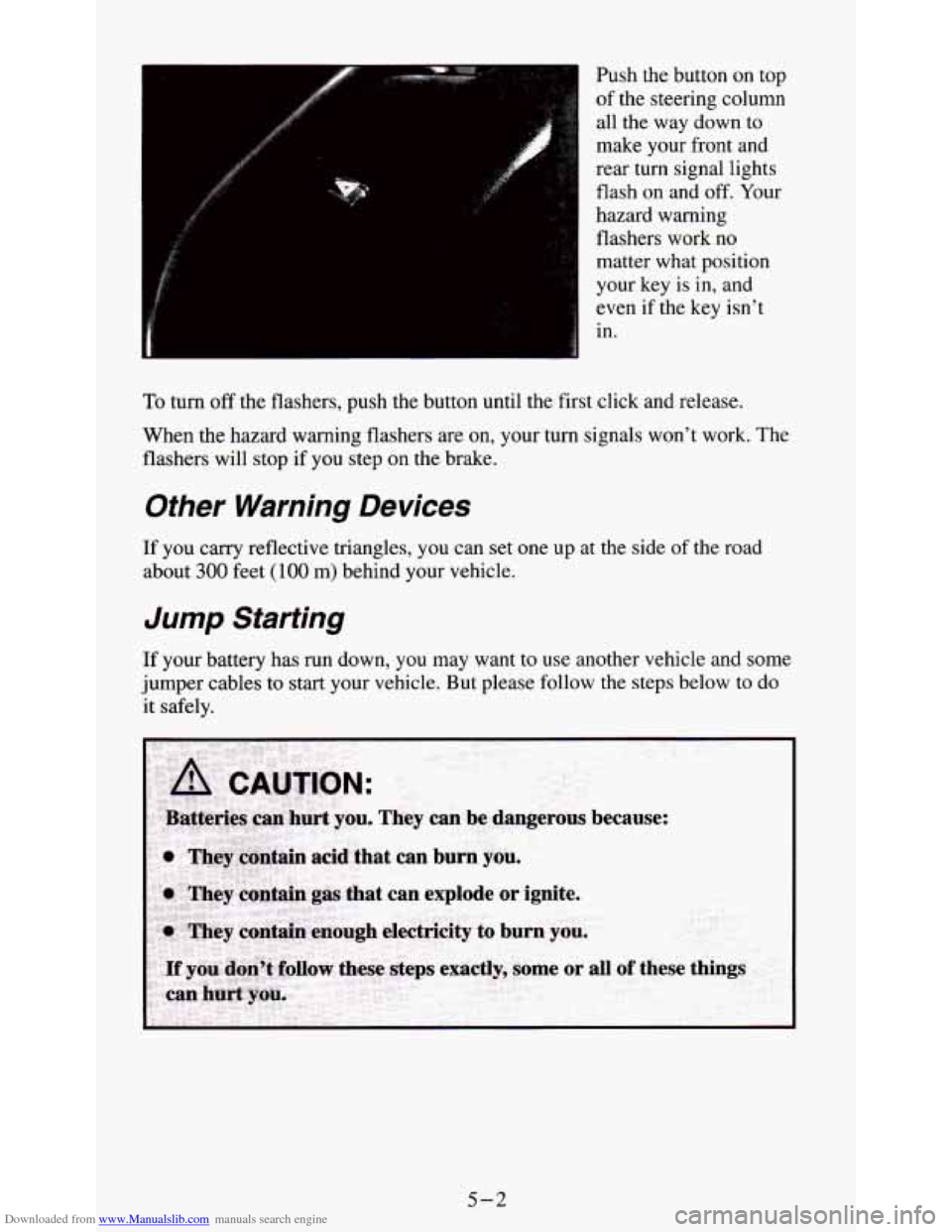
Downloaded from www.Manualslib.com manuals search engine Push the button on top
of the steering column
all the way down
to
make your front and
rear turn signal lights
flash on and
off. Your
hazard warning
flashers work
no
matter what position
your key is
in, and
even if the key isn’t
in.
To turn off the flashers, push the button until the first click and release.
When the hazard warning flashers are on, your turn signals won’t work. The
flashers will stop if you step on the brake.
Other Warning Devices
If you carry reflective triangles, you can set one up at the side of the road
about
300 feet (100 m) behind your vehicle.
Jump Starting
If your battery has run down, you may want to use another vehicle and some
jumper cables to start your vehicle. But please follow the steps below to do
it safely.
5-2
Page 190 of 354
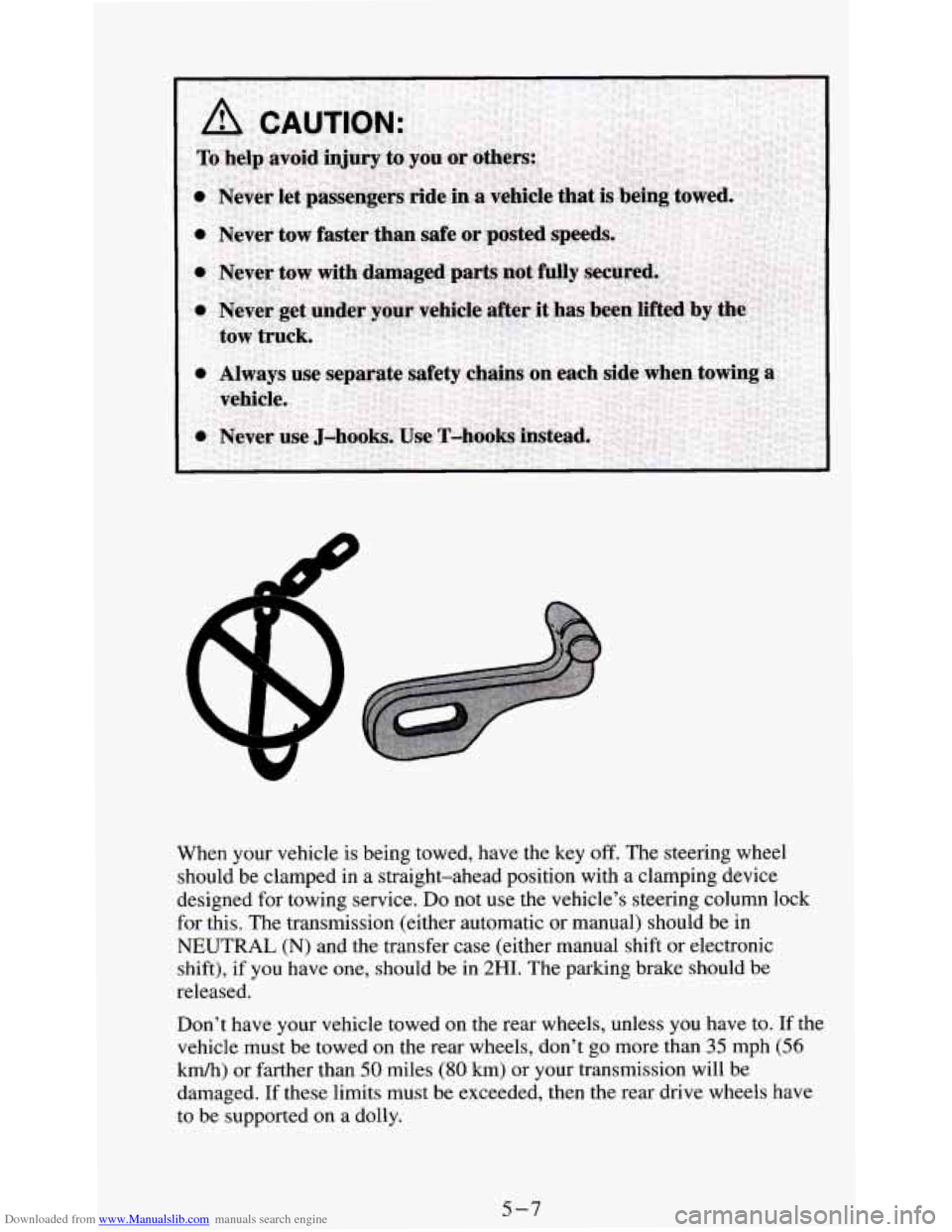
Downloaded from www.Manualslib.com manuals search engine When your vehicle is being towed, have the key off. The steering wheel
should be clamped in a straight-ahead position with
a clamping device
designed for towing service.
Do not use the vehicle’s steering column lock
for this. The transmission (either automatic or manual) should be
in
NEUTRAL (N) and the transfer case (either manual shift or electronic
shift), if you have one, should be in 2HI.
The parking brake should be
released.
Don’t have your vehicle towed
on the rear wheels, unless you have to. If the
vehicle must be towed on the rear wheels, don’t
go more than 35 mph (56
kmk) or farther than 50 miles (80 km) or your transmission will be
damaged.
If these limits must be exceeded, then the rear drive wheels have
to be supported on a dolly.
5-7
Page 323 of 354
Downloaded from www.Manualslib.com manuals search engine Engine Coolant Level
Check the engine coolant level and add the proper coolant mix if necessary.
See “Coolant”
in the Index for further details.
Windshield Washer Fluid Level
Check the windshield washer fluid level in the windshield washer tank and
add the proper fluid
if necessary. See “Windshield Washer Fluid” in the
Index for further details.
At Least Once a Month
Tire Inflation
Check tire inflation. Make sure tires are inflated to the pressures specified
on
the CertificatiodTire label located on the driver’s door lock pillar. See
“Tires” in the Index for further details.
Cassette Deck
Clean cassette deck. Cleaning should be done every 50 hours of tape play.
See “Audio Systems” in the Index for further details.
At Least Four Times a Year
Tailgate Lubrication
Lubricate tailgate latch bolt, handle assembly pivot points, and hinges w\
ith
lubricant recommended
in Part D. Lubricate every 3,000 miles (5 000 km) if
following schedule
I or every 7,500 miles (1 2 500 km) if following schedule
11.
At Least Once a Year
Key Lock Cylinders
Lubricate the key lock cylinders with the lubricant specified in Part D.
Body Lubrication
Lubricate all body door hinges, the body hood, fuel door and rear
compartment hinges, latches and locks including interior glove
box and
console doors, and any moving seat hardware. Lubricate the hood safety
lever pivot and prop rod pivot. Part D tells you what to use. More frequent
lubrication may be required when exposed to a corrosive environment.
7-36
Page 324 of 354
Downloaded from www.Manualslib.com manuals search engine 1.
2.
3.
Before you start, be sure you have enough room around the vehicle.
Firmly apply both the parking brake
(see “Parking Brake” in the Index
if necessary) and the regular brake.
NOTE:
Do not use the accelerator pedal, and be ready to turn off the
engine immediately
if it starts.
On automatic transmission vehicles, try to start the engine
in each gear.
The starter should work
only in PARK (P) or NEUTRAL (N). If the
starter works
in any other position, your vehicle needs service.
On manual transmission vehicles, put
the shift lever in NEUTRAL (N),
push
the clutch down halfway and try to start the engine. The starter
should work only when the clutch
is pushed down all the way to the
floor. If the starter works when the clutch isn’t pushed all the way
down, your vehicle needs service.
Steering Column Lock
While parked, and with the parking brake set, try to turn the key to LOCK
in each shift lever position.
With an automatic transmission, the key should turn to LOCK only
when the shift lever is in PARK (P).
With a manual transmission, the key should turn to LOCK only when
the shift lever
is in REVERSE (R).
On vehicles with
a key release button, try to turn the key to LOCK without
pressing the button. The
key should turn to LOCK only with the key button
depressed.
On all vehicles, the key should come
out only in LOCK.
7-37
Page 327 of 354
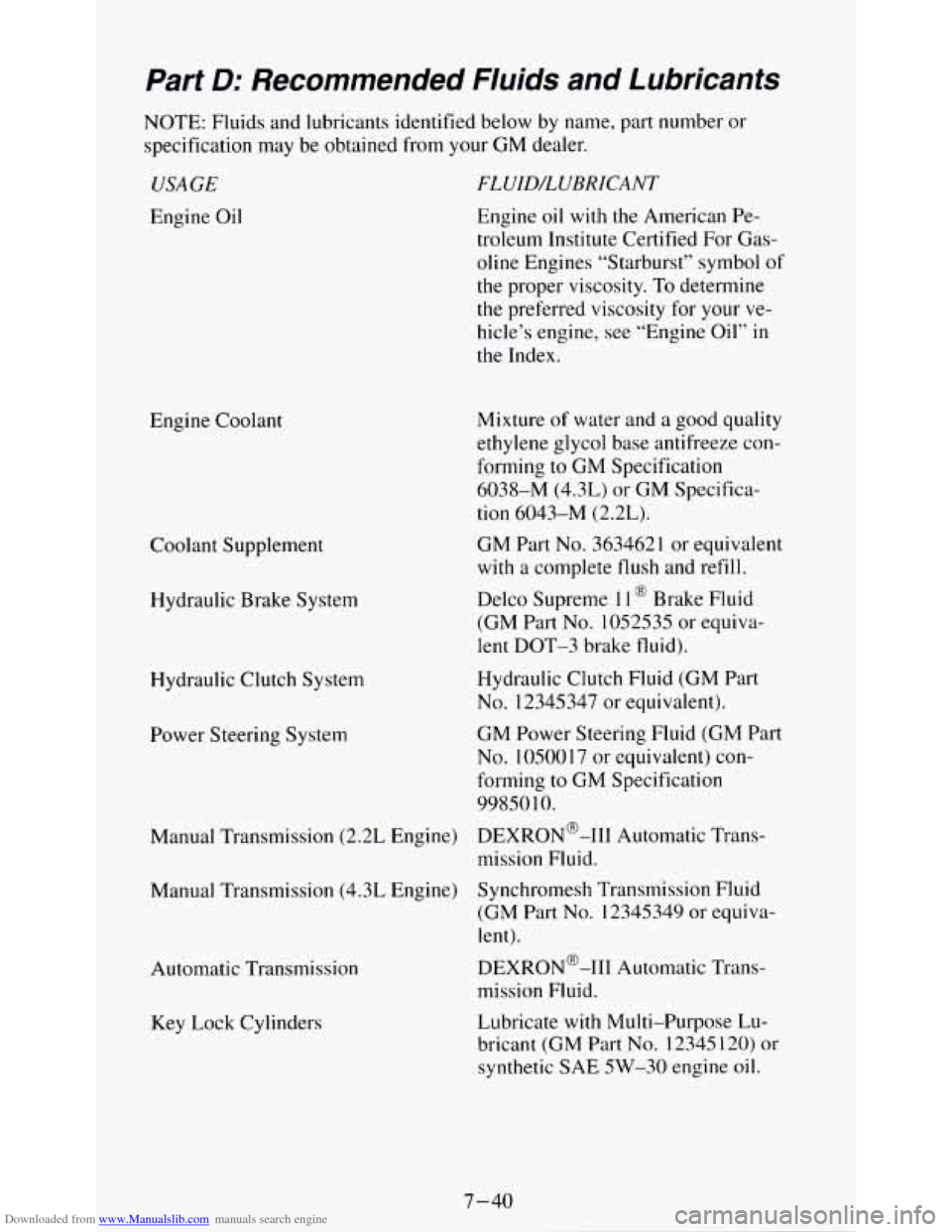
Downloaded from www.Manualslib.com manuals search engine Part D: Recommended Fluids and Lubricants
NOTE: Fluids and lubricants identified below by name, part number or
specification may be obtained from your GM dealer.
USAGE
Engine Oil
Engine Coolant
Coolant Supplement
Hydraulic Brake System
Hydraulic Clutch System
Power Steering System
FLUID/LUBRICANT
Engine oil with the American Pe-
troleum Institute Certified For Gas-
oline Engines “Starburst” symbol
of
the proper viscosity. To determine
the preferred viscosity for your ve-
hicle’s engine, see “Engine
Oil” in
the Index.
Mixture of water and
a good quality
ethylene glycol base antifreeze con-
forming to GM Specification
6038-M (4.3L)
or GM Specifica-
tion 6043-M (2.2L).
GM Part
No. 3634621 or equivalent
with a complete flush and refill.
Delco Supreme
1 1 @ Brake Fluid
(GM Part
No. 1052535 or equiva-
lent DOT-3 brake fluid).
Hydraulic Clutch Fluid (GM Part
No. 12345347 or equivalent).
GM Power Steering Fluid (GM Part
No.
10500 1 7 or equivalent) con-
forming
to GM Specification
99850
IO.
Manual Transmission (2.2L Engine) DEXRON@-I11 Automatic Trans-
mission Fluid.
Manual Transmission
(4.3L Engine) Synchromesh Transmission Fluid
(GM Part
No. I2345349 or equiva-
lent).
Automatic Transmission
Key Lock Cylinders DEXRON@-TI1
Automatic Trans-
mission Fluid.
Lubricate with Multi-Purpose Lu-
bricant (GM Part
No. 12345 120) or
synthetic SAE SW-30 engine
oil.
7-40
Page 348 of 354
Downloaded from www.Manualslib.com manuals search engine I
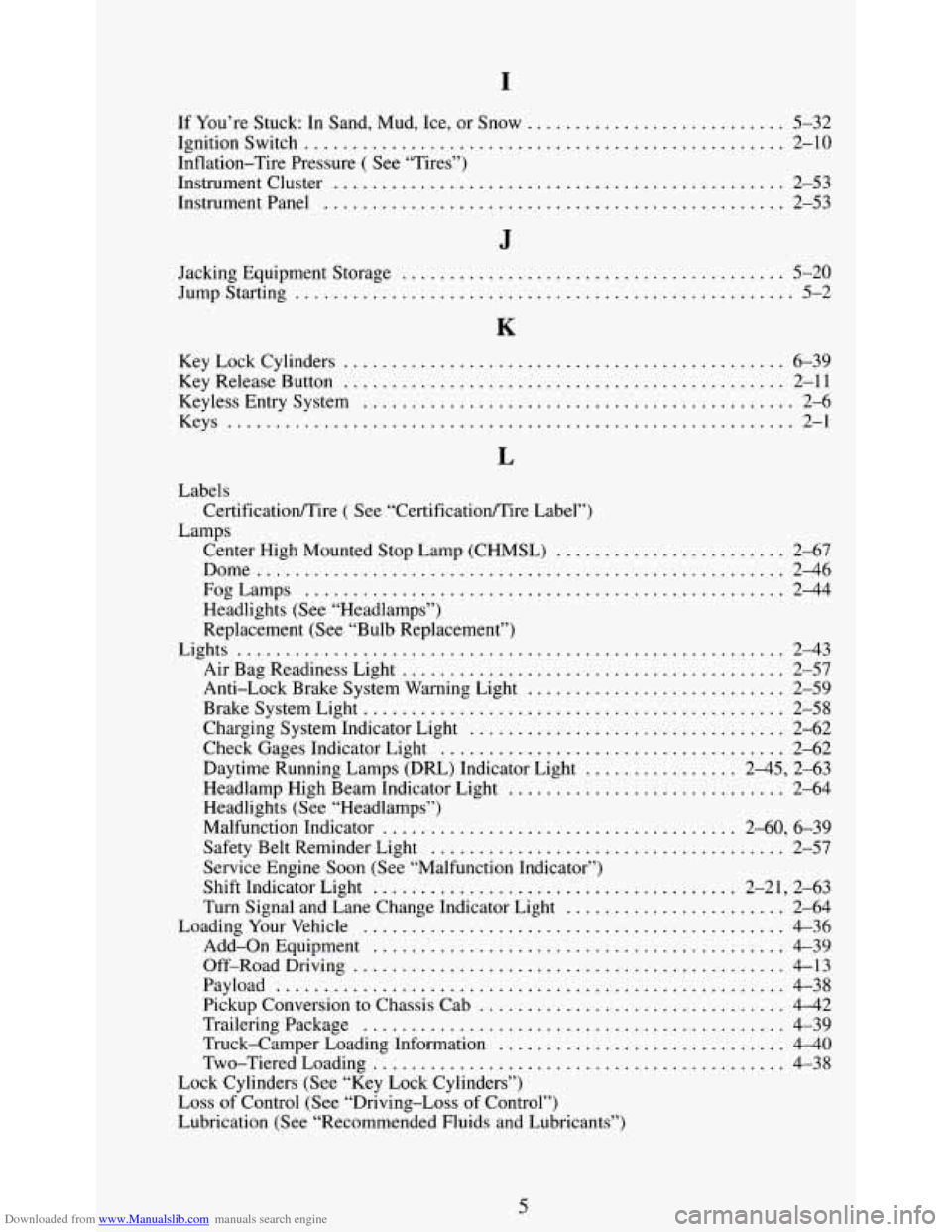
If You’re Stuck: In Sand. Mud. Ice. or Snow ........................... 5-32
Ignitionswitch
.................................................. 2-10
Inflation-Tire Pressure
( See “Tires”)
Instrument Cluster
............................................... 2-53
Instrumentpanel
................................................ 2-53
Jacking Equipment Storage
........................................ 5-20
Jumpstarting .................................................... 5-2
K
KeyLockCylinders .............................................. 6-39
Key Release Button
.............................................. 2-11
Keyless Entry System
............................................. 2-6
Keys
........................................................... 2-1
L
Labels
Lamps Certificatioflire
( See “Certification/Tire Label”)
Center High Mounted
Stop Lamp (CHMSL) ........................ 2-67
Dome
....................................................... 2-46
FogLamps
.................................................. 2-44
Headlights (See “Headlamps”)
Replacement
(See “Bulb Replacement”)
Lights
......................................................... 2-43
Air Bag Readiness Light
........................................ 2-57
Anti-Lock Brake System Warning Light
........................... 2-59
BrakeSystemLight
............................................ 2-58
Charging System Indicator Light
................................. 2-62
Check Gages Indicator Light
.................................... 2-62
Daytime Running Lamps (DRL) Indicator Light
................ 2-45. 2-63
Headlamp High Beam Indicator Light
............................. 2-64
Headlights (See “Headlamps”)
Malfunction Indicator
..................................... 2-60. 6-39
Safety Belt Reminder Light
..................................... 2-57
Service Engine Soon (See “Malfunction Indicator”) Shift Indicator Light
...................................... 2-21. 2-63
Turn Signal and Lane Change Indicator Light
....................... 2-64
Loading Your Vehicle
............................................ 4-36
Add-on Equipment
........................................... 4-39
Off-Road Driving
............................................. 4-13
Payload ..................................................... 4-38
Pickup Conversion to Chassis Cab
................................ 4-42
TraileringPackage
............................................ 4-39
Truck-Camper Loading Information
.............................. 440
Two-Tiered Loading ........................................... 4-38
Lock Cylinders (See “Key Lock Cylinders”)
Loss of Control (See “Driving-Loss of Control”)
Lubrication (See “Recommended Fluids and Lubricants”)
5