oil type CHEVROLET S10 1995 2.G Owners Manual
[x] Cancel search | Manufacturer: CHEVROLET, Model Year: 1995, Model line: S10, Model: CHEVROLET S10 1995 2.GPages: 354, PDF Size: 18.92 MB
Page 256 of 354
Downloaded from www.Manualslib.com manuals search engine Lock Cylinders
To be sure your locks operate properly, they must be lubricated.
Refer
to the Maintenance Schedule to determine how often to lubricate them
and what type of lubricant to use.
You should not
use penetrating oils because they could wash out the factory
installed lubricant and cause the lock to bind. De-icers which contain
alcohol could also wash away the lubricant,
so be sure to lubricate the lock
after using a de-icer of this type.
Exhaust System
To help prevent damage to your exhaust system, do not continue to drive
your vehicle if you notice:
Engine misfiring
Loss of performance
Exhaust system components hanging lower than normal.
Loud exhaust system noises.
Other unusual operating conditions
Have your engine and exhaust system serviced regularly.
Three-way Catalytic Converter
Your vehicle’s three-way catalytic converter is designed to reduce the
pollutants in your vehicle’s exhaust. Use only unleaded fuel in your vehicle.
If you use leaded fuel, you could damage your three-way catalytic converter
and other engine components.
Engine Control Module System
This system has an oxygen (02) sensor that helps keep your engine’s
air-fuel mixture at a proper level. Use only unleaded fuel in your vehicle. If
you use leaded fuel, you could damage your oxygen
(02) sensor and affect
your vehicle’s emissions.
Malfunction Indicator Lamp (SERVICE ENGINE
SOON)
This light on your instrument panel lets you know when your emission
system needs service. See “Malfunction Indicator Lamp” in the Index.
6-39
Page 266 of 354
Downloaded from www.Manualslib.com manuals search engine Using Foam-Type Cleaner on Fabric
Vacuum and brush the area to remove any loose dirt.
Always clean a whole trim panel or section. Mask surrounding trim
0 Mix Multi-Purpose Powdered Cleaner following the directions on the
along
stitch or welt lines.
container label.
Use suds only and apply with a clean sponge.
Don’t saturate the material.
Don’t rub it roughly.
As soon as you’ve cleaned the section, use a sponge to remove the
suds.
0 Rinse the section with a clean, wet sponge.
0 Wipe off what’s left with a slightly damp paper towel or cloth.
Then dry it immediately with a blow dryer or a heat lamp.
I NOTICE:
Be careful. A blow dryer may scorch the fabric.
0 Wipe with a clean cloth.
Using Solvent-Type Cleaner on Fabric
First, see if you have to use solvent-type cleaner at all. Some spots and
stains will clean off better with just water and mild soap.
If you need to use a solvent:
Gently scrape excess soil from the trim material with a clean, dull knife
or scraper. Use very little cleaner, light pressure and clean cloths
(preferably cheesecloth). Cleaning should start at the outside
of the
stain, “feathering” toward the center. Keep changing to a clean section
of the cloth.
0 When you clean a stain from fabric, immediately dry the area with a
blow dryer to help prevent a cleaning ring. (See the previous NOTICE.)
6-49
Page 267 of 354
Downloaded from www.Manualslib.com manuals search engine Fabric Protection
Your vehicle has upholstery and carpet that has been treated with
Scotchgard" Fabric Protector, a 3M product. Scotchgard" protects fabrics
by repelling oil and water, which are the carriers
of most stains. Even with
this protection, you still need
to clean your upholstery and carpet often to
keep
it looking new.
Further information on cleaning is available by calline 1-800433-3296 (in
Minnesota, 1-800-642-6 167).
Special Cleaning Problems
Greasy or Oily Stains
Stains caused by grease, oil, butter, margarine, shoe polish, coffee with
cream, chewing gum, cosmetic creams, vegetable oils, wax crayon, tar and
asphalt can be removed
as follows:
Carefully scrape off excess stain.
Follow the solvent-type instructions described earlier.
Shoe polish, wax crayon, tar and asphalt will stain if left on a vehicle
seat fabric. They should be removed as soon as possible.
Be careful,
because the cleaner
will dissolve them and may cause them to spread.
Non-Greasy Stains
Stains caused by catsup, coffee (black), egg, fruit, fruit juice, milk, soft
drinks, wine, vomit, urine and blood can be removed as follows:
Carefully scrape off excess stain, then sponge the soiled area with cool
water.
If a stain remains, follow the foam-type instructions described earlier.
If an odor lingers after cleaning vomit or urine, treat the area with a
waterhaking soda solution:
I teaspoon (5 ml) of baking soda to 1 cup
(250 ml) of lukewarm water.
If needed, clean lightly with solvent-type cleaner.
Combination Stains
Stains caused by candy, ice cream, mayonnaise, chili sauce and unknown
stains can be removed as follows:
Carefully scrape off excess stain, then clean with cool water and allow
to dry.
If a stain remains, clean it with solvent-type cleaner.
6-50
Page 268 of 354
Downloaded from www.Manualslib.com manuals search engine Cleaning Vinyl
Use warm water and a clean cloth.
Rub with a clean, damp cloth to remove dirt. You may have to do it
more than once.
Things like tar, asphalt and shoe polish will stain if you don’t get them
off quickly. Use a clean cloth and a solvent-type vinyl cleaner,
Cleaning Leather
Use a soft cloth with lukewarm water and a mild soap or saddle soap.
For stubborn stains, use a mild solution of 10% isopropyl alcohol
Never use oils, varnishes, solvent-based or abrasive cleaners, furniture
(rubbing alcohol) and
90% water.
polish or shoe polish on leather.
Soiled leather should be cleaned immediately. If dirt is allowed to work
into finish,
it can harm the leather.
Cleaning the lop of the Instrument Panel
Use only mild soap and water to clean the top surfaces of the instrument
panel. Sprays containing silicones or waxes may cause annoying reflections
in the windshield and even make it difficult to see through the windshield
under certain conditions.
Care of Safety Belts
Keep belts clean and dry.
6-51
Page 286 of 354
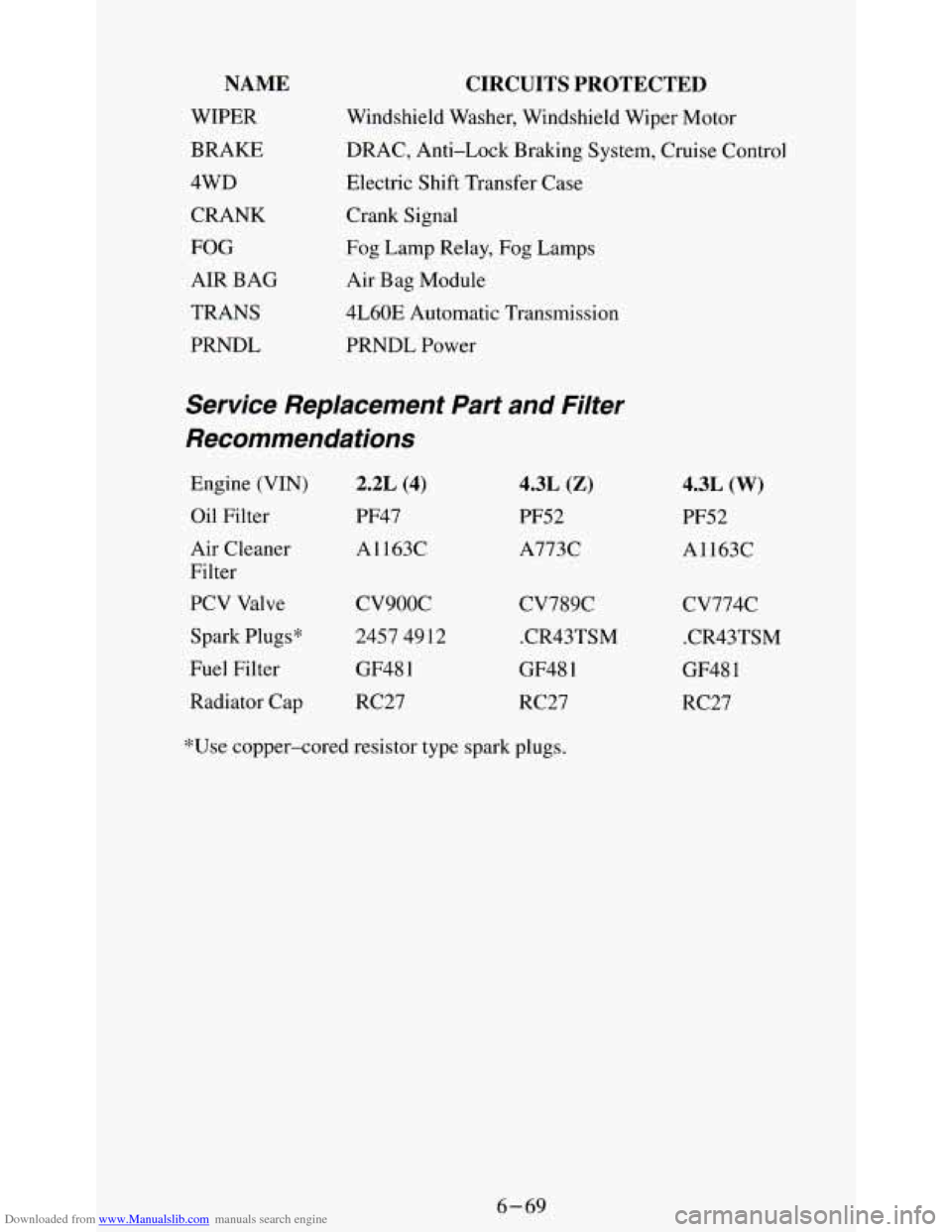
Downloaded from www.Manualslib.com manuals search engine NAME
WIPER
BRAKE
4WD CRANK
FOG
AIR BAG
TRANS
PRNDL
CIRCUITS PROTECTED
Windshield Washer, Windshield Wiper Motor
DRAC, Anti-Lock Braking System, Cruise Control
Electric Shift Transfer Case
Crank Signal
Fog Lamp Relay, Fog Lamps
Air Bag Module
4L60E Automatic Transmission
PRNDL Power
Service Replacement Part and Filter
Recommendations
Engine (VIN)
Oil Filter
Air Cleaner
Filter
PCV Valve
Spark Plugs*
Fuel Filter
Radiator Cap
2.2L (4)
PF47 A1163C
cv9ooc
2457 49 12
GF48
1
RC27
4.3L (Z)
PF52
A773C
CV789C .CR43TSM
GF48
1
RC27
4.3L (W)
PF52
A1163C
cv774c .CR43TSM
GF48
1
RC27
*Use copper-cored resistor type spark
plugs.
6-69
Page 287 of 354
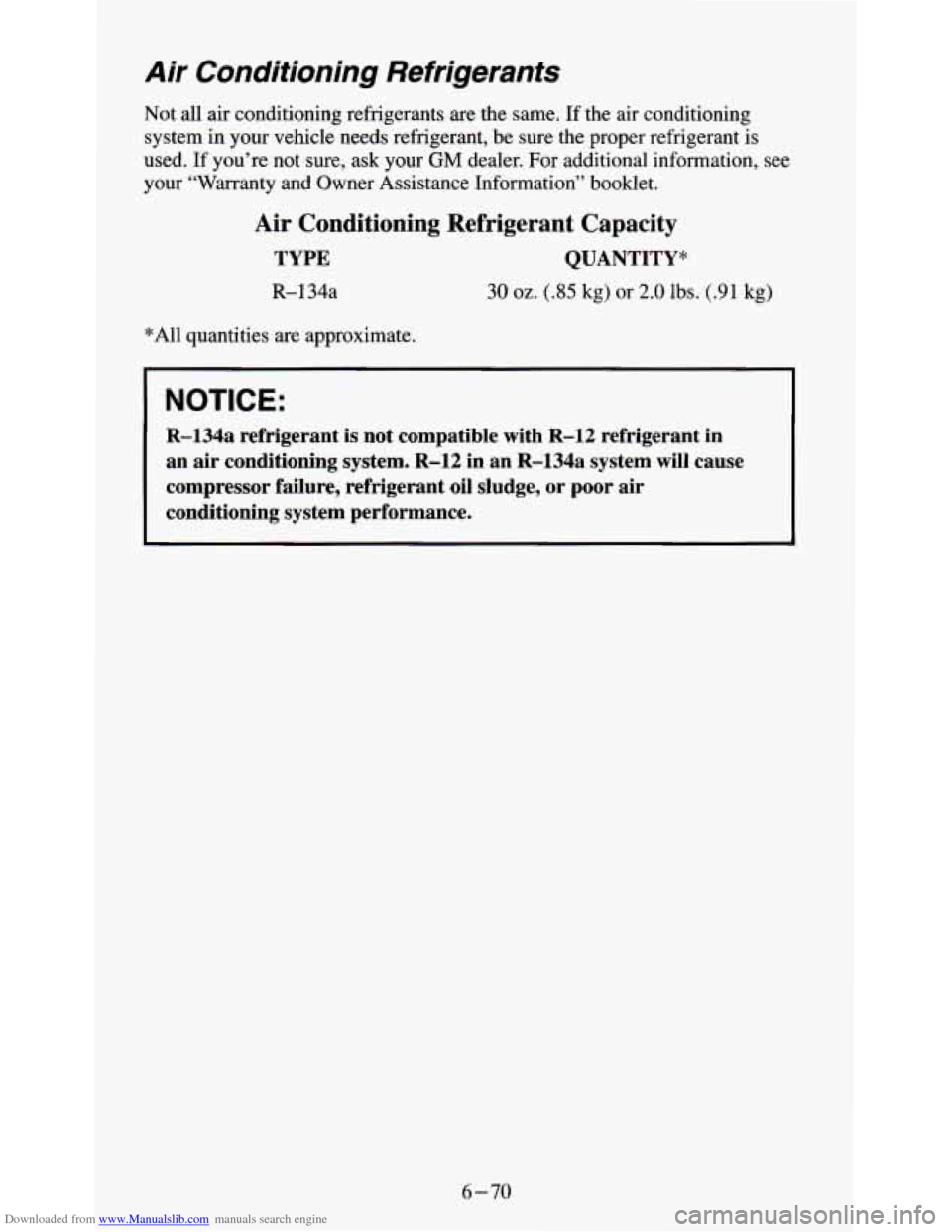
Downloaded from www.Manualslib.com manuals search engine Air Conditioning Refrigerants
Not all air conditioning refrigerants are the same. If the air conditioning
system in your vehicle needs refrigerant, be sure the proper refrigerant is
used. If you’re not sure, ask your
GM dealer. For additional information, see
your “Warranty and Owner Assistance Information” booklet.
Air Conditioning Refrigerant Capacity
TYPE QUANTITY*
R-134a
*All quantities are approximate.
30 oz. (35 kg) or 2.0 lbs. (.91 kg)
NOTICE:
R-134a refrigerant is not compatible with R-12 refrigerant in
an air conditioning system. R-12 in an R-134a system will caus\
e
compressor failure, refrigerant oil sludge, or poor air
conditioning system performance.
6-70