Fuel system CHEVROLET S10 1996 2.G User Guide
[x] Cancel search | Manufacturer: CHEVROLET, Model Year: 1996, Model line: S10, Model: CHEVROLET S10 1996 2.GPages: 375, PDF Size: 20.73 MB
Page 285 of 375
Downloaded from www.Manualslib.com manuals search engine Sheet Metal Damage
If your vehicle is damaged and requires sheet metal
repair or replacement, make sure the body repair shop
applies anti-corrosion material to the parts repaired or
replaced to restore corrosion protection.
Finish Damage
Any stone chips, fractures or deep scratches in the finish
should be repaired right away. Bare metal will corrode
quickly and may develop into a major repair expense.
Minor chips and scratches can be repaired with touch-up
materials available from your dealer or other service
outlets. Larger areas
of finish damage can be corrected
in your dealer’s body and paint shop.
Underbody Maintenance
Chemicals used for ice and snow removal and dust control
can collect
on the underbody. If these are not removed,
accelerated corrosion (rust) can occur
on the underbody
parts such as fuel lines, frame, floor pan, and exhaust
system even though they have corrosion protection. At least
every spring,
flush these materials from the
underbody with plain water. Clean any areas where mud
and other debris can collect. Dirt packed
in closed areas
of the frame should be loosened before being flushed.
Your dealer or an underbody vehicle washing system
can do this for you.
Chemical Paint Spotting
Some weather and atmospheric conditions can create
a chemical fallout. Airborne pollutants can fall upon
and attack painted surfaces on your vehicle. This
damage can take two forms: blotchy, ringlet-shaped
discolorations, and small irregular dark spots etched
into
the paint surface.
Although no defect in the paint job causes this, GM
will repair, at no charge to the owner, the surfaces of
new vehicles damaged by this fallout condition within
12 months or 12,000 miles (20 000 km) of purchase,
whichever occurs first.
This applies only
to materials manufactured and sold by
General Motors. Bodies, body conversions or equipment
not made or sold by General Motors are not covered.
Page 291 of 375
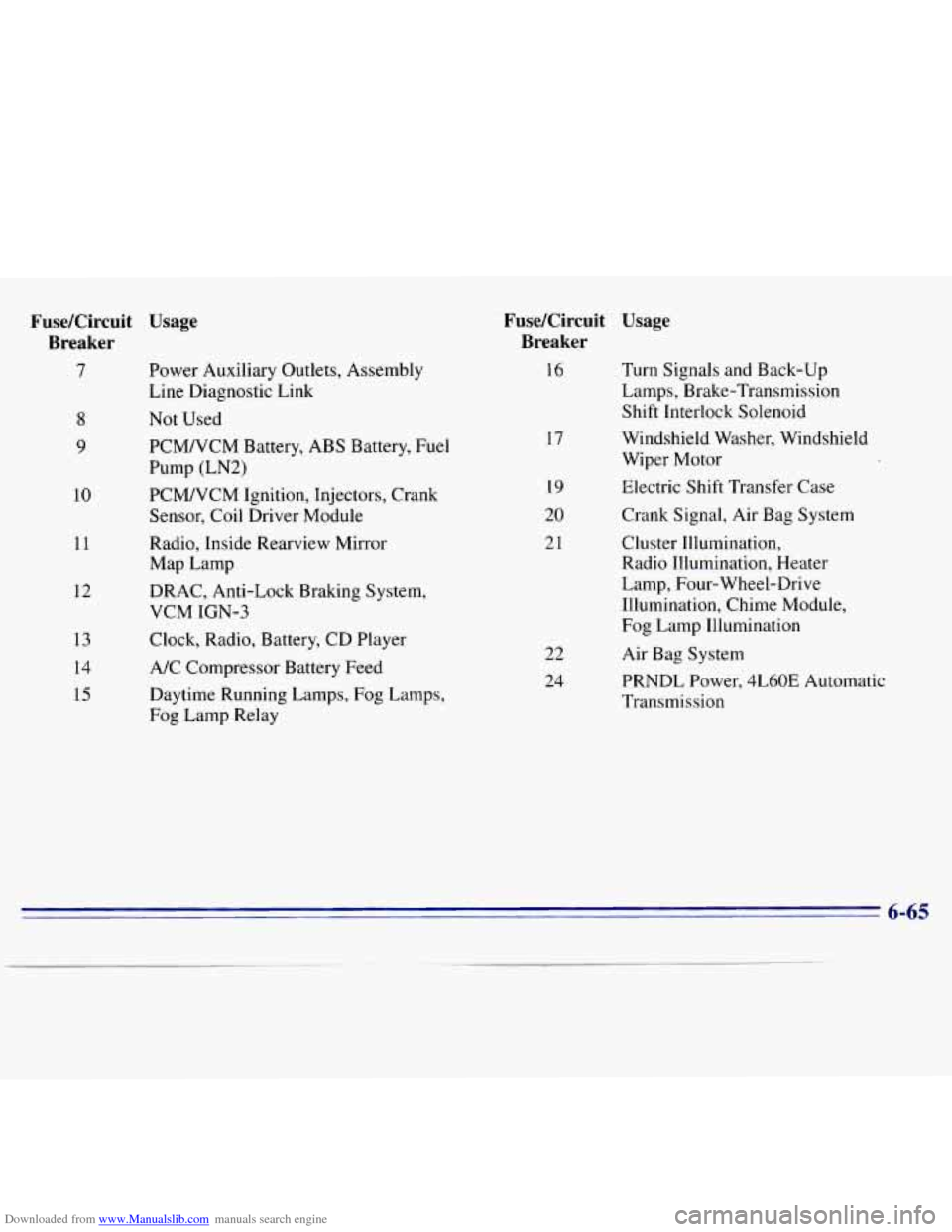
Downloaded from www.Manualslib.com manuals search engine Fuse/Circuit Usage Breaker
7 Power Auxiliary Outlets, Assembly
Line Diagnostic Link
8
9
10
11
12
13
14
15
Not Used
PCMNCM Battery,
ABS Battery, Fuel
Pump (LN2)
PCM/VCM Ignition, Injectors, Crank
Sensor, Coil Driver Module
Radio, Inside Rearview Mirror
Map Lamp
DRAC, Anti-Lock Braking System,
Clock, Radio, Battery,
CD Player
VCM
IGN-3
A/C Compressor Battery Feed
Daytime Running Lamps,
Fog Lamps,
Fog Lamp Relay
Fuse/Circuit Usage Breaker
16
17
19
20 21
22
24 Turn
Signals and Back-up
Lamps, Brake-Transmission
Shift Interlock Solenoid
Windshield Washer, Windshield Wiper Motor
Electric Shift Transfer Case
Crank Signal, Air Bag System
Cluster Illumination,
Radio Illumination, Heater
Lamp, Four- Wheel-Drive
Illumination, Chime Module,
Fog Lamp Illumination
Air Bag System
PRNDL Power, 4L60E Automatic
Transmission
6-65
Page 294 of 375
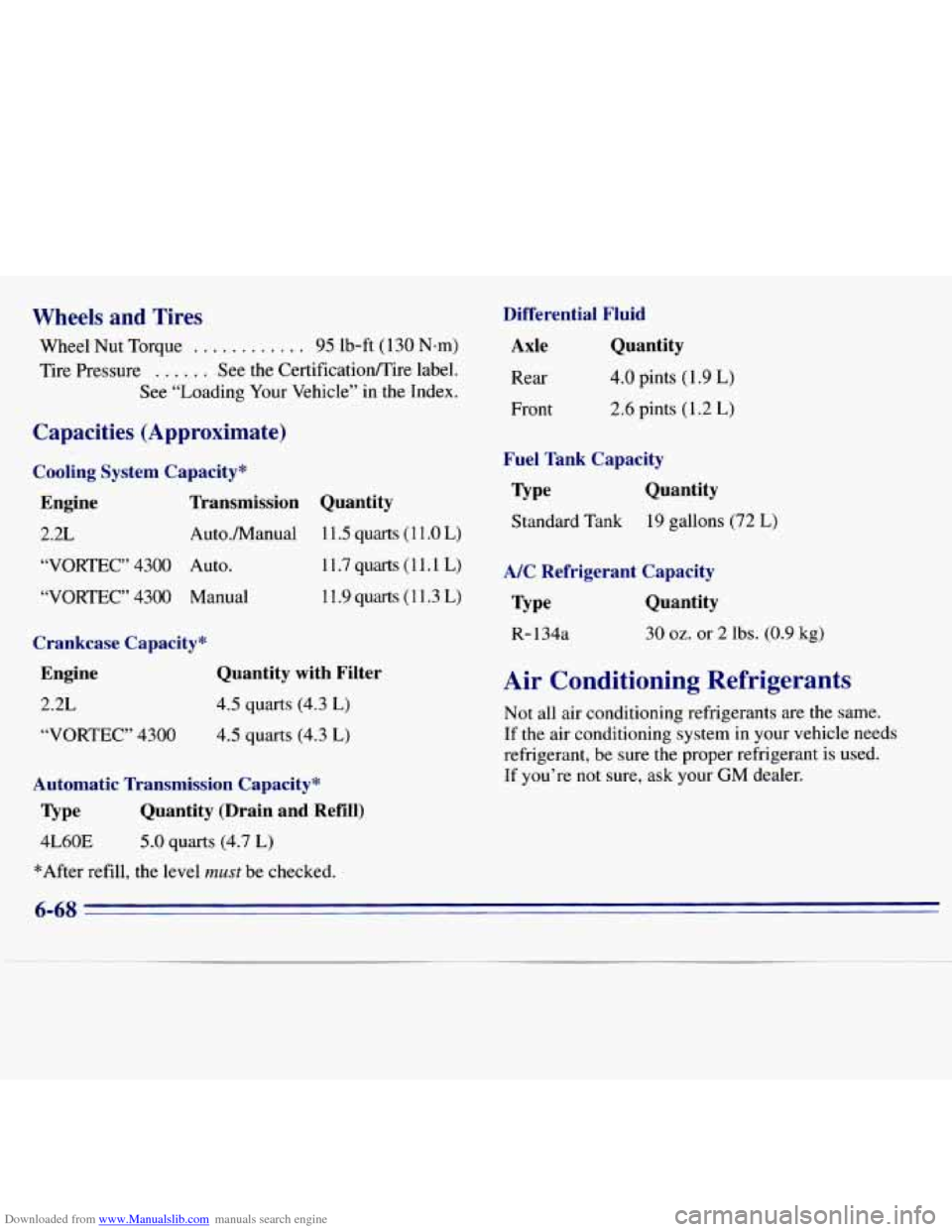
Downloaded from www.Manualslib.com manuals search engine Wheels and Tires
Wheel Nut Torque . . . . . . . . . . . . 95 lb-ft (130 N-m)
Tire Pressure . . . . . . See the Certificatiod‘Tire label.
See “Loading Your Vehicle”
in the Index.
Capacities (Approximate)
Cooling System Capacity*
Engine Transmission Quantity
2.2L Auto./Manual 1 1.5 quarts (1 1 .O L)
“VORTEC” 4300 Auto. 11.7quarts(11.1
L)
“VORTEC” 4300 Manual
11.9quarts(11.3L)
Crankcase Capacity*
Engine Quantity with Filter
2.2L 4.5 quarts (4.3 L)
“VORTEC” 4300 4.5 quarts (4.3 L)
Automatic Transmission Capacity*
Type Quantity (Drain and Refill)
4L60E 5.0 quarts (4.7 L)
*After refill, the level must be checked.
Differential Fluid
Axle Quantity
Rear 4.0 pints (1.9 L)
Front 2.6 pints (1.2 L)
Fuel Tank Capacity
Type Quantity
Standard Tank 19 gallons (72 L)
A/C Refrigerant Capacity
Type Quantity
R- 134a 30 oz. or 2 lbs. (0.9 kg)
Air Conditioning Refrigerants
Not all air conditioning refrigerants are the same.
If the air conditioning system in your vehicle needs
refrigerant, be sure the proper refrigerant is used.
If you’re not sure, ask your GM dealer.
6-68
Page 300 of 375
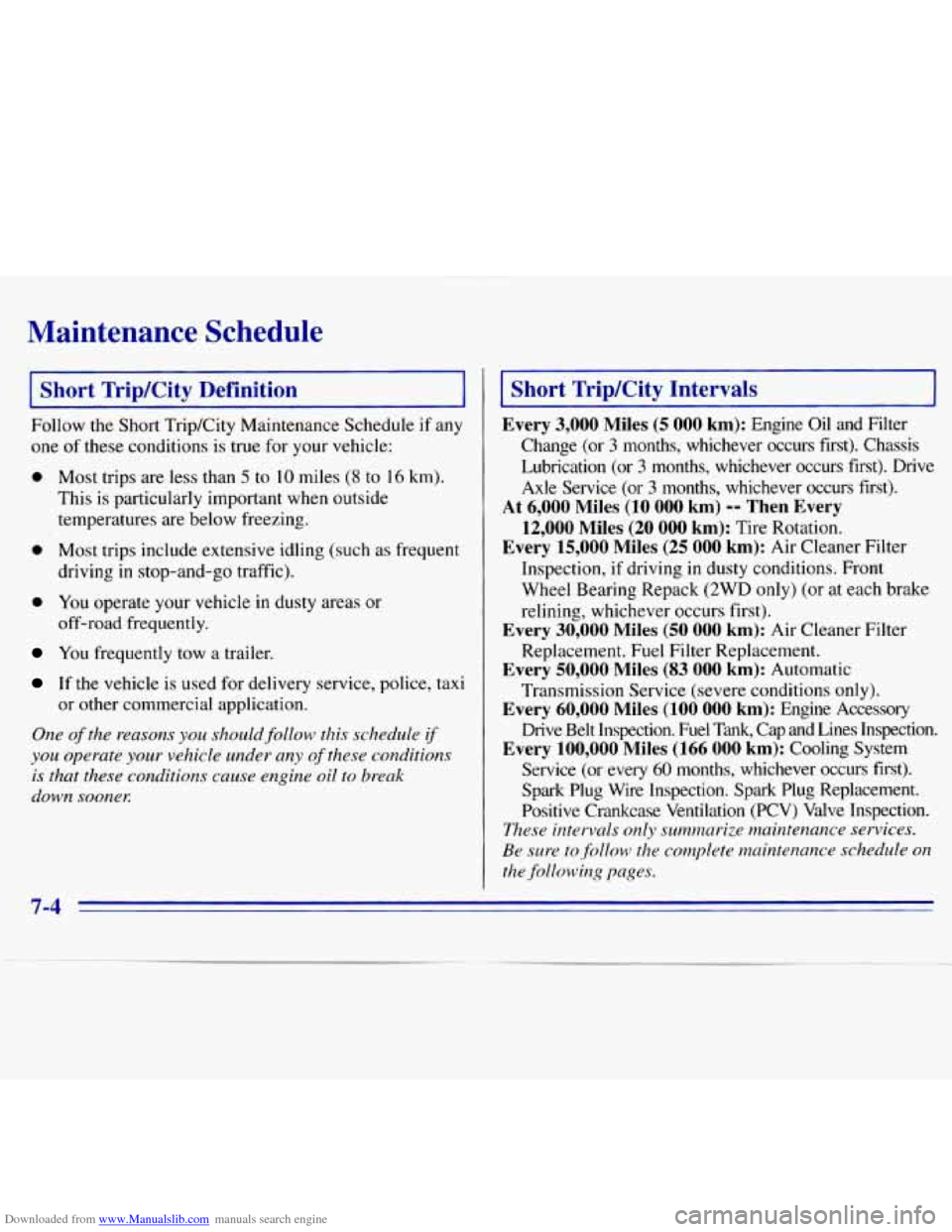
Downloaded from www.Manualslib.com manuals search engine Maintenance Schedule
I Short TripKity Definition
__~
Follow the Short TripKity Maintenance Schedule if any
one
of these conditions is true for your vehicle:
0 Most trips are less than 5 to 10 miles (8 to 16 km).
This is particularly important when outside
temperatures are below freezing.
driving
in stop-and-go traffic).
0 Most trips include extensive idling (such as frequent
0 You operate your vehicle in dusty areas or
off-road frequently.
You frequently tow a trailer.
If the vehicle is used for delivery service, police, taxi
or other commercial application.
One of the reasons you should follow this sch.edule if
you operate your vehicle under any qf these conditions
is that these conditions
cause engine oil to break
down soone):
Short TripKity Intervals
Every 3,000 Miles (5 000 km): Engine Oil and Filter
Change (or
3 months, whichever occurs first). Chassis
Lubrication (or
3 months, whichever occurs first). Drive
Axle Service (or
3 months, whichever occurs first).
At 6,000 Miles (10 000 km) -- Then Every
12,000 Miles (20 000 km): Tire Rotation.
Every 15,000 Miles (25 000 km): Air Cleaner Filter
Inspection,
if driving in dusty conditions. Front
Wheel Bearing Repack
(2WD only) (or at each brake
relining, whichever occurs first).
Every 30,000 Miles (50 000 km): Air Cleaner Filter
Replacement.
Fuel Filter Replacement.
Every 50,000 Miles (83 000 km): Automatic
Transmission Service (severe conditions only).
Every 60,000 Miles (100 000 km): Engine Accessory
Drive Belt Inspection. Fuel
Tank, Cap and Lines Inspection.
Every 100,000 Miles (166 000 km): Cooling System
Service
(or every 60 months, whichever occurs first).
Spark Plug Wire Inspection.
Spark Plug Replacement.
Positive Crankcase Ventilation (PCV) Valve Inspection.
These intervals only sumrnurize maintenance services.
Be sure to.follow the complete maintenance schedule on
the%following pages.
7-4
Page 301 of 375
Downloaded from www.Manualslib.com manuals search engine Maintenance Schedule
Follow this maintenance schedule only if none of the
conditions from the Short Trip/City Maintenance
Schedule
is true.
Driving a vehicle with a fully warmed engine under
highway conditions causes engine
oil to break
down slower:
Every 7,500 Miles (12 500 km): Engine Oil and Filter
Change (or every 12 months, whichever occurs first).
Chassis Lubrication (or every 12 months, whichever
occurs first). Drive Axle Service.
At 7,500 Miles (12 500 km) -- Then Every
15,000 Miles (25
000 km): Tire Rotation.
Every 30,000 Miles (50 000 km): Fuel Filter
Replacement. Air Cleaner Filter Replacement. Front
Wheel Bearing Repack (2WD only) (or at each brake
relining, whichever occurs first).
Transmission Service (severe conditions only).
Drive Belt Inspection.
Fuel Tank, Cap and
Lines Inspection.
Every 100,000 Miles (166 000 km): Cooling System
Service (or every
60 months, whichever occurs first).
Spark Plug Wire Inspection. Spark Plug Replacement.
Positive Crankcase Ventilation (PCV) Valve Inspection.
Every 50,000 Miles (83 000 km): Automatic
Every 60,000 Miles (100 000 km): Engine Accessory
These intervals only summarize maintenance services.
Be sure
to follow the complete maintenance schedule on
the following pages.
7-5
Page 343 of 375
Downloaded from www.Manualslib.com manuals search engine Part B: Owner Checks and Services
Listed below are owner checks and services which
should be performed
at the intervals specified to help
ensure the safety, dependability and emission control
performance
of your vehicle.
Be sure
any necessary repairs are completed at once.
Whenever any fluids or lubricants are added
to your
vehicle, make sure they are the proper ones, as shown
in Part
D.
At Each Fuel Fill
It is important for you or a service station attendant to
pegorm these underhood checks at each fuel
fill.
Engine Oil Level Check
Check the engine oil level and add the proper oil
if necessary. See “Engine Oil” in the Index for
further details.
Engine Coolant Level Check
Check the engine coolant level and add the proper
coolant mix if necessary. See “Engine Coolant” in
the
Index for further details.
Windshield Washer Fluid Level Check
Check the windshield washer fluid level in the
windshield washer tank and add the proper fluid if
necessary. See “Windshield Washer Fluid” in the Index
for further details.
At Least -Once a Month
Tire Inflation Check
Make sure tires are inflated to the correct pressures. See
“Tires”
in the Index for further details.
Cassette Deck Service
Clean cassette deck. Cleaning should be done every
50 hours of tape play. See “Audio Systems” in the Index
for further details.
7-47
Page 344 of 375
Downloaded from www.Manualslib.com manuals search engine At Least Twice a Year
Restraint System Check
Make sure the safety belt reminder light and all your
belts, buckles, latch plates, retractors and anchorages are
working properly. Look for any other loose or damaged
safety belt system parts. If you see anything that might
keep a safety belt system from doing its job, have it
repaired. Have any torn or frayed safety belts replaced.
Also look for any opened or broken air bag covers, and
have them repaired
or replaced. (The air bag system
does not need regular maintenance.)
Manual Transmission Check
Check the transmission fluid level; add if needed. See
“Manual Transmission” in the Index. A fluid
loss may
indicate a problem. Check the system and repair if needed.
Automatic Transmission Check
Check the transmission fluid level; add if needed. See
“Automatic Transmission” in the Index.
A fluid loss may
indicate a problem. Check the system and repair if needed.
Hydraulic Clutch System Check
At Least Four Times a Year
Tailgate Lubrication Service
Lubricate tailgate latch bolt, handle assembly pivot
points, and hinges with lubricant recommended in
Part
D. Lubricate every 3,000 miles (5 000 km) if
following schedule I or every
7,500 miles (12 500 km)
if following schedule 11.
At Least Once a Year
Key Lock Cylinders Service
Lubricate the key lock cylinders with the lubricant
specified in Part
D.
Body Lubrication Service
Lubricate all body door and fuel door hinges, latches
and locks including the glove box, console doors and the
body hood, and any moving seat hardware. Lubricate
the hood safety lever pivot and prop rod pivot. Part
D
tells you what to use. More frequent lubrication may be
required when exposed to a corrosive environment.
Check the fluid level in the clutch reservoir. See
“Hydraulic Clutch Fluid” in the Index.
A fluid loss in
this system could indicate a problem. Have the system
inspected and repaired at once.
7-48