maintenance CHEVROLET S10 1996 2.G User Guide
[x] Cancel search | Manufacturer: CHEVROLET, Model Year: 1996, Model line: S10, Model: CHEVROLET S10 1996 2.GPages: 375, PDF Size: 20.73 MB
Page 246 of 375
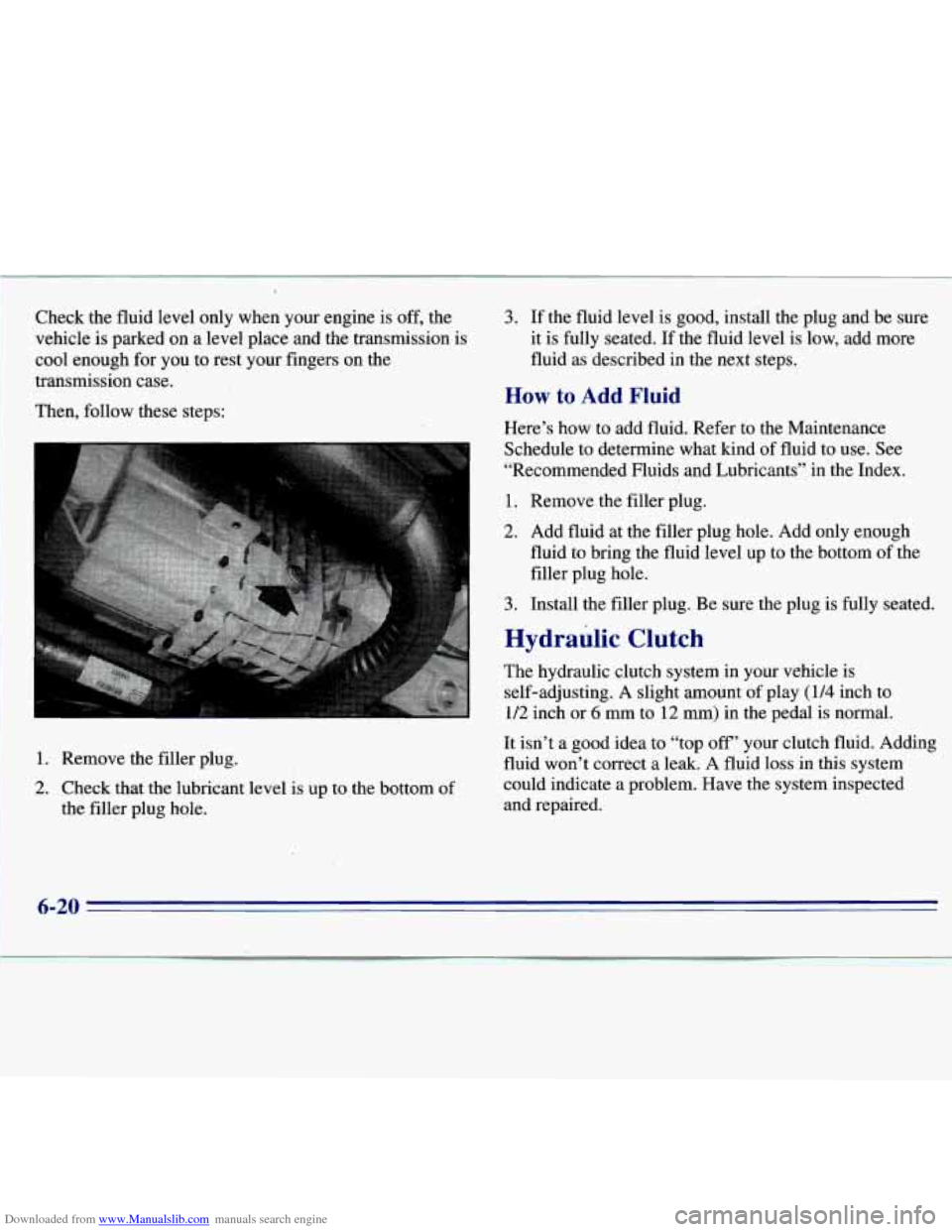
Downloaded from www.Manualslib.com manuals search engine Check the fluid level only when your engine is off, the
vehicle is parked on a level place and the transmission is
cool enough for you to rest your fingers on the
transmission case.
Then, follow these steps: 3. If the fluid level is good, install the plug and be sure
it is fully seated. If the fluid level is low, add more
fluid as described in the next steps.
How to Add Fluid
Here’s how to add fluid. Refer to the Maintenance
Schedule to determine what kind of fluid to use. See
“Recommended Fluids and Lubricants” in the Index.
1. Remove the filler plug.
2. Add fluid at the filler plug. hole. Add only enough
fluid to bring the fluid level up to the bottom of the
filler plug hole.
3. Install the filler plug. Be sure the plug is fully seated.
Hydraulic Clutch -
The hydraulic clutch system in your vehicle is
self-adjusting.
A slight amount of play (1/4 inch to
1/2 inch or 6 mm to 12 mm) in the pedal is normal.
1. Remove the filler plug.
2. Check that the lubricant level is up to the bottom of
the filler plug hole. It isn’t a
good idea to “top
off’ your clutch fluid. Adding
fluid won’t correct a leak. A fluid
loss in this system
could indicate a problem. Have the system inspected
and repaired.
6-20 I
Page 247 of 375
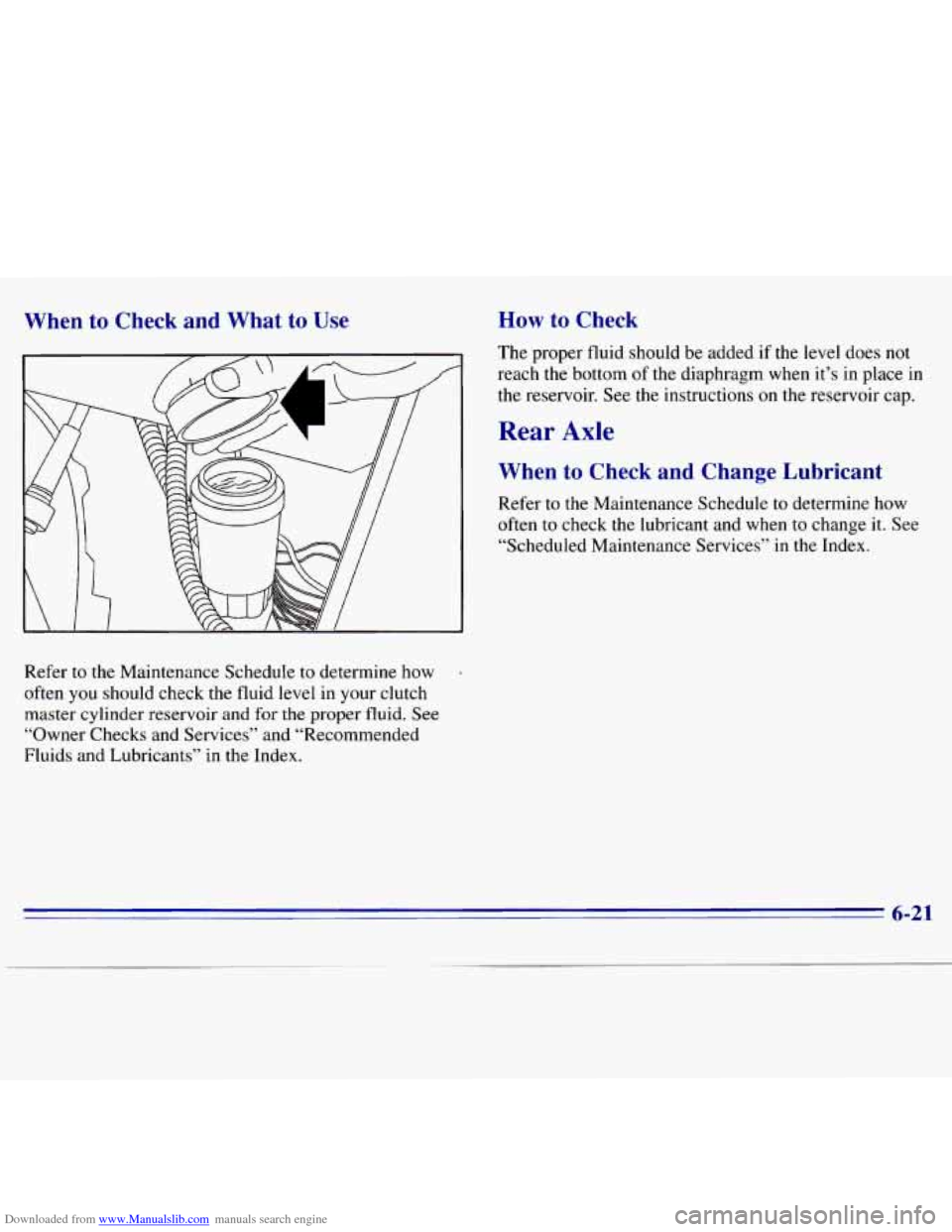
Downloaded from www.Manualslib.com manuals search engine When to Check and What to Use How to Check
The proper fluid should be added if the level does not
reach
the^ bottom of the diaphragm when it’s in place in
the reservoir. See the instructions on the reservoir cap.
Rear Axle
When to Check and Change Lubricant
Refer to the Maintenance Schedule to determine how
often to check the lubricant and when to change it. See
“Scheduled Maintenance Services” in the Index.
Refer to the Maintenance Schedule to determine how
-
often you should check the fluid level in your clutch
master cylinder reservoir and for the proper fluid. See
“Owner Checks and Services” and “Recommended
Fluids
and Lubricants” in the Index.
6-21
Page 248 of 375
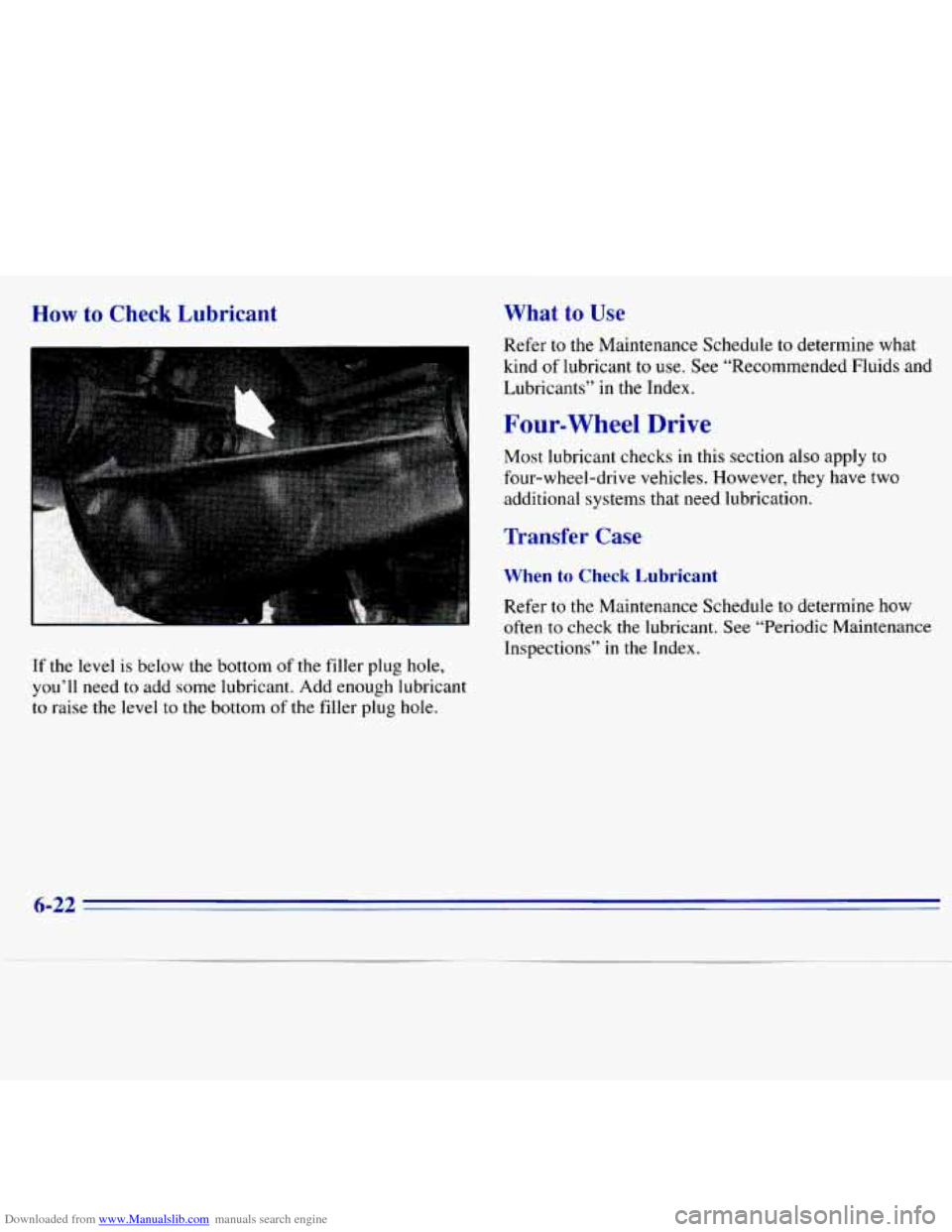
Downloaded from www.Manualslib.com manuals search engine How to Check Lubricant
If the level is below the bottom of the filler plug hole,
you’ll need to add some lubricant. Add enough lubricant
to raise the level to the bottom of the filler plug hole.
What to Use
Refer to the Maintenance Schedule to determine what
kind
of lubricant to use. See “Recommended Fluids and
Lubricants” in the Index.
Four-wheel Drive
Most lubricant checks in this section also apply to
four-wheel-drive vehicles. However, they have two
additional systems that need lubrication.
Transfer Case
When to Check Lubricant
Refer to the Maintenance Schedule to determine how
often
to check the lubricant. See “Periodic Maintenance
Inspections”
in the Index.
6-22
Page 249 of 375
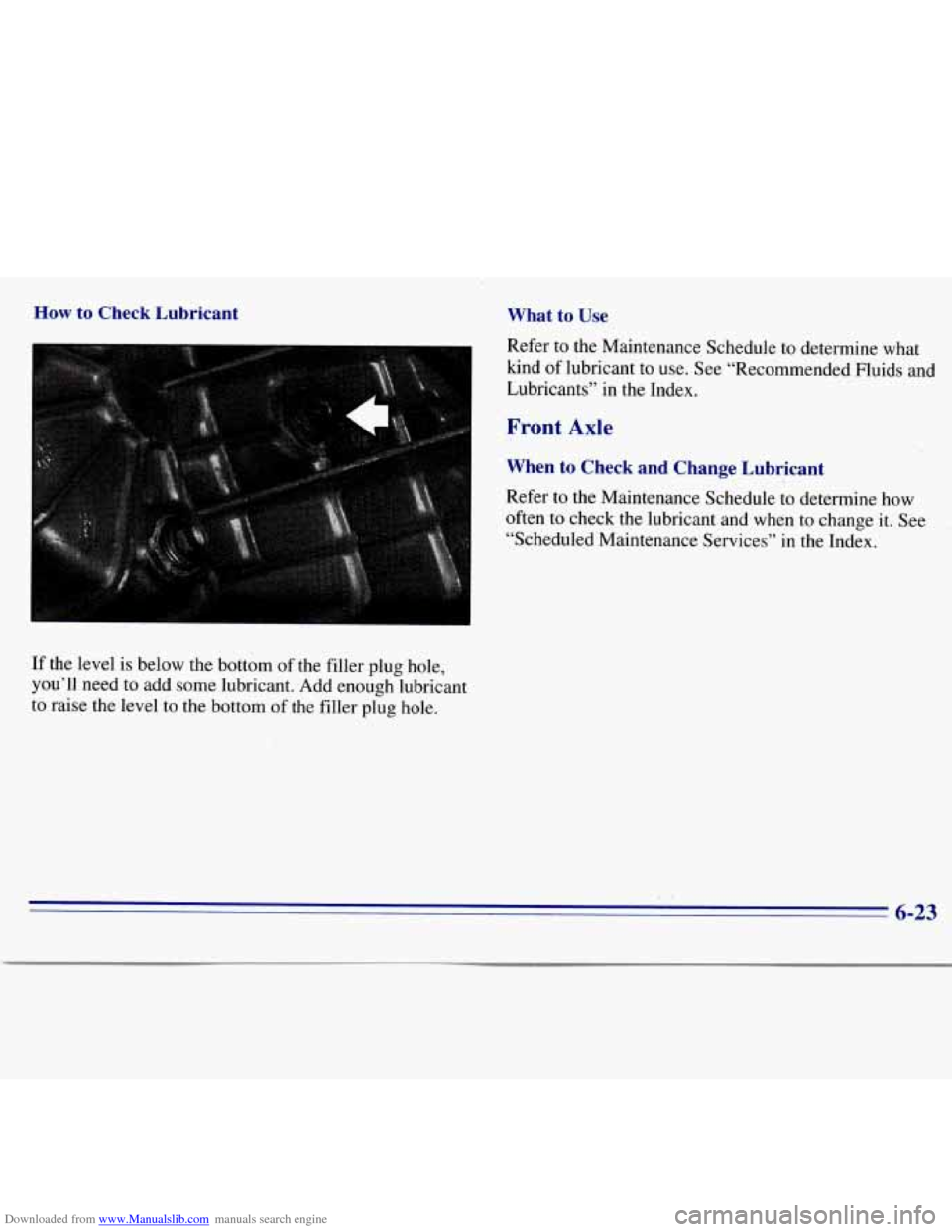
Downloaded from www.Manualslib.com manuals search engine How to Check Lubricant
If the level is below the bottom of the filler plug hole,
you’ll need to add some lubricant. Add enough lubricant
to raise the level to the bottom of the filler plug hole.
What to Use
Refer to the Maintenance Schedule to determine what
kind
of lubricant to use. See “Recommended Fluids and
Lubricants” in the Index.
Front Axle
When to Check and Change Lubricant
Refer to the Maintenance Schedule to determine how
often to check the lubricant and when to change it. See
“Scheduled Maintenance Services” in the Index.
6-23
Page 250 of 375
Downloaded from www.Manualslib.com manuals search engine How to Check Lubricant
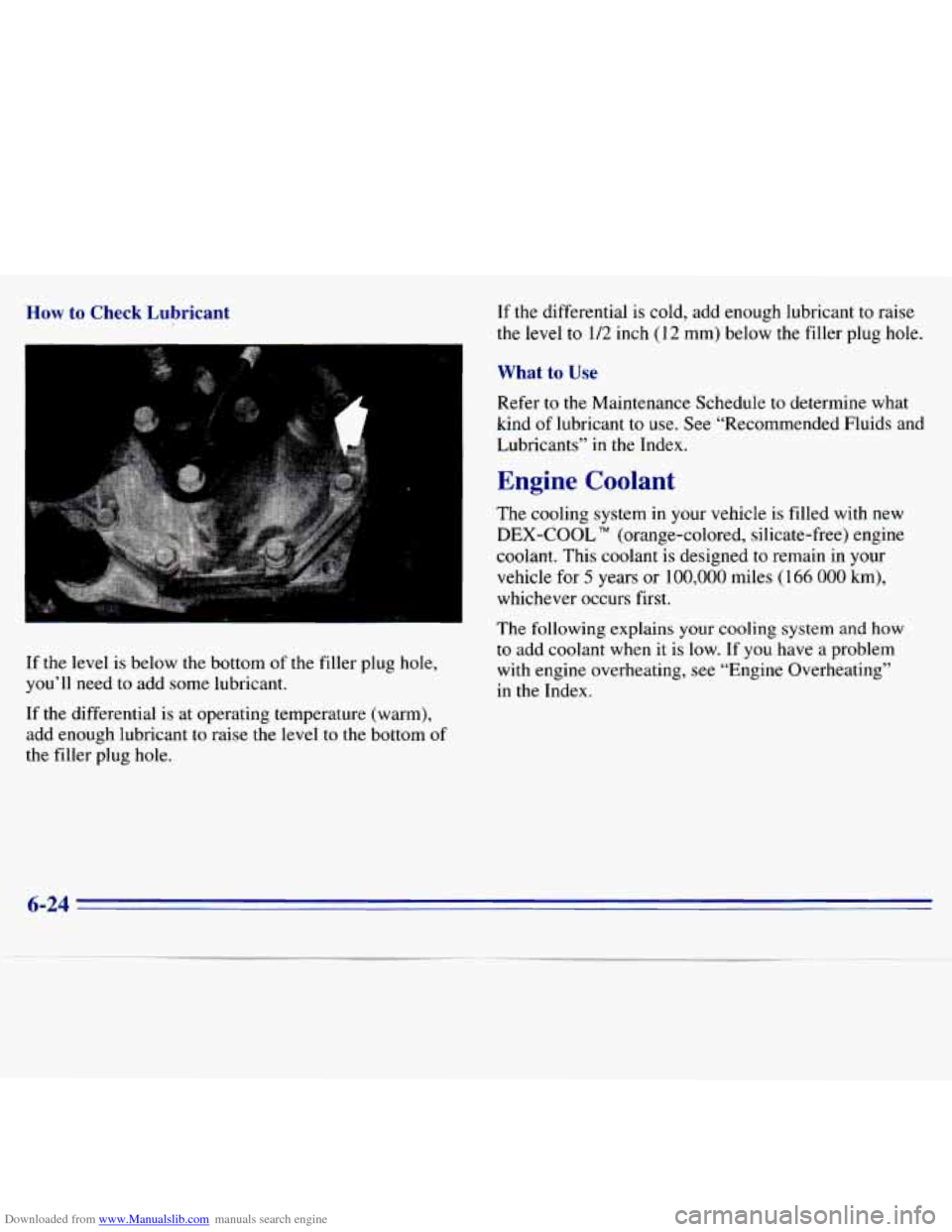
If the level is below the bottom of the filler plug hole,
you’ll need to add some lubricant.
If the differential is at operating temperature (warm),
add enough lubricant
to raise the level to the bottom of
the filler plug hole. If
the differential is cold, add enough lubricant to raise
the level
to 1/2 inch (12 mm) below the filler plug hole.
What to Use
Refer to the Maintenance Schedule to determine what
kind of lubricant to use. See “Recommended Fluids
and
Lubricants’’ in the Index.
Engine Coolant
The cooling system in your vehicle is filled with new
DEX-COOL R’l (orange-colored, silicate-free) engine
coolant. This coolant is designed to remain in your
vehicle for
5 years or 100,000 miles ( 166 000 km),
whichever occurs first.
The following explains your cooling system and
how
to add coolant when it is low. If you have a problem
with engine overheating, see “Engine Overheating”
in the Index.
6-24
Page 255 of 375
Downloaded from www.Manualslib.com manuals search engine Power Steering Fluid How To Check Power Steering Fluid
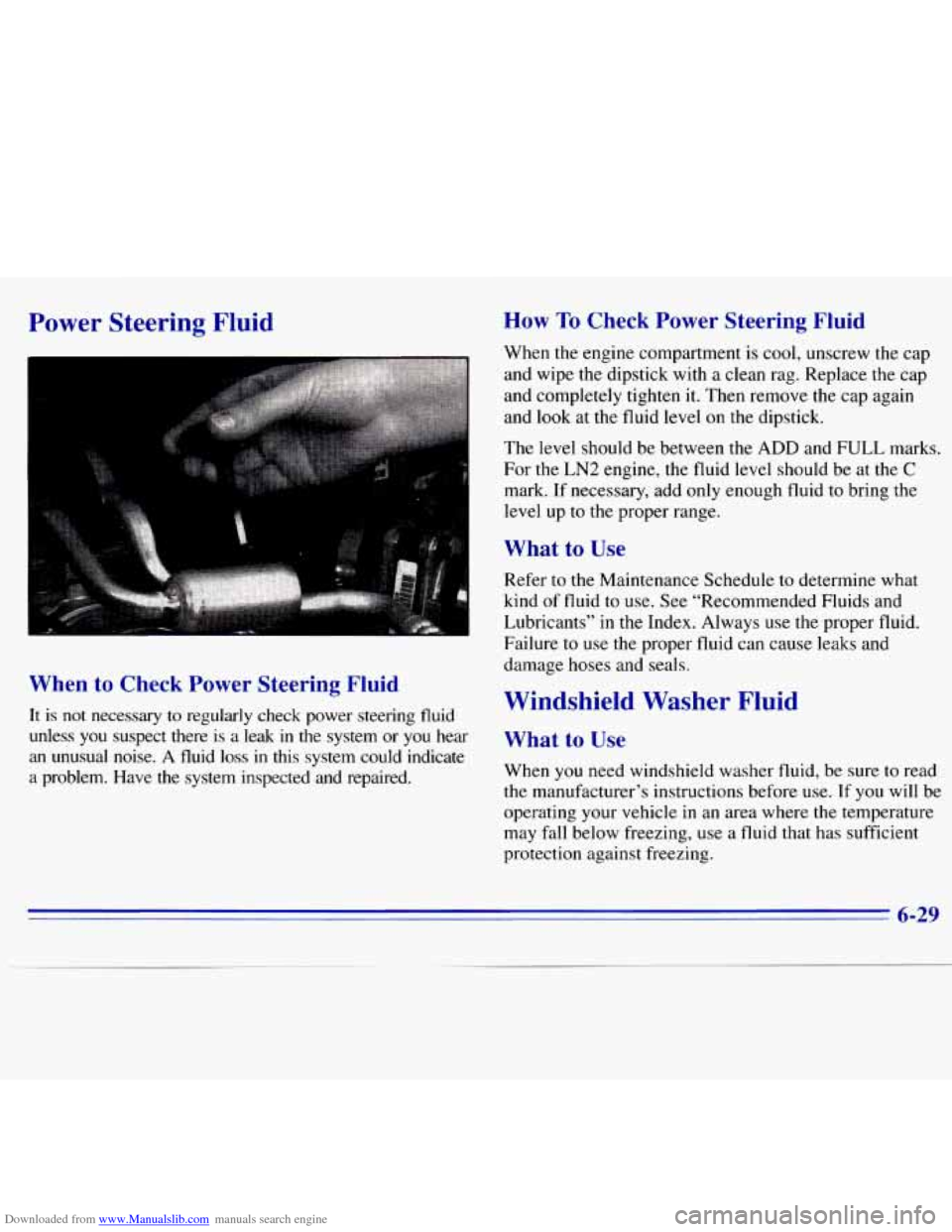
When the engine compartment is cool, unscrew the cap
and wipe the dipstick with a clean rag. Replace the cap
and completely tighten it. Then remove the cap again
and
look at the fluid level on the dipstick.
The level should be between the
ADD and FULL marks.
For the
LN2 engine, the fluid level should be at the C
mark. If necessary, add only enough fluid to bring the
level up
to the proper range.
What to Use
Refer to the Maintenance Schedule to determine what
kind of fluid
to use. See “Recommended Fluids and
Lubricants” in the Index. Always use the proper fluid.
Failure to
use the proper fluid can cause leaks and
damage hoses and seals.
Windshield Washer Fluid
What to Use
When you need windshield washer fluid, be sure to read
the manufacturer’s instructions before use. If you will be
operating your vehicle
in an area where the temperature
may fall below freezing, use a fluid that has sufficient
protection against freezing.
When to Check Power Steering Fluid
It is not necessary to regularly check power steering fluid
unless you suspect there is a leak
in the system or you hear
an unusual noise.
A fluid loss in this system could indicate
a problem. Have
the system inspected and repaired.
6-29
Page 257 of 375
Downloaded from www.Manualslib.com manuals search engine Brakes
Brake Fluid
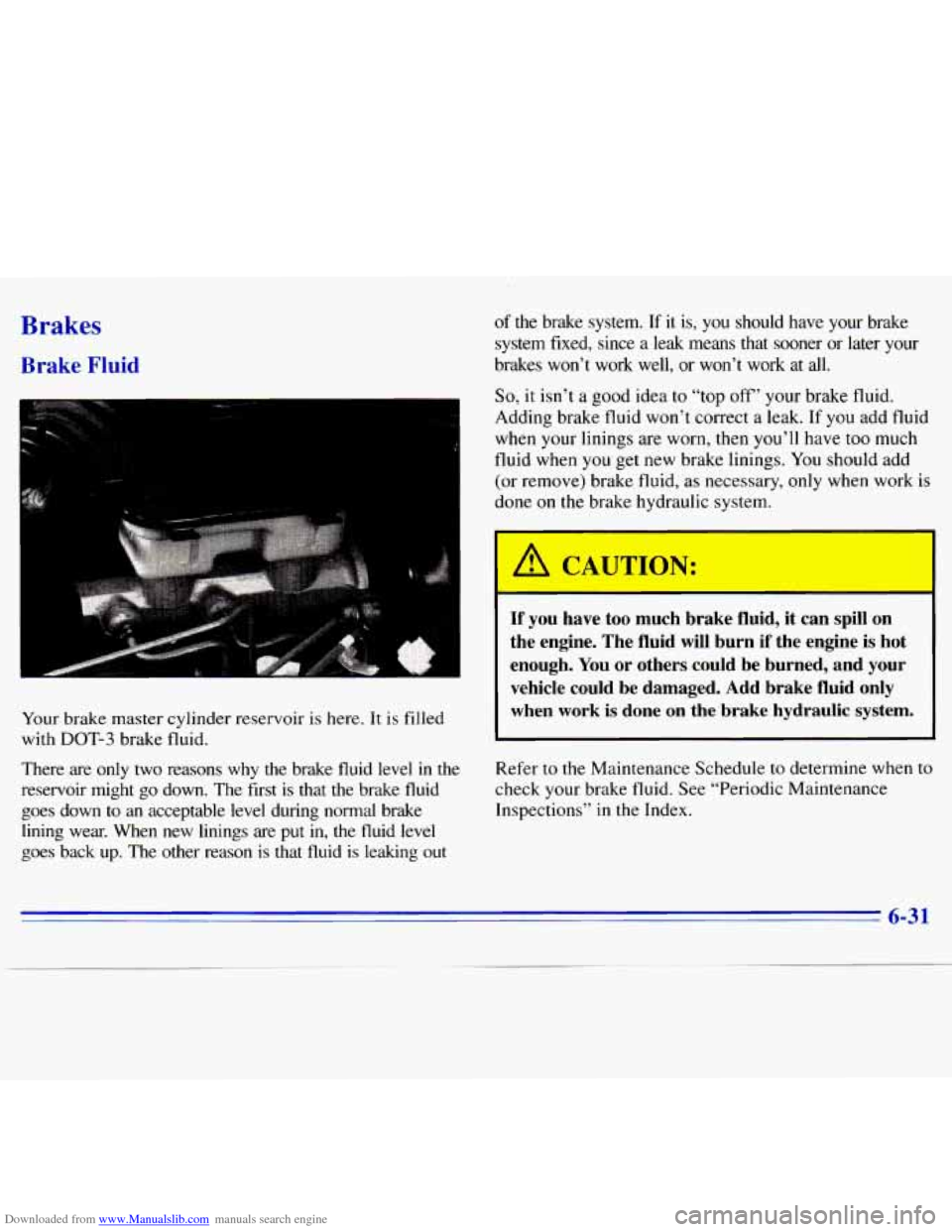
Your brake master cylinder reservoir is here. It is filled
with
DOT-3 brake fluid.
There are only two reasons
why the brake fluid level in the
reservoir might
go down. The first is that the brake fluid
goes down
to an acceptable level during normal brake
lining wear. When new linings
are put in, the fluid level
goes back up. The other reason
is that fluid is leaking out
of the brake system. If it is, you should have your brake
system fixed, since a leak means that sooner or later your
brakes won’t work well, or won’t work at all.
So, it isn’t a good idea to “top off’ your brake fluid.
Adding brake fluid won’t correct a leak.
If you add fluid
when your linings are worn,
then you’ll have too much
fluid when
you get new brake linings. You should add
(or remove) brake fluid, as necessary, only when work
is
done on the brake hydraulic system.
’ A CAUTION: I
If you have too much brake fluid, it can spill on
the engine. The fluid will burn if the engine is hot
enough. You or others could be burned, and your
vehicle could be damaged. Add brake fluid only
when work
is done on the brake hydraulic system.
Refer to the Maintenance Schedule to determine when to
check your brake fluid. See “Periodic Maintenance
Inspections”
in the Index.
6-31
Page 268 of 375
Downloaded from www.Manualslib.com manuals search engine Windshield Wiper Blade Replacement
See “Normal Maintenance Replacement Parts” in the
Index for the proper type
of replacement blade.
NOTICE:
Use care when removing or installing a blade
assembly. Accidental bumping can cause the arm
to fall back and strike the windshield.
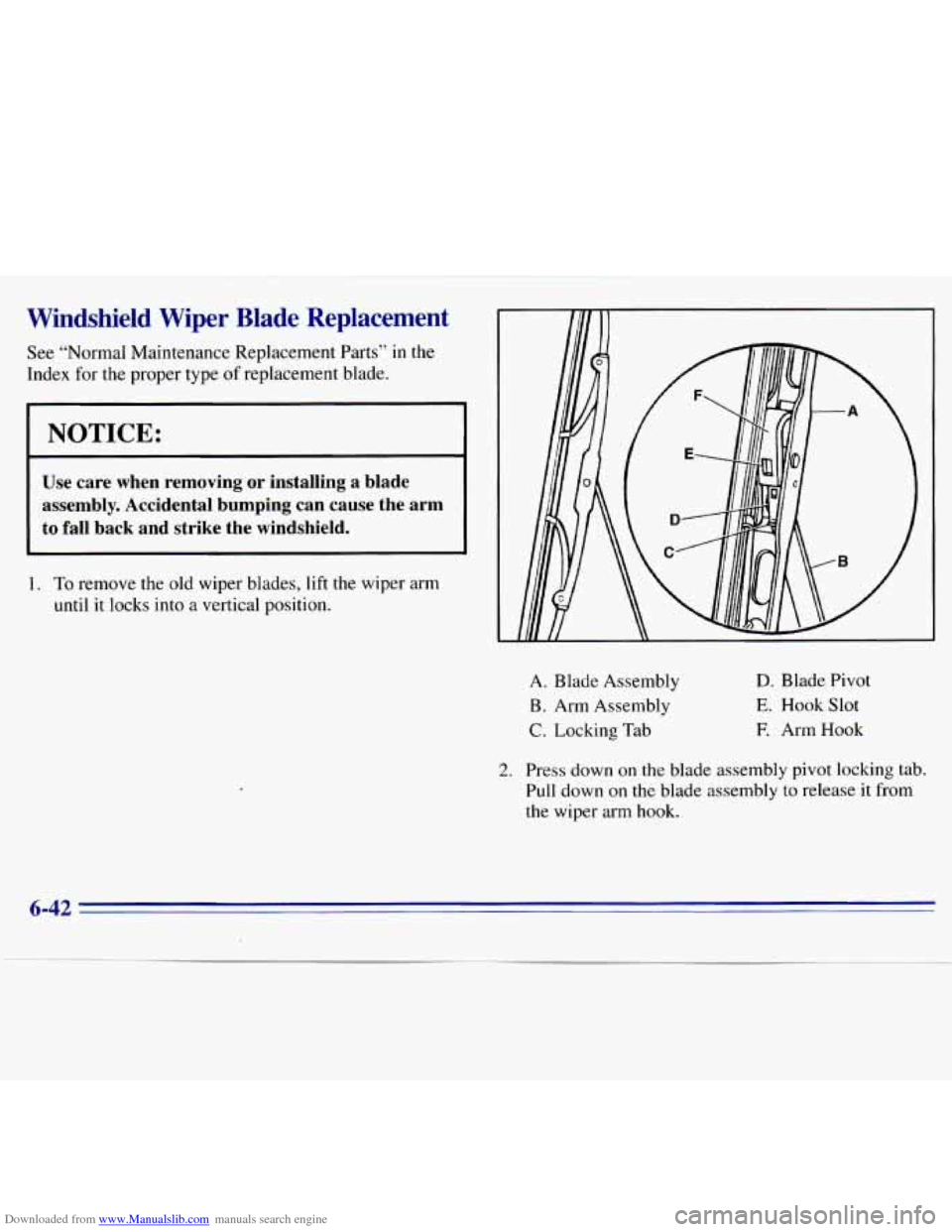
1. To remove the old wiper blades, lift the wiper arm
until it locks into a vertical position.
A. Blade Assembly
B. Arm Assembly
C. Locking Tab
D. Blade Pivot
E. Hook Slot
E Arm Hook
2. Press down on the blade assembly pivot locking tab.
Pull down on
the blade assembly to release it from
the wiper arm hook.
6-42
Page 272 of 375
Downloaded from www.Manualslib.com manuals search engine Tire Inspection and Rotation
Fires should be inspected every 6,000 to 8,000 miles
(10 000 to 13 000 km) for any signs of unusual wear. If
unusual wear is present, rotate your tires as
soon as
possible and check wheel alignment. Also check for
damaged tires or wheels. See “When It’s Time for New
Tires” and“‘Whee1 Replacement” later
in this section for
more information.
I
J.
@
I
The purpose of regular rotation is to achieve more uniforrn
wear for all tires on the vehicle. Thy first rotation is the
most important.
See “Scheduled Maintenance Services” in
the Index for scheduled rotation intervals.
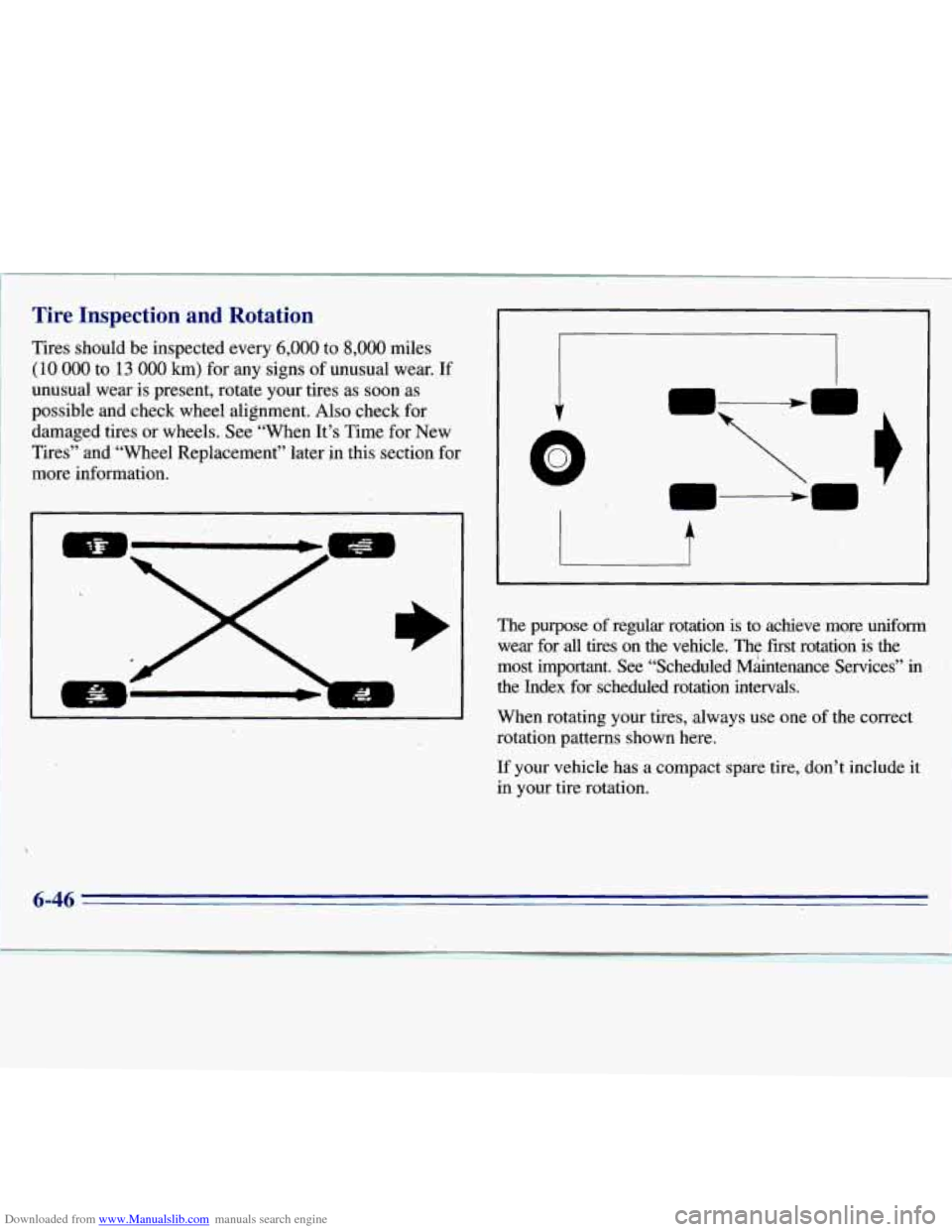
When rotating your tires, always use one
of the correct
rotation patterns shown here.
If your vehicle has a compact spare tire, don’t include it
in your tire rotation.
6-46
Page 285 of 375
Downloaded from www.Manualslib.com manuals search engine Sheet Metal Damage
If your vehicle is damaged and requires sheet metal
repair or replacement, make sure the body repair shop
applies anti-corrosion material to the parts repaired or
replaced to restore corrosion protection.
Finish Damage
Any stone chips, fractures or deep scratches in the finish
should be repaired right away. Bare metal will corrode
quickly and may develop into a major repair expense.
Minor chips and scratches can be repaired with touch-up
materials available from your dealer or other service
outlets. Larger areas
of finish damage can be corrected
in your dealer’s body and paint shop.
Underbody Maintenance
Chemicals used for ice and snow removal and dust control
can collect
on the underbody. If these are not removed,
accelerated corrosion (rust) can occur
on the underbody
parts such as fuel lines, frame, floor pan, and exhaust
system even though they have corrosion protection. At least
every spring,
flush these materials from the
underbody with plain water. Clean any areas where mud
and other debris can collect. Dirt packed
in closed areas
of the frame should be loosened before being flushed.
Your dealer or an underbody vehicle washing system
can do this for you.
Chemical Paint Spotting
Some weather and atmospheric conditions can create
a chemical fallout. Airborne pollutants can fall upon
and attack painted surfaces on your vehicle. This
damage can take two forms: blotchy, ringlet-shaped
discolorations, and small irregular dark spots etched
into
the paint surface.
Although no defect in the paint job causes this, GM
will repair, at no charge to the owner, the surfaces of
new vehicles damaged by this fallout condition within
12 months or 12,000 miles (20 000 km) of purchase,
whichever occurs first.
This applies only
to materials manufactured and sold by
General Motors. Bodies, body conversions or equipment
not made or sold by General Motors are not covered.