towing CHEVROLET S10 1996 2.G User Guide
[x] Cancel search | Manufacturer: CHEVROLET, Model Year: 1996, Model line: S10, Model: CHEVROLET S10 1996 2.GPages: 375, PDF Size: 20.73 MB
Page 86 of 375
Downloaded from www.Manualslib.com manuals search engine If a bulb is burned out, replace it to help avoid an
accident. If the arrows don’t go
on at all when you
signal a turn, check the fuse (see “Fuses and Circuit
Breakers” in the Index) and for burned-out bulbs.
If
you have a trailer towing option with added wiring for
the trailer lamps,
a different turn signal flasher is used.
With this flasher installed, the signal indicator will flash
even if a turn signal bulb is burned out. Check the front
and rear turn signal lamps regularly to make sure they
are working.
Headlamp High/Low Beam Changer
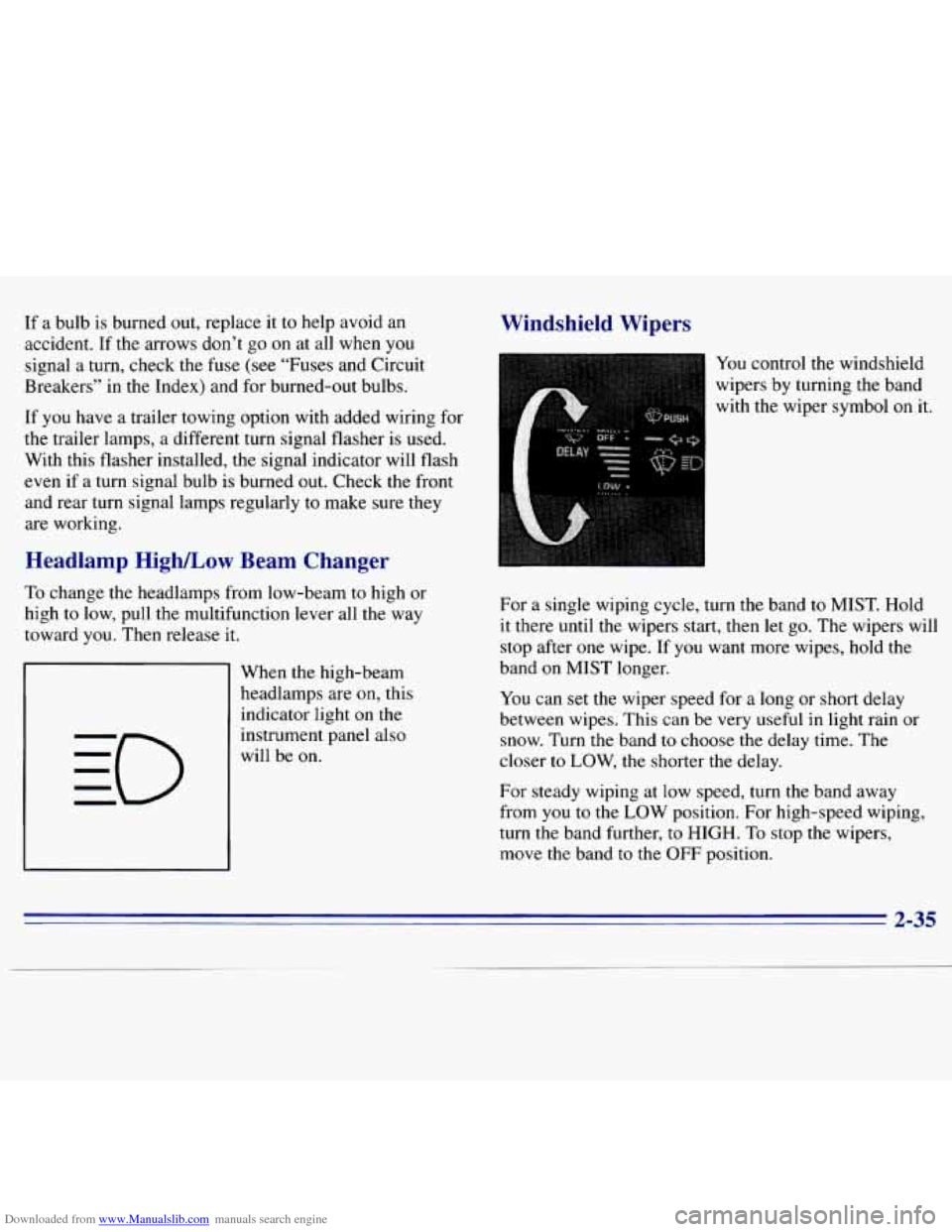
To change the headlamps from low-beam to high or
high to low, pull the multifunction lever all the way
toward you. Then release it.
When the high-beam
headlamps are
on, this
indicator light
on the
instrument panel also
will be
on.
Windshield Wipers
You control the windshield
wipers by turning the band
with the wiper symbol
on it.
For a single wiping cycle, turn the band
to MIST. Hold
it there until the wipers start, then let go. The wipers will
stop after one wipe. If you want more wipes, hold the
band
on MIST longer.
You can set the wiper speed for a long or short delay
between wipes. This can be very useful in light rain or
snow. Turn the band
to choose the delay time. The
closer
to LOW, the shorter the delay.
For steady wiping at
low speed, turn the band away
from
you to the LOW position. For high-speed wiping,
turn the band further,
to HIGH. To stop the wipers,
move the band
to the OFF position.
2-35
Page 107 of 375
Downloaded from www.Manualslib.com manuals search engine If the light c.omes on while you are driving, pull off the
road and stop carefully. You may notice that the pedal is
harder to push. Or, the pedal may go closer to the floor.
It may take longer to stop. If the light is still on, have the
vehicle towed for service. (See “Towing Your Vehicle”
in the Index.)
A CAUTION:
I
Your brake system may not be working properly
if the brake system warning light
is on. Driving
with the brake system warning light on can lead
to an accident. If the light is still on after you’ve
pulled
off the road and stopped carefully, have
the vehicle towed for service.
When the ignition is on, the brake system warning light
will also come on when you
set your parking brake. The
light will stay
on if your parking brake doesn’t release
fully.
If it stays on after your parking brake is fully
released, it means you have a brake problem.
Anti-Lock Brake System Warning Light
ANTI - LOCK
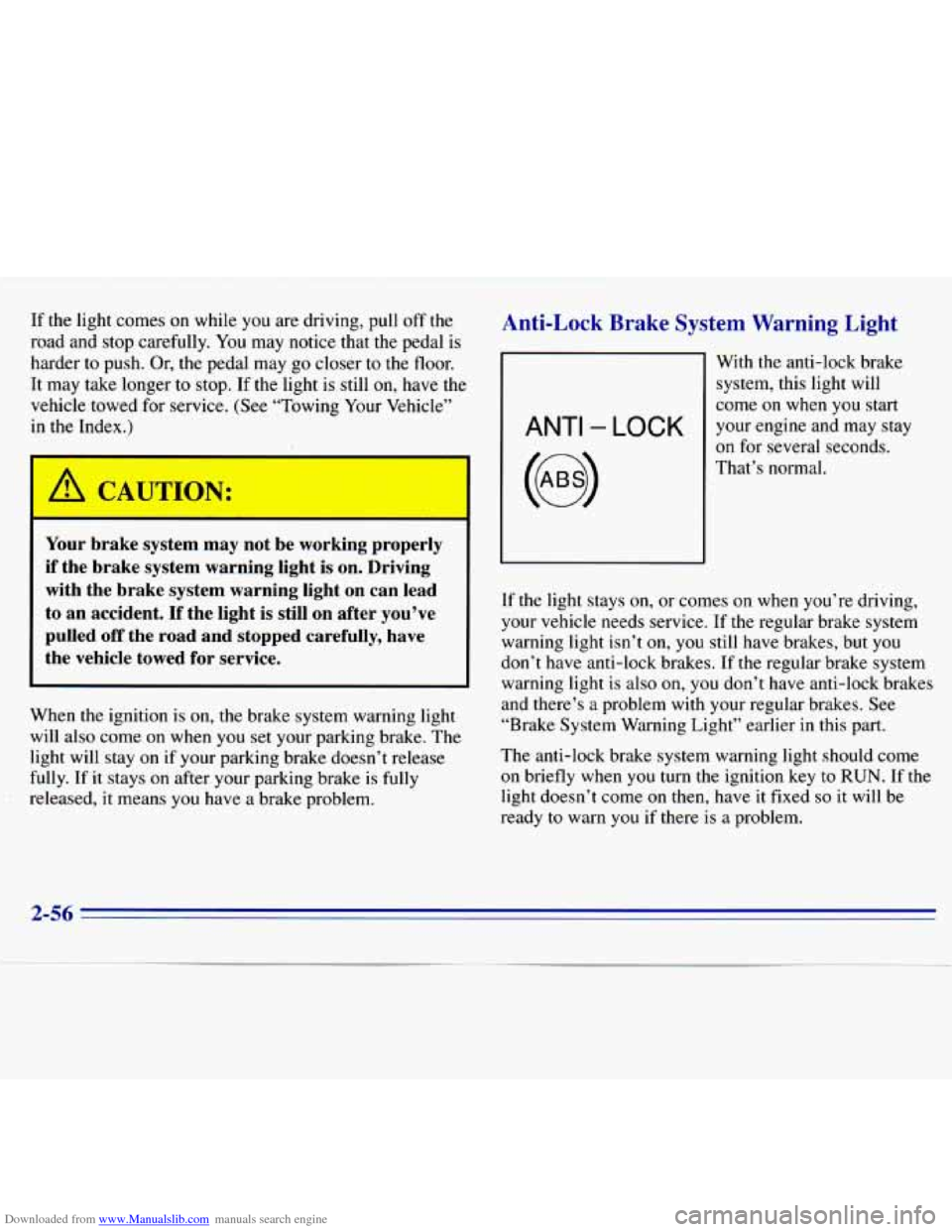
With the anti-lock brake
system, this light will
come
on when you start
your engine and may stay
on for several seconds.
That’s normal.
If the light stays on, or
comes on when you’re driving,
your vehicle needs service. If the regular brake system
warning light isn’t
on, you still have brakes, but you
don’t have anti-lock brakes. If the regular brake system
warning light is also on, you don’t have anti-lock brakes
and there’s
a problem with your regular brakes. See
“Brake System Warning Light” earlier in this part.
The anti-lock brake system warning light should come
on briefly when
you turn the ignition key to RUN. If the
light doesn’t come
on then, have it fixed so it will be
ready
to warn you if there is a problem.
2-56
Page 109 of 375
Downloaded from www.Manualslib.com manuals search engine NOTICE:
~~
If you keep driving your vehicle with this light
on, after a while, your emission controls may not work as well, your fuel economy may not be as
good and your engine may not run as smoothly.
This could lead to costly repairs that may not be
covered by your warranty.
This light should come on, as a check to show you it is
working, when the ignition is on and the engine is not
running. If the light doesn’t come on, have
it repaired.
This light will also come
on during a malfunction in one
of two ways:
Light Flashing -- A misfire condition has been
detected. A misfire increases vehicle emissions and
may damage the emission control system on your
vehicle. Dealer or qualified service center diagnosis
and service is required.
Light On Steady -- An emission control system
malfunction has been detected on your vehicle.
Dealer or qualified service center diagnosis and
service may be required.
If the Light Is Flashing
The following may prevent more serious damage to
your vehicle:
Reduce vehicle speed.
0 Avoid hard accelerations.
Avoid steep uphill grades.
0 If towing a trailer, reduce the amount of cargo being
hauled as soon as
it is possible.
If the light
stops flashing and remains on steady, see “If
the Light
Is On Steady” following.
If
the light continues to flash, when it is safe to do so,
stop the vehicle. Put your vehicle in PARK (P). Turn the
key off, wait at least
10 seconds and restart the engine.
If the light remains on steady, see “If the Light
Is On
Steady” following. If
the light is still flashing follow the
previous steps, and drive the vehicle to your dealer or
qualified service center for service.
2-58
Page 172 of 375
Downloaded from www.Manualslib.com manuals search engine Recreational Vehicle Towing
(Four-wheel Drive Oniy)
1.
2.
3.
4.
Set the parking brake firmly.
Place
an automatic transmission in PARK (P) or a
manual transmission in FIRST (1).
Firmly attach the vehicle being towed to the tow
vehicle.
Do not tow the vehicle by the rear bumper
bar. Refer to
the hitch manufacturer’s instructions.
Place the transfer case shift lever in NEUTRAL (N).
Recreational vehicle towing is not recommended for
vehicles
with the optional electronic shift transfer case
because the transfer case has
no neutral position.
Shifting the transfer case into NEUTRAL (N) can
cause your vehicle to roll even if the transmission
is in
PARK (P), for an automatic transmission,
or if your vehicle is in gear, for a manual
transmission. This is because the transfer case
overrides the transmission.
5. Release the parking brake only after the vehicle
being towed is firmly attached to the tow vehicle.
6. Insert the ignition key into the ignition switch and
turn it one notch forward of the LOCK position. This
places the key
in the OFF position, which unlocks
the steering column while preventing battery drain.
Unlocking the steering
column will allow for proper
movement
of the front wheelshires during towing.
4-41
Page 178 of 375
Downloaded from www.Manualslib.com manuals search engine Trailer Recommendations
You must subtract your hitch loads from the CWR
for your vehicle. Weigh your vehicle
with your trailer
attached,
so that you won’t go over the GVWR or
the GAWR.
You’ll get the best performance
if you spread out the
weight of your load the right way, and
if you choose the
correct hitch and trailer brakes.
For more information, see “Towing a Trailer”
in
the Index.
Pickup Conversion to Chassis Cab
General Motors is aware that some vehicle owners may
consider having the pickup box removed and a
commercial or recreational body installed. However, we
recommend that conversions of this type not be done to
pickups. Owners should be aware that, as manufactured,
there are differences between a chassis cab and
a pickup
with the box removed which may affect vehicle safety.
For specific information on
this pickup, contact the GM
Zone Office for your area. (See the “Warranty and
Owner Assistance” booklet for Zone Office.)
Towing a Trailer
1 A CAUTION:
I
If you don’t use the correct equipment and drive
properly, you can lose control when you pull a
trailer. For example,
if the trailer is too heavy, the
brakes may not work well
-- or even at all. You
and your passengers could be seriously injured.
Pull a trailer only if you have followed all the
steps in this section.
Ask your GM dealer for
advice and information about towing a trailer with your vehicle.
4-47
Page 179 of 375
Downloaded from www.Manualslib.com manuals search engine NOTICE:
Pulling a trailer improperly can damage your vehicle and result in costly repairs not covered by
your warranty.
To pull a trailer correctly, follow
the advice in this part, and see your
GM dealer
for important information about towing a trailer
with your vehicle.
Every vehicle is ready for some trailer towing. If yours
was
built with trailering options, as many are, it’s ready
for heavier trailers.
But trailering is different than just
driving your vehicle by itself. Trailering means changes
in handling, durability and fuel economy. Successful,
safe trailering takes correct equipment, and
it has to be
used properly.
That’s the reason for this part.
In it are many
time-tested, important trailering tips and safety rules.
Many of these are important for your safety and that
of
your passengers. So please read this section carefully
before you pull a trailer.
If Ydu Do Decide To Pull A Trailer
If you do, here are some important points:
0
0
0
0
There are many different laws, including speed limit
restrictions, having to do with trailering. Make sure
your rig
will be legal, not only where you live but
also where
you’ll be driving. A good source for this
information can be state or provincial police.
Consider using a sway control if your trailer will
weigh
2,000 lbs. (900 kg) or less. You should always
use a sway control
if your trailer will weigh more
than
2,000 lbs. (900 kg). You can ask a hitch dealer
about sway controls.
Don’t tow
a trailer at all during the first 500 miles
(800 km) your new vehicle is driven. Your engine,
axle or other parts could be damaged.
Then, during the first
500 miles (800 km) that you
tow
a trailer, don’t drive over 50 mph (80 kmh) and
don’t make starts at full throttle. This helps your
engine and other
parts of your vehicle wear in at the
heavier loads.
4-48
Page 180 of 375
Downloaded from www.Manualslib.com manuals search engine 0 If you haw a11 automatic transmission, you should Vehicle Axle Ratio Max. Trailer Wt.
use DRIVE (D) (or, as you need to, a lower gear)
when towing a trailer. Operating your vehicle in 2-Wheel Drive,
DRIVE (D) when towing a trailer will minimize heat 2.Z Engine 3.73 2,000
lbs. (908 kg)
4.10 2,000 lbs. (908 kg)
buildup and extend the life
of your transpission. If 2-Wheel Drive, 3.08 5,000 lbs.(2 270 kg)
you have a manual transmission and you are towing
“VORTEC” 4300 3.42 6,000 lbs.(2 724 kg)
a trailer, it’s better not to use
FIFTH (5) gear. Just Auto. Trans.
drive in
FOURTH (4) gear (or, as you need to, a -
lower gear). pi,. 2-Wheel Drive,
“-“‘VORTEC” 4300 3.08 4,000 lbs.( 1 816 kg)
Three important considerations have to do with weight:
Man. Trans. ,I+, : = . -
the weight of the trailer,
0 the weight of the trailer tongue
0 and the weight on your vehicle’s tires.
Weight of the Trailer
How heavy can a trailer safely be? 4-Wheel Drive,
3.08 4,500
lbs.(2 043
kg)
“VORTEC” 4300 3.42
5,500 lbs.(2 497 kg)
Auto. Trans. 3.73
5,500 lbs.(2
497 kg)
4-Wheel Drive, 3.08 3,500
lbs.( 1 589 kg)
“VORTEC” 4300 3.42
4,000 lbs.( 1 816
kg)
Man. Trans. 3.73
4,500 lbs.(2 043 kg)
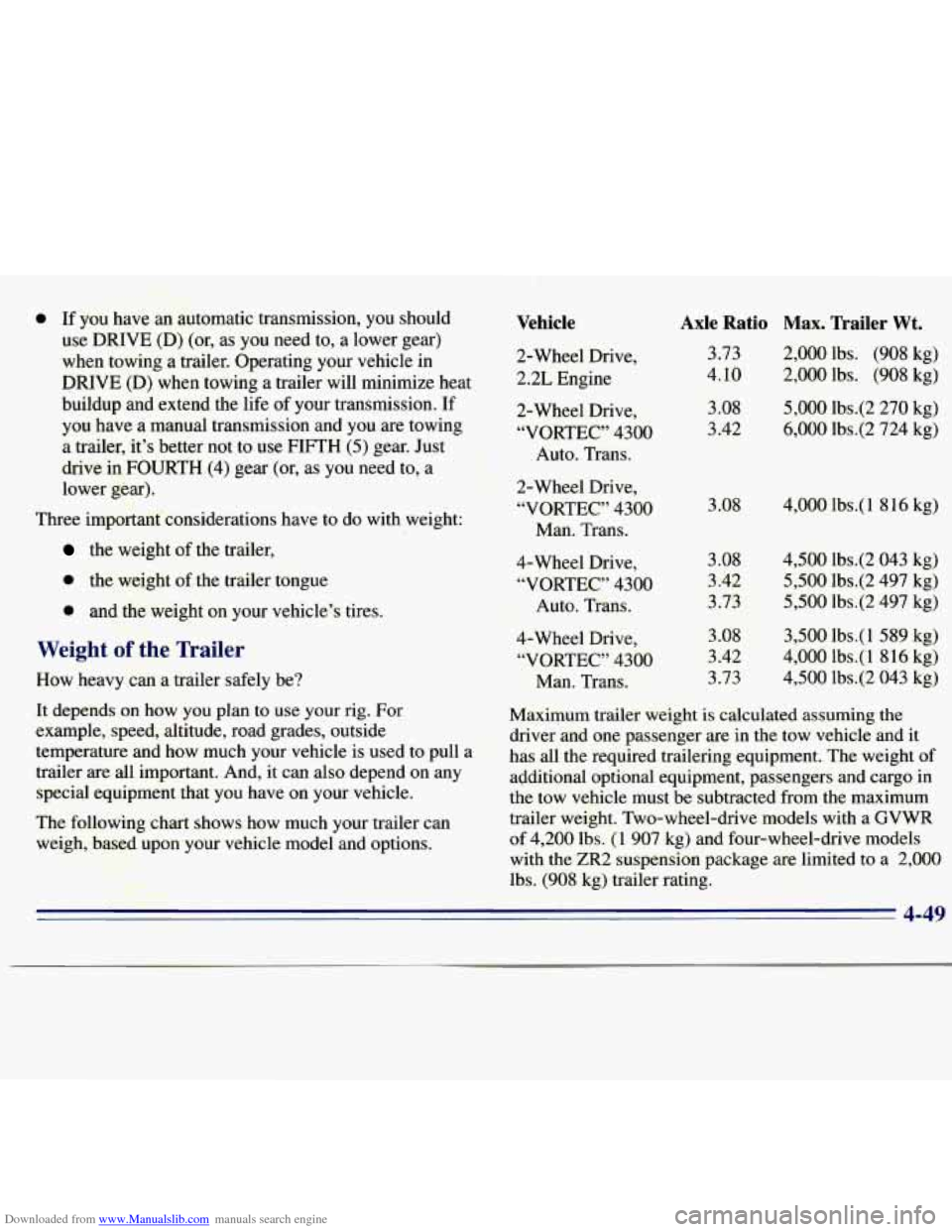
It depends
on how you plan to use your rig. For
Maximum trailer weight is calculated assuming the
example, speed, altitude, road grades, outside
driver and one passenger are in the tow vehicle and it
temperature and how Your vehicle is used to Pull a
’ has all the required trailering equipment. The weight of
trailer are all important. And, it can also depend on any
agditional optional equipment, passengers and cargo in
special equipment that you have on your vehicle.
the tow vehicle must be subtracted from the maximum
The following chart shows how much your trailer can trailer weight. Two-wheel-drive models
with a GVWR
weigh, based upon your vehicle model and options. of
4,200 lbs.
(1 907 kg) and four-wheel-drive models
JT”;’ ,-p?? , ,- -&-I:. , * with the ZR2 suspension package are limited to a 2,000
’ , :-qqg$+. r *? *. F:. rr I‘
ty+ : ‘ -.. 4 I lbs. (908 kg) trailer rating.
4-49
Page 183 of 375
Downloaded from www.Manualslib.com manuals search engine Trailer Brakes
If your trailer weighs more than 1,000 lbs. (450 kg)
loaded, then it needs its own brakes
-- and they must be
adequate. Be sure to read and follow
the instructions for
the trailer brakes
so you’ll be able to install, adjust and
maintain them properly.
Your trailer’s brake system can tap into the vehicle’s
hydraulic brake system only if
a
a
The trailer parts can withstand 3,000 psi
(20 650 kPa) of pressure.
The trailer’s brake system will use less than
0.02 cubic inch (0.3 cc) of fluid from your vehicle’s
master cylinder. Otherwise, both braking systems
won’t work well. You could even lose your brakes.
If everything checks
out this far, then make the brake
fluid tap at the port on the master cylinder that sends
fluid
to the rear brakes. But don’t use copper tubing for
this. If
you do, it will bend and finally break off. Use
steel brake tubing.
Driving with a Trailer
Towing a trailer requires a certain amount of experience.
Before setting
out for the open road, you’ll want to get
to know your rig. Acquaint yourself with the feel of
handling and braking with the added weight of the
trailer. And always keep
in mind that the vehicle you are
driving is now a good deal longer and not nearly
as
responsive as your vehicle is by itself.
Before
you start, check the trailer hitch and platform
(and attachments), safety chains, electrical connector,
lamps, tires and mirror adjustment. If the trailer has
electric brakes, start your vehicle and trailer moving and
then apply the trailer brake controller
by hand to be sure
the brakes are working. This lets
you check your
electrical connection at the same time.
During your trip, check occasionally
to be sure that the
load is secure, and that the lamps and any trailer brakes
are still working.
Page 184 of 375
Downloaded from www.Manualslib.com manuals search engine Following Distance
Stay at least twice as far behind the vehicle ahead as you
would when driving your vehicle without a trailer. This
can help
you avoid situations that require heavy braking
and sudden turns.
Passing
You’ll need more passing distance up ahead when
you’re towing
a trailer. And, because you’re a good deal
longer, you’ll need to
go much farther beyond the
passed vehicle before you can return to your lane.
Backing Up
Hold the bottom of the steering wheel with one hand.
Then, to move the trailer to the left, just move that hand
to the left. To move the trailer to the right, move your
hand to the right. Always back up slowly and, if
possible, have someone guide
you.
Making Turns
NOTICE:
Making very sharp turns while trailering could
cause the trailer to come in contact with the
vehicle. Your vehicle could be damaged. Avoid
making very sharp turns while trailering.
When you’re turning with a trailer, make wider turns
than normal.
Do this so your trailer won’t strike soft
shoulders, curbs, road signs, trees or other objects.
Avoid jerky or sudden maneuvers. Signal well
in
advance.
4-53
Page 185 of 375
Downloaded from www.Manualslib.com manuals search engine Turn Signals When Towing a Trailer
When you tow a trailer, your vehicle has to have extra
wiring and a heavy-duty turn signal flasher (included
in
the optional trailering package).
The green arrows on your instrument panel will flash
whenever you signal a turn or lane change. Properly
hooked up, the trailer lamps will also flash, telling other
drivers you’re about to turn, change lanes or stop.
When towing a trailer, the green arrows on your
instrument panel will flash for turns even if the bulbs on
the trailer are burned out. Thus, you may think drivers
behind
you are seeing your signal when they are not. It’s
important
to check occasionally to be sure the trailer
bulbs are still working.
Driving On Grades
Reduce speed and shift to a lower gear before you start
down a long or steep downgrade. If you don’t shift
down,
you might have to use your brakes so much that
they would get hot and no longer work well, On
a long uphill grade, shift down and reduce your
speed to around
45 mph (70 kdh) to reduce the
possibility of engine
and transmission overheating.
If you have an automatic transmission, you should use
DRIVE (D) when towing a trailer. Operating your
vehicle in DRIVE (D) when towing a trailer will
minimize heat buildup and extend the life of your
transmission. Or, if you have a manual transmission, it’s
better not to use FIFTH
(5), just drive in FOURTH (4)
(or, as you need to, a lower gear).
When towing at high altitude on steep uphill grades,
consider the following: Engine coolant will boil
at a
lower temperature than at normal altitudes. If you turn
your engine off immediately after towing at high altitude
on steep
uphill grades, your vehicle may show signs
similar to engine overheating. To avoid this, let the
engine run while parked (preferably on level ground)
with the automatic transmission in PARK
(P) (or the
manual transmission out of gear and the parking brake
applied) for
a few minutes before turning the engine off.
If you do get the overheat warning, see “Engine
Overheating’’
in the Index.
4-54