trailer CHEVROLET S10 1996 2.G Owner's Manual
[x] Cancel search | Manufacturer: CHEVROLET, Model Year: 1996, Model line: S10, Model: CHEVROLET S10 1996 2.GPages: 375, PDF Size: 20.73 MB
Page 202 of 375
Downloaded from www.Manualslib.com manuals search engine If No Steam Is Coming From Your Engine
If you get the overheat warning but see or hear no
steam, the problem may not be too serious. Sometimes
the engine can get a little too hot when you:
Climb a long hill on a hot day.
Stop after high-speed driving.
Idle for long periods in traffic.
Tow a trailer. See “Driving on Grades” in the Index
If
you get the overheat warning with no sign of steam,
try this for a minute or
so:
1. If you have an air conditioner, turn it off.
2. Turn on your heater to full hot at the highest fan
speed
and open the window as necessary.
3. If you’re in a traffic jam, shift to NEUTRAL (N);
otherwise, shift to the highest gear while
driving
-- AUTOMATIC OVERDRIVE (,@)
or DRIVE (D) for automatic transmissions.
If you no longer have the overheat warning, you can
drive. Just to be safe, drive slower for about
10 minutes.
If the warning doesn’t come back on, you can
drive normally.
If the warning continues, pull over, stop, and park your
vehicle right away.
If there’s still no sign of steam, push the accelerator until
the engine speed is about twice
as fast as normal idle
speed. Bring the engine speed back to normal idle speed
after two or three minutes. Now see
if the warning stops.
But then, if you still have the .warning, turn ofthe
engine
and get everyone out of the vehicle until it
cools down.
You may decide not to lift the hood but to get service
help right
away.
5-12
Page 211 of 375
Downloaded from www.Manualslib.com manuals search engine Engine Fan Noise
This vehicle has a clutched engine cooling fan. When
the clutch is engaged, the fan spins faster to provide
more air
to cool the engine. In most every day driving
conditions the clutch is not engaged. This improves fuel
economy and reduces fan noise. Under heavy vehicle
loading, trailer towing and/or high outside temperatures,
the fan speed increases when the clutch engages.
So
you may hear an increase in fan noise. This is normal
and should not be mistaken as
the transmission
slipping or making extra shifts. It is merely the
cooling system functioning properly. The fan will slow
down when additional cooling
is not required and the
clutch disengages.
You may also hear this fan noise when you start the
engine. It will go away as the fan clutch disengages.
If a Tire Goes Flat
It’s unusual for a tire to “blow out” while you’re driving,
especially if
you maintain your tires properly. If air goes
out of a tire, it’s much more likely to leak out slowly.
But if
you should ever have a “blowout,” here are a few
tips about what
to expect and what to do:
If a front tire fails,
the flat tire will create a drag that
pulls
the vehicle toward that side. Take your foot off the
accelerator pedal and grip the steering wheel firmly.
Steer
to maintain lane position, and then gently brake to
a stop well out of the traffic lane.
A rear blowout, particularly on a curve, acts much like a
skid and may require the same correction you’d
use in a
skid.
In any rear blowout, remove your foot from the
accelerator pedal. Get the vehicle under control by
steering the way you want the vehicle to
go. It may be
very bumpy and noisy, but
you can still steer. Gently
brake to a stop
-- well off the road if possible.
If a tire goes flat, the next part shows how to use your
jacking equipment
to change a flat tire safely.
5-21
Page 239 of 375
Downloaded from www.Manualslib.com manuals search engine As shown in the chart, SAE 5W-30 is best for your
vehicle. However, you can use
SAE 1OW-30 if it’s going
to be
0°F (- 18°C) or above. These numbers on an oil
container show its viscosity, or thickness.
Do not use
other viscosity oils, such as
SAE 20W-50. 7
NOTICE:
Use only engine oil with the American
Petroleum Institute Certified For Gasoline
Engines “Starburst” symbol. Failure to use
the recommended oil can result in engine
damage not covered by your warranty.
GM Goodwrench’ oil meets all the requirements for
your vehicle.
Engine Oil Additives
Don’t add anything to your oil. Your GM dealer is ready
to advise
if you think something should be added.
When te Change Engine Oil
See if any one of these is true for you:
e
e
e
8
e
Most trips are less than 5 to 10 miles (8 to 16 km).
This is particularly important when outside
temperatures are below freezing.
Most trips include extensive idling (such as frequent
driving in stop-and-go traffic).
You operate your vehicle in dusty areas or off-road
frequently.
You frequently tow a trailer.
The vehicle is used for delivery service, police, taxi
or other commercial application. I
Driving under these conditions causes engine oil to
break down sooner.
If any one of these is true for your
vehicle, then you need to change your oil and filter
every 3,000 miles
(5 000 km) or 3 months -- whichever
occurs first.
If none of them is true, change the oil and filter every
7,500 miles (12 500 km) or 12 months -- whichever
occurs first. Driving a vehicle with a fully warmed
engine under highway conditions causes engine oil to
break down slower.
6-13
Page 242 of 375
Downloaded from www.Manualslib.com manuals search engine Automatic Transmission Fluid
When to Check and Change
A good time to check your automatic transmission fluid
level is
when the engine oil is changed.
Change both the fluid and filter every
50,000 miles
(83
000 km) if the vehicle is mainly driven under one or
more
of these conditions:
In heavy city traffic where the outside temperature
regularly reaches 90°F (32°C) or higher.
0 In hilly or mountainous terrain.
0 When doing frequent trailer towing.
0 Uses such as found in taxi, police or delivery service.
If you do not use your vehicle under any of these
conditions, the fluid and filter do not require changing.
See “Scheduled Maintenance Services” in the Index.
How to Check
Because this operation can be a little difficult, you may
choose to have this done at your
GM dealer’s Service
Department. If you do it yourself, be sure to follow all the instructions\
here, or
you could get a false reading on the dipstick.
NOTICE:
Too much or too little fluid can damage your
transmission.
Too much can mean that some of
the fluid could come out and fall on hot engine
parts or exhaust system parts, starting a fire. Be
sure to get an accurate reading if you check your
transmission fluid.
Wait at least 30 minutes before checking the
transmission fluid level if
you have been driving:
When outside temperatures are above 90°F (32°C).
0 At high speed for quite a while.
0 In heavy traffic -- especially in hot weather.
0 While pulling a trailer.
To get the right reading, the fluid should be at normal
operating temperature, which is 180°F to
200°F
(82°C to 93°C).
6-16
Page 300 of 375
Downloaded from www.Manualslib.com manuals search engine Maintenance Schedule
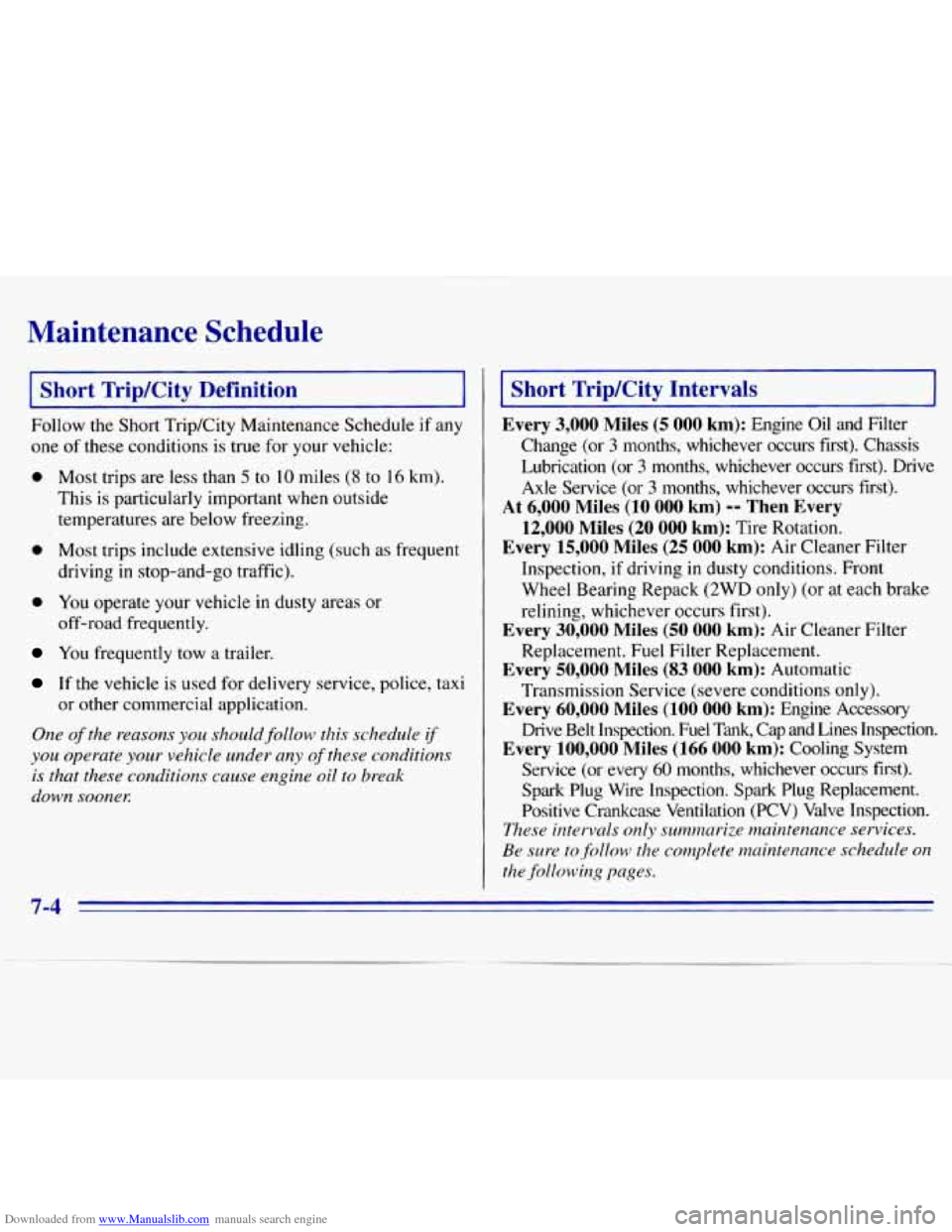
I Short TripKity Definition
__~
Follow the Short TripKity Maintenance Schedule if any
one
of these conditions is true for your vehicle:
0 Most trips are less than 5 to 10 miles (8 to 16 km).
This is particularly important when outside
temperatures are below freezing.
driving
in stop-and-go traffic).
0 Most trips include extensive idling (such as frequent
0 You operate your vehicle in dusty areas or
off-road frequently.
You frequently tow a trailer.
If the vehicle is used for delivery service, police, taxi
or other commercial application.
One of the reasons you should follow this sch.edule if
you operate your vehicle under any qf these conditions
is that these conditions
cause engine oil to break
down soone):
Short TripKity Intervals
Every 3,000 Miles (5 000 km): Engine Oil and Filter
Change (or
3 months, whichever occurs first). Chassis
Lubrication (or
3 months, whichever occurs first). Drive
Axle Service (or
3 months, whichever occurs first).
At 6,000 Miles (10 000 km) -- Then Every
12,000 Miles (20 000 km): Tire Rotation.
Every 15,000 Miles (25 000 km): Air Cleaner Filter
Inspection,
if driving in dusty conditions. Front
Wheel Bearing Repack
(2WD only) (or at each brake
relining, whichever occurs first).
Every 30,000 Miles (50 000 km): Air Cleaner Filter
Replacement.
Fuel Filter Replacement.
Every 50,000 Miles (83 000 km): Automatic
Transmission Service (severe conditions only).
Every 60,000 Miles (100 000 km): Engine Accessory
Drive Belt Inspection. Fuel
Tank, Cap and Lines Inspection.
Every 100,000 Miles (166 000 km): Cooling System
Service
(or every 60 months, whichever occurs first).
Spark Plug Wire Inspection.
Spark Plug Replacement.
Positive Crankcase Ventilation (PCV) Valve Inspection.
These intervals only sumrnurize maintenance services.
Be sure to.follow the complete maintenance schedule on
the%following pages.
7-4
Page 302 of 375
Downloaded from www.Manualslib.com manuals search engine I Short Trip/City Maintenance Schedule I
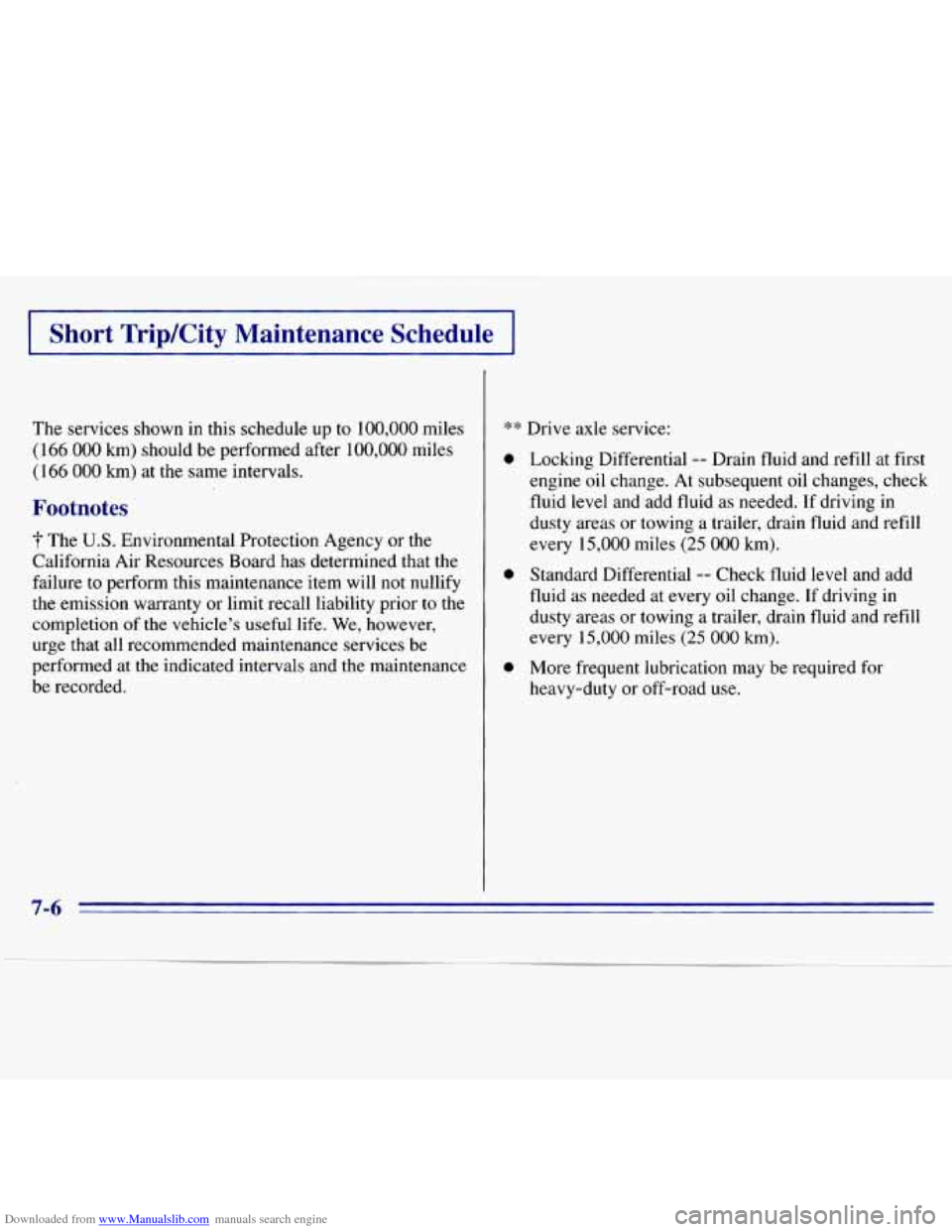
The services shown in this schedule up to 100,000 miles
( 166 000 km) should be performed after 100,000 miles
(166
000 km) at the same intervals.
Footnotes
-f- The U.S. Environmental Protection Agency or the
California Air Resources Board has determined that the
failure to perform this maintenance item will not nullify
the emission warranty or limit recall liability prior
to the
completion
of the vehicle’s useful life. We, however,
urge that all recommended maintenance services be
performed at the indicated intervals and the maintenance
be recorded.
** Drive axle service:
0
0
0
Locking Differential -- Drain fluid and refill at first
engine
oil change. At subsequent oil changes, check
fluid level and add fluid as needed. If driving in
dusty areas or towing a trailer, drain fluid and refill
every 15,000 miles
(25 000 km).
Standard Differential
-- Check fluid level and add
fluid as needed at every oil change. If driving in
dusty areas or towing
a trailer, drain fluid and refill
every
15,000 miles (25 000 km).
More frequent lubrication may be required for
heavy-duty or off-road use.
Page 314 of 375
Downloaded from www.Manualslib.com manuals search engine I Short TripKity Maintenance Schedule I
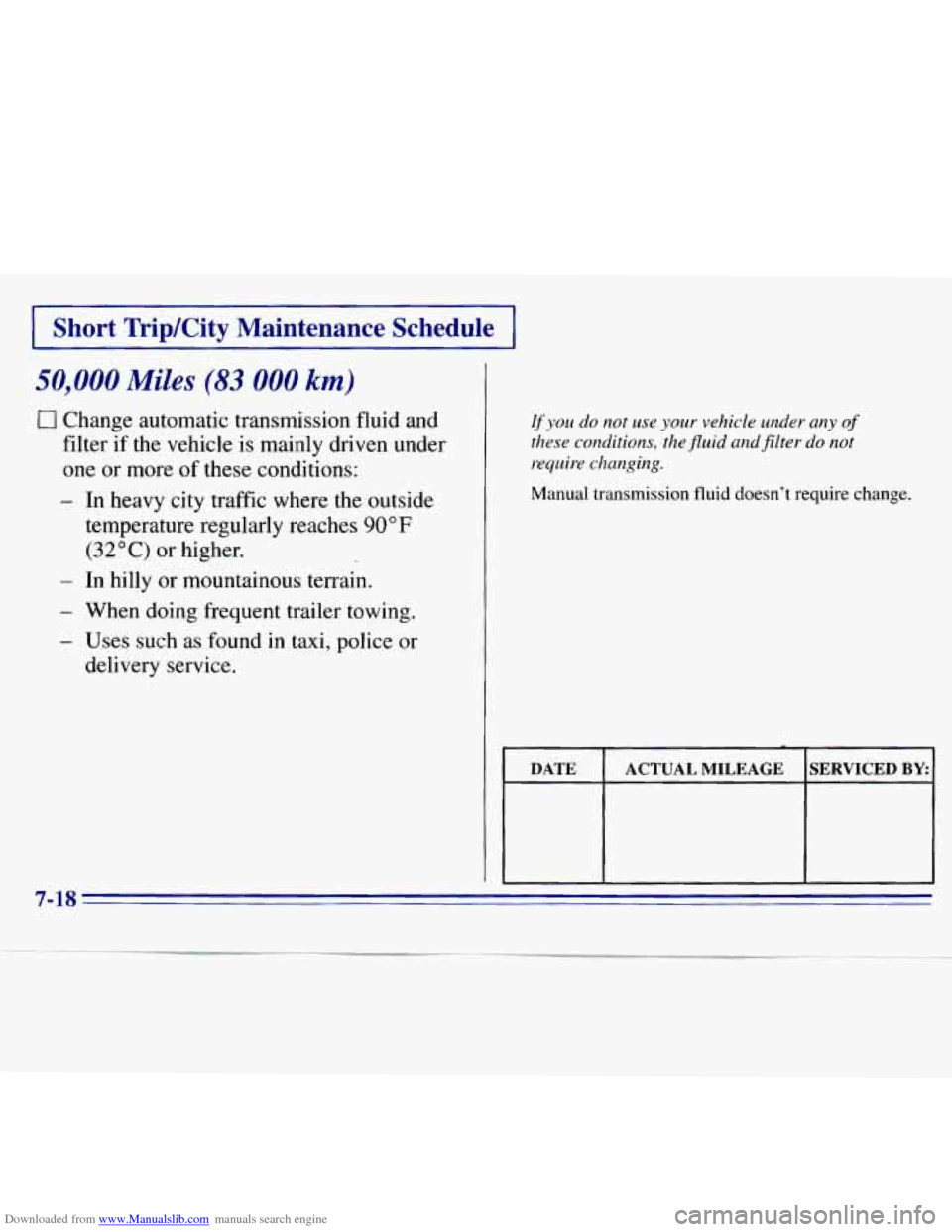
50,000 Miles (83 000 km)
0 Change automatic transmission fluid and
filter
if the vehicle is mainly driven under
one or more of these conditions:
In heavy city traffic where the outside
temperature regularly reaches
90 OF
(32°C) or higher.
In hilly or mountainous terrain.
When doing frequent trailer towing.
Uses such as found in taxi, police or
delivery service.
If you do n.ot use your vehicle under any of
these conditions, the fluid and filter do not
require changing.
Manual transmission fluid doesn’t require change.
DATE
-
ACTUAL MILEAGE SERVICED BY
I
7-18
Page 327 of 375
Downloaded from www.Manualslib.com manuals search engine I Short Trip/City Maintenance Schedule I
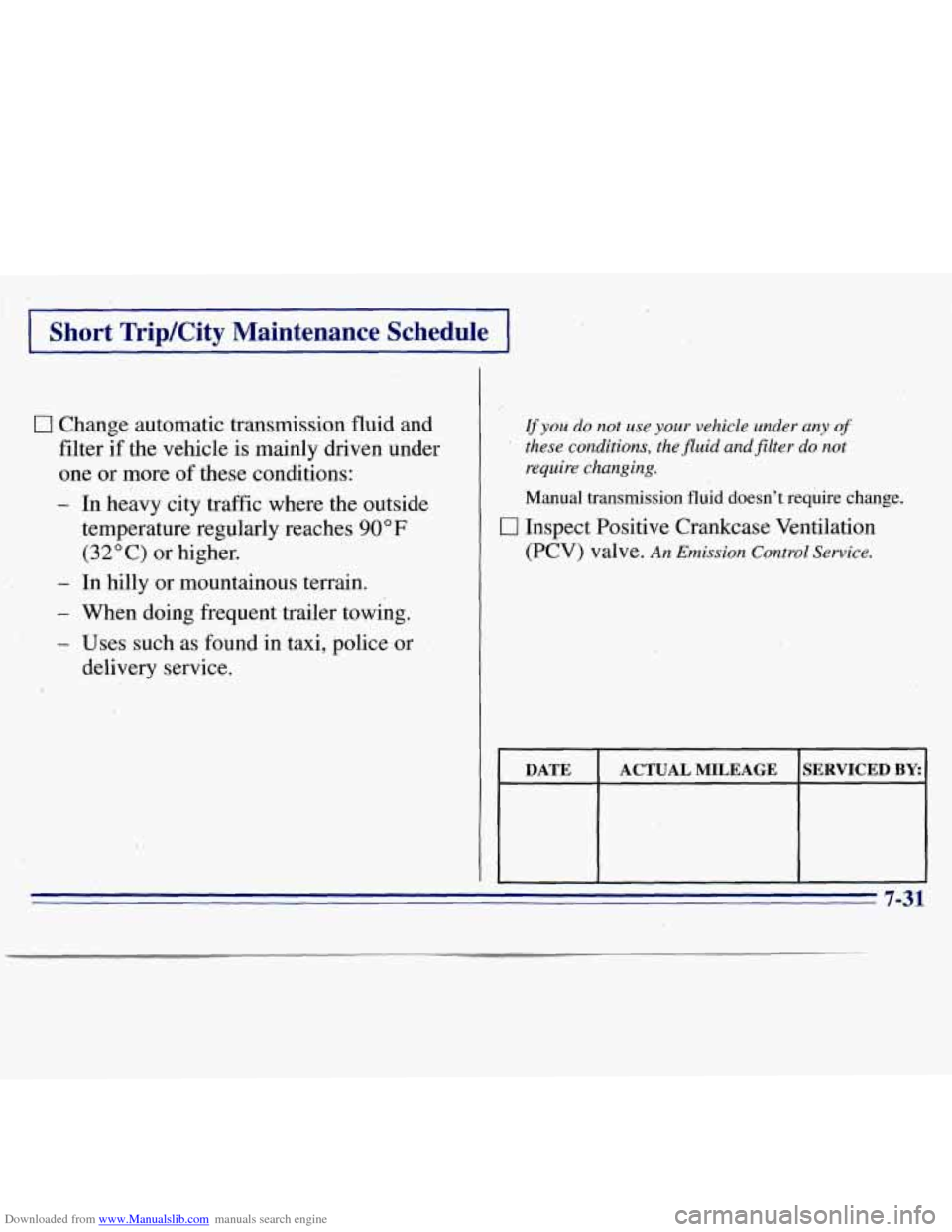
0 Change automatic transmission fluid and
filter
if the vehicle is mainly driven under
one
or more of these conditions:
- In heavy city traffic where the outside
temperature regularly reaches
90 OF
(32 O C) or higher.
- In hilly or mountainous terrain.
- When doing frequent, trailer towing.
- Uses such as found in 'taxi, police or
delivery service.
.*
If you do not use your vehicle under any of
' these conditions, the fluid and filter do not
require changing.
Manual transmission fluid doesn't require change.
L7 Inspect Positive Crankcase Ventilation
(Pcv) valve. An Emission Control Service.
I I
DATE ACTUAL MILEAGE
7-31
Page 328 of 375
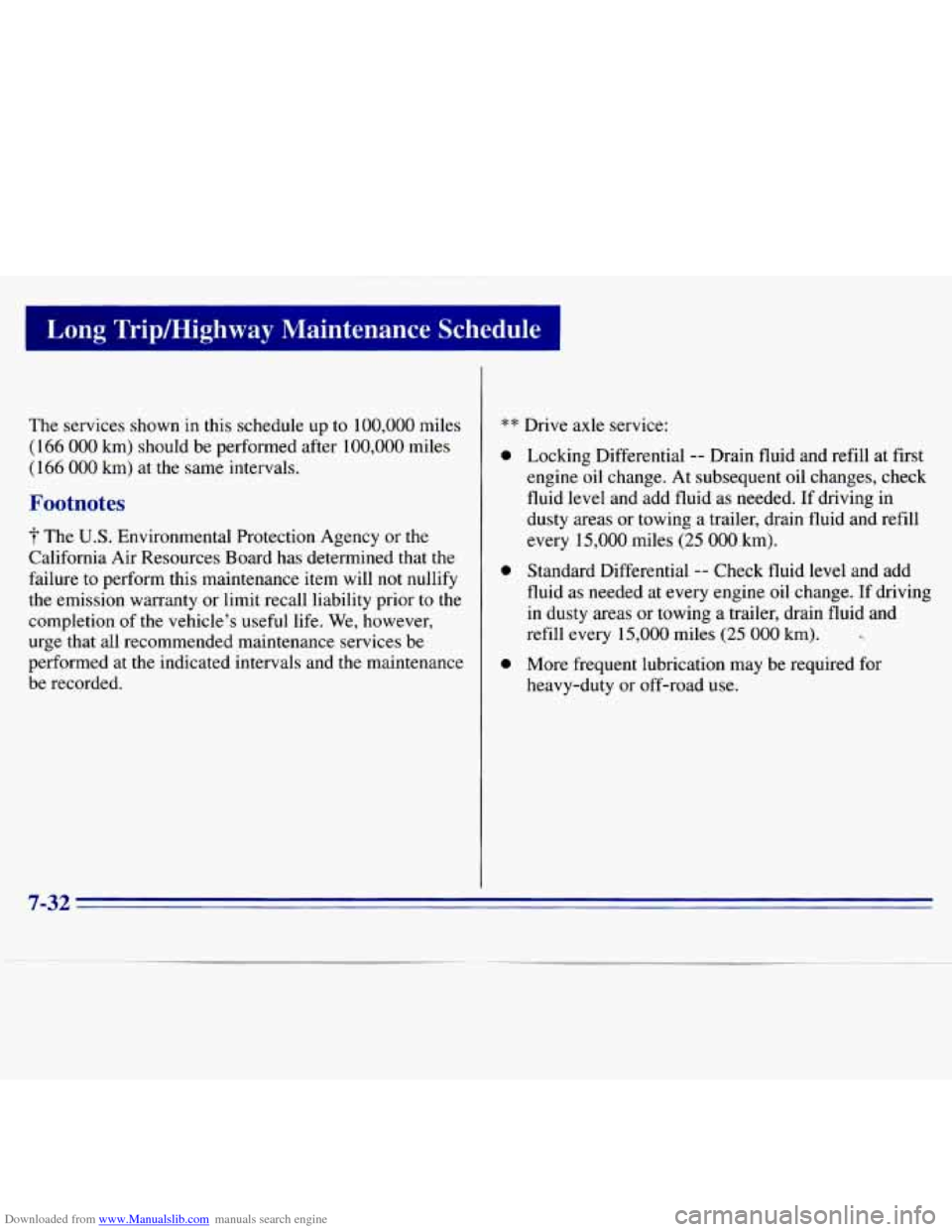
Downloaded from www.Manualslib.com manuals search engine The services shown in this schedule up to 100,000 miles
(166 000 km) should be performed after 100,000 miles
(166 000 km) at the same intervals.
Footnotes
The U.S. Environmental Protection Agency or the
California Air Resources Board has determined that the
failure to perform this maintenance item will not nullify
the emission warranty or limit recall liability prior to the
completion
of the vehicle’s useful life. We, however,
urge that all recommended maintenance services be
performed at the indicated intervals and the maintenance be recorded.
** Drive axle service:
0 Locking Differential -- Drain fluid and refill at first
engine oil change. At subsequent oil changes, check
fluid level and add fluid as needed.
If driving in
dusty areas or towing a trailer, drain fluid and refill
every
15,000 miles (25 000 km).
0 Standard Differential -- Check fluid level and add
fluid as needed at every engine oil change. If driving
in dusty areas or towing a trailer, drain fluid and
refill every
15,000 miles (25 000 km). ..
0 More frequent lubrication may be required for
heavy-duty or off-road use.
Page 334 of 375
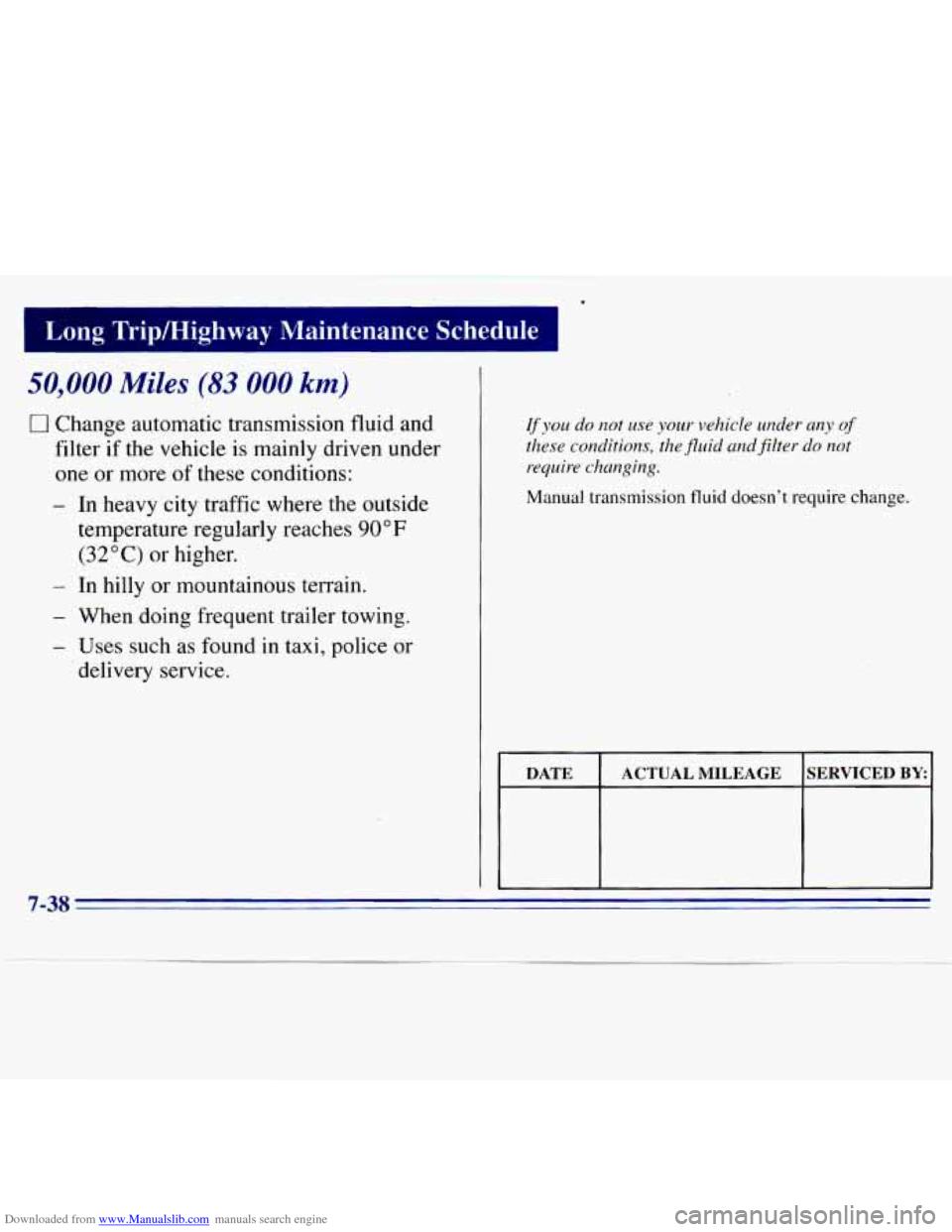
Downloaded from www.Manualslib.com manuals search engine I Long Tripmighway Maintenance Schedule
50,000 Miles (83 000 km)
0 Change automatic transmission fluid and
filter
if the vehicle is mainly driven under
one or more
of these conditions:
In heavy city traffic where the outside
temperature regularly reaches
90 O F
(32°C) or higher.
In hilly or mountainous terrain.
When doing frequent trailer towing.
Uses such as found
in taxi, police or
delivery service.
If you do not use your vehicle under any of
these conditions, the fluid and filter do not
require changing.
Manual transmission fluid doesn’t require change.
I I I 1
DATE ACTUAL MILEAGE SERVICED BY:
7-38