ABS CHEVROLET S10 1996 2.G Owners Manual
[x] Cancel search | Manufacturer: CHEVROLET, Model Year: 1996, Model line: S10, Model: CHEVROLET S10 1996 2.GPages: 375, PDF Size: 20.73 MB
Page 137 of 375
Downloaded from www.Manualslib.com manuals search engine Avoid needless heavy braking. Some people drive in
spurts -- heavy acceleration followed by heavy
braking
-- rather than keeping pace with traffic. This
is a mistake. Your brakes may not have time to cool
between hard stops. Your brakes will wear out much
faster if you
do a lot of heavy braking. If you keep pace
with the traffic and allow realistic following distances,
you will eliminate a lot
of unnecessary braking. That
means better braking and longer brake life.
If your engine ever stops while you’re driving, brake
normally but don’t pump your brakes. If you do,
the
pedal may get harder to push down. If your engine
stops,
you will still have some power brake assist. But
you will use it when you brake. Once the power assist is
used up,
it may take longer to stop and the brake pedal
will be harder to push.
Anti-Lock Brakes
Your vehicle has anti-lock brakes (ABS). ABS is an
advanced electronic braking system that will help
prevent
a braking skid.
When you start your engine and begin to drive away,
your anti-lock brake system will check itself.
You may
hear a momentary motor or clicking noise while this test
is going on. This is normal.
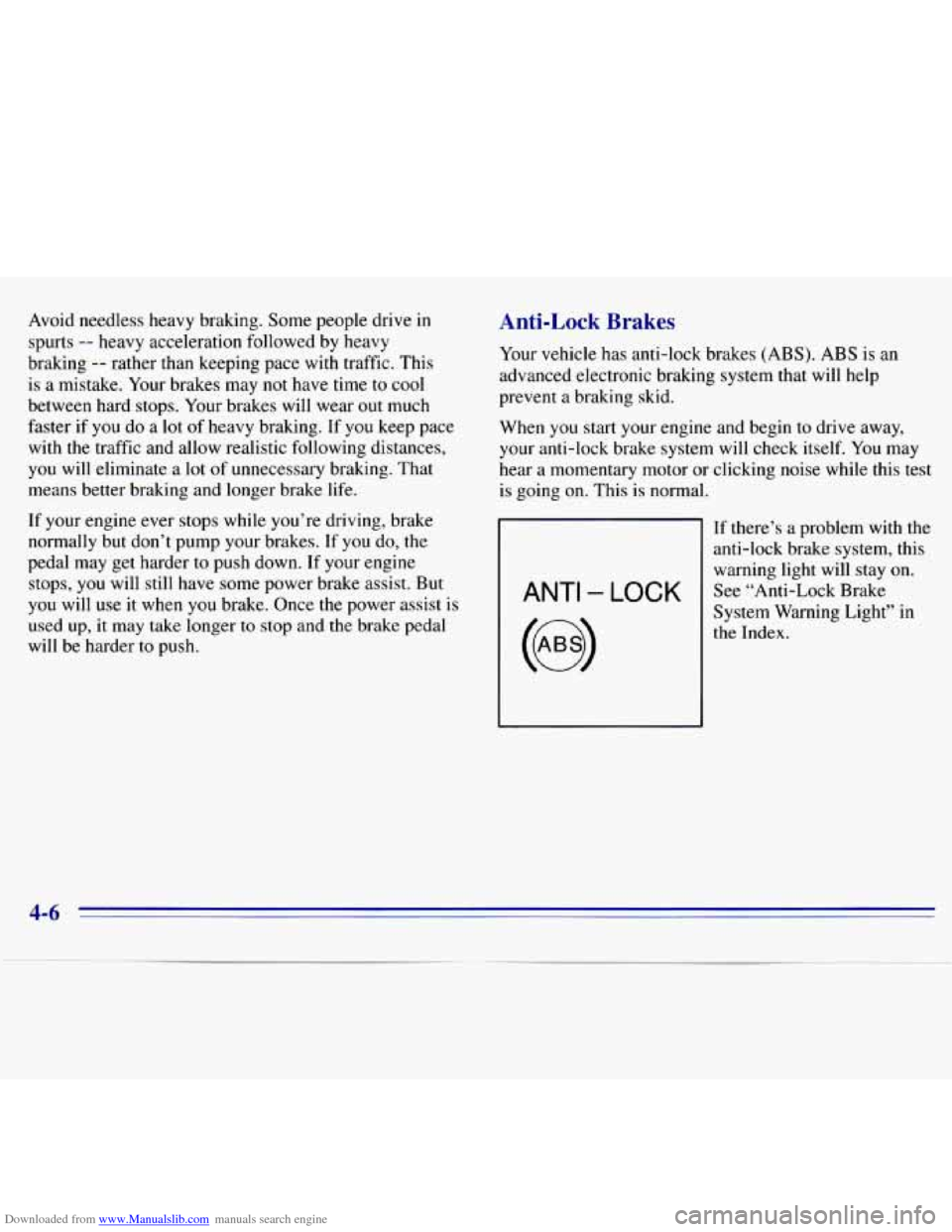
If there’s a problem with the
anti-lock brake system, this
warning light will stay
on.
See “Anti-Lock Brake
System Warning Light” in
the Index.
4-6
Page 138 of 375
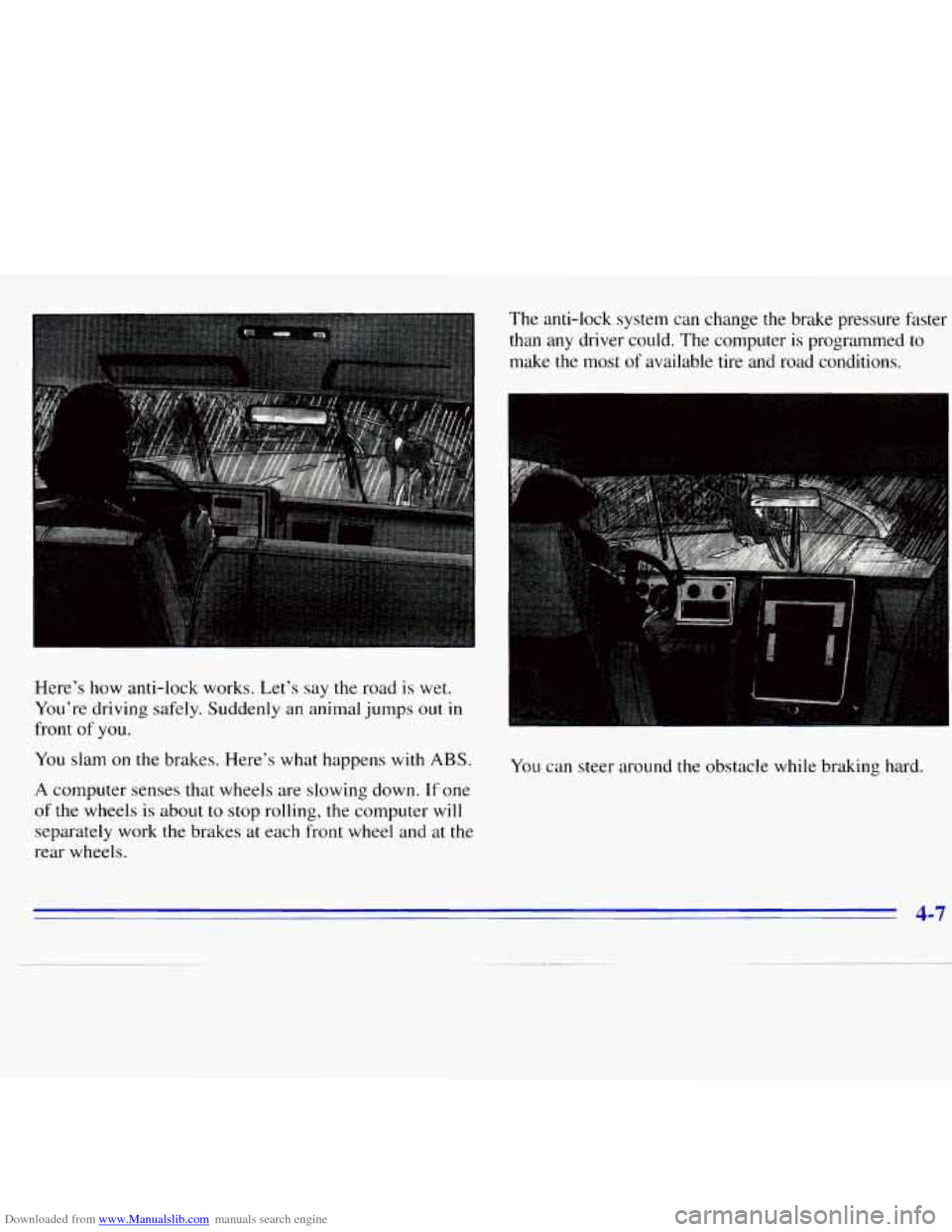
Downloaded from www.Manualslib.com manuals search engine Here’s how anti-lock works. Let’s say the road is wet.
You’re driving safely. Suddenly an animal jumps
out in
front of you.
You slam on the brakes. Here’s what happens with ABS.
A computer senses that wheels are slowing down. If one
of the wheels is about to stop rolling, the computer will
separately work the brakes
at each front wheel and at the
rear wheels. The anti-lock system can change the brake pressure faster
than any driver could. The computer
is programmed to
make the most
of available tire and road conditions.
You can steer around the obstacle while braking hard.
4-7
Page 144 of 375
Downloaded from www.Manualslib.com manuals search engine If your vehicle starts to slide, ease your foot off the
accelerator pedal and quickly steer the way you want the
vehicle to go. If
you start steering quickly enough, your
vehicle may straighten out. Always be ready for a
second skid if it occurs.
Of course, traction is reduced when water, snow, ice,
gravel or other material is on the road. For safety, you’ll
want
to slow down and adjust your driving to these
conditions. It is important to slow down
on slippery
surfaces because stopping distance will be longer and
vehicle control more limited.
While driving
on a surface with reduced traction, try your
best to avoid sudden steering, acceleration or braking
(including engine braking by shifting
to a lower gear).
Any sudden changes could cause
the tires to slide. You
may
not realize the surface is slippery until your vehicle
is skidding. Learn to recognize warning clues
-- such as
enough water, ice or packed snow
on the road to make a
“mirrored surface”
-- and slow down when you have
any doubt.
Remember: Any anti-lock brake system (ABS) helps
avoid only the braking skid.
Driving Guidelines
Off-Road Driving with Your
Four-Wheel-Drive Vehicle
This off-road guide is for vehicles that have
four-wheel drive.
Also, see “Anti-Lock Brakes”
in the Index.
If your vehicle doesn’t have four-wheel drive, you
shouldn’t drive off-road unless you’re on a level,
solid surface.
Off-road driving can be great fun. But it does have some
definite hazards.
The greatest of these is the terrain itself.
“Off-roading” means you’ve left
the great North
American road system behind. Traffic lanes aren’t
marked. Curves aren’t banked. There are no road signs.
Surfaces can be slippery, rough, uphill or downhill. In
short, you’ve gone right back to nature.
Off-road driving involves some new skills. And that’s
why it’s very important that you read this guide. You’ll
find many driving tips and suggestions. These will help
make your off-road driving safer and more enjoyable.
4-13
Page 186 of 375
Downloaded from www.Manualslib.com manuals search engine Parking on Hills
You really should not park your vehicle, with a trailer
attached, on a hill. If something goes wrong, your rig
could start to move. People can be,injured, and both
your vehicle and the trailer can be damaged.
But if you ever have to park your rig on a hill, here’s
--
how to do it:
1. Apply your regular brakes, but don’t shift into
PARK
(P) yet, or into gear for a manual
transmission. When parking uphill, turn your
wheels away from the curb. When parking downhill,
turn your wheels into the curb.
2. Have someone place chocks under the trailer wheels.
3. When the wheel chocks are in place, release the
regular brakes until the chocks absorb the load.
4. Reapply the regular brakes. Thenapply your
parking brake, and then shift into PARK (P), or
REVERSE (R) for a manual transmission.
5. If you have a four-wheel-drive vehicle with a
manual transfer case shift lever, be sure the transfer
case is. in a drive gear
-- not in NEUTRAL, (N).
6. Release the regular brakes.
It can be dangerous to get out of your vehiclt: if
the shift lever is not fully in PARK (P) with the
parking brake firmly set. Your vehicle can roll.
If you have left the engine running, the vehicle
can move suddenly.
You or others could be
injured. To be sure your vehicle won’t move, ev
‘en
when you’re on fairly level ground, use the steps
that follow.
If you have €our-wheel drive with a manual
transfer case shift lever and your transfer case
is
in NEUTRAL (N), your vehicle will, be free to
roll, even if your shift lever is in PARK (P). So; be
sure the transfer case is in a drive gear
-- not in
NEUTRAL
(N).
4-55
Page 265 of 375
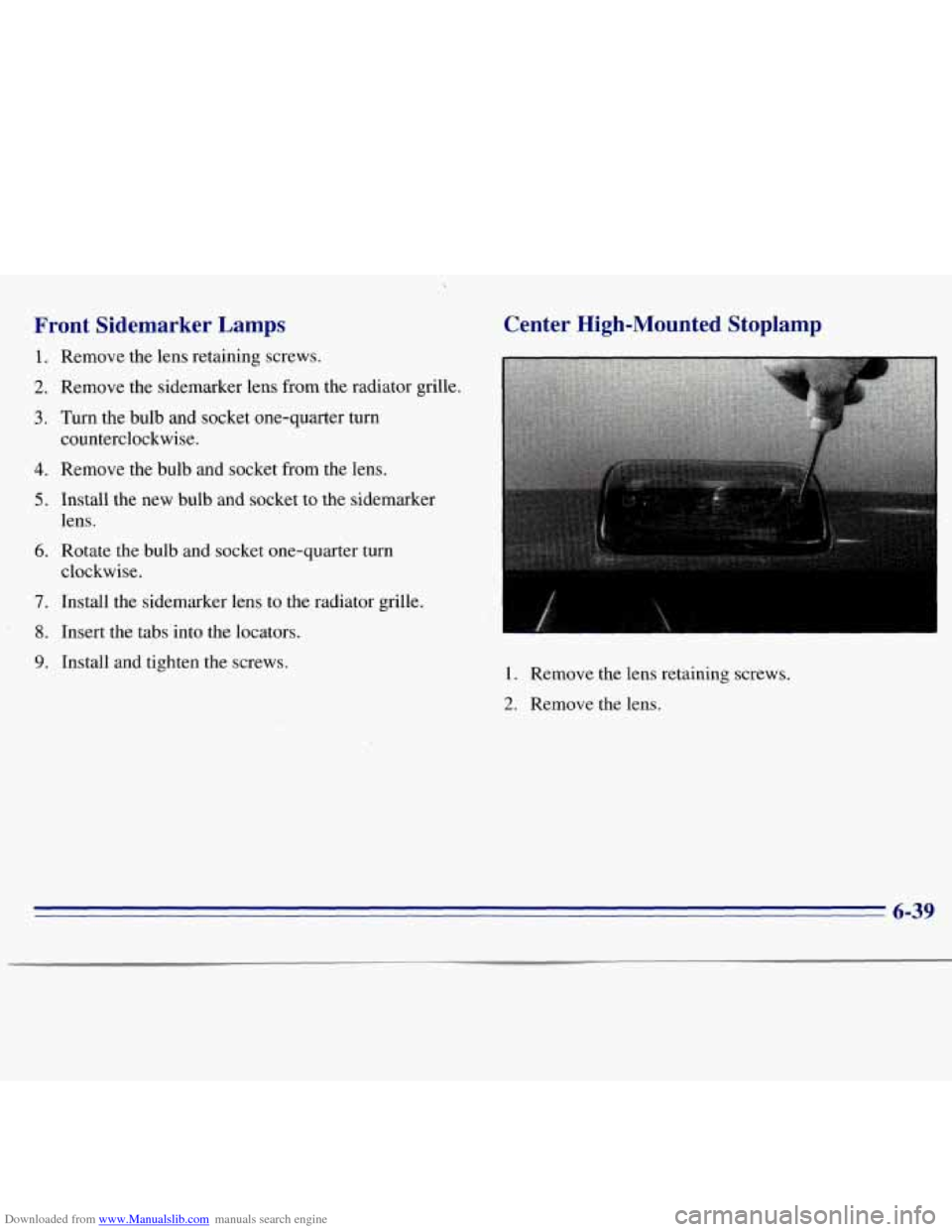
Downloaded from www.Manualslib.com manuals search engine Front Sidemarker Lamps
1.
2.
3.
4.
5.
6.
7.
8.
9.
Remove the lens retaining screws.
Remove the sidemarker lens from the radiator grille.
Turn the bulb and socket one-quarter turn counterclockwise.
Remove the bulb and socket from the lens. Install the new bulb and socket to the sidemarker
lens.
Rotate the bulb and socket one-quarter turn
clockwise.
Install the sidemarker lens to the radiator grille.
Insert the tabs into the locators.
Install and tighten the screws.
Center High-Mounted Stoplamp
1. Remove the lens retaining screws.
2. Remove the lens.
6-39
Page 267 of 375
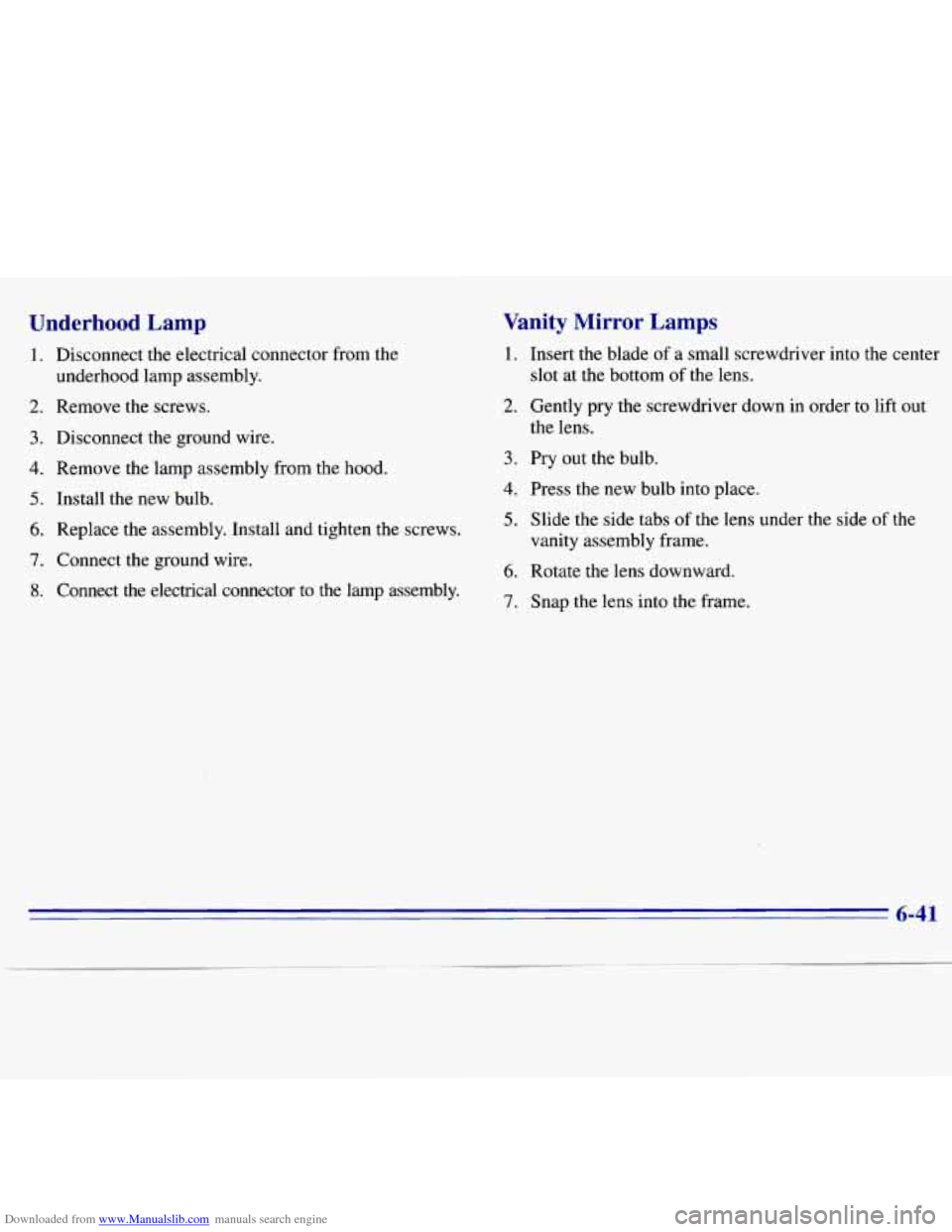
Downloaded from www.Manualslib.com manuals search engine Underhood Lamp
1. Disconnect the electrical connector from the
underhood lamp assembly.
2. Remove the screws.
3. Disconnect the ground wire.
4. Remove the lamp assembly from the hood.
5. Install the new bulb.
6. Replace the assembly. Install and tighten the screws.
7. Connect the ground wire.
8. Connect the electrical connector to the lamp assembly.
Vanity Mirror Lamps
1.
2.
3.
4.
5.
6.
7.
Insert the blade of a small screwdriver into the center
slot at the bottom of the lens.
Gently pry the screwdriver down in order to lift out
the lens.
Pry out the bulb.
Press the new bulb into place.
Slide the side tabs
of the lens under the side of the
vanity assembly frame.
Rotate the lens downward. Snap the lens into the frame.
6-41
Page 286 of 375
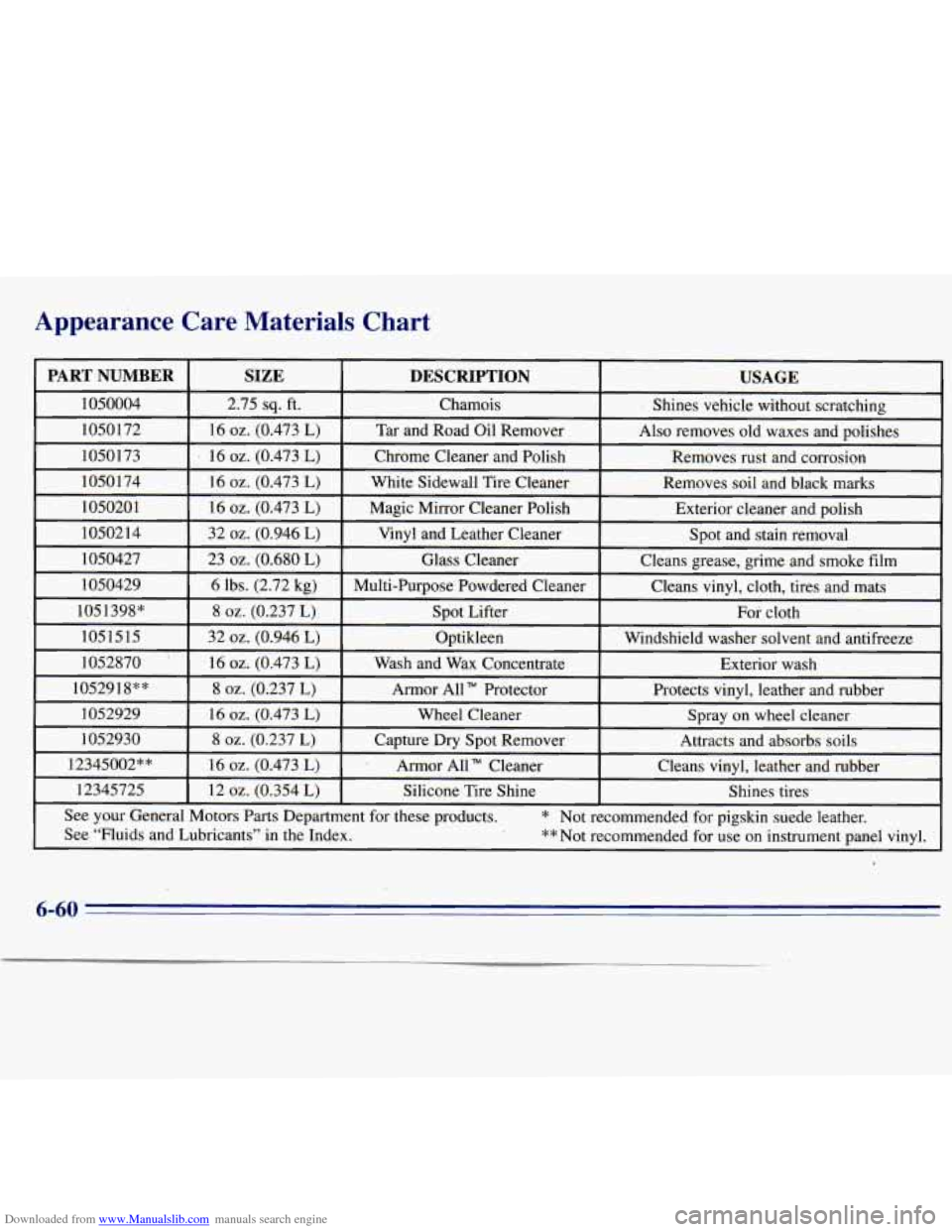
Downloaded from www.Manualslib.com manuals search engine Appearance Care Materials Chart
1051515 32 oz. (0.946 L) Optikleen Windshield washer solvent and antifreeze
1052870 16
oz. (0.473 L) Wash and Wax Concentrate Exterior wash '
I 1052918** I 8 oz. (0.237 L) I hmor All"'' Protector 7 Protects vinyl, leather and rubber
1052929
16 oz. (0.473 L) Wheel Cleaner Spray on wheel cleaner
1052930
8 oz. (0.237 L) Capture Dry Spot Remover Attracts and absorbs soils
12345002"" 16
oz. (0.473 L) .- Armor All TM Cleaner Cleans vinyl, leather and rubber
See your General Motors Parts Department for these products,
* Not recommended for pigskin suede leather.
See "Fluids and Lubricants'' in the Index.
' **Not recommended for use on instrument panel vinyl.
12345725
12
oz. (0.354 L) Silicone Tire Shine Shines tires
6-60
Page 291 of 375
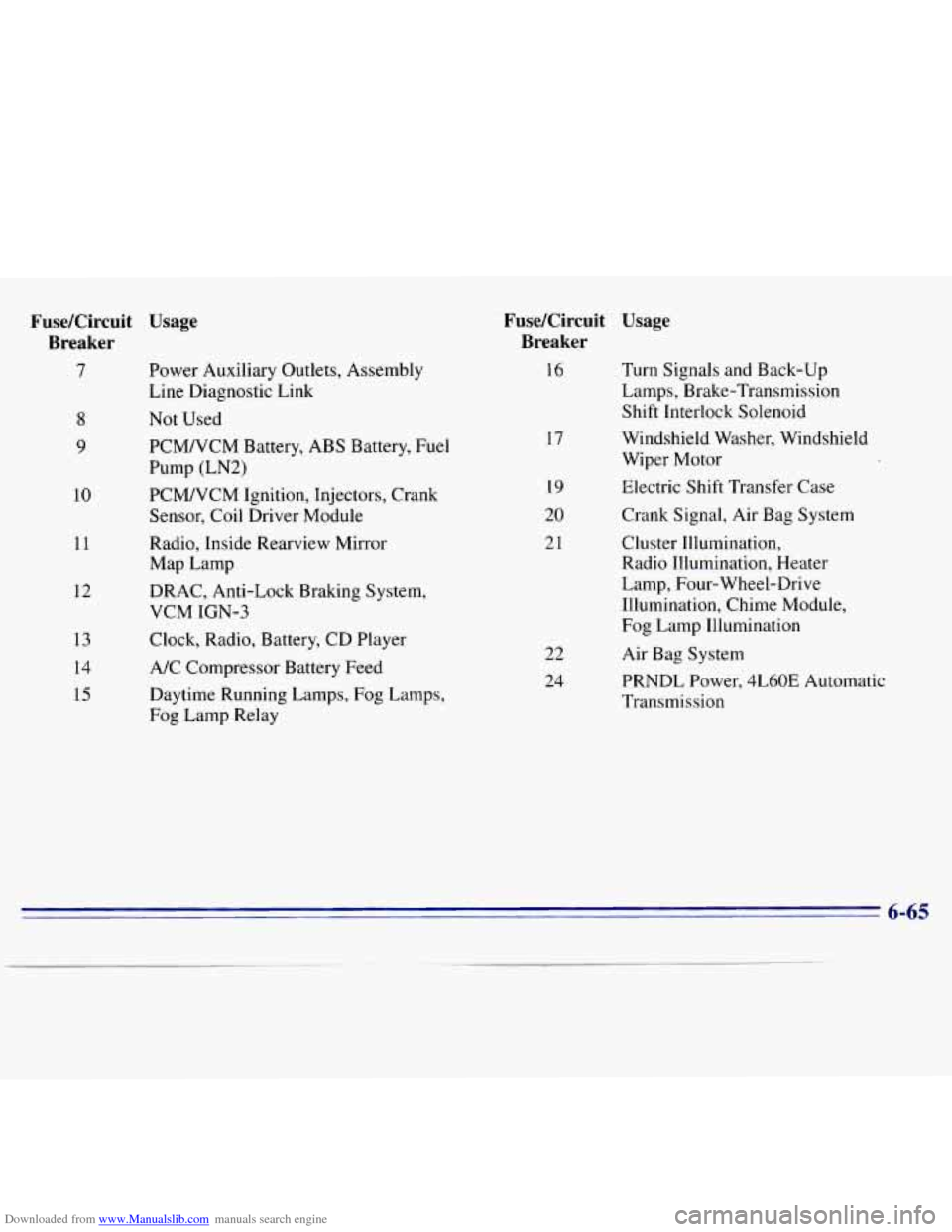
Downloaded from www.Manualslib.com manuals search engine Fuse/Circuit Usage Breaker
7 Power Auxiliary Outlets, Assembly
Line Diagnostic Link
8
9
10
11
12
13
14
15
Not Used
PCMNCM Battery,
ABS Battery, Fuel
Pump (LN2)
PCM/VCM Ignition, Injectors, Crank
Sensor, Coil Driver Module
Radio, Inside Rearview Mirror
Map Lamp
DRAC, Anti-Lock Braking System,
Clock, Radio, Battery,
CD Player
VCM
IGN-3
A/C Compressor Battery Feed
Daytime Running Lamps,
Fog Lamps,
Fog Lamp Relay
Fuse/Circuit Usage Breaker
16
17
19
20 21
22
24 Turn
Signals and Back-up
Lamps, Brake-Transmission
Shift Interlock Solenoid
Windshield Washer, Windshield Wiper Motor
Electric Shift Transfer Case
Crank Signal, Air Bag System
Cluster Illumination,
Radio Illumination, Heater
Lamp, Four- Wheel-Drive
Illumination, Chime Module,
Fog Lamp Illumination
Air Bag System
PRNDL Power, 4L60E Automatic
Transmission
6-65