ECU CHEVROLET S10 1997 2.G User Guide
[x] Cancel search | Manufacturer: CHEVROLET, Model Year: 1997, Model line: S10, Model: CHEVROLET S10 1997 2.GPages: 402, PDF Size: 21.04 MB
Page 182 of 402
Downloaded from www.Manualslib.com manuals search engine A CAUTION:
Do not load your vehicle any heavier than the
GVWR, or either the maximum €ront .or rear
GAWR. Ifyou do, parts on your vehicle can
break, or it can change the way your- vehicle
handles. These couId cause-you to lose control.
Also, .overloading can shorten the life of
~ your vehicle.
Using he-avier s.uspension comp'onents to get added
durability might not
change. your weight ratings. Ask
your dealer to help you load your vehicle the right way.
I NOTICE.:
Your warranty does not cover-parts. or
components that fail because of overloading.
If you put t Igs imide your vehicle. -- like suitcases,
tools, p.ackages, ~r anything else -- they will go as fast
as.
ae. vehicle goes. 1f'yo.u have t~ st0.p or turn quickly,
or if there is a crash, they'll keep going.
h CAUTION:
Things you pnt inside your vehicle can strike
-and .injure people in-a- sudden
stop or-turn-, 0r.m
a. crash.
0. Put things in the cargo area .of your vehicle.
Try to spread the weight evenly.
Never stack heavier things, like .suitcases.,.
inside the vehickso that
some of them are
above the top.s'of 'the seats.
0- Don't leave 'an unsecured child restraint in
your vehicle.
@ When you carry something inside the
vehicle, secure. it whenever yon can.
+. Don't leave a seat-folded down mle!sS you
need tu.
There's also important loading information for off -road
driving in this manual. See "Loading Your- Vehicle for
Off-Road Driving" in the Index.
4-45
Page 205 of 402
Downloaded from www.Manualslib.com manuals search engine I
TO hdp avoid injury to you or! otfiws:
* Never let passengers ride in a vehicle that is
@ Never tow faster than safe or posted speeds.
0 Never taw "wish d.amage.d piarts not
0 Never.@ under your vehicle after it has
being towed.
fully secured,
been.
I[i€ted by the tow truck.
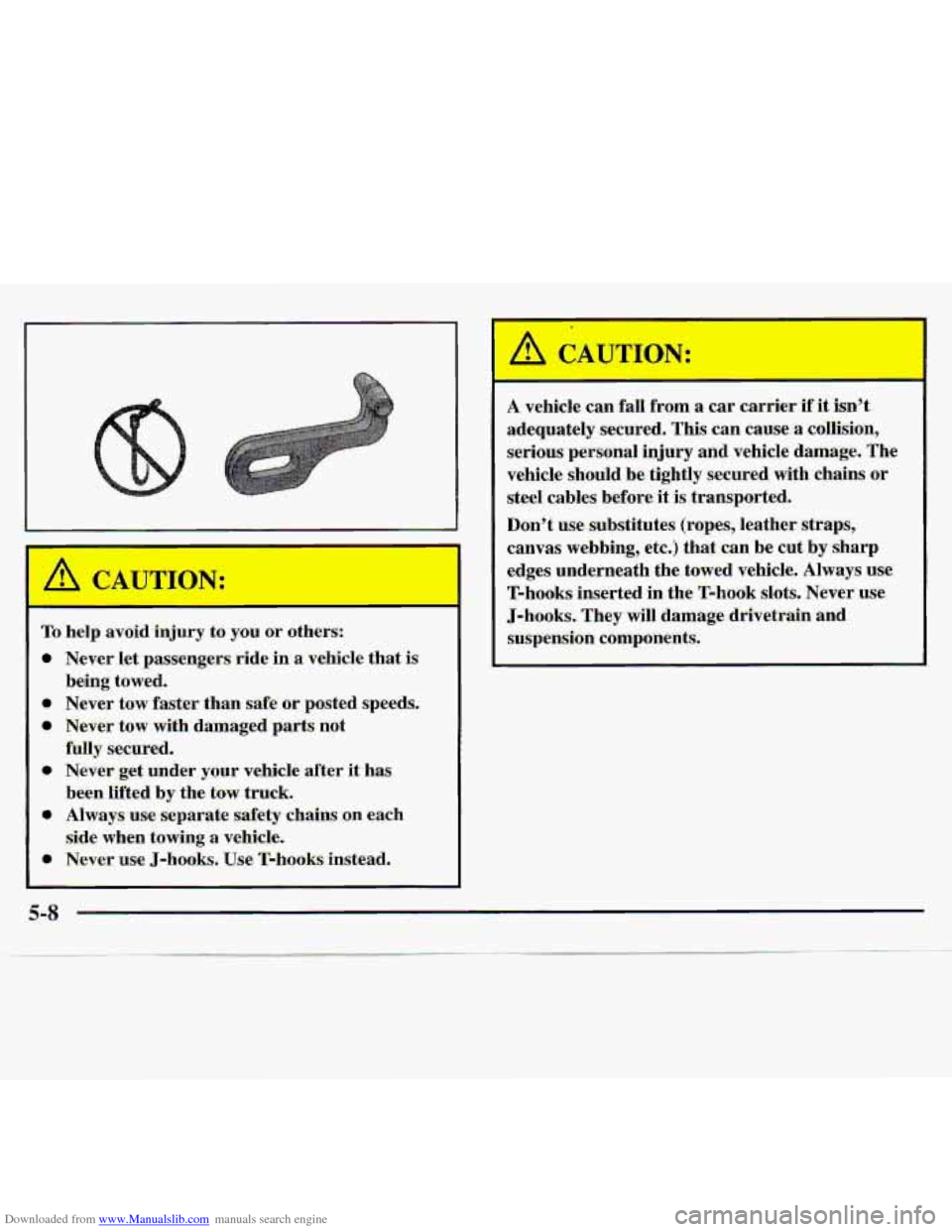
Always we s,eparate safety chains..on each
.side -when towing a vehicle.
0 Newr use J-hooks. Use T-hooks instead.
A vehicle can fall from a car carrier .i it isn't
adequately secured.
This can cause a .:collision9
serious personal injury and vehicle damage. The
vehicle
shouid.be tightly secured with chains or
steel cables before
it is transported.
Dan% use substitutes (ropes, leather-straps,
canvas webbing, etc.) that can be cut by sharp
edges. underneath thedowed vehicle. Always use
T-hooks inserted in the T=hook slots, Never use
J-hooks. They will damage .drivetrain *and
suspension components.
Page 229 of 402
Downloaded from www.Manualslib.com manuals search engine I
Incorrect wheel nuts or imprdperly tightened
wheel nuts can cause th,e-wheel to become loose
and-even comeaff. This. could lead to 'an accident.
Fk swe'to use the corre-ct whee1 nuts. If pu have
to .iiep-lsrC.e them, be sure. to get 'new GM origin.al
equipment
wheel nuts.
Stop somewhere as soon as you can and have the
nuts tightened with a torque wpsnch to 95 lb-ft
(I30 Nmj.
I NOTICE:
Improperly .. tiightened wheel nuts: can lead to
brake - pulsatian-and r.otor damage. To avoid
expe-nsive brake
repairs; evenly tighten the wheel
nuts in the proper sequence and to the proper
tGrque spe~~citign.
Storing .a F1i ' or Spare .Tire and To&
A CAUTION:
Storing a jack, a tire or other equipment In the
passenger .compartment of the vehicle could
cause injury. In .r.,sudden stop -or collision, loose
equipment, could strike smneome. Stote all these
in the proper place.
Don't use the existing hoist to store a tire with an
,aluminum wheel or it could &amage the wheel.
Secure. the tire in the pichp bed.
Follow this diagram to store the underbody
-mounted spare.
Page 251 of 402
Downloaded from www.Manualslib.com manuals search engine a
0
-0
Most trip3 .are less. than 5 to 10 miles (8 to Xi km).
This is particularly impgrtant when outsid.:
tempemratures me below Freezing;
Most trips include.-extensive idling (such .as fiequenr
driving .in stopand-go traffic).
YQU operate- yo.^ vehicle in dusty areas or
You frkquently tow a'traila.
The vehicle is .used for delivtyy ,service, police, taxi
or other cornexcia1 application.
a€f-roid fraquen-tly. Driving
undef these conditions
causes eagineail to
break down sooner. If' a.ny one of these is true for your
vehicle,
-then you need to .change, your oil and filter
every 3,060..mil~s (3' 000 km] or 3 .months - whichever
0cc:U.rs first.
If none of them is true, use the lopg triplhighway
maintenance schedule. Change. the bil-and filter every
'7.,500 miles (1.2.5.00 km) or 1.2 months -- whicheve-r
u.cc.urs first. Driving a vehicle with 3 fully warmqd
engine under highway coridifians causeis engine oil- to
break dawn dower.
Rem-ote Oil Filter (Four=Whe:el Drive)
The access ,dcmx fm the ;re:mote:oil filter is in-the steering
linkage shiqld as-sbrnbly hated under the. r.adiator
support. Twist the screw to unlock or lack the dom.
Make sure 8 you open the door, it is securely closed.
when
you are finished.
Page 253 of 402
Downloaded from www.Manualslib.com manuals search engine To remove this air cleaner,
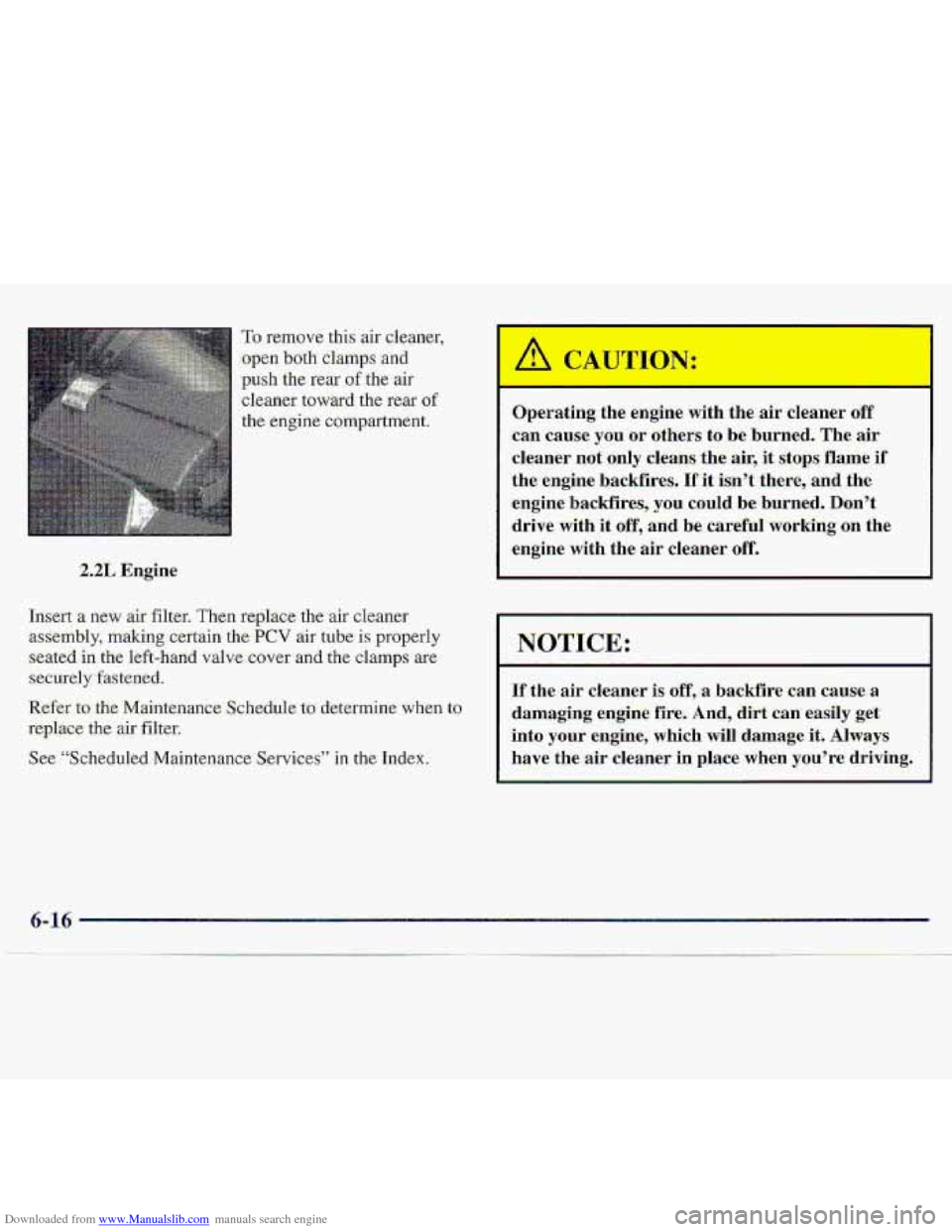
.open both &mps and
push the rear of:the air
cleaner toward the rear of
the engine compartment.
2.2L Engine
Insert
a ne’w air filter. Then replace the air cleaner
assembly, making certain the PCV air tube is properly
-seate.d in the left-hand valve- cover and the clamps are
securely fastened.
Refer to- the M.aintenan.ce .Schedule to ‘determirre when to
replace the ais- filter..
See “Scheduled Ma.intenance-Sel.vic.es” in the Index.
t
CA .- .-
Operating the engine with the air cleaner off
can cause you or others to be burned. The air
cleaner not only cleans the air, it stops. flame if
-the engine backfires.
If it isn’t there, and the
engine backfires, you could be burned. Don’t
drive with it
off, and be careful working on the
engine
with the air cleaner off.
I NOTICE:
If the air cleaner is off, :a backfire can cause, a
.dam-aging engine
fire, And, dirt can easily get
into
your engine, which will damage it. Always
have the air cleaner in place when you’re driving,
6-16
Page 289 of 402
Downloaded from www.Manualslib.com manuals search engine Tire, Chains
use tire chains. They can damage your vehicle
because there’s not enough clearance.
Use another type
of traction device only if its
manufacturer recommends it
for use on your
vehicle and tire size combination and road
conditions. Follow that -manufacturer’s
instructions.
To help avoid damage to your
vehicle, drive slowly, readjust or remove the
device if
it’s contacting your vehicle, and don’t
spin your -wheels..
NOTICE: (Continued)
’ NOTICE: (Continued)
If you do find a traction device that will fit, install
them on the rear4irgs.
If you have other size tires, use tire chains only
where legal and only when you
must. Use. only
SAE Class “S” type chains that are the proper
size
for your tires. Install them on the drive axle
tires (four-wheel-drive vehicles. can use chains on
both axles) and tighten them as tightly as possible
with the ends. securely fastened. Drive slowly
and
follow the chain manufacturer’s instructions. If
you can hear the chains contztc,ting your vehicle,
stop and retighten them.
If the contact contimes;
slow down until
it stops. Driving toa fast or
spinning the wheels with chains on will damage
your vehicle.