key CHEVROLET S10 1997 2.G User Guide
[x] Cancel search | Manufacturer: CHEVROLET, Model Year: 1997, Model line: S10, Model: CHEVROLET S10 1997 2.GPages: 402, PDF Size: 21.04 MB
Page 57 of 402
Downloaded from www.Manualslib.com manuals search engine Theft, Parking at Mght
Vehicle theft isbig Business, especially in.some cities,
Although your vehicle has a number of theft-detefren’t
-features, we know that nothin-g we put on
it can make
it.impassible
to steal. However, there’ are- ways you
.ean.bqlp.
Key in the Ignition
If you leave your vehicle with the keys inside, it’s; an
easy target for Joy riders or professional thieve-s -- .so
don’t .do it.
When you. park your-vehicle and open the driver’s dam,
you’ll he;rr a tone remiding you to remove your key
from the ignitipo and take it with you. Always do this.
Your steering wheel will be locked, and so will your
ignitkm: If you have an automatic tr-arcmission, taking
your key out also lacks your msmis.sian. And
remember to
lack.thc doors.
P&k in a lighted spot, close all windows and 1.ock.your
vehicle.. Remember to keep your valuables .out of sight.
Put .them in a storage are&
6.r take them with .you.
Parking .. Lots,
‘If you pafk in a lot where:someone will be watching.
your vehicle, it’s be:st
to lgck it up-and take ywr keys.
But what if you have to-leave your ignition key? What if
YOU have to leave something. valuable in your vehicle?
0. Put your vxl-luables i.n a. st;or.age. area, like your
glove
box.
Lock all the doors except the driver’s.
2-10
Page 58 of 402
Downloaded from www.Manualslib.com manuals search engine New Vehkk “Bre-ak-In”
NOTICE:
Your modern vehicle d.oesn’t need an elaborate
“break-in.”
But it will perform better in the long
run if you follow these guidelines:
0 Keep your speed at 55 mph (88 km/h) or
less far the first 500 miles (805 km).
Don’t drive at any one speed -- fast or
slow
-- for the first-500 miles (805 km).
Don’t make full-thro.ttle starts.
200 miles. (322 km) or so. During this time
your
new brake linings aren’t yetbro-ken
in. Hard stops with new linings cmmean
premature wear and earlier replacement.
Follow this breaking-in guideline every
time you
get new brake linings.
See “Tbwing a Trailer” in the Index for
more information..
Avoid makiilg hard stops for the first
Don’ttow a trailer during break-in.
Ignition Positions
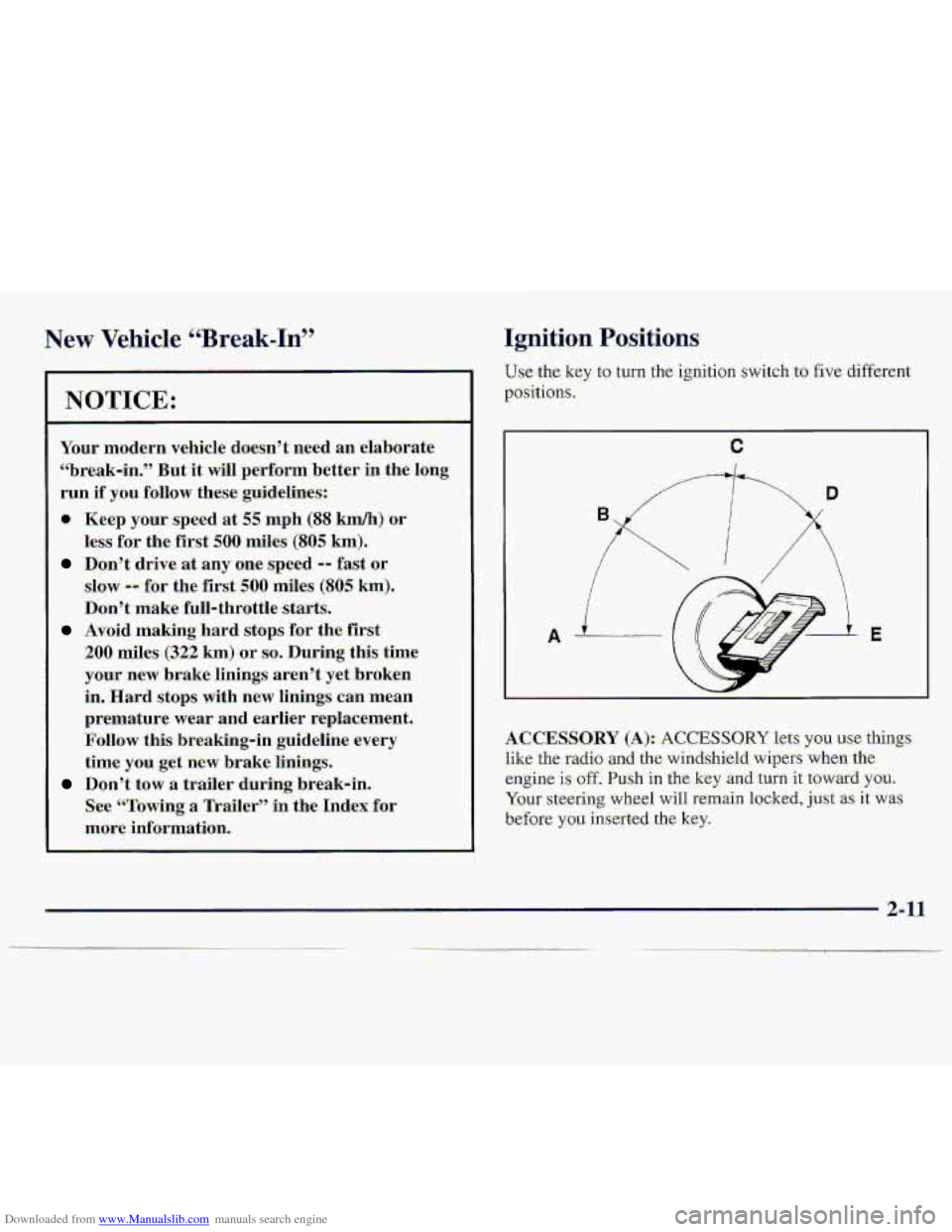
Use.the key to-turn the ignition switch to €ive different
positions,
A 3.
ACCESSORY (A):. ACCESSO-RY lets ysu .use‘-thi-ngs
like the radio ad the.winds,hield wipe-rs when the
engine is off. Push i.n the key -and turn it toward. YOU.
Your steering wheel will remain locked, just. as it was
before
you inserted the. key.
2-11
Page 59 of 402
Downloaded from www.Manualslib.com manuals search engine NOTICE:
Don't operate accessories. in the ACCESSORY
position far long periods of time. Prolonged.
operation
of accessories in the ACCESSORY
position could drain your battery-and prevent
you
from skarting your vehicle.
LOCK (E): This position locks your ignition; -steering
wheel-and tra-nsmiss-ion.
It's a theft-deterfeat feature.
You will oaly be able to remove your key whe.n the
ignition is turned to. LOCK.
.OFF (C); This position lets you turn off.the engine but
Tstill turn the steering wheel'. Us.e OFF if you must have
~yx.u- whic1.e in motion while -the erigine :is off (for
example, if your vehickis being towed).
RUN (I)): This is the positio-n for driving.
START (E): This starts your engine. On manual transmission
vehicles, turning t.he key
to
LOCK will lock the steerihgcolumn and result
in
a lass of ability to steer the vehicle. This could
cause
-a collision. If you need to turn the enghe
off while the vehicle is moving, turn the key only
to OFF. Don't press the key release button while
the vehicle is moving.
NOTICE:
If your key seems stuck in 'LOCK. and -you can't
turn it, be sure you
are using the corkect key; if
so, is it all the way in? If'ft is, then turn the
steering wheel left and right while you turn the
key h.ard. But t.urn the key only with
your hand.
Using
a tool to force it could. break the key or the
ignition switch.
'If none of this. works, then your
vehicle needs service.
2-12
Page 60 of 402
Downloaded from www.Manualslib.com manuals search engine Key Release Button
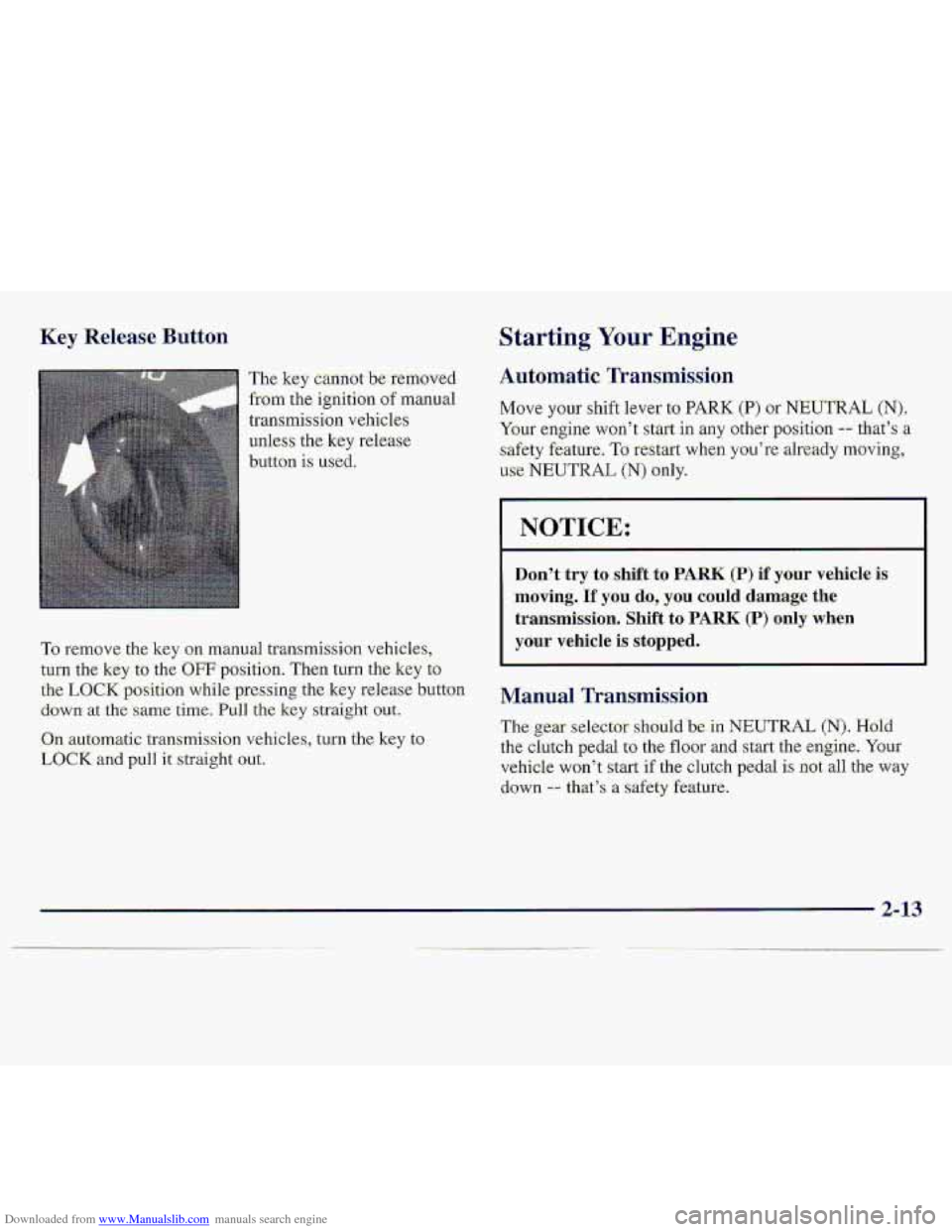
The key cannot b.e removed
from ttie ignition of manual
transmission vehicles
unless the
key release
button is used.
Starting Your ,Engine
Automatic Transmissio.n
Move your shift lever to PARK (P) or NEUTRAL (N).
Your engine won’t start in any .other position -- that’s a
safet,y feature. To reStart when you’re already moving,
use NEUTRAL (N) only.
I NOTICE:
Don’t try to shift to PARK (P) if your vehicle is
moving. If you do, you could damage the
transmission. Shift to
PARK (P) only when
your vehicle is stopped. To remove the key on manual transmission vehicles,
turn the key to the
OFF position. Then turn the key to
the LOCK position while pressing the key release button Manual Transmission
down- at the .s.arne time. Pull the key straight out.
On automatic transmission vehicles, tu,rn the key to
LOCK and pull it straight out.
The gear selector should be in NEUTRAL (N). Hold
the clutch pedal to the floor and start the engine. Your
vehicle won’t start if the clutch pedal is not all. the way
down -- that’s a safety feature.
2-.13
Page 61 of 402
Downloaded from www.Manualslib.com manuals search engine I Starting Your 2.2 Liter Engine
1. Without puslung -the accelerator pedal, turn your
ignition key to STUT. When the engine starts, let
go :of the key. The idle speed will go down as your
engine gets
warm.
NOTICE:
Holding your key in START for Ionger than 15
.secon&at a time will cause your battery to h.e
drained much sooner. And the excessive heat- can
7-- t : ~ ,1 :, .. damage your starter motor. ->..c , .-2
NOTICE:
Your engine is designed to work with the
electronics in., your vehicle.
If you add .ekectrical
parts
or accessories, you could change the way
the engine operates. Before addmg electrical
equipment, check
with your dealer. If you dodt,
your engine might not perf0.m properly.
If you ever have to have your vehicle -towed, see
the part
of this manual that tells.how to do it
without damaging your vehicle. See "Towing
Your Vehicle'? in the Index. ~~
1 2. If your engine still won't start (or starts but then
staps), it could be flooded with too much gasoline.
Try pushing your accelerator pedal all the way to the
€lcm and holcling-it there as you hold the key in
START for about three seconds. If'the vehicle starts
briefly but-then stops
again,. db the same thing, but
this time keep the pedal down for five or six-seconds.
This clears the' extra gasoline from the engine.
2-14
Page 62 of 402
Downloaded from www.Manualslib.com manuals search engine Starting You~~~~VQRTEC’~ 4300 Engine
1. Witho.ut pushing the: amilerator pedal, turn your
ignition- key to START. When the-engine starts, let
go of the. key, The idle speed w go-down as your
engine gets warm.
NOTICE:
Holding your key :in START for longer khan
15 .sec.onds at- a lime will cause. your battery-to be
draihed:-much so6ner. And the exc4?ssiVe heat can
damage
your starter motor.
2. If it doe.sn’t start right away? hold your key in
START. If it doe‘sh’t start in 10 seconds, push ,the
accelerator p:edal .all tkway down for five. more
seconds, 01- .until it starts.
3. If your engine stili wun’t .start (or sta?s but then
stops)., wait 15 seca,nds and start over..
When .the engine starts, let go of the key and the
accelerator pedal.
NOTICE:
Your engine is designed to work with t.he
electronics in
your vehicle. If you .add electpica1
parts or :accessories, you could change the way
the engine operates, B-efore adding electrical
equipment, check with
y0u.r dealer. If you dan’t,
your engine might not perform
properly.
If-you ever have to have your vehicle. towed, see
the part
of this manual that tells- how to do it:
without damaging your vehicle. See “Towing,
Your Vehile” in the Index.
.
Page 64 of 402
Downloaded from www.Manualslib.com manuals search engine Automatic Transmission Operation
Your automatic transmission may have a shift lever
located
on the console between the seats or on the
steering column.
There are several different positions for your shift lever.
If your vehicle is equipped with a column shift lever,
it
features an electronic shift position indicator within the
instrument cluster. This display must be powered
anytime the shift lever is capable of being moved out
of
the PARK (P) position. This means that if your key is in
the
OFF position, but not locked, there will be a small
current drain
on your battery which could discharge
your battery over a period of time.
If you need to leave
your key in the ignition
in the OFF position for an
extended period, it is recommended that you disconnect
the battery cable from the battery
to prevent discharging
your battery.
PARK (P): This locks your rear wheels. It’s the best
position to use when you start your engine because your
vehicle can’t move easily.
Lf! C A TION:
It is dangerous to get out of your vehicle if the
shift lever is not fully in
PARK (P) with the
parking brake
firmly set. Your vehicle can roll.
Don’t leave your vehicle when the engine is
running unless you have to.
If you have left the
engine running, the vehicle can move suddenly.
You or others could be injured.
To be sure your
vehicle won’t move, even when you’re on fairly
level ground, always set your parking brake and
move the shift lever to
PARK (P).
If you have four-wheel drive, your vehicle
will be free to roll
-- even if your shift lever
is in
PARK (P) -- if your transfer case is in
NEUTRAL (N). So, be sure the transfer case is in
a drive gear, two-wheel high (2HI) or four-wheel
high (4HI) or four-wheel low (4LO)
-- not in
NEUTRAL (N). See “Shifting Into PARK (P)” in
the Index.
If you’re pulling a trailer, see “Towing
a Trailer’’ in the Index.
2-17
Page 77 of 402
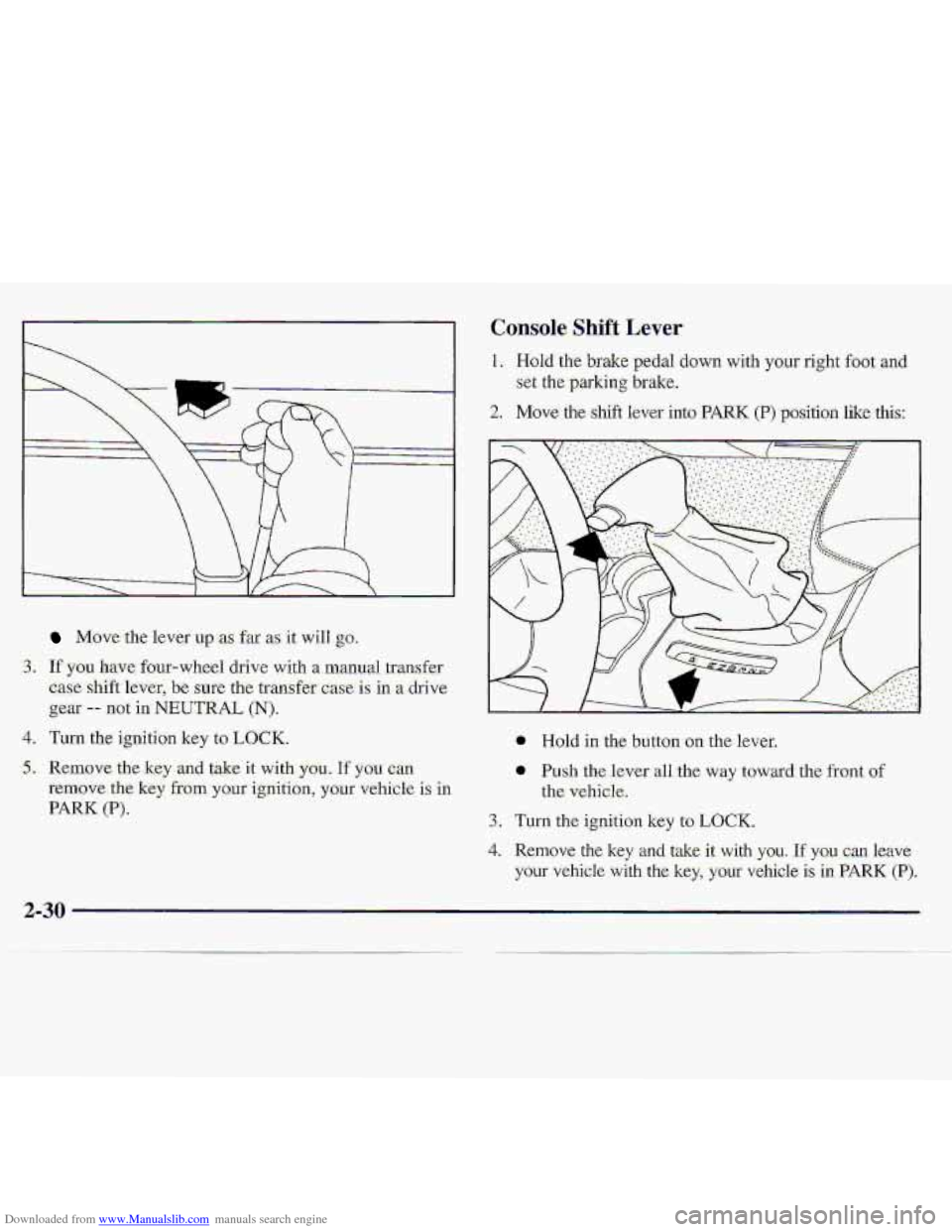
Downloaded from www.Manualslib.com manuals search engine Move the lever rjp as far as it will ga:
.3. If you have four-wheel drive with a manual .transfer
case shiftleverj be sure the transfer case is in a drive.
gear
-- not in NEUTRAL (N).
4. Turn the ignition key to LO-CK.
5. Remove the key and take it with you. Fyou c.an
remove the key from your ignitibn, your vehicle is in
PARK (P),
Console Shift Lever
1. Hold the bvake pedal dawn with your ri,ght foot and
2. Move the -shift .lever into PARK (PI position like this:
set the ,parking brake.
0 Hold in the button on the lever.
0 Push the lever abbe way towd the front of
t-he. vehicle.
3. Turn the ignition key to LOCK.
4. Remove the key and take it with you. If y0.u can leave
your vehicle
with the key, your vehicle is in PARK (P).
2-30
Page 79 of 402
Downloaded from www.Manualslib.com manuals search engine Shifting Out of PARK (.P)
(Automatic Transmission)
Your vehick has a brake-transmission shift biterlock.
You have to fully apply your regular brake before. you
can :.shift from PARK (P) when the i-gnitlon is in the
RUN position. See- “Automatic Transmission Operation”
in the Index,
If you cannot shift out of PARK (P), ease pressure on
the shift lever -- push the shift lever all the way into
PARK (PI as you maintain brake application. Then
move the shift lever into the gear you want (you must
pms the shift lever button if you have the. console
shift lever).
If you ever ho1.d the brake pedal down but still can’t
shift out
of PARK- (P), try this:
Par g, Your Vehicle (M-anual
Transmi,ssion Models Only)
Before you-get out of your vehicle, turn off your engine,
put
y.0~11- manual transmission in REVERSE-(R) and
firmly .apply the parking bzakei
If you have four-wheel drive with a manual transfer case
.shift lever, be sure
your transfer case is in a drive gear.
Your vehic1.e
could roll if it i.sn’t.
If you are parking on a hill or pulling a trailer, see
“Towing a Trailer” in the Index.
I. Turn the key to OFF.
2. Apply and ho-18 the brake until the end of Step 4.
3. Sliiffto NEUTRAL (N).
4. Start. the vehicle and then shift to the drive gear
5. Have the vehide fixed as soon as you can.
you want.
2-32
Page 103 of 402
Downloaded from www.Manualslib.com manuals search engine Air Bag. Readiness-L-ight
There is '.an air hag readines.s light on the instrumen-t
panel, which shows A1R.BA.G. The syste.m checks the.
air.
bag's electrical system for malfunction-s. The light
,tells
.you, if thereis -an ekctrical pmbkm. The system
check
ificlndes .the ak bag sensors, the ,air bag. nzQdule,
the wiring. and the diagnostic module. For- more
infcjrmation on the air bag system, s,ee "Air Bag" in
the
Index.
AIR
BAG
'This, light will come on
when you start your engine,
and it will flash for a few
-seconds. Then the light
:should go Out.. This means
,the system is r"eady.
If-tbe air bag readiness light stays on afterylau start the
efi.gine or c.omes on wh&n you are drivingj. yo.ur air bag
s.ystem may not work properly. Have :your vehicle
serviced right away.
The air bag readiness light sho.uid. flash.for a few
seconds when you turn the. ignition key to RUN. If the
light doesn't come
on. then, have it- fixed SO it will be
ready to warn you if there is a problem.
I--i/
The charging system light
will c.ome on briefly when
you turn on the ignition,
but the engine is not
-running, as- ,a cheek to
show -you it is- working.
1t:should go .out once the engine. is Iuming. If it stays
on, or corms on while you are driving; you may have a
problem with the chargigg system. It c'ould. indicate that
you have problems with a generator ,dsive belt, or
%math& ekctrical probIern. Have it checked right away.
Driving whilethis light is. on could drain ,your b.attery.
If you must drive a short distance. with the light an, be,
certain
to turn. off all your wxssories, .such as the radio
adair conditioner.