towing CHEVROLET S10 1997 2.G Owners Manual
[x] Cancel search | Manufacturer: CHEVROLET, Model Year: 1997, Model line: S10, Model: CHEVROLET S10 1997 2.GPages: 402, PDF Size: 21.04 MB
Page 61 of 402
Downloaded from www.Manualslib.com manuals search engine I Starting Your 2.2 Liter Engine
1. Without puslung -the accelerator pedal, turn your
ignition key to STUT. When the engine starts, let
go :of the key. The idle speed will go down as your
engine gets
warm.
NOTICE:
Holding your key in START for Ionger than 15
.secon&at a time will cause your battery to h.e
drained much sooner. And the excessive heat- can
7-- t : ~ ,1 :, .. damage your starter motor. ->..c , .-2
NOTICE:
Your engine is designed to work with the
electronics in., your vehicle.
If you add .ekectrical
parts
or accessories, you could change the way
the engine operates. Before addmg electrical
equipment, check
with your dealer. If you dodt,
your engine might not perf0.m properly.
If you ever have to have your vehicle -towed, see
the part
of this manual that tells.how to do it
without damaging your vehicle. See "Towing
Your Vehicle'? in the Index. ~~
1 2. If your engine still won't start (or starts but then
staps), it could be flooded with too much gasoline.
Try pushing your accelerator pedal all the way to the
€lcm and holcling-it there as you hold the key in
START for about three seconds. If'the vehicle starts
briefly but-then stops
again,. db the same thing, but
this time keep the pedal down for five or six-seconds.
This clears the' extra gasoline from the engine.
2-14
Page 62 of 402
Downloaded from www.Manualslib.com manuals search engine Starting You~~~~VQRTEC’~ 4300 Engine
1. Witho.ut pushing the: amilerator pedal, turn your
ignition- key to START. When the-engine starts, let
go of the. key, The idle speed w go-down as your
engine gets warm.
NOTICE:
Holding your key :in START for longer khan
15 .sec.onds at- a lime will cause. your battery-to be
draihed:-much so6ner. And the exc4?ssiVe heat can
damage
your starter motor.
2. If it doe.sn’t start right away? hold your key in
START. If it doe‘sh’t start in 10 seconds, push ,the
accelerator p:edal .all tkway down for five. more
seconds, 01- .until it starts.
3. If your engine stili wun’t .start (or sta?s but then
stops)., wait 15 seca,nds and start over..
When .the engine starts, let go of the key and the
accelerator pedal.
NOTICE:
Your engine is designed to work with t.he
electronics in
your vehicle. If you .add electpica1
parts or :accessories, you could change the way
the engine operates, B-efore adding electrical
equipment, check with
y0u.r dealer. If you dan’t,
your engine might not perform
properly.
If-you ever have to have your vehicle. towed, see
the part
of this manual that tells- how to do it:
without damaging your vehicle. See “Towing,
Your Vehile” in the Index.
.
Page 64 of 402
Downloaded from www.Manualslib.com manuals search engine Automatic Transmission Operation
Your automatic transmission may have a shift lever
located
on the console between the seats or on the
steering column.
There are several different positions for your shift lever.
If your vehicle is equipped with a column shift lever,
it
features an electronic shift position indicator within the
instrument cluster. This display must be powered
anytime the shift lever is capable of being moved out
of
the PARK (P) position. This means that if your key is in
the
OFF position, but not locked, there will be a small
current drain
on your battery which could discharge
your battery over a period of time.
If you need to leave
your key in the ignition
in the OFF position for an
extended period, it is recommended that you disconnect
the battery cable from the battery
to prevent discharging
your battery.
PARK (P): This locks your rear wheels. It’s the best
position to use when you start your engine because your
vehicle can’t move easily.
Lf! C A TION:
It is dangerous to get out of your vehicle if the
shift lever is not fully in
PARK (P) with the
parking brake
firmly set. Your vehicle can roll.
Don’t leave your vehicle when the engine is
running unless you have to.
If you have left the
engine running, the vehicle can move suddenly.
You or others could be injured.
To be sure your
vehicle won’t move, even when you’re on fairly
level ground, always set your parking brake and
move the shift lever to
PARK (P).
If you have four-wheel drive, your vehicle
will be free to roll
-- even if your shift lever
is in
PARK (P) -- if your transfer case is in
NEUTRAL (N). So, be sure the transfer case is in
a drive gear, two-wheel high (2HI) or four-wheel
high (4HI) or four-wheel low (4LO)
-- not in
NEUTRAL (N). See “Shifting Into PARK (P)” in
the Index.
If you’re pulling a trailer, see “Towing
a Trailer’’ in the Index.
2-17
Page 66 of 402
Downloaded from www.Manualslib.com manuals search engine AUT-OMATIC OVERDRIVE (@): This yosition is for
normal driving. If y.ou need more :power for passing, and
yodre:
(r, GQing less than about 35 mpli (56: krnlh), push your
axelerator p:edal about halfway down.
Going< about 35 inph (56 knci/h> or more, push the
accelerator all the way down.
You'-ll shift down to the next gedr and have more power.
AUTOMATIC OVERDRIVE (0) should not b.e used
when towing
a trailer, carrying a heavy load, driving on
steep.
hills, 6r for off-road-driving.. Selecr DRIVE (D)
when operating the vehicle under any of these
conditions.
DRIVE @): This position is also use.d for normal
driving,'however it offers more power -and lower fuel
economy than AUTQMATIC -aVERDRIVE (a). You
should use DRIVE (D) when rowing a trailer; carrying a
heavy load, driving. on steep hills or winding roads or
for .off-road driving.
SEC-OND (2): This position gives. you more power but.
lower fuel economy.' You can use SECOND (2) aji hills.
It can help control your speed as-you go .down steep
mountain
roads., but then you would..also want to use
your brakes off-and on. YOU can ds~ use SECOND (2)
2-19
Page 75 of 402
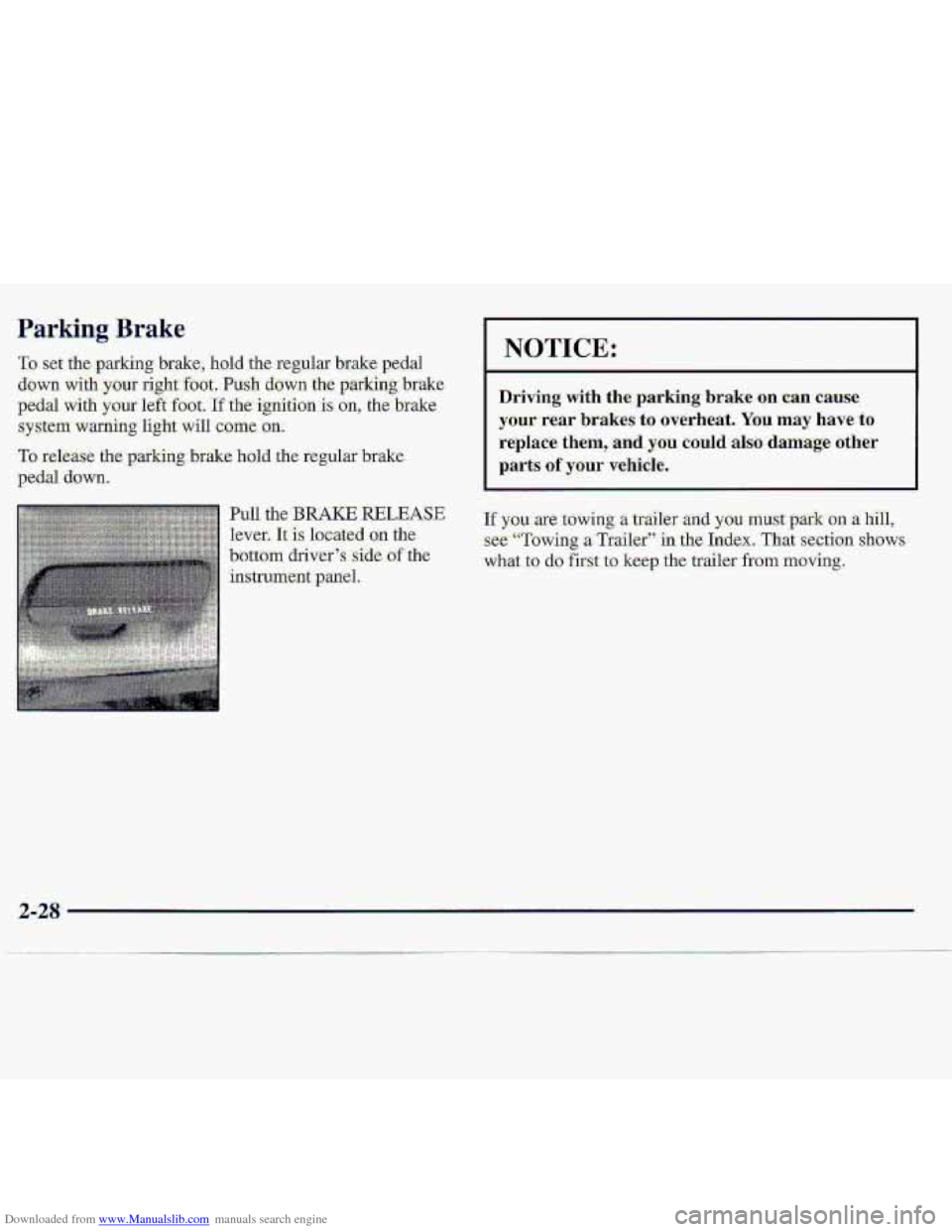
Downloaded from www.Manualslib.com manuals search engine Parking Brake
I NOTICE: I
Driving with .the:p.arking brake on c=an.cause
your- rear brakes to overheat. Y0.u may have to
replace them, and you. could .also-damage other
parts of your vehicle.
If you. are towing a trailer and.you must. park on a hill,
see--"Towing a Trailer" in. the Iadex. That section shows
what to
do first- to. ke.ep the trailer from moving.
Page 76 of 402
Downloaded from www.Manualslib.com manuals search engine Shifting Into PARK (P) (Automatic
Transmission Models Only)
It can be dangerous to get out of your vehicle if
the shift lever is not fd1y in PARK (P) with the
parking brake firmly set. Your vehicle can roll.
If you have left the engine- running, the vehicle
can move suddenly. You or others could be
injured.
To be sure your vehicle won’t move, even
when you’re on fairly level ground, use the steps
that follow.
If you have four-wheel drive with
a manual transfer case-shift lever and your
transfer case
is in NEUTRAL (N), your vehicle
wiIl be free to roll, even if your shift lever is in
PARK (P). So, b.e sure the trans€er case is in a
drive gear -- not in NEUTRAL (N). If you’re
pulling
a trailer, see CLTowing a Trailer’’ in
the Index.
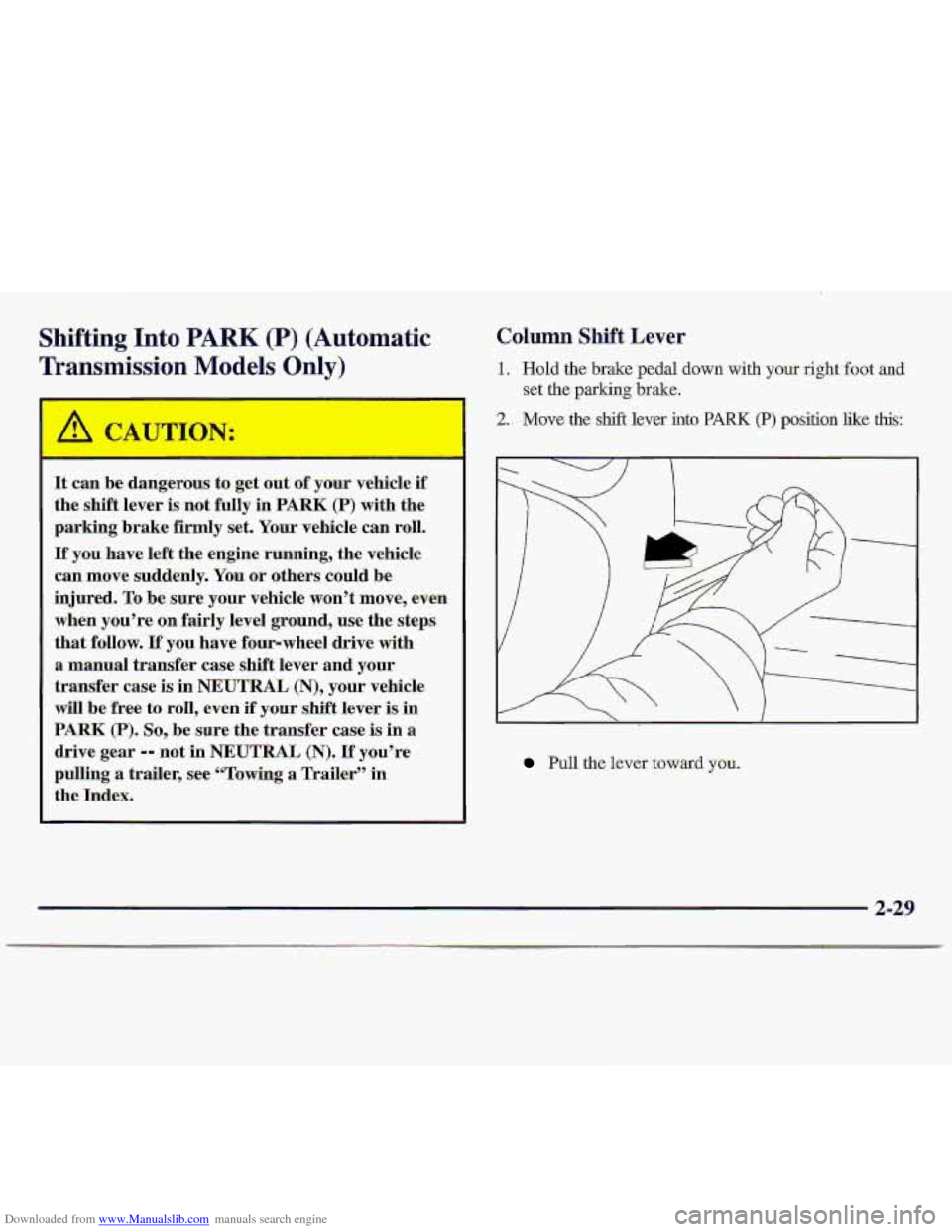
Column Shift Lever
1. Hold the brake pedal down with your right,foot and
2. Move the SM lever into PARK (P) position like this:
set the parking brake.
1 I
Pull the lever toward you.
2-29
Page 79 of 402
Downloaded from www.Manualslib.com manuals search engine Shifting Out of PARK (.P)
(Automatic Transmission)
Your vehick has a brake-transmission shift biterlock.
You have to fully apply your regular brake before. you
can :.shift from PARK (P) when the i-gnitlon is in the
RUN position. See- “Automatic Transmission Operation”
in the Index,
If you cannot shift out of PARK (P), ease pressure on
the shift lever -- push the shift lever all the way into
PARK (PI as you maintain brake application. Then
move the shift lever into the gear you want (you must
pms the shift lever button if you have the. console
shift lever).
If you ever ho1.d the brake pedal down but still can’t
shift out
of PARK- (P), try this:
Par g, Your Vehicle (M-anual
Transmi,ssion Models Only)
Before you-get out of your vehicle, turn off your engine,
put
y.0~11- manual transmission in REVERSE-(R) and
firmly .apply the parking bzakei
If you have four-wheel drive with a manual transfer case
.shift lever, be sure
your transfer case is in a drive gear.
Your vehic1.e
could roll if it i.sn’t.
If you are parking on a hill or pulling a trailer, see
“Towing a Trailer” in the Index.
I. Turn the key to OFF.
2. Apply and ho-18 the brake until the end of Step 4.
3. Sliiffto NEUTRAL (N).
4. Start. the vehicle and then shift to the drive gear
5. Have the vehide fixed as soon as you can.
you want.
2-32
Page 81 of 402
Downloaded from www.Manualslib.com manuals search engine Running, Your Engine While Yo-u’re
Parked (Automatic Tr-ammission)
It’s better not to park with the -.engine running. But if
ever have to, here are some things to knbw.
Idling the engine with L; air system control
off could allow dangerous exhaust into
yom.-vehicle (see the ear1ie.r Caution under
“Engine Exhaust”).
Ab, idiirig-in a. closed-ili place can let deadly
carbon monoxide
(Ca) into y.our vehicle even if
the fen switch is at the highest Setti.ng. One place
this can happen
is a ,garage. Exhaust -- with
CO -- can come in easily. NEVER park in a
,-garage with th-e engine runnihg.
Another cl~sed-in place
can be a. blizzard. (S.ee
“Blizzard” in the Index.)
r
It can be dangerous to get aut.of your vehicle if
the shift lever is not fully in PARK (P) with the
parking brake-firmIy set, Your vehicle c.an roll.
Don’t leave your vehicle when the engine is
running unless you have
to. If you’ve left th.e
engine runnhg, the vehicle can
move suddenly.
You
or others. could be injured. To be sure your
vehicle won’t move, even when you’re bn fairIy
level ground, always set your parking brake -and
move the shift 1-ever-to PARK (P).
If you have four-wheel drivecwith a manual transfer case
shift lever and your tKans-fer case .is in.NErJTRAL. (N),
your v8hicle will be free to roll, even if your shift lever
is in PAR.K (P). So, be sure the tran-sfer c.ase is in a drive
gear
-- not in NEUTRAL (N). Always-set y.our-p.arking
brake.
Follow the proper steps to be sure your vehicle
won’t move. See “Shifting Into PARK.(P)” in the Index.
If you’re pulling a.trailer, see “Towing a Trailer” in
the Index.
2-34
Page 85 of 402
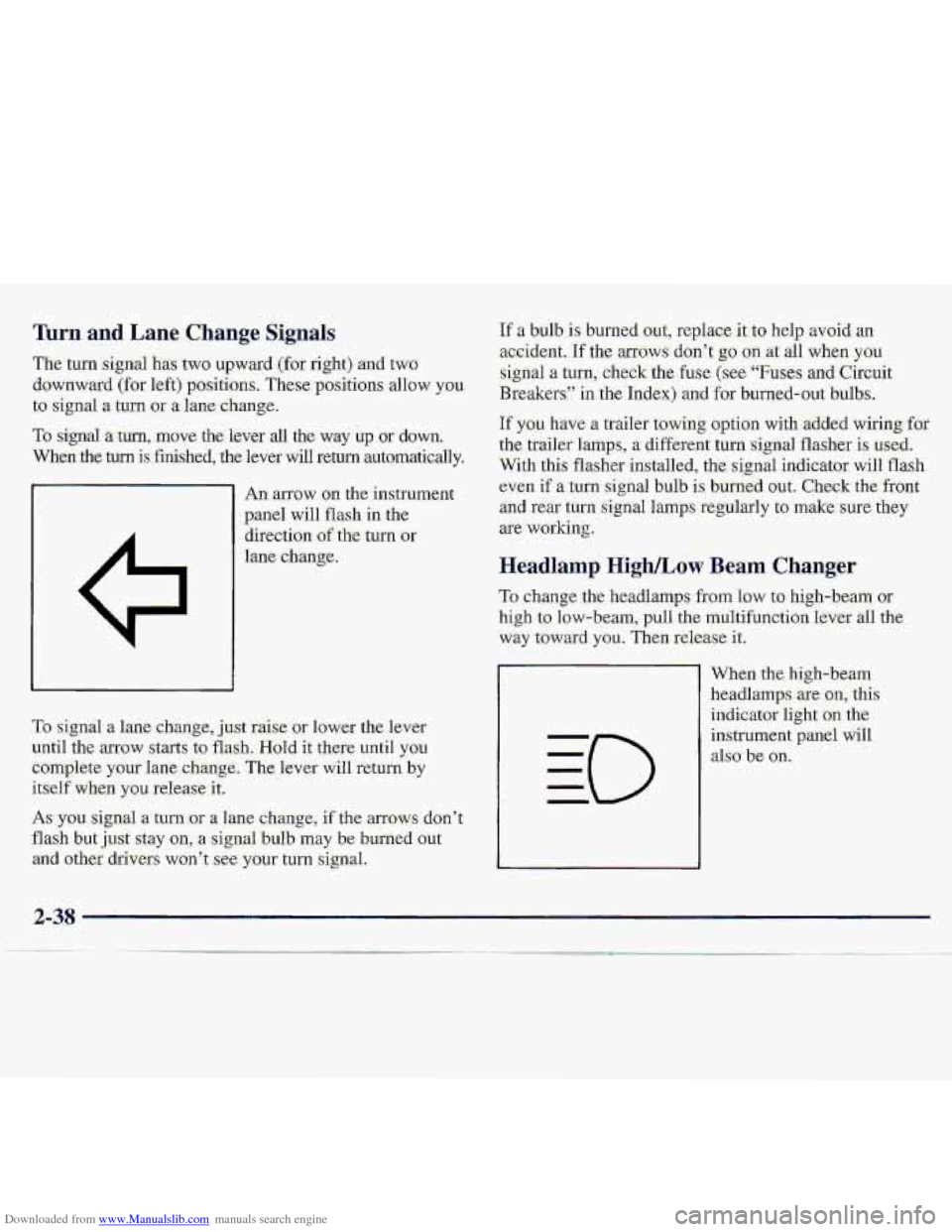
Downloaded from www.Manualslib.com manuals search engine Turn and Lane Change Si,gnak
The turn signal has two upward (fat right) and- two
ciownwa~d
(for left) p??sitions. Tbese positions allow you
to signal a turn 0.r a.lane. change:
To signal -a turn, move the lever all the way up or down.
When the turn is finished, the lever will return aut~omatically.
An anow on. the instrume
panel will flash in the
direction
of the- turn or
lane change.
If a bulb is: burned.out, replace it.t-o help avoid an
acc.ident. If the arfows don’t g.0 on at all when you
sign-a1 a turn, check the fuse (see “Fu-se.s and Circuit
Breakersl’ in the .Ind.ex) and for burned-oat bulbs.
If you have n trailer towing option with -added wiring, for
the. traiier%mps, a d-ifferent turn :signal flasher is used.
With this flashes installed, the signal. indicator will flash
even if a.tum
signal bulb is burllid OW. Check the-ffont
an.d rear turn signal lamps -regularly tu make sure. they
are working.
Headl-amp High/Low Beam Changer
To change the headlamps from low to high-beam or
high to low-beam, pull the multifunction lever all the
way t.oward you. Then release it.
To signa1 a Lane change, j,ust raise- or lower the. lever
until the arrow starts to flash. Hold it there until you
Complete your lane,c,hangc, The kevei- will return by
itself when you release it.
As you signal a turn -or a lane c,hange, if the armws don’t
flash but just sxay on, a signal buIb may be burned Gut
arid other. drivers won’t ,see. your turn signal.. When the.’hi.gh-beam
headlamps are
on,. this
indicator
light .OM the
instrument pgniJ will
dso be on.
..
2-38
Page 105 of 402
Downloaded from www.Manualslib.com manuals search engine .Brake System WarningLlght
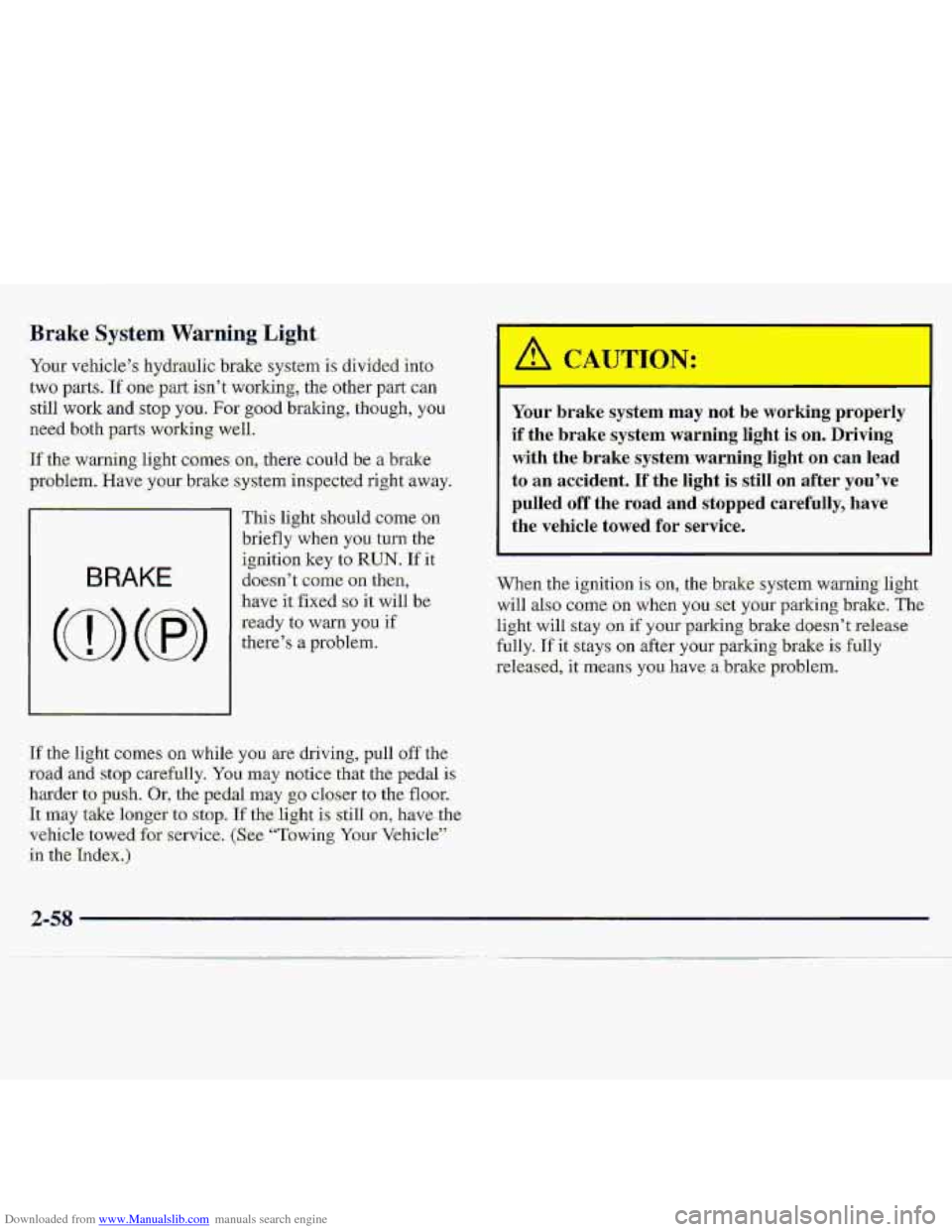
‘Your v&iiele”s hydraulic brake system is divided into-
.two pam. If one part i.sn’t working, thc other part. can
-still work and stop you. For go.od haking, though, you
need both parts working well.
‘If the warning. light comes- an, thae could be a brake
problem. Have ymr brake system inspected right -away.
BRAKE
I
This li.ght shouId came on
briefly when you turn the
ignition key
to RUN. If it
do-e-sn’
t come on then,
have it fixed so it will be
ready to warn you if
t11ei3e7.s 8 problem..
If the light camcs .gn while you are- driving, pull off the
road aid stop carefully. You may notice ,that the pedal is
.harder-t=o push. Or, the pedal may $0 closer to the floor.
‘kmay ‘take ionger to. stop. If the-light is sail1 on, have the-
vehicle
tawed for service, (S:ee- “Towing Your Vehicle”’.
in the
Index.)
J:
Your brake sysrem may not be working properly
if
the brake system warning light is on. Driving
with the brake system warning light on can lead
to an accident. If the light is still on after you’ve
pulled off the road and stopped carefully, have
the vehicle
towed for service.
.When the ignition is on, the brakesystem warning light
will also c0rn.e oa when yo.u.:set y.@ur parking brake. The
light will stay .on if your parking brake doesn’t release
fully.
If it stays on after your parking brake is fully
-released,
it means you have a brake problem.
2-58