seats CHEVROLET S10 2003 2.G User Guide
[x] Cancel search | Manufacturer: CHEVROLET, Model Year: 2003, Model line: S10, Model: CHEVROLET S10 2003 2.GPages: 432, PDF Size: 2.82 MB
Page 22 of 432
How to Wear Safety Belts Properly
This part is only for people of adult size.
Be aware that there are special things to know about
safety belts and children. And there are different
rules for smaller children and babies. If a child will be
riding in your vehicle, see
Older Children on page 1-30orInfants and Young Children on page 1-32. Follow
those rules for everyone's protection.
First, you'll want to know which restraint systems your
vehicle has.
We'll start with the driver position.
Driver Position
This part describes the driver's restraint system.
Lap-Shoulder Belt
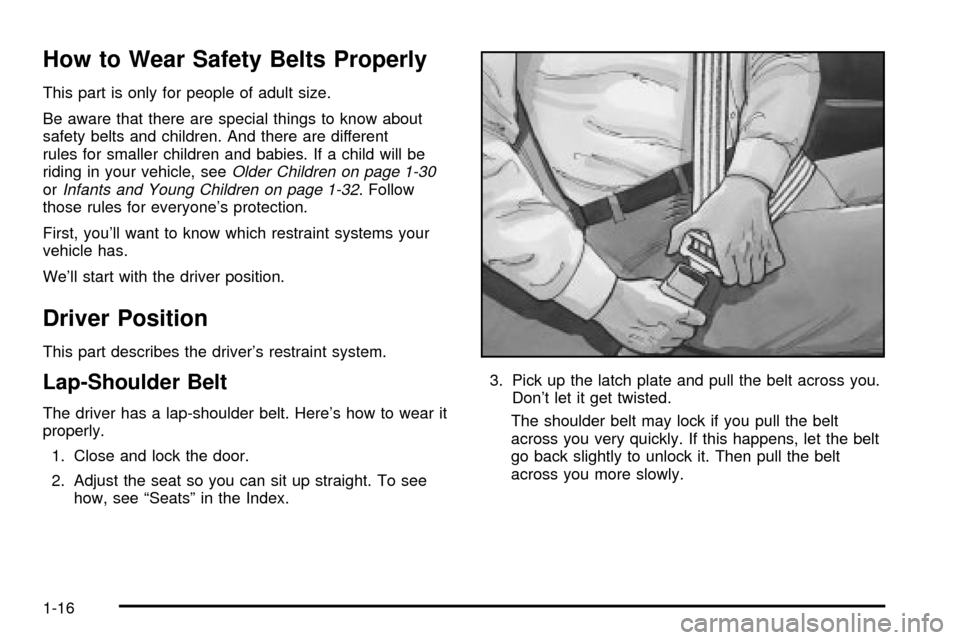
The driver has a lap-shoulder belt. Here's how to wear it
properly.
1. Close and lock the door.
2. Adjust the seat so you can sit up straight. To see
how, see ªSeatsº in the Index.3. Pick up the latch plate and pull the belt across you.
Don't let it get twisted.
The shoulder belt may lock if you pull the belt
across you very quickly. If this happens, let the belt
go back slightly to unlock it. Then pull the belt
across you more slowly.
1-16
Page 36 of 432
Child Restraints
Older Children
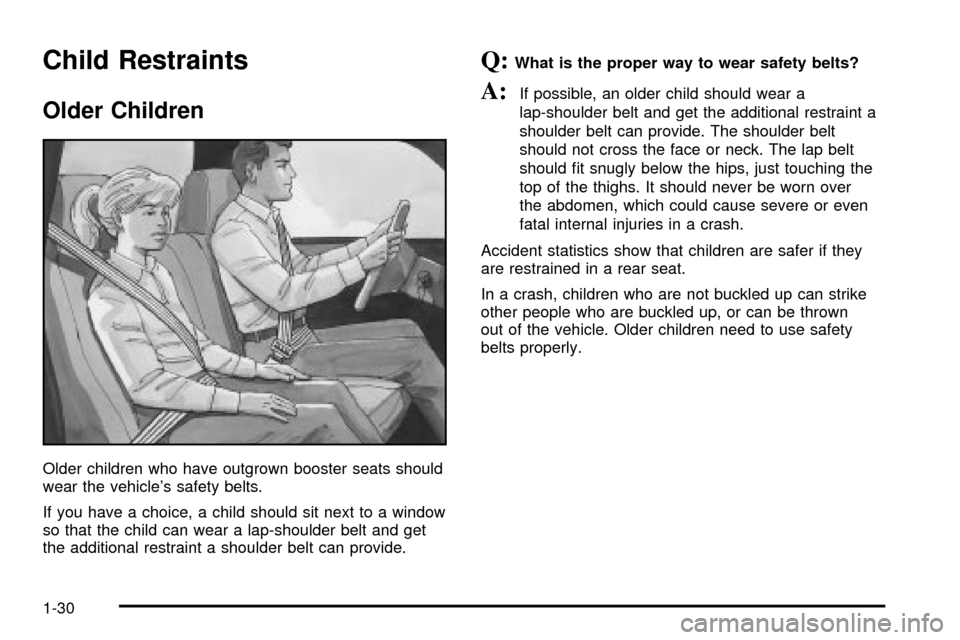
Older children who have outgrown booster seats should
wear the vehicle's safety belts.
If you have a choice, a child should sit next to a window
so that the child can wear a lap-shoulder belt and get
the additional restraint a shoulder belt can provide.
Q:What is the proper way to wear safety belts?
A:If possible, an older child should wear a
lap-shoulder belt and get the additional restraint a
shoulder belt can provide. The shoulder belt
should not cross the face or neck. The lap belt
should ®t snugly below the hips, just touching the
top of the thighs. It should never be worn over
the abdomen, which could cause severe or even
fatal internal injuries in a crash.
Accident statistics show that children are safer if they
are restrained in a rear seat.
In a crash, children who are not buckled up can strike
other people who are buckled up, or can be thrown
out of the vehicle. Older children need to use safety
belts properly.
1-30
Page 43 of 432
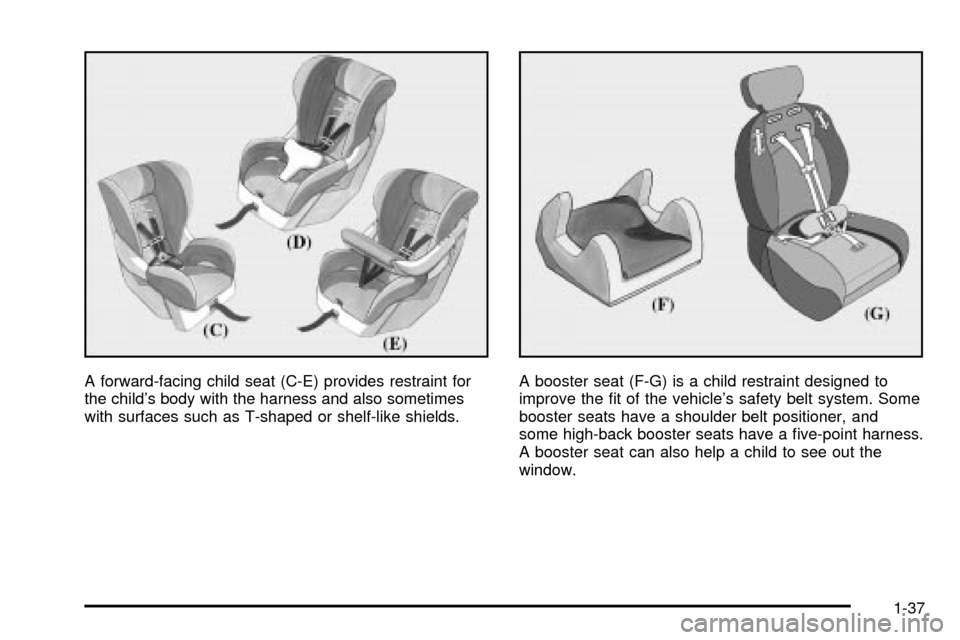
A forward-facing child seat (C-E) provides restraint for
the child's body with the harness and also sometimes
with surfaces such as T-shaped or shelf-like shields.A booster seat (F-G) is a child restraint designed to
improve the ®t of the vehicle's safety belt system. Some
booster seats have a shoulder belt positioner, and
some high-back booster seats have a ®ve-point harness.
A booster seat can also help a child to see out the
window.
1-37
Page 58 of 432
You'll be using the lap-shoulder belt. SeeTop Strap on
page 1-41if the child restraint has one. Be sure to
follow the instructions that came with the child restraint.
Secure the child in the child restraint when and as
the instructions say.
1. Your vehicle has a right front passenger air bag. If
your vehicle is a regular cab pickup or extended
cab pickup and you are using a rear-facing
child restraint in this seat, make sure the air bag is
turned off. See
Air Bag Off Switch on page 1-61.
On all models, if your child restraint is
forward-facing, always move the seat as far back
as it will go before securing it in this seat. See
Manual Seats on page 1-3orPower Seats
on page 1-4.
2. Put the restraint on the seat.
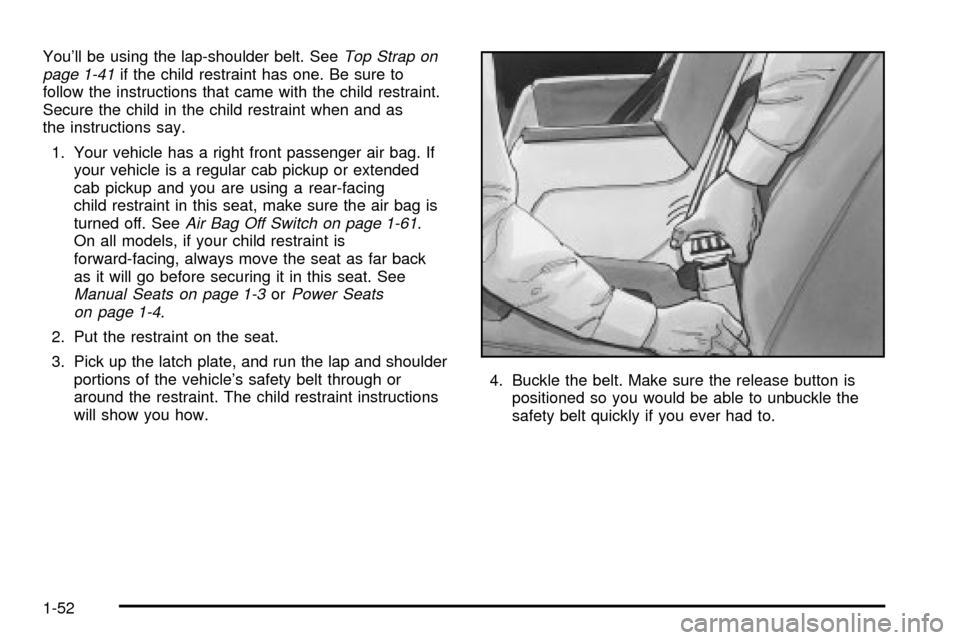
3. Pick up the latch plate, and run the lap and shoulder
portions of the vehicle's safety belt through or
around the restraint. The child restraint instructions
will show you how.4. Buckle the belt. Make sure the release button is
positioned so you would be able to unbuckle the
safety belt quickly if you ever had to.
1-52
Page 120 of 432
To reset the trip computer, press the MODE and
US/MET buttons simultaneously for at least two
seconds. All functions will be displayed brie¯y once the
system is reset. Reset can only be performed in the
AVG ECON, FUEL USED and AVG SPEED modes. All
three modes are reset at the same time.
Front Storage Area
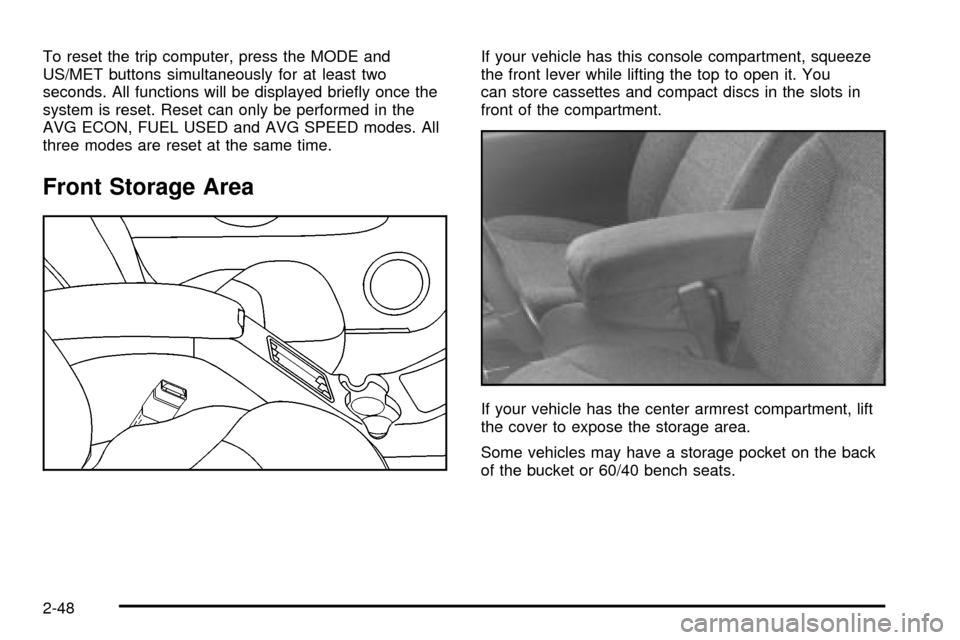
If your vehicle has this console compartment, squeeze
the front lever while lifting the top to open it. You
can store cassettes and compact discs in the slots in
front of the compartment.
If your vehicle has the center armrest compartment, lift
the cover to expose the storage area.
Some vehicles may have a storage pocket on the back
of the bucket or 60/40 bench seats.
2-48
Page 148 of 432

Operation Tips
·
Clear away any ice, snow or leaves from the air
inlets at the base of the windshield that may
block the ¯ow of air into your vehicle.
·Use of non-GM approved hood de¯ectors may
adversely affect the performance of the system.
·Keep the path under the front seats clear of objects
to help circulate the air inside of your vehicle more
effectively.
Warning Lights, Gages and
Indicators
This part describes the warning lights and gages that
may be on your vehicle. The pictures will help you
locate them.
Warning lights and gages can signal that something is
wrong before it becomes serious enough to cause
an expensive repair or replacement. Paying attention to
your warning lights and gages could also save you
or others from injury.Warning lights come on when there may be or is a
problem with one of your vehicle's functions. As you will
see in the details on the next few pages, some
warning lights come on brie¯y when you start the
engine just to let you know they're working. If you are
familiar with this section, you should not be alarmed
when this happens.
Gages can indicate when there may be or is a problem
with one of your vehicle's functions. Often gages
and warning lights work together to let you know when
there's a problem with your vehicle.
When one of the warning lights comes on and stays on
when you are driving, or when one of the gages shows
there may be a problem, check the section that tells you
what to do about it. Please follow this manual's advice.
Waiting to do repairs can be costly±and even dangerous.
So please get to know your warning lights and gages.
They're a big help.
3-22
Page 251 of 432
{CAUTION:
Do not load your vehicle any heavier than the
GVWR, or either the maximum front or rear
GAWR. If you do, parts on your vehicle can
break, and it can change the way your vehicle
handles. These could cause you to lose
control and crash. Also, overloading can
shorten the life of your vehicle.
Using heavier suspension components to get added
durability might not change your weight ratings. Ask your
dealer to help you load your vehicle the right way.
Notice:Your warranty does not cover parts
or components that fail because of overloading.
If you put things inside your vehicle±like suitcases, tools,
packages, or anything else±they will go as fast as the
vehicle goes. If you have to stop or turn quickly, or
if there is a crash, they'll keep going.
{CAUTION:
Things you put inside your vehicle can strike
and injure people in a sudden stop or turn, or
in a crash.
·Put things in the trunk of your vehicle. In a
trunk, put them as far forward as you can.
Try to spread the weight evenly.
·Never stack heavier things, like suitcases,
inside the vehicle so that some of them
are above the tops of the seats.
·Do not leave an unsecured child restraint
in your vehicle.
·When you carry something inside the
vehicle, secure it whenever you can.
·Do not leave a seat folded down unless
you need to.
There's also important loading information for off-road
driving in this manual. See
ªLoading Your Vehicle
for Off-Road Driving²underOff-Road Driving with Your
Four-Wheel-Drive Vehicle on page 4-14.
4-49
Page 339 of 432
Removing the Spare Tire and Tools
The jacking equipment you'll need is stored inside the
plastic jack cover which is behind the front seats, either
on the center of the wall (extended cab) or on the
passenger's side of the wall (regular cab).
The jacking equipment for the crew cab is located
behind the rear seatback on the passenger's side of the
vehicle.
1. To remove it, turn the plastic wing nut
counterclockwise. Remove the jack cover.
2. Turn the wing nut counterclockwise and remove the
wheel blocks, jack and wheel wrench.
Notice:Never remove or restow a tire from/to a
stowage position under the vehicle while the vehicle
is supported by a jack. Always tighten the tire
fully against the underside of the vehicle when
restowing.
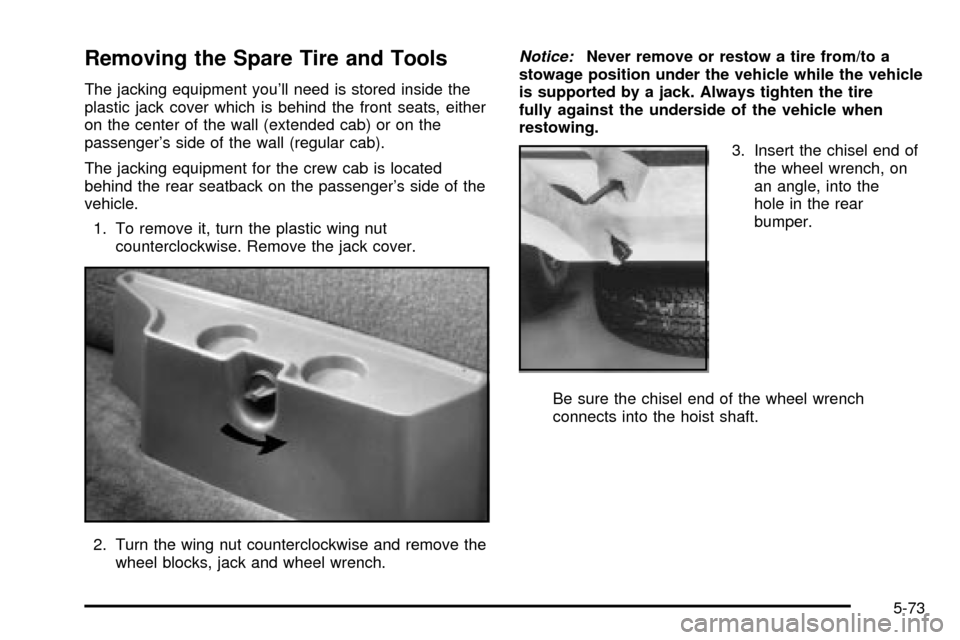
3. Insert the chisel end of
the wheel wrench, on
an angle, into the
hole in the rear
bumper.
Be sure the chisel end of the wheel wrench
connects into the hoist shaft.
5-73
Page 360 of 432
If you ever have a problem on the road and don't have
a spare fuse, you can borrow one that has the same
amperage. Just pick some feature of your vehicle
that you can get along withoutÐ like the radio or
cigarette lighterÐand use its fuse, if it is the correct
amperage. Replace it as soon as you can.
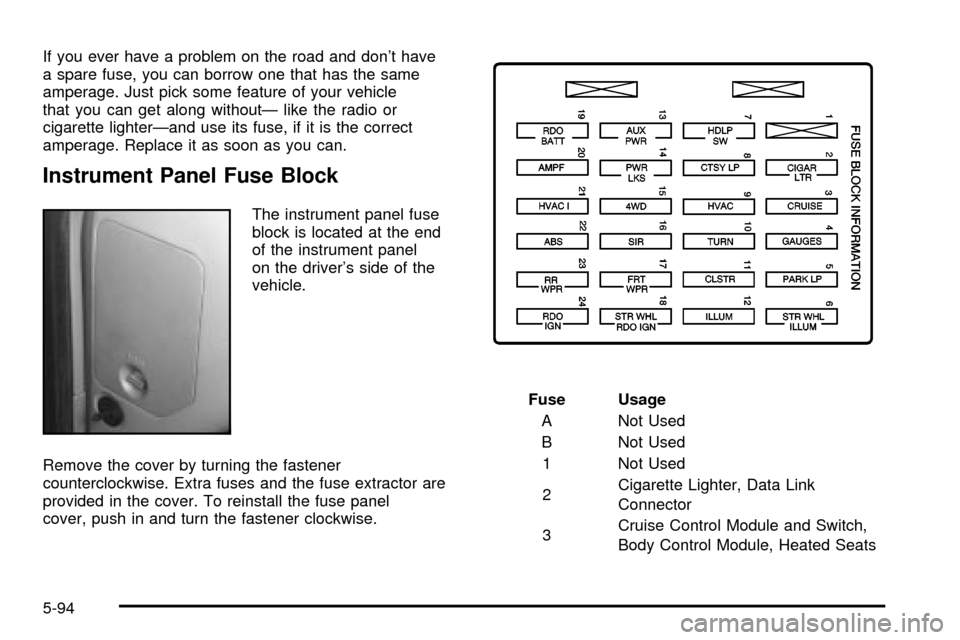
Instrument Panel Fuse Block
The instrument panel fuse
block is located at the end
of the instrument panel
on the driver's side of the
vehicle.
Remove the cover by turning the fastener
counterclockwise. Extra fuses and the fuse extractor are
provided in the cover. To reinstall the fuse panel
cover, push in and turn the fastener clockwise.Fuse Usage
A Not Used
B Not Used
1 Not Used
2Cigarette Lighter, Data Link
Connector
3Cruise Control Module and Switch,
Body Control Module, Heated Seats
5-94
Page 402 of 432
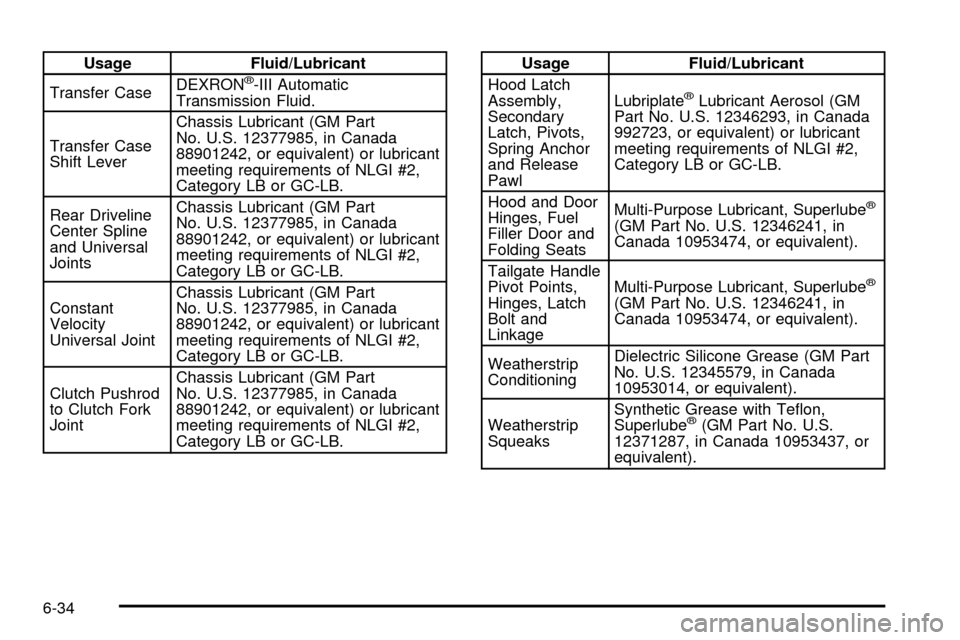
Usage Fluid/Lubricant
Transfer CaseDEXRONž-III Automatic
Transmission Fluid.
Transfer Case
Shift LeverChassis Lubricant (GM Part
No. U.S. 12377985, in Canada
88901242, or equivalent) or lubricant
meeting requirements of NLGI #2,
Category LB or GC-LB.
Rear Driveline
Center Spline
and Universal
JointsChassis Lubricant (GM Part
No. U.S. 12377985, in Canada
88901242, or equivalent) or lubricant
meeting requirements of NLGI #2,
Category LB or GC-LB.
Constant
Velocity
Universal JointChassis Lubricant (GM Part
No. U.S. 12377985, in Canada
88901242, or equivalent) or lubricant
meeting requirements of NLGI #2,
Category LB or GC-LB.
Clutch Pushrod
to Clutch Fork
JointChassis Lubricant (GM Part
No. U.S. 12377985, in Canada
88901242, or equivalent) or lubricant
meeting requirements of NLGI #2,
Category LB or GC-LB.
Usage Fluid/Lubricant
Hood Latch
Assembly,
Secondary
Latch, Pivots,
Spring Anchor
and Release
PawlLubriplate
žLubricant Aerosol (GM
Part No. U.S. 12346293, in Canada
992723, or equivalent) or lubricant
meeting requirements of NLGI #2,
Category LB or GC-LB.
Hood and Door
Hinges, Fuel
Filler Door and
Folding SeatsMulti-Purpose Lubricant, Superlube
ž
(GM Part No. U.S. 12346241, in
Canada 10953474, or equivalent).
Tailgate Handle
Pivot Points,
Hinges, Latch
Bolt and
LinkageMulti-Purpose Lubricant, Superlube
ž
(GM Part No. U.S. 12346241, in
Canada 10953474, or equivalent).
Weatherstrip
ConditioningDielectric Silicone Grease (GM Part
No. U.S. 12345579, in Canada
10953014, or equivalent).
Weatherstrip
SqueaksSynthetic Grease with Te¯on,
Superlube
ž(GM Part No. U.S.
12371287, in Canada 10953437, or
equivalent).
6-34