towing CHEVROLET S10 2003 2.G Owner's Manual
[x] Cancel search | Manufacturer: CHEVROLET, Model Year: 2003, Model line: S10, Model: CHEVROLET S10 2003 2.GPages: 432, PDF Size: 2.82 MB
Page 263 of 432

Following Distance
Stay at least twice as far behind the vehicle ahead as
you would when driving your vehicle without a trailer.
This can help you avoid situations that require
heavy braking and sudden turns.
Passing
You'll need more passing distance up ahead when
you're towing a trailer. And, because you're a good deal
longer, you'll need to go much farther beyond the
passed vehicle before you can return to your lane.
Backing Up
Hold the bottom of the steering wheel with one hand.
Then, to move the trailer to the left, just move that hand
to the left. To move the trailer to the right, move your
hand to the right. Always back up slowly and, if possible,
have someone guide you.
Making Turns
Notice:Making very sharp turns while trailering
could cause the trailer to come in contact with the
vehicle. Your vehicle could be damaged. Avoid
making very sharp turns while trailering.When you're turning with a trailer, make wider turns
than normal. Do this so your trailer won't strike
soft shoulders, curbs, road signs, trees or other objects.
Avoid jerky or sudden maneuvers. Signal well in
advance.
Turn Signals When Towing a Trailer
When you tow a trailer, your vehicle has to have extra
wiring and a heavy-duty turn signal ¯asher.
The arrows on your instrument panel will ¯ash whenever
you signal a turn or lane change. Properly hooked up,
the trailer lamps will also ¯ash, telling other drivers
you're about to turn, change lanes or stop.
When towing a trailer, the arrows on your instrument
panel will ¯ash for turns even if the bulbs on the trailer
are burned out. Thus, you may think drivers behind
you are seeing your signal when they are not. It's
important to check occasionally to be sure the trailer
bulbs are still working.
4-61
Page 264 of 432
Driving On Grades
Reduce speed and shift to a lower gear before you start
down a long or steep downgrade. If you don't shift
down, you might have to use your brakes so much that
they would get hot and no longer work well.
If you have an automatic transmission, you should use
THIRD (3) when towing a trailer. Operating your
vehicle in THIRD (3) when towing a trailer will minimize
heat buildup and extend the life of your transmission.
Or, if you have a manual transmission, it's better not to
use FIFTH (5). Just drive in FOURTH (4) (or, as you
need to, a lower gear).
When towing at high altitude on steep uphill grades,
consider the following: Engine coolant will boil at a lower
temperature than at normal altitudes. If you turn your
engine off immediately after towing at high altitude
on steep uphill grades, your vehicle may show signs
similar to engine overheating. To avoid this, let the
engine run while parked (preferably on level ground)
with the automatic transmission in PARK (P) (or
the manual transmission out of gear and the parking
brake applied) for a few minutes before turning the
engine off. If you do get the overheat warning,
see
Engine Overheating on page 5-30.
Parking on Hills
{CAUTION:
You really should not park your vehicle, with a
trailer attached, on a hill. If something goes
wrong, your rig could start to move. People
can be injured, and both your vehicle and the
trailer can be damaged.
But if you ever have to park your rig on a hill, here's
how to do it:
1. Apply your regular brakes, but don't shift into
PARK (P) yet, or into gear for a manual
transmission. When parking uphill, turn your wheels
away from the curb. When parking downhill, turn
your wheels into the curb.
2. Have someone place chocks under the trailer
wheels.
3. When the wheel chocks are in place, release the
regular brakes until the chocks absorb the load.
4-62
Page 265 of 432

4. Reapply the regular brakes. Then apply your
parking brake, and then shift into PARK (P), or
REVERSE (R) for a manual transmission.
5. If you have a four-wheel-drive vehicle with an
automatic transfer case, be sure the transfer case is
in a drive gear±not in NEUTRAL.
6. Release the regular brakes.
When You Are Ready to Leave After
Parking on a Hill
1. Apply your regular brakes and hold the pedal down
while you:
·start your engine,
·shift into a gear, and
·release the parking brake.
2. Let up on the brake pedal.
3. Drive slowly until the trailer is clear of the chocks.
4. Stop and have someone pick up and store the
chocks.
Maintenance When Trailer Towing
Your vehicle will need service more often when you're
pulling a trailer. SeePart A: Scheduled Maintenance
Services on page 6-4for more on this. Things that are
especially important in trailer operation are automatic
transmission ¯uid (don't over®ll), engine oil, axle
lubricant, belt, cooling system and brake system. Each
of these is covered in this manual, and the Index
will help you ®nd them quickly. If you're trailering, it's a
good idea to review these sections before you start
your trip.
Check periodically to see that all hitch nuts and bolts
are tight.
4-63
Page 288 of 432

Automatic Transmission Fluid
When to Check and Change
A good time to check your automatic transmission ¯uid
level is when the engine oil is changed.
Change both the ¯uid and ®lter every 15,000 miles
(25 000 km) if the vehicle is mainly driven under one or
more of these conditions:
·In heavy city traffic where the outside temperature
regularly reaches 90ÉF (32ÉC) or higher.
·In hilly or mountainous terrain.
·When doing frequent trailer towing.
·Uses such as found in taxi, police or delivery
service.
If you do not use your vehicle under any of these
conditions, change the ¯uid and ®lter every
50,000 miles (83 000 km).
See
Part A: Scheduled Maintenance Services on
page 6-4.
How to Check
Because this operation can be a little difficult, you may
choose to have this done at the dealership service
department.
If you do it yourself, be sure to follow all the instructions
here, or you could get a false reading on the dipstick.
Notice:Too much or too little ¯uid can damage
your transmission. Too much can mean that some
of the ¯uid could come out and fall on hot engine
part or exhaust system parts, starting a ®re.
Too little ¯uid could cause the transmission to
overheat. Be sure to get an accurate reading if you
check your transmission ¯uid.
Wait at least 30 minutes before checking the
transmission ¯uid level if you have been driving:
·When outside temperatures are above 90ÉF (32ÉC).
·At high speed for quite a while.
·In heavy traffic±especially in hot weather.
·While pulling a trailer.
5-22
Page 297 of 432

If No Steam Is Coming From Your
Engine
If you get an engine overheat warning but see or hear
no steam, the problem may not be too serious.
Sometimes the engine can get a little too hot when you:
·Climb a long hill on a hot day.
·Stop after high-speed driving.
·Idle for long periods in traffic.
·Tow a trailer. See ªDriving on Gradesº under
Towing a Trailer on page 4-54.
If you get the overheat warning with no sign of steam,
try this for a minute or so:
1. In heavy traffic, let the engine idle in NEUTRAL
while stopped. If it is safe to do so, pull off the
road, shift to PARK (P) or NEUTRAL and let the
engine idle.
2. Turn on your heater to full hot at the highest fan
speed and open the window as necessary.If you no longer have the overheat warning, you can
drive. Just to be safe, drive slower for about 10 minutes.
If the warning doesn't come back on, you can drive
normally.
If the warning continues, pull over, stop, and park your
vehicle right away.
If there's still no sign of steam, idle the engine for three
minutes while you're parked. Push down the accelerator
until the engine speed is about twice as fast as normal
idle speed for at least three minutes while you're parked.
If you still have the warning,
turn off the engine and get
everyone out of the vehicleuntil it cools down.
You may decide not to lift the hood but to get service
help right away.
5-31
Page 305 of 432
Engine Fan Noise
This vehicle has a clutched engine cooling fan. When the
clutch is engaged, the fan spins faster to provide more air
to cool the engine. In most everyday driving conditions,
the clutch is not engaged. This improves fuel economy
and reduces fan noise. Under heavy vehicle loading,
trailer towing and/or high outside temperatures, the fan
speed increases when the clutch engages. So you may
hear an increase in fan noise. This is normal and should
not be mistaken as the transmission slipping or making
extra shifts. It is merely the cooling system functioning
properly. The fan will slow down when additional cooling
is not required and the clutch disengages.
You may also hear this fan noise when you start the
engine. It will go away as the fan clutch disengages.
Power Steering Fluid
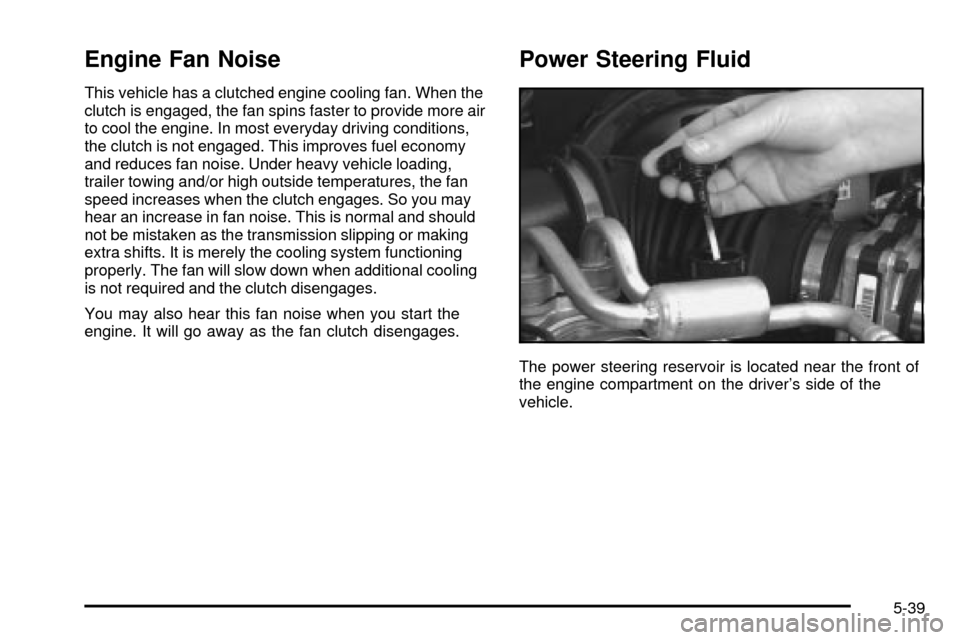
The power steering reservoir is located near the front of
the engine compartment on the driver's side of the
vehicle.
5-39
Page 339 of 432
Removing the Spare Tire and Tools
The jacking equipment you'll need is stored inside the
plastic jack cover which is behind the front seats, either
on the center of the wall (extended cab) or on the
passenger's side of the wall (regular cab).
The jacking equipment for the crew cab is located
behind the rear seatback on the passenger's side of the
vehicle.
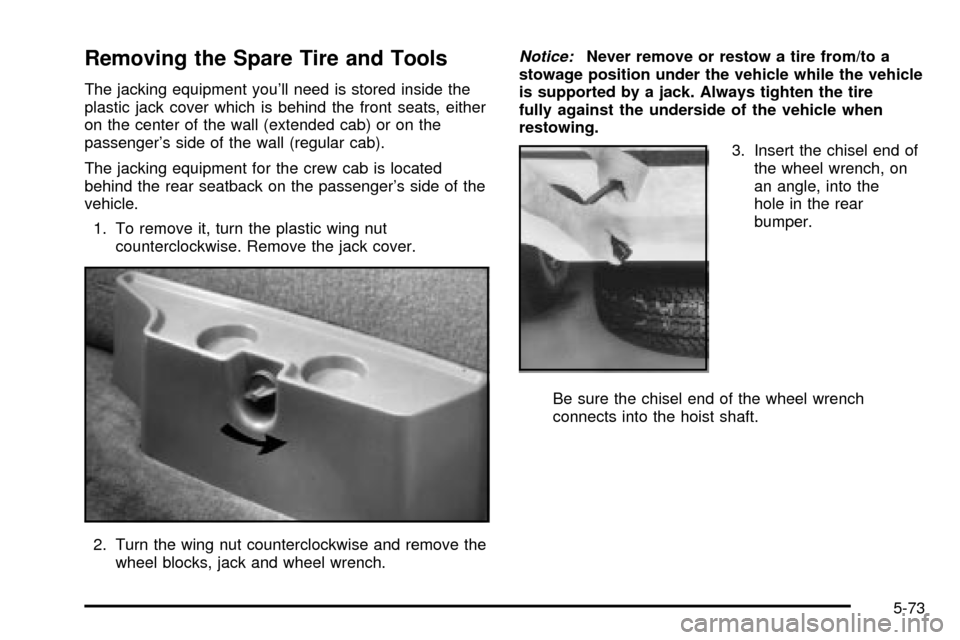
1. To remove it, turn the plastic wing nut
counterclockwise. Remove the jack cover.
2. Turn the wing nut counterclockwise and remove the
wheel blocks, jack and wheel wrench.
Notice:Never remove or restow a tire from/to a
stowage position under the vehicle while the vehicle
is supported by a jack. Always tighten the tire
fully against the underside of the vehicle when
restowing.
3. Insert the chisel end of
the wheel wrench, on
an angle, into the
hole in the rear
bumper.
Be sure the chisel end of the wheel wrench
connects into the hoist shaft.
5-73
Page 374 of 432

Every 100,000 Miles (166 000 km):Spark Plug Wire
Inspection. Spark Plug Replacement. 4.3L V6 Engine
Only: Positive Crankcase Ventilation (PCV) Valve
Inspection.
Every 150 000 Miles (240 000 km):Cooling System
Service (or every 60 months, whichever occurs
®rst). Engine Accessory Drive Belt Inspection.
These intervals only summarize maintenance services.
Be sure to follow the complete scheduled maintenance
on the following pages.
Long Trip/Highway De®nition
Follow this scheduled maintenanceonlyif none of the
conditions from the Short Trip/City Scheduled
Maintenance are true. Do not use this schedule if the
vehicle is used for trailer towing, driven in a dusty area
or used off paved roads. Use the Short Trip/City
schedule for these conditions
Driving a vehicle with a fully warmed engine under
highway conditions will cause engine oil to break down
slower.
Long Trip/Highway Intervals
Every 7,500 Miles (12 500 km):Engine Oil and Filter
Change (or every 12 months, whichever occurs
®rst). Chassis Lubrication (or 12 months, whichever
occurs ®rst). Drive Axle Service. Tire Rotation.
Every 15,000 Miles (25 000 km):Engine Air Cleaner
Filter Inspection. Automatic Transmission Service
(severe conditions only).
Every 30,000 Miles (50 000 km):Fuel Filter
Replacement (4.3L V6 engine only). Engine Air Cleaner
Filter Replacement. Front Wheel Bearing Repack
(two-wheel drive only) (or at each brake relining,
whichever occurs ®rst).
Every 50,000 Miles (83 000 km):Automatic
Transmission Service (normal conditions).
Every 90,000 Miles (150 000 km):Fuel Filter
Replacement (2200 L4 engine only).
6-6
Page 375 of 432

Every 100,000 Miles (166 000 km):Spark Plug Wire
Inspection. Spark Plug Replacement. 4.3L V6 Engine
Only: Positive Crankcase Ventilation (PCV) Valve
Inspection.
Every 150,000 Miles (240 000 km):Cooling System
Service (or every 60 months, whichever occurs
®rst). Engine Accessory Drive Belt Inspection.
These intervals only summarize maintenance services.
Be sure to follow the complete scheduled maintenance
on the following pages.
Short Trip/City Scheduled
Maintenance
The services shown in this schedule up to 100,000 miles
(166 000 km) should be repeated after 100,000 miles
(166 000 km) at the same intervals for the life of
this vehicle. The services shown at 150,000 miles
(240 000 km) should be repeated at the same interval
after 150,000 miles (240 000 km) for the life of this
vehicle.
See
Part B: Owner Checks and Services on page 6-26andPart C: Periodic MaintenanceInspections on
page 6-31.
Footnotes
²The U.S. Environmental Protection Agency or the
California Air Resources Board has determined that the
failure to perform this maintenance item will not nullify
the emission warranty or limit recall liability prior to
the completion of the vehicle's useful life. We, however,
urge that all recommended maintenance services be
performed at the indicated intervals and the
maintenance be recorded.
#Lubricate the front suspension, ball joints, steering
linkage, parking brake cable guides, propshaft splines,
universal joints, constant velocity joint and brake
pedal springs.
+A good time to check your brakes is during tire
rotation. See Brake System Inspection on page 6-32.
**
Drive axle service. See Part D: Recommended Fluids
and Lubricants on page 6-33for proper lubricant to use:
·Check ¯uid level and add ¯uid as needed. If driving in
dusty areas or when towing a trailer, drain ¯uid and
re®ll every 15,000 miles (25 000 km).
·If your vehicle has a locking differential, drain ¯uid
and re®ll at ®rst engine oil change.
·More frequent lubrication may be required for
heavy-duty or off-road use.
6-7
Page 377 of 432

qFor Two-Wheel-Drive vehicles only: Clean and
repack the front wheel bearings (or at each
brake relining, whichever occurs ®rst).
qChange automatic transmission ¯uid and ®lter if the
vehicle is mainly driven under one or more of these
conditions:
þ In heavy city traffic where the outside
temperature regularly reaches 90ÉF (32ÉC) or
higher.
þ In hilly or mountainous terrain.
þ When doing frequent trailer towing.
þ Uses such as found in taxi, police or delivery
service.
If you do not use your vehicle under any of these
conditions, change the ¯uid and ®lter every 50,000 miles
(83 000 km).
18,000 Miles (30 000 km)
qChange engine oil and ®lter (or every 3 months,
whichever occurs ®rst).An Emission Control Service.
qLubricate chassis components (or every 3 months,
whichever occurs ®rst).(See footnote #.)
qCheck rear/front axle ¯uid level and add ¯uid as
needed. Check constant velocity joints and axle seals
for leaking.
(See footnote **.)
qRotate tires. SeeTire Inspection and Rotation on
page 5-64for proper rotation pattern and additional
information.(See footnote +.)
21,000 Miles (35 000 km)
qChange engine oil and ®lter (or every 3 months,
whichever occurs ®rst).An Emission Control Service.
qLubricate chassis components (or every 3 months,
whichever occurs ®rst).(See footnote #.)
qCheck rear/front axle ¯uid level and add ¯uid as
needed. Check constant velocity joints and axle seals
for leaking.
(See footnote **.)
24,000 Miles (40 000 km)
qChange engine oil and ®lter (or every 3 months,
whichever occurs ®rst).An Emission Control Service.
qLubricate chassis components (or every 3 months,
whichever occurs ®rst).(See footnote #.)
qCheck rear/front axle ¯uid level and add ¯uid as
needed. Check constant velocity joints and axle seals
for leaking.
(See footnote **.)
qRotate tires. SeeTire Inspection and Rotation on
page 5-64for proper rotation pattern and additional
information.(See footnote +.)
6-9