service CHEVROLET S10 2003 2.G Owner's Guide
[x] Cancel search | Manufacturer: CHEVROLET, Model Year: 2003, Model line: S10, Model: CHEVROLET S10 2003 2.GPages: 432, PDF Size: 2.82 MB
Page 238 of 432
Highway Hypnosis
Is there actually such a condition as ªhighway
hypnosisº? Or is it just plain falling asleep at the wheel?
Call it highway hypnosis, lack of awareness, or
whatever.
There is something about an easy stretch of road with
the same scenery, along with the hum of the tires on the
road, the drone of the engine, and the rush of the
wind against the vehicle that can make you sleepy. Don't
let it happen to you! If it does, your vehicle can leave
the road in
less than a second,and you could crash and
be injured.
What can you do about highway hypnosis? First, be
aware that it can happen.
Then here are some tips:
·Make sure your vehicle is well ventilated, with a
comfortably cool interior.
·Keep your eyes moving. Scan the road ahead and
to the sides. Check your mirrors and your
instruments frequently.
·If you get sleepy, pull off the road into a rest,
service or parking area and take a nap, get some
exercise, or both. For safety, treat drowsiness
on the highway as an emergency.
Hill and Mountain Roads
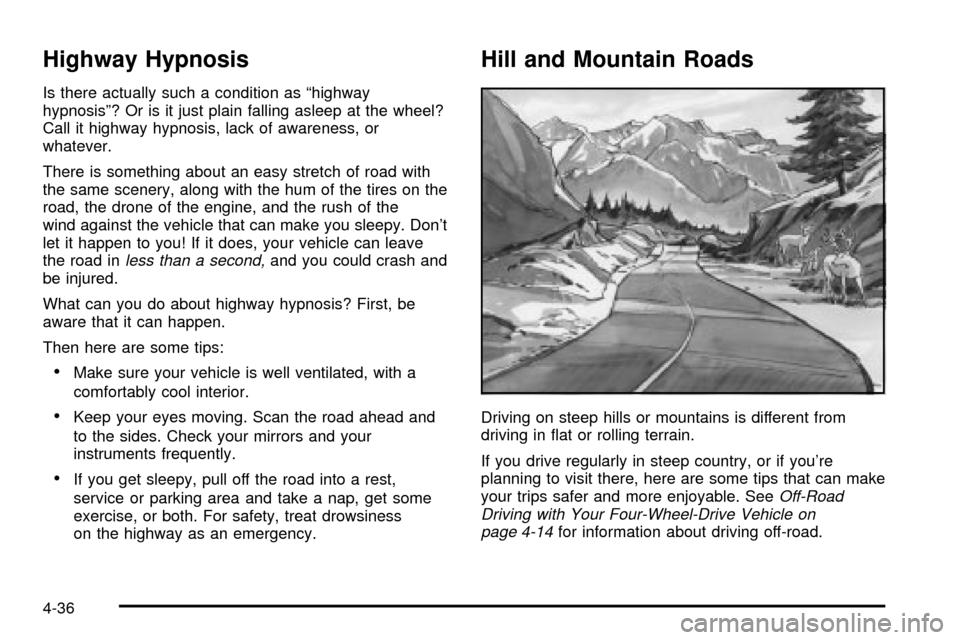
Driving on steep hills or mountains is different from
driving in ¯at or rolling terrain.
If you drive regularly in steep country, or if you're
planning to visit there, here are some tips that can make
your trips safer and more enjoyable. See
Off-Road
Driving with Your Four-Wheel-Drive Vehicle on
page 4-14
for information about driving off-road.
4-36
Page 246 of 432

Notice:Never use recovery hooks to tow the
vehicle. Your vehicle could be damaged and
it would not be covered by warranty.
Towing
Towing Your Vehicle
Consult your dealer or a professional towing service if
you need to have your disabled vehicle towed. See
Roadside Assistance Program on page 7-6.
If you want to tow your vehicle behind another vehicle
for recreational purposes (such as behind a motorhome),
see ªRecreational Vehicle Towingº following.
Recreational Vehicle Towing
Recreational vehicle towing means towing your vehicle
behind another vehicle ± such as behind a motorhome.
The two most common types of recreational vehicle
towing are known as ªdinghy towingº (towing your vehicle
with all four wheels on the ground) and ªdolly towingº
(towing your vehicle with two wheels on the ground and
two wheels up on a device known as a ªdollyº).
With the proper preparation and equipment, many
vehicles can be towed in these ways. See
Dinghy
TowingandDolly Towing,following.Here are some important things to consider before you
do recreational vehicle towing:
·What's the towing capacity of the towing vehicle?
Be sure you read the tow vehicle manufacturer's
recommendations.
·How far will you tow? Some vehicles have
restrictions on how far and how long they can tow.
·Do you have the proper towing equipment?
See your dealer or trailering professional for
additional advice and equipment recommendations.
·Is your vehicle ready to be towed? Just as you
would prepare your vehicle for a long trip, you'll
want to make sure your vehicle is prepared to be
towed. See
Before Leaving on a Long Trip on
page 4-35.
4-44
Page 247 of 432

Dinghy Towing
Notice:Towing your vehicle with all four wheels on
the ground will damage drivetrain components.Your two-wheel-drive vehicle should not be towed with
all four wheels on the ground. Your transmission
has no provision for internal lubrication while being
towed. To properly to your vehicle, it should be placed
on a platform trailer with all four wheels off the
ground. Towing with all four wheels on the ground
should be avoided.
In rare cases when it's unavoidable and your vehicle
must be towed with all four wheels on the ground,
the propeller shaft to axle yoke orientation should be
marked and the propeller shaft removed following
the applicable service manual removal/installation
procedure. See
Service Publications Ordering
Information on page 7-10.
Dust or dirt can enter the back of the transmission
through the opening created by removing the propeller
shaft if proper protection is not provided. Also, check
the transmission ¯uid level before driving the vehicle. Two-Wheel Drive Vehicles Only
4-45
Page 249 of 432
Your two-wheel-drive vehicle should not be towed with
two wheels on the ground. Your transmission has
no provision for internal lubrication while being towed.
To properly tow your vehicle, it should be placed
on a platform trailer with all four wheels off the ground.
Towing with all four wheels on the ground should be
avoided.
In rare cases when it's unavoidable and your vehicle
must be towed with two wheels on the ground, the
propeller shaft to axle yoke orientation should be marked
and the propeller shaft removed following the applicable
service manual removal/installation procedure. See
Service Publications Ordering Information on page 7-10.
Dust or dirt can enter the back of the transmission
through the opening created by removing the propeller
shaft if proper protection is not provided. Also, check
the transmission ¯uid level before driving the vehicle.
Use the following steps to dolly tow your vehicle:
1. Put the front wheels on a dolly.
2. Put the vehicle in PARK (P).
3. Set the parking brake and then remove the key.
4. Disconnect the propshaft as described above.5. Clamp the steering wheel in a straight-ahead
position with a clamping device designed for towing.
6. Release the parking brake.
Be sure to use the proper towing equipment designed
for recreational vehicle towing. Follow the instructions for
the towing equipment.
{CAUTION:
Shifting a four-wheel-drive vehicle's transfer
case into NEUTRAL can cause your vehicle to
roll even if the transmission is in Park (P) for
an automatic transmission, or if your vehicle is
in gear, for a manual transmission. You or
others could be injured. Make sure the parking
brake is ®rmly set before you shift the transfer
case to NEUTRAL.
If your vehicle has four-wheel-drive it cannot be dolly
towed. A four-wheel-drive vehicle must be towed
by ¯atbed.
4-47
Page 256 of 432
Towing a Trailer
{CAUTION:
If you don't use the correct equipment and
drive properly, you can lose control when you
pull a trailer. For example, if the trailer is too
heavy, the brakes may not work well -- or even
at all. You and your passengers could be
seriously injured. Pull a trailer only if you have
followed all the steps in this section. Ask your
dealer for advice and information about towing
a trailer with your vehicle.
Notice:Pulling a trailer improperly can damage
your vehicle and result in costly repairs not covered
by your warranty. To pull a trailer correctly, follow
the advice in this part, and see your dealer for
important information about towing a trailer with
your vehicle. Additional rear axle maintenance
is required for a vehicle used to tow a trailer. See
ªScheduled Maintenance Servicesº in the Index.Your vehicle may be able to tow a trailer. To identify
what the vehicle trailering capacity is for your vehicle,
you should read the information in
ªWeight of the Trailerºthat appears later in this section.
If yours was built with trailering options, as many are,
it's ready for heavier trailers. But trailering is different
than just driving your vehicle by itself. Trailering means
changes in handling, durability and fuel economy.
Successful, safe trailering takes correct equipment, and
it has to be used properly.
That's the reason for this part. In it are many time-tested,
important trailering tips and safety rules. Many of
these are important for your safety and that of your
passengers. So please read this section carefully before
you pull a trailer.
4-54
Page 259 of 432

* If your vehicle is equipped with RPO V4A (XtremeŸ
Sport Appearance Package), your vehicle was
neither intended nor designed to tow a trailer. For more
information on RPO codes, see
Service Parts
Identi®cation Label on page 5-92.
Maximum trailer weight is calculated assuming only the
driver is in the tow vehicle and it has all the required
trailering equipment. The weight of additional optional
equipment, passengers and cargo in the tow vehicle
must be subtracted from the maximum trailer weight.
The weight of the trailer tongue also affects trailering
capacity. See²
Weight of the Trailer Tongue²next.**The Gross Combination Weight Rating (GCWR) is the
total allowable weight of the completely loaded vehicle
and trailer including any passengers, cargo, equipment
and conversions. The GCWR for your vehicle should
not be exceeded.
You can ask your dealer for our trailering information or
advice, or you can write us at the address listed in your
Warranty and Owner Assistance Information Booklet.
In Canada, write to:
General Motors of Canada Limited
Customer Communication Centre, 163-005
1908 Colonel Sam Drive
Oshawa,, Ontario L1H 8P7
4-57
Page 265 of 432

4. Reapply the regular brakes. Then apply your
parking brake, and then shift into PARK (P), or
REVERSE (R) for a manual transmission.
5. If you have a four-wheel-drive vehicle with an
automatic transfer case, be sure the transfer case is
in a drive gear±not in NEUTRAL.
6. Release the regular brakes.
When You Are Ready to Leave After
Parking on a Hill
1. Apply your regular brakes and hold the pedal down
while you:
·start your engine,
·shift into a gear, and
·release the parking brake.
2. Let up on the brake pedal.
3. Drive slowly until the trailer is clear of the chocks.
4. Stop and have someone pick up and store the
chocks.
Maintenance When Trailer Towing
Your vehicle will need service more often when you're
pulling a trailer. SeePart A: Scheduled Maintenance
Services on page 6-4for more on this. Things that are
especially important in trailer operation are automatic
transmission ¯uid (don't over®ll), engine oil, axle
lubricant, belt, cooling system and brake system. Each
of these is covered in this manual, and the Index
will help you ®nd them quickly. If you're trailering, it's a
good idea to review these sections before you start
your trip.
Check periodically to see that all hitch nuts and bolts
are tight.
4-63
Page 267 of 432

Service............................................................5-3
Doing Your Own Service Work.........................5-3
Adding Equipment to the Outside of Your
Vehicle......................................................5-4
Fuel................................................................5-4
Gasoline Octane............................................5-4
Gasoline Speci®cations....................................5-5
California Fuel...............................................5-5
Additives.......................................................5-6
Fuels in Foreign Countries...............................5-6
Filling Your Tank............................................5-7
Filling a Portable Fuel Container.......................5-9
Checking Things Under
the Hood....................................................5-10
Hood Release..............................................5-10
Engine Compartment Overview.......................5-12
Engine Oil...................................................5-15
Engine Air Cleaner/Filter................................5-19
Automatic Transmission Fluid.........................5-22
Manual Transmission Fluid.............................5-25
Hydraulic Clutch...........................................5-26
Engine Coolant.............................................5-27Radiator Pressure Cap..................................5-29
Engine Overheating.......................................5-30
Cooling System............................................5-32
Engine Fan Noise.........................................5-39
Power Steering Fluid.....................................5-39
Windshield Washer Fluid................................5-40
Brakes........................................................5-41
Battery........................................................5-45
Jump Starting...............................................5-46
Rear Axle.......................................................5-51
Four-Wheel Drive............................................5-52
Front Axle......................................................5-53
Bulb Replacement..........................................5-54
Halogen Bulbs..............................................5-54
Headlamps..................................................5-54
One-Piece Front Turn Signal Lamps................5-56
Two-Piece Front Turn Signal Lamps................5-57
Center High-Mounted Stoplamp (CHMSL).........5-58
Taillamps.....................................................5-59
Replacement Bulbs.......................................5-59
Windshield Wiper Blade Replacement..............5-60
Section 5 Service and Appearance Care
5-1
Page 268 of 432

Tires..............................................................5-62
In¯ation -- Tire Pressure................................5-63
Tire Inspection and Rotation...........................5-64
When It Is Time for New Tires.......................5-65
Buying New Tires.........................................5-66
Uniform Tire Quality Grading..........................5-67
Wheel Alignment and Tire Balance..................5-68
Wheel Replacement......................................5-68
Tire Chains..................................................5-70
If a Tire Goes Flat........................................5-71
Changing a Flat Tire.....................................5-72
Compact Spare Tire......................................5-83
Appearance Care............................................5-83
Cleaning the Inside of Your Vehicle.................5-84
Care of Safety Belts......................................5-86
Weatherstrips...............................................5-87
Cleaning the Outside of Your Vehicle..............5-87
Sheet Metal Damage.....................................5-89Finish Damage.............................................5-89
Underbody Maintenance................................5-90
Chemical Paint Spotting.................................5-90
Vehicle Care/Appearance Materials..................5-90
Vehicle Identi®cation......................................5-92
Vehicle Identi®cation Number (VIN).................5-92
Service Parts Identi®cation Label.....................5-92
Electrical System............................................5-93
Add-On Electrical Equipment..........................5-93
Headlamps..................................................5-93
Windshield Wiper Fuses................................5-93
Power Windows and Other Power Options.......5-93
Fuses and Circuit Breakers............................5-93
Capacities and Speci®cations..........................5-99
Capacities and Speci®cations........................5-100
Normal Maintenance Replacement Parts.........5-101
Section 5 Service and Appearance Care
5-2
Page 269 of 432
Service
Your dealer knows your vehicle best and wants you to
be happy with it. We hope you will go to your dealer
for all your service needs. You will get genuine GM parts
and GM-trained and supported service people.
We hope you will want to keep your GM vehicle all GM.
Genuine GM parts have one of these marks:
Doing Your Own Service Work
If you want to do some of your own service work, you'll
want to use the proper service manual. It tells you much
more about how to service your vehicle than this manual
can. To order the proper service manual, see
Service
Publications Ordering Information on page 7-10.
Your vehicle may have an air bag system. If it does, see
Servicing Your Air Bag-Equipped Vehicle on page 1-64before attempting to do your own service work.
You should keep a record with all parts receipts and list
the mileage and the date of any service work you
perform. See
Part E: Maintenance Record on page 6-35.
{CAUTION:
You can be injured and your vehicle could be
damaged if you try to do service work on a
vehicle without knowing enough about it.
·Be sure you have sufficient knowledge,
experience, the proper replacement parts
and tools before you attempt any vehicle
maintenance task.
CAUTION: (Continued)
5-3