check engine CHEVROLET S10 2004 Owner's Guide
[x] Cancel search | Manufacturer: CHEVROLET, Model Year: 2004, Model line: S10, Model: CHEVROLET S10 2004Pages: 422, PDF Size: 4.16 MB
Page 281 of 422
When to Check Power Steering Fluid
It is not necessary to regularly check power steering fluid
unless you suspect there is a leak in the system or
you hear an unusual noise. A fluid loss in this system
could indicate a problem. Have the system inspected
and repaired. SeeEngine Compartment Overview
on page 5-12for reservoir location.
How to Check Power Steering Fluid
Turn the key off, let the engine compartment cool down,
wipe the cap and the top of the reservoir clean, then
unscrew the cap and wipe the dipstick with a clean rag.
Replace the cap and completely tighten it. Then
remove the cap again and look at the fluid level on
the dipstick.
The level should be between the ADD and FULL marks.
If necessary, add only enough fluid to bring the level
up to the proper range.
What to Use
To determine what kind of fluid to use, seePart D:
Recommended Fluids and Lubricants on page 6-32.
Always use the proper fluid. Failure to use the proper
fluid can cause leaks and damage hoses and seals.
5-37
Page 283 of 422
Brakes
Brake Fluid
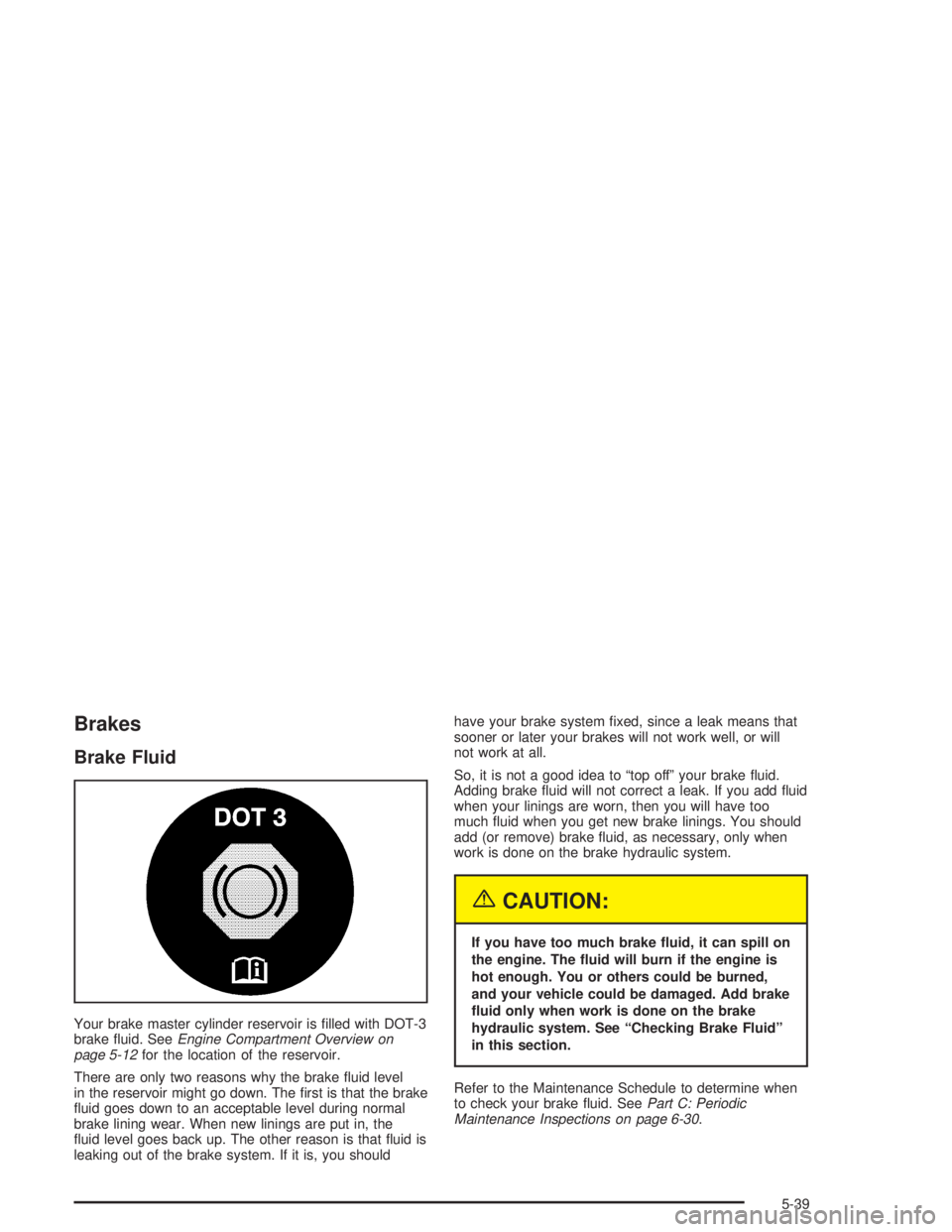
Your brake master cylinder reservoir is filled with DOT-3
brake fluid. SeeEngine Compartment Overview on
page 5-12for the location of the reservoir.
There are only two reasons why the brake fluid level
in the reservoir might go down. The first is that the brake
fluid goes down to an acceptable level during normal
brake lining wear. When new linings are put in, the
fluid level goes back up. The other reason is that fluid is
leaking out of the brake system. If it is, you shouldhave your brake system fixed, since a leak means that
sooner or later your brakes will not work well, or will
not work at all.
So, it is not a good idea to “top off” your brake fluid.
Adding brake fluid will not correct a leak. If you add fluid
when your linings are worn, then you will have too
much fluid when you get new brake linings. You should
add (or remove) brake fluid, as necessary, only when
work is done on the brake hydraulic system.
{CAUTION:
If you have too much brake uid, it can spill on
the engine. The uid will burn if the engine is
hot enough. You or others could be burned,
and your vehicle could be damaged. Add brake
uid only when work is done on the brake
hydraulic system. See “Checking Brake Fluid”
in this section.
Refer to the Maintenance Schedule to determine when
to check your brake fluid. SeePart C: Periodic
Maintenance Inspections on page 6-30.
5-39
Page 289 of 422
1. Check the other vehicle. It must have a 12–volt
battery with a negative ground system.
Notice:If the other vehicle’s system is not a 12-volt
system with a negative ground, both vehicles can
be damaged. Only use vehicles with 12-volt systems
with negative grounds to jump start your vehicle.
2. Get the vehicles close enough so the jumper cables
can reach, but be sure the vehicles aren’t touching
each other. If they are, it could cause a ground
connection you don’t want. You wouldn’t be able to
start your vehicle, and the bad grounding could
damage the electrical systems.
To avoid the possibility of the vehicles rolling, set
the parking brake firmly on both vehicles involved in
the jump start procedure. Put an automatic
transmission in PARK (P) or a manual transmission
in NEUTRAL before setting the parking brake. If
you have a four-wheel-drive vehicle, be sure
the transfer case is not in NEUTRAL (N).Notice:If you leave your radio or other accessories
on during the jump starting procedure, they could
be damaged. The repairs would not be covered
by your warranty. Always turn off your radio and
other accessories when jump starting your vehicle.
3. Turn off the ignition on both vehicles. Unplug
unnecessary accessories plugged into the cigarette
lighter or in the accessory power outlets. Turn off
the radio and all lamps that aren’t needed. This will
avoid sparks and help save both batteries. And it
could save your radio!
4. Open the hoods and locate the batteries. Find the
positive (+) and negative (-) terminal locations on
each vehicle. SeeEngine Compartment Overview
on page 5-12for more information on location of the
battery.
5-45
Page 290 of 422
{CAUTION:
Using a match near a battery can cause battery
gas to explode. People have been hurt doing
this, and some have been blinded. Use a
ashlight if you need more light.
Be sure the batteries have enough water. You
do not need to add water to the ACDelco
®
battery (or batteries) installed in your new
vehicle. But if a battery has ller caps, be sure
the right amount of uid is there. If it is low,
add water to take care of that rst. If you do
not, explosive gas could be present.
Battery uid contains acid that can burn you.
Do not get it on you. If you accidentally get it
in your eyes or on your skin, ush the place
with water and get medical help immediately.
{CAUTION:
Fans or other moving engine parts can injure
you badly. Keep your hands away from moving
parts once the engine is running.
5. Check that the jumper cables don’t have loose or
missing insulation. If they do, you could get a
shock. The vehicles could be damaged too.
Before you connect the cables, here are some
basic things you should know. Positive (+) will go to
positive (+) or to a remote positive (+) terminal if
the vehicle has one. Negative (-) will go to a heavy,
unpainted metal engine part or to a remote
negative (-) terminal if the vehicle has one.
Don’t connect positive (+) to negative (-) or you’ll
get a short that would damage the battery and
maybe other parts too. And don’t connect the
negative(-) cable to the negative (-) terminal on the
dead battery because this can cause sparks.
5-46
Page 348 of 422
Engine Identication
The 8th character in your VIN is the engine code. This
code will help you identify your engine, specifications
and replacement parts.
Service Parts Identication Label
You’ll find this label on the inside of the glove box.
It’s very helpful if you ever need to order parts. On this
label is:
•your VIN,
•the model designation,
•paint information and
•a list of all production options and special
equipment.
Be sure that this label is not removed from the vehicle.
Electrical System
Add-On Electrical Equipment
Notice:Don’t add anything electrical to your
vehicle unless you check with your dealer rst.
Some electrical equipment can damage your vehicle
and the damage wouldn’t be covered by your
warranty. Some add-on electrical equipment can
keep other components from working as
they should.
Your vehicle has an air bag system. Before attempting
to add anything electrical to your vehicle, see
Servicing Your Air Bag-Equipped Vehicle on page 1-52.
Headlamps
The headlamp wiring is protected by an internal circuit
breaker. An electrical overload will cause the lamps
to go on and off, or in some cases to remain off. If this
happens, have your headlamp wiring checked
right away.
5-104
Page 355 of 422
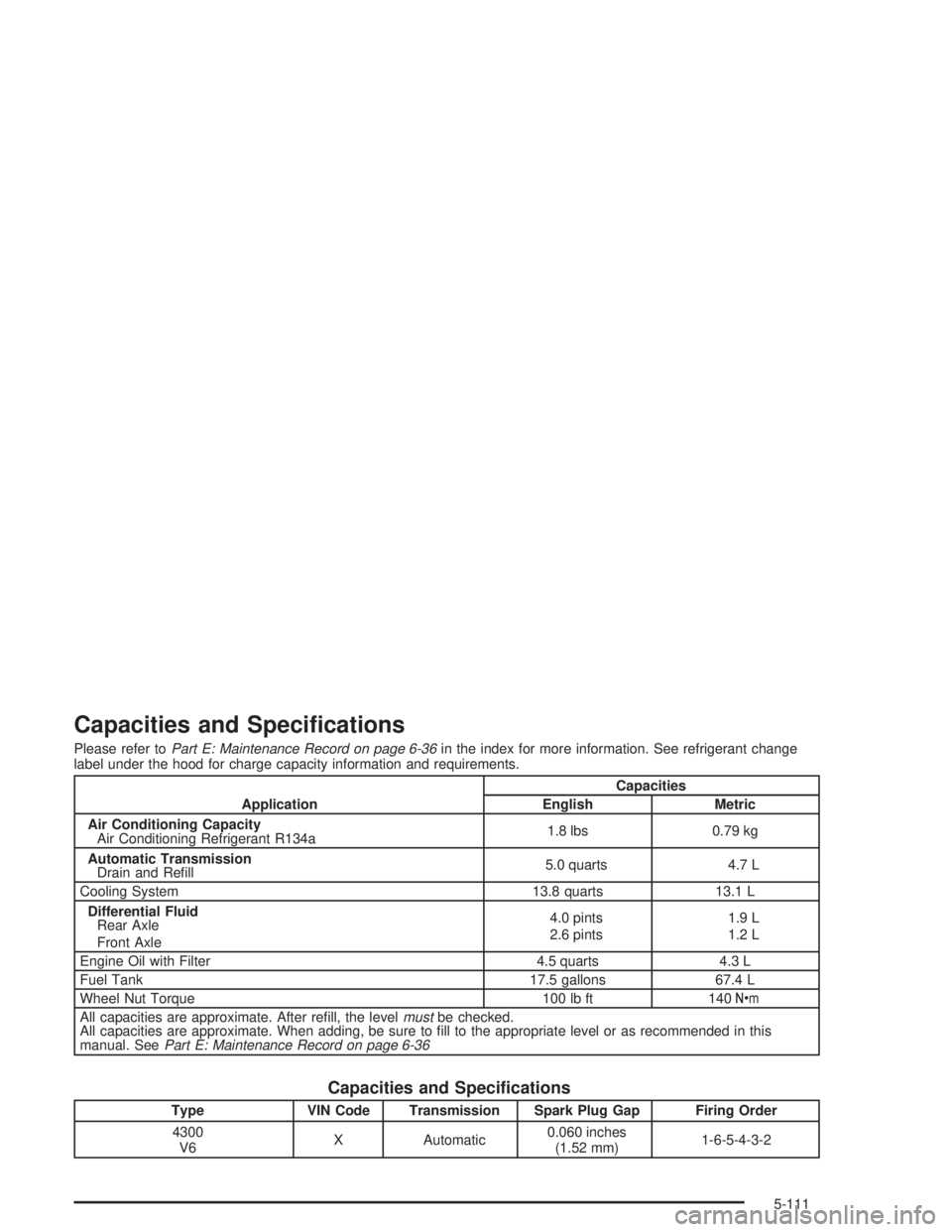
Capacities and Specications
Please refer toPart E: Maintenance Record on page 6-36in the index for more information. See refrigerant change
label under the hood for charge capacity information and requirements.
ApplicationCapacities
English Metric
Air Conditioning Capacity
Air Conditioning Refrigerant R134a1.8 lbs 0.79 kg
Automatic Transmission
Drain and Refill5.0 quarts 4.7 L
Cooling System 13.8 quarts 13.1 L
Differential Fluid
Rear Axle
Front Axle4.0 pints
2.6 pints1.9 L
1.2 L
Engine Oil with Filter 4.5 quarts 4.3 L
Fuel Tank 17.5 gallons 67.4 L
Wheel Nut Torque 100 lb ft 140Y
All capacities are approximate. After refill, the levelmustbe checked.
All capacities are approximate. When adding, be sure to fill to the appropriate level or as recommended in this
manual. SeePart E: Maintenance Record on page 6-36
Capacities and Specications
Type VIN Code Transmission Spark Plug Gap Firing Order
4300
V6X Automatic0.060 inches
(1.52 mm)1-6-5-4-3-2
5-111
Page 357 of 422
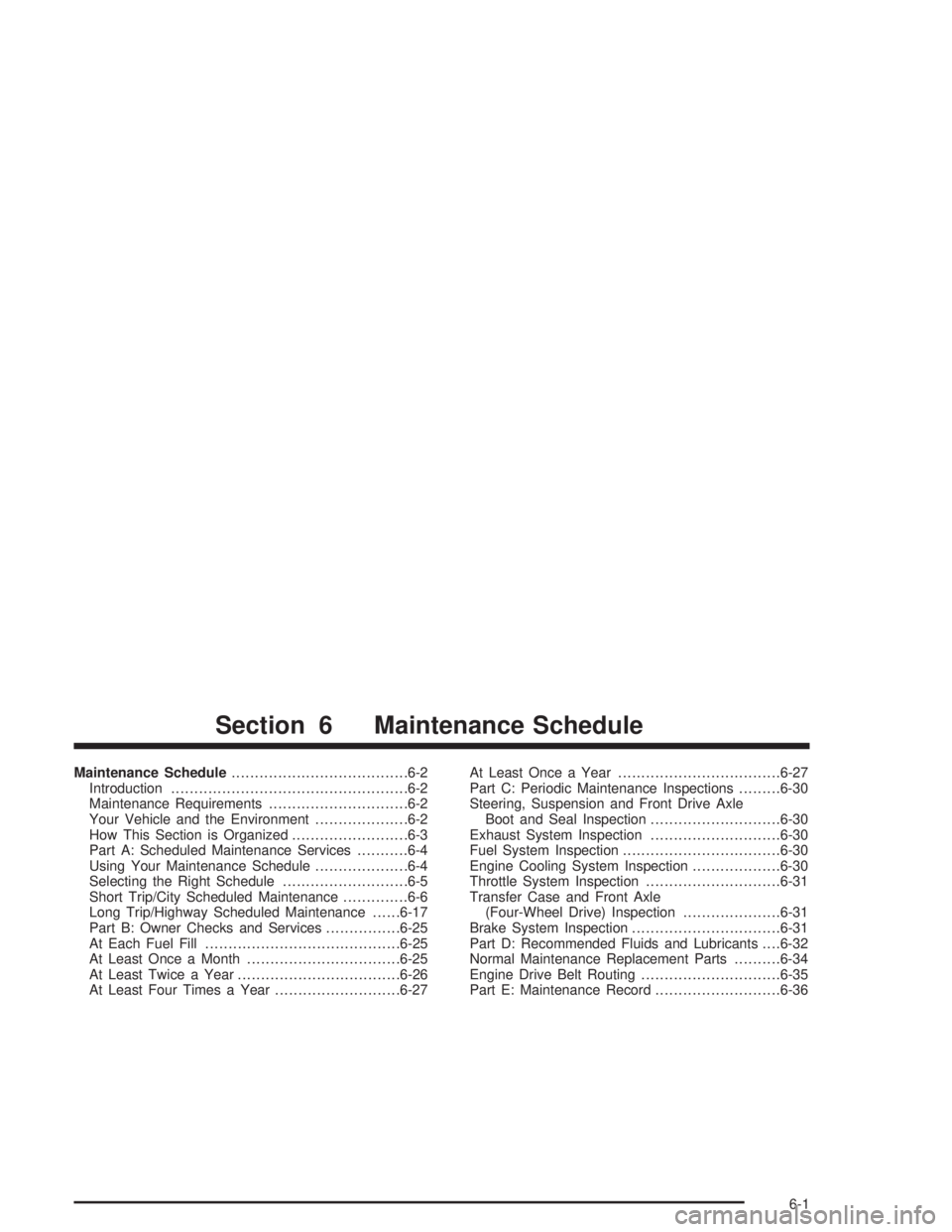
Maintenance Schedule......................................6-2
Introduction...................................................6-2
Maintenance Requirements..............................6-2
Your Vehicle and the Environment....................6-2
How This Section is Organized.........................6-3
Part A: Scheduled Maintenance Services...........6-4
Using Your Maintenance Schedule....................6-4
Selecting the Right Schedule...........................6-5
Short Trip/City Scheduled Maintenance..............6-6
Long Trip/Highway Scheduled Maintenance......6-17
Part B: Owner Checks and Services................6-25
At Each Fuel Fill..........................................6-25
At Least Once a Month.................................6-25
At Least Twice a Year...................................6-26
At Least Four Times a Year...........................6-27At Least Once a Year...................................6-27
Part C: Periodic Maintenance Inspections.........6-30
Steering, Suspension and Front Drive Axle
Boot and Seal Inspection............................6-30
Exhaust System Inspection............................6-30
Fuel System Inspection..................................6-30
Engine Cooling System Inspection...................6-30
Throttle System Inspection.............................6-31
Transfer Case and Front Axle
(Four-Wheel Drive) Inspection.....................6-31
Brake System Inspection................................6-31
Part D: Recommended Fluids and Lubricants. . . .6-32
Normal Maintenance Replacement Parts..........6-34
Engine Drive Belt Routing..............................6-35
Part E: Maintenance Record...........................6-36
Section 6 Maintenance Schedule
6-1
Page 358 of 422
Maintenance Schedule
Introduction
Important: Keep engine oil at the proper level and
change as recommended.
Have you purchased the GM Protection Plan? The Plan
supplements your new vehicle warranties. See your
Warranty and Owner Assistance booklet or your dealer
for details.
Maintenance Requirements
Maintenance intervals, checks, inspections and
recommended fluids and lubricants as prescribed in this
manual are necessary to keep your vehicle in good
working condition. Any damage caused by failure
to follow scheduled maintenance may not be covered by
warranty.
Your Vehicle and the Environment
Proper vehicle maintenance not only helps to keep your
vehicle in good working condition, but also helps the
environment. Improper vehicle maintenance can
even affect the quality of the air we breathe. Improper
fluid levels or the wrong tire inflation can increase
the level of emissions from your vehicle. To help protect
our environment, and to keep your vehicle in good
condition, be sure to maintain your vehicle properly.
6-2
Page 362 of 422
Long Trip/Highway Denition
Follow this scheduled maintenanceonlyif none of the
conditions from the Short Trip/City Scheduled
Maintenance are true. Do not use this schedule if the
vehicle is used for trailer towing, driven in a dusty area
or used off paved roads. Use the Short Trip/City
schedule for these conditions
Driving a vehicle with a fully warmed engine under
highway conditions will cause engine oil to break down
slower.
Long Trip/Highway Intervals
Every 7,500 Miles (12 500 km):Engine Oil and Filter
Change (or every 12 months, whichever occurs
first). Chassis Lubrication (or 12 months, whichever
occurs first). Drive Axle Service. Tire Rotation.
Every 15,000 Miles (25 000 km):Engine Air Cleaner
Filter Inspection. Automatic Transmission Service
(severe conditions only).
Every 30,000 Miles (50 000 km):Fuel Filter
Replacement. Engine Air Cleaner Filter Replacement.
Every 50,000 Miles (83 000 km):Automatic
Transmission Service (normal conditions).Every 100,000 Miles (166 000 km):Spark Plug Wire
Inspection. Spark Plug Replacement. Positive
Crankcase Ventilation (PCV) Valve Inspection.
Every 150,000 Miles (240 000 km):Cooling System
Service (or every 60 months, whichever occurs
first). Engine Accessory Drive Belt Inspection.
These intervals only summarize maintenance services.
Be sure to follow the complete scheduled maintenance
on the following pages.
Short Trip/City Scheduled
Maintenance
The services shown in this schedule up to 100,000 miles
(166 000 km) should be repeated after 100,000 miles
(166 000 km) at the same intervals for the life of
this vehicle. The services shown at 150,000 miles
(240 000 km) should be repeated at the same interval
after 150,000 miles (240 000 km) for the life of this
vehicle.
SeePart B: Owner Checks and Services on page 6-25
andPart C: Periodic Maintenance Inspections on
page 6-30.
6-6
Page 363 of 422
Footnotes
†The U.S. Environmental Protection Agency or the
California Air Resources Board has determined that the
failure to perform this maintenance item will not nullify
the emission warranty or limit recall liability prior to
the completion of the vehicle’s useful life. We, however,
urge that all recommended maintenance services be
performed at the indicated intervals and the
maintenance be recorded.
#Lubricate the front suspension, ball joints, steering
linkage, parking brake cable guides, propshaft splines,
universal joints, constant velocity joint and brake
pedal springs.
+A good time to check your brakes is during tire
rotation. See Brake System Inspection on page 6-31.
**Drive axle service. See Part D: Recommended Fluids
and Lubricants on page 6-32for proper lubricant to use:
•Check uid level and add uid as needed. If driving in
dusty areas or when towing a trailer, drain uid and
rell every 15,000 miles (25 000 km).
•If your vehicle has a locking differential, drain uid
and rell at rst engine oil change.
•More frequent lubrication may be required for
heavy-duty or off-road use.
3,000 Miles (5 000 km)
❑Change engine oil and filter (or every 3 months,
whichever occurs first).An Emission Control Service.
❑Lubricate chassis components (or every 3 months,
whichever occurs first).(See footnote #.)
❑Check rear/front axle fluid level and add fluid as
needed. Check constant velocity joints and axle seals
for leaking.(See footnote **.)
6,000 Miles (10 000 km)
❑Change engine oil and filter (or every 3 months,
whichever occurs first).An Emission Control Service.
❑Lubricate chassis components (or every 3 months,
whichever occurs first).(See footnote #.)
❑Check rear/front axle fluid level and add fluid as
needed. Check constant velocity joints and axle seals
for leaking.(See Footnote **.)
❑Rotate tires. SeeTire Inspection and Rotation on
page 5-74for proper rotation pattern and additional
information.(See footnote +.)
6-7